



Abstract
This qualitative phenomenological study aims to investigate fourth and fifth graders’ uses of mass media (TV, newspapers, Internet, magazines) and to assess their various features as sources for science learning. The data were collected from 47 purposefully selected students through focus groups and were analyzed through qualitative analysis using uses and gratifications theory as a conceptual framework. The results indicated that students were active in choosing and utilizing media to meet their cognitive, affective, personal integrative, and social integrative needs. Furthermore accessibility, content, and presentation were the key factors in influencing students’ motivation of use of the media.
Keywords
Introduction
Science information is disseminated through a wide range of channels. From childhood to adult life, we learn science both in school and beyond. A huge amount of science-related knowledge is acquired outside of traditional learning environments (Falk & Dierking, 2010). The mass media are the most readily available and sometimes the only source of information in this case (Nelkin, 1995). Sources that are mainly used in informal learning environments such as newspapers, TV, magazines, Internet, and science centers are no replacement for a formal science education, but this does not mean they do not have any value (Bell, Lewenstein, Shouse, & Feder, 2009; Friedman & Mappen, 2011). In fact, as Gilbert (2007) notes, education systems are slow to keep up with progress in the field of science. Apropos of this, Gordon, Brigdlall, and Meroe (2004) claim that schools cannot manage the task of disseminating science learning alone and accordingly might benefit from collaboration with other institutions.
The media, as a well-known science information resource, have an important influence on attitudes toward science (Lee & Scheufele, 2006). Its role in science education is threefold: First, the media make science more accessible to students (Osborne & Collins, 2000). Second, outside the school, the media are the most readily available and sometimes the only source of information on scientific issues (Nelkin, 1995). Third, people already pick up most of their science knowledge through the media (Detjen, 1995). The media’s role in science education has gradually been increasing (Dierking, 2005; Fenichel & Schweingruber, 2010).
For Weitkamp (2010), science-related information may be disseminated through both fiction (novels, films, etc.) and nonfiction (newspapers, magazines, etc.) media. The media may also be categorized as traditional (TV, radio, newspaper, magazines) and new/alternative (Internet) media (Gross, 2003). Changes in science and technology news coverage bring about changes in how these resources are used. One reason for students’ increased interest in extracurricular sources of science information could be that science information presented on TV, in magazines, and in newspapers is more entertaining now than it had been in the past. Turkey is a country where youngsters spend a considerable amount of time on TV and home Internet use. Radio, newspaper, and magazine consumption lags behind TV and Internet usage. For this reason, Turkey is an especially interesting place to study young people’s science learning from media. This transition in media coverage is also changing audiences’ preferences. Science and Engineering Indicators (http://www.nsf.gov/statistics/seind12/), for example, reported shifts among adults and young people alike in the United States. According to the report, younger audiences mainly use Internet for news and information, including science and technology information, and their Internet usage increases with education level and income. The Internet has also become a dominant source of current news, science and technology information, and other specialized information.
Notable among decades of studies examining the dissemination of science-related knowledge through media is Hook and Brake’s (2010) reference to direct and indirect learning, as discussed through obvious and incidental learning from television. In a related study, Brossard and Shanahan (2006) identified and tested the 31 terms most often used in the U.S. media. They were not able to find statistical evidence to conclude that either newspaper consumption or television exposure affected scientific literacy. They did, however, find a positive relationship between media and scientific literacy when controlling for age, gender, and science education. This study implicates that the media coverage is linked to scientific literacy for certain individuals, if not for all.
According to Hook and Brake (2010), the Internet, as a new medium, sometimes provides unintentional information via popular sites such as Facebook, Twitter, MySpace, and YouTube. However, they maintained that science learning through the Internet is still significant because those who belong to a group or have any other interest in, connection to, or knowledge of science may reach each other easily. Trench’s (2008) research deals with the trend toward the Internet as a primary element in science communication, arguing that Internet communication is thoroughly integrated into scientific practice. In the United States, the Internet was determined to be a much more helpful tool for accessing science information than any other medium (National Science Board, 2004).
Uses and gratifications theory (UGT) suggests that media users play an active role in choosing and using the media that best fulfills their needs. According to O’Donohoe (1993), “The mass media constitute a resource on which audiences draw to satisfy various needs. In its conception of an active, goal-directed audience, it is consistent with emerging views of the advertising consumer” (p. 52).
This theory puts forward that people actively select and use media for purposes of gratification. Katz, Gurevitch, and Haas (1973) list 35 basic human needs based on an extensive analysis of the literature and organize them into five categories:
Cognitive needs: Strengthening information, knowledge, and understanding
Affective needs: Strengthening aesthetic, pleasurable, and emotional experiences
Personal integrative needs: Strengthening credibility, confidence, stability, and status
Social integrative needs: Strengthening contact with family, friends, and the world
Tension release needs: Escaping and diversion
As with adults, young children as consumers of media are not passive recipients of science information. Previous research in this area has paid little attention to the role of mass media on young students’ science learning and the media’s characteristics as science information sources, which is the focus of this research (Gelmez-Burakgazi, 2012). However, current studies underline the effect of positive childhood science experiences on adult interest in science (Elsley & McMellon, 2010; Osborne, Collins, & Simon, 2003; Oskala, Keaney, Chan, & Bunting, 2009). On the other hand, it is remarkable that there exist many studies relating a decline in attitudes toward science from the age of 11 years onward (Breakwell & Beardsell, 1992), from Grade 5 through Grade 11 (Baykul, 1990), from elementary to high school level (Piburn & Baker, 1993); in interest toward science among school-age students (Gilbert, 2008); and in enthusiasm toward science even through the ages of 5 to 11 years (Pell & Jarvis, 2001), from Grade 4 to Grade 8 (Bulus-Kirikkaya, 2011). Therefore, this study aims to investigate students’ perceptions and experiences of using science information sources at this critical age level (10-12) to enlarge and enrich their learning of science. The specific research questions included the following:
Method
Utilizing a qualitative phenomenological approach, this study aims to explore the meaning of experiences, conceptions, and emotions (Creswell, 2007; Moustakas, 1994; Yildirim & Simsek, 2008) of students in science learning through sources not directly related to the academic curricula.
The data were gathered through focus groups with purposefully selected students in four elementary schools (two public schools, two private schools) in Ankara, Turkey, in 2011. Patton (2002) states, “The logic and the power of purposeful sampling lies in selecting information-rich cases indepth” (p. 230). Besides its strengths like enhancing the credibility of the study “because subjects can reliably inform the research question” (Houser, 2011, p. 424), ease of access to the targeted population, and being less time-consuming, purposeful sampling had also pitfalls as explained by Koerber and McMichael (2008): difficulty in generalizing to other subjects and selection bias. In order to minimize the first weakness, the researchers have avoided broader generalizations of the findings. The second weakness, selection bias, “is not a concern if clear criteria are used and researcher is aware of his or her biases” (Houser, 2011, p. 424). The criterion used in this study was “having an interest in science,” because the students with an interest in learning science would have richer experiences of learning from a variety of information sources and would provide more detailed and in-depth perspectives into the research questions. Based on this criterion, researchers collaborated with teachers and school administrations in selecting information-rich students. Through this process, the researchers intentionally reached a sample of students that were different from the larger body of students who may not be as interested in science. This intentional selection was necessary based on the purpose of the study since the relationship between media and science literacy may not be observed in all students (Brossard & Shanahan, 2006), but at the same time, this selection leads to a serious limitation in generalization of the results to all students.
Twenty-three students from fifth-grade classes (14 girls, 9 boys) and 24 students from the fourth-grade classes (12 girls, 12 boys) were selected for the focus groups, based on their experience with the phenomenon at hand. Students’ ages ranged from 10 to 12 as the literature indicated declines in attitudes and interests toward science at this critical age level (Baykul, 1990; Breakwell & Beardsell, 1992; Bulus-Kirikkaya, 2011; Gilbert, 2008; Pell & Jarvis, 2001; Piburn & Baker, 1993).
At the beginning of the focus groups, participants were asked some demographic information questions (age, science grade at past term, parents’ education level, age, job; and their TV, Internet, magazine, and newspaper access in home contexts). All of the participants’ science scores for the past term were 5 on a scale of 5. Therefore, the participants were high-achieving students. Public schools represented low- and medium-socioeconomic families, whereas families in private schools were from medium- and high-socioeconomic families. Participants mainly came from highly educated families. Most of the parents had college (N = 67) and graduate degrees (master’s/PhD; N = 21). Some of the parents had high school degree (N = 6). All the participants had TV and Internet access at home.
In the semistructured interview format, open-ended questions were employed to examine students’ use of media in learning science. The interview schedule was validated by expert review in terms of depth, scope, appropriateness to the participants, and compatibility with the research questions. The interview questions were checked by three individuals: a professor in the area of curriculum and instruction who is also a well-known researcher using qualitative inquiry, a person with a PhD in science education, and a PhD candidate who is studying elementary school students. Following the revisions within the context of expert review, the schedule was piloted with one fourth- and one fifth-grade student. Eight focus groups were run with six students participating in each, except for the fifth-grade focus group in Private School A conducted with five students. Focus groups were organized separately for fourth and fifth graders. Each focus group lasted approximately 130 minutes, with a break dividing the session into two parts. The interaction in focus groups was recorded to prevent the potential threat of data loss due to only taking notes.
Multiple data sources (four schools, two grade levels) and investigators (two researchers) were employed to triangulate the outcomes, as suggested by Patton (1990). The use of multiple data sources has led the researchers to gather data from a variety of students, thereby to see a broader picture of the science learning phenomenon. In addition to this, involvement of two researchers enhanced the validity of the research (Denzin, 2009) as they controlled and cross-checked data collection and analysis phases together.
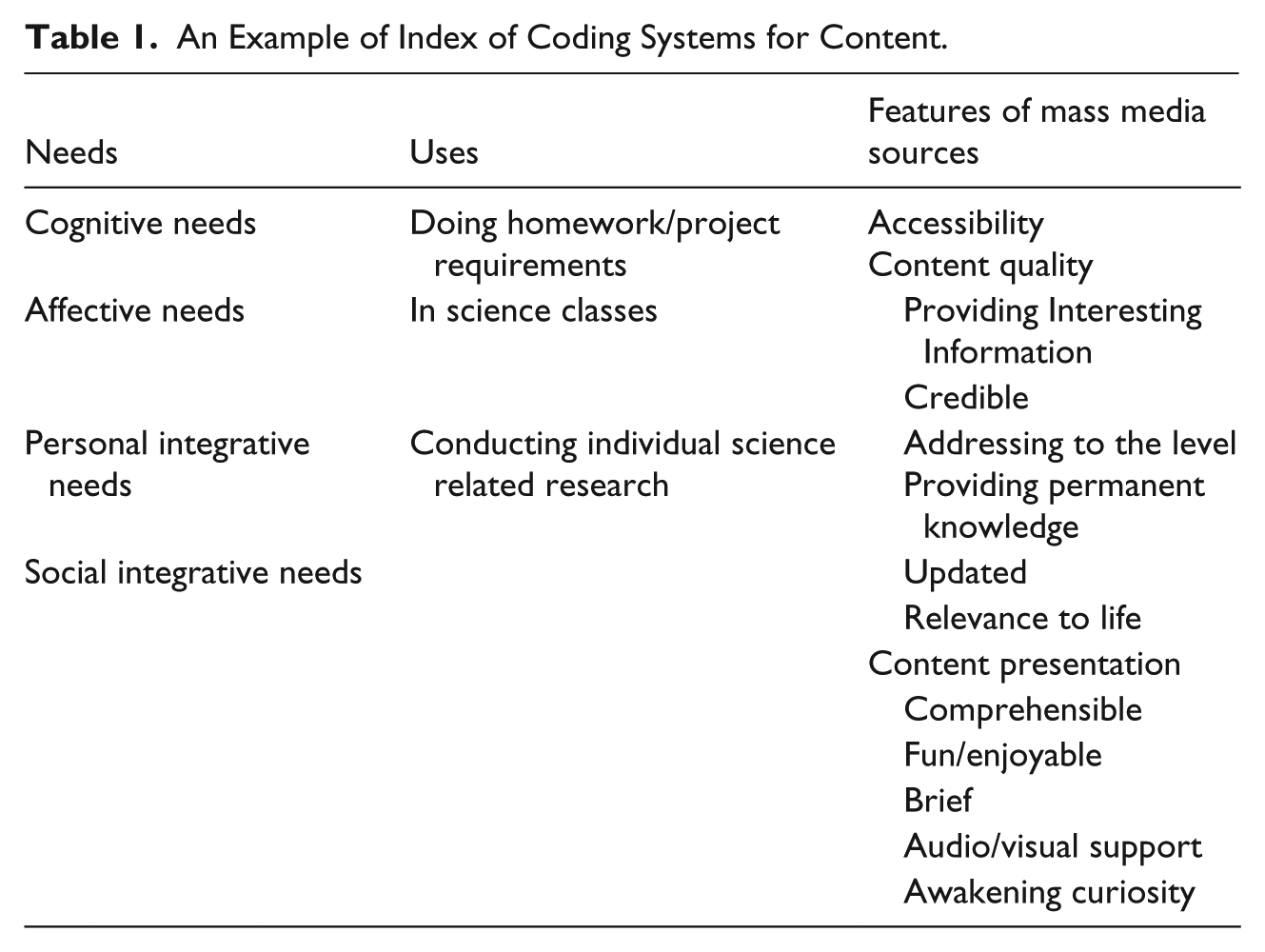
For qualitative data analysis, significant statements were selected for a more thorough explanation, key themes were identified, and an exhaustive description of the phenomenon was presented (Creswell, 1998; Moustakas, 1994). Accordingly, the analysis process pursued the following steps: (a) close reading, (b) coding, (c) thematizing, (d) exploring patterns, and (e) description and interpretation. Table 1 presents an example of coding system.
An Example of Index of Coding Systems for Content.
In presentation of the findings, thick descriptions were used to enable the readers to draw their own conclusions (Geertz, 1973; Lincoln & Guba, 1985). Detailed explanations of the participants, procedures, and results were provided to enrich the transferability and replicability of the study.
Results
The results indicated that students chiefly used Internet, science magazines, and TV (see Figure 1) as science information sources in doing homework, conducting individual and group research for science assignments, and in science classes. Most of the students (N = 27) reported that accessibility was the most important aspect of their choice of media. In addition to content quality, the presentation of interesting topics, real-life relevance, age-appropriateness, the frequency with which it was updated, and the cultivation of reputations for trustworthiness were other key factors in students’ use of media sources. In the following section, results are presented under the headings of TV, science magazines, newspapers, and the Internet.
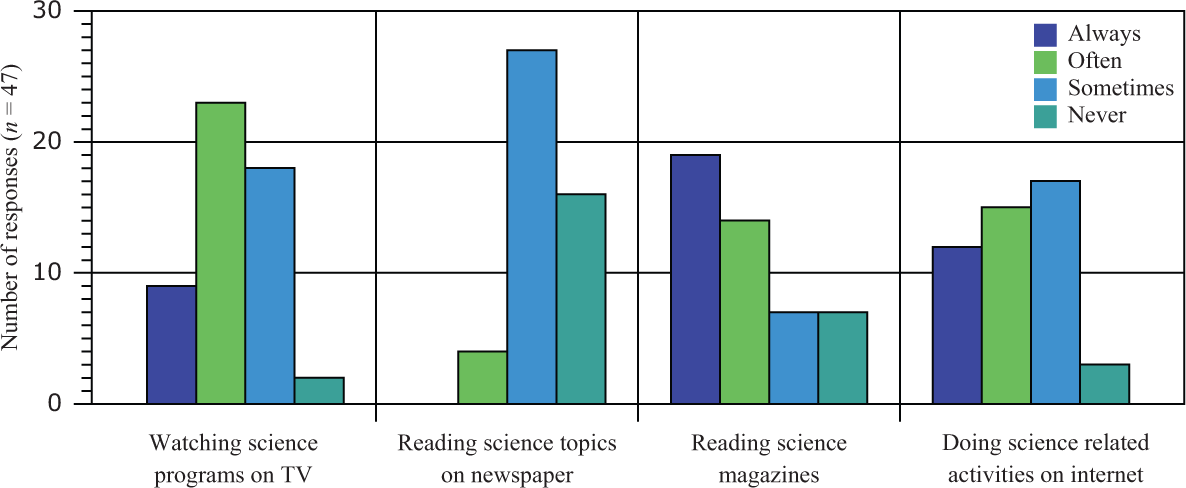
Students’ use of media sources for science-related purposes.
TV
Analysis of the interviews conducted with students revealed that television content was perceived as effective in the sense of presenting authentic, updated, and interesting information that was repeatable, as programs could be recorded and watched again. Myth Busters and Ultimate Survival were the TV programs mentioned in the context of science-focused programs they watched.
TV was among the sources perceived as accessible. Students saw TV as a source of authentic news that was relevant to their daily lives. By way of illustration, S38 (fifth grader, Private School A) commented as follows: It [science on TV] is permanent because real things happen there [on TV]. To me, it is interesting and sometimes fun.
Learning science from television was enjoyable for students as content was disseminated both audibly and visually. Students claimed that when they watched something on TV they felt like they were within the scene they were watching. As S21 (fourth grader, Private School B) explained, For example a lunar eclipse, solar eclipse . . . We already know them but . . . I’ve never seen a solar eclipse in my life. I watched one in a documentary and I felt like I’ve seen it. How does that happen? These kinds of programs do really help [to learn science].
Similarly, comparing TV with her textbook, S15 (fourth grader, Private School A) commented, In the textbook there are not many realistic-looking pictures of fossils but long texts. That’s why textbooks capture my interest less. But the TV is both audio and visual, and at the same time they [programs] are animated, which is really interesting.
As summarized in Figure 2, students stated that science on TV was interesting, easy to understand, and fun. What is more, they explained that they learned different things from science programs than what was being taught in school, and this supplemental education further piqued their curiosity and motivated them to dig deeper. Moreover, some students explained that if they desired to learn more about something they came across on TV, they used the Internet or science books or asked questions of their teachers and families.
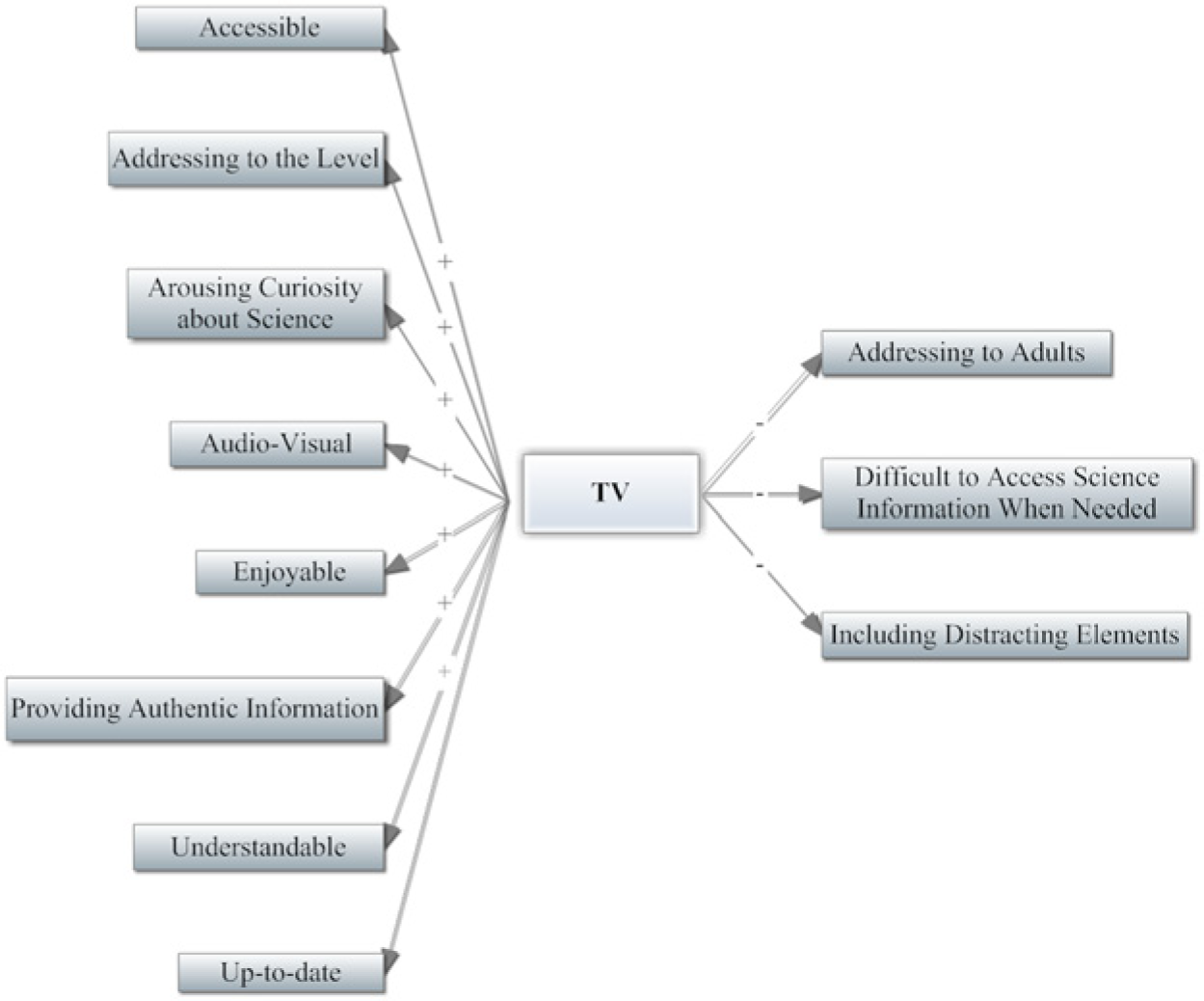
Effective and ineffective features of TV as a science information source.
Students described TV is effective as a science learning tool because of its visuals and its potential to pique curiosity, especially when quality programs are selected, though students did report difficulty understanding some programs. Other reported drawbacks of TV as a learning tool included the broadcasting of programs that distracted the students, of programs too similar in theme to one another, and of children’s educational programs during the school day, as well as the complaint that the information was presented too quickly. One of the fourth-grade students commented that she had difficulty in retaining the information she learned from TV, which could have to do with the impediments reported above.
The analysis further revealed, however, that 13 students in four focus groups disapproved of TV as it did not address them at their levels. Some students did not find it helpful to use the TV for learning science, explaining that it was uncommon to see scientists on TV and that little science-related information could be found on TV that students in this research had access to. Some representative quotes are provided below: I don’t use TV much for science learning purposes. On TV, in general, I hardly see scientists but mostly some people speaking. (S5, fourth grader, Public School A) It is hard for me to find science-related programs on TV. That’s why I don’t use the TV [to learn science]. (S19, fourth-grader, Private School B)
TV, as a mass media resource, targets people of all ages. Because of this, students also criticized TV for lacking programs directed at their specific age and education levels. However, at the same time, TV was praised as an up-to-date resource with interesting and relevant science-related content.
Science Magazines
Students reported learning about many interesting topics in science magazines and pointed out that these topics were sometimes complementary to what they were learning in school. As different from the public schools in the study, magazines emerged to be one of the main science information sources in private schools. Furthermore, the results revealed that science magazines contained quality and trustworthy knowledge presented in an age-appropriate style and that it was easy to retain what was learned. Most of the students explained that they found the topics covered in science magazines interesting and that they enjoyed reading them while also learning something new. Two students articulated the relationship between this feeling and retention of information: They [science magazines] are fun and you learn various things. They talk to you at your level and you can understand better. So this makes the information permanent in your mind. (S5, fourth grader, Public School A) I think they [science magazines] are really fun because they are for us. They address us, as S42 said. Like the name: “Science and Child” . . . They’re understandable; we’re having fun, and so it becomes permanent in our minds. It also makes us more curious about science, and there are many experiments I’d like to try too. (S45, fifth grader, Private School B)
Unlike with TV, there were not many drawbacks identified regarding the content of science magazines. As an outlier comment, one of the fourth-grade students from Private School B complained that science magazines focused more on animals than on humans in their coverage.
In relation to the presentation of content in science magazines, students claimed that learning science from magazines provoked their curiosity. They appreciated colorful pictures, compelling visuals printed in high quality, and brief explanatory text in science magazines, as demonstrated in Figure 3.
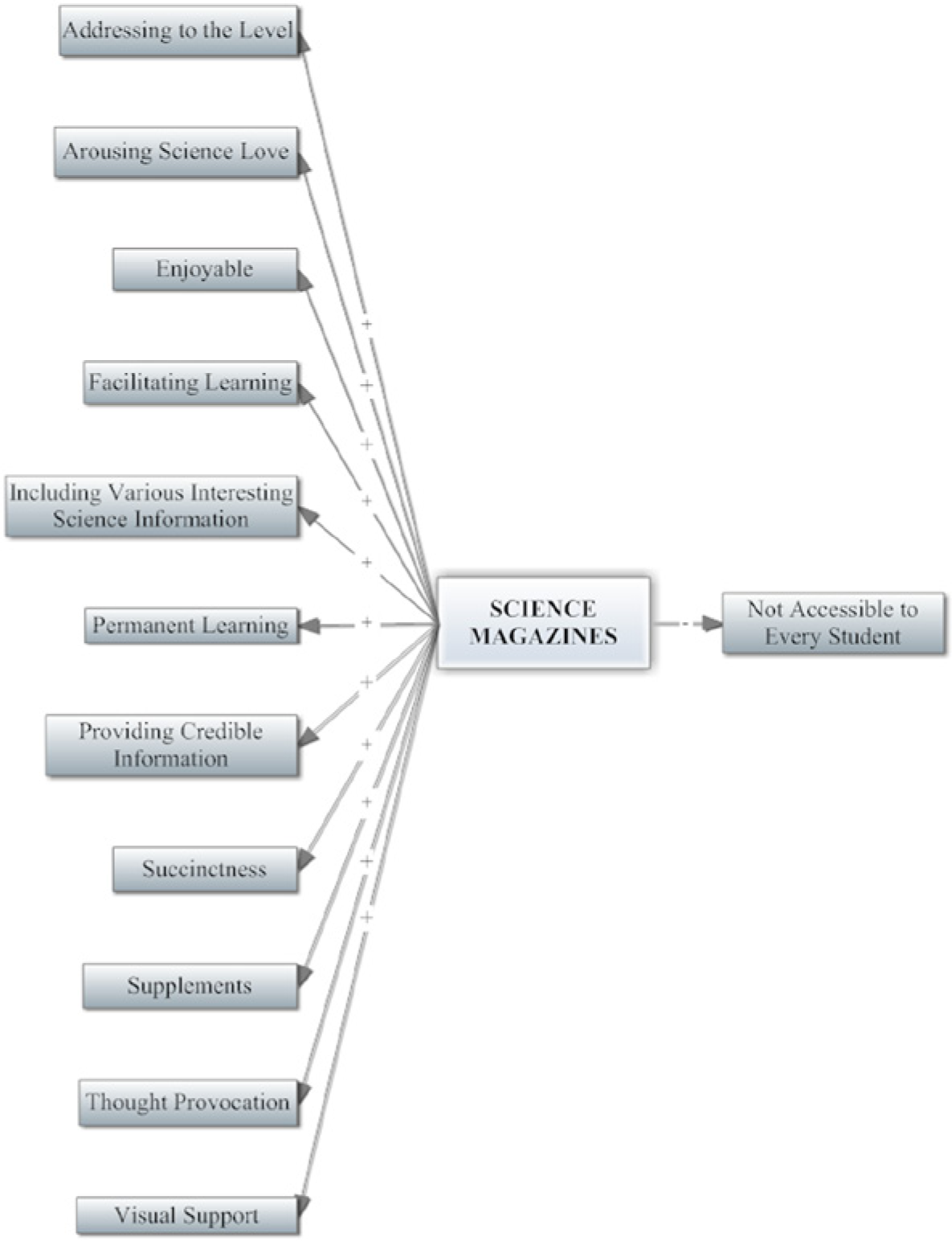
Effective and ineffective features of science magazines as science information source.
The analysis of the data also revealed that students followed up on the things they found interesting in science magazines with further research. Five students said they searched through archived magazines with their supplements, and some of them cut out pictures and hung them up in their rooms or glued them to their personal notebooks. They also shared the information they found interesting with their classmates and teachers.
The analysis further indicated that some science magazines were more useful to students than others. The magazine Science and Child created a lively experience for students, with many colorful visuals, games, and comics in it. Moreover, the material published was in line with school curricula but offered different perspectives to students. Integrating what her friends said about science magazines, S35 (fifth grader, Public School B) concluded, I think the best example of all these features in it is Science and Child. Because with this magazine, we do fun things, learn different things and wonder about them. We feel like we want to buy it again and learn about science more and more.
According to the interviewees, the effective content presentation features (e.g., comprehensibility, fun/enjoyment, succinctness, visual support, thought provocation) are not accompanied by many drawbacks. However, three fifth graders from Private School B notably criticized National Geographic Kids for its small typeface, which made it difficult for them to read and understand the contents.
Newspapers
Content was cited by students as a reason for using newspapers as a resource for science-related information. They agreed that science information in newspapers was up-to-date, trustworthy, and interesting. They added that what they learned in newspapers was different from what they were learning through school science curriculum. Information in newspapers was actually considered more trustworthy and frequently updated than information from some other sources by the students. By way of illustration, S45 (fifth grader, Private School B) noted the following: The newspaper updates itself every day. I learn recent science-related news from the newspapers. It’s also more reliable than the Internet. That’s why I like newspapers better.
Between science magazines and newspapers, the students preferred science magazines since they were directed at their age-group. Analysis of the data revealed that students had not yet developed newspaper reading habits. However, students confirmed that some parents shared interesting information they came across in the newspapers with them.
Students claimed that since newspapers targeted a broad readership, it was sometimes difficult for them to understand the science content in them. Apart from not addressing the level of the students, newspapers were also reported not to include sufficient science coverage, focusing instead on “adult” issues. As the following student put it, There isn’t much science-related news in the newspaper anymore. Instead of science issues, the news is about murder, voting, and detectives, so I don’t read it. (S23, fourth grader, Private School B)
S16 (fourth grader, Private School A) made the interesting comment that topics covered in newspapers were also available on TV, and accordingly, she preferred watching TV. Furthermore, some of the students described newspapers as old-fashioned, one step behind the Internet and TV, which might even update their information continuously.
Overall, as also exemplified in Figure 4, both fourth- and fifth-grade students complained about problematic content presentation in newspapers. The biggest criticism was of a lack of visual support. This was combined with the observation that the information in newspapers was not directed at their age-group and thus not readily comprehensible for the students. For reasons along these lines, students explained that they did not prefer to read newspapers in order to learn science.
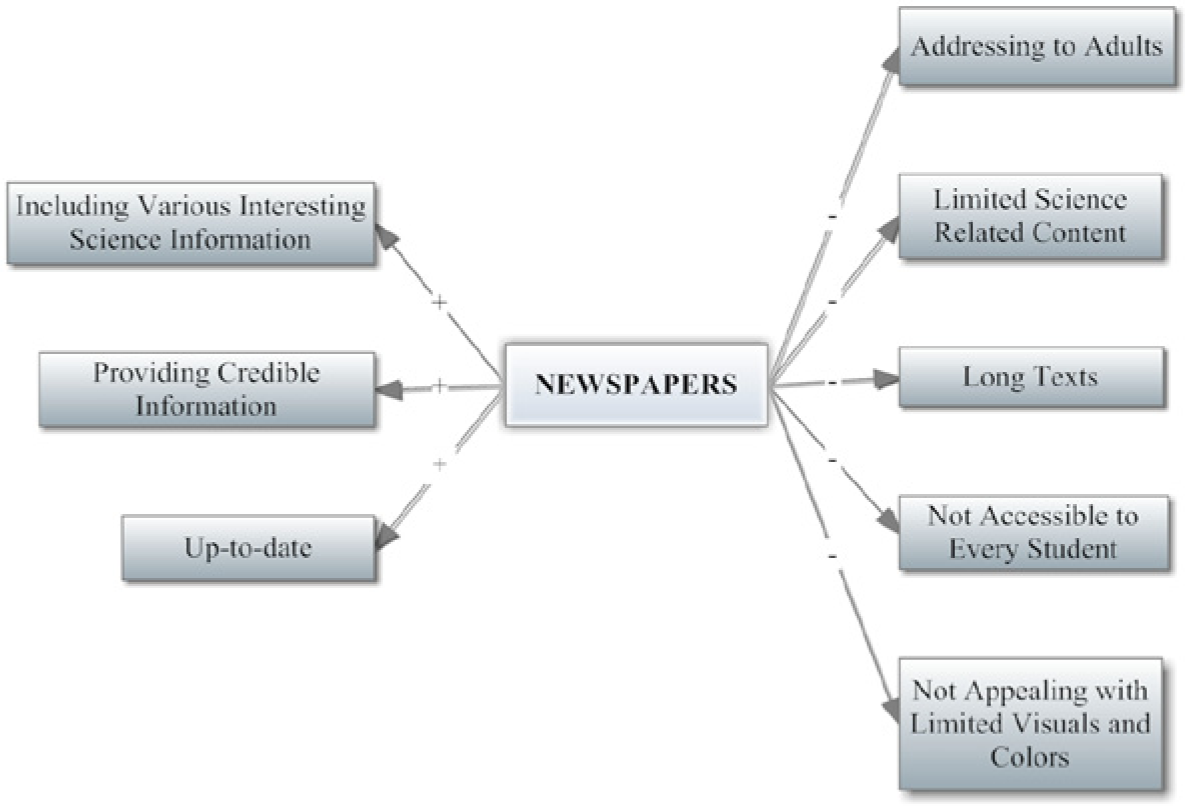
Effective and ineffective features of newspapers as science information source.
Internet
In comparison to other media sources examined, the majority of the students in this study stated that they were more likely to use the Internet. Students in this study explained that they mainly used Internet sites like Google and Wikipedia for science-related research purposes. In one of the public schools, students stated that they used a Facebook group that their class teacher had opened for sharing science-related information. However, in public schools, the Internet was chiefly in use for presentation purposes, for example, accessing sites of My Slide Place (slaytyerim.com) and Watch Slides (slaytizle.com) with reference to science courses. Pupils in private schools in particular reported using the Internet as a primary source in school contexts. Students used the Internet to access science information as it generally provided detailed and interesting science information. As observed by two students, The Internet has the most detailed information. It’s the only way for me to access the information I need. (S25, fifth grader, Public School A) I think science information on the Internet is understandable because we can access every single detail, and I find it very meaningful to learn something from different angles. (S4, fourth grader, Public School A)
Comparing the Internet with TV, S43 further explained that she preferred to use the Internet rather than TV because she found it easier to retain information she learned: I prefer using the Internet [for science-related research] to TV. Because TV speaks directly but you search [for information] on the Internet and I think this [type of learning] is more long-lasting.
Furthermore, science-related information on the Internet aroused students’ curiosity about science and directed them to pursue more information independently, as articulated by one student: It [the Internet] grabs my interest and raises my curiosity. When I learn something, I want to know more and so I surf the Internet [for more information] and read more. (S17, fourth grader, Private School A)
Along with its effective features, Internet content was also criticized over its credibility and for the level of science-related information it presents. To begin with, students who participated in this study mentioned that they did not trust all the information on the Internet and that they often needed to double check its content. Alternatively, in coping with problems such as validity and authenticity, S21 (fourth grader, Private School B) explained that he stuck with the websites suggested to him by his family, teachers, and friends. Students also explained that they had difficulty deciding which information they should use, which caused them to sometimes feel the Internet was a waste of time. The comments by several students are as follows: I usually don’t believe what I find. For example, I remember one text that seemed pointless to me. I checked it on other sites as well, and when I compared them they handled the subject in the same way. If things are similar on various sites, then I think it’s true and I use it in my homework. (S24, fourth grader, Private School B) It sometimes takes too much time to find reliable information that speaks to our age-group. So, I think researching from the Internet is just a waste of Time. (S46, fifth grader, Private School B)
Despite its advantages, the Internet was often criticized for its occasional poor quality, for being unnecessarily long, and for its overly advanced information about science. Students mainly complained that the content of websites was sometimes complex, with vague wording, in addition to being difficult to judge its credibility. The public school students also noted that the dominance of English sometimes made it difficult to comprehend the details of the information presented: Some of the information I have accessed through the Internet is in English and difficult to understand with the unfamiliar words. . . . It’s not fun anymore. Reading is fine but when I can’t read and understand these words, it [accessing science information on the Internet] starts to get boring. (S25, fifth grader, Public School A) The information on the Internet is hard to understand because it’s for such a wide variety of people [making it difficult to locate age-appropriate material]. (S32, fifth grader, Public School B)
According to the students, their access to Internet content was also limited by its presentation in small fonts, as articulated by S26 (fifth grader, Public School A): When you Google something, there is lots of tiny information that I can’t read. I think this is wrong. OK, it provides a huge amount of information, but who reads all these long texts? Maybe some people do it, but I do not.
Likewise, S14 (fourth grader, Private School A) concurred: “Who wants to read thousands of lines without pictures?”
Briefly, as summarized in Figure 5, content presentation on the Internet is considered enjoyable, which awakens students’ curiosity. However, the presentation style was often an obstacle, with its inclusion of long texts with complex words and foreign terms.
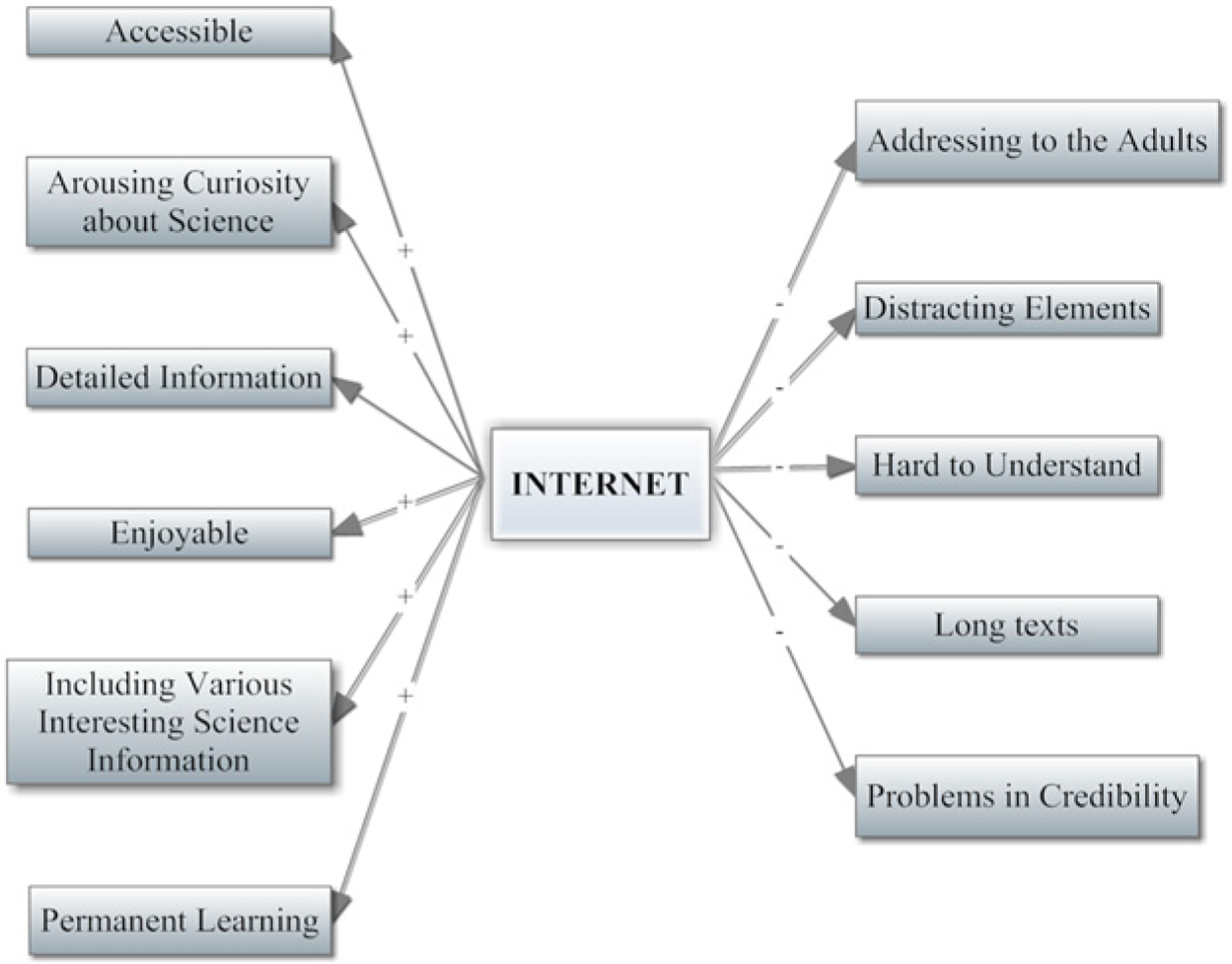
Effective and ineffective features of the Internet as a science information source.
Discussion
Students access science information by multiple means. The details of their motivations and methods require in-depth analysis. This analysis involves detailing effective or ineffective features of mass media sources based on student reporting and describing how these features are utilized for science learning. Students in this study draw on mass media resources both within and outside the school setting for various science learning purposes. In this study, students’ use of TV, Internet, newspapers, and science magazines has been examined. The results indicate that the Internet was at the forefront of the media resources examined, which was consistent with the findings of Butt, Clery, Abeywardana, and Phillips (2010) and Bubela et al. (2009).
First of all, students’ media use differed according to school type, that is, public and private school student habits differed within the classroom. Internet and science magazines were the primary science learning resources in private school classrooms. Next, in contexts outside of school, the Internet was a commonly used mass media resource by the fourth and fifth graders. Private school students added that they also used TV and science magazines for science learning outside the school. One possible explanation for such a difference could be socioeconomic levels of students who attend private school (Wimer, 2007). This could be as simple as a correlation between families that can afford to enroll their children in private schools and those who can afford to subscribe to premium television channels and magazines where engaging and age-appropriate science content can be found. In the United Kingdom, the Royal Society (2008) report also makes reference to the issue: “There is strong evidence of a link between SES and attainment in science among 5–11 year olds” (p. 4).
According to UGT, people use media to satisfy their specific needs (Katz et al., 1973). One of the foundations of UGT is the active audience (Blumler & Katz, 1974). Accordingly, audience needs dictate their consumption decisions. The students in this study also actively engaged with various media resources in order to meet their social and psychological needs. Of the five UGT categories cited by Katz et al. (1973), the results of this study demonstrated that the students used mass media for cognitive, affective, personal integrative, and social integrative needs.
To begin with, students employed the Internet and sometimes science magazines to meet homework and project requirements. In addition to this use, students draw on the Internet during the science classes. Uses of these forms of media may have stemmed from the students’ cognitive needs, which are explained by Katz et al. (1973) as “needs related to strengthening information, knowledge, and understanding” (p. 166).
The use of mass media also related to students’ pursuit of science-related knowledge on their own. Here, it is important to note that students did not conduct individual science-related research unless required by their teachers to do so. Nevertheless, they explained that within the context of school-related homework and projects, they sometimes went further doing additional research and reading. When they did this they mostly preferred the Internet and science magazines, as these were both accessible and rich with information. They also shared science information they found interesting in these sources in class. This mode of media use thus incorporates aspects of their cognitive, personal, and social integrative needs, as also explained by Katz et al. (1973). That is, by conducting individual research, students not only acquired information, knowledge, and understanding (cognitive needs) but also boosted their emotional experience (affective needs) and made contact with their friends and teachers (social integrative needs) in the process of sharing.
TV, Internet, newspapers, and magazines were the media resources students liked to use and share with their teachers and classmates. These resources were selected primarily for their accessibility, which corroborates the contention of Senemoglu (2001), who suggested that educational material should be both accessible and usable. The finding of students’ desire to share what they learned with others and “the need to participate in discussions with friends” might be further explained by students’ personal (gaining prestige and high standing) and social (contact with people) integrative needs, as suggested by Katz et al. (1973, p. 172).
Apart from this, the results also revealed that key motivation for students’ use of mass media revolved around accessibility, content, and presentation. Accordingly, resources that combined accessibility (TV, Internet) with appeal (TV, Internet, science magazines), credibility (newspapers), content appropriateness (science magazines), and frequency of update (TV, Internet, newspapers) were preferable. Resources that presented their content in memorable (TV, science magazines) and permanent (science magazines) ways were also considered to be effective.
With regard to content presentation, comprehensibility (science magazines), enjoyment (science magazines, Internet), clarity (TV, science magazines), inclusion of visual aids (TV, science magazines), and ability to arouse curiosity (TV, Internet, science magazines) were important factors that influenced students’ selection of mass media resources.
Media sources were by and large regarded as current and directed at “a wide array of people” by the students. Among them, the Internet was the most highly regarded resource among others because of its convenience and accessibility. This result corroborated the findings of a great deal of previous work in this field (Butler, 1995; Clark, 2000; Falk & Dierking, 2010; Horrigan, 2006; National Foundation for Educational Research, 2011). Clark (2000) further emphasized the influence of the Internet as a science information source: “This new resource provides rich opportunities to support the development of scientific argumentation skills, going well beyond those available in typical instruction” (p. 859). Students explained that they mainly used Google, Wikipedia, and Facebook. However, in public schools, the Internet was chiefly in use for presentation purposes, for example, accessing sites like slaytyerim.com (My Slide Place) and slaytizle.com (Watch Slides) with reference to science courses. This finding is consistent with Hakverdi-Can and Dana’s (2012) study that found teachers unaware that the Internet was being used as a tool by which users could take virtual trips to museums, zoos, and science centers; access online databases; or participate in Internet-oriented workshops, as opposed to using it merely for the purpose of preparing presentations.
The credibility of the Internet as a resource was an important issue highlighted by the students. This result confirms the findings of Metzger (2007), who emphasized that accessing accurate information matters for users. Among the media resources analyzed here, the credibility of the Internet for providing accurate science-related information was most questioned by the students. Newspapers, in contrast, were thought to provide the most credible information among the students. However, the results indicated that newspapers were at the background of the media sources examined. Although students chiefly complained about newspapers’ voice mostly addressing adults, they also highlighted that providing limited science news and few visuals and inclusion of long texts were other weaknesses as science information sources. One possible explanation for this could be limited reading habit among school-age children, which was in agreement with the findings of the EARGED (Department of Research and Development of Education) Report (2007).
Hass (1981, as cited in Clark, 2000) stated, “Source credibility is associated with high levels of education, intelligence, professional attainment, and familiarity with the issue” (p. 860). In contrast to Horrigan’s (2006) study, in which the participants considered the Internet a credible source for checking science information, participants from this study criticized the Internet on the basis of reliability and authenticity over any other factor, in comparison with the other media resources in question. In order to cope with this issue, students tried to check the accuracy of their online findings with additional websites or other sources of information, like their families, teachers, and science books. This result was in agreement with Horrigan’s (2006) study, which indicated that “80% of those who have gotten science news and information online have engaged in at least one of these ‘fast-checking’ activities” (p. 2).
The visuals in media were also influential on students’ perceptions of these sources as effective or ineffective. According to Birkok (2008), the decreasing reading comprehension among students makes visual representation more important. This is one of the reasons why TV was attractive to the students as an information source. This result confirms the idea of “television is easy, print is tough” (Salomon, 1984); therefore, TV was perceived as a memorable science information source by some students. This was in contrast to the study by Gregory and Miller (2000), who discussed the difficulty in retaining TV-based science information. Students in this study reported that they had the sense of “being there” while they were watching TV. This kind of involvement, engagement, or learning (Brown & Cairns, 2004; Dede, 2005; Falconer, 2013; Hummel, Freeland, Craft, & McKellips, 2011) might be explained by the assumptions of the immersion theory. As engagement and involvement are obviously important in education (Bransford, Brown, & Cocking, 1999), TV emerges to be a valuable medium in students’ science learning.
The fun and enjoyment the content caused made the media more valuable for the students. TV, Internet, and science magazines were the resources most closely associated with entertainment value. This aspect becomes important since “the general public is uninterested in science and technology as not being fun” (Gilbert, 2007, p. 123). As Alexander (2000) emphasizes, “learning lies between play and academics” (p. 1), underscoring the relevance of fun in the learning and teaching of science by young people. This is also consistent with findings reported by National Foundation for Educational Research (2011): Promoting science as interesting and fun by capitalising on, and demonstrating, the potential for science to be interesting, fun and engaging so as to avoid potential negative perceptions of it as boring or difficult. (p. 8)
One of the interesting results of this study was the degree of sophistication the students at the age of 10 or 11 displayed in their comments on the various science information sources. They were well aware of the potential as well as their advantages and disadvantages as science information sources. Of course, this result could partially be due to the purposeful selection of the students who were interested in science. However, even for “the interested students,” this level of awareness of the quality of sources and critical assessment of their various characteristics was admirable. As Jerome Bruner (1991) said, children are little scientists, and when they are in the right environment they can learn and discover the external world themselves. So the students who participated in this study could be examples of these explorers of sources to learn science.
Implications for Practice
In this qualitative study, the researchers’ aim was not to generalize to the results to all fourth and fifth graders. The sampling was purposeful, targeting volunteer students who were interested in science. However, by selecting different types of schools for the study, we hoped to increase the variety of perspectives from different school contexts.
Within this context, the findings indicated that the students in our sample had the impression that TV programs in Turkey mostly addressed adults and that science programs for children were broadcast at times that conflicted with students’ school schedules. Thus, students could not effectively use TV to access science information, which in turn decreased its effectiveness as a resource for learning. In addition, commercials and advertisements were found to be distracting elements. At this point, suggestions might be in order for TV producers, teachers, and parents. If it is possible, TV producers could broadcast children’s science programs in the evenings and at the weekends, and with limited commercial interruption or other distracting elements. In addition, what is suggested for teachers is to encourage students to conduct science research by watching science programs on TV and to inform students about which channels and programs to watch in advance. In parallel with this, parents should monitor their children’s TV-watching habits closely and guide their TV choices.
Next, newspapers were criticized by participants in the study for addressing adults, for containing insufficient science content, and for presenting information in the form of long texts with limited visuals. Furthermore, newspapers were not considered an accessible resource. This resulted in low motivation among students to use newspapers as a resource for science-related information. These findings suggest that newspapers in Turkey should communicate science to children through various channels like including a “science page,” publishing a visual or colorful “children’s science page” in addition to their usual content, or publishing a “children’s newspaper” supplement once a week or more. Here, the idea of including stories of pages dedicated to science stories in a newspaper does not necessitate a change in reader expectations to the conventional “politics in the front, sports in the back” composition, as discussed by Gregory and Miller (2000). One way or another, though, it would be meaningful to make use of the medium in a way that would improve its standing as a resource for science information. Another approach might be for newspapers to be distributed daily to public school libraries in order to give students from lower socioeconomic backgrounds to more of an opportunity to access science-related information through newspapers. At this point, teachers and parents should encourage students to recognize newspapers as a science learning resource and to help them develop habits to access information through this medium.
The results also indicated that science magazines were effective in students’ science learning in many ways: by being comprehensible, fun/enjoyable, and brief; by providing visual support; by awakening curiosity; by instilling permanent science information; and by increasing curiosity and science love. However, science magazines were not accessible to each and every student. The data suggest that it would be helpful to students if science magazines are ordered to school libraries periodically so as to enhance the accessibility. Again, here, teachers and parents should support students to take science magazines as a science information source and to use it in accessing science information.
Last but not least, students in this study expressed a preference for using the Internet for purposes like homework and projects and for individual science-related research, as discussed in the Results section. However, Internet content is also being criticized for problems of credibility, as well as for distracting and inappropriate elements associated with it. These findings suggest that teachers and families should carefully monitor and guide students’ Internet usage, especially regarding which sites to visit, what information to trust, and how much information to pursue.
Footnotes
Declaration of Conflicting Interests
The author(s) declared no potential conflicts of interest with respect to the research, authorship, and/or publication of this article.
Funding
The author(s) received no financial support for the research, authorship, and/or publication of this article.