




Abstract
Science festivals enable scientists to engage with publics, but format design reflecting different engagement models is contested. This study gathered mixed-methods data over 3 years (2011-2013) from on-site surveys (N = 661) of a health science festival, exploring audience preferences for dissemination or dialogue formats (lectures, discussions, community expo, lab experiments, and day out). Irrespective of time, age–group, or gender, lectures were significantly ranked the main attraction (76.8%), most highly attended (89.1%), and most useful format (83.8%). Thematic analysis revealed five themes exploring nonformal learning motivations for audiences, highlighting that knowledge/understanding acquisition is perceived as empowering greater health literacy.
Introduction
Science festivals are growing in popularity as a means for the public to access topical scientific and health issues and interact with researchers. It has been argued that festivals offer a unique environment for science communication, providing multiple levels of engagement where audiences can choose how much and when they interact with science and scientists (Jensen & Buckley, 2014). Science festivals therefore offer an interesting and relevant environment to elucidate audience preferences for engagement, as they feature a breadth of formats offering a range of engagement and learning styles. This article set out to explore these format preferences, within the contexts of informal science education, health communication, and public engagement.
Science Festival Environments
The term science festival is broad, encompassing university open days, citywide events, national campaigns, and international awareness weeks (Nolin, Bragesjö, & Kasperowski, 2006). Festivals in general are cohesive as time-bound themed public celebrations (Getz, 2010), and more specifically, science festivals aim to bring “public audiences and scientific concepts together” (Bultitude, McDonald, & Custead, 2011, p. 167). The science festival movement is growing internationally, with 94 festivals identified worldwide in 2008 (Bultitude et al., 2011) and subsequently 34 identified in the United Kingdom alone in 2014 (British Interactive Group, 2014). An Ipsos MORI poll of the British public identified science festivals as being part of a wide range of cultural activities, with 3% of those surveyed having been to a science festival in the past year (Ipsos MORI, 2014). This translates to larger science festivals attracting tens of thousands of visitors, with an estimated 19,000 unique visits to the British Science Festival in 2013 (Newcastle University & the British Science Association, 2014).
Increasingly, festivals are utilized by scientists to disseminate research findings and encourage public dialogue and, indeed, are cited in the United Kingdom as a key way to start engagement with the public (National Coordinating Centre for Public Engagement, 2014a; Wellcome Trust, 2014). This is in parallel with international funding and policy requirements driving public engagement and impact from research (Ministry of Business Innovation and Employment, 2014; Palmer & Schibeci, 2014; Research Councils UK, 2010). The informal environment of festivals tends to attract multigenerational audiences, necessitating a mix of communication aims and methods (Grant, 2004). As such, varying engagement formats may be employed to enable communication and connection with audiences, including lectures, hands-on science exhibits, interactive demonstrations, discussions, debates, performances, and information stands (Fikus, 2005).
Theoretically, this informal environment should enable a variety of science communication, learning, and engagement practices to coincide (Holliman, Collins, Jensen, & Taylor, 2009). However, festivals and other live science events have been criticized for relying on traditional one-way science communication techniques such as lectures (Riise, 2008), and urged to include more dialogic-style formats (House of Lords Select Committee on Science and Technology, 2000; Office of Science and Technology, 2004). Lectures are one of the oldest formats for science communication, famously utilized by Michael Faraday in his Royal Institution Christmas Lectures (Royal Institution, 2014). However, lecture dissemination has come to be associated with didactic pedagogy and the deficit model of the “Public Understanding of Science” (PUS) movement (Bauer, 2009).
This “grand narrative” of science communication (Trench, 2008) indicates that top-down, packaged communication of scientific information does not work, particularly in countries like the United Kingdom that have experienced media furors around issues such as bovine spongiform encephalopathy and genetic modification of foods and the resulting damage to public trust in science (Wynne, 2006). Instead, the buzzword of “Public Engagement With Science” (PES; Vincent, 2014) has become commonplace to indicate “publicly engaged science” aiming to open up science and its governance (Stilgoe, Lock, & Wilsdon, 2014). Engagement is defined as “a two-way process, involving interaction and listening, with the goal of generating mutual benefit” (National Coordinating Centre for Public Engagement, 2014b). It is notable that scientists applying to take part in science festivals in the United Kingdom are now mainly encouraged to develop hands-on activities enabling two-way dialogue and interaction with the public (Bristol Food Connections, 2014; Festival of Nature, 2014; University of the West of England, 2014; Wellcome Trust, 2014).
It has been argued that this narrow two-way singular interaction view of PES does not reflect (1) the aims of many scientists taking part in engagement activities, that is, to inspire, raise awareness, and improve public knowledge (Besley, Oh, & Nisbet, 2013), or (2) the drive to evaluate effectiveness of engagement activities for learning (Trench, 2008). In a survey of European Union science communication events, the most widely shared objective of science festivals was to “raise public awareness of science” (Fikus, 2005), a goal shared beyond the European Union context (NZ International Science Festival, 2014; Singapore Science Festival, 2014; USA Science & Engineering Festival, 2014; World Science Festival, 2014). Indeed, evaluations of science festivals have found that visitors’ self-reported benefits of attendance are related to learning about scientific information and an increased interest in science (Grant, 2004; Newcastle University and the British Science Association, 2014). This was reinforced by published research from the Cambridge Science Festival, which indicated that participants were motivated by creating interest in new topics of science, by being informed, enthused, and educated (Jensen & Buckley, 2014).
The current research sought to explore audience preferences for engagement styles at science festivals in the light of this literature. While there is much research describing the aims of scientists taking part in communication or public engagement activities, colloquially described as “deficit” versus “dialogue,” there is little research exploring which style audiences may actually prefer. Experts in science communication agree that audience awareness should be the prime concern for scientists taking part in communication efforts (Bray, France, & Gilbert, 2011), which correlates with the context model, where scientists need to consider what people want to know in their particular circumstances (Weigold, 2001). While PES interactivity may act as an overarching goal for science in society, it stands that sometimes audience needs may correlate more closely with PUS knowledge acquisition. Science festivals were chosen as the environment to explore this continuum, as they offer many concurrent format choices, with no value judgments implied to the audience. It is therefore worth defining typologies of engagement and learning, before describing how these are considered within the science festival under question.
Engagement and Learning in Informal Environments
Engagement
Engagement mechanisms were classified by Rowe and Frewer (2005) according to the flow of information between sponsors (scientists) and participants (publics). Public communication involves one-way transmission from scientists to publics, which is exemplified by lectures or the traditional media. Public consultation involves scientists receiving information from the public, such as in a dialogue debate or a public survey. Public participation is a transactional two-way process, whereby publics are actively involved and co-creating knowledge with scientists.
Irwin (2008) defines another way of organizing public engagement by classifying different styles according to orders of thinking and interaction. First-order public engagement involves promoting awareness, interest, and learning, whereby scientists invite publics to learn more about their perspectives without themselves finding out more about public perspectives. Second-order public engagement is dialogic, where information is exchanged and both scientists and publics are assumed to have valuable knowledge to offer. Third-order public engagement involves communication between multiple stakeholders in a wider sociocultural context, exploring how science can do the most good for society.
Engagement in the context of informal science education takes on a different connotation as it indicates interest in an activity. Informal science educators aim to encourage public engagement as an “integral part of participation in or learning about science, or as a stepping stone to further participation or learning” (McCallie et al., 2009, p. 20).
Learning
Learning is defined as the “the acquisition of knowledge or skills through experience, study, or by being taught” (Oxford Dictionaries, 2014). Learning is most commonly associated with formal learning environments such as schools and universities; however, informal environments also provide opportunities for learning, with 80% of children’s time spent out of school (Bell, Lewenstein, Shouse, & Feder, 2009), and nearly half of adult science understanding deriving from learning in leisure time (Falk, Storksdieck, & Dierking, 2007).
Informal learning occurs when knowledge is obtained naturally through experiential, tacit, and participatory means with no learning outcomes defined; this is “never intentional from the learner’s standpoint” (Organisation for Economic Co-operation and Development, 2014). Within the field of science communication, informal science learning is a broad term that encompasses “activities taking place outside the formal education system that seek to raise awareness of, and interest and engagement with, science and other STEM subjects” (Wellcome Trust, 2012b, p. 11). The definition is taken to refer to both learning outside of school, and adult lifelong learning.
However, the term informal learning tends to be used interchangeably with, or in place of, the more accurate term nonformal learning. Here, intentional learning (from the learner’s standpoint) takes place in a nonformal manner, for example, without curricula or accreditation (Eshach, 2007). While the learner’s intention can be debated, evidence suggests that informal science providers do intend people to learn from their activities, mainly using a social constructivist framework whereby meaning is constructed through deliberation and discussion with others (Wellcome Trust, 2012a).
Scientific Literacy
Scientific literacy is the broad concept of an individual’s ability to use and process scientific knowledge, in order to make informed decisions through scientific thinking (Liu, 2009). More broadly, it has also been linked with the ability to participate in science-related issues and activities throughout life as scientifically literate citizens (Crowell & Schunn, 2014). Scientific literacy has been subject to controversy, as it has been linked to the concept of an overall public “deficit” of knowledge and attitudes that needs to be rectified through science communication in the PUS movement (Bauer, 2009; 2015). However, scientific literacy is broadly accepted in formal education as a means to measure and quantify understanding and attitudes of and about science gained through scientific curricula, such as through the Programme for International Student Assessment (Organisation for Economic Co-operation and Development, 2006).
As with public engagement, scientific literacy is conceptualized very differently by varied interest groups (Laugksch, 2000). The theory most in alignment with typologies of public engagement appears to be that of Shamos (1995), whereby cultural scientific literacy is the simplest form, implying passive understanding of scientific lexicon and knowledge. Functional scientific literacy is more active, where the holder can converse meaningfully with scientific evidence as available to the public and make use of understanding of science in decision making within their life context. It could be argued that “true scientific literacy” implies an expert status, with understanding of theories and the process of scientific enterprise; however, the key point of this discussion is around the development of scientific literacy for critical citizenship.
Health Literacy
Related to this concept is health literacy, representing the motivation and ability of individuals to gain access to, understand, and use information in ways that promote and maintain good health (Frisch, Camerini, Diviani, & Schulz, 2012). Again, health literacy is conceived as existing on a continuum (Nutbeam, 2000), whereby functional health literacy is concerned with basic understanding of health care and choices. Interactive health literacy occurs when individuals or groups can question and engage with health choices; critical health literacy refers to individuals or groups informing and influencing health care interventions and policies (Sykes, Wills, Rowlands, & Popple, 2013).
People with low health literacy have greater risk of limited access to care and poorer health outcomes (Berkman, Sheridan, Donahue, Halpern, & Crotty, 2011). Conversely, health communication efforts focus on increasing health literacy as a personal and community asset (Nutbeam, 2008), which can reduce health inequalities (Pleasant & Kuruvilla, 2008). Measures of health literacy include health knowledge, attitudes, motivation, self-efficacy, and behavioral intentions (Bandura, 2004; Nutbeam, 2000). Therefore, while scientific literacy is a controversial concept, improved health literacy is seen as a goal of many health communication efforts (Bay et al., 2012; Ishikawa & Kiuchi, 2010).
Brain Day Auckland
To explore the dichotomy between PES interactivity and PUS knowledge acquisition, this study focused on a health science festival in New Zealand (NZ), called Brain Day Auckland (Centre for Brain Research [CBR], 2012b). The field of neuroscience is a popular topic for engagement activities (Devonshire & Hathway, 2014; Sperduti, Crivellaro, Rossi, & Bondioli, 2012; Zardetto-Smith, Mu, Phelps, Houtz, & Royeen, 2002) as it has been argued that studying the brain can tell us much about ourselves, including our personality, emotions, creativity, and intelligence (Dowie & Nicholson, 2011; Illes et al., 2010). While recent research indicates that these efforts are not permeating the public consciousness (O’Connor & Joffe, 2014), brain research is still an attractive and broad topic for science communication efforts.
Brain Day Auckland is one of six nationwide events coordinated by the Neurological Foundation of New Zealand as part of Brain Awareness Week, an international effort to raise awareness of brain research (Frantz, McNerney, & Spitzer, 2009). Over 82 countries are involved, however, events in NZ attract the largest single audiences in the world (Neurological Foundation of New Zealand, 2013). Brain Day Auckland was established in 2004 as a laboratory open house, and it expanded to a more diverse science festival format in 2010, with the establishment of the CBR at The University of Auckland. The event aims to communicate information about brain health and disease along with current neuroscience research, while also engaging publics in the ongoing research process. The free 1-day festival is held on a Saturday daytime in a university conferencing venue and is advertised widely in local media (radio and newspaper), online and via community group networks. The event is staffed by volunteer neuroscience researchers and students who interact freely with the estimated 3,000 members of the public.
Similar to other festival formats described in the literature (Bultitude et al., 2011), the event attracts a multigenerational audience and features a variety of activities (CBR, 2012a):
Eight hands-on science demonstrations
Five children’s activity stalls
Two music/art showcases
A feedback message station
Community expo featuring approximately 40 community groups
Opportunities for subsequent public involvement (Advisory Boards and Research Volunteer Register)
Two thirds of the programming is dedicated to talks with scientists, including 6 to 12 traditional didactic lectures (e.g., “Brain Chatter: Brain Cell Communication in Learning, Health and Disease”; CBR, 2012a) and six dialogue discussions with community/scientist experts (e.g., “Preventing and Recovering From a Stroke”; CBR, 2012a). The lectures have enormous capacities, with two 500-seat lecture theatres employed for each lecture, resulting in some popular lectures attracting up to 1,000 audience members. The lectures feature 20 minutes of traditional expert dissemination, with one person discussing a topic in depth. No demonstrations are included, but subsequent audience question time of 20 minutes is facilitated by a chairperson. The discussions are held in smaller capacity rooms, with two 300 seat theatres employed—these tend to not reach capacity. The discussions aim for a more dialogic style of science communication, with 20 minutes for four panel members to outline their perspective, and then a further 30 minutes for audience discussion and engagement on the topic. Other formats focus on interactivity and fun as their priorities.
Figure 1 summarizes the Brain Day formats and their suggested alignment with models of engagement (Irwin, 2008; Rowe & Frewer, 2005) and health literacy (Nutbeam, 2000). It is not suggested that audiences/publics will systematically flow through each stage of engagement, as it is understood that science festivals are flowing and diverse by nature. However, as people engage in different aspects of the festival, potential for development of health literacy within the context of the brain and neurodegenerative diseases is offered. This diagram is useful to highlight the styles of engagement employed at the science festival in question and how we might expect audiences to interact with the various formats.

Diagram detailing Brain Day Auckland engagement formats, information flow, and relation to health literacy concepts.
Research Question
What formats do audiences at a science festival prefer and why?
This research used a pragmatic correlation model to explore the central research question. It is set in a social constructivist framework to help align various models of public engagement and learning from the perspective of the audience.
Method
Study Design
In order to observe audience preferences over time, data were gathered from a cross-sectional sample of participants at the annual science festival at three different time points, during Brain Day Auckland in 2011, 2012, and 2013. A mixed-methods questionnaire was designed to answer the research question enabling triangulation of quantitative data on audience characteristics and preferences, along with qualitative data on audience motivations (Denscombe, 2010a). Preference was measured through questions about attendance, perceived attractiveness, and perceived usefulness. Ethics consent was given by the University of Auckland Human Participants Ethics Committee (Reference 2011/034).
A team of trained postgraduate neuroscientist volunteers offered the written questionnaire to people entering each annual Brain Day; participants were able to take part in their own time and return the questionnaire anonymously to drop boxes on the day. To increase the return rate, all returned questionnaires were eligible to enter a prize draw for an iPad, via a separate tear-off name slip. People with disabilities with limited ability to read or write, or those younger than 16 years, were invited to ask a caregiver (e.g. a family member) to help them consent and take part.
Study Measures
The questionnaire wording was piloted in 2011 and refined for use in 2012 and 2013. Event feedback was obtained through Rank List questions regarding the five main formats of the day:
Lectures
Discussions
Community expo information
Hands-on laboratory experiments
General good day out (music, art, and atmosphere)
The formats were ranked in terms of attraction, attendance, and perceived usefulness. Likert-type scales were used to assess agreement with statements about the festival formats. Open questions explored participants’ views on the attraction and perceived usefulness of the various formats. A demographic section collected data on the participants’ age, gender, ethnicity, and education level (based on standard NZ census categories).
Data Analysis
Quantitative data from each annual cross-sectional cohort were cleaned and summarized in Microsoft Excel 2010; missing values were coded as 99 for analysis. Descriptive statistics and nonparametric tests were conducted in IBM SPSS Statistics Version .20 (IBM Corp., 2011). Where people rated only their number one choice in the rank list questions, the missing values were coded as 6 (lower than 5), as it was deemed this was meaningful information about their overall choice. Where people rated their choices equally, all counted toward this choice. Rank list questions were analyzed according to the percentage of participants (per year) who rated the format at each level of preference. The usefulness percentage was determined from the number of people who actually attended each event rather than the overall cohort total.
To explore differences between the three annual cohorts, the 95% confidence intervals (CIs) for each rating per year were compared, along with appropriate statistical tests. If there was no significant difference, the annual cohorts were averaged (mean) to create one overall sample response for each question. The averaged responses (giving a larger N for statistical power) were then further analyzed using descriptive statistics, and nonparametric Kruskal-Wallis, Wilcoxon signed ranks, cross-tabulation, multinomial regression, Spearman correlation, and parametric Pearson correlation tests to explore differences between audience characteristics and their format preferences.
The interpretation and analysis of the open response questions followed the general inductive approach to thematic analysis (Thomas, 2006). The text was read several times to ensure familiarity, and then codes were identified and named using QSR International NVivo Version 9 software (QSR International Pty Ltd, 2010). Rigor was improved through constant comparison enabling organization into themes, followed by three researchers independently cross-checking codes for consistency. Qualitative responses were triangulated with quantitative data to further explore preferences for festival formats.
Results
Sample Characteristics
The total sample over three years consisted of 661 completed questionnaires, with a mean cohort of 220.3 (SD = 24.6) per year. While this is a large sample size, the annual response rate was only around 7% of the estimated total attendance of 3,000 per year; which is comparable to other response rates at busy public events. Cross-tabulation statistical testing and 95% CIs indicated there were no significant differences between the cohorts, gender χ2(2, N = 642) = 3.0, p = .22; ethnicity χ2(10, N = 631) = 11.0, p = .36; education χ2(2, N = 407) = 4.8; p = .09; age-group χ2(8, N = 599) = 11.4, p = .18. As such, the three cohorts were combined to give one overall sample for demographic characteristics.
The overall sample was female dominated (66.4%) and had a high proportion of people who had completed postgraduate studies (42.3%); however, the percentage of people who had completed undergraduate education or a trade certificate (25.2%) was similar to those who had no formal education post secondary school (26.6%). The sample showed a broad spread of all ages ranging from 7 to 87 years, but the dominant age category (25.5%) included adults aged 50 to 64 years with a mean age of 48.5 years (SD = 19.3; Figure 2). Spearman correlation indicated that age and education level were strongly positively correlated r(599) = .19, p <.001, indicating that people with high school qualifications or undergraduate degrees were also the youngest members of the sample.
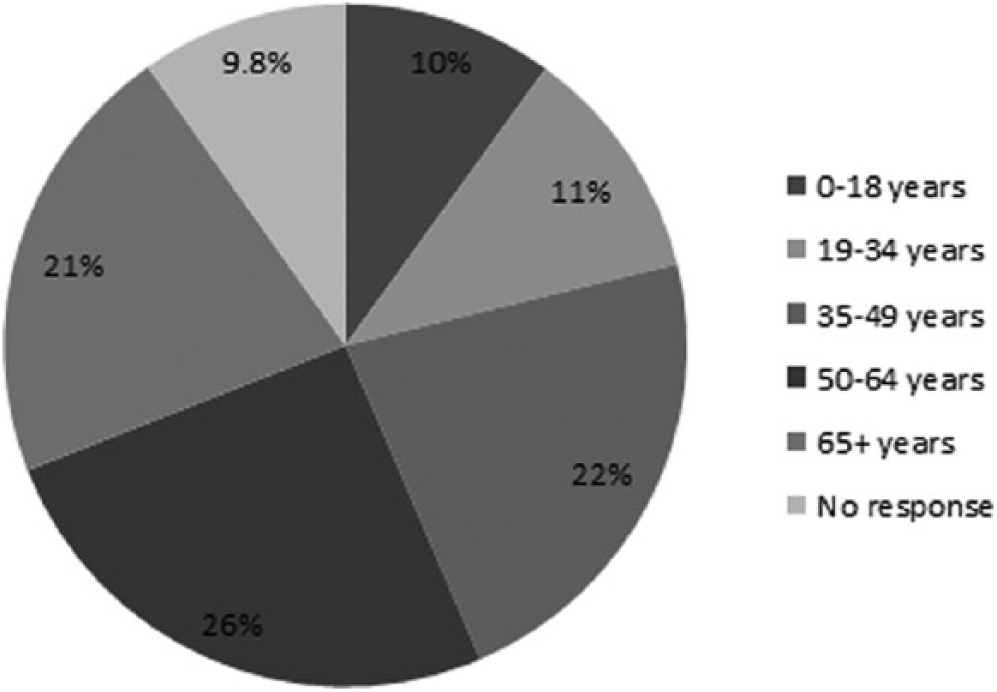
A pie chart indicating the age breakdown of sampled audience members at Brain Day Auckland.
The majority of participants were of New Zealand European descent (64.1%) or Asian (11.2%) with a very low representation of Maori (1.9%) and Pacific Islanders (1.7%) compared to population averages (74% New Zealand European, 12% Asian, 15% Maori, 7% Pacific Islander, (Statistics New Zealand, 2013)). The majority of participants (69.1%) identified themselves as neurologically healthy, while 12.0% identified themselves as having a neurological condition, with a further 14.1% caring for someone with a condition. Within the NZ population it has been stated that 20% of New Zealanders will experience a brain disease in their lifetime (Neurological Foundation of New Zealand, 2012); this reflects the 26% of participants experiencing (living with or caring for) a brain disease in the sample.
It is difficult to state whether this sample is reflective of the overall Brain Day audience, as no empirical data exist to classify audience members at this free, open event. However, allowing for potential sampling bias, it was felt the overall makeup of the sample broadly reflected the audiences seen at Brain Day Auckland.
Attraction to Brain Day
When asked to rank the formats of Brain Day in order of their attraction, over three quarters of participants in each annual cohort ranked lectures as the main reason they attended the science festival (see Table 1). A Kruskal-Wallis test and 95% CIs confirmed that there was no significant difference in the range of ranks for each annual cohort χ2 (2, N = 660) = 2.6, p = .28, indicating the ratings were consistent over time. A Wilcoxon signed-ranks test confirmed that in every year, all formats were rated significantly lower than lectures, Z = 11.3, p < .001, as seen in Figure 3. However, a Wilcoxon signed-ranks test indicated there was a significant difference in how the second choices were ranked over time, expo χ2(2, N = 660) = 7.8, p = .02, discussions χ2(2, N = 660) = 17.6, p < .001, labs χ2(2, N = 660) = 9.4, p = .01; in 2011 and 2012 the community expo was the second top ranked choice (M = 26.4%, 95% CI [19.7, 33.2]), while in 2013 it was discussions (M = 30.7%, 95% CI [24.2, 37.3]), as seen in Figure 4.
Percentage Ratings of Attractiveness, Attendance, and Usefulness of Brain Day Formats.

Note. Many participants did not rank the formats in full, or rated a number of options as their number one choice, so percentages do not add up to 100%.
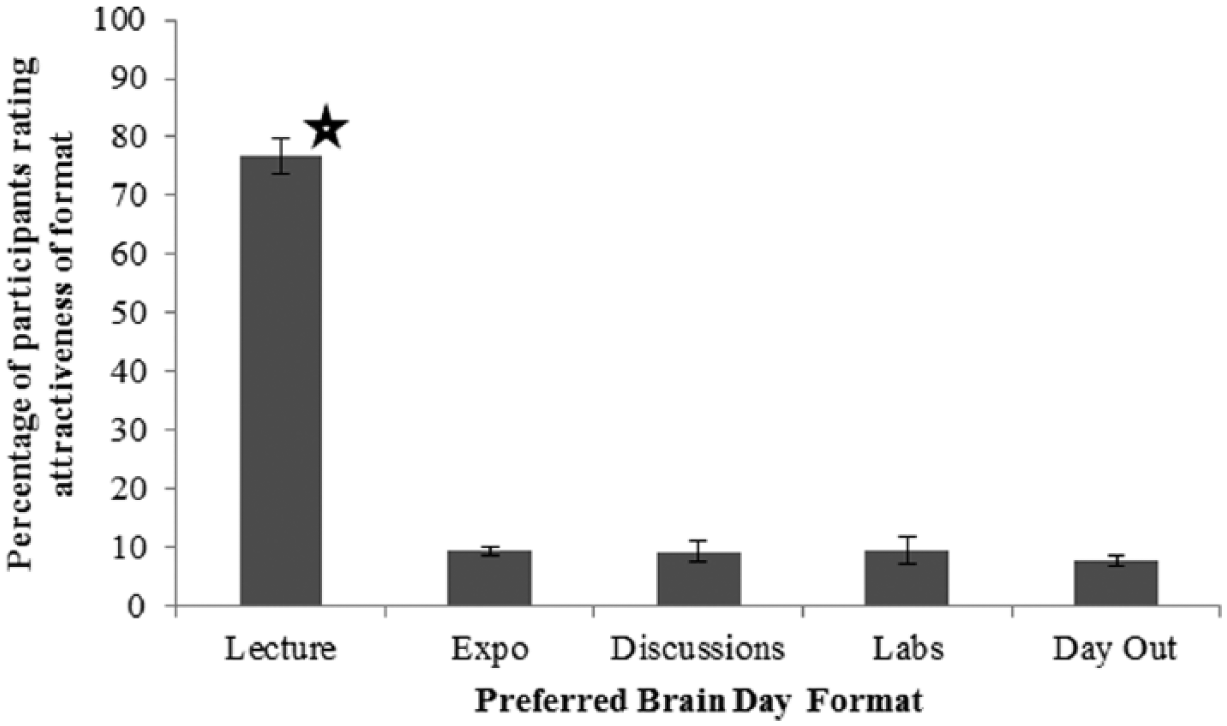
A bar chart indicating the choice of main attraction in Brain Day format for the overall sample.

A bar chart indicating the main and second choices for Brain Day formats for each annual cohort.
While there were annual differences in second choice attractions, the primary choice of lectures each year was consistently high. As such, the annual cohorts were combined into one overall sample, with a mean percentage of 76.8% (95% CI [73.5, 79.9]) of people ranking lectures as their number one attraction, as seen in Figure 2. The sample was explored further with multinomial regression to look for statistical differences in demographic preferences. There was no significant difference between how men or women ranked their main attraction (lectures), Wald χ2(1) = .93, p = .34. There were also no significant differences between how the 19 to 34 age-group, Wald χ2(1) = .75, p = .39, and the 50 to 64 age-group, Wald χ2(1) = .04, p = .84, ranked their main attraction (lectures) compared to the 65+ age-group. However, the 0 to 18 age-group, Wald χ2(1) = 17.6, p < .001, and the 35 to 49 age–group, Wald χ2(1) = 10.8, p < .001, ranked their attractions significantly differently to the 65+ year age-group. Cross tabulations indicated that while the main attraction for these age groups was still lectures, lab experiments were the second choice for the 0 to 18 and 35 to 49 age-groups and the community expo was the least preferred choice for 0- to 18-year-olds. The main attraction for each age group can be seen in Figure 5.
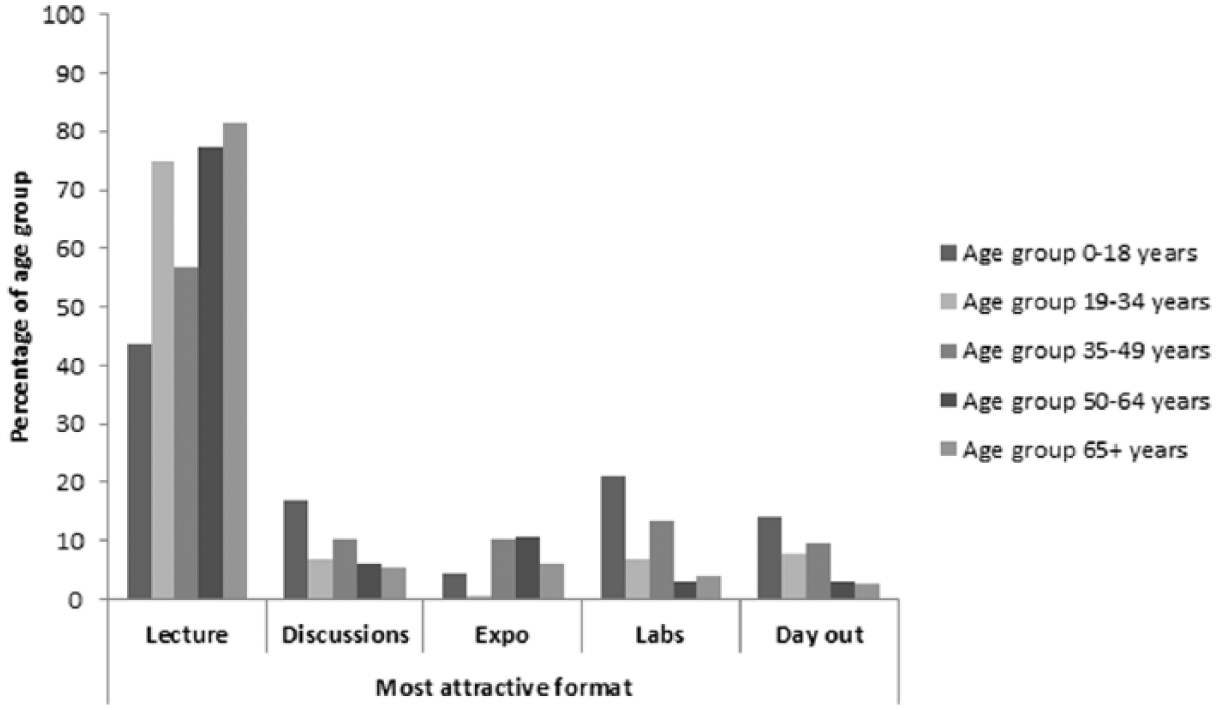
A bar chart indicating the choice of main attraction to Brain Day formats by age-group.
There were no significant differences across ethnic groups, Wald χ2(1) = .32, p = .57; however, this finding is inconclusive for Maori and Pacific Peoples groups as the N values were so small. The sample comparison for education included data only from the 2012 and 2013 cohorts as this demographic question was not asked in 2011. This indicated that there were no significant differences between how high school leavers, Wald χ2(1) = .07, p = .79, and participants with undergraduate degrees, Wald χ2(1) = 1.9, p = .17, rated their main attraction, compared to participants with postgraduate degrees. While the percentage of high school leavers (M = 64.2%) preferring lectures tended to be lower than postgraduates (M = 69.7%), this was still their main choice.
Formats Attended at Brain Day
There were no significant differences between how the three cohorts rated attendance. The overall sample indicated that lectures were the most attended format at Brain Day (M = 89.1%, 95% CI [86.9, 91.6]). Most people visited more than one format during the day (M = 72.3%, 95% CI [69.1, 75.9]); 59.8% of participants attended the community expo, while 38.3% and 30.1% of participants attended discussions and hands-on laboratory experiments, respectively (see Table 1). As reflected in the attractiveness data, participants aged 0 to 18 years and 35 to 49 years attended the science laboratory experiments more than older attendees, while the older age groups were more involved with the community expo. Discussions and labs were the formats most purposefully not attended by older age-groups.
Usefulness of Formats
Participants rated the usefulness (as defined by themselves) of the formats they did attend, and again lectures came top, with no significant differences between annual cohorts. Within the overall sample, lectures were rated as most useful by 83.8% (95% CI [80.8, 86.7]) of participants. The attendance and perceived usefulness of the various formats can be seen in Table 1 and Figure 6. Only 25.6% of people attending the expo found it useful, 32.7% found the discussions useful, and 37.4% found the laboratory experiments useful.
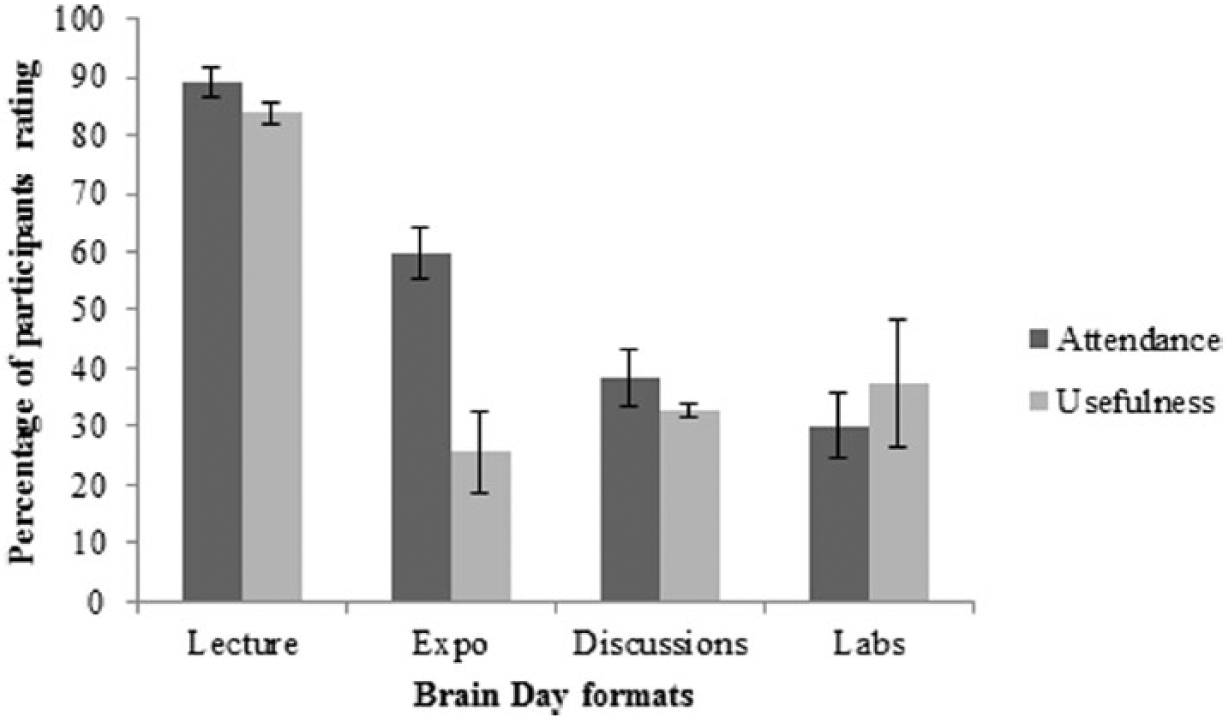
A bar chart indicating the attendance and perceived usefulness of Brain Day formats.
Participants were asked to rate agreement using Likert-type scales (1-5 rating) with various statements about Brain Day and the formats they engaged with, with a rating of 5 indicating they strongly agreed with the statement. The three annual cohorts were combined to give one overall sample. Brain Day as a whole was rated highly by participants as “a good day out for the whole family” (M = 4.2, SD = 0.8). Notably, there was high agreement with the statements “Brain Day has helped me to learn more about how to keep my brain in optimum health” (M = 4.2, SD = 0.7) and “I think lectures are a good way to gain information on brain research” (M = 4.5, SD = 0.7). Participants strongly disagreed with the statement “I did not learn anything useful for me or my family at Brain Day” (M = 1.5, SD = 0.7), and they also disagreed with the statement “I cannot understand neuroscience as it is too confusing and complicated” (M = 2.2, SD = 0.8). A Pearson correlation indicated there was a significant positive relationship between participants agreeing “I think lectures are a good way to gain information on brain research” and “I think that Brain Day has helped me to learn more about how to keep my brain in optimum health,” r(450)= .36, p < .001. This indicates that lectures are perceived as an effective form of learning and knowledge translation at this event.
Understanding Format Choice
Participants were asked to describe why they ranked their format choices in the manner they did. The following five inductive themes, compiled from responses from all three cohorts, capture the core messages reported by participants.
Interested in Learning
This theme encompassed the participants’ general interest and motivation for learning. Participants indicated that they enjoyed learning for the sake of learning and that neuroscience was a particularly interesting topic. This was the dominant theme in the open responses with 33% of responses giving this thematic reason.
Afflicted with curiosity. (Male, age 59, New Zealand European) To learn more and expand on current knowledge. (Female, age not given, New Zealand European) Acquisition of knowledge and understanding. (Female, age not given, European) I’m interested in learning. (Male, age 16, New Zealand European)
This theme is consistent with the majority of participants choosing lectures as their preferred format. Participants indicated that while they generally preferred lectures as a learning format, they particularly found the style at Brain Day to be interesting and informative.
I find the lectures very interesting and on topics that I haven’t learnt about in previous education. Also think the lectures are not only informative but also entertaining. (Female, age 45, New Zealand European) High quality lectures going, easily digested information including links to sources of more information. (Male, age 65, New Zealand European) The themes are very interesting and I prefer listening to a lecture rather than reading an article. (Female, age 19, European)
Knowledge Is Power
This theme brought together participants who had an interest in a specific condition, which affected themselves or a person they knew, with 26% of responses citing this theme. This is related to the concept of health literacy, with participants indicating that more information enabled them to discuss and interact with health professionals or scientists with more confidence.
Knowledge and information increases sense of power, that is, decreases sense of helplessness in having a progressive incurable disease. (Male, age 64, New Zealand European) I am aging and concerned that both my brain and body age “well”! Husband had a stroke so always interested. Knowledge is stimulating and power! (Female, age 72, New Zealand European) Because neither the registrar nor the neurosurgeon would discuss the way the brain works—with me after two MRI scans and identification of two meningioma . . . I valued the scientists showing youngsters—wish I’d had such explanation rather earlier in my life. (Female, age 79, New Zealand European)
Participants were also seeking practical advice about brain health maintenance and improvement.
Having had parents with Alzheimer’s—I am interested to learn if I can help my brain to stay alive longer. (Female, age 62, New Zealand European) To learn how to maintain my brain at as high a level as possible. (Male, age 68, European) I had a stroke, so I want to know everything about my brain and how to develop it back after the damage. (Female, age 51, Asian)
Research and Expert Opinion
In this theme participants indicated that they wanted to hear first-hand information and opinions from experts in the field, with 20% of the responses citing this reason. They appreciated the personal knowledge and experience built up by scientists and hoped to learn directly from the people undertaking research.
Opportunity to hear lecturers on topics they are passionate about, and they talk with knowledge and enthusiasm. (Female, age 54, Asian) Talking to scientists helps sift fact from fiction. Get to know who is doing what research and see if I can help. (Male, age 54, New Zealand European) The quality of speakers/professors available was too good an opportunity to miss. I think their research is absolutely amazing and fascinating. (Female, age 35, Pacific Peoples)
Participants also indicated that they appreciated the process of research itself, as a way of discovering new knowledge. They wanted to learn about the latest cutting-edge developments in the field of neuroscience.
Interested in research and progress of research on subjects. (Female, age 13, New Zealand European) Because of the variety of choice available, free to the public, marvelous opportunity to learn new/latest research without cost. (Female, age 64, New Zealand European)
Career and Professional Development
This theme indicated that Brain Day was relevant to the participants’ career path or job, with 16% of responses citing this theme. Most participants indicated that they attended Brain Day to update their professional knowledge as part of “Continuing Professional Development” or “Continuing Medical Education.”
I’m a pharmacist and I’m interested in understanding diseases and conditions as I’m usually involved in a multidisciplinary team. (Female, age 37, New Zealand European) As a speech language therapist “the brain” is a high interest area. (Female, age 58, New Zealand European) As an occupational therapist I am working with people with cognitive decline, so the lectures are very relevant and important. (Female, age 36, New Zealand European)
Some participants were also interested in gaining more information in order to direct their future career choice.
Talking to scientists—because I have many options to study at uni [sic] but not sure which one to take. If I experience it for myself I would know what I would be doing at the end of the day. (Male, age not given, African) I’m a high school student in year 13. I’m keen to experience what studying at university is like before I leave school. All of the lectures were on very interesting topics. I was just as keen to go to the discussions. I love discussions and arguments. (Female, age 16, New Zealand European)
Other participants indicated that knowledge and understanding on the brain would be useful in many professions and that they would pass this information on to others.
I am very interested in how the brain works. As a teacher I think it is very important to try and understand the brain more. (Female, age 22, New Zealand European) To learn more so I can pass info on to residents at the retirement village I work at. (Female, age 56, New Zealand European)
Engaging in Curiosity
This theme stems from participants who had ranked laboratory experiments as their main format choice, with only 5% citing this reason. Participants were mainly parents who wanted to engage their children in science activities.
I wanted to engage my daughter in curiosity about the human brain. (Female, age 33, New Zealand European) Great for children to speak to scientists. (Female, age 40, New Zealand European) Because I have three young children, I often like to take them to some sort of special day like this. This gives them a bit more understanding of how their brain works and they also have fun in the kiddies’ area. (Female, age 39, Asian)
Other parents indicated that they were attending due to their children’s interests or needs at school.
Great information for our children, both currently studying the brain at school. (Female, age 41, New Zealand European) We have a 7 year old son who really wants to know how the brain works. (Male, age 44, New Zealand European)
Some participants were children themselves, who indicated that they enjoyed learning through hands-on experiences.
Because I like doing hands-on experiments. And I’m also interested in the brain. (Male, age 10, Latin American) I chose science lab experiments because I think having to learn with a hands-on experience is fun but you also learn sooo [sic] much. (Female, age 13, Asian)
Discussion
Adult Preferences for Engagement and Learning Formats
This study provides evidence that festival formats employing traditional PUS-style communication, namely, lectures, were preferred by the majority of adult participants, with the primary motivation being nonformal learning. While the “mixed economy” of engagement orders found in science festivals (Holliman et al., 2009) was clearly utilized and accessed at Brain Day Auckland, formats enabling PES two-way dialogue were not necessarily preferred. The data highlighted how participants actively sought out first-order engagement, with their primary goal being the enjoyment and empowerment of learning new knowledge and information. This reinforces data from other science festivals, where participants highlighted the role of science festivals in “creating interest” in science topics (Grant, 2004; Jensen & Buckley, 2014).
Participants were consistent over time (three years) in their preference for a lecture format at the science festival. Over three quarters of participants (M = 76.8%) ranked lectures as their main attraction, and this was consistent for age, gender, ethnicity, and education, with no statistically significant differences found between groups or across the three years. Almost all participants (M = 89.1%) attended at least one lecture, with lectures being the format which most participants (M = 83.8%) rated as useful, with high agreement (M = 4.5) that they had learnt something at Brain Day. However, nearly three quarters (72.3%) of participants also participated in other formats at the festival, which reinforces assertions that science festivals enable multiple orders of public engagement (Holliman et al., 2009). While the movements of participants were not tracked, we postulate that the science festival environment enables people to learn new information through first-order engagement, and then move elsewhere to discuss it directly with scientist or community experts through second-order dialogue engagement. Direct interaction with scientists was highlighted as a key benefit for science festival audiences in previous research (Jensen & Buckley, 2014).
For family audiences, both quantitative and qualitative data indicated that hands-on lab experiments were the second preferred learning format for adults aged 35 to 49 years and children (0-18 age-group). Qualitative data indicated that this represented parents bringing children to engage in learning; interestingly parents did have the goal of learning (nonformal learning) but the children may not have had learning as their primary goal, instead preferring to primarily have fun (informal learning). Topic choice and experiment design may make a difference to the attractiveness of other formats, as discussions were the second choice for the sample in 2013, while the community expo was the second choice in other years. This study reinforces existing research indicating that science festivals are unique in enabling varied levels of engagement and learning styles to take place at the same time, meeting audience requirements through a variety of formats, interactions, and communicators (Holliman et al., 2009; Jensen & Buckley, 2014).
Nonformal Learning
The qualitative data supported the quantitative data, indicating that participants were motivated by learning new knowledge and understandings of science, health, neuroscience, and more general research topics. Five themes highlighted the different reasons participants wanted to learn: Interested in learning, Knowledge is power, Research and expert opinion, Professional and career development, and Engaging in curiosity. While festivals may provide an informal learning environment, most interactions should be considered as nonformal learning, where learning is intentional (Eshach, 2007). This places festivals into an informal science education context, where learning needs to be engaging and enjoyable (McCallie et al., 2009), and highlights that science festivals can be educational leisure experiences enabling learning for fun (Packer, 2006). It also reinforces data from U.S. science festivals, which reported that 75% of participants stated that festivals “made science learning fun” (Science Festival Alliance, 2013, p. 6).
Participants indicated that they associated lectures with learning, as they wanted to hear up to date information about the latest thinking in the field, directly from knowledgeable experts undertaking the research. While lectures can be associated with the final “evidence” stage of science communication (Bucchi, 2008), the qualitative data indicated that participants did not view Brain Day lectures in this way. Brain Day lectures were described as being fun, engaging, opinionated, and insightful. This may be because of the design of the lectures: being only 20 minutes long with extra time for audience questions and including an insight into the research process and future directions (CBR, 2012a). This fits with literature urging scientists to communicate the “Public Understanding of Research” (Pickersgill, 2011) by representing scientists themselves (Horst, 2013) and by presenting a “deviation” model of science as a continuing discussion of evidence, risk and uncertainty (Bucchi, 2008). The lectures have been developed in a research centre that has a long history of engaging with the community (Fogg, 2009), and as such a deep understanding of audience needs may have been developed. Further research is warranted to determine whether different lecture styles can generate similar results.
These data give weight to concepts of scientific literacy whereby not everyone can be truly scientifically literate, and instead the “expert” has a vital role in informing public scientific debate (Laugksch, 2000; Shamos, 1995). Previous studies have indicated that young audiences felt they did not learn enough from dialogue events where their opinions were given equal weight (Wilkinson, Dawson, & Bultitude, 2011), indicating a desire for first-order engagement. Indeed, the notion that knowledge is empowering in itself is central to the concepts of scientific and health literacy as an asset: by being able to inform and influence individual and community self-efficacy and behavior (Laugksch, 2000; Nutbeam, 2000). Further research is warranted to explore whether audiences who seek out learning through lectures do actually gain new understanding, or whether subsequent dialogue and discussion are helpful to consolidate this knowledge.
Contexts of Relevance
The lectures were cited as being able to provide practical advice and information on health disorders in order to build on experiential knowledge, as indicated in health literacy literature (Wilcox et al., 2009). Topic choice is clearly critical, as learning is most engaging when it is relevant to the audiences’ lives and values and where it can directly influence their health or policy decisions (McCallie et al., 2009). Neuroscience is a context of relevance to the audience attracted to the festival, but not only that, the audience is contextually relevant to the scientists researching the brain and brain diseases. As such, knowledge of audience needs (Bray et al., 2011) and the contextual framework for engagement (Weigold, 2001) may have been refined over several years to enable the delivery of stimulating and relevant lectures. This reinforces literature indicating that health sciences are a popular subject for public and patient communications (Cohen et al., 2008), and so audience preferences encountered in this study may not hold true for other topics; further research is warranted at other science festivals. Further research is also warranted to discern whether science festivals do stimulate changes in self-efficacy and behavior, and whether this interest in learning about the topic is continued.
Limitations
This research was conducted at one health science festival, in one social environment, and as such the data need to be treated in context without generalizing more broadly. It must also be noted that this research took place in New Zealand, a country that has not had the same level of public health scares as elsewhere, such as the United Kingdom. As such, expert communication may be more trusted than elsewhere in the world, despite moves from policy officials to drive NZ science communication toward dialogic models of PES (Du Plessis, 2003).
While lectures may be a suitable format for the majority of participants in our study, the particular ethnic and socioeconomic mix of audiences highlighted that not all sections in the NZ public were being reached. While a wide spread of ages, gender, and education levels were represented in the sample, it was notably skewed toward older people, females, and highly educated postgraduates. Maori and Pacific Peoples were particularly underrepresented. Age-group and education level were also found to be positively correlated; so while the sample did include people with less education, this may have been because they were younger and had not yet completed their education. This finding is similar to research from science festivals in the United States, where the samples also tended to be highly educated, White, and female (Science Festival Alliance, 2013). However, more work is needed to reach and engage groups whose preference is not to seek out learning or attend science-based events.
Any questionnaire relying on self-selection encounters response bias (Denscombe, 2010b), in that participants who completed the survey may be the most opinionated or literate and may not be a true reflection of the entire population. Therefore, while the participants who completed the questionnaire mainly preferred lectures, we cannot be certain that this is true of the entire Brain Day audience. However, audience figures certainly reinforced the questionnaire data, as lectures were consistently full on all three annual Brain Days, with some presentations attracting audiences of up to 1,000 people.
Future Directions and Implications for Practitioners
As emphasized earlier, this research was conducted at one health science festival in one social environment. As such, the conclusion that lectures are a preferred format should be kept in context, and much further research is warranted. In particular, it would be interesting to replicate this study at health science festivals in other countries, or at science festivals encompassing wider topic choices. Science festivals attracting audiences with different characteristics would also make interesting research contexts, to explore whether preferences for lectures from older, educated adult audiences also hold true for younger or less educated audiences. This study indicated that younger audience members still significantly preferred lectures over other formats; however, the subsample size (0- to 34-year-olds = 21%) was much smaller than the rest of the age-groups (35+ years = 69%). More work may be needed to discern whether nonformal learning is a priority for younger age-groups and whether underserved groups are excluded by the more academic style of learning presented by lectures. Finally, the lecture as a concept would be interesting to explore, to discern whether stand-alone lectures are as attractive when taken out of the science festival environment. Our view is that lectures in a science festival environment offer a unique opportunity for information dissemination alongside further opportunities for discussion and interaction presented by other formats.
Conclusion: Health Literacy as an Asset
While two-way individual interactions are a valuable aim for science festivals, this does not hold true if attempts for dialogue, feedback, and participation are at the expense of audience needs for health and scientific knowledge. A limited view of first-order engagement and public communication as a “deficit model” fails to take into account the concept that public engagement may be temporal, with interactions happening over time. Our view is that public engagement should be viewed on a continuum, whereby information flow enables and facilitates interaction between publics and scientists. All methods of engagement are needed to fulfill this information flow; publics may wish to contribute to research dialogue and policy with their lay knowledge but may first want more scientific knowledge in order to do so.
Within health communication, health literacy is viewed as a personal and community asset, rather than a measurement of knowledge. This was highlighted in the qualitative data, with participants asserting that “knowledge is power.” Learning about neuroscience gave them not only enjoyment but also more understanding and control over their own and their family’s health care. This fits with Feinstein’s (2011) view of science literacy as individuals and groups being able to “integrate scientific ideas with other sources of meaning, connecting those ideas with their lived experience” to make meaning that is relevant to their lives (p. 180). We conclude that rather than thinking of lectures as purely one-way deficit communication, an asset-based model means that we can redefine expert dissemination of research findings as central to an engagement model, building on the knowledge, skills, and understandings that people already hold.
Footnotes
Acknowledgements
The advice, help, and support of scientists and staff, particularly Professor Richard Faull, in the Centre for Brain Research at The University of Auckland were instrumental in conducting this research. Our thanks also go to Dr. Deidre Toher in the Department of Engineering Design and Mathematics at the University of the West of England, Bristol, for her statistical advice.
Declaration of Conflicting Interests
The author(s) declared the following potential conflicts of interest with respect to the research, authorship, and/or publication of this article: The corresponding author for this article was the Communications and Liaison Manager for the Centre for Brain Research at The University of Auckland at the time this research was conducted.
Funding
The author(s) disclosed receipt of the following financial support for the research, authorship, and/or publication of this article: This research was supported by the Centre for Brain Research at The University of Auckland.