



Abstract
Drawing on exemplification theory and confirmation bias, this study examined exposure to online science information and subsequent attitude impacts. Participants freely browsed online messages manipulated to feature (a) either exemplar or numeric information and (b) opposing viewpoints, resulting in a 2 (exemplar vs. numeric) × 2 (supporting vs. opposing technology) within-subjects design. Online search findings pertained to four different topics: fracking, biofuels, genetically modified foods, and nanotechnology. Attitudes toward science topics were measured before and after exposure. Exemplar messages fostered longer reading among high-empathy individuals but less exposure among high-numeracy individuals. Participants preferred attitude-consistent messages, which produced attitude shifts.
Communicating science to the public is pivotal for taking full advantage of scientific innovations and to enable discourse on ethics and policies pertaining to subsequent societal change. The question of what message features might attract lay audiences to science information is paramount in determining how the messages should be presented for effective science outreach. A key challenge for science communication results from recipients’ confirmation bias toward messages that align with their preexisting attitudes and values (e.g., Kahan, Jenkins-Smith, & Braman, 2011), which hinders constructive discourse and fosters polarization. The present study aims to identify message features that attract individuals to science messages and to examine how exposure to science messages subsequently affects attitudes on science issues. With regard to selective exposure as a phenomenon, it draws on a broader definition than the confirmation bias and considers any “systematic bias in selected messages that diverges from the composition of accessible messages” (Knobloch-Westerwick, 2015, p. 3) to reflect selectivity. That is, when individuals choose and spend more time reading certain types of messages, showing a consistent pattern instead of reflecting the type of messages available, message exposure is said to be selective. This study builds both on exemplification theory (Zillmann, 1999) and theories of confirmation bias (Festinger, 1957; Taber & Lodge, 2006) to investigate how online users (a) select from messages on science topics with opposing viewpoints that are either exemplar-based versus statistics-based, (b) how online users’ attitudes are affected by the subsequent exposure, (c) and how individual differences in responsiveness to empathetic depictions versus quantitative information might moderate selections and attitude shifts. Those three features of the study provide unique contributions that build on and extend previous research on selective exposure to science communication (e.g., Jang, 2014). In the following, we discuss relevant theoretical frameworks along with key empirical findings and elaborate on selective exposure as a guiding research paradigm. Derived hypotheses are tested in an online field study, where participants viewed online science information via a search portal.
Exemplification, Selective Exposure, and Attitude Impacts
The often abstract nature of scientific information may deter many lay recipients, who are generally thought to find personalization in media coverage appealing (e.g., Bennett, 2009). The present study draws on exemplification theory (Zillmann, 1999), which conceptualizes the use of vivid, concrete exemplars (case illustrations) in contrast to the use of perceptually pallid statistics (statistical, baserate information in numeric formats) in media messages. Exemplars “describe causes, importance, and consequences of the problem under consideration from the unique perspective of an individual” (Brosius & Bathelt, 1994, p. 48), which may be a more accessible, intuitive format to present science information to lay audiences. Empirical research has yielded significant effects of inclusion of exemplars in news—such news affects opinions on controversial topics more strongly (Perry & Gonzenbach, 1997), yields more narrative engagement (Kim, Bigman, Leader, Lerman, & Cappella, 2012), and affects issue perceptions as well as behavior beyond short-term effects, for up to 2 weeks (Gibson & Zillmann, 1994; Knobloch-Westerwick & Sarge, 2015; Zillmann, Gibson, Sundar, & Perkins, 1996).
The outlined research implies that exemplars in science information could make such messages more attractive and foster more exposure to science information. At least in the context of health news, exemplars have yielded a positive effect on exposure when compared with statistics-based news (Hastall & Knobloch-Westerwick, 2013; Knobloch-Westerwick & Sarge, 2015). On the other hand, however, science information with statistics may convey more “scientificness” (Thomm & Bromme, 2012) and thus attract more exposure, despite less intuitive appeal. Based on exemplification theory (Zillmann, 1999) and related empirical work (Hastall & Knobloch-Westerwick, 2013; Knobloch-Westerwick & Sarge, 2015), the following hypothesis will be tested:
As it is possible that different recipients approach science information very specifically, and because science news often features much numeric information (Griffin, 1999) as opposed to the otherwise often case-illustrated news and media messages (Bennett, 2009; Zillmann, 1999), it is proposed that information consumers’ characteristics will affect the impact put forward in Hypothesis 1. Drawing further on exemplification research (Gibson, Callison, & Zillmann, 2011) as well as scholarship on numeracy (Peters, 2012), the relative attraction to exemplars or statistics in science information should depend on recipients’ numeracy and trait empathy. Numeracy involves greater attentiveness to quantitative versus qualitative information (Zillmann, Callison, & Gibson, 2009), whereas trait empathy (Davis, 1980) should facilitate perceived emotional connection with portrayed individuals that serve as exemplars.
Given earlier indications of effects of exemplification on perceptions, attitudes, and behavior (Gibson & Zillmann, 1994; Knobloch-Westerwick & Sarge, 2015; Perry & Gonzenbach, 1997; Zillmann et al., 1996), a research question on the role of exemplification for persuasive effects will be examined.
Online Science Information
As Internet users commonly access science messages online (e.g., Harrigan, 2006), the present study will examine science information use in the online context. Furthermore, scholars have called for research to address web-based seeking of science information (e.g., M. C. Nisbet & Goidel, 2007; see also Becker, Dalrymple, Brossard, Scheufele, & Gunther, 2010; Weeks, Friedenberg, Southwell, & Slater, 2012). The online information search context differs from exposure to science information in traditional media, in that users will typically encounter several messages on a topic lined up together—on the same online search results list, contradictory scientific information may appear. This circumstance affects the information selection and processing in important ways.
Experimental evidence has yielded that readers of science information are more uncertain regarding the issue if a single presented science message presents conflicting information on that matter, as opposed to a single message featuring only consensus (Dixon & Clarke, 2013). Yet other similar work did not find consistent effects on certainty across different science topics (Jensen & Hurley, 2012). Experimental work on how lay recipients respond to conflicting science information from several web messages has yielded that those messages that are deemed more plausible are more likely to be recalled and integrated into a broader understanding of the topic at hand (Maier & Richter, 2013), similar to a confirmation bias of selective exposure, processing, and recall (e.g., DeFleur & Ball-Rokeach, 1989). Several studies (e.g., Bråten & Strømsø, 2006; Stadtler, Scharrer, Brummernhenrich, & Bromme, 2013) demonstrated that lay recipients of science information notice and integrate conflicting evidence to a greater extent if they read several messages, as opposed to reading the same text presented in one message. Hence, the online presentation of conflicting science messages might instigate more elaboration and subsequent attitude impacts than messages in traditional formats. But will online users indeed attend to conflicting and counterattitudinal messages if they are free to select?
The Role of Values and Attitudes in Science Information Use
Following the perspective of the science literacy model (as explained by Miller, 1998), a higher level of science knowledge in the general population is thought to foster more favorable attitudes. However, the suggested relationship between knowledge and attitudes is relatively weak in empirical studies, as a large cross-national meta-analysis found (Allum, Sturgis, Tabourazi, & Brunton-Smith, 2008). Hence, more recent work emphasizes general values and specific attitudes held by lay recipients of science information, as those may greatly affect the information intake and processing and then, in turn, knowledge and support for science (Ho, Brossard, & Scheufele, 2008; E. C. Nisbet, Hart, Myers, & Ellithorpe, 2013; M. C. Nisbet & Goidel, 2007). Citizens’ values and attitudes appear to channel their involvement with science information—“Faced with a daily torrent of news, citizens use their value predispositions (such as political or religious beliefs) as perceptual screens, selecting news outlets and Web sites whose outlooks match their own” (M. C. Nisbet & Mooney, 2007, p. 56). Such bias from preexisting attitudes and values on what science information is selected for actual consumption has important implications because it fosters polarization in society regarding risks and scientific innovation (e.g., Kahan, 2012).
Unfortunately, the existing research on biased processing of science information cannot shed light on some of the most crucial processes involved. Specifically, with much of the related research relying on cross-sectional data (e.g., Besley & Shanahan, 2005; Brewer & Ley, 2011; Feldman, Maibach, Roser-Renouf, & Leiserowitz, 2012; Zhao, 2009), it is difficult to disentangle whether the attitudes were shaped by media exposure or whether the attitudes led individuals to select certain science messages from the media. In the realm of exposure to political messages, numerous studies have recently corroborated what Festinger’s (1957) theory of cognitive dissonance already suggested nearly six decades ago—individuals favor messages that align with preexisting views (e.g., Garrett, 2009; Knobloch-Westerwick & Meng, 2009; Taber & Lodge, 2006). With regard to science information, only one study has, to our knowledge, examined selective exposure. Jang (2014) largely adopted the research design and procedure that Knobloch-Westerwick and Meng (2009) had applied to study exposure to political messages in the context of an online magazine but employed messages that pertained to controversial science topics (stem cell research, genetically modified foods, global warming, and evolution). Jang (2014) found that, for two of the four topics (stem cell and GM foods), participants were more likely to click on attitude-discrepant science messages and also spent more time on them, compared with attitude-consistent messages (however, global warming and evolution did not yield any significant choice patterns). This finding appears to contradict the majority of the above-mentioned findings from political communication research, which calls for further tests of the matter for the science communication domain. Jang’s findings also highlight the necessity of accounting for relevant individual differences and their effects on exposure, because individuals high on religiosity and high on political knowledge did exhibit an attitude-consistent bias in exposure (Jang, 2014). These results were interpreted as demonstrating that individuals high on certainty regarding scientific issues were most likely to engage in confirmation bias, while those who were less certain (either less knowledgeable or less religious) sought out novel information from attitude-discrepant science articles. Finally, mixed patterns of results by topic may relate to beliefs about science and technological risk, which are influenced by cultural values such as individualism and egalitarianism (cf. Kahan et al., 2011). Thus, it remains important to continue to examine and account for differences and similarities between topics in their patterns of message exposure and effects.
Given that research on political messages has consistently found a confirmation bias in exposure and only one selective exposure study on science messages found an effect in the opposite direction, the present study tests for the following hypothesis on this matter:
Additionally, the previous research by Jang (2014) did not consider differences in how news articles were framed and presented, and it is unclear if issue stances may have been confounded with information presentation. Specifically, the present investigation examines exemplars and numerics and relevant ways of presenting science information. As exemplars are thought to attract greater exposure (see Hypothesis 1), it is worth exploring in a research question whether this exemplification effect might even override the confirmation bias suggested in Hypothesis 4.
Numeracy has further been suggested to affect the extent to which individuals engage in motivated reasoning regarding science information to bolster existing views; yet theoretical predictions and empirical evidence have been inconsistent (Kahan et al., 2012). Thus, a research question will examine whether numeracy moderates the confirmation bias in exposure suggested in Hypothesis 4.
Processing and Attitude Impacts of Science Information
Recent work has examined how science information exposure shapes opinions regarding science topics and what role factual evidence plays in that process: For instance, Druckman and Bolsen’s (2011) findings revealed limited influence of factual information on initial opinions, which did not exceed the influence of preexisting values and science credibility perceptions. Furthermore, supplementing message frames with factual information did not exert more impact on opinion formation than frames without facts. Moreover, Druckman and Bolsen (2011) concluded that recipients process additional factual information in a biased, opinion-consistent fashion once they have formed an initial opinion; evidence is viewed as more compelling if it aligns with preexisting opinions, and impartial facts are likely perceived as corroborating preexisting opinions. Similarly, an experiment found that preexisting beliefs (but not topic familiarity) predicted reinforcing effects of information exposure regarding nanotechnology (Kahan, Braman, Slovic, Gastil, & Cohen, 2009).
However, the existing work on attitudinal impact of science information did not enable recipients to select and sample from science messages, as they would in a regular online use setting. Thus, the present study examines how exposure to science information influences attitudes regarding the science topics. Although much work in the political communication context (e.g., Taber & Lodge, 2006) suggests that media users not only prefer attitude-consistent messages over attitude-discrepant messages (e.g., Knobloch-Westerwick & Meng, 2009) but also process information in attitude-bolstering fashion, evidence on how this exposure to science information affects attitudes is lacking. Specifically, Jang’s (2014) findings imply that recipients of science information might be more open to selecting attitude-challenging content but did not capture impacts on attitudes. Based on the perspective that information recipients engage in motivated reasoning and process information such that existing attitudes are reinforced (e.g., Taber & Lodge, 2006), we hypothesize only an attitude-reinforcing effect of exposure to attitude-congruent messages:
Method
Overview
A single-session online field study was conducted with 229 participants, using an online research procedure created with Microsoft Silverlight. Participants’ attitudes toward four science and technology issues were measured (dichotomously and with Likert-type scales, embedded among distracter topics), followed by attitude certainty. The four target topics were fracking, genetically modified (GM) food, biofuels, and nanotechnology. The next section assessed participants’ numeracy, trait empathy, and media use habits. Participants were then permitted to view alleged online search results and browse articles for each of the four target topics and read whichever articles they liked for a period of 2 minutes per topic while a computer program recorded exposure to each article. This time frame aligns with typical online search behavior, as search result pages are typically examined for 18 to 30 seconds before making a selection (Buscher, White, Dumais, & Huang, 2012; Lorigo et al., 2006), and 102 seconds is the average time then spent on a website accessed through an online search (Mitchell, Jurkowitz, & Olmstead, 2014). After reading articles about the four topics, the participants completed another computer-based questionnaire to measure shifts in topic attitudes, the covariates of religiosity, scientific knowledge, and attitudes toward science and technology, as well as basic demographic information.
Participants and Recruitment
A total of 276 participants were recruited from a large Midwestern university’s research pool of undergraduate students in communication who received extra credit for their participation. After screening out 33 participants who did not complete the online session and 14 participants who appeared inattentive (i.e., they either spent more than 90 seconds on a search results overview page or more than 240 seconds in total on the four overview pages), complete and valid entries were obtained for 229 participants. Of this sample, 56.3% of participants were female, 74.6% White/Caucasian, 12.3% Asian, 8.3% African American, 0.4% Native American, 4.4% other (Mage = 21.84, SD = 3.84).
Stimuli and Stimuli Pretest
Online Information Portal
An experimental site with the masthead “Wired” was employed to present alleged search results, one topic at a time (see example of search results overview page in Figure 1). To ensure ecological validity, the look of an actual site was mimicked by the experimental site. One of four topical keywords appeared in the search box, such as “fracking,” followed by four headlines with corresponding lead paragraphs relating to the search topic. Participants picked articles they wanted to read by clicking. During this time, their message exposure was recorded by logging each hyperlink click and the seconds spent on each page. Then participants were able to return to the search results overview page at any time by selecting the “back to search results” button to select other articles.

Example of online search results overview page for fracking topic.
Topics
The four target topics of fracking, GM food, biofuels, and nanotechnology were selected based on high and roughly equivalent levels of press coverage during the preceding 2 years (as indicated by LexisNexis search results). Furthermore, this selection of topics featured two energy issues and two issues pertaining to technology at the molecular level. Moreover, for both the energy domain and the molecular-level technology domain, one topic was anticipated to be overall viewed negatively (fracking and GM foods) and one positively (biofuels and nanotechnology), as reported below under “Attitudinal Measures.”
Headlines, Leads, and Articles
Sixteen articles (four per topic) were compiled from news and advocacy sources and edited for length, stance, and clarity of content. Articles had a mean length of 703.5 words (SD = 7.7). For each issue, the researchers created headlines (4-5 words each) and lead paragraphs (25 words each; see Table 1 for a complete list of headlines and leads), two in support of the particular technology or scientific innovation and two in opposition. Article headlines and leads featured either exemplar or numeric information as evidence. For each topic, two of four articles featured exemplars—one supporting and one opposing the science innovation or technology—and two featured numeric information—one in support and one in opposition. The individuals mentioned in the exemplar articles had first names that are commonly used for both genders (e.g., Morgan) so that participants of both sexes would be equally likely to relate to these characters.
Stimuli Headlines and Leads.

The manipulations of stimuli were tested with an online survey, offered as an extra credit assignment in an undergraduate communication course at a large Midwestern university. A total of 12 men and 24 women participated in the pretest (Mage = 21.85, SD = 3.53). Participants were asked to examine the headlines and leads and to indicate the presence of either “numbers and statistics” or “examples and case descriptions.” Specifically, the prompts “I expect the article to feature many numbers and statistics” and “I expect the article to feature examples and case descriptions” were used with a 7-point scale with strongly disagree and strongly agree as anchor labels. Participants also indicated the extent to which they perceived each article would support or oppose the issue in question based on the prompt “I expect the article to support . . .” on a 7-point scale with strongly disagree to strongly agree (see Table 2). As reported in Table 2, all utilized leads were perceived as desired: For each topic, two of four articles featured exemplars—one in support and one opposing the science innovation or technology—and two featured numeric information—one in support and one opposing the science innovation or technology.
Stimuli Pretest Results for Article Leads Shown as Online Search Results.
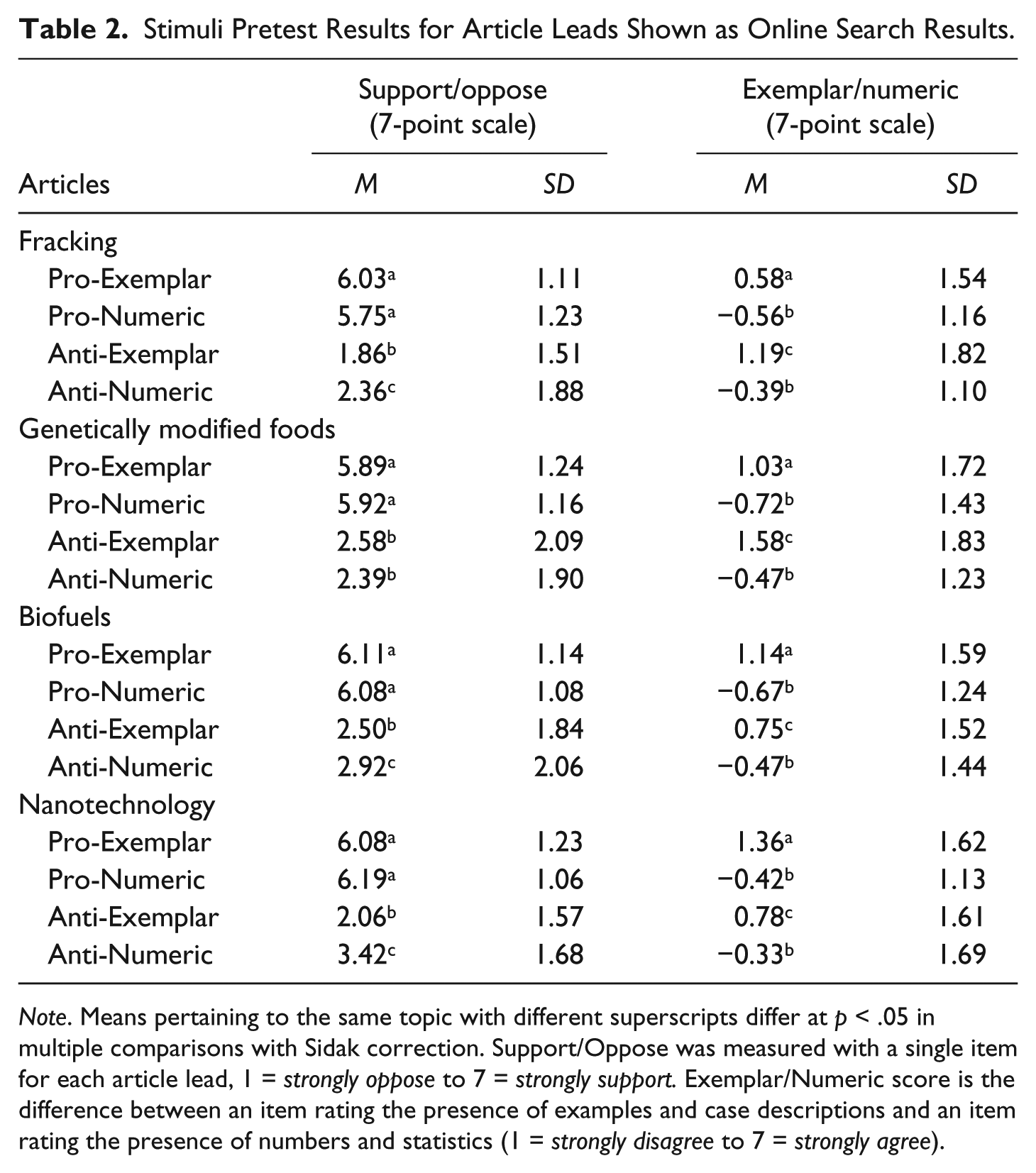
Note. Means pertaining to the same topic with different superscripts differ at p < .05 in multiple comparisons with Sidak correction. Support/Oppose was measured with a single item for each article lead, 1 = strongly oppose to 7 = strongly support. Exemplar/Numeric score is the difference between an item rating the presence of examples and case descriptions and an item rating the presence of numbers and statistics (1 = strongly disagree to 7 = strongly agree).
Sources
To rule out that the sources (URLs) influenced the patterns of interest through varying levels of credibility or other impacts, all used URLs were established to have equally high perceived credibility. To this end, 12 women and 6 men (Mage = 21.44, SD = 1.20) from the same study population completed an online questionnaire on online source perceptions to earn extra credit. For various sites, they were asked to indicate “based on the website name and URL above, I expect the website to be credible” (1 = strongly disagree to 7 = strongly agree) in order to identify homogenous sets of high-credibility sources for use in the main study. Sixteen sources and their URLs (e.g., National Academy of Sciences; http://www.nasonline.org/) were selected, with a grand mean of 5.71 (SD = 0.19) and no significant pairwise differences among them.
Stimuli Rotations and Randomization
On the overview page for each issue, headlines and leads were randomized in a 2 (attitude-consistent or -discrepant) × 2 (exemplar or numeric) factorial design. Each participant saw each of the four issues (fracking, GM foods, biofuels, and nanotechnology) in the same sequence. For each issue, the placement of headlines and leads on the search results page was randomized, with one attitude-consistent exemplar, one attitude-consistent numerics article, one attitude-discrepant exemplar, and one attitude-discrepant numeric, all available for reading. Furthermore, each news headline was paired with a high credibility source as described above, in a rotated fashion.
Attitudinal Measures
Attitudes (Dichotomous)
Attitudes were measured as a dichotomous variable (oppose or support). Participants were first given a task to familiarize themselves with the protocol (see Knobloch-Westerwick & Meng, 2011, for further details of the procedure). Participants were asked to place one finger on the “z” key and one finger on the “/” key. Each symbol corresponded to either a negative or positive attitude. Participants then evaluated eight distracter topics as well as the four science and technology issues. The specific cues used for the four target issues were “Genetically modified foods,” “Biofuels,” “Nanotechnology,” and “Fracking.” Whether they selected “z” or “/” reflected either oppose or support as response option labels. Participants were instructed to complete the procedure as quickly as possible without compromising accuracy (see Table 3 for proportions of support and opposition).
Descriptive Statistics for Main Experiment Sample.
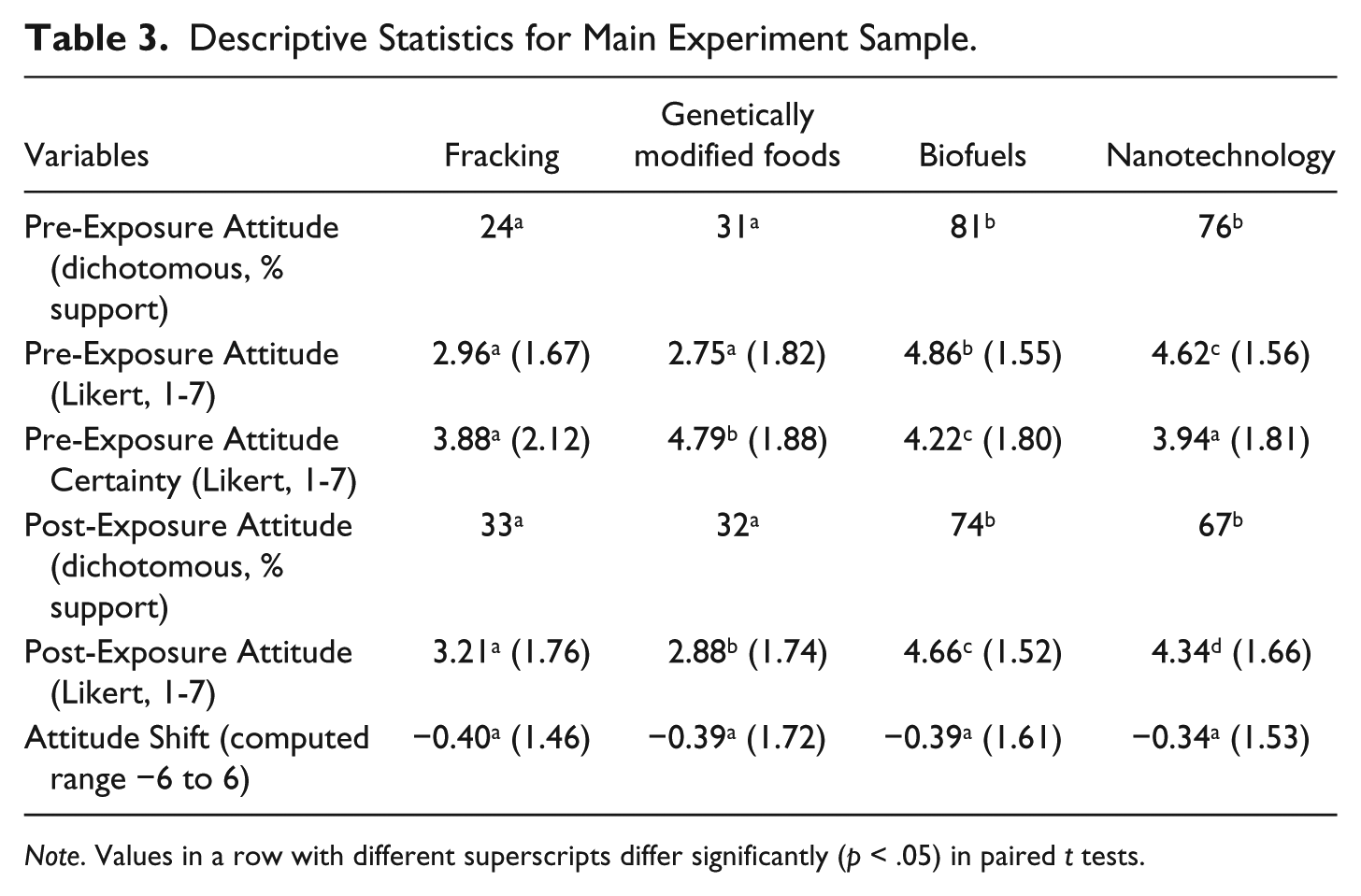
Note. Values in a row with different superscripts differ significantly (p < .05) in paired t tests.
Attitude Shift
Explicit attitudes toward each of the four target technologies as well as six distracter topics were measured with the prompt “Please indicate how STRONGLY you support or oppose the following issues” on 7-point anchored scales (1 = strongly oppose to 7 = strongly support) both before and after exposure to the articles (see Table 3). Again, the specific cues used for the four target issues were “Genetically modified foods,” “Biofuels,” “Nanotechnology,” and “Fracking.” Attitude shift is the difference in pre- versus postexposure attitudes, which is then reverse scored for those who oppose the issue, so that the personal stance (pro or against) does not affect scores (see Table 3).
Attitude Certainty
The first set of attitude measures, before the message exposure task, included a rating task with the prompt “how certain are you of your opinion toward the following issues,” with a 7-point scale ranging from not at all certain to extremely certain. Descriptive statistics for attitude certainty are included in Table 3. Across the four measures, the mean attitude certainty was at M = 4.21 (SD = 1.33).
Message Exposure
Exposure was measured in the time spent reading each particular kind of news article. The software application was designed to measure participants’ message exposure in seconds to online articles with either attitude-consistent or attitude-discrepant positions. Prior work has validated this exposure measure and found it to be highly correlated with reading behavior reflected in eyeball movement and recalled reading extent (Knobloch, Hastall, Zillmann, & Callison, 2003; Zillmann, Knobloch, & Yu, 2001). Dichotomous attitude measurements from the first task were used to determine whether message exposure was attitude-consistent or attitude-discrepant. Dichotomous and explicit attitude measures were strongly correlated for each topic (rs of .65, .68, .47, and .55 for fracking, GM food, biofuels, and nano, respectively; all p < .001), indicating that the dichotomous measure provided a valid means of categorizing exposure as attitude-consistent or -discrepant. In addition, whether the lead included numeric or exemplar information was coded accordingly, creating four exposure variables for each of four topics: (a) attitude-consistent exemplar, (b) attitude-consistent numeric, (c) attitude-discrepant exemplar, and (d) attitude-discrepant numeric (see Table 3 for mean exposure times). This allows for testing whether exposure is selective, that is, if particular types of messages are viewed at a disproportionate rate. Likewise, these differentiated measures of time spent reading news articles allow for testing effects of reading certain message types on subsequent attitudes.
Of the 120 seconds afforded for browsing each set of results, an average of 29.61 seconds (SD = 23.62) was spent on the overview page. This time was greater for the first presented topic, fracking (M = 36.27, SD = 25.33), a significant difference with the overview browsing time for other topics, all pairwise comparisons p < .001. Participants exercised selectivity in viewing search results, typically clicking on just about half of the articles for each topic (M = 2.10, SD = 0.95). When an article was selected for reading, it was viewed for M = 56.76 seconds, SD = 32.09.
Trait Measures
Numeracy
A measure of numeracy (Schwartz, Woloshin, Black, & Welch, 1997) consisted of three questions designed to measure the individual’s ability to comprehend and perform basic mathematic expressions. This is important, as numeric information obviously deals with numbers and statistics. Items such as “Imagine that we flip a fair coin 1,000 times. What is your best guess about how many times the coin would come up heads in 1,000 flips? <fill in blank> times out of 1,000” were presented, and open-ended answers were coded dichotomously as correct (1) or incorrect (0). A participant score on the index represents the sum of these three questions (M = 2.06, SD = 0.95).
Trait Empathy
Participants responded to 14 items pertaining to two relevant dimensions of Davis’ (1980) multidimensional approach to empathy index, empathic concern and perspective taking. Agreement with items such as “When I see someone being taken advantage of, I feel kind of protective towards them” and “I believe that there are two sides to every question and try to look at them both” was reported on 5-point Likert-type scales (1 = does not describe me well to 5 = describes me very well). A participant’s measure on this index is the result of the mean of their 14 responses (M = 3.66, SD = 0.53, α = .785). Trait empathy and numeracy were not significantly correlated (r = .11, ns).
Covariates
Three additional traits—religiosity, science knowledge, and attitude toward science—were measured as well, as they are found to play a role in beliefs about science topics and in responses to science communication (e.g., Dudo et al., 2011; Scheufele, Corley, Shih, Dalrymple, & Ho, 2009) and could confound the influence of attitudes or other traits.
Given the important role played by religion in determining attitudes toward science, particularly in the United States, religiosity was measured with the Duke University Religion Index (Koenig, Meador, & Parkerson, 1997), which assesses three major dimensions of religiousness, including institutional, noninstitutional, and intrinsic religiousness. The scale consists of two questions that assess the frequency of a participant’s engagement in various religious behaviors (e.g., “How often do you attend church or other religious meetings?”; 1 = never to 6 = more than once a week) and three questions about the role of religion (e.g., “In my life, I feel the presence of the Divine [i.e., God]”; 1 = definitely not true of me to 5 = definitely true of me). The index for religiosity represents an average of the five responses (M = 2.84, SD = 1.25, α = .898). It was not significantly correlated with numeracy or trait empathy (ns).
Science knowledge was assessed with 13 true-false questions (e.g., “The center of the Earth is very hot”) from the civic scientific literacy measure (Miller, 1998). Items were coded as correct (1) or incorrect (0). A participant’s measure on the index represents the sum of these items (M = 8.11, SD = 2.52, α = .641). Science knowledge was significantly correlated with numeracy (r = .27, p < .001) and religiosity (r = −.22, p = .001). Finally, participants were asked to evaluate six statements (adopted from Kawamoto, Nakayama, & Saijo, 2011) regarding their attitude toward science as a benefit to society (e.g., “I hope scientific thinking prevails more in the society”) on anchored 7-point scales (1 = strongly disagree to 7 = strongly agree). A higher mean response represents a more positive attitude toward science as a benefit to society (M = 5.23, SD = 1.12, α = .885). Attitude toward science correlated with numeracy (r = .18, p = .008), trait empathy (r = .18, p = .008), and science knowledge (r = .23, p = .001).
Results
Impacts on Exposure to Science Information Online
An analysis of covariance with message exposure as within-group factors (4 × 2 × 2, differentiated by topic, attitude consistency, and exemplification) and the variables trait empathy, numeracy, religiosity, science knowledge, and attitude toward science as covariates was conducted. It yielded only one main effect, which emerged for attitude consistency, F(1, 222) = 10.6, p = .001,
Furthermore, to clarify how the covariates in the analysis of covariance reported above affected message exposure, regression analyses were performed. The variables trait empathy, numeracy, science knowledge, religiosity, and attitude toward science served as predictors for exposure to (a) attitude-consistent messages, (b) attitude-discrepant messages, (c) numeric messages, and (d) exemplar messages as criteria. For exposure to attitude-consistent messages, only trait empathy had a significant effect, with beta = .15, p = .029. Similarly, exposure to attitude-discrepant messages was also linked to trait empathy, with beta = −.17, p = .013. Individuals with greater science knowledge spent more time with numeric messages (beta = .21, p = .004). Exemplar messages attracted less exposure among participants with higher numeracy (beta = −.14, p = .048) and longer exposure among participants with higher trait empathy (beta = .14, p = .040).
Impacts of Exposure on Attitude Shift
Multiple regression analyses examined whether exposure to (a) attitude-consistent messages, (b) attitude-discrepant messages, (c) numeric messages, and (d) exemplar messages as predictors in turn affect attitude shift while controlling for the variables trait empathy, numeracy, religiosity, science knowledge, and attitude toward science. Only exposure to attitude-consistent messages emerged as a significant predictor for attitude shift, with beta = .20, p = .019. When running this regression model for each topic separately (excluding exposure to exemplar information to avoid multicollinearity), the results showed that exposure to attitude-consistent messages on fracking (beta = .24, p = .024) and on biofuels (beta = .25, p = .012) had such attitude-reinforcing effects, whereas no significant impacts emerged for GM food and nanotechnology.
To shed light on influences of message types on attitude shift more specifically, a follow-up regression used (a) attitude-consistent exemplar messages, (b) attitude-discrepant exemplar messages, (c) attitude-consistent numeric messages, and (d) attitude-discrepant numeric messages as predictors and the same control trait variables. Overall, only exposure to attitude-consistent numeric messages had a significant impact on attitude shift, with beta = .21, p = .007. When running this regression model for each topic separately (excluding exposure to dissonant exemplar information to avoid multicollinearity), significant impacts emerged for both exposure to attitude-consistent numeric messages and exposure to attitude-consistent exemplar messages for fracking (beta = .24 and .26, respectively, p ≤ .001) and nanotechnology (beta = .24 and .20, respectively, p ≤ .008), while biofuels yielded a significant impact of exposure to attitude-consistent exemplar messages (beta = .19, p = .012) but no significant impact of exposure to attitude-consistent numeric messages (beta = .12, p = .118). For GM food, none of the impacts approached significance.
These mixed findings for attitude shift are in keeping with the notion that topic characteristics may moderate effects. Although topic did not moderate patterns of exposure in the present data (cf. Jang, 2014), the effects of that exposure on attitude shift were qualified by topic. It is noteworthy that attitude-consistent fracking messages consistently reinforced attitudes, as this topic had a low level of attitude certainty (Table 3), so that perhaps there was more potential for attitude shift. Biofuels and nanotechnology showed moderate certainty and some attitude reinforcement, while the more certain attitudes for GM food did not show any exposure effects on attitude shift. Indeed, adding attitude certainty as a moderator in the regression models indicated that lower certainty was linked to stronger effects of attitude-consistent messages for fracking (beta = −.382, p = .029). However, this interaction fell short of significance for biofuels (beta = −.213, p = .254) and nanotechnology (beta = −.168, p = .345).
Discussion
When seeking information about science topics, lay individuals commonly use online search engines to access information about scientific knowledge and innovation. This experiment presented participants with the opportunity to freely browse a series of alleged online search results on four relevant issues in science and technology. The leads of the online science information were manipulated to make use of either exemplar or numeric evidence. Furthermore, online article leads were also manipulated to indicate supportive or oppositional stances regarding the scientific innovations in question: fracking, GM foods, biofuels, and nanotechnology.
Regarding Hypothesis 1, no main effect of the message characteristic (exemplar vs. numeric) on message exposure emerged. However, exposure to exemplar versus numeric messages depended on individual differences: Users with high trait empathy dedicated more time to reading exemplar information, while those high on numeracy dedicated more time to reading numeric information. These findings provide support for Hypotheses 2 and 3. These effects persisted across topics, and after controlling for religiosity, science knowledge, and attitude toward science. Additionally, analyses found that higher trait empathy was associated with greater exposure to attitude-consistent articles, and higher science knowledge was associated with greater exposure to articles featuring numbers.
Regarding Hypothesis 4, results corroborated the suggested confirmation bias in participants’ exposure behavior, as online information users favored attitude-consistent messages. This confirmation bias emerged across all four topics. Inclusion of exemplars did not affect this pattern (Research Question 2). Even though some scholarly work suggests that recipients’ numeracy might affect the extent of confirmation bias (Kahan et al., 2012), the present data did not find such a moderating effect (Research Question 3) on the confirmation bias in exposure to science information. Shifts in attitudes were also examined as consequences of exposure to the different types of online science information. Exposure to attitude-consistent messages was found to reinforce existing attitudes. This finding supports Hypothesis 5 but did not emerge uniformly across all topics, only for fracking and biofuels. Also, while numeric attitude-consistent exposure emerged as specifically influential across all four topics, examination for specific topics yielded that both exemplar and numeric attitude-consistent reinforced attitudes. Thus, no clear evidence regarding differential persuasive effects of numeric versus exemplar messages emerged in response to Research Question 1.
Limitations of the present investigation include the finite number of science topics used, which restricts the generalizability of the results. Although the issues were relatively diverse in their baseline support (Table 3) and relative appeal to conservatives or liberals, all four represent technological innovations that pose environmental risks, which are typically seen as more beneficial and less risky by hierarchical-individualists, compared to communitarian-egalitarians (Kahan et al., 2009; Kahan et al., 2011). This is in contrast to topics such as stem-cell research or evolution (Jang, 2014) that relate differently to cultural beliefs. Future work should examine more topics.
Another limitation is the use of a sample comprised of college students, which may have more knowledge of, and more positive attitudes in general toward, science than the overall population. For example, the average participant answered 61% of items correctly on the science knowledge measure, compared with 55% for the average Western adult (Miller, 1998). In contrast to the cultural cognition model, the scientific literacy perspective (Miller, 1998) emphasizes the role of knowledge in informing attitudes toward science. This perspective can help reconcile the findings with those of Jang (2014). On the surface, the present finding of a general confirmation bias (Hypothesis 4), regardless of topic, contrasts with the previous study of selective exposure to online science information (Jang, 2014), which found a preference for attitude-discrepant exposure for at least for two of the four topics. However, in Jang’s sample, those with high perceived science knowledge and high religiosity showed attitude-consistent exposure patterns instead, which was attributed to attitude certainty. While the studies’ sample sizes were comparable, Jang’s study featured 238 participants from a stratified quota sampling method, and the present study built on a convenience sample of 229 students. The use of a representative sample by Jang may account for that study’s main effect of selective exposure to attitude-discrepant messages, as many respondents may have held relatively minimal science knowledge, and subsequently uncertain attitudes. This corresponds with the confirmation bias seen in the present study’s sample of university students. Their relatively high scores on science literacy, and moderately certain attitudes, may account for their confirmation bias. In addition to a relationship of literacy and certainty with selective exposure (as illustrated by Jang), the present results also show a link in which greater attitude uncertainty is associated with more attitude reinforcement from attitude-consistent messages. This pattern may reflect an attitude formation process, and future research should consider the interplay between scientific literacy and cultural cognition, rather than treating them as mutually exclusive propositions (e.g., Kahan et al., 2009). It appears both must be considered.
An additional limitation is that, given that exposure was tested as a self-selection phenomenon and was not experimentally assigned, there is the potential for spurious correlations between selectivity in message exposure and subsequent attitude shift. However, the inclusion of control variables helps in suggesting that it is indeed selective exposure to attitude-consistent numeric information that has a positive effect on attitude shift after exposure.
In addition to the differences in topics, samples, and moderating trait variables used in both studies, a number of methodological differences between Jang’s (2014) setup and the present study exist, that could also contribute to the differences in findings. First of all, both studies manipulated the stance of the messages to include supporting and opposing views, but Jang also included a neutral view. The presence of moderate views might dampen perceptions of ideological conflict that could otherwise activate confirmation bias (Dixon & Clarke, 2013; Jensen & Hurley, 2012; Maier & Richter, 2013). Message length in the present study was considerably longer, even after accounting for time available for browsing; accordingly, participants in the present study had 704 words of attitude-consistent material available per browsing minute, whereas Jang’s participants had only 300 words of attitude-consistent material available per browsing minute and thus may have run out of material that they preferred. This difference in total browsing time window could help account for the time spent with attitude-discrepant articles in Jang’s (2014) study, as readers often view attitude-consistent articles first and then move toward reading attitude-discrepant articles (Westerwick, Kleinman, & Knobloch-Westerwick, 2013). Finally, the present study manipulated the messages to emphasize either exemplar or numeric information, message characteristics which influenced participants’ exposure. Accounting for differences in information presentation in the present study removes any possible confounds of presentation style and allows for a more precise assessment of whether attitude-consistent or -discrepant articles are chosen at differential rates.
The present study demonstrated that confirmation bias in message exposure was evident across multiple topics, providing support in the science communication setting for the classic pattern of selective exposure seen in political and other contexts. However, although a consistent effect, the size of that effect was modest (4.6% of variance explained). This is in line with Garrett’s (2009) emphasis on the distinction between selective exposure and selective avoidance. Although individuals may select attitude-consistent messages at a higher rate, it does not follow that they completely cocoon themselves off from attitude-discrepant messages and reside in echo chambers. In the present study, participants did spend a substantial (albeit lesser) amount of time with science articles that challenged their attitudes. Even when accounting for moderating traits, selectivity remained modest, and the absolute amount of time spent with attitude-discrepant information did not approach zero. This lack of selective avoidance is consistent with Jang’s (2014) findings, where some participants (depending on individual differences) even spent more time reading attitude-discrepant information. Furthermore, the lack of selective avoidance has important implications, as demonstrated by the results, because exposure to attitude-discrepant information does not have the same polarizing effect on attitude shift that exposure to attitude-consistent information does.
In addition to testing for selective exposure in the science communication context, the present study built on previous work (Jang, 2014) by also considering how exemplification (Zillmann, 1999) might affect message exposure. Using vivid case studies and personal stories is a promising technique for conveying science information to the public. However, exemplification had a surprisingly limited influence. Individual differences played a key role, as empathetic people spent more time viewing articles with exemplars, while people high on numeracy spent more time viewing articles with numeric information. Additional findings indicated that empathy heightened the extent of confirmation bias, but attitude certainty did not. However, attitude certainty appears to have played a role in the effects of message exposure on subsequent attitudes. The selection of attitude-consistent messages produced reinforcing effects on attitudes, but these effects were inconsistent across science topics. Attitude-consistent numeric messages were most likely to consistently produce reinforcing attitude shifts. Future research is needed to not only examine how exposure to different types of science communication messages have the potential to contribute to public awareness of science but also to polarize public opinion regarding controversial technological advances.
Scientific innovation can benefit societal change, but change also depends on public opinion and individual attitudes. It is pivotal to understand how individuals select information about science and how the subsequent exposure shapes their attitudes. The present work may aid the tailoring of science information to different population segments—for instance, for information users with high numeracy, the present evidence suggests that the use of exemplars might deter them from closer reading of online content. On the other hand, population segments with high trait empathy should be more drawn to science information that features exemplars. An important challenge for general outreach appears to reside in preexisting attitudes—once an attitude on a topic has been formed, it can be difficult to attract information consumers to messages that do not align with said attitudes. Along these lines, the present data showed a bias toward attitude-confirming content. Given that scientific discovery often yields contradictory evidence, and expert consensus evolves only over time, lay individuals may often stick with a view formed earlier that may no longer converge with state-of-the-art scientific knowledge. With these dynamics in the development of scientific knowledge, confirmation bias may be particularly harmful toward spreading scientific advancements to the general population.
Footnotes
Declaration of Conflicting Interests
The author(s) declared no potential conflicts of interest with respect to the research, authorship, and/or publication of this article.
Funding
The author(s) received no financial support for the research, authorship, and/or publication of this article.