




Abstract
Thus far, few studies have examined how scientists choose different social media platforms, or how using multiple platforms of social media is related to public engagement with science. This article investigates the role of social media in China’s science communication and scientists’ selective use of them. We found that social media enabled Chinese scientists to avoid relying on legacy media and to develop more interdisciplinary collaborations. In the process, these scientists strategically chose different social media platforms to increase controllability. Despite their preference for the approach of knowledge dissemination rather than dialogues, Chinese scientists tried to avoid the bureaucratic practice of science communication, and instead, they promoted some level of public participation.
Keywords
Introduction
The rapid expansion of social media has multiplied the tools for science communication (Bik & Goldstein, 2013), and it has provided opportunities to engage the public in active dialogue (Smith, 2016). However, although scholars explore intensively scientists’ uses of blogs (Allan & Colson, 2011; Colson, 2011; Jarreau, 2015; Lo, 2016) 1 and Twitter (Collins, Shiffman, & Rock, 2016; Smith, 2016) in public science communication, few studies have examined how scientists choose strategically among different social media platforms. Accordingly, little attention has been given to the implication of scientists’ selective use of multiple social media for engaging the public with science, a central theme of the current scholarship on science communication (Stilgoe, Lock, & Wilsdon, 2014).
This article is an effort to fill this gap. In doing so, our China-based research also introduces two novel dimensions, which are considered rarely by mainstream scholarship on science communication. First, this study examines nonmainstream social media, because most mainstream Western social media such as Facebook or Twitter are blocked in China (Bamman, O’Connor, & Smith, 2012). As we will discuss later, Chinese social media such as Weibo or WeChat have different functions from their Western counterparts, which has led to a social media ecology that is different from that of the West.
Second, social media has changed the transmission and control of information dramatically in China (Tu, 2016), but what impact has it exerted on State-dominated science communication in the country (Jia & Liu, 2014; J. Y. Zhang, 2015)? State-dominated science communication, which is sometimes equivalent to propaganda, is featured by publicizing scientific achievements and boasting of their political implications and the advantages of socialism, and highlighting national pride (Jia & Liu, 2009; Jia & Liu, 2014). No doubt both the non-Western social media environment and social media’s possible impact on State-dominated science communication are legitimate topics for students of public engagement with science to probe.
To explore these crucial, but underinvestigated dimensions, we present here a study based on qualitative interviews with 25 Chinese scientists who are known as active online science communicators. This article will first review previous studies on scientists’ use of new media for science communication, the recent literature on choice of social media in the field of computer-mediated communication (CMC), and research on public engagement with science in the social media era. Then, we will report findings on the perceived role of social media in communicating science, how Chinese scientists choose different platforms of social media, and the implications of the use of social media for public engagement with science.
Literature Review and Research Questions
Scientists’ Use of Social Media
In the past decade, new media studies have flourished in the field of science communication, because “scientists, their institutions, and the scientific knowledge they produce are now entangled in new media environments” (Brossard, 2013, p. 14906). In communicating science to the public, blog and social network sites, which are both treated as social media here, are two major types of studied media.
The advent of blogs highlights the possibility that scientists can circumvent mass media that they have long suspected (Lowrey, 2006). Although earlier research focused on exploring science blogs as a possible alternative to science journalism (Bonetta, 2007; Brumfiel, 2009) and their role in influencing scientists’ communication to both the public and their peers (Batts, Anthis, & Smith, 2008), later studies found that scientists were not motivated to use science blogs to replace science journalists (Mahrt & Puschmann, 2014). Rather, scientists relied more on legacy journalistic media than on social media (Allgaier, Dunwoody, Brossard, Lo, & Peters, 2013), and scientists who blogged considered themselves as explainers of science and public intellectuals instead of reporters of science (Jarreau, 2015).
After blogs were introduced, Facebook and Twitter soon penetrated the science community widely. A survey of 3,748 scientists who were members of the American Association for the Advancement of Science (AAAS) found that 47% of them used social media to talk about science or read about scientific developments, at least some of the time (Rainie, Funk, & Anderson, 2015). Similarly, Collins et al. (2016) found that most of the 587 scientists they surveyed used Twitter (88%), Facebook (82%), and LinkedIn (66%).
Among studies on scientists’ use of social media, some briefly tapped how scientists choose different media. For example, scientists favored Twitter over Facebook in both internal and external science communication (Collins et al., 2016; Yeo, Cacciatore, Brossard, Scheufele, & Xenos, 2014). Most scientists who were surveyed used Facebook for personal communication regularly. According to Lo (2016), scientists used different online media for different purposes; personal websites were used mainly for internal scientific communication, social networks were preferred for private use, and blogs served mainly as a source of science information.
Although the above perspective was adopted to explain scientists’ selective use of social media, current literature is scant in revealing motivations for scientists’ choice among different types of social media when communicating science to the public. Luckily, CMC scholars’ research on the use of cross-platform social media offers some insight.
CMC scholarship investigates how computer-mediated media (e.g., instant messaging, e-mail, chat rooms, online forums, social network services) influence human interaction and the corresponding social effects of such influence (Thurlow, Lengel, & Tomic, 2004). In the CMC domain, cross-platform social media use usually indicates that users selectively use multiple social media platforms, often simultaneously, and sometimes they use them across different devices (S. J. Kim, 2016). Adopting the CMC approach can help us better understand how behavioral, social, and technological factors jointly influence scientists’ social media use across platforms.
For example, CMC scholars found that users defined and adopted repertoires of different social media platforms to expand their online influence (Taneja, Webster, Malthouse, & Ksiazek, 2012). Although social media users perceived features of different sites that “afforded” different types of activities, they thought about affordances within the context of their overall assessment of all available platforms (Zhao, Lampe, & Ellison, 2016). Thus, they both maintained boundaries between platforms, and they allowed content and audience to permeate across these boundaries.
As for social influences, J. Y. Kim (2000), among others, stressed that in different CMC scenarios, individuals always develop certain group identities and social norms, which then influence their online communication behaviors. In terms of media technologies, CMC scholars largely reject the idea that technologies determine how people use them. Rather, in developing the concept of the duality of media (S. J. Kim, 2016; Webster, 2011), they suggested that there were mutual adaptations between media functions and users’ practices. As agents use media, they reproduce and alter the structural features of the media environment. The interaction and mutual composition between users and media constitute the duality of media.
Other CMC scholars argued that the extant social media studies have focused primarily on mainstream social media such as Facebook or Twitter, but they have neglected some local, nonmainstream social media platforms. This may lead to conceptual problems for new media studies, because these “minor” platforms may have different social functions from those of Facebook or Twitter and, therefore, they result in different user behaviors (Lampinen, 2016). With non-Western social media such as Weibo or WeChat as primary research targets, this study attempts to widen the scope of mainstream scholarship on social media uses.
Social Media and Public Engagement With Science
From blogs to Twitter, social media has been praised as a digital tool to promote public engagement with science (Batts et al., 2008; Luzón, 2013; Soto et al., 2016). “[E]ffective public engagement means figuring out ways to structure and promote conversations with the public that recognize, respect, and incorporate differences in knowledge, values, perspectives, and goals” (Nisbet & Scheufele, 2009, p. 1777). Because social media provides interactive channels for dialogue between scientists and the public, it seems an ideal place for such engagement.
Following this logic, studies have traced the role of social media in promoting dialogue for community-engaged research (Soto et al., 2016). Researchers used the size of Twitters’ audience of research institutions and scientists to evaluate the level of engagement (Kahle, Sharon, & Baram-Tsabari, 2016). However, government agencies have communicated science using social media in a one-way mode, and most of their tweets received few responses from their audience (Bhattacharya, Srinivasan, & Polgreen, 2014; Lee & Vandyke, 2015). These results imply that digital engagement is not just about the number of people who use technology to obtain information. It requires determination and endeavor from both researchers and stakeholders to contribute to a productive dialogue (Grand, Davies, Holliman, & Adams, 2015).
Despite these sporadic reflections, the relationship between the Internet and public engagement with science has not been explored sufficiently (Stilgoe et al., 2014). One of the untapped areas to be explored here is the implications of scientists’ selective use of different social media for public engagement.
The cross-platform use of social media allows scientists to move between different communities and contexts, enabling them to employ social media both as communication tools and engagement tools, such as facilitating lay audience to contribute data or commentary (Grand, Holliman, Collins, & Adams, 2016). The blurred boundary necessitates the adoption of an analytical theoretical framework that allows greater flexibility.
Irwin’s (2008) conceptualization of the three orders of public engagement seems an ideal framework to examine the flexible interaction between scientists’ public engagement efforts and their use of social media. Proposed to replace the simple distinction between dialogue and the “deficit model” that sees scientific illiteracy at the root of the public’s lack of support for science and emerging technologies (Bucchi, 2008), the three orders of public engagement framework recognizes an “uneasy coexistence and unconsidered juxtaposition” (Irwin, 2008, p. 204) between the first-order (deficit-filling, one-way and top-down mode, with scientific knowledge placed in central place), the second-order (two-way, bottom-up and dialogic mode), and the third-order (multiply-framed, contextual, and a deeply reflective “science in society” approach) thinking and practices in the process of science communication.
Applying Irwin’s (2008) three-order framework to digital communication, Grand et al. (2016) and Smith (2016) found that scientists’ attitudes about public engagement in social media were ambiguous, complex, and yet flexible. For example, in her study of scientists’ use of Twitter, Smith (2016) found that although the first-order thinking dominated, some second-order thinking—such as admitting lay-knowledge and two-way communication—also emerged among the interviewed scientists. Will scientists’ selective use of different social media platforms in a non-Western environment reflect the three-order thinking in public engagement with science? We will investigate this issue later in this article.
Blog, Weibo, WeChat, and the Online Public Sphere in China
When talking about sociopolitical factors that influence social media and public engagement, we cannot neglect China’s Internet censorship (King, Pan, & Roberts, 2013), which blocks Facebook, Twitter, Google, and YouTube from being accessible in China. However, censorship also gives us a chance to look beyond the mainstream social media to examine other social media environments, which may demonstrate a different social media ecology (Lampinen, 2016).
Amid China’s economic takeoff, its social media, which have ranged from blogs to Weibo to WeChat, have developed quickly. Partly due to China’s tight control on traditional media, the Internet, particularly social media, has provided online public spheres to the nation’s activists (DeLuca, Brunner, & Sun, 2016). Although the focus of this study is not on activism, learning the contentious characteristics of many Chinese social media platforms is important for us to understand the online behavior of Chinese scientists.
If we move beyond the information control/resistance paradigm, we can explore how a range of different social media platforms is deployed in science communication in contemporary China. China’s blog sites began to appear in early 2000. By the end of 2007, there had been 73 million blog spaces that involved 47 million blog writers, which accounted for 25% of all Internet users at that time. Sina Blog, which was affiliated with the largest Chinese portal at that time, Sina.com.cn, became the largest blog site (China Internet Network Information Center, 2007). By promoting discussions on public issues, blogs have fueled the formation of China’s online public sphere (Leibold, 2011; Lu & Qiu, 2013).
The public sphere also extended to the Chinese science community. In 2007, ScienceNet.cn, which is affiliated with the Chinese Academy of Sciences, emerged as a major player in the field that attracted thousands of scientists to open a blog account with the site. Unlike Scienceblog.com in the United States, which targets the mass audience primarily, ScienceNet.cn claimed it was a home for Chinese scientists across the globe (but not the public who was interested in science). In recent years, another popular science website, Guokr.com, which features a large number of science blogs that target the young mass audience, has matured quickly (K. Zhang & Gao, 2014).
Weibo, a microblogging site like Twitter, was launched by Sina.com.cn in 2009. Although it shares many characteristics with Twitter, Weibo has two major differences. First, information that is contained in Weibo’s 140-character-limit is much richer than a Twitter microblog, because a single character in Chinese can represent an entire English word. Second, discussion threads can be attached to individual posts, so that it is easier to get involved in a public dialogue around certain themes. The two typical Weibo characteristics, plus China’s tight control of traditional media, has made Weibo function more like a public forum than a social networking tool (Rauchfleisch & Schäfer, 2015). Weibo’s monthly active users reached 313 million in December 2016 (China Internet Watch, 2017).
WeChat, which was launched by the Chinese Internet giant Tencent in 2011, is primarily a smart phone application. It can be considered an upgraded WhatsApp, but with additional capabilities that include “the social features of Facebook, and Instagram, mixed with Skype and a walkie-talkie” (Svensson, 2013). The main difference between Weibo and WeChat is that the latter is more private (Harwit, 2016). Unlike Weibo or Twitter, where people can simply “follow” any individual account, joining a friend’s circle (like Facebook’s wall) on WeChat and, hence, viewing the posts of that person, requires permission of that person. But WeChat has two more functions for “publicness.” Any individual or organization can publish a public account, which can be considered as a mobile phone-based publication, without a license that is essential for traditional media in China. The mobile publication can be subscribed to by any users. The second publicness function is WeChat’s group chat. Each group allows up to 500 members. Information from a WeChat public account can be transmitted quickly by being posted into a chat group and then it can be transmitted to other chat groups by overlapping group members (Wang & Gu, 2016).
With a combination of publicness and privacy, WeChat developed quickly, and it reached 889 million monthly active users by the end of 2016 (China Internet Watch, 2016), somewhat in parallel with the decline of Weibo as a result of strict government control on Weibo’s claimed public sphere (Johnson, 2014). By the end of 2016, there were 695 million smart phone users in China (China Internet Network Information Center, 2017). Hence, almost every smart phone user in China has WeChat installed on their phone today.
Both the richer information in Weibo’s tweets and WeChat’s public accounts and chat groups distinguish them from typical social networking tools in the West. Then, how are these differences embodied in the context of science communication? What are their implications for public engagement with science?
Research Questions
Based on the above literature review, we designed our first two research questions to investigate how Chinese scientists perceive the role of social media in science communication and their use of social media across platforms. Our third research question addresses the implications of the scientists’ use of social media for public engagement with science in the Chinese context.
Data and Research Method
Sample
Unlike previous studies that either surveyed scientists quantitatively (Lo, 2016) or recruited scientists online for interviews (Smith, 2016), we adopted a targeted sampling method (Watters & Biernacki, 1989) to recruit scientists who were active in using social media for science communication. We chose communication-savvy scientists as our sample for the following reasons.
First, communication-savvy scientists should understand the role of new media in science communication more deeply, have a higher probability of using multiple social media platforms, and be more aware of public engagement issues than average scientists. Choosing them for our sample can better reflect the pursuit of typical or variant rather than representative cases in a qualitative study (Small, 2009). Second, communication-savvy scientists should share with common scientists many behavior characteristics, such as the pursuit of controllability and the reluctance to interact with audience. By carefully examining the online behaviors of communication-savvy scientists, we can logically infer average scientists’ social media uses. This does not mean that our sample is representative of the latter, but mean that our sample owns the typical characteristics of scientists’ behavior to use social media.
Third, because most Chinese scientists are not engaged actively in regular public communication of science (Liu et al., 2011), it will be hard to examine scientists’ social media behaviors related to such communication if we chose ordinary scientists as our sample. Fourth, communication-savvy scientists may play an exemplary role for average scientists to follow if the latter regularly practice science communication.
Based on the above reasoning, we believe that our sample has explanatory power for our research questions on Chinese scientists’ use of social media. This is the inductive reasoning supported by Yin’s (2009) recommendation to choose the most typical examples in case studies.
We asked editors of leading popular science websites and mobile science publications, and peer scholars of science communication to recommend candidates who were working scientists and who used at least one of the three targeted social media (blog, Weibo, WeChat). The results showed that few Chinese scientists actively used Weibo for science communication, and this echoed previous studies (Fan, Jia, Peng, & Zhang, 2013). To supplement our search, we checked the top 100 science and technology (S&T) Weibo, science blog, and WeChat S&T public accounts. Although most of the accounts were owned and written by popular science writers who were not incumbent working scientists (although many of them were former scientists), about three dozen working scientists were identified through this approach. We determined a sample of 40 working scientists who were active in science communication in news media. Finally, 25 of them accepted our interviews.
Among the interviewees (Table 1), three were females and 22 were males, which indicated a highly skewed distribution by gender among scientists who are active in science communication in China. We tried to select interviewees who were as diverse as possible in geographical location and academic discipline, but most of those interviewed were in Beijing, which reflected the fact that the capital city is the research hub of China, and that it has accumulated huge resources for science communication.
Basic Information about the Interviewees Who Participated in our Study on Use of Social Media by Scientists to Interact with the Public.
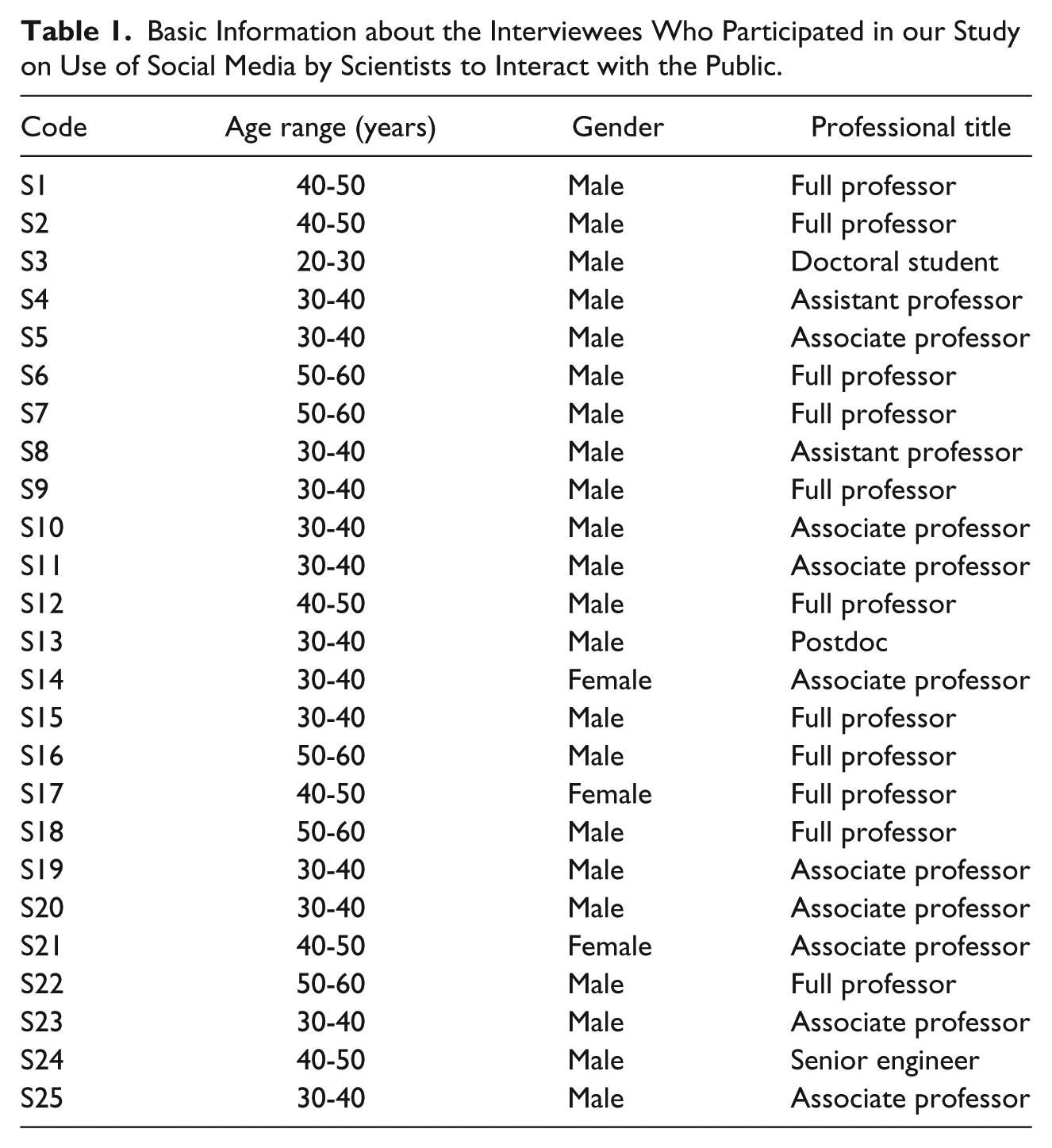
Ethical procedures of the study were implemented to protect interviewees. During our interviews, we explained the background, purpose, and methods of this study and the potential risks it may incur to interviewees. Informed consents were obtained orally from all informants. Then, when coding our sample, we processed interviewee information anonymously, and we only presented their age range, gender, and academic rank in the table of the background information on interviewees. We did not report their academic disciplines and locations in the table so that readers cannot identify them by combining our presented findings and the discipline and location information. In reporting our findings, we obscured identifiable personal information (such as avoiding mentioning the name of popular science products with which our interviewees were involved) wherever possible. In cases where the reported information may have been identifiable as that of an individual, we checked with the relevant interviewees to make sure they were comfortable with the reported contents.
Interview Design and Data Analysis
With each of our interviewees, we conducted a semistructured interview. Interviews were conducted in Chinese, mostly through telephone and Skype between late November 2016 and March 2017. The interviews lasted from 40 minutes to 1 hour 30 minutes, with an average length of 64 minutes. We developed a list of general questions that was based on our research questions, and some of them are listed below:
What do you think about the role of social media (often asked with concrete types: blogs, Weibo, or WeChat) in science communication? What is its role in your own career? Do you think it can change the fact that most Chinese scientists are not engaged in science communication (Liu et al., 2011)?
Then we asked them to describe their daily social media use in science communication and their preference among blogs, Weibo, WeChat, and other possible platforms. A batch of follow-up questions were then asked to address personal and institutional factors that influenced their cross-platform media use. Finally, we asked them how they assessed the role of public/audience in their public science communication, their information sources, and their response to and interaction with an audience.
After the interview, we transcribed the interview and discussed interview highlights and data insufficiency immediately. In accordance with the discussions, adjustments were made for the next interview, which included (1) some questions that were mentioned repeatedly were simplified, if theoretical saturation occurred; (2) some new dimensions that emerged from previous interviews were supplemented; (3) some important or unexpected information that was obtained from previous interviewees was confirmed in the next interview(s).
Through analytical categorization (Fetterman, 1984) and constant comparisons (Glaser & Strauss, 2009; Miles & Huberman, 1994), we analyzed the data. All transcripts were read line by line. We coded the data analytically, and we compared, matched, and recategorized concepts to form various themes, such as the relationship between scientists’ social media uses and their attitude to traditional media, or scientists’ preference to controllability when choosing different social media platforms. These themes were then subsumed under each of the research questions. Repeated discussions were held among coauthors to reach a consensus on these themes and their relevance to our research questions.
Research Findings
Perceived Role of Social Media in Science Communication
Our Research Question 1 asked interviewed Chinese scientists how they perceived the role of blogs, Weibo, WeChat, and other social media in their public communication of science. A couple of common dimensions emerged, which ranged from empowering scientists to reduce their reliance on legacy media to adopting diversified incentives and networking with science community peers and other like-minded friends.
Voice Beyond Legacy Media
Similar to previous studies that stressed social media’s role in replacing traditional media (Bonetta, 2007; Brumfiel, 2009), a majority of our interviewees agreed that the new social media empowered them with the capacity to express their opinions openly and to avoid inaccurate media representation. “The worst thing is journalists who thought they understood [what we talked] but they did not,” said S6, a full professor in physics.
Others applauded social media’s huge and measurable impacts, which are unparalleled by conventional media. “Last year a leading social media site and I produced a [popular science] video and it has won 15 million visits,” said one planetary scientist (S5). He was echoed by a high-energy physicist (S15), who provided articles to a WeChat public account that was focused on popular science. “The conventional media, including their online version, do not have many readers. Although a [WeChat] public account looks like a traditional online medium, its function of forwarding and sharing articles makes the article reach a much wider audience.”
None of the interviewed scientists wanted or expected that either blogs or WeChat public accounts would replace legacy media. Rather, several of them (S5, S10, S16, S22, S23, S24) reported that with the new social media, their relationship with legacy media became better, because journalists can first read their articles or comments in their blogs or WeChat friend’s circles before discussing the content with the scientists.
Many interviewed scientists also worried about the fragmentation of science information and the flooding of false science news in social media. Yet the situation has become another motivation for the interviewed scientists to fulfill their public intellectual role (Jarreau, 2015). “My old parents often forwarded some [false] health information distributed in their WeChat chat groups to me, asking me to follow their guides. Every time I experienced this, I felt the importance to improve the public scientific literacy,” said S1, a neuroscientist.
Broader Networking
Besides bringing a chance for scientists to “speak out,” social media was considered by our interviewed scientists to help them access updated information more easily and to reach a wider or specific audience. This may, in turn, bring more interdisciplinary collaboration or support.
S22, a leading astrophysicist said he set up WeChat chat groups for his graduate students and lab members. At the same time, he joined other scientists’ chat groups to share scientific advances within these groups and to transform some advances into popular science articles, which were then posted in his friends’ circles that were followed by many science journalists.
S12, a medical scientist, published a Wechat public account: The ** medicine [I study] (the discipline was deleted by authors to protect interviewee) is quite new in China or even in the world. With this public account, medical scientists, doctors, medical instrument dealers, and some patients become familiar with the work, and this allows interdisciplinary research and application to keep growing.
Involvement in social media communication also helped some interviewed scientists acquire external funding. S25, a neuroscientist, reported that his active presence in Weibo-based public discussion on scientific issues increased his fame, which helped him obtain external funding from pharmaceutical firms.
In these cases, the boundaries between scholarly communication, public science communication, and science-industry links were blurred. Most scientists who we interviewed reported that when they used social media, they did not draw a clear distinction between the above tasks.
Diversified Return
Like S25, S20, who was a young paleontologist who became famous for sharing his study in social media, received his university’s funding to expand his lab, which has “built up honor for the university.” In these two cases, however, the funding did not consist of peer-reviewed research grants. All interviewed scientists denied emphatically that their science communication efforts, which included those that relied on social media, won peer reviewers’ recognition in the funding review process. Some scientists (S5, S21) even reported negative consequences. “They thought doing science popularization is not a proper duty for working scientists and will necessarily reduce the time and energy used for research,” S5 said.
But the lack of funding seemed to be offset by other returns. S3, S5, S7, S20, and S23 reported that they received remarkable revenues from online science communication. The revenues were primarily generated through advertising income sharing between these scientists and the social media platforms that published their articles, hosted their (public account) publications, or organized question and answer sessions for them.
S21, an associate professor in food science, admitted that the costs that were associated with guiding her students in science communication were covered by readers’ gratuity, which can be paid online conveniently from the readers’ WeChat account. To provide incentives to writers, WeChat, Weibo, and other social media platforms in China provide readers’ a gratuity function. Writers can easily click on the option of requesting gratuity when posting/uploading their articles into social media platforms. The minimum default gratuity amount in many platforms is 5 yuan (US$.074), which is half of the retail price of a print copy of a popular science magazine.
Others enjoyed the fame and respect from ordinary or targeted audiences. “To promote scientists to do science popularization, a positive feedback mechanism is very important. Social media enables us to feel the feedback more easily and quickly,” said S11, a chemical scientist.
To summarize our findings for Research Question 1, we found that social media has helped scientists circumvent legacy media, broaden their research collaboration, and create additional economic returns. Although they stressed the importance of communicating science to the public, most interviewed scientists also benefited professionally from using various social media. Meanwhile, with social media, the boundary between scholarly communication and public science communication is being blurred. Next, do scientists use different social media platforms selectively in their communication efforts?
Use of Cross-Platform Social Media
Our Research Question 2 investigated scientists’ use of cross-platform social media and the underlying factors for their choices among blogs, Weibo, WeChat, and other social media. Although Lo (2016) observed that scientists used different online media for different purposes, CMC scholars revealed that people’s actual cross-platform uses of social media were far more complicated (Zhao et al., 2016). One such complication is technological development that may shape users’ choices.
Technological Development
At the time of the interviews, most interviewees had, or once had, a blog account. “I began to blog on ScienceNet.cn in 2008 when it was popular among colleagues and friends. At first I didn’t know what to write until gradually I found it was most suitable for science popularization and graduate education,” said S18, a senior zoologist.
Despite its initial attraction, blog use has declined dramatically. Among interviewees, only four (S4, S12, S18, S19) still updated their blogs actively with original content. “Blogs have been technologically outdated,” said S7, a leading astrophysicist and a famous science communicator who admitted openly that a major driver for him to communicate science was to make a decent personal income. According to him, blogs required so much time, but they offered so little return in money and influence.
However, technological development alone cannot fully explain this shift away from blogs. Technically speaking, microblog sites appeared shortly after the heyday of blogs, but unlike Western scientists, who have used Twitter widely in both internal and external communications (Collins et al., 2016; Rainie et al., 2015), only five interviewees (S8, S14, S20, S21, S25) used Weibo as their primary social media platform for science communication. About half of the interviewed scientists have never had a microblog account, and other scientists used Weibo as a secondary channel to promote their science communication material.
On the other hand, all interviewees had a WeChat account. Most of them have at least used one of its functions—public account, friends’ circle, or chat group—for science communication. We will analyze reasons for this in the next subsection. Apparently, technological development alone cannot explain fully the initial use by Chinese scientists of blogs, their subsequent negligence of Weibo, and their recent embrace of WeChat.
Publicness Versus Controllability
The low explanatory power of technological development per se is also reflected by the fact that most incumbent and former blog users among our interviewees opened their blog accounts on ScienceNet.cn or Guokr.com, rather than on popular blog sites that were affiliated with the much larger public portals such as Sina.com.cn or Sohu.com. “If the editors [of the public blog sites] did not recommend your blog articles, they will only be read by a few hundred. But editors seldom recommended a science blog,” said S2, a particle physicist.
But Weibo’s huge readership and its limited control by editors have not attracted scientists. S9 said, “I don’t have a Weibo account. I do not have time to deal with readers’ feedbacks. I also worry about the uncontrollability. Anyone can come and say something [to my tweets]!”
During our interviews, the controllability issue emerged again and again, from those who never used Weibo to a popular science star in social media who has millions of Weibo followers (S14). “I do not know most followers. So, I became highly cautious when speaking on Weibo,” said S14, a young female associate professor.
As mentioned briefly in our literature review, Weibo was recognized as a public sphere rather than merely a social networking tool in China. This has affected Chinese scientists’ uses of it. “There are often extreme expressions on Weibo. I would not use it for science communication,” said S1.
Two scientists, one young (S9) and one senior (S18), mentioned social norms among scientists regarding social media use. “Many [scientists] around me do not use Weibo, saying it is too noisy. There is simply no such culture [to use Weibo] among [Chinese] scientists,” said S9.
WeChat superseded Weibo, partly because of its better privacy protection and less censorship by the Chinese government (Johnson, 2014). None of our interviewees experienced any direct censorship of their articles, but still they preferred greater privacy and control in their uses of social media.
Balancing Returns and Choice of Social Media
Not everyone worried about controllability. S7 said he had reduced his Weibo use, because with a paucity of science readers, the commercial return was low. But recently, he increased his use of Weibo, because the medium introduced a new algorithm that combines visit-based payments to contracted writers and then recommends these writers’ tweets. This means that for a popular writer, the more visits his or her articles can attract, the more money he or she can earn, and then there will be a greater chance that his or her next post will be recommended.
A minority of interviewed scientists (S8, S14, S21, S25) preferred Weibo over other media, because they wanted their voices or information to be heard by the widest possible audience, despite the possible impact of Weibo’s uncontrollability. “I am not a famous guy and nor a strong candidate for research grants, so even if there is people sporadically leaving extreme words on my tweets, I simply ignore them,” said S8, an assistant professor in the life sciences. He added he did not care if peers left negative comments about his Weibo use, because he seldom filed application for competitive grants. S14 and S25 had similar situations.
With the increase in new functions that have been introduced by individual social media sites, users not only decide which platform to adopt but they also choose which function to use on a single platform. S17, a female scientist, only used a friend’s circle on WeChat for science communication.
I am not an active science communicator but made famous by the symbols linked to me—“first female chief ** (discipline was deleted by authors to protect interviewee) scientist,” or “first female delegate of [Chinese Communist] Party’s ** (the session of the congress was deleted by authors) National Congress from ** (the name of province was deleted by authors) Province.” So, friend’s circle is enough for me to both reach media and maintain personal networks.
S16, who is an environmental scientist who is often quoted by the media in their environmental reporting, chose only to set up and to manage a WeChat chat group that included many leading environmental journalists nationwide. “Environmental issues involve so many factors, far beyond pure research. Thus, the best rewarding thing [in using social media for science communication] is to offer news clues and real-time consultation [to journalists],” he said.
To summarize our findings for Research Question 2, we found Chinese scientists have diversified uses for social media, which result from an interaction among technological development, the desire for controllability, social norms of scientists, and the pursuit of maximum returns. What are the implications of their use of cross-platform social media for public engagement with science?
Scientists’ Use of Social Media and Public Engagement With Science
Our Research Question 3 addresses the implications of Chinese scientists’ use of social media for public engagement with science. We found that their perceived role of social media in science communication and their cross-platform uses of the media were largely consistent with Irwin’s (2008) first-order thinking in science communication, which stresses a knowledge dissemination approach and the authoritative and central role of science. Yet their behaviors showed a subtle contrast with classic Western discourse on science communication.
First-Order Thinking
All interviewed scientists expressed that their primary motivation to communicate science, online or offline, was to bring more scientific knowledge to the people or to improve China’s public scientific literacy. “Our civic scientific literacy is too low. New media offers a good chance for us to improve it,” said S5.
Many of the scientists that we interviewed mentioned or hinted that the public had little knowledge about science. This confirmed their preference toward Irwin’s first-order thinking in science communication. That scientists consider the public to have low knowledge about science has been confirmed repeatedly by many studies (Besley & Nisbet, 2013; Simis, Madden, Cacciatore, & Yeo, 2016). Our sample was no exception.
When interviewees were asked what their favorite forms of online science communication were, most of them preferred to write popular science articles, followed by online lectures, and then an online question and answer format. Some very active communicators among the interviewees also liked making video and audio programs.
When they faced an “unscientific public,” the option of holding interactive social media dialogues was excluded by most interviewees because of a lack of time or a reluctance to deal with controversies. This was evidenced partly by their shunning Weibo. Even though blogs provided authors with greater jurisdiction over the content, scientists who were asked about interactivity on blogs revealed that they wanted mainly to respond to readers’ comments about scientific knowledge part of their blogs (S18, S19).
Public Participation and Dialogues
Echoing the reluctance of Chinese scientists to talk directly with individuals was their avoidance of being involved in public controversies. “I would intentionally not choose controversial topics [for science popularization] to avoid endless debates and quarrels,” said S2, whose opinions were shared by most other interviewees. Some scientists dealt with the public’s “incorrect” perceptions, such as the safety of genetically modified (GM) foods, but they did not think that the public and mass media should participate in a debate that was related to some mega-scientific projects or the claimed misconduct of scientists (S1, S2, S4, S6, S9).
The reluctance of Chinese scientists to get involved in public dialogue has its sociopolitical and institutional roots. During our interviews, several scientists reflected that they were advised not to speak out in social media when there was a controversial issue, because they needed to be politically correct or to avoid offending other scientists (S2, S4, S13, S16). “When there was a controversy, there will be notice from our institute leadership, warning us to keep silence before journalists or in social media,” said S13.
On other occasions, the environment of public opinion in China currently is sometimes unfriendly toward scientists who speak out. Populism often flooded social media (Lin, 2015). “When I tweeted about the contributing sources for Beijing’s air pollution, there were always some people claiming I was hired by Western conspiracy groups to hype China’s pollution,” said S14.
If we use Irwin’s (2008) taxonomy of the three-order thinking of public engagement, the science communication efforts by Chinese scientists seem to be in the first-order—the transmission of scientific knowledge and stressing the central role of science—despite their use of social media. However, a closer reexamination might provide some different scenarios from those of the West.
Contextualize Public Engagements in China
The third-order thinking of Irwin’s taxonomy, which is the “science in society” model, stresses scientists’ submission to the societal supervision of their work. It seems our interviewees have not adopted this order of thinking. Evidence for this was that when communicating science to the public, most of our interviewees avoided talking about their own research breakthroughs. For the small number who mentioned their own work (S1, 12, S15, S19, S20), their targeted readers were other professionals (not just scientists, but also doctors, investors, and science-related merchants). But was this really an indication that Chinese scientists try to exempt their own research from public supervision?
The answer is “no,” at least for some interviewees. “I do not popularize my own research because this will be considered by many peers as a self-promotion. In today’s [Chinese] science community, scientists generally are very reluctant to propagandize their own research, thinking that those having done so often win undue funding or other resources,” said S9, who was supported by S5 and S7.
To many scientists, avoiding communicating their own research publicly is not to evade public scrutiny, but it is done to avoid the stereotype of State-dominated science publicity. Another evidence for the intention to avoid the stereotype of official propaganda was that most of the interviewed scientists were reluctant to collaborate with or rely on their institutions’ publicity departments to communicate science, though the publicity departments often sought their assistance.
Although most interviewees avoided being involved in public debate on controversies, some younger scientists have developed some different habits. S3, a doctoral student who majored in chemical science, was made famous after he was reported by official media as defending the scientific conclusion on Baike.com, the Chinese equivalent of Wikipedia, about the low toxicity of a controversial chemical against activists who claimed that it was highly toxic. S3 said, **(the name was deleted by authors to protect interviewee) reported it as a battle to defend scientific accuracy, but the fact is during the process, my classmates and I have had many dialogues with activists. We eventually persuaded them not to revise the Baike entry.
S20’s case offered another example of public engagement. “Many paleontology lovers reported possible fossil clues to us through Weibo. About one fourth of our scientific findings came from this source.” The practice is consistent with what public participation in scientific research has achieved in the West (Bonney, Phillips, Ballard, & Enck, 2016).
Summarizing our findings for Research Question 3, we found that Chinese scientists have not been accustomed to a dialogue-based science communication. Although they stressed the central role of science—an indication of Irwin’s (2008) first-order thinking in science communication, they also tried to avoid the stereotype of State-dominated science communication and the corresponding official propaganda. Social media help some scientists pursue autonomy, while they enable others to achieve a certain level of public engagement.
Discussion and Conclusion
In this article, we examined the practices of Chinese scientists to use various social media for science communication, and we investigated particularly their selective use of different platforms of social media and the implications of scientists’ social media use for the public’s engagement with science. Our interviews and observations showed that social media helped Chinese scientists circumvent legacy media, reach a wider audience while receiving more interdisciplinary collaboration, and realize multiple returns that ranged from personal income to social recognition. In the process, these scientists chose different social media platforms strategically to maximize fame and economic returns, to minimize uncontrollability, and to lessen possible negative impacts such as peers’ criticism.
It seems that despite the fast development of social media in China, dialogue-based science communication has not been adopted widely by Chinese scientists. In this sense, social media enabled Chinese scientists to “encounter,” but not to engage the public actively.
However, as described above, in the Chinese context, dialogue should not be considered a sole criterion to assess public engagement with science even in the digital world, because of institutional controls, perceived government censorship (even though this is not so straightforward to natural scientists as to social science scholars) (Jia, Miao, Zhang, & Cao, 2017) and, sometimes, a public opinion environment that is unfriendly. With the help of social media, Chinese scientists have struggled to avoid the State-dominated science communication. Social media enabled some of them to engage the public in controversial issues and to demonstrate the potential for citizen science to flourish under an authoritative regime. In her studies, Smith (2016) demonstrated scientists’ willingness for public engagement on Twitter, despite their apparent claims that were based on the deficit model, and J. Y. Zhang (2015) displayed Chinese scientists’ voluntary practice of science communication despite political control. Our study has paralleled these earlier findings with more evidences.
This study also contributes to the current scholarship on science communication by extending the straightforward affordance perspective on scientists’ use of social media (Jarreau, 2015; Lo, 2016). Indeed, scientists use different types of media for different purposes, but their media choice was also influenced by technological development, social norms, and sociopolitical environment (e.g., Twitter is blocked in China). In their practice to adopt social media for science communication, scientists and the available social media have interacted in certain institutional and sociopolitical environments. The mutual adaptation between media functions and scientists’ uses of them is what the concept of duality of media has implied (S. J. Kim, 2016; Webster, 2011). Our study here reveals the nuanced interaction between media structure and agents (scientists) in a science communication setting.
Following this line of thinking, we also identified a rule: The more a scientist is adept in using new media for science communication and controlling possible negative impacts, the more he or she either uses more platforms or more functions on one platform. On the other side of the coin, scientists who are more junior in science communication are more likely to collapse all science communication and personal networking activities onto one major platform or one media function.
Although the current study is primarily a theoretical investigation, it has practical implications. First, it enables science communication scholars and practitioners to better understand how Chinese scientists are involved in science communication, the challenges they face, and the sociopolitical settings of such communication that are different from those of the West. Second, all interviewed scientists in this study were communication-savvy people. Examining their communication behaviors and constraints can help policy makers design more effective policies to encourage working scientists to do science communication.
Yet our study has two limitations. The first is the location. China’s active censorship and control of social media, and the corresponding impacts on users’ psychology, make it difficult to generalize the study’s findings globally. But some of the findings are instructive despite the different political environments. For example, the obscured boundary between scholarly communication and public science communication in social media should hold true in the West (Grand et al., 2016). There is also no reason to question the observation that media-savvy scientists used more social media platforms or more media functions for communication than junior communicators.
In fact, China as a research site can also offer a methodological advantage (Anderson, 2012). It offered the chance to observe a social media ecology that was completely different from that of the West, and it gave us a chance to study nonmainstream, social media platforms and their users (Lampinen, 2016).
The second limitation is our sample. We intentionally selected scientists who were active in science communication, and most of them were recommended by editors of social media sites. This makes it improper to use our study findings to replace large sample surveys on scientists’ media use. Most of our interviewees were in Beijing, and our sample also did not include scientific disciplines that are conventionally not an active area for science communication, such as mathematics.
But following the recommendation of Yin (2009) to choose more variant examples in case studies and Small’s (2009) suggestion on the sample typicality and logical inference, we believe our sample can offer insights into the behavioral preference of scientists in social media choice and use. For example, the controllability criterion should hold true for the average scientists’ use of social media. There is no reason to question that average scientists should also try to balance technological accessibility, personal returns, and social and institutional constraints when they use social media in science communication, which is an important logical inference that we obtained from this study. In this sense, our findings can legitimately explain our research questions on Chinese scientists’ social media uses, even though our sample is only a small set of these scientists. Additional studies are encouraged to examine the validity of our study findings with multiple samples and in more diverse sociopolitical environments.
Footnotes
Acknowledgements
We would like to thank Thomas A. Gavin, Professor Emeritus, Cornell University, for help with editing the English in this article. We are also grateful to the editors and the two anonymous reviewers for their instructive comments, which enable us to improve the article.
Declaration of Conflicting Interests
The author(s) declared no potential conflicts of interest with respect to the research, authorship, and/or publication of this article.
Funding
The author(s) disclosed receipt of the following financial support for the research, authorship, and/or publication of this article: This study is supported by Basic Scientific Research Funds for National Nonprofit Institutes (China Research Institute for Science Popularization 2017LYE020709).