




Abstract
Two studies examined perceptions of scientific and social (social network and public) consensus on scientific issues and their impact on scientific beliefs, using samples of Japanese people. In Study 1 (N = 434), participants’ estimates of scientific and social consensus predicted their scientific beliefs independently of each other. In Study 2 (N = 694), the presentation of scientific and public consensus information as an anchor for consensus estimation influenced participants’ scientific beliefs through their perceptions of scientific and public consensus. The perceived credibility of scientists had little if any effect on the relationship between perceived scientific consensus and scientific beliefs.
Keywords
Introduction
Recent research has shown that people’s perceptions of scientific consensus—the extent to which scientists agree on a scientific issue—predict and influence their beliefs about the issue (Cook & Lewandowsky, 2016; Ding, Maibach, Zhao, Roser-Renouf, & Leiserowitz, 2011; Dixon & Clarke, 2013; Dunwoody & Kohl, 2017; Kohl et al., 2016; Lewandowsky, Gignac, & Vaughan, 2013; McCright, Dunlap, & Xiao, 2013; van der Linden, Clarke, & Maibach, 2015; van der Linden, Leiserowitz, Feinberg, & Maibach, 2015). That is to say, those who estimate greater consensus among scientists on the existence of a scientific phenomenon (e.g., anthropogenic climate change) or causality (e.g., vaccine-autism link) are more likely to accept and be certain about the scientific phenomenon or causality. There are many cases where the average person’s scientific beliefs considerably deviate from the actual scientific consensus (e.g., Kennedy, LaVail, Nowak, Basket, & Landry, 2011; Leiserowitz, Maibach, Roser-Renouf, Smith, & Dawson, 2012; Pew Research Center, 2015). Individuals’ perceptions of scientific consensus may provide the key to understanding and reducing the deviation (Ding et al., 2011; van der Linden, Leiserowitz, et al., 2015).
Despite the accumulation of evidence suggesting the importance of perceived scientific consensus in scientific belief change and maintenance, little is known about the unique role of scientific consensus perception, particularly as opposed to social consensus perception. In the present research, social consensus refers to a consensus among nonscientists’ group members, including one’s social network members, such as family, friends, and acquaintances (social network consensus) and other ordinary people in a society (public consensus). Just because the actual scientific consensus can be an indicator of tentatively established knowledge (Miller, 2013) and is substantially distinguished from the actual social consensus (Pew Research Center, 2015), it does not necessarily follow that the well-documented power of perceived scientific consensus is unique. Do people perceive scientific consensus separately from social consensus? Do their perceptions of scientific consensus predict and influence their scientific beliefs independently of their perceptions of social consensus, and if so, how and under which conditions? The present research addressed these issues.
Role of Perceived Scientific and Social Consensus
Research on the impact of perceived scientific consensus has assumed that scientists’ agreement on a scientific issue acts as a heuristic cue about the acceptability of a scientific claim and thereby exerts informational influence (see e.g., van der Linden, Leiserowitz, Feinberg, & Maibach, 2014). Informational influence refers to processes that change or maintain individuals’ perceptions, attitudes, and beliefs by providing them with information about reality (Deutsch & Gerard, 1955). This influence is distinguished from normative influence—processes that enforce individuals’ compliance with others’ positive expectations, thereby affecting their opinions and judgments (Ash, 1955; Deutsch & Gerard, 1955). The assumption that informational influence underlies the power of scientific consensus seems reasonable, given that ordinary people usually regard scientists as the most reliable source of scientific information (Lang & Hallman, 2005; Leiserowitz et al., 2012; Mohr, Harrison, Wilson, Baghurst, & Syrette, 2007). Indeed, prior research has demonstrated that informing people about a consensus or conflict among scientists on a scientific issue influences their beliefs about the issue (Clarke, Dixon, Holton, & McKeever, 2015; Cook & Lewandowsky, 2016; Deryugina & Shurchkov, 2016; Dixon & Clarke, 2013; Dunwoody & Kohl, 2017; Kohl et al., 2016; Lewandowsky et al., 2013).
Having said that, people do not always accept scientific consensus information from external sources (e.g., scientists) as it is. Evidence suggests that people’s perceptions of scientific consensus are often distorted because they tend to process information about the actual scientific consensus in favor of their cultural worldviews (Cook & Lewandowsky, 2016; Kahan, Jenkins-Smith, & Braman, 2011) and party identification (McCright et al., 2013). Therefore, understanding the role of perceived scientific consensus in scientific belief change and maintenance is an important issue.
The gateway belief model proposed by van der Linden, Leiserowitz, et al. (2015) emphasizes the role of perceived (or believed) scientific consensus. According to this model, ordinary people perceive (or form their beliefs about) a level of scientific consensus on the basis of externally provided scientific information, such as information about the actual scientific consensus, and change their scientific beliefs in accordance with the perceived level. The findings of previous studies that perceived scientific consensus mediated between the presentation of scientific consensus information and scientific belief change (e.g., Dixon, 2016; van der Linden, Clarke, et al., 2015; van der Linden, Leiserowitz, et al., 2015; van der Linden, Leiserowitz, & Maibach, 2016) provide support for the postulation of the gateway belief model. Of course, this does not imply that the causality between perceived consensus and scientific beliefs is unidirectional. People’s preexisting beliefs may influence their consensus perceptions (Leviston, Walker, & Morwinski, 2013; Shtulman, 2013). Yet, based on the gateway belief model and the supporting findings, the present research focused on perceived consensus as the antecedent of scientific belief change.
In contrast to the effects of perceived scientific consensus, the effects of perceived social consensus have received relatively little attention in the context of research on the general public’s scientific beliefs. Nevertheless, there are two reasons to expect that perceived social consensus exerts informational influence on scientific beliefs. First, ordinary people (at least sometimes) regard their group and social network members as a reliable source of scientific information, in particular when they are exposed to conflicting or ambiguous information from different sources (Haynes, Barclay, & Pidgeon, 2008; Hilton, Petticrew, & Hunt, 2007). A particular idea that is widely accepted in one’s group and social network often gives a signal that the idea may be correct (Cialdini & Goldstein, 2004; Visser & Mirabile, 2004). Even though people may have no great expectations for their group and social network members’ expertise in scientific research, they may use perceived social consensus to heuristically judge whether a scientific claim is acceptable. Second, some evidence suggests that social consensus information may influence people’s scientific beliefs through their perceptions of social consensus. For example, Stangor, Sechrist, and Jost (2001) found that providing individuals with information about a consensus among their group members on a psychological issue (i.e., stereotypic traits of African American) changed their estimates of a level of group consensus and beliefs about the issue in accordance with the given consensus information. Puhl, Schwartz, and Brownell (2005) also found that individuals who received in-group consensus information favorable to obese people improved their beliefs about the cause of obesity.
However, few empirical studies have investigated perceived scientific and social consensus by including both in one study. As an exceptional case, van der Linden et al. (2016) conducted a study comparing the power of perceived scientific consensus on the discrimination of global warming believers from nonbelievers with that of perceived consensus among social network members and among the general American. van der Linden et al. found that perceived scientific consensus had a greater predictive power than perceived consensus among the general American but did not differ from perceived consensus among social network members. Unfortunately, this study remained silent on whether the participants perceived scientific consensus separately from social consensus, social network consensus in particular. Thus it is unclear whether the participants’ perceptions of scientific and social consensus predicted and influenced their scientific beliefs independently of each other. The main goal of the present research was to examine the independent effects of perceived scientific and social consensus on scientific beliefs.
Perceived Credibility of Scientists
Given that, as noted previously, the power of perceived scientific consensus is derived from the perceivers’ reliance on scientists as a source of scientific information, their perceptions of the credibility of scientists may affect the relation between their perceptions of scientific consensus and scientific beliefs. Perceived credibility is defined by two dimensions: perceived competence (or expertise) and trustworthiness (Fiske & Dupree, 2014; Pornpitakpan, 2004). Perceived competence and trustworthiness refer to perceptions of the extent to which a person or group is capable of producing and showing accurate knowledge and the extent to which the person or group intends to communicate information truthfully, respectively (Fiske & Dupree, 2014). Perceived credibility of information source is an important factor that influences the persuasiveness of a message from the source (Pornpitakpan, 2004), particularly when the message is processed heuristically (Petty & Wegner, 1999). Therefore, as Hahn, Harris, and Corner (2016) argued, communicating the actual scientific consensus to people may be more effective in changing their scientific beliefs the more credible they perceive scientists to be. However, there is insufficient evidence as to this possibility. For example, Clarke et al. (2015) found that the presentation of information indicating a controversy over a scientific fact (i.e., no link between vaccine and autism) enhanced individuals’ perceptions of a disagreement among scientists, thereby decreasing their confidence in the scientific fact, only for those who had a stronger deference to scientific authority. In a study by Dixon (2016), individuals’ perceptions of scientific consensus on the safety of genetically modified (GM) food influenced their beliefs about the issue, regardless of their deference to scientific authority. Whether perceived credibility of scientists moderates the relation between perceived scientific consensus and scientific beliefs remains unclear. The present research investigated this question as well.
The Present Research
In the present research, two studies were conducted. Study 1 disentangled the relations among perceived scientific consensus, perceived social consensus, and scientific beliefs, using a correlational methodology. Study 2 investigated whether externally induced perceptions of scientific and social consensus influence scientific beliefs independently of each other. In this study, consensus information as an anchor for consensus estimation was used to experimentally manipulate levels of perceived scientific and social consensus. Additionally, Studies 1 and 2 assessed participants’ perceptions of the credibility of scientists and examined whether this variable acts as the moderator. Based on the above discussion, we proposed and tested the following hypotheses:
The present research was administered to samples of Japanese people. Despite the increasing research attention to the power of perceived scientific consensus, previous studies have mainly focused on samples of American and Australian people, limiting the generalizability of the findings. Considering that Japanese people have less trust in science than American and British people (Kuriyama, Sekiguchi, Otake, & Chayama, 2011) and that East Asian people, including Japanese people, show a marked tendency toward conformity with social consensus (e.g., Corriveau, Kim, Song, & Harris, 2013; Kim & Markus, 1999), it is worthwhile to examine whether and how Japanese people’s perceptions of scientific consensus predict and influence their scientific beliefs. In the present research, we adopted four (socio-)scientific issues: (a) human activity as the primary cause of climate change (climate change), (b) the validity of the blood type personality (BT personality), or the Japanese popular belief that a person’s ABO blood type predicts his or her personality, (c) the safety of reoperating nuclear power reactors in Japan that have been suspended after the Fukushima accident (nuclear power), and (d) the scientific value of Japan’s whale research, including whaling for scientific purposes (whale research). The issue of climate change was chosen for comparability to prior work (e.g., Cook & Lewandowsky, 2016; van der Linden et al., 2016; van der Linden, Leiserowitz, et al., 2015). The other three issues, which are popular and still controversial in Japan, were used to verify whether the effects of perceived scientific and social consensus on scientific beliefs generalize to different scientific issues.
Study 1
Study 1 investigated whether scientific and social consensus are perceived differentially, whether perceived scientific and social consensus predict scientific beliefs independently of each other, and whether and how perceived credibility of scientists moderates the effects of perceived scientific consensus. As in van der Linden et al. (2016), this study assessed perceived social consensus by separating it into perceived social network and public consensus. Participants estimated the percentages of scientists, their social network members, and the general public who shared a view on a scientific issue. They also reported their scientific beliefs about the issue and their perceptions of the credibility of scientists.
Method
Participants
An Internet-based survey was conducted in September 2016. Participants came from a panel of Japanese members maintained by Intage Inc., a survey research company. Of the 1,354 members who were invited by e-mail to participate, 434 (32.1%) completed the survey. Although this survey did not intend to take a representative sample of the general Japanese population, the sample included people with a wide range of sociodemographic characteristics: 49.8% females; 19.6% 18 to 29 years, 19.6% 30 to 39 years, 20.3% 40 to 49 years, 20.7% 50 to 59 years, and 19.8% 60 to 69 years (M = 44.69 years, SD = 14.26); and 48.8% full-time workers, 20.5% full-time homemakers, 9.2% retired and unemployed persons, and 5.8% students. A power analysis conducted using G*Power 3.1.3 (Faul, Erdfelder, Buchner, & Lang, 2009) indicated that a total of 434 participants was sufficient to detect an effect size of Cohen’s f2 = 0.02 (or η2 = .01), a small effect as judged by Cohen’s (1988) criteria, at 80% power (α = .05).
Measures and Procedure
All questions were created and presented in Japanese. 1 First, participants rated scientists’ competence in addressing a variety of scientific issues and their trust in scientists’ opinions about scientific issues, using 7-point Likert-type scales ranging from not at all competent (1) to very competent (7) and not at all trustworthy (1) to very trustworthy (7), respectively. The two ratings were averaged (r = .71, p < .001). Higher scores indicated higher perceived credibility of scientists. Second, participants rated their familiarity toward each of the four scientific issues, using 7-point Likert-type scale ranging from not at all familiar (1) to very familiar (7). Third, participants estimated the percentages (0% to 100%) of scientists working in fields relevant to each issue, their social network members, and the general Japanese who would agree on each of the following four statements: “Human activity (e.g., CO2 emissions) is the primary cause of recent global warming,” “A person’s blood type is at least partly related to the person’s personality,” “The reoperation of nuclear power reactors in Japan is scientifically unproblematic,” and “Japan’s whale research is useful in collecting scientific data on whales.” Finally, participants’ beliefs about the four scientific issues were assessed. They rated their agreement on the above-mentioned four statements, using a 7-point Likert-type scale ranging from strongly disagree (1) to strongly agree (7). After answering all the questions, they were debriefed.
Results and Discussion
Perceived Scientific, Social Network, and Public Consensus
The mean estimated percentages and standard deviations of scientific, social network, and public consensus on the four scientific issues are presented in Table 1. Repeated measure analyses of variance revealed significant differences in the estimated percentage among the three kinds of consensus on climate change, F(2, 866) = 10.48, p < .001,
Mean Estimated Percentages (Standard Deviations) of Scientific, Social Network, and Public Consensus in Study 1.
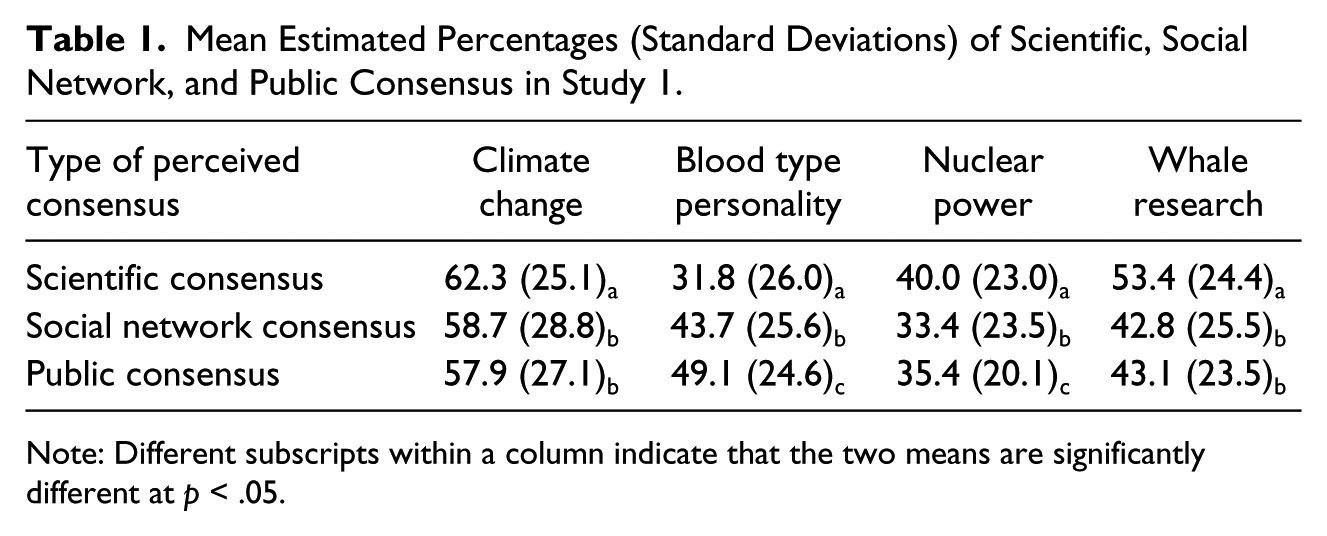
Note: Different subscripts within a column indicate that the two means are significantly different at p < .05.
Table 2 shows correlations among the estimated percentages of scientific, social network, and public consensus. Regardless of scientific issue, perceived scientific consensus was positively and moderately correlated with perceived social network consensus, rs = .42 to .62, ps < .001, and perceived public consensus, rs = .25 to .59, ps < .001. Correlations between perceived social network and public consensus were highly positive, rs = .72 to .88, ps < .001.
Correlations Among Perceived Scientific, Social Network, and Public Consensus in Study 1.

p < .001.
In summary, participants estimated the percentages of scientific consensus differently from social network and public consensus. Correlations of perceived scientific consensus with perceived social network and public consensus were significantly positive and moderate. These findings suggest that scientific consensus was perceived somewhat separately from social network and public consensus. On the contrary, participants’ estimates of social network and public consensus were roughly comparable or did not significantly differ from each other. In addition, perceived social network and public consensus were highly correlated. Therefore, it seems that participants did not clearly distinguish between social network and public consensus in their perceptions.
Relations Between Perceived Consensus and Scientific Beliefs
The mean ratings of scientific beliefs were 4.78 (SD = 1.22) for climate change, 3.79 (SD = 1.44) for BT personality, 3.44 (SD = 1.46) for nuclear power, and 4.19 (SD = 1.11) for whale research. The estimates of social network and public consensus were highly correlated, and therefore a composite index, perceived social consensus, was created by averaging the two estimates. In the following analyses, this index was used.
To examine whether perceived scientific and social consensus predict scientific beliefs independently of each other, multiple regression analyses were conducted on the ratings of beliefs about the four scientific issues. The results of the multiple regression analyses are presented in Table 3 (Models A, C, E, and G). In support of Hypothesis 1, perceived scientific consensus significantly predicted scientific beliefs independently of perceived social consensus for climate change, b = .018 (SE = .002), p < .001, f2 = 0.10; BT personality, b =.017 (SE = .002), p < .001, f2 = 0.08; nuclear power, b = .009 (SE = .003), p < .01, f2 = 0.02; and whale research, b = .006 (SE = .002), p < .05, f2 = 0.01. Perceived social consensus was a significant predictor only for nuclear power, b = .024 (SE = .004), p < .001, f2 = 0.08, and whale research, b = .017 (SE = .003), p < .001, f2 = 0.09.
Results of Multiple Regression Analyses in Study 1.
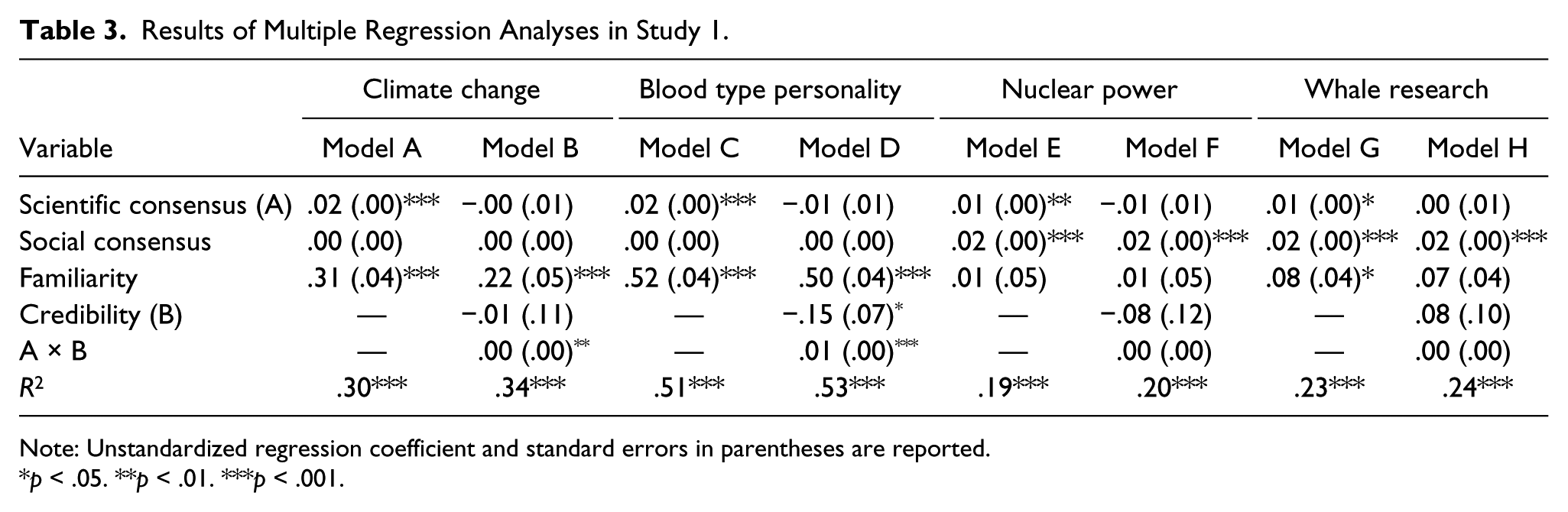
Note: Unstandardized regression coefficient and standard errors in parentheses are reported.
p < .05. **p < .01. ***p < .001.
Additional analyses using Meng, Rosenthal, and Rubin’s (1992) statistical test for comparing correlated correlation coefficients revealed that participants’ perceptions of scientific consensus were more strongly correlated with their beliefs about climate change (r = .46) and BT personality (r = .53) and more weakly correlated with their beliefs about nuclear power (r = .33) and whale research (r = .36) than their perceptions of social consensus (r = .35, .26, .42, and .46, respectively), Z = 3.04, p < .005; Z = 4.96, p < .001; Z = 2.04, p < .05; and, Z = 2.64, p < .01, respectively.
Moderating Effects of Perceived Credibility
The mean score for perceived credibility of scientists was 4.71 (SD = 1.01). To examine whether perceived credibility of scientists moderates the relation between perceived scientific consensus and scientific beliefs, moderation analyses were conducted on the ratings of beliefs about the four scientific issues, using the PROCESS macro (Model 1) for SPSS by Hayes (2013). The moderation models included perceived scientific consensus, perceived credibility, and their interaction as predictors and perceived social consensus and familiarity as covariates. The results of the moderation analyses are presented in Table 3 (Models B, D, F, and H). The perceived scientific consensus × perceived credibility interactions were significant only for climate change, b = .004 (SE = .002), p < .01, f2 = 0.01, and BT personality, b = .007 (SE = .002), p < .001, f2 = 0.02. The decomposition of the interactions, using the Johnson-Neyman technique, indicated that the simple slopes defining the effect of perceived scientific consensus on scientific beliefs were significantly greater than zero when the perceived credibility scores were over 2.23 (M − 2.48 SD) for climate change (see Figure 1) and over 1.62 (M − 3.09 SD) for BT personality (see Figure 2). Taken together, perceived credibility of scientists acted as the moderator for climate change and BT personality, supporting Hypothesis 3 partly.
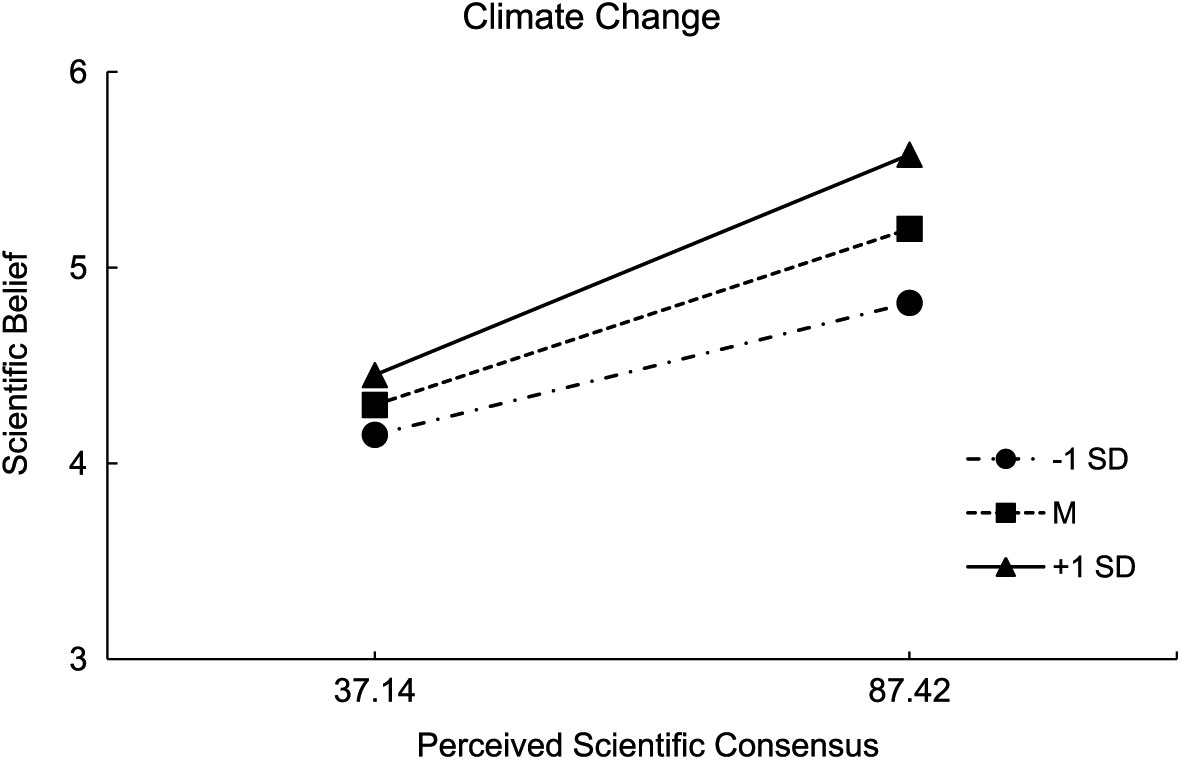
Interaction between perceived scientific consensus and perceived credibility for beliefs on climate change in Study 1.
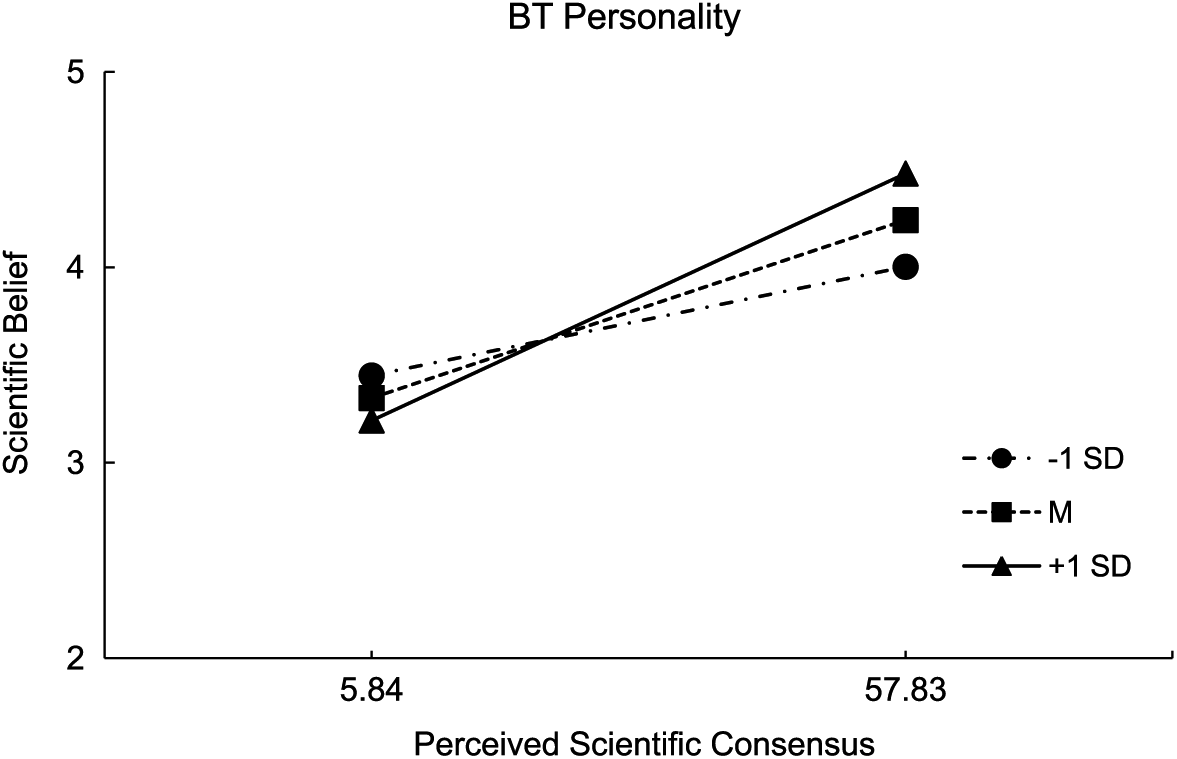
Interaction between perceived scientific consensus and perceived credibility for beliefs on BT personality in Study 1.
Study 2
The primary goal of Study 2 was to investigate the causal effects of scientific and social consensus perception on scientific beliefs, by experimentally manipulating levels of perceived scientific and social consensus. Three conditions were constructed and compared: scientific consensus feedback, public consensus feedback, and no feedback conditions. Participants in the scientific and public consensus feedback conditions estimated recent past levels of scientific or public consensus on scientific issues first, then received feedback about the consensus levels as an externally generated anchor for the following consensus estimation, and finally estimated current levels of scientific and public consensus. The estimation of consensus existing at the two different times was adopted so that participants would not regard the second consensus estimation as a test on their memory and comprehension of the feedback information. Participants in the no feedback condition estimated recent past levels of scientific consensus first and then current levels of scientific and public consensus without receiving feedback. Maibach, Peters, and Leiserowitz (2015) suggested that estimating a level of consensus before receiving feedback about the actual consensus enhances the acceptability of the feedback. Additionally, prior research on the anchoring effect has demonstrated that the estimation of an unknown quantity is biased toward a numerical value given as an anchor (Tversky & Kahneman, 1974; Wittenbrink & Henly, 1996; for a review, see Furnham & Boob, 2011). Therefore, it was expected that participants who received the feedback indicating relatively high (or low) consensus would estimate a higher (or lower) current level of consensus than those who did not. In this study, we asked whether the experimentally manipulated perceptions of scientific and social consensus influenced their scientific beliefs independently of each other.
Study 2 also examined whether perceived credibility of scientists moderates the mediating effects of perceived scientific consensus. In Study 1, perceived credibility of scientists did not act as the moderator for nuclear power or whale research. Remember that Study 1 measured participants’ perceptions of the credibility of scientists in general. Given that the general public perceives the credibility of scientists differently according to scientific issue (e.g., Scientific American, 2010), this measure may have been too broad to assess perceived credibility of scientists addressing some specific issues. In Study 2, participants reported their perceptions of the credibility of scientists in fields relevant to each scientific issue.
Method
Participants
An Internet-based experiment was conducted in October 2016. Participants came from a panel of Japanese members maintained by Intage Inc. Of the 3,008 members who were invited by e-mail, 694 (23.1%) completed the experiment. The sample included 50.0% females; 19.9% 18 to 29 years, 19.6% 30 to 39 years, 20.2% 40 to 49 years, 20.2% 50 to 59 years, and 20.2% 60 to 69 years (M = 44.66 years, SD = 14.16); and 47.6% full-time workers, 19.7% full-time homemakers, 9.7% retired and unemployed persons, and 5.7% students. None of them participated in Study 1. Participants were randomly assigned to one of the following three feedback conditions: scientific consensus feedback condition (n = 230), public consensus feedback condition (n = 234), and no feedback condition (n = 230). The present sample size was sufficient to detect a small effect (f2 = 0.02) at 80% power (α = .05) where the effect was the perceived scientific consensus × perceived credibility interaction.
Stimulus Materials
Depending on the experimental manipulation, information about a fictitious survey was presented in Japanese: In 2013, some research institutes jointly conducted a survey of scientists’ opinions ([the scientific consensus feedback and no feedback conditions], Japanese people’ opinions [the public consensus feedback condition]) about a variety of scientific issues, with a random sample of 1,052 scientists, including those who worked in fields relevant to each issue ([the scientific consensus feedback and no feedback conditions], 2,325 ordinary Japanese people [the public consensus feedback condition]).
Feedback about the results of the 2013 survey reporting scientific or public consensus was also given to participants in the scientific and public consensus feedback conditions. The scientific and public consensus feedback were created by adding 20 percentage points to the mean estimated percentages of scientific and public consensus in Study 1 for climate change (82% of scientists and 78% of people) and nuclear power (60% of scientists and 55% of people) and subtracting 20 percentage points from the mean estimated percentages of scientific and public consensus in Study 1 for BT personality (12% of scientists and 29% of people) and whale research (33% of scientists and 23% of people).
Measures and Procedure
All questions were created and presented in Japanese. First of all, participants rated scientists’ competence in addressing each of the four scientific issues and their trust in scientists’ opinions about each scientific issue, using 7-point Likert-type scales ranging from not at all competent (1) to very competent (7) and not at all trustworthy (1) to very trustworthy (7), respectively (rs = .58-.74, ps < .001). They also rated their familiarity toward each of the four scientific issues, using the same measure as in Study 1. Second, participants were informed about the 2013 survey of scientists or ordinary Japanese people. Following that, participants in the scientific consensus condition estimated the percentages (0% to 100%) of scientists (working in fields relevant to each issue) who had agreed on each of the same statements as in Study 1 in the 2013 survey. After the consensus estimation, they received the scientific consensus feedback and then rated their surprise at the given consensus information, using a 7-point Likert-type scale ranging from not at all surprised (1) to very surprised (7). This rating was used to make them pay attention to the feedback (Stangor et al., 2001). Participants in the public consensus feedback condition estimated the percentages of ordinary Japanese people who had agreed on each statement, then received the public consensus feedback, and finally rated their surprise at the given consensus information. Participants in the no feedback condition estimated the percentages of scientists who had agreed on each statement but did not receive any consensus feedback or rate their surprise. Third, participants estimated the percentages of scientists and the general Japanese who would agree on each statement at the moment of the present study. Finally, participants rated their agreement on the four statements, using the same measure as in Study 1. After answering all the questions, they were debriefed.
Results and Discussion
Perceived Scientific and Public Consensus After Consensus Feedback
Table 4 shows the mean estimated percentages and standard deviations of scientific and public consensus on the four scientific issues after consensus feedback as a function of feedback condition.
2
One-way analyses of variance were conducted to examine the effects of scientific and public consensus feedback on the estimation of scientific and public consensus. Brown-Forsythe tests were used when Levene’s tests indicated unequal variances across the feedback conditions. With regard to the estimation of scientific consensus, there were significant differences among the feedback conditions for BT personality, Brown-Forsythe (2, 456.10) = 13.80, p < .001,
Mean Estimated Percentages (Standard Deviations) of Scientific and Public Consensus in Study 2.
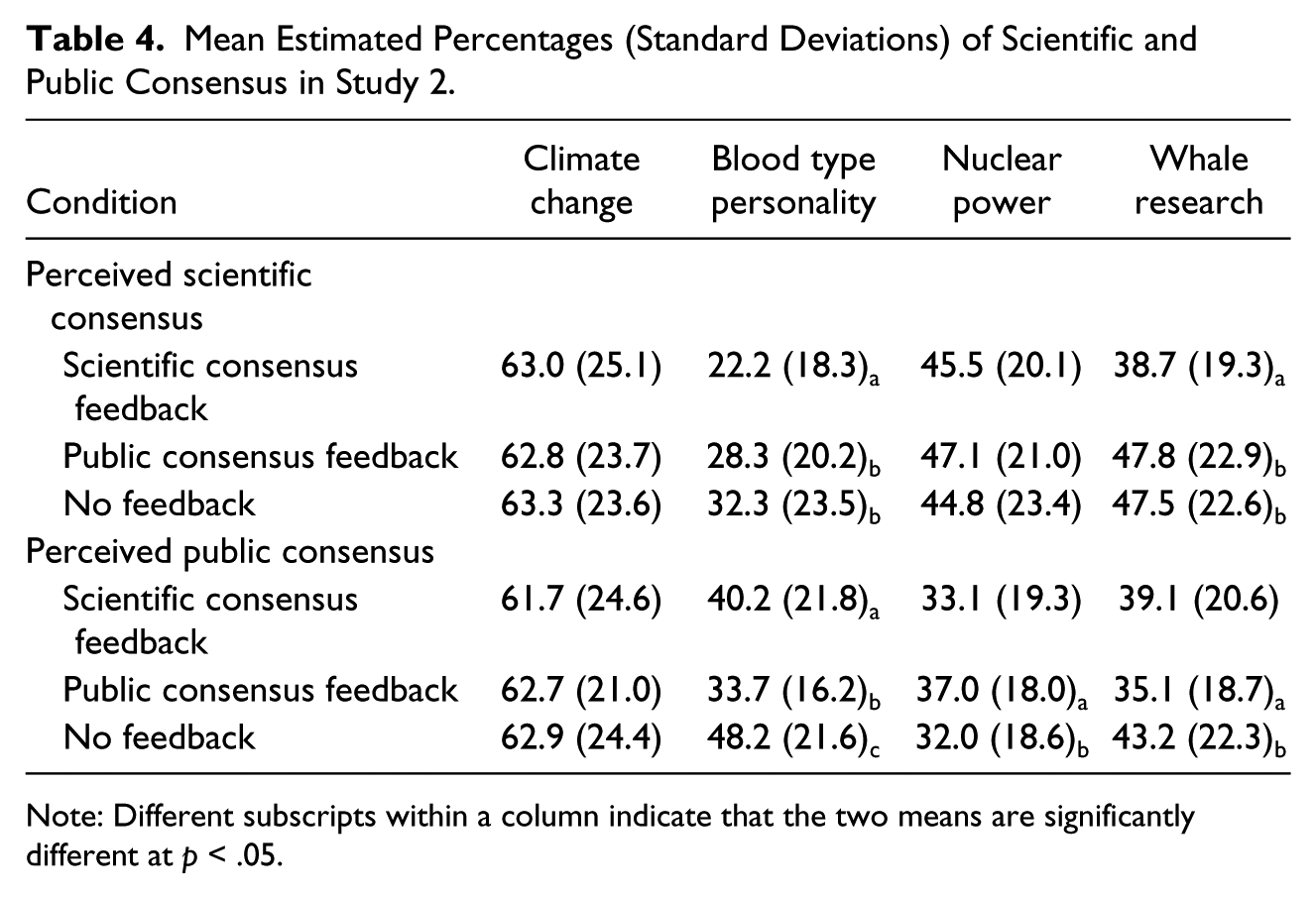
Note: Different subscripts within a column indicate that the two means are significantly different at p < .05.
Mediating Effects of Perceived Consensus on Scientific Beliefs
The mean ratings of scientific beliefs were 4.77 (SD = 1.23) for climate change, 3.51 (SD = 1.39) for BT personality, 3.49 (SD = 1.52) for nuclear power, and 4.15 (SD = 1.16) for whale research.
To examine whether perceived scientific consensus mediates between scientific consensus feedback and scientific beliefs, mediation analyses were conducted on the ratings of scientific beliefs, using the PROCESS macro (Model 4) for SPSS (Hayes, 2013). The mediation models included feedback condition (0 = no feedback or public consensus feedback condition, 1 = scientific consensus feedback condition) as an independent variable, perceived scientific and public consensus after consensus feedback as mediators, and familiarity toward each issue as a covariate. As mentioned above, perceived scientific consensus was successfully manipulated only for BT personality and whale research. Therefore, the mediation analyses focused on the two issues. The indirect effects of scientific consensus feedback were estimated with 10,000 bootstrap samples. Table 5 shows the results of the mediation analyses. For BT personality, the mediating effects of perceived scientific consensus were significantly smaller than zero when the scientific consensus feedback condition was contrasted with the no feedback condition (bias-corrected bootstrap 95% confidence interval [CI; −.31, −.12]) and the public consensus feedback condition (95% CI [−.19, −.05]). The feedback condition had no significant direct effects on participants’ beliefs about BT personality for scientific consensus feedback versus no feedback, b = .04 (SE = .11), or public consensus feedback, b = .05 (SE = .10), suggesting that perceived scientific consensus was a single dominant mediator. For whale research, perceived scientific consensus was a significant mediator only when the scientific consensus feedback condition was contrasted with the public consensus condition (95% CI [−.14, −.00]). The mediating effects of perceived public consensus were also significant when the scientific consensus feedback condition was contrasted with the no feedback condition (95% CI [−.15, −.01]) and the public consensus feedback condition (95% CI [.01, .13]). The direct effects of the feedback condition were not significant for scientific consensus feedback versus no feedback, b = −.00 (SE = .10), or public consensus feedback, b = .01 (SE = .10).
Mediating Effects of Perceived Scientific and Public Consensus in Study 2.

Note: Point estimates and bias-corrected bootstrap 95% confidence intervals in parentheses are reported.
In the same way, mediation analyses were conducted to test the indirect effects of public consensus feedback on beliefs about BT personality, nuclear power, and whale research, with feedback condition (0 = no feedback condition, 1 = public consensus feedback condition) as an independent variable, perceived scientific and public consensus as mediators, familiarity as a covariate, and 10,000 bootstrap samples. As shown in Table 5, the mediating effects of perceived public consensus were significantly greater than zero for nuclear power (95% CI [.03, .19]) and significantly smaller than zero for whale research (95% CI [−.17, −.03]). The feedback condition had no significant direct effects for nuclear power, b = −.21 (SE = .13), or whale research, b = −.01 (SE = .10).
In summary, perceived scientific and public consensus mediated the effects of consensus feedback on scientific beliefs independently of each other. The feedback indicating relatively low scientific consensus on BT personality and whale research decreased participants’ estimates of scientific consensus, which in turn weakened their beliefs about the two issues independently of their estimates of public consensus. The public consensus feedback strengthened participants’ beliefs about nuclear power and weakened their beliefs about whale research only through their estimates of public consensus on each issue. These results support Hypothesis 2.
Moderated Mediation Analyses
The mean scores for perceived credibility of scientists were 4.26 (SD = 1.10) for climate change, 3.55 (SD = 1.23) for BT personality, 3.68 (SD = 1.25) for nuclear power, and 4.07 (SD = 1.07) for whale research. To examine whether perceived credibility of scientists moderates the mediating effects of perceived scientific consensus, moderated mediation analyses using the PROCESS macro (Model 14) for SPSS (Hayes, 2013) were conducted on the ratings of beliefs about BT personality and whale research, with feedback condition (0 = no feedback or public consensus feedback condition, 1 = scientific consensus feedback condition), perceived scientific consensus, perceived credibility, and perceived scientific consensus × perceived credibility interaction as predictors and perceived public consensus and familiarity as covariates. The perceived scientific consensus × perceived credibility interactions were not significant predictors of beliefs about BT personality (scientific consensus feedback vs. no feedback, b = .002 [SE = .002], and public consensus feedback, b = .001 [SE = .002]), or whale research (scientific consensus feedback vs. no feedback, b = .002 [SE = .002], and public consensus feedback, b = −.002 [SE = .002]), indicating that perceived credibility of scientists did not moderate the mediating effects of perceived scientific consensus. Thus, Hypothesis 3 is not supported.
General Discussion
Prior research has accumulated evidence that people’s perceptions of scientific consensus predict and influence their scientific beliefs (e.g., Cook & Lewandowsky, 2016; Ding et al., 2011; van der Linden, Clarke, et al., 2015). The results of the present research strengthen the findings of previous work and contribute to the refinement of the gateway belief model (van der Linden, Leiserowitz, et al., 2015) in two ways. First, the present findings suggest that ordinary people perceive scientific consensus somewhat differently from social consensus. In Study 1, participants’ estimates of scientific consensus were moderately correlated with but significantly different from their estimates of social network and public consensus, regardless of scientific issue. In Study 2, scientific consensus feedback slightly affected participants’ estimation of public consensus. However, the crossover effects of scientific and public consensus feedback were limited, suggesting that they distinguished scientific consensus from public consensus in their perceptions. Second, more importantly, the present research provides evidence that perceived scientific consensus has an independent effect on the perceivers’ scientific beliefs. Study 1 found that participants’ estimates of scientific consensus significantly predicted their scientific beliefs independently of their estimates of social consensus. Study 2 also found that participants’ estimates of scientific consensus mediated the effects of scientific consensus feedback on their scientific beliefs independently of their estimates of public consensus. Overall, the present research gives empirical support for the idea—the assumption underlying the gateway belief model—that perceived scientific consensus plays a unique role in scientific belief change.
Unexpectedly, in Study 2, scientific consensus feedback did not successfully change participants’ estimation of scientific consensus on climate change or nuclear power. Therefore, for the two issues, whether perceived scientific consensus was causally related to scientific beliefs remains unexamined. One possible reason why scientific consensus feedback did not produce the intended effects is that participants may have regarded information about recent past levels of scientific consensus on the four scientific issues, but climate change and nuclear power in particular, as outdated. Accordingly, rather than the feedback, they may have relied on their preexisting knowledge and beliefs to estimate current levels of scientific consensus. Another, but not exclusive, possibility is that the processing of scientific consensus feedback may have been cognitively complex and demanding. Participants received the feedback about recent past levels of scientific consensus on the four scientific issues and then estimated current levels of scientific consensus, without referring to the feedback. This procedure may have made it difficult for them to remember the feedback information accurately and thereby adjust their estimation, with the result that scientific consensus feedback had limited effects. Prior research has demonstrated that a change in perceived scientific consensus causes a change in beliefs about a variety of scientific issues, including climate change (e.g., van der Linden, Leiserowitz, et al., 2015), vaccination (e.g., Clarke et al., 2015), and GM food (Dixon, 2016). There is no reason to suspect that the causal effects of perceived scientific consensus observed in Study 2 are peculiar to BT personality and whale research. Yet future work should ascertain that externally induced perceptions of scientific consensus influence beliefs about other scientific issues independently of perceived social consensus.
The present results also support and extend prior findings that people’s perceptions of social consensus on a scientific issue predicted their beliefs about the scientific issue (Puhl et al., 2005; Stangor et al., 2001; van der Linden et al., 2016). Study 1 found that perceived social consensus on nuclear power and whale research were significant predictors of beliefs about the two issues, even after controlling for the predicting effects of perceived scientific consensus. In Study 2, the public consensus feedback influenced participants’ beliefs about nuclear power and whale research through their perceptions of public consensus. Moreover, perceived public consensus partly mediated between scientific consensus feedback and their beliefs about whale research. These findings suggest that, at least for some scientific issues, people rely on their perceptions of social consensus, as well as scientific consensus, to judge the extent to which a scientific claim is acceptable.
The evidence that perceived credibility of scientists moderated the effects of perceived scientific consensus is mixed. In Study 1, perceived credibility of scientists in general acted as the moderator for climate change and BT personality. As expected, the relations between participants’ estimates of scientific consensus on and their beliefs about the two scientific issues were stronger for those who perceived scientists to be more credible. In Study 2, participants reported their perceptions of the credibility of scientists working in fields relevant to each issue. Contrary to expectations, however, perceived credibility did not moderate the mediating effects of perceived scientific consensus. Note that the significant perceived scientific consensus × perceived credibility interactions found in Study 1 were negligibly small in the magnitude of effect (f2 = 0.01) for climate change and small (f2 = 0.02) for BT personality. The mixed results may be partly due to the fact that the moderating effects of perceived credibility were trivial if they exist at all. In any case, the present findings suggest that participants’ perceptions of scientific consensus predicted and influenced their scientific beliefs almost without being conditioned by their perceptions of the credibility of scientists. This is surprising, considering that, on average, they perceived scientists not to be highly credible (for Study 1, M = 4.71, and for Study 2, Ms = 3.55-4.26, with the possible scores ranging from 1-7). Ordinary people may rely on perceived scientific consensus just because they think that scientists are relatively more reliable than other sources of scientific information (Fiske & Dupree, 2014; Lang & Hallman, 2005). Alternatively, they may tend to automatically process information about scientific consensus; therefore their perceptions of the credibility of scientists may hardly intervene in their use of perceived scientific consensus. Unfortunately, the present data did not allow for specifying the reason why perceived credibility of scientists had little if any influence on the power of perceived scientific consensus. Further work is needed to address this issue.
Implications and Limitations
The results of the present research have implications for science communication. One implication is related to the present findings that perceived scientific consensus was distinguishable from perceived social consensus and uniquely predicted and influenced scientific beliefs. These findings stress anew the importance of scientific consensus perception. Ordinary people’s beliefs about a scientific issue may deviate from a consensus among scientists on the scientific issue partly because they misperceive the consensus level (Ding et al., 2011). Furthermore, improving their perceptions of scientific consensus by effectively informing them about the actual scientific consensus (Myers, Maibach, Peters, & Leiserowitz, 2015; van der Linden et al., 2014) may be useful in reducing the deviation. However, it is important to note that the impact of perceived scientific consensus on scientific beliefs may differ according to scientific issue. In Study 1, as compared with perceived social consensus, perceived scientific consensus was strongly correlated with climate change and BT personality beliefs but weakly correlated with nuclear power and whale research beliefs. This implies that there may be some cases where science communication focusing on individuals’ perceptions of scientific consensus alone does not work successfully.
Another but related implication is the need for realizing that the general public must deal with information about scientific consensus, surrounded by their social network members’ and the general public’s opinions. The present findings suggest that social consensus is perceived differently from scientific consensus and that perceived social consensus influences scientific beliefs independently of perceived scientific consensus. Communicating the actual scientific consensus to individuals may successfully improve their perceptions of scientific consensus but at the same time widen the gap between perceived scientific and social consensus; beside, the widened gap may discourage them from changing their scientific beliefs. It is not easy for even scientists to escape from the influence of public opinion about a scientific issue (Lewandowsky, Oreskes, Risbey, Newell, & Smithson, 2015), let alone for laypersons. Additionally, not a few people have a misunderstanding about the nature of scientific consensus, including the reason why scientists disagree on a scientific issue (Sadler, Chambers, & Zeidler, 2004; Shanteau, 2000). Under the circumstances, merely providing ordinary people with information about a level of scientific consensus may have limited effects. It may be necessary not only to communicate the actual scientific consensus but also to highlight and explain its meaning and significance.
Although the present findings add to the growing literature on the relationship between perceived scientific consensus and scientific beliefs, several limitations should be noted. First, the present research used samples coming from the general Japanese population. The observed effects of perceived scientific consensus are largely consistent with the findings of prior research based on samples of American and Australian people (e.g., Cook & Lewandowsky, 2016; Ding et al., 2011; van der Linden, Leiserowitz, et al., 2015), increasing generalizability. But still, it is possible that different effects of perceived scientific and social consensus might be found in different countries and cultures. To ensure that the present findings are generalizable, future research should include samples coming from other countries and cultures.
The second limitation concerns the design for determining the impact of externally induced perceptions of scientific and social consensus on scientific beliefs. Study 2 analyzed the causal effects of perceived scientific and public consensus, by comparing the feedback conditions. Participants’ preexisting scientific beliefs were not measured and therefore were not included in the analyses. Given that participants were randomly assigned to the feedback conditions, it seems reasonable to infer that the observed differences in scientific beliefs among the feedback conditions were due to the experimental manipulation. Yet the present design could be strengthened by controlling for participants’ preexisting scientific beliefs. Additionally, the present research focused on the immediate effects of perceived scientific and public consensus. However, it is theoretically and practically important to ascertain whether the effects of externally induced perceptions of scientific and social consensus on scientific beliefs last for a long time. Subsequent studies should examine the impact of perceived scientific and social consensus, using an experimental design in which scientific beliefs are assessed before, immediately after, and long after the presentation of consensus information.
Finally, though the present research did not consistently find the moderating effects of perceived credibility of scientists, there may be other moderators that have an effect. For instance, Dixon (2016) found that individuals’ prior attitudes toward GM food moderated the effects of perceived scientific consensus on their beliefs about the safety of GM food, suggesting the involvement of motivated processing. Accuracy motivation may also act as the moderator, given that the power of perceived consensus stems from informational influence (Cialdini & Goldstein, 2004). That is, perceived scientific and social consensus may have greater impact for individuals who are motivated to be accurate than for those who are not. Examining the effects of these possible moderators contributes to the determination of a psychological mechanism underlying the impact of perceived scientific and social consensus and is worthy of future research.
Footnotes
Declaration of Conflicting Interests
The author(s) declared no potential conflicts of interest with respect to the research, authorship, and/or publication of this article.
Funding
The author(s) disclosed receipt of the following financial support for the research, authorship, and/or publication of this article: This research was supported by Japan Society for the Promotion of Science Grant/Award No. “Grant-in-Aid of Scientific Research (C), No. 15K04055.”