




Abstract
Science clubs are programs that allow people (especially children and youngsters) to meet regularly outside of school programs and engage with science and technology activities. Clubs encourage participants to foster attitudes, capabilities, and knowledge related to STEM fields with the goal of promoting interest and passion about science. As such programs provide big opportunities to improve the impact of public communication of science activities, it is really important to look at the impacts of such programs. Quark Group runs the Children Science Club since 2002, and up to 2016, it developed science recreation activities with 711 children and young people. In order to establish the influence the club had on its participants, we conducted a survey that provided 244 answers. This article presents the findings of this follow-up study.
Keywords
Introduction: The Need for Permanent Science Communication Programs
Nowadays, there is widespread international concern for the lack of interest of young people in natural sciences, and the corresponding need to stir and support more vocations on science, technology, engineering, and math (STEM; Krapp & Prenzel, 2011; Sahin, 2013; Vartiainen & Aksela, 2013). In order to accomplish this, we cannot rely only on school programs, with their distant view of science results and the process that brings them to life; we have to go beyond that and really get people, especially children and young children, engaged with STEM: It is ( . . . ) imperative that the communication of science and all the potential it holds for future generations be done in a manner that would draw young learners to science and to sustain their interest and involvement in school science but also in activities beyond the school curriculum. (Hartley, 2014, p. 22)
There is a wide variety of media to draw people to STEM, but one of the most attractive options lies in science communication activities that promote a full interaction with participants on three different levels: physical, intellectual, and emotional. The first two have traditionally been set as important goals for learning environments, allowing participants to engage in “hands-on” experimentation and “minds-on” reflection (Hofstein & Rosenfeld, 1996, p. 87). And we also have to consider the role of emotions: “The more intense emotions the pupils experience in the learning situation the better the learning outcome. The child’s interest and motivation to learn can be aroused and altered through emotions” (Vartiainen & Aksela, 2013, p. 316).
Full interaction strategies intend to turn participants from observers into protagonists: playing the role of researchers in a science recreation experience. The word “recreation” here implies a dual meaning, which is characterized by Lewenstein (2013):
Re-creation as a new creation of scientific elements that already existed. That is, helping participants understand how science works and also bringing new meaning to knowledge as it is related to their lives: “talking about ‘re-creation’ acknowledges that every time we present scientific information, we create new meaning, new knowledge” (Lewenstein, 2013, p. 89)
Recreation as relaxation, something people would do to enjoy themselves. Recreational activities come in many forms, “including participating in clubs and sports, gardening, hunting, or collecting” (Lewenstein, 2013, p. 89). This dimension intends to encourage participants to stay involved in STEM-related activities, which, in turn, could help achieve further objectives; as Burns, O’Connor, and Stocklmayer (2003, p. 197) put it, “Enjoyment and other affective responses may evoke positive feelings and attitudes that may lead to subsequent, deeper encounters with science.”
Interactive museum exhibits and recreational science workshops are two important means that promote such type of processes. Both cases stimulate participants to dive into science in informal contexts as they play, ponder issues, and discuss their ideas. This often results in excitement for those involved, which could turn to be a spark of interest to pursue a deeper understanding of science and technology and even a career in a STEM field. But we have to be careful not to overestimate the impact of events of brief duration; it is hard to expect great changes with respect to knowledge, attitudes, or behavior (Neresini & Pellegrini, 2008).
An isolated experience rarely results in a closer relation to STEM: It needs subsequent follow-ups to flourish. There is a need for permanent programs that would foster a closer relationship between STEM and the participants’ personal interests. Such extracurricular science programs will not “force” people to learn but will provide learning opportunities where they can freely choose whether or not to participate (Lewenstein, 2013).
This article starts with a characterization of science clubs and the main features they use to get people closer to STEM in a significant way. Then, we present the experience of the Children Science Club in Zacatecas, Mexico, over the past 28 years; and finally, we provide the results of a follow-up study intended to identify the effect the Club had on its participants in the period from 2002 to 2016.
Science Clubs
A club is a program that brings together a group of people with a common interest, who meet regularly to carry out activities related to that interest. Such programs cover a wide array of themes: sports, arts, crafts, and—of course—science.
Based on Blanco (2004), we can understand science clubs as extracurricular programs that show science is something you put into practice rather than something you simply learn. In this kind of science communication programs, participants perform activities that allow them to discover things, going beyond plain knowledge and explanations, to see science as a never-ending practice that allows humans to understand and predict the behavior of nature.
This approach allows people involved to play the role of researchers in science recreation activities, which is part of a growing trend of engaging science communication and informal STEM education endeavors. Sahin (2013) emphasizes the transcendence of after-school programs because of their potential to promote student learning and develop scientific literacy, and Hartley (2014) cites various reports to establish science clubs as important means for the development of positive attitudes toward science. From a broad perspective, science clubs appear to be a valuable option for the growth of science communication and STEM education strategies. In order to complement such a macro approach, it is necessary to provide case studies that show the effects of specific programs on their participants.
Identifying the Effects: The Proper Perspective
Neresini and Pellegrini (2008, p. 243) state that, however communication is defined, there is some agreement that “it is a process that can create change in those who take part in it.” To see the value of science clubs we have to look for possible effects on their participants. Hartley (2014) highlights the success in the PISA test by countries that promote extracurricular STEM activities, while Sahin (2013) establishes that they can stimulate science-specific interests. If we intend to assess the value of a public communication of science endeavor, we must look for a possible influence on the people involved, which is not an easy task: Science communication outcomes and responses may not be easy to study scientifically; they inevitably occur in the “real world” rather than the controlled conditions of a research laboratory ( . . . ) It is also important to recognize that significant long-term consequences of science communication may occur as participants contemplate their existing knowledge, encounter other new experiences, and reorganize their thinking. (Burns et al., 2003, p. 185)
Conducting a study with such a scope demands the proper conditions of distance and perspective, so that we can establish the personal influence on participants. An immediate measurement will highlight momentary emotions but will not shed light on the medium- and long-term effects, because short-term effects are highly unstable (Neresini & Pellegrini, 2008). We must turn to a different methodology to study the “effects generated by the repeated involvement in numerous communicative events of the same type” (Neresini & Pellegrini, 2008, p. 246).
The challenge in this type of study lies in being able to contact participants after several years to collect their impressions. In this context, science clubs (with a proper record of people involved) provide an excellent opportunity to do follow-up studies. In the subsequent sections, we provide a case study of one such club.
About the Children Science Club
Zacatecas is the capital city of the state of the same name, in the central region of Mexico. The metropolitan area of Zacatecas, which includes the neighboring city of Guadalupe, has a population of 334,000 people (INEGI, 2015). Tourism is one of the most important economic activities for Zacatecas, which relates to it having one of the highest number of museums per capita in Mexico.
The Science Museum of the Autonomous University of Zacatecas opened in October 1983, with the exhibition of a physics apparatus cabinet from the 19th century. It was not possible to use the cabinet’s devices for interactive activities, but in order to complement the exhibit, ever since the beginning, the staff implemented different science communication programs: lectures, demonstrations, publication of small magazines, and projection of science fiction movies. In 1990, the Museum launched its first after-school strategy directed specifically for children: The Children Science Club. The Club has always been independent of formal education programs and is open to work with all children willing to participate.
In order to attract potential members for the Club, the Science Museum has carried out advertising campaigns that initially included information in local newspapers, visits to radio shows, delivery of flyers, and, more recently, sharing information about the program in social media. Interested children sign up at the beginning of a semester (in February or August) to attend during a 4-month span (that ends in June or December); a member is able to return for as many semesters as he or she wants.
Every Saturday for the past 25 years, participants aged 6 to 13 years have attended the Museum during the school year to perform experiments intended to help them discover scientific principles instead of just receiving information about them. In essence, these activities are performed as recreational science workshops. The goal has been to provide a different approach to science, one that could get participants interested in digging deeper. With these kinds of activities, the Club worked for over a decade with an average attendance of 12 children per session; and this approach continues to be the foundation for the Club.
In 2001, the Quark Group was created with the goal of having a team of young people operating the Club. The Science Museum made a call for university students interested in participating in activities of public communication of science; Quark started with eight members who were trained by science communication professionals from the Museum, in order to help them share their passion for STEM while acting as recreational science facilitators.
This Group has managed the Club for the past 16 years but has also gone further than its initial goals: by specializing in recreational science workshops, developing resources for science popularization, and developing events in schools, science fairs, and other special projects. Quark is now one of the largest volunteer groups devoted to public communication of science in Latin America, with more than 60 members currently active and more than 300 volunteers who have been part of the group.
Quark established a new approach in the Club from day one: It expanded the age range to 5 to 15 years; every session now consists of activities grouped thematically, supporting each other for a better understanding of the involved phenomena; and contents from 1 week are linked to the following sessions, to ease the understanding of more complex scientific concepts. Each weekly session lasts for 2 hours and consists of 6 different recreational workshops, which use experiments to get participants engaged in physical, mental, and emotional levels.
Over the 2002 to 2016 span, the Club had an average attendance of 60 children per session, with more than 40% returning from one year to the next. This led to the creation of a new program of activities every year, in order to avoid repetition that could be boring for the children involved.
The most important change came a bit naturally: one of Quark’s founding members was a former participant of the Children Science Club. Now, in addition to previous goals, the Club pursued the objective of getting young people involved in science communication endeavors. This started the idea of the Science Youth Squad: Just like professional soccer teams are looking for tomorrow’s great stars from early ages, the Club intends to find and prepare children who could become the next generation of science popularizers. From 2004 to this day, 65 boys and girls (ages 13-15 years) have jumped from the Club to Quark; 19 of them are still active.
With all of this, Quark and the Museum have accomplished what Sahin (2013, p. 8) calls “developing communities of practice,” through activities that get the participants’ emotional side, their intellectual achievement, and a sense of belonging, all together into the group. This kind of reaction from participants has kept Quark and the Museum working on the Club, but there is also the legitimate question of what is the real effect of the Club’s activities on participants.
The Study
A study on the Children Science Club has the advantage of the record of names and phone numbers of 711 participants who were involved in the program from 2002 to 2016. This information allowed us to reach former participants and invite them to fill out an online survey or answer the questions by phone. The study was able to gather information from 244 participants, which accounts for 34.3% of the participants in the 2002 to 2016 period.
Of the total responses, 48 (19.7%) came from participants who joined the Club in the 2002 to 2004 span; 39 (16%) from those who entered in the 2005 to 2007 period; 45 (18.4%) from 2008 to 2010; 32 (13.1%) from 2011 to 2013; and 80 (32.8%) joined in the 2014 to 2016 period. In terms of gender, 101 respondents (41.4%) were female and 143 were male (58.6%).
One of the most important features of the Club is the high returning rate of participants. We posed the question of how many semesters they had been involved with the program. Fifty-five respondents (22.5%) were only involved in one semester, 100 (41%) were there between 2 and 4 semesters, 39 (16%) stayed for 5 to 7 semesters, 37 (15.2%) were involved for 8 to 10 semesters, and 13 (5.3) stayed between 12 and 16 semesters. We summarize these data in Figure 1.

Permanence of participants in the Children Science Club.
Of the respondents, 77.5% participated in the Club for more than a year and 36.5% for more than 2.5 years. We also posed the question of what participants got from the activities, and in this case, participants were able to select all the options they considered true. Data show that 88% of all respondents had fun while participating in the activities, 82% were able to understand phenomena around them, 78% learned things that were useful in school, and 35% found a scientific vocation in the Children Science Club.
The survey also required participants to grade their satisfaction on a scale of 1 (lowest) to 5 (highest): 61% graded the Club with a 5; 29% gave a 4; 8% assigned a 3; 2% rated a 2; and nobody selected 1. Using the same scale, respondents were asked how likely they were to recommend the Club to a friend or relative: 82% gave the highest score; 11% answered with a 4; 5% with a 3; 2% selected 3; and the lowest grade got less than 1%. With these two elements, we see that most participants have a lasting positive impression about the Club.
Looking for vocational information, we distinguished respondents who have already made a career choice or are about to do so: 11 (5%) correspond to grad students, 73 (30%) are either college students or graduates that did not study any further, 46 (19%) are in high school, 50 (20%) study in middle school, and 64 (36%) are still in elementary school. If we group college students, college graduates, and grad students, we have a subgroup of 83 respondents; Figure 2 shows their vocational choice, via the question of what they are studying, or (in case they have graduated) what did they study.
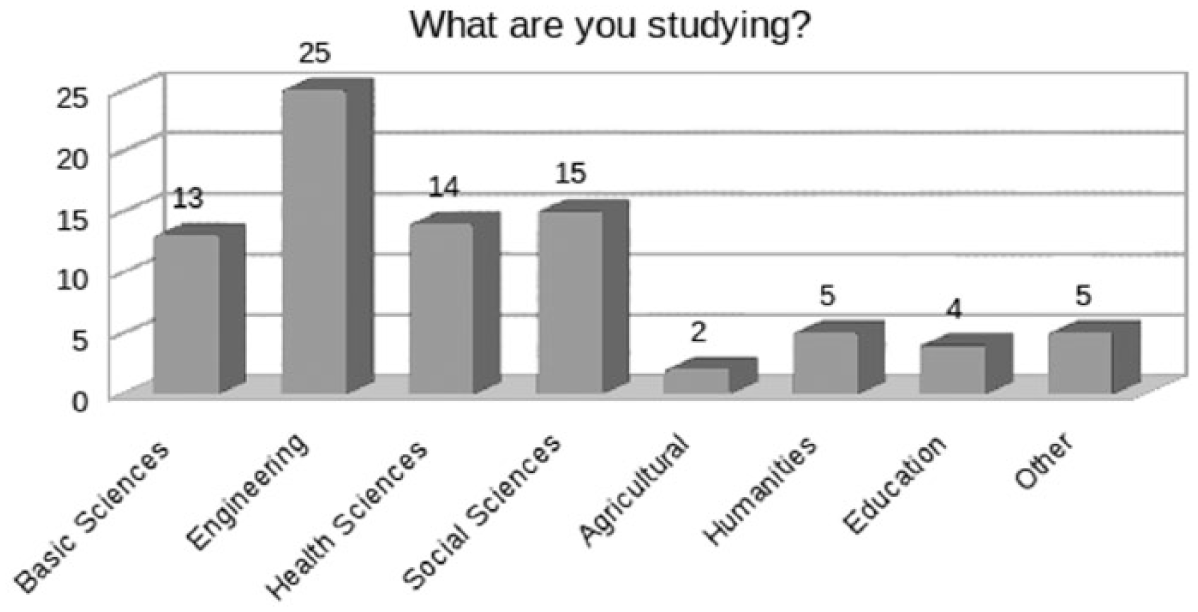
Vocational profile of former participants of the Children Science Club who are college students or graduates.
These data show that 16% of the respondents’ college choice was basic sciences (mathematics, physics, chemistry, or biology), and 30% went for engineering; if we group these segments, we see that 46% decided to pursue a career in a STEM-related field.
As for respondents currently in high school, the group includes 46 who are about to make a career choice. Figure 3 shows 30% are oriented toward basic sciences and 20% gear toward a branch of engineering; half of the responses in this subgroup have a STEM-related vocation.
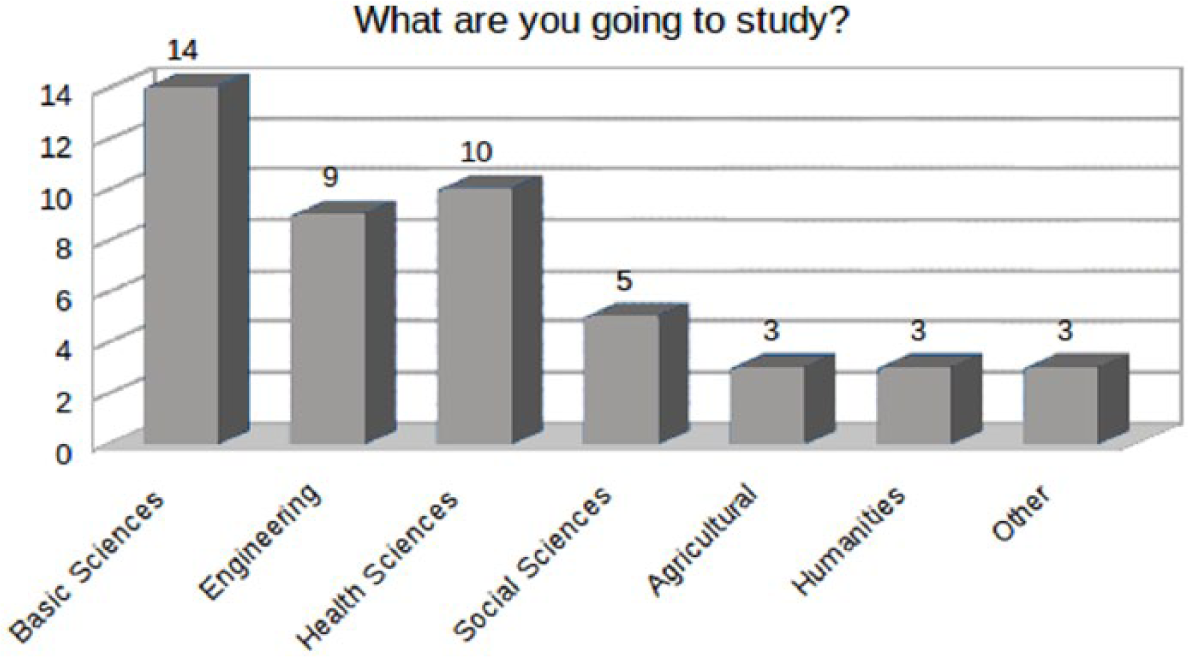
Vocational profile of former participants of the Children Science Club who are currently studying in high school.
Finally, as the Club is developed by institutions devoted to science communication (the Science Museum and Quark Group), it was interesting to find out how much it stirred an interest for participants to collaborate in science communication endeavors. Thirteen percent of all respondents have already participated in the development of some kind of science communication activity, while 70% are willing to do it, leaving only 17% who have no interest on it whatsoever. This is a good indication of the foundation Quark is building within boys and girls in the Club, setting them for the opportunity of collaborating as volunteers in the future.
Conclusions
The results obtained in our study highlight the value of the Children Science Club as an effective science communication program on three different levels:
Enjoyable: Motivates participants to stay involved in the activities, leaving a lasting positive impression on them.
Useful: Provides elements that serve children in school or in other aspects of their life.
Stable: Offers a permanent place for anybody interested to attend and participants to keep going as long as they want to.
This reinforces the relevance of programs that go beyond occasional activities to provide a recurring space to engage with STEM, as a way of developing interest and passion for science. The scope of this study is not able to support deeper conclusions, especially on career paths; hence, we cannot establish the Club as a vocational factor; not without a more comprehensive study. In the future, we intend to pursue further research to provide additional insights.
The specific value of the Children Science Club lies in going beyond the spark produced by a brief science event: providing a permanent program where young people can attend to keep the fire of interest in STEM lit.
Footnotes
Declaration of Conflicting Interests
The author(s) declared no potential conflicts of interest with respect to the research, authorship, and/or publication of this article.
Funding
The author(s) received no financial support for the research, authorship, and/or publication of this article.
