




Abstract
While uncertainty is central to science, many fear negative effects of communicating scientific uncertainties to the public, though research results about such effects are inconsistent. Therefore, we test the effects of four distinct uncertainty frame types (deficient, technical, scientific, consensus) on three outcomes (belief, credibility, behavioral intentions) across three science issues (climate change, GMO food labeling, machinery hazards) with an experiment using a national sample (N = 2,247) approximating U.S. census levels of age, education, and gender. We find portraying scientific findings using uncertainty frames usually does not have significant effects, with an occasional exception being small negative effects of consensus uncertainty.
Uncertainty is inherent to the very nature of science (T. S. Kuhn, 1970; Popper, 1959; Shanteau, 2000), and also even central to the methods of statistical science (R. A. Carpenter, 1995). Communicating the uncertainties of science is often important for satisfying accuracy as well as ethical imperatives (Keohane, Lane, & Oppenheimer, 2014). However, public-facing science communicators often shy away from portraying the uncertainties of science. For example, journalists often avoid them by portraying scientific findings as more certain than they truly are (Brechman, Lee, & Cappella, 2009; Retzbach & Maier, 2015), sometimes for the purpose of maximizing simplicity for lay audiences (Ebeling, 2008), and sometimes to avoid presumed possible negative effects (Stocking, 1999).
However, the assumption of detrimental effects from portrayals of uncertainty is tenuous at best—as the experimental evidence shows negative, positive, and null effects of such portrayals (Miles & Frewer, 2003). But these tests have used very different operationalizations of uncertainty, topics of study, and dependent variables—which renders meta-analytic inferences and practical recommendations difficult (Gustafson & Rice, 2018). Thus, it is imperative to compare the relative effects of different types of uncertainty portrayals on diverse outcome variables across contexts within one controlled experiment. To further this area of research, the present study uses a large survey experiment (N = 2,247) to test the effects of four distinct types of uncertainty frame types (and a control condition) on three attitude and behavioral intention outcome variables across three separate science issues.
Uncertainty Frames in Science Contexts
Generally, uncertainty is “when details of situations are ambiguous, complex, unpredictable, or probabilistic; when information is unavailable or inconsistent; and when people feel insecure in their own state of knowledge or the state of knowledge in general” (Brashers, 2001, p. 478). While uncertainty is an epistemological fixture of the world, it also can exist as an individual’s belief about the certainty of something (“internal certainty”), a person’s belief about someone else’s certainty (“external certainty”), and also as a feature or characteristic in communication content.
The latter—uncertainty as a message characteristic—often takes the form of descriptive or qualifying information. For example, science journalism often emphasizes incomplete information, controversies, and caveats by means of distinct uncertainty frames (Rice, Gustafson, & Hoffman, 2018). According to Entman (1993), the process of framing is “to select some aspects of a perceived reality and make them more salient in a communicating text, in such a way as to promote a particular problem definition, causal interpretation, moral evaluation, and/or treatment recommendation for the item described” (p. 52). While there is some friction in the field about the nature and boundaries of the concept of framing (see Cacciatore, Scheufele, & Iyengar, 2016; Scheufele & Iyengar, 2017), scholars agree that (a) framing is a core component of human cognition and message processing and that (b) the manner in which information is framed influences communication effects because “. . . frames are never neutral: they define an issue, identify causes, make moral judgements and shape proposed solutions” (O’Neill, Williams, Kurz, Wiersma, & Boykoff, 2015, p. 380).
Uncertainty-framed public science communication is commonplace (e.g., considering climate change alone: Antilla, 2005; Bailey, Giangola, & Boykoff, 2014; Boykoff & Boykoff, 2004; Kuha, 2009; Painter & Ashe, 2012; Rice et al., 2018; Zehr, 2000), and can arise from diverse causes (Stocking, 2010), including good intentions such as journalistic norms (Bennett, 1996; Boykoff & Boykoff, 2004), malignant motives such as public disinformation (Jacques, Dunlap, & Freeman, 2008; Oreskes & Conway, 2011), and even the very nature of science itself (Stocking, 1999). These different causes lead to different expressions (or frames) of uncertainty that have distinct meanings and implications. One viable typology consists of four distinct types of uncertainty frames (deficient, technical, scientific, and consensus), derived from a content analysis of science journalism (Rice et al., 2018) and a review of the empirical literature (Gustafson & Rice, 2018).
Types of Uncertainty Frames
Deficient Uncertainty
A frame of deficient uncertainty emphasizes a known lack of knowledge (a “known unknown”)—sometimes due to a lack of research, or because that thing is fundamentally unknowable, or because the problem space has expanded (Hacking, 1975; K. M. Kuhn, 2000; Stocking & Holstein, 1993; Zehr, 2000). One study (Broomell & Kane, 2017) found that emphasizing known barriers to research negatively affected perceptions of the research field among Republicans but not Democrats (Broomell & Kane, 2017). In contrast, one study (Jensen, 2008) found that “hedging” that emphasized deficient uncertainties (known limitations of the study) resulted in higher trustworthiness ratings, another study found that these same hedges reduced fatalistic beliefs about cancer (Jensen et al., 2011), while another found no main effects of the uncertainty frame (Jensen et al., 2017). Another experiment (K. M. Kuhn, 2000) found that when a probabilistic risk estimate is portrayed as being caused by deficient uncertainty, ensuing risk perceptions are no different than those of the control group (no uncertainty frame).
Technical Uncertainty
Many scientific claims are limited by measurement error, modeling approximations, and other methodological imprecisions. Thus, science communication often includes of projected ranges, confidence intervals, and probabilities. Gustafson and colleagues (Gustafson & Rice, 2018; Rice et al., 2018) term these quantified errors as technical uncertainty. Analogous conceptualizations and operationalizations used in prior diverse research are often just termed general, undifferentiated “uncertainty” (e.g., Cabantous, Hilton, Kunreuther, & Michel-Kerjan, 2011; Dieckmann, Gregory, Peters, & Hartman, 2017; Johnson & Nakayachi, 2017; Johnson & Slovic, 1998; Morton, Rabinovich, Marshall, & Bretschneider, 2011; Rabinovich & Morton, 2012), and others have used “imprecision” (e.g., Benjamin & Budescu, 2018). Communicating some technical uncertainty has been associated with positive effects on some outcomes (e.g., higher perceived trustworthiness, accuracy, informativeness, and behavioral intentions) relative to control conditions (Johnson & Slovic, 1995; Morton et al., 2011) and relative to consensus uncertainty (Benjamin & Budescu, 2018). However, other studies found negative effects on different outcomes (e.g., lower competence perceptions; Johnson & Slovic, 1995).
Scientific Uncertainty
Karl Popper (1961) argued that we should think and talk about knowledge as being “tentative forever” (p. 280) in part because there is always the inescapable possibility that future research will edit the current best available knowledge in ways that are presently wholly unknown and unknowable. The uncertainty from these “unknown unknowns” affects how we describe our current best understandings of theoretical explanations, descriptive observations, causal effects, computational models, and methodological practices. While the accumulation of further verifying evidence could, in theory, reduce the probability that a finding will be disproven or adjusted by future research, some degree of this “scientific uncertainty” is an ever-present accoutrement of (even the most confident of) scientific findings. Frames of scientific uncertainty often emphasize that the uncertainty about a claim is an inherent feature of the scientific process or that further research may uncover unknown errors in our current understandings (Gustafson & Rice, 2018). Scientific uncertainty is distinct from deficient uncertainty in that the latter is a known, identifiable shortcoming in a specific area while the former is a general epistemological philosophy of unknown unknowns that can be applied to all knowledge.
The effects of scientific uncertainty frames are not often studied. In one study, Frewer et al. (2002) tested opinions of the perceived acceptability of different causes of uncertainty about food safety and found that scientific uncertainty (“The information provided is the best available at present, but things may change in the future”) was rated by respondents as one of the most likely causes and as the most acceptable.
Consensus Uncertainty
Uncertainty can also take the form of portrayed disagreement among relevant parties (e.g., experts, the public) or within the body of evidence itself (Aklin & Urpelainen 2014; Binder, Hillback, & Brossard, 2016; Boykoff & Boykoff, 2004; Broomell & Kane, 2017; Dieckmann, Johnson, et al., 2017). This is identified as a frame of consensus uncertainty (Gustafson & Rice, 2018). Other terms for similar concepts appear in diverse literature (e.g., “controversy-based information” in Clarke, Dixon, Holton, & McKeever, 2015; “conflict ambiguity” in Cabantous et al., 2011; Smithson, 1999; “conflicting information” in D. M. Carpenter et al., 2016; “conflict” in Benjamin & Budescu, 2018). Experimental research testing consensus uncertainty messages suggests that they negatively affect attitudinal support and credibility perceptions (Benjamin & Budescu, 2018; Broomell & Kane, 2017; Corner, Whitmarsh, & Xenias, 2012; Koehler, 2016). There is no evidence to suggest that consensus uncertainty frames have positive effects. Conversely, much evidence indicates both immediate and downstream positive effects of messages that state low consensus uncertainty (high consensus; e.g., van der Linden, Leiserowitz, Feinberg, & Maibach, 2015; van der Linden, Leiserowitz, & Maibach, 2018; van der Linden, Leiserowitz, Rosenthal, & Maibach, 2017).
Distinguishing and Testing All Four Uncertainty Frames
Despite these differences in the conceptualization, operationalization, and (potentially) effects of these uncertainty frames, the experimental literature has rarely made conceptual distinctions between the types. Rather, most studies operationalize one type of uncertainty, label it “uncertainty,” and compare that one type against a control condition. However, to our knowledge, only a handful of studies to date have made direct statistical comparisons of the effects of different uncertainty types in science communication (Benjamin & Budescu, 2018; Binder et al., 2016; Clarke et al., 2015; Corbett & Durfee, 2004; K. M. Kuhn, 2000; Rabinovich & Morton, 2012), but each is limited by methodological or conceptual issues and none assess all four types. For example, five of these six (excepting Benjamin & Budescu, 2018) use small student samples (e.g., Binder et al. had fewer than 20 observations per cell), which render analyses underpowered for detecting the small effects that are typical in framing manipulations. Corbett and Durfee (2004) and Clarke et al. (2015) both compared high uncertainty of one type against low uncertainty of another type—which disables conclusions about the effect of the manipulation of uncertainty type itself. Another study (Benjamin & Budescu, 2018) compared the effects of technical uncertainty, consensus uncertainty, and a hybrid of both. But they used no control condition and displayed all three frames to all participants, making it difficult to isolate the effects of each frame. Binder et al. (2016) and K. M. Kuhn (2000) only tested effects on one outcome variable (risk perceptions). To advance this area of uncertainty framing research, this study compares the effects of all four types of uncertainty frames in one experiment.
Responses to Uncertainty Frames
The extant research on the effects of uncertainty frames in science communication most commonly investigates three major categories of responses as outcome variables. The first is beliefs about the claim itself (claim belief), such as accuracy or importance. In contexts where the claim is about risk or threat, this also often includes risk perceptions such as threat likelihood and threat severity (e.g., Han, Moser, & Klein, 2007; Hovland, Janis, & Kelly, 1953). The second is an assessment of the credibility of the source (credibility) of the source of the scientific claim (e.g., Jensen & Hurley, 2012). The third is the reader’s intention to engage in individual or collective behaviors supporting the message claim (behavioral intention; e.g., Morton et al., 2011). The present study uses one outcome variable in each category.
Moderators of Responses to Uncertainty Frames
In addition to direct effects of uncertainty manipulations, K. M. Kuhn (2000), Binder et al. (2016), and Rabinovich and Morton (2012) found interaction effects with prior issue position, prior opinions about science and scientists, and ideology. Here we consider these, as well as issue context, as potential moderators of the effects of uncertainty frames.
Prior Issue Position
Responses to uncertainty frames may be fertile ground for motivated reasoning and confirmation bias (Nickerson, 1998) due to the inherent ambiguity of uncertain information (Dieckmann, Gregory, et al., 2017). For example, Nan and Daily (2015) found that portrayals of high consensus uncertainty regarding vaccine safety resulted in more supportive attitudes for individuals with a supportive prior issue position, but less supportive attitudes for individuals with an opposing position.
Deference to Science
An individual’s deference to, and trust in, science is a significant influence on responses to science communication in general (Anderson, Scheufele, Brossard, & Corley, 2012; Binder et al., 2016; Lee & Scheufele, 2006), and may also influence the effects of uncertainty portrayals (Aklin & Urpelainen, 2014).
Ideology and Worldview
Political ideology and worldviews often are important influences on individuals’ opinions about science issues, and some research has found that political views moderate the effects of uncertainty frames (Broomell & Kane, 2017). This is likely because people often evaluate (scientific) information with motivated reasoning, such that they tend to opt for identity-, value-, and belief-consistent interpretations and responses (Bolsen, Druckman, & Cook, 2014; Dieckman, Gregory, et al., 2017; Kahan, Jenkins-Smith, & Braman, 2011). This theoretical foundation implies that while uncertainty frames themselves may have notable effects, variations in ideology and worldview may also be important explanations of responses to uncertainty-framed science.
Issue Contexts
Although most framing effects studies test effects in only one issue context, it is likely that effects of uncertainty frames are issue-specific because uncertainty is more tolerable about some things than about others (Afifi & Weiner, 2004). Indeed, an experiment (Jensen & Hurley, 2012) found that portrayals of consensus uncertainty about toxic sewage sludge had negative effects on credibility perceptions, but uncertainty about reintroduction of gray wolves to populated areas did not.
Hypotheses and Research Questions
The review indicates that consensus uncertainty is the frame type with the most experimental evidence supporting causal (in particular, negative) effects. This is corroborated by the theoretical interpretation that consensus uncertainty not only portrays an absence of an identifiable answer or verdict but even provides evidence to the contrary in the form of oppositional expert support.
Hypothesis 1a: A claim of scientific research containing a consensus uncertainty frame will correspond with lower claim belief, credibility, and behavioral intentions, compared with claims portrayed without any uncertainty frame.
While the extant literature does not provide an overall conclusion about whether deficient, technical, and scientific uncertainty frames have positive effects on attitudinal responses, the extant evidence seems to indicate that they do not have the significant negative effects that have been observed with consensus uncertainty.
Hypothesis 1b: A claim of scientific research containing a consensus uncertainty frame will correspond with lower claim belief, credibility, and behavioral intentions compared with claims containing a deficient, technical, or scientific uncertainty frame.
Given the mixed evidence on the effects of deficient, technical, and scientific uncertainty, respectively, there is little justification for venturing specific hypotheses about their relative effects. Therefore, we ask:
Research Question 1: How do individuals’ responses to uncertain science (by way of claim belief, credibility, and behavioral intentions) compare across claims containing different types of uncertainty frames (four types and a control)?
We are aware of just one experimental test of the effects of uncertainty frames that compared effects across issues (Jensen & Hurley, 2012), which found that effects do vary across issues. Thus, it is reasonable to expect that the relative effects of different uncertainty frames may vary across issues in the present study. However, because of the exploratory nature of this research, we do not offer hypotheses regarding the pattern of differences across issues. Instead, we ask:
Research Question 2: How do individuals’ responses to uncertainty frames compare across relevant issue contexts?
Method
Design
This study consisted of a between-subjects survey experiment with conditions varying by three issues (climate change, GMO food labeling, occupational hazards of operating vibrating machinery) and five uncertainty frame conditions (deficient, technical, scientific, consensus, and a control condition). Participants completed pretest measures of general issue opinions, then were randomly assigned to one experimental condition, then viewed a corresponding stimulus (a simulated news article), and then completed posttest survey measures—all within the Qualtrics online survey platform.
Issue Contexts
In selecting relevant issue contexts, our goal was to choose a range of issues that differ in their level of popularization and partisan polarization but would also all still be comparable in their target of risk and the scientific consensus about that risk. We chose climate change, GMO labeling, and vibrating farming machinery. The first selected issue, climate change (CC), has wide recognition and is deeply divided along American political views (Hart & Feldman, 2016; Kahan et al., 2011; Leiserowitz et al., 2019) as a consequence of ideological tenets and also through partisan politicizing of the issue. The second issue, labeling of genetically modified foods (GMO), also is popularized and large segments of the population hold polarized prior opinions (Kennedy & Funk, 2016; McFadden & Lusk, 2017). However, opinions about GMO foods are not correlated with political ideology, but rather are (positively) correlated with (lower) education, (female) gender, and (higher) perceptions that genetic engineering is unethical or immoral (Elder, Greene, & Lizotte, 2018; Lusk et al., 2004). For a vast majority of the population, the third issue, occupational hazards in farming associated with exposure to vibrating machinery (VM), is not associated with strong, preexisting, polarized attitudes, or any particular ideology. While scientists themselves are confident that extended contact with vibrating machinery (tractors, power tools, etc.) is extremely damaging to musculoskeletal health (e.g., Langer, Ebbesen, & Kordestani, 2015; Lings & Leboeuf-Yde, 2000), there is no indication that the general public has preexisting opinions about this issue. In fact, even occupational health and safety professionals are largely unaware of the evidence regarding this hazard (Paschold & Sergeev, 2009).
Sample
Participants were recruited using Qualtrics, an online survey platform that offers a “Panels” product that assembles custom-ordered samples for survey research by selecting the participants recruited by a large assortment of other, traditional market research panels to fill desired sample quotas (e.g., education, political opinion, age). These diverse market research services compensate panel members with diverse incentives such as money, gift cards, reward points, and coupons. After eliminating participants who failed attention-check items, exhibited speeding or straight-lining, or did not agree to the consent form, the pilot study consisted of 622 participants, and the main study sample consisted of about 150 participants per each of the 15 conditions (n = 2,247). The main study recruited the sample to satisfy a 50% split of male and female, an approximated match of U.S. census proportions of educational attainment (28% high school or less; 34% some university or 2-year degree; and 38% 4-year degree or higher) and age (14%, 18-30 years; 25%, 31-50 years; 39%, 51-70 years; 12%, ≥71 years), and a 50% split of self-identified conservatives and liberals (to ensure varied worldviews and because online opt-in samples tend to skew toward being more liberal). The main sample was 83% White.
Measures
The pilot study was used to guide preliminary scale development through analyses of reliability and dimensionality, resulting in a rewording only of the items in the measure of prior issue position on vibrating machinery hazards. In the main study, we also assessed scale reliability (using Cronbach’s α) and dimensionality (using exploratory factor analysis), and these analyses guided decisions on which items to retain in each mean scale. EFAs were performed within each scale (via Mplus v.7.11; Muthén & Muthén, 2013), using maximum likelihood estimation and oblique (geomin) rotation, because emerging factors are likely to be correlated. Decisions about dimensionality were guided by Kaiser’s eigenvalue criteria, Catell’s scree plot, and parallel analysis (i.e., eigenvalue Monte Carlo analysis with 50 iterations). The Supplemental Material (available online) displays descriptive statistics, eigenvalues, factor loadings, and reliabilities for each item and their mean scales, as well as full text of each item.
Prior Issue Position
This measure was necessarily different for each of the three issues, but similar in structure and style. In the climate change conditions, prior issue position was assessed with a five-item measure adapted from Dieckmann, Gregory, et al. (2017). For the GMO foods labeling conditions, it was assessed with a five-item measure adapted from Frewer and colleagues (Frewer et al., 2002; Frewer, Howard, & Shepherd, 1998). For the occupational hazards of farming (vibrating machinery) conditions, prior issue position was assessed with a five-item measure developed to resemble its counterpart measures in the climate change and GMO labeling conditions.
Deference to Science
Deference to science—used as a covariate in the analyses—was assessed with a four-item measure developed by Binder et al. (2016).
Hierarchical-Egalitarian and Individualist-Collectivist Worldview
Ideology/worldview was measured with the short form of the cultural cognition measure (Bolsen & Druckman, 2015; Kahan et al., 2011) which contains six items measuring egalitarian worldview attitudes and six items measuring collectivist worldview attitudes. A full measurement model EFA was conducted using all 12 items simultaneously, showing that one item in each of these dimensions cross-loaded with the other dimension. Thus, only the five non-cross–loading items of each scale are used in the two mean scales.
Claim Belief
Internal certainty is an individual’s own opinion of the degree to which a claim or research finding is (un)certain (e.g., Binder et al., 2016; Chang, 2015), and has most commonly been measured with self-report Likert-style measures that often contain only one item (e.g., “I am certain that . . .”; e.g., Clarke et al., 2015; Corbett & Durfee, 2004; Dixon & Clarke, 2013). Our measure expanded on that form by including three different phrasings of internal certainty about negative effects. Perceived risk was assessed with a three-item measure (adapted from Binder & colleagues, and Bolsen & Druckman, 2015) referring to the severity of the threat posed to farmers and agriculture workers—which was the scientific finding presented in the stimuli. Since the stimulus message was a claim about risk, internal certainty about the claim and perceived risk are very similar. The items on the internal certainty scale represent the likelihood of the threat (to farmers), and items on the perceived risk represent severity of the threat (for farmers). These are commonly used as the two dimensions of risk perception (e.g., Han et al., 2007). The measurement model EFA showed that internal uncertainty and perceived risk loaded on the same factor. Thus, the six items are combined into one mean scale and labeled claim belief.
Perceived Credibility
Credibility refers to an individual’s perception of the trustworthiness/honesty and the expertise/competence of the source advancing the claim or research finding. This was assessed using a measure constructed from semantic differential items from foundational (e.g., Berlo, Lemert, & Mertz, 1969; Hovland et al., 1953; McCroskey, 1966) and contemporary (e.g., Jensen & Hurley, 2012) credibility scales, with four response items measuring trustworthiness and four items measuring expertise.
Behavioral Intentions
Behavioral intentions were measured with three items (see Supplemental Materials) each representing an intention toward participating in actions that would aid the farmers and workers that the stimulus said were being affected.
Manipulation Check: External Certainty (by Uncertainty Frame Type)
External certainty refers to an opinion about what someone else’s opinion is; here, an individual’s perception of the degree of certainty that scientists hold about a claim or research finding (e.g., Dixon & Clarke, 2013; Lewandowsky, Gignac, & Vaughan, 2013). This manipulation check was intended to assess whether or not participants correctly distinguished between each type of uncertainty, so we administered four distinct individual external certainty items—one for each of the four uncertainty types (see Supplemental Materials for items). Successful message manipulations should result in higher mean values on the corresponding external certainty item compared with the other conditions.
Experimental Conditions Stimuli
Each participant viewed a one-page simulated news article reporting that new scientific research has found that (one of the three issues) is having negative effects on farmers and agriculture workers (see Table 1 for text and placement, Supplemental Materials for a full example). The language of the news article was held constant across all 15 conditions, except for necessary references to the issue and the clauses that were the uncertainty frame manipulation (which varied accordingly across the four uncertainty and one control conditions). The content and style of the uncertainty frame manipulations was taken from actual uncertainty-framed science news published in The New York Times, The Washington Post, and The Wall Street Journal between 2009 and 2015, as coded in a content analysis by Rice et al. (2018). However, the stimuli did not display the name of any newspaper, so as to not trigger biases toward the issues based on attitudes toward those publications. The online survey platform required participants to spend at least 15 seconds viewing the news article before moving on. Among participants who passed the data quality checks, the mean time spent viewing the one-page news article was 124 seconds, and the median was 106 seconds.
The Four Uncertainty Statements Positioned in Each News Article.

Note. “[topic]” in Table 1 is a placeholder for mentions of the issue itself, such as “GMO labeling laws,” “climate change,” and “extended periods of contact with vibrating machinery.” Similarly “[effects]” in Table 1 is a placeholder for mentions of the issue-specific effects on farmers, such as “livelihood,” “workers’ income” (conditions: climate change, GMO labeling) and “health,” “arthritis and chronic pain” (condition: vibrating machinery).
Results
Manipulation Check
To assess whether the uncertainty frame manipulations (portrayals of different kinds of scientists’ uncertainty) were noticed and distinguishable from each other, analyses of covariance (ANCOVAs) tested for differences in the four external certainty items (each referencing a particular external certainty type) across frame type and control conditions. This analysis combined the three issues (CC, GMO, VM) because the uncertainty clauses and the manipulation check measures were constant across all three issues. These tests controlled for age, individualist worldview, hierarchical worldview, and deference to science because, despite random assignment, a one-way analysis of variance (ANOVA) indicated that the means on these four variables differed significantly across the frame type conditions—omnibus: age F(4, 2242) = 5.44, p < .001; individualism F(4, 2242) = 3.34, p = .010; hierarchical F(4, 2242) = 6.87, p < .000; deference to science F(4, 2242) = 2.74, p = .027 (see Table 2).
Manipulation Check: External Uncertainty Type Means Across Uncertainty Frame Type Conditions.

Note. LSD = least significant difference; η2 = partial eta square; ULCI = upper limit 95% confidence interval; LLCI = lower limit 95% confidence interval. Bold text represents each uncertainty type outcome variable’s corresponding uncertainty type stimulus condition.
The manipulation check ANCOVAs demonstrated that, as expected, perceptions of each external certainty type (deficient, technical, scientific, consensus) held by the scientists referred to in the stimulus news articles were significantly higher in each corresponding treatment condition (deficient, technical, scientific, consensus) compared with the control condition (p < .001). The main effects of uncertainty frame type on external certainty were moderate to large (η2 from .05 to .21).
The marginal means of each external certainty item indicated that participants not only distinguished uncertainty frame conditions from the control conditions but also distinguished uncertainty frame types from each other. The lone exception was that scores on the technical uncertainty item in the technical uncertainty conditions did not (quite) differ significantly from that item’s scores in the scientific uncertainty condition. These results heighten confidence that these particular operationalizations of each of these four uncertainty types (experimental manipulations) were sufficiently noticeable in strength, recognizably distinct in nature, and conceptually valid in operationalization.
Tests of the Hypotheses and Research Questions
Analyses
Hypotheses 1a and 1b and Research Questions 1 and 2 investigate the extent to (and ways in) which individuals’ reported claim belief, credibility perceptions, and behavioral intentions vary across uncertainty frame type and control conditions, and across issues. This was done within each issue separately by testing mean differences in these three outcome variables across the four uncertainty frame type and the control condition while controlling for prior issue positions and also any demographic variables that happened to be unequally distributed across frame type conditions (i.e., MANCOVA [multivariate analysis of covariance] with LSD post hoc comparisons).
In addition to controlling for prior position, the MANCOVAs in the CC issue conditions (n = 743) included covariates of age, individualist worldview, hierarchical worldview, and deference to science because a one-way ANOVA indicated that their means were different across CC frame conditions—omnibus: age F(4, 738) = 2.38, p < .001; individualism F(4, 738) = 5.63, p < .000; hierarchical F(4, 738) = 6.07, p < .000; deference F(4, 738) = 3.01, p < .018.
In addition to prior issue position, the analyses in the GMO labeling conditions (n = 749) controlled for age, individualist worldview, and hierarchical worldview because these three demographic variables differed across GMO labeling frame conditions—omnibus: age F(4, 744) = 2.11, p < .078; individualism F(4, 744) = 2.92, p = .020; hierarchical F(4, 744) = 6.05, p < .000.
In the VM issue analyses (n = 755), only education differed across frame type conditions, F(4, 750) = 2.41, p = .048, so it was used as a covariate alongside prior position. All of these analyses used standardized z-scores (M = 0; standard deviation [SD] = 1) of the covariates and dependent variables, calculated within each issue’s five conditions.
Comparisons of Outcome Means Across Conditions
Figure 1 plots the marginal means of the three outcome variables (claim belief, credibility, behavioral intentions) across the four frame types and the one control condition, with a separate figure for each of the three issues. Table 3 provides the analysis results for each issue.
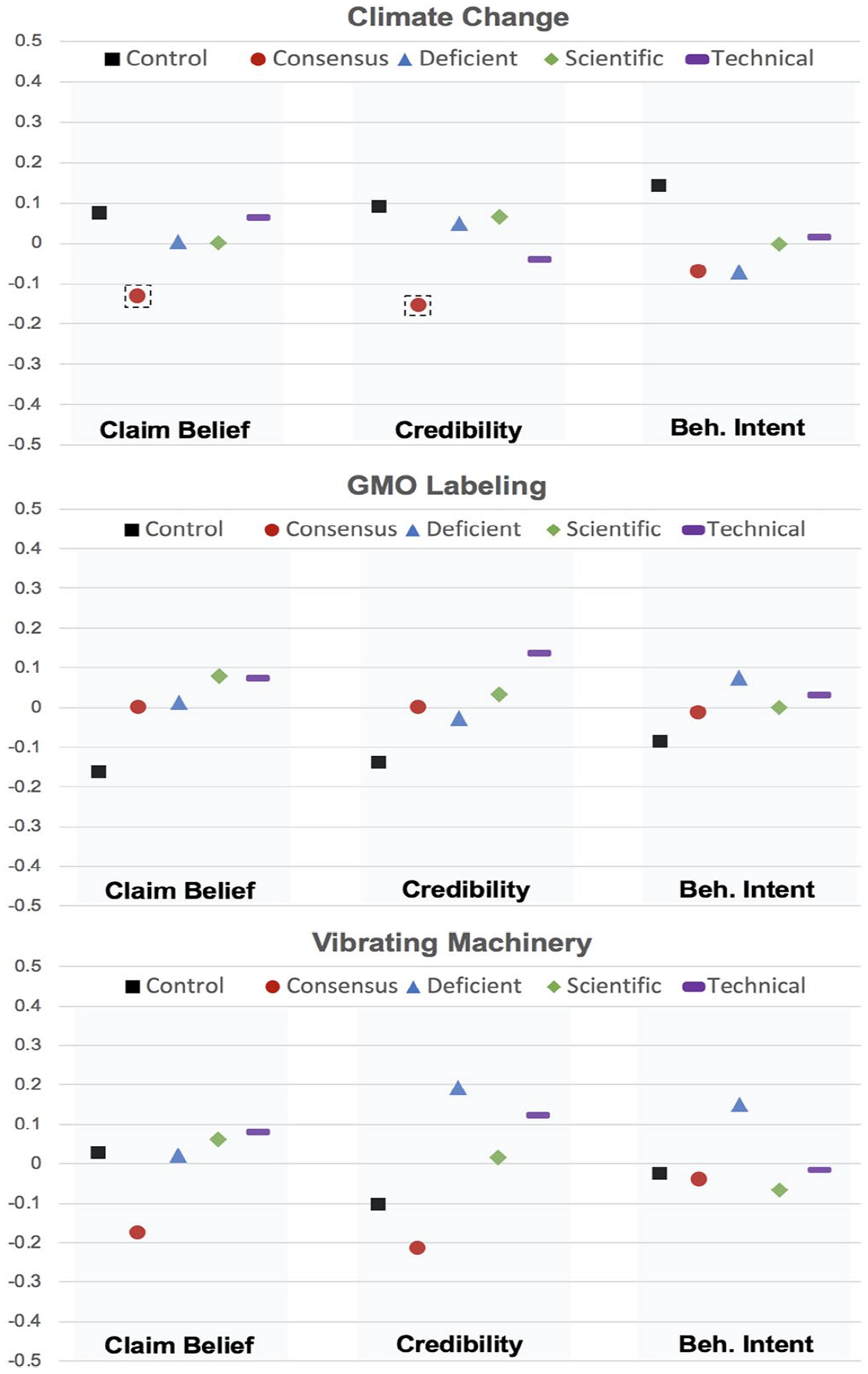
Comparing the marginal means (z-standardized; y-axis) of the three dependent variables, for the five experimental conditions, in each of three topics (each figure).
Omnibus Test of the Effect of Frame Type on Outcomes for Three Issues.
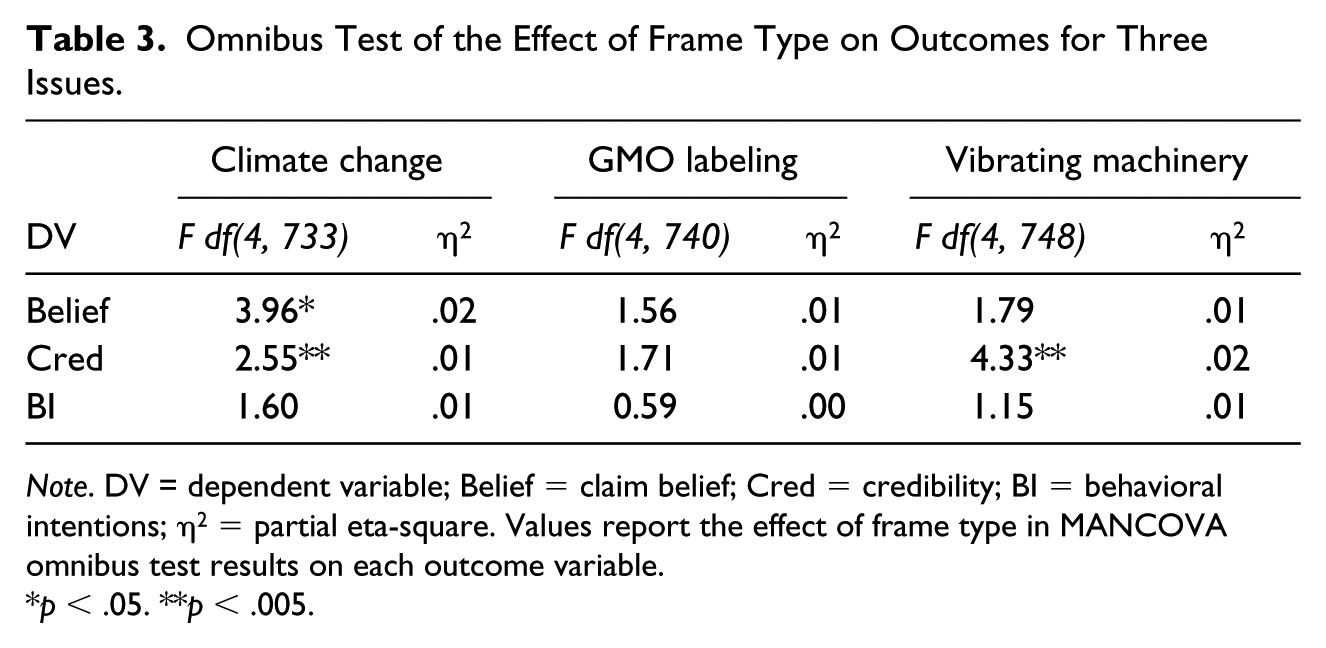
Note = DV, dependent variable; Belief = claim belief; Cred = credibility; BI = behavioral intentions; η2 = partial eta-square. Values report the effect of frame type in MANCOVA omnibus test results on each outcome variable.
p < .05. **p < .005.
Climate change
LSD post hoc comparisons revealed that claim belief was significantly lower in the consensus uncertainty condition (Mz-score = −0.13) compared with the control condition (Mz = 0.07; p = .000) as well as compared with deficient (Mz = 0.00; p = .019), technical uncertainty (Mz = 0.06; p = .001), and scientific (Mz = 0.00; p = .024). Similarly, credibility was lowest in the consensus uncertainty condition (Mz = −0.16)—significantly lower than in the control condition (Mz = 0.09; p = .006), and deficient (Mz = 0.05; p = .022) and scientific (Mz = 0.06; p = .014) uncertainty. Pairwise comparisons show that compared with the control condition (Mz = 0.14), behavioral intentions were significantly lower in the consensus (Mz = −0.07; p = .029) and deficient uncertainty (Mz = −0.07; p = .029) conditions compared with the control condition, but the omnibus test was not significant and as such these small differences in behavioral intent are tenuous (Table 3).
GMO labeling
The omnibus test of differences by frame type was not significant for any outcome in the GMO labeling conditions. Thus, the results of the following pairwise comparisons should be seen as tenuous. Compared with the control condition (Mz = −0.16), claim belief was higher in the technical (Mz = 0.07; p = .031) and scientific uncertainty (Mz = 0.08; p = .031) conditions. Similarly, credibility was higher in the technical uncertainty condition Mz = 0.14) than in the control condition (Mz = −0.14; p = .011).
Vibrating machinery
Credibility was lower in the consensus uncertainty condition (Mz = 0.22) than in the deficient (Mz = 0.19; p = .000) or technical uncertainty (Mz = 0.12; p = .003) or scientific (Mz = 0.01; p = .040) conditions, with a significant omnibus effect of frame type. Claim belief was also lower in the consensus uncertainty condition (Mz = −0.18) than in the scientific (Mz = 0.06; p = .030) or technical uncertainty (Mz = 0.08; p = .020) conditions. However, the omnibus test was not significant, adding uncertainty to these small differences. Behavioral intentions did not differ significantly across any frame type conditions.
Summary
The results indicate partial support for Hypotheses 1a and 1b, such that claim belief and credibility perceptions were slightly lower in response to a consensus uncertainty frame compared with the control and compared with some other uncertainty frame types. This effect is observed in CC and VM conditions but not in the GMO condition. However, effect sizes were very small (η2 = .00-.02). Concerning Research Question 1, in every instance of a significant difference, it is consensus uncertainty (low) compared with some other frame type condition (high). Regarding Research Question 2, the climate change and vibrating machinery conditions had very similar patterns of results across the uncertainty frame types (Figure 1) such that the consensus uncertainty condition produced the lowest claim belief and credibility. However, the GMO condition diverged from this pattern, with the control condition (portraying no uncertainty) being associated with the lowest claim belief and credibility.
Discussion, Limitations, and Future Research Directions
Discussion
This study provides a robust experimental test—across three diverse issue contexts—of whether there are effects of different types of real-world uncertainty frames, relative to a control condition and relative to each other. Importantly, the manipulation check found that respondents noticed and accurately distinguished the operationalized differences in frame type.
In the CC and VM issue conditions, claim belief was slightly but significantly lower in the consensus uncertainty conditions than in the control conditions. For climate change only, credibility is also lower in the consensus uncertainty condition than the control condition.
Portrayals of consensus uncertainty may have negative effects because they introduce the possibility of expert support for both sides, thereby legitimizing (and even providing evidence for) positions of dissent or denial. While these observed effects are small, it is important to keep in mind that they capture a snapshot of attitudes in response to just one message—a message that integrated the uncertainty frame subtly into an authentic news article. It is likely that overtime effects of repeated exposure to aggregate framing trends in broader discourse can have large and lasting effects that are not captured by normative social-scientific experimental methods.
We emphasize two main implications. The first is the apparent (small) negative effect of consensus uncertainty frames in some circumstances. This corroborates prior experimental evidence (e.g., Benjamin & Budescu, 2018; Broomell & Kane, 2017; Corner, Whitmarsh, & Xenias, 2012; Gustafson & Rice, 2018; Koehler, 2016). It also adds additional importance to the substantial evidence from van der Linden and colleagues indicating the benefits of communicating scientific consensus (low consensus uncertainty; van der Linden et al., 2015; van der Linden et al., 2018).
The second implication is that even though participants recognized the presence of the uncertainty frames (and distinguished between them), these data indicate—in this snapshot—no pattern of significant effects of deficient, technical, or scientific uncertainties compared with the control condition on these attitudinal outcome variables. This is of great importance because science communicators often should communicate uncertainties to maximize accuracy and follow ethical principles. Perhaps these findings of no effects of these uncertainty frames in a realistic news article can provide science communicators reassurance that clearly discussing the uncertainties of science may not have negative effects—even when the audience specifically recognizes that those uncertainties were stated. As a reminder, because distinctions between these uncertainty types were clearly made in the manipulation check, this observed lack of effect on outcome variables is not likely because participants failed to see a difference between any of these uncertainty frames (or lack thereof). Rather, it is more likely that these different frames just do not have significantly different effects (on these attitudes, in this one-time survey, with these operationalizations, in the context of these three issues, in this sample).
One interesting result is that while effects on beliefs and credibility perceptions emerged, behavioral intentions were no different across any frame type conditions within any issue or combinations of issues. Perhaps these behaviors themselves were too unfamiliar or difficult to be affected by the manipulations. Readers should keep in mind that these results may not generalize to other, different behavioral intentions. However, one explanation that is well supported by theory is that changing behaviors in general is inherently more difficult than changing beliefs or attitudes (e.g., McGuire, 2012). It is also possible that behavioral intentions are further down the causal chain, such that its change is predicated on changes in beliefs and attitudes. This model is supported by extant research on the determinants of behavior change in science communication contexts (e.g., Bamberg & Möser, 2007; Hornsey, Harris, Bain, & Fielding, 2016). As a supplemental analysis exploring this idea, we used the data from the climate change conditions and ran a parallel mediation analysis using the PROCESS macro in SPSS and 5,000 bootstrapped samples (Hayes, 2013; Model 4). Results showed that the effect of the consensus uncertainty condition (X = 1) compared with the control condition (X = 0) significantly lowered behavioral intentions (Y) via decreases in claim belief (M1; standardized indirect effect = −.067; LLCI = −.136; ULCI = −.012; bootstrapped SE = .031) and credibility perceptions (M2; standardized indirect effect = −.038; LLCI = −.094; ULCI = −.001; bootstrapped SE = .024). These results support the idea that even when uncertainty frames do not have significant direct effects, they still might have significant and important effects via indirect routes.
Another intriguing finding is that no significant effects were observed in the GMO conditions—not even with consensus uncertainty. One possible explanation is that participants already thought that scientists disagreed on the broad issue of GMOs (which is corroborated by the relatively low prior issue position; see Supplemental Material), and thus, frames of uncertainty are seen as more credible and believable in uncertainty frame conditions than in the control condition (Figure 1). This implies that “acceptable” levels of uncertainty vary across issues—which is consistent with prior findings (Jensen & Hurley, 2012), and is a valuable question for future research.
Limitations
Although this study is carefully designed to avoid plausible alternate explanations and confounds, there are some limitations that should guide interpretations of these findings. First, there may be other valid types and typologies of uncertainty frames, providing more or different nuances. Second, while a prior content analysis (Rice et al., 2018) and the present manipulation check give confidence in the theoretical and ecological validity of the current operationalizations (message wording), there are many possible alternative, valid operationalizations. These might result in more, less, or different patterns of, effects. It is important that future research tests how diverse uncertainty type operationalization—and diverse message media, genres, and sources—affect observed effects.
Third, the online experimental survey is not a truly ecologically valid context. As with many similar studies, a one-time message stimulus is not likely to generate large or long-lasting effects. Longitudinal studies and/or studies using a diversified mix of media sources and platforms are difficult and costly, but they are often necessary for understanding the true effects of phenomena like framing. Fourth, the three issues used in this study likely differ in terms of public understanding of the science, public awareness and understanding of the issue, scientific consensus, threat severity, threat salience, and the degree to which a particular degree of scientists’ uncertainty is perceived as acceptable. It is yet unclear to what extent these contextual characteristics determine the effects of uncertainty frames—but it is likely that they are nonnegligible forces.
Future Research Directions
Future research should explore and expand on whether there are functional differences in cognitive responses to these different uncertainty frame types. The degree to which, and the manner in which, these different frames spark different schema or emotions is a fundamental explanatory mechanism for why there would be (or not be) different effects (e.g., Nabi, Gustafson, & Jensen, 2018).
It may be the case that (say, consensus) uncertainty frames about Claim A in Issue 1 may not only have negative effects on attitudes about Claim A in Issue 1 but also about Claim B in Issue 1. An example is if scientists are portrayed as having consensus uncertainty about the effects of climate change (which would not be inaccurate), this portrayal may also increase perceptions that scientists have consensus uncertainty about the existence or causes of climate change (which would be inaccurate). This possible “uncertainty transfer” might also be another effect of motivated reasoning.
Research should also explore the extent to which variations in message source (e.g., politicians, stakeholders, media; see Rice et al., 2018) may moderate the effects of some uncertainty frames. Similarly, research should study more carefully how individual characteristics moderate these effects—especially characteristics that relate to attitudes toward, or preferences for, uncertainty. For example, one small experiment found tentative evidence that need for cognition moderated the effect of an uncertainty frame (Winter, Kramer, Rösner, & Neubaum, 2015). Future research could also test interactions of uncertainty frame type with the covariates used in these analyses.
Finally, appropriate and relevant uncertainty frames could be a strategic tool used to mitigate psychological reactance. That is, it may be that the right portrayals of (say, scientific or deficient) uncertainty could reduce the severity or frequency of instances where oppositional audiences perceive scientists (or others) as being elitist, domineering, or dogmatic. It may be that individuals—particularly those with prior oppositional issue beliefs—would respond more positively to behavioral recommendations (and the sources of them) if they were presented with full disclosure of the (deficient, technical, or scientific) uncertainties of science.
Supplemental Material
SC-19-0059_Effects_of_Uncertainty_Framing__SupplementFINALSP – Supplemental material for The Effects of Uncertainty Frames in Three Science Communication Topics
Supplemental material, SC-19-0059_Effects_of_Uncertainty_Framing__SupplementFINALSP for The Effects of Uncertainty Frames in Three Science Communication Topics by Abel Gustafson and Ronald E. Rice in Science Communication
Footnotes
Acknowledgements
The authors thank Dr. Robin Nabi and Dr. Andy Merolla for their guidance on this project.
Declaration of Conflicting Interests
The author(s) declared no potential conflicts of interest with respect to the research, authorship, and/or publication of this article.
Funding
The author(s) disclosed receipt of the following financial support for the research, authorship, and/or publication of this article: Funding for this research was provided by the Arthur N. Rupe endowment.

Author Biographies
References
Supplementary Material
Please find the following supplemental material available below.
For Open Access articles published under a Creative Commons License, all supplemental material carries the same license as the article it is associated with.
For non-Open Access articles published, all supplemental material carries a non-exclusive license, and permission requests for re-use of supplemental material or any part of supplemental material shall be sent directly to the copyright owner as specified in the copyright notice associated with the article.
