




Abstract
The order in which individuals receive information about wildlife may influence their attitude toward wildlife differently. We explored order effects of a threat message that induced more fear versus a suffering message that elicited more compassion on attitude toward wildlife. Specifically, we focused on bats, a risk-laden species also suffering massive mortalities due to a disease affecting bat populations across the United States. We randomly assigned 1,506 U.S. adults to one of eight message conditions as part of a 2 (message order: suffering → threat vs. threat → suffering) × 2 (suffering messages) × 2 (threat messages) between-subjects factorial design or a control (no message) condition. We found a significant two-way interaction between message order and biospheric values on attitude toward bats. For people with high biospheric values, reading a suffering message first led to a more positive attitude than reading a threat message first, whereas reading a threat message first led to a more positive attitude than reading a suffering message first for people with low biospheric values. Compassion but not fear mediated these effects. Theoretical and practical implications are provided.
Introduction
One way in which individuals form attitudes toward a target is through mediated information they receive about the target. Such information can offer attributes of different valence (e.g., positive vs. negative) to describe that target and can come in various sequential orders. The order of information may be especially crucial when information about the target is inconsistent but provides the basis for initial judgment formation or target reevaluation (Asch, 1946; Hogarth & Einhorn, 1992). We focus on one particular target of inconsistent information: the “scary victim.” The scary victim, as a type, both poses and suffers from threats to humans and wildlife, and this duality leads to often inconsistent messages. Examples in the media abound in which a target, or more specifically wildlife species, is not only portrayed as a vulnerable victim suffering from external forces but also stigmatized or demonized as posing severe threats to others (Bombieri et al., 2018). Sharks, for example, could be considered an archetype of a “scary victim” in wildlife, and research has shown that media coverage emphasizes both their threats to humans alongside their being threatened with extinction (Muter, Gore, Gledhill, Lamont, & Huveneers, 2013).
A major challenge facing today’s wildlife conservation efforts is the mixed and often biased information the media disseminate about scary victims (Bombieri et al., 2018; Muter et al., 2013). Rather than focus on the vulnerable conservation status of these species, the media tend to favor sensationalistic coverage of human-wildlife interactions, most of which paints these species in a negative light, leaving the public with unwarrantedly heightened risk appraisals of these species (Bombieri et al., 2018). In addition to popular media coverage, research has also shown that messages about species coming from different government agencies may emphasize different aspects of the species (Kretser, Lauber, Dixon, & McComas, 2014). For instance, public health agencies may focus on the zoonotic diseases that a species may carry, whereas wildlife agencies tend to communicate more about conservation efforts needed for a species (Kretser et al., 2014). These competing communication goals and the inconsistent messages these goals produce may create a messaging environment in which the general public is confused and thus acts in a way that runs counter to what is intended by different agencies, potentially resulting in a no-win situation.
In the context of the competing messaging environment about conservation, we seek to investigate how audience members respond to the depiction of scary victims, here not only defined as stigmatized species that are cast in the role of being a threat to others but which also deserve compassion due to suffering from disease or other factors. We operationalize the depiction of scary victims as the inclusion of one threat-based, fear-inducing message and one suffering-based, compassion-inducing message about a species, specifically bats. More important, we draw on the classic literature on order effects, which examines how the order in which information is received influences persuasion (Lana, 1964), and the emerging literature on emotional flow, which provides a framework for how to consider the evolution and changes of emotions during exposure to a persuasive message (Nabi, 2015). Because the emotional flow framework takes into account the order in which emotions are elicited by a persuasive appeal, it is used as a new angle to explore the order effects of information that can easily arouse competing emotions. Specifically, we concentrate on examining whether the presentation order of two conflicting messages influences audience members’ attitude toward bats and whether emotions elicited by each message may explain any observed order effects. In addition, we explore whether order effects depend on certain characteristics of the audience, for instance, motivation to process the message. This is based on the attitude strength perspective, which assumes that order effects may vary depending on message recipients’ motivation or ability to process the message (Haugtvedt & Wegener, 1994). By integrating different theoretical perspectives and applying them to the context of bat conservation, we hope to provide new insights into how different theories can complement one another and offer practical implications for how to develop better ways to communicate about scary victims.
Literature Review
Order Effects and Attitude Strength Perspective
Research has demonstrated that the order in which individuals encounter information can affect persuasion (Haugtvedt & Wegener, 1994). When order effects occur, they usually manifest in two forms: primacy and recency effects. Primacy effects emerge when the first piece of information in a sequence has the biggest impact on persuasion compared with information that comes later. In contrast, recency effects arise when the last piece of information in a sequence is more influential than the preceding information in persuasion. Empirical work has provided evidence supporting both primacy and recency effects in a wide range of research contexts (e.g., Cromwell, 1950; Hovland & Mandell, 1957; Stone, 1969). However, disagreement exists over which of the two effects is more likely to appear (Hogarth & Einhorn, 1992).
Several theoretical accounts have been provided to integrate different findings about order effects (e.g., Haugtvedt & Wegener, 1994; Hogarth & Einhorn, 1992; Lana, 1964; Petty, Tormala, Hawkins, & Wegener, 2001). In particular, Haugtvedt and Wegener (1994) put forward an attitude strength explanation, which contends that whether primacy or recency effects may manifest depends on message recipients’ motivation and ability to elaborate. Drawing from the elaboration likelihood model’s (Petty & Cacioppo, 1986) emphasis on the role of elaboration in producing strong attitudes, Haugtvedt and Wegener (1994) suggested conceptualizing order effects as a test of attitude strength, that is, in this case, “the degree of attitude resistance in the face of attack” (p. 207). Specifically, if the initial information succeeds in changing an existing attitude or establishing a new attitude that does not previously exist, how much the subsequent information can change this attitude reflects attitude strength ensuing from the initial information (Haugtvedt & Petty, 1992). Therefore, primacy effects may be considered as the initial information leading to high levels of attitude strength or strong resistance to change caused by subsequent information because the initial information would produce the greatest impact on persuasion (Haugtvedt & Wegener, 1994). In contrast, recency effects may be thought of as the initial information leading to low levels of attitude strength or weak resistance to change caused by subsequent information because information that is encountered later would be more influential (Haugtvedt & Wegener, 1994).
Importantly, factors, such as motivation and ability to elaborate, that strengthen elaboration in the process of forming or changing an attitude are likely to increase attitude strength and influence the odds of the emergence of primary versus recency effects (Haugtvedt & Petty, 1992; Petty & Cacioppo, 1986). That means when motivation or ability to elaborate on information concerning an attitude target is high, message recipients are likely to start thoughtful scrutiny of the initial information. Elaboration requiring such effort will likely lead to greater integration of the information provided in the initial information with existing knowledge structures and help shape the existing attitude toward the target (Petty & Cacioppo, 1986). The resulting attitude (and thus resistance to change) from this elaboration process should be relatively strong. Although message recipients with high motivation or ability are equally likely to elaborate subsequent information, the strong attitude formed from processing the initial information is likely to create strong resistance to any subsequent information that threatens the attitude formed (Haugtvedt & Wegener, 1994). In other words, the attitude formed from the elaboration of the initial information is likely to sustain and represent the final attitude toward the target discussed in the series of information. Therefore, it is assumed that primacy effects are more likely to occur when motivation or ability to elaborate is high (Haugtvedt & Wegener, 1994). On the contrary, when motivation or ability to elaborate on information concerning an attitude target is low, message recipients are unlikely to form strong attitudes because of low elaboration. In this case, memory and recall of the most recent information may be used as a basis for a final attitude, especially when elaboration is so low that no attitudes are fully formed until the attitudinal inquiry (Haugtvedt & Wegener, 1994). Thus, it is presumed that there is a higher chance of recency effects when motivation or ability to elaborate is low (Haugtvedt & Wegener, 1994).
Haugtvedt and Wegener (1994) conducted two experiments operationalizing motivation to elaborate as message relevance to investigate this attitude strength account. Message recipients received pro- and counterarguments regarding the institution of a senior comprehensive exam (in Experiment 1) or the construction of a nuclear power plant (in Experiment 2). These arguments were delivered in an either “pro/con” or “con/pro” argument order. The personal relevance to either the exam or the nuclear power plant was also manipulated. Across the two experiments, Haugtvedt and Wegener (1994) found that for those with high perceived relevance, receiving the arguments in the “pro/con” (vs. “con/pro”) order resulted in a more favorable attitude toward the issue, showing primary effects. In contrast, for those with low perceived relevance, the “con/pro” (vs. “pro/con”) argument order led to a more positive attitude toward the issue, illustrating recency effects. These findings provide support for the attitude strength perspective.
The attitude strength perspective has also been used to explain and integrate findings from other research on primacy and recency effects (Kassin, Reddy, & Tulloch, 1990; Lana, 1961, 1963a, 1963b; Petty et al., 2001). It should be noted that the motivation or ability to elaborate was operationalized differently across studies. In addition to message relevance, variables, such as perceived interest in a topic, familiarity with a topic, controversial nature of a topic, and need for cognition were also considered as indexes of motivation for elaboration through the lens of the attitude strength angle (Haugtvedt & Wegener, 1994). Relevant to our study, the studies explained by the attitude strength perspective examined the order of competing messages that differed in their opinion of a particular target.
Because we focus on conservation efforts related to bats, we use a specific set of values, namely, biospheric values, as proxy for motivation to elaborate messages about bat conservation. A biospheric value orientation places the costs and benefits to ecosystems or the biosphere at the center of individual decision making (Stern & Dietz, 1994). Studies have shown that people with stronger biospheric values tend to show stronger pro-environmental attitudes and intentions and behave more pro-environmentally (see Steg & De Groot, 2012, for a review). Because values are intrinsically motivational and guide behaviors by providing individuals with goals to achieve (Parks & Guay, 2009), it follows that individuals with high biospheric values (i.e., strong concern for the nature) would be more motivated to elaborate on messages related to bats than those with low biospheric values. Based on the assumption of the aforementioned attitude strength perspective, we predict that a primacy effect will be more likely to occur for those with high biospheric values (i.e., high motivation) and a recency effect will be more likely to emerge for those with low biospheric values (i.e., low motivation).
Order Effects and Emotions
Research on order effects has primarily focused on the effects on cognitive outcomes (e.g., Hogarth & Einhorn, 1992; Lana, 1964). Rarely has the investigation of order effects looked into the different discrete emotions that may be induced by various pieces of information or how the varied placement of different emotion-laden information may influence persuasion. This is an underexplored area that may help provide a more thorough understanding of how order effects function because discrete emotions can contribute uniquely to persuasion above and beyond the influence of mere information or cognition (Nabi, 2007). A related idea recently proposed is called emotional flow, which refers to the evolution of the emotional experience during exposure to a persuasive message, marked by one or more emotional shifts (Nabi, 2015). The emotional flow framework is relevant to the current study because, depending on the message content (e.g., depicting bats as threats or as victims or both), people may experience multiple emotions or emotional shifts. It should be noted the original emotional flow framework differs slightly from the current study’s context. Specifically, the emotional flow framework assumes that the emotions elicited by information are aligned toward a common persuasive goal (e.g., fear about climate change threats → hope about climate change solutions; both lead to more favorable attitudes and actions regarding climate change mitigation; Nabi, Gustafson, & Jensen, 2018). In contrast, while the target (i.e., bats) of emotion in the current study is the same, the informational content could be seen as conflicting (i.e., bats as threats vs. bats as victims). Thus, the resulting emotions are not aligned to achieve a common persuasive goal.
The idea of emotional flow is inherently connected with the idea of order. Essentially, emotional flow takes place when information conveyed within a message changes, which causes shifts in emotions. If a message inducing emotional flow is considered as consisting of several pieces eliciting different emotions, the message can be seen as having a fixed order arranging these pieces. For instance, a message may include both threat and suffering information about a wildlife species, with one likely to induce fear and the other compassion. Both pieces of information can be arranged in a particular order in the message. A primacy effect can occur when the piece of information that appears initially in the message is most influential in influencing persuasion via the emotion induced by this initial piece. In contrast, a recency effect can emerge when the most recent piece of information generates the greatest impact on persuasion through the emotion this last piece evokes.
We focus on the sequential order of a threat message that induces fear versus a suffering message that elicits compassion toward bats. Fear and compassion are examined in the current study through the lens of appraisal theories of emotions (Lazarus, 1991). Although we focus on fear and compassion specifically for bats, it is possible to imagine other types of stigmatized groups that bear similar characteristics and could be considered scary victims, such as the aforementioned sharks, which may themselves be prone to order effects such as those investigated in this study.
Fear is considered a negative emotion, which is elicited because of “a concrete and sudden danger of imminent physical harm” (Lazarus, 1991, p. 338) and motivates people to avoid or escape from a threatening target (Lazarus, 1991). Furthermore, feeling afraid of a target is likely to elicit a more negative attitude toward that target (Tannenbaum et al., 2015). Research has shown that a message that features the threat of a target is likely to induce fear toward that target (Tannenbaum et al., 2015). In contrast, compassion is considered a positive emotion, which is felt when witnessing another’s suffering and which subsequently generates a desire to help ease that suffering (Goetz, Keltner, & Simon-Thomas, 2010). Feeling compassionate can improve attitudes toward stigmatized groups and lead to helping behaviors (Batson, Lishner, & Stocks, 2015; Goetz et al., 2010). Research has demonstrated that a message that focuses on the suffering of a target tends to elicit compassion toward that target (Goetz et al., 2010). Because of their differences in valence, action tendencies, and influence on attitudes toward the target eliciting the emotion, fear and compassion appear to be incongruent with one another in the formation of attitudes toward the same target. An empirical question remains when both emotions are experienced, “Which one will be more influential?”
Fear and compassion are considered highly relevant to the current study, in which negative, stigmatized messages villainizing bats and conservation messages describing the suffering of bats are tested. With the exception of one study that found that fear negatively and compassion positively influenced shark conservation support (Myrick & Evans, 2014), little research has examined how message-induced fear and compassion might affect attitudes related to bat conservation. In addition, no studies have examined how the order in which individuals experience fear and compassion elicited by messages may influence attitudes, which deserves further exploration because it can enhance a better understanding of order effects and emotional flow.
Context
In the current study, we focus on bats and two diseases associated with bats, namely, rabies and white-nose syndrome (WNS). Bats are a risk-laden species, and they are also frequently depicted in mainstream media as scary or threatening (Knight, 2008). In terms of public health risks, bats can transmit rabies, a disease fatal to humans if untreated, and bats’ accumulated excrement in buildings can create conditions favorable for pathogens that are harmful to humans (Adams & Pedersen, 2013). Bats also face conservation challenges, with nearly 300 bat species considered to be in a vulnerable conservation status (International Union for Conservation of Nature, 2018). Among these challenges is WNS, a highly contagious disease among cave-hibernating bats caused by the fungus Pseudogymnoascus destructans (Blehert et al., 2009). Since 2006, over 6 million bats have died due to WNS, which has mortality rates higher than 90% for some species (Froschauer & Coleman, 2012), resulting in the largest species die-off in North American history. Bats and the two diseases provide an ideal context for testing the depiction of scary victims and the influences of fear and compassion on attitudes because information about bats and rabies, that is, threat information, is likely to induce fear, whereas information about bats and WNS, that is, suffering information, may elicit compassion. Different presentation orders of such information can be easily found from different agencies (e.g., National Park Service, 2016; Virginia Department of Conservation and Recreation, 2015), affirming the ecological validity of testing their order effects. Such investigations can assist individuals and organizations in designing more effective communication strategies for species, like bats, that face a myriad of conservation challenges.
We label the two competing messages as threat or suffering messages based on their intrinsic message features rather than the potential emotions they induce, which is consistent with recommendations from O’Keefe (2003). Drawing on research showing the intrinsic message features that are likely to elicit fear or compassion (Goetz et al., 2010; Tannenbaum et al., 2015), we first propose two hypotheses predicting that the two messages will indeed induce primarily the target emotion:
We focus on attitude toward bats as the outcome variable because we draw from the literature on order effects and the attitude strength perspective that focuses on attitude as the final outcome (Haugtvedt & Wegener, 1994; Petty et al., 2001). An individual’s attitude toward bats will likely be formed as a direct function of fear and compassion toward bats. Based on the attitude strength perspective regarding how motivation to elaborate may moderate order effects, and the conceptualization of biospheric values as a motivational factor to process bat-related information, we propose the following hypothesis:
Finally, drawing on the emotional flow framework, we are also interested in examining whether emotions induced by the messages explain potential order effects. Because of the lack of evidence supporting a concrete hypothesis, we propose a research question to investigate a conceptual model for this study (Figure 1).

Conceptual model.
Method
Participants
We recruited 1,506 U.S. adults, who received $1 for participation in the study, via Amazon’s Mechanical Turk during September 1 to 2, 2017. Among the participants, 41.8% were male, 58.2 % were female with a mean age of 38.08 years (SD = 12.24). The median highest level of education was a bachelor’s degree, and the median annual household income was $35,000 to $49,999. The distribution of racial background among participants was White 76.0%; Black 7.8%; Asian 7.4%; Hispanic or Latino 5.6%; other, including multiethnic and/or multiracial, 2.8%; and 0.5% preferred not to answer. Prior to this study, 86.7% of the participants said that they were aware that some bats carry rabies, and 68.3% said that they knew nothing about WNS.
Stimuli
We created two types of messages for use in our experiment in consultation with wildlife conservation experts. The first one is the threat message. The threat messages started with a picture of a bat, followed immediately by a bulleted list that included basic descriptions of rabies (e.g., what rabies is, what percentage of bats have rabies, how rabies is transmitted from an infected animal, the fatalness of rabies) and recommended behaviors for rabies prevention (e.g., avoid direct contact with bats, seek medical help after direct contact with a bat). The second is the suffering message. The suffering messages also started with a picture depicting the consequence (deceased bats) or prevalence of WNS (a map). Below the picture appeared a bulleted list explaining what WNS is, how WNS affects bats, why bats dying from WNS should be a concern, and what can be done to help bats. The format of these messages is similar to how bat rabies and WNS information is communicated in real-world handouts (e.g., White-Nose Syndrome Interagency Communications and Outreach Working Group, 2017). There are two threat and two suffering messages. The two threat messages differed in only the picture provided in the message: one showed a bat displaying sharp teeth, and the other showed a bat with a closed mouth. Similarly, the two suffering messages differed in only the picture included in the message, with one showing a dying, WNS-infected bat in the snow and the other showing a map of WNS occurrence in the United States. We chose these pictures based on our review of pictures commonly used in handouts about bats, rabies, and WNS. We used two threat and two suffering messages to reduce the concern that the effects identified in the current study were constrained to a specific message/picture used in the experiment (O’Keefe, 2002).
Procedure
We randomly assigned participants to one of eight message conditions as part of a 2 (message order: suffering → threat vs. threat → suffering) × 2 (suffering messages) × 2 (threat messages) between-subjects factorial design or a control (no message) condition. After completing the informed consent, participants were told that they would read two messages about bats in the United States on subsequent pages. In the ST (suffering → threat) condition, participants read the suffering message first and the threat message second. In the TS (threat → suffering) condition, participants read the threat message first and the suffering message second. Participants in all conditions completed a questionnaire including key measures detailed in the next section.
Key Measures
Emotions
For participants in the message conditions, we measured their emotions—namely, compassion and fear—three times during the study. After reading the first message (Time1), we asked participants to indicate to what extent they felt each of the listed emotions while reading the information on the previous page (0 = not at all to 6 = extremely). We measured the same emotions again after participants had read the second message (Time2). Later in the questionnaire, participants also reflected on how the two messages overall (Time3) made them feel (Dillard, Li, Meczkowski, Yang, & Shen, 2017). Compassionate, sympathetic, and softhearted were used to measure compassion (Lu & Schuldt, 2016). Afraid, fearful, and scared were used to measure fear (Shen & Dillard, 2007). We created scales for compassion and fear, respectively, by averaging each emotion item. The descriptive statistics are shown in Table 1. We asked participants in the control condition only once to indicate to what extent they were feeling each of the listed emotions at the moment and created averaged scales for compassion and fear (α = .93, Mcompassion = 2.34, SD = 1.67; α = .96, Mfear = 0.85, SD = 1.26).
Descriptive Statistics of Compassion and Fear for Message Order Conditions.

Note. ST = “suffering → threat” condition; TS = “threat → suffering” condition; items were measured on a 0 to 6 scale. For Time1 and Time2 measures, numbers with the same letter are significantly different at p < .05.
Attitude Toward Bats
We asked participants to what extent they agreed or disagreed that each of the following words was a good description of bats: useful, worthless (reverse-coded), and beneficial (0 = strongly disagree to 6 = strongly agree). We adapted these three items from previous research (Lu et al., 2017) to assess the attitude toward bats and averaged them to create an attitude scale (α = .86, M = 4.88, SD = 1.18).
Biospheric Values
We asked participants to what extent they agreed or disagreed with each of six statements (0 = strongly disagree to 6 = strongly agree): “All animals have a right to live”; “As humans, we have a moral obligation to ensure that we do not cause the extinction of other species”; “The Earth’s fragile ecosystems can be disrupted by very small changes in the balance of species”; “Losing one species will have far-reaching effects on the ecosystem as a whole”; “The Earth’s remaining ecosystems should be conserved at all costs”; “Every species has equal value and an equal right to exist.” We adapted these items from prior research (Brackney & McAndrew, 2001; McComas, Schuldt, Burge, & Roh, 2015) to measure biospheric values and averaged them to create a biospheric values scale (α = .91, M = 4.74, SD = 1.05).
Analyses
For the preliminary analyses, we first tested whether the message conditions had different influences on biospheric values, which was measured after message exposure, and attitude toward bats. In particular, we were interested in whether there was any difference between the two threat messages or the two suffering messages. We ran three-way analyses of variance (ANOVAs) featuring the message order condition, the threat message condition, and the suffering message condition, and their two-way and three-way interactions as the independent variables, and biospheric values and attitude toward bats as the dependent variable, respectively. The control condition was not included in the three-way ANOVAs.
Then, we examined whether the message conditions influenced attitude toward bats differently than the control condition. Based on results of the three-way ANOVAs, we conducted a one-way ANOVA featuring the two message order conditions and the control condition as the independent variable and attitude toward bats as the dependent variable.
To examine Hypotheses 1a and 1b regarding the differences in the level of fear and compassion elicited by the threat and suffering messages, we conducted two-way mixed repeated ANOVAs featuring the message order condition (TS = 1, ST = 0) as the between-subjects factor, time (i.e., Time1 and Time2) as the within-subjects factor, and compassion and fear as the dependent variable, respectively. As supplemental analyses, we also conducted paired-samples t tests to examine whether the level of compassion versus that of fear elicited by each message was different.
Finally, we conducted one-way ANOVAs featuring the message order condition as the independent variable, and compassion and fear at Time3 as the dependent variable, respectively, to examine whether overall experience of compassion and fear during message exposure differed across conditions.
To examine Hypothesis 2 regarding the moderating effects of biospheric values, we constructed a general linear model featuring the message order condition, biospheric values, and their interaction as the independent variables, and attitude toward bats as the dependent variable.
To address Research Question 1 regarding the mediating role played by compassion and fear, we conducted a moderated mediation analysis using the PROCESS macro for SPSS with 10,000 bootstrap resamples and 95% confidence interval (CI) to explore whether compassion and fear at Time1 and Time2 could serve as mediators (Hayes, 2017). Because the numbered models provided by PROCESS do not match exactly the conceptual model in Figure 1, we created a customized model (Hayes, 2017). Specifically, based on the conceptual model in Figure 1, the message order condition served as the independent variable and attitude toward bats served as the dependent variable. Compassion and fear at Time1 and Time2 served as the mediators, with compassion at Time2 following compassion at Time1 and fear at Time2 following fear at Time1. Biospheric values performed as the moderator of the five paths from the message order condition to the four mediators and the dependent variable.
Results
Preliminary Analyses
The three-way ANOVAs did not find that the two suffering message conditions, the two threat message conditions, or any interaction involving these conditions differentially influenced the moderator (i.e., biospheric values) or the outcome variable (i.e., attitude toward bats). Given that outcome, we collapsed these conditions respectively for more parsimonious tests, resulting in the two message order conditions (i.e., ST and TS) and the control condition.
The one-way ANOVA results showed a significant main effect of the three conditions on attitude toward bats, F(2, 1503) = 19.61, p < .001,
Testing Hypotheses 1a and 1b
Detailed statistics are shown in Table 1. Starting with compassion, the results showed a significant interaction between the message order condition and time, F(1, 1342) = 1702.89, p < .001,
In relation to fear, there was a significant interaction between the message order condition and time, F(1, 1342) = 531.66, p < .001,
Moreover, the results of paired-samples t tests show that participants felt significantly more of either compassion or fear than the other emotion at Time1 and Time2 depending on the condition, ps < .001. Finally, the one-way ANOVAs showed that participants’ compassion and fear rating at Time3 did not differ significantly. Taken together, these results suggest that Hypotheses 1a and 1b were supported: A threat message about bats elicited more fear than a suffering message, and a suffering message elicited more compassion than a threat message.
Testing Hypothesis 2
We found a significant main effect of the message order condition on attitude toward bats, F(1, 1340) = 10.39, p = .001,
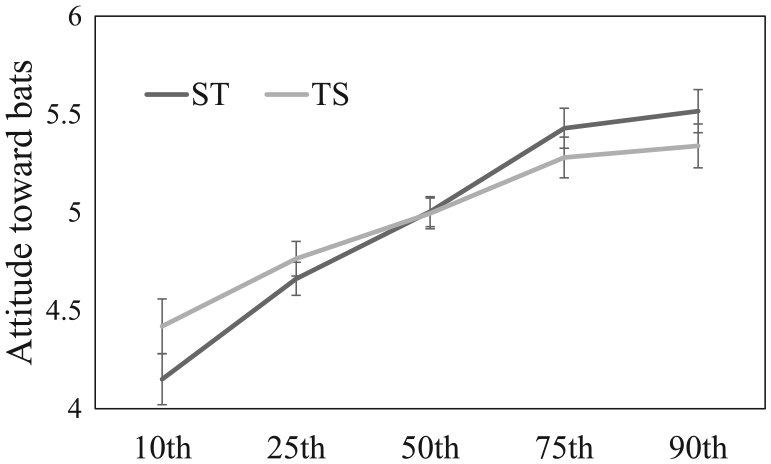
Graph depicting the effect of the message order condition on attitude toward bats at the 10th, 25th, 50th, 75th, and 90th percentiles of biospheric values. Error bars represent 95% confidence intervals.
Moderated Mediation Analysis for Research Question 1
With regard to fear, the results show that the confidence intervals for the effects of the indirect path from the message order condition through fear at Time1 alone (Βindirect = 0.01, SE = 0.01, 95% CI [−0.01, 0.02]) or fear at Time2 alone (Βindirect = 0.02, SE = 0.01, 95% CI [−0.01, 0.04]) to attitude toward bats included 0 (Figure 3). In addition, the confidence intervals for the effects of the indirect path from the message order condition through fear at Time1 and then fear at Time2 (Βindirect = 0.01, SE = 0.01, 95% CI [−0.01, 0.02]) to attitude toward bats also included 0. In other words, fear at Time1 and fear at Time2 did not serve as mediators.

Moderated mediation model showing interaction effects of the message order condition and biospheric values on attitude toward bats via compassion and fear at Time1 and Time2.
With regard to compassion, the results show that the confidence intervals for the effects of the indirect path from the message order condition through compassion at Time1 alone (Βindirect = −0.05, SE = 0.01, 95% CI [−0.07, −0.03]) or compassion at Time2 alone (Βindirect = 0.04, SE = 0.01, 95% CI [0.02, 0.07]) to attitude toward bats did not include 0 (Figure 3). In addition, the confidence intervals for the effects of the indirect path from the message order condition through compassion at Time1 and then compassion at Time2 (Βindirect = −0.02, SE = 0.01, 95% CI [−0.03, −0.01]) to attitude toward bats did not include 0. In other words, the indirect effects of the message order condition moderated by biospheric values on attitude toward bats was mediated by compassion at Time1 and Time2. Specifically, for people with extremely low (10th percentile) biospheric values, the TS (vs. ST) condition led to less compassion at Time1 (Βindirect = −0.16, SE = 0.03, 95% CI [−0.24, −0.10]) and more compassion at Time2 (Βindirect = 0.17, SE = 0.04, 95% CI [0.09, 0.25]), which resulted in a more positive attitude toward bats, whereas for people with moderately high (75th percentile) or extremely high (90th percentile) biospheric values, the ST (vs. TS) condition led to more compassion at Time1 (75th percentile: Βindirect = −0.28, SE = 0.05, 95% CI [−0.39, −0.18]; 90th percentile: Βindirect = −0.29, SE = 0.06, 95% CI [−0.40, −0.19]) and less compassion at Time2 (75th percentile: Βindirect = 0.28, SE = 0.06, 95% CI [0.15, 0.40]; 90th percentile: Βindirect = 0.28, SE = 0.06, 95% CI [0.16, 0.41]), which led to an improved attitude toward bats.
Discussion
Bats, as might other scary victims, suffer from the idiosyncrasies of whether media frame them as threats to public health or victims of disease. Because of the conflicting messaging environment about bats and other wildlife species, for example, sharks, we investigated whether the order of competing messages inducing fear versus compassion toward bats was an important factor influencing attitude toward these scary victims. We further examined the conditions under which the order was more impactful and the underlying mechanisms (i.e., emotions at different time points) that explained the observed effects.
Participants in the message conditions received conflicting information about bats, which could result in different attitudes toward bats depending on how they processed the information. We found that, as compared with the control condition, regardless of the order, providing messages about bats that included information about threat (i.e., fear inducing) and suffering (i.e., compassion inducing) increased positive attitude toward bats, which is consistent with previous research showing that when a more balanced set of information (vs. threat-only information) is provided, people tend to evaluate bats more positively (Lu et al., 2017). We speculate that our findings may be because participants weighed the suffering message more heavily than the threat message in the formation of their final attitude toward bats. Along these lines, we found that participants knew more about bats and rabies than WNS prior to this study and thus might have given value to the more novel information.
The current study is in line with recent trends advocating for a more nuanced, process-oriented approach to studying how emotions may explain classic framing effects like the gain-loss framing (Nabi et al., 2019). It should be noted that we did not focus simply on general affect (e.g., positive vs. negative) but also on discrete emotions. Although general affect may be applicable to situations where message recipients are asked to form impressions of an unfamiliar target based on a list of descriptions (Asch, 1946), we believe that discrete emotions can be more useful in explaining reactions to more complex messages (Nabi, 2007). Investigating discrete emotions as a possible underlying mechanism may also provide some insights into the inconsistency of order effects research. For instance, research has shown that the feeling of one emotion may blunt the feeling of a subsequent emotion if the two emotions differ in their appraisal tendencies (Winterich, Han, & Lerner, 2010). When information delivered in a sequence elicits two adjacent emotions that may blunt one another, a predicted order effect may not appear because the blunting effect may interfere with how much weight message recipients assign to each piece of information when forming their attitude. In such situations, only when the emotions underlying each piece of information are taken into account can the process of how order effects occur be fully understood.
Coming back to the current study, although we successfully manipulated the order of the competing information as indicated by the different emotions measured at each time point, we found no main effect of the order on attitude toward bats. This finding may be unsurprising because the overall information participants received was the same across the two conditions and the order manipulation might be too subtle to cause any significant differences. In addition, when participants were asked retrospectively how they felt overall as they went through the two messages, their emotional responses did not differ.
The original emotional flow framework (Nabi, 2015) and its few empirical investigations (Nabi et al., 2018; Nabi & Myrick, 2019) have focused on emotions that work coherently for a common persuasive goal. However, there are situations where the emotional flow framework is not readily applicable. For instance, a persuasive message may induce multiple unintended or undesirable emotions that work against the intent of the message creator (Dillard, Plotnick, Godbold, Freimuth, & Edgar, 1996). Another example is that some persuasive messages may provide ostensibly two-sided arguments for an attitude target to disguise their persuasive intent but nevertheless try to nudge the message recipients toward one end of the attitude spectrum (Crowley & Hoyer, 1994). In such situations, two-sided arguments can elicit conflicting emotions concerning the attitude target, and there will likely be some changes in emotions during exposure to these arguments. It should be noted that we do not intend to argue that the original scope of the emotional framework is flawed. Instead, we believe that adopting a broader definition of emotional flow and taking into consideration how competing emotions may shift from one to another can be beneficial to the further theorization of the original framework, for instance, considering the relationship (e.g., competing, coordinating, etc.) between multiple emotions in the flow process. We explored one way to study the flow of emotions elicited by competing information, which is through the lens of order effects. Future research can also examine other angles for competing emotions, including those proposed for the original emotional framework, such as arranging discrete emotions in a specific sequence to maximize their impacts on different persuasive outcomes, examining the influence of information placed at the point of an emotional shift, and assessing how a previously felt emotion may influence the elicitation or experience of a subsequent emotion (Nabi, 2015).
Drawing on the attitude strength perspective that proposed motivation to elaborate as an important moderator for order effects (Haugtvedt & Wegener, 1994), we investigated whether biospheric values, which served as a proxy of motivation to elaborate, could moderate the order effects of fear- and compassion-inducing information. Consistent with the attitude strength perspective, the results showed a primacy effect of compassion-inducing information on attitude toward bats for people with high biospheric values and a recency effect of compassion-inducing information for people with low biospheric values. We acknowledge that the attitude strength perspective may only be applicable when the initial attitudes toward a target are pliable (Haugtvedt & Wegener, 1994). If the premessage attitude is unlikely to be changed, the order of information should not have an impact on the attitude. However, we found no evidence that the attitudes of those with extremely high biospheric values were immovable. This might be because the attitudes of those with extremely high (90th percentile) biospheric values were still well below the upper end of our attitude scale, suggesting that there was room for change. Future research may empirically explore order effects in this alternative situation when initial attitudes are unlikely to be changed. If order effects disappear in such a situation, it may in fact provide more support for the attitude strength perspective.
Perhaps a more intriguing finding was the identification of the two mediators: compassion at Time1 and Time2. These two mediators helped not only explain the underlying mechanism from a dynamic, process-oriented perspective (Lang & Ewoldsen, 2010) but also provide additional support for the attitude strength explanation. The traditional self-reported measure of emotions usually implemented after the entire message exposure period was unable to explain the findings. Instead, measures that captured participants’ emotional responses at different time points during their message exposure were better able to elucidate the effects. Specifically, the moderated mediation analysis indicated that it was the differences in compassion felt at different time points that contributed to the differences in attitude toward bats. Interestingly, there were also differences in fear at different time points, but fear was not a significant mediator. In other words, the reason why some participants had a more positive attitude toward bats was because they felt more compassionate, not because they felt less fear. These results seem to suggest that in forming attitude toward bats, compassion played a more critical role than fear. Because we did not design our study to investigate when and why compassion would outperform fear in influencing attitude, future research should devote more effort to understanding how contradictory emotions like compassion and fear may interact with each other to influence attitude.
Despite the study’s contributions, we should note some limitations. First, apart from the differences in compassion and fear between the threat and the suffering messages, there might be other differences between the two messages that could also explain the results. For instance, the difference in perceived novelty noted earlier might have contributed to a difference in attitude toward bats. Importantly, research on fear appeals has examined how prior knowledge influences the appeal’s effectiveness and provided some evidence showing that a strong fear appeal is more effective among people with a relatively lower (vs. higher) level of prior knowledge (De Pelsmacker, Cauberghe, & Dens, 2011; Nabi, Roskos-Ewoldsen, & Dillman Carpentier, 2008). This is partly because people with a lower (vs. higher) level of prior knowledge are less likely to show reactance to the fear appeal (Nabi et al., 2008). In the current study, the threat message, consisting of both threat and efficacy information, can be considered a fear appeal. Because most participants prior to participating in our study had been aware of the fact that bats can carry rabies, our threat message might have not been very effective for them. In contrast, because of participants’ relatively low familiarity with WNS, the suffering message might have been more influential in changing their attitudes (Wood, 1982). Relatedly, the reason why compassion and not fear explained the moderation results might be because the more influential novel message about WNS made compassion more impactful in determining participants’ final attitude.
Along similar lines, because media coverage tends to focus on negative images of bats, any mention of positive attributes of bats and their status as vulnerable species may be considered novel to the public. It would be difficult and arguably less ecologically valid to avoid introducing confounding factors like perceived novelty if the goal is to investigate messages conveying competing information (e.g., threat vs. suffering) about bats. In addition, it is possible that the correlation between perceived novelty and felt compassion would be small, if significant at all. Even if perceived novelty were to explain the findings, it is likely that felt compassion would still remain an important mediator. That stated, we did not design this study to examine the role of prior knowledge or perceived novelty in influencing the processing of competing messages and thus did not include relevant measures. One promising line of research for future investigations is to select another scary victim, whose threat and suffering are equally familiar to participants, so that it is possible to have a cleaner examination of the mediating role played by emotions.
Second, although the threat message elicited significantly more fear than the suffering message as well as more intense fear than compassion within the message, the level of fear in the threat condition was still relatively low. It is possible that bats were not perceived as a personal threat by many participants because of the relatively low frequency of encountering one in real life. However, because fear can be experienced not only by direct contact but also through vicarious exposure or social learning (Rachman, 1977), we believe that people can still feel scared of bats, even though their probability of encountering one is relatively low. In fact, scholars have documented that the public is generally afraid of bats (Kingston, 2016). Then perhaps participants could have reported high levels of fear toward bats but did not due to the way in which the measures and messages were constructed. Specifically, for those in the message conditions, they were not asked about their feelings toward bats but about their feelings toward the messages. In addition, the threat message was different from typical media portrayal of bats, which tend to sensationalize the threats posed by bats. Our threat message also included efficacy information regarding protection from bat rabies, which might have served to reduce participants’ reported fear to some extent (Dillard et al., 2017).
Relatedly, fear may not be the only emotion relevant to the context of bats and rabies. Disgust, an emotion that motivates an act of rejection in response to passive or latent danger (Newhagen, 1998), could be another major emotion experienced in this context and might explain the relatively low level of reported fear. Indeed, scholars have mentioned the relevance of disgust to bats and rabies (e.g., bats are dirty animals that can transmit rabies; Bexell & Feng, 2013). Unfortunately, because the primary focus of our study was to compare the dominant emotion elicited by either the threat message or the suffering message, we considered only one emotion for each message. When investigating the audience’s emotional changes during message exposure, future research should consider not only how emotions may shift when the theme shifts (e.g., from threat to suffering) but also how emotions may change or coexist even within the same theme.
Third, we acknowledge that conservation intentions or behaviors may be a more important outcome to examine for practical implications. The primary reason why we focused on attitudes toward bats in this study was because of the attitude strength framework we adopted. Prior research examining order effects and attitude strength perspective all focused on attitude as the final outcome and did not propose any predictions regarding behavioral intentions or behaviors (Haugtvedt & Wegener, 1994; Petty et al., 2001). In addition, our threat message recommended rabies prevention behaviors and suffering message recommended bat conservation behaviors. These are two different types of behaviors that are not exclusive to one another, meaning that the threat message may lead to more adoption of the rabies prevention behavior but does not necessarily reduce the intention for conservation, and the opposite is true for the suffering message. In contrast, attitude is a variable that can be influenced by both the threat and the suffering messages. Specifically, any negative influence of the threat message on attitude is irreconcilable with any positive impact of the suffering message on attitude. The competing messages have to be weighed when message recipients form their final attitude. Future research can try to identify potential behaviors that may be directly influenced by exposure to both threat and suffering messages and examine if the attitude strength perspective is still applicable.
Finally, text-based messages may not be the optimal type of media for testing order effects of emotion-laden messages because, realistically speaking, the audience members have the freedom to choose the order in which they would like to read a text-based message. Individuals do not have to follow the sequence of the text structured by the message creators. Therefore, audio- and video-based media content may be a better choice, though the audience members can still choose to skip certain content. Future research could examine order effects using audio- and video-based media.
Practically speaking, our study casts light on how message creators may arrange different pieces of information sequentially to achieve conservation goals. In doing so, it provides implications for communication about species like bats that are traditionally portrayed as villains in the media but are in fact victims of various suffering. Knowing the target audience and potentially their values, communication practitioners can think strategically about which information they want to place at the front and at the end of the message. For instance, when practitioners are designing a message presenting various facts about a species, they should consider placing information that elicits compassion toward the species at the end of the message for those who may care less about the species and its conservation. In contrast, practitioners should ensure that the compassion-inducing information is the first piece of information that those who care more about the species and conservation come across. If text-based messages, like pamphlets, are used, message designers may choose to place different pieces of information on separate pages to better guide the order in which people receive the information. Future research can also explore the implications of order effects in messages communicating about other scary victims, which are suffering victims also posing potential threats to others. Our findings suggest the importance of considering the order of information when designing these messages.
Footnotes
Declaration of Conflicting Interests
The authors declared no potential conflicts of interest with respect to the research, authorship, and/or publication of this article.
Funding
The authors disclosed receipt of the following financial support for the research, authorship, and/or publication of this article: This research was funded by the Small Grant Awards provided by the Institute for the Social Sciences at Cornell University.
