




Abstract
This study employs the risk information seeking and processing (RISP) model to examine social cognitive variables that motivate active information seeking and systematic processing. The research context is the recent childhood vaccine scandals in China. As a novel contribution to the RISP literature, a significant interaction between relevant channel beliefs and perceived information gathering capacity is unveiled. This result suggests that both information quality and accessibility to information channels influence information seeking, which is an important finding with theoretical and practical implications for other science communication issues.
Keywords
Research on information seeking and information processing focuses on factors that make individuals more prone to actively seek information and carefully process this information. In the past two decades, several theoretical models have been proposed to delineate motivational factors that influence information seeking and information processing within the fields of mass, interpersonal and organizational communication, and information science (c.f., Afifi & Weiner, 2004; Johnson et al., 1995; Wilson, 1999). In particular, the risk information seeking and processing (RISP) model (Griffin et al., 1999) has been examined in a variety of contexts ranging from flooding in urban watershed (Griffin et al., 2008), sexual assault prevention (Pokrywczynski et al., 2019), to cancer clinical trials (Yang et al., 2010). Most of the key hypotheses in the model have received consistent support, with the model accounting for half of the variance in information seeking (range: .10-.72, median: 52%) and about one third of the variance in systematic processing (range: .03-.78, median: 34%) (Yang, Aloe, et al., 2014).
Although the model appears to demonstrate excellent explanatory power, most of the empirical evidence has been generated based on U.S. samples. Much is unknown about what motivates people to actively seek and process information in a highly censored media system. This exploration is important because in an information environment heavily monitored by the government, people have more limited access to information, both in terms of quality and quantity (MacKinnon, 2009). Thus, it is crucial to examine what social cognitive factors motivate people to search for risk information that may not be readily available. Furthermore, although the RISP model proposes moderation effects (Griffin et al., 1999) among key predicting variables (Figure 1), these relationships have never been examined empirically. Last, with a few exceptions, prior RISP studies have focused primarily on risk perception and negative emotions, although many risk-laden issues such as new technology also bring about important societal benefits (Lee et al., 2005). Thus, in this research, we attempt to push theory testing and theory development in three ways. First, we recruit an adult sample from mainland China to test the applicability of the RISP model in a cultural context that is different from the United States. Although several prior studies have employed Chinese samples, most of them are only focused on information seeking (e.g., Yang, Kahlor, et al., 2014). Second, we examine both direct and interactive effects of key predicting variables. Third, we incorporate both risk and benefit perception, as well as negative and positive emotions, to evaluate how they influence communication behaviors. Below, we first briefly introduce the issue context of this study, and then review key concepts of the RISP model to propose specific hypotheses.
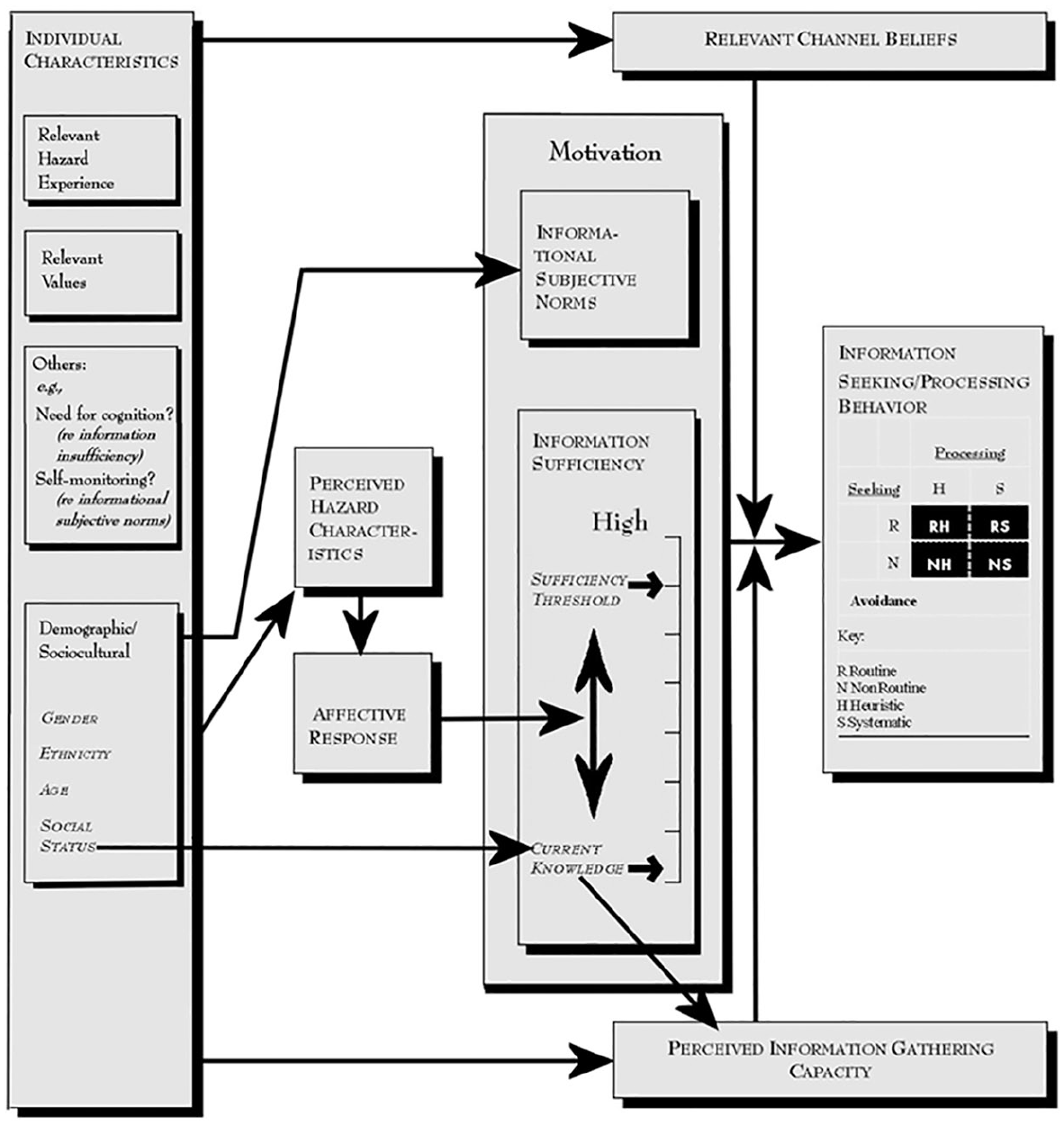
Risk information seeking and processing model (Griffin et al., 2013).
Issue Context: Vaccine Scandals
The issue context for this study is the recent childhood vaccine scandals in China. China has one of the highest infant vaccination rates in the world (Phillips, 2018), with diphtheria-pertussis-tetanus-(DPT), polio, and measles vaccines all reaching 99% immunization coverage (World Health Organization [WHO], 2020). However, repeated vaccine scandals have shaken Chinese parents’ confidence in vaccine safety. In 2013, eight infants died after receiving hepatitis B vaccine (Barboza, 2013). In 2016, vaccines that were improperly stored led to the death of four children (Qiu et al., 2016). In 2018, one of China’s largest vaccine manufacturers, Changsheng Biotechnology, profited from over 250,000 substandard DPT vaccines (Kuo, 2018). In 2019, over 100 children received expired polio vaccines in eastern China (Wee & Chen, 2019). These vaccine scandals plagued Chinese parents with uncertainty about vaccine safety. For instance, Yu et al. (2016) found that before the hepatitis B vaccine scandal in 2013, 85% of the surveyed parents viewed domestic vaccines as safe; after the scandal, only 26.7% agreed that domestic vaccines were safe.
In the midst of this public trust crisis, emotions ran high. For instance, hashtags related to the 2018 vaccine scandal were viewed 600 million times within the first few days (Kuo, 2018). As one Chinese father said, “I [and my family] will not be having any more vaccination in mainland China until the government takes real and serious steps to resolve this issue” (Leng & Huang, 2018). Many Chinese parents searched and shared information on social media about getting their children vaccinated in Hong Kong to avoid substandard vaccines (Fung et al., 2016). As a result, parents who were able to travel to nearby regions or countries opted to get their children vaccinated elsewhere because they did not view domestic vaccines as safe (Paquette, 2018). Unfortunately, low-income families had to rely on domestic vaccines to meet China’s childhood vaccine mandate (Wang et al., 2018).
Although public risk perception about vaccine safety increased as a result of these scandals, the actual risk posed by substandard vaccines was low (Wang et al., 2018). Specifically, although the substandard vaccines have lost efficacy in preventing the diseases they were intended to prevent, they were not life threatening or directly harmful to human health (WHO, 2016). The only recourse needed was a catch-up shot of the effective vaccine. Nevertheless, as Wang et al. (2018) cautioned, the lack of accurate information about the vaccine scandals may lead to other negative consequences, such as hesitation about vaccination, which did not previously exist. Therefore, from a communication perspective, we seek to identify motivational factors that drive Chinese parents to actively seek information about the vaccine scandals and process relevant information in a thoughtful and elaborate manner (termed as systematic processing). Past research indicates that active information seeking and systematic processing are crucial communication behaviors that contribute to the formation of knowledge (Kahlor & Rosenthal, 2009), attitude (Griffin et al. 2002), and behavior (Yang, Rickard, et al., 2014). To this end, the RISP model seems to be an applicable theoretical framework for this research.
Risk Information Seeking and Processing Model
Proposed two decades ago, the RISP model was developed based on the heuristic systematic model (HSM; Eagly & Chaiken, 1993) and the theory of planned behavior (TBP; Ajzen, 1991) to depict sociopsychological factors that influence individuals’ risk-related information seeking and information processing, as well as their subsequent belief, attitude, and behavior. Here, information seeking is defined as active searching of information, which is different from other information acquisition behaviors such as information scanning (Niederdeppe et al., 2007). Although the RISP model includes both systematic processing and heuristic processing, Yang, Aloe, et al. (2014) argue that it is unproductive to study motivational factors behind heuristic processing because heuristic processing is the default information strategy that involves a minimum of cognitive effort (Chaiken, 1980). Therefore, we focus on systematic processing in this research. Systematic processing is a “relatively analytic and comprehensive treatment of judgment-relevant information” (Chen & Chaiken, 1999, p. 74). The RISP model proposes that information insufficiency and informational subjective norms motivate active seeking and systematic processing, while perceived hazard characteristics, affective responses, and other individual characteristics contribute to these two primary motivational factors. Furthermore, relevant channel beliefs and perceived information gathering capacity influence seeking and processing by exerting either direct or interactive effects.
As one of the central concepts of the RISP model, informational insufficiency is developed based on the HSM’s sufficiency principle, which states that “people will exert whatever effort is required to attain a ‘sufficient’ degree of confidence that they have satisfactorily accomplished their processing goals” (Eagly & Chaiken, 1993, p. 330). Three types of motivations may influence information processing—accuracy motivation, defense motivation, and impression motivation. While accuracy motivation addresses human’s fundamental need to maintain accurate attitude, defense motivation and impression motivation deal with people’s need to defend their existing beliefs or maintain a positive social image.
The RISP model employs a two-item measurement strategy to evaluate information insufficiency, which accounts for the contribution of perceived current knowledge while assessing the impact of sufficiency threshold (the amount of information one would need to achieve sufficient understanding of a risk topic) on seeking and processing (Griffin et al., 2004). Past research has evidenced numerous times that perceived current knowledge is often positively related to information sufficiency threshold (Griffin et al., 2004; Griffin et al., 2008), which suggests that accuracy motivation is at the core of information insufficiency. That is, even when people already perceive themselves as possessing a decent amount of knowledge about a risk topic, those who have a stronger accuracy motivation will desire to know more. Similarly, Griffin et al. (1999) propose that informational subjective norms, a construct similar to impression motivation, also contributes to information insufficiency because when people sense that others expect them to know something about a risk topic, they will realize their existing knowledge is inadequate or desire to achieve greater information sufficiency. In this study, it is reasonable to assume that Chinese parents who already know a lot about the vaccine scandals, as well as those who perceive strong social pressure to maintain high level of information about this issue, will have higher sufficiency threshold. Thus, we first hypothesize that controlling for the antecedent variables (individual characteristics, perceived hazard characteristics, and emotional responses), current knowledge (Hypothesis 1a [H1a]) and informational subjective norms (H1b) will be positively related to information sufficiency threshold.
Besides the HSM’s impression motivation, the other theoretical root of informational subjective norms is the TPB’s subjective norms concept (Ajzen, 1991). Defined as an individual’s willingness to engage in communication behaviors because of expectations from important others, this variable accounts for potential influence from individuals’ social environment. Past research has shown that informational subjective norms have direct, positive relationships with both information seeking (Kahlor, 2007) and systematic processing (Griffin et al., 2008). In the current research context, since the vaccine scandals affected many Chinese families with young children, people who perceive a need to achieve greater information sufficiency and those who believe that others want them to stay on top of information will seek information more actively and process this information more systematically. Thus, controlling for antecedent variables, we expect information insufficiency to have a positive relationship with information seeking (H2a) and systematic processing (H2b). We also hypothesize that informational subjective norms will be positively related to information seeking (H3a) and systematic processing (H3b).
As the most underresearched concept in the RISP model, relevant channel beliefs deserve more scholarly attention. This concept is originally defined as individuals’ beliefs that a particular information channel contains information that is relevant, unbiased, and trustworthy. In today’s information landscape, trust in media sources is increasingly important because misinformation is being shared widely on social media (Allcott & Gentzkow, 2017; Grinberg et al., 2019), and social media can influence the agenda-setting function of traditional media (Guo & Vargo, 2018). In particular, misinformation (i.e., false information that is shared, regardless of whether there is intent to mislead) and disinformation (i.e., deliberately misleading information) (Strauss, 2018) on social media add noise to an already sensationalized news environment and usurp traditional media’s power to build and set agenda among their audiences. In this research, therefore, we conceptualize relevant channel beliefs as the extent to which people believe that the media distort information through perceived bias and sensationalism. Because most Chinese parents encountered information about the vaccine scandals on both mass media and social media (Wang et al., 2018), we anticipate that the perception of information in the media as biased, inaccurate, and incomplete will be negatively related to information seeking (H4a) and systematic processing (H4b).
The RISP model posits that perceived information gathering capacity is also likely to influence communication behaviors. Griffin et al. (1999) defined this variable as one’s perceived ability to seek and process information in order to achieve desired outcome, and it is conceptually similar to the HSM’s notion of capacity and the TPB’s perceived behavioral control concept. That is, even when people are motivated to seek or process information, those with limited access to information or limited capacity to understand information will be less likely to engage in these behaviors. In today’s information-saturated media environment, this variable may play a more marginal role in influencing information seeking (Kahlor, 2007). However, as related to information processing, one’s capacity related to critical thinking and evaluation of information may still play a crucial role. In the current research context, perceived information gathering capacity may be an important variable because people who are more aware of their own critical information-gathering capacities may be more likely to seek information. Since information related to each vaccine scandal bears different complexity and intricacy, it is reasonable to anticipate that perceived information gathering capacity will be positively related to information seeking (H5a) and systematic processing (H5b).
Although the RISP model depicts an interaction effect between relevant channel beliefs and perceived information gathering capacity (Griffin et al., 1999), no empirical study to date has evaluated this interaction. This interaction is proposed based on the notion of a cost versus benefit analysis that people may engage in when choosing information channels (Chaffee, 1986). In particular, people may select information channels that offer the most relevant and reliable information (benefit), while at the same time, are most accessible based on their perceived information gathering capacity (cost). Griffin et al. (1999) suggest that information providers should offer information that audiences need rather than information that experts think they should have, which calls for a need to understand audiences’ evaluation of information channels. Griffin et al. (2013) further elaborated that the combination of channel beliefs, motivations, and capacity could generate different seeking and processing activities. Consequently, they argue that it is necessary for risk communication researchers and practitioners to understand the interaction between message characteristics and individuals’ information processing capabilities to predict their responses to messages.
Furthermore, Griffin et al. (2008) argue that while information quality would dominate this cost versus benefit calculation in an ideal world, capacity may routinely trump information quality in the real world. In the current research context, even when Chinese parents want to acquire information from foreign media to circumvent the media censorship in China, if they do not have the ability to access or understand this information, they will not be able to engage in effective information seeking and processing. Thus, we anticipate perceived information gathering capacity to moderate the relationship between relevant channel beliefs and information seeking and processing. Although there is theoretical support for this interaction effect, due to the lack of empirical evidence, we raise a research question to evaluate these relationships (Research Question 1 [RQ1]).
As antecedent variables in the RISP model, both perceived hazard characteristics and affective responses can trigger a greater need for information, and the RISP model posits that these two variables will influence information seeking and processing indirectly through information insufficiency. Past research has shown that perceived hazard characteristics can elicit strong negative emotions, which subsequently increase information insufficiency and motivate communication behaviors (Kahlor, 2007). Several other studies, however, demonstrate that both negative and positive affective responses to risk, such as anger, worry, and optimistic feelings, may influence information seeking and processing directly (Griffin et al., 2008; Kahlor et al., 2018). The risk perception literature has a tradition of evaluating risks and benefits together, especially in relation to new technologies (Siegrist et al., 2000; Slovic et al., 2004). Perceived benefits have also been explored in health communication research, such as conceptualized in the health belief model (Janz & Becker, 1984). Together, research from all these disciplines indicate that people often do not analyze risks separately from benefits when making judgment (Alhakami & Slovic, 1994; Saba & Messina, 2003).
Vaccination carries important personal and societal benefits. Given the high vaccine coverage in China, it is possible that most Chinese parents will associate positive emotions with vaccination based on perceived benefits. To our knowledge, there is very little research exploring the role of benefit perception in risk information seeking and processing (Bessette et al., 2019). In the context of HPV vaccination, Baldwin et al. (2013) found that perceived vulnerability (as a component of perceived hazard characteristics) is associated with information seeking, but perceived benefits are not related to information seeking. Nonetheless, perceived benefits are related to vaccination intention. Rutsaert et al. (2015) pointed out that when risk and benefit information are simultaneously available, it may create information insufficiency and motivate people to seek more information to resolve the uncertainty resulted from potentially conflicting information. Furthermore, these risk-benefit judgments can generate positive or negative emotions, which may serve as a cue for important judgment and decision (Slovic et al., 2004). In a recent study about carbon capture and storage technology, Kahlor et al. (2020) found that both pathways (risk perception through worry; benefit perception through hope) were significantly related to information seeking. Contrary to past research, which has primarily focused on one or two emotions (Yang, Aloe, et al., 2014), in this study, we will examine a variety of positive and negative emotions that Chinese parents may experience due to the vaccine scandals. Although the RISP model has only included perceived hazard characteristics, in this study, we expect that perceptions related to both vaccine safety (risks) and benefits will contribute to information insufficiency, information seeking, and information processing. Furthermore, when considering these risks and benefits, people may experience both negative and positive emotions. Therefore, as another novel contribution to the literature, we also inquire how risk and benefit perception (RQ2), as well as negative and positive emotions (RQ3), contribute to the RISP model.
Last, the fundamental goal of health and risk communication is to motivate individuals to engage in behaviors that will improve their well-being. To this end, this study also examines whether systematic processing contributes to Chinese parents’ intention to vaccinate their children in the future. Past research has shown that systematic processing contributes positively to attitude (Griffin et al., 2002) and behavioral formation (Yang, Rickard, et al., 2014) in both health and environmental contexts. That is, when people make cognitive effort to process relevant information, they are more likely to develop beliefs and attitudes that are strong, persistent, and influential on behavior (Petty & Cacioppo, 1986). In this research context, however, more systematic processing about the vaccine scandals may lead parents to be more hesitant about vaccination because of the potential risk from faulty vaccines. Thus, we ask a research question to examine the relationship between systematic processing and vaccination intention (RQ4). Figure 2 illustrates the theoretical model with all research hypotheses.

Hypotheses based on the risk information seeking and processing (RISP) model.
Method
Sample
Data were collected through a cross-sectional survey hosted on Qualtrics in May, 2019. The survey questionnaire was first translated into Chinese by one of the coauthors and then back-translated by the other to ensure accuracy and integrity. To target the population that was most affected by the vaccine scandals, a total of 354 parents were recruited from panels of Chinese residents supplied by Qualtrics’ partner providers in Mainland China. 1 Qualtrics attempted to achieve quotas based on the latest Chinese census data on education, household income, and region, but they had to relax on these quotas due to a lack of participants in lower income and lower education categories. The majority of the participants had one child (71.2%). About two thirds of our participants (60.5%) were female, and the average age was 29.85 years (SD = 4.11). Median survey completion time was 11.11 minutes. Table 1 shows sample demographics. Compared with national statistics, our sample overrepresented Chinese citizens with higher income and higher education.
Sample Demographics as Compared With the Latest Chinese Census Data (N = 354).
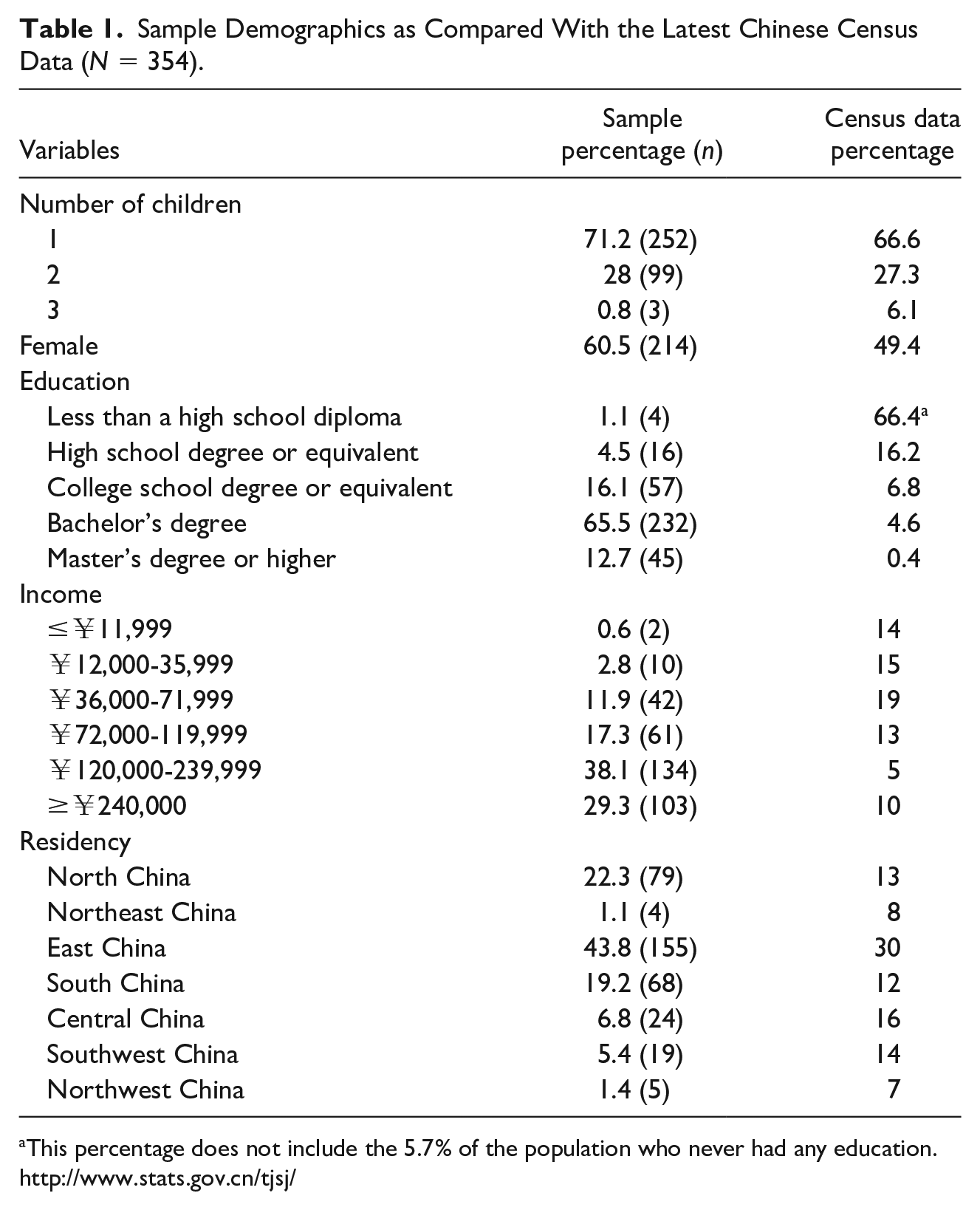
This percentage does not include the 5.7% of the population who never had any education. http://www.stats.gov.cn/tjsj/
Measures
All items were adapted from past research. Unless otherwise noted, all items were measured on a 5-point scale. Individual item wording and descriptive statistics are shown in the Supplemental Appendix A (available online). Table 2 shows zero-order correlations among key variables.
Zero-Order Correlations Among Key Variables.
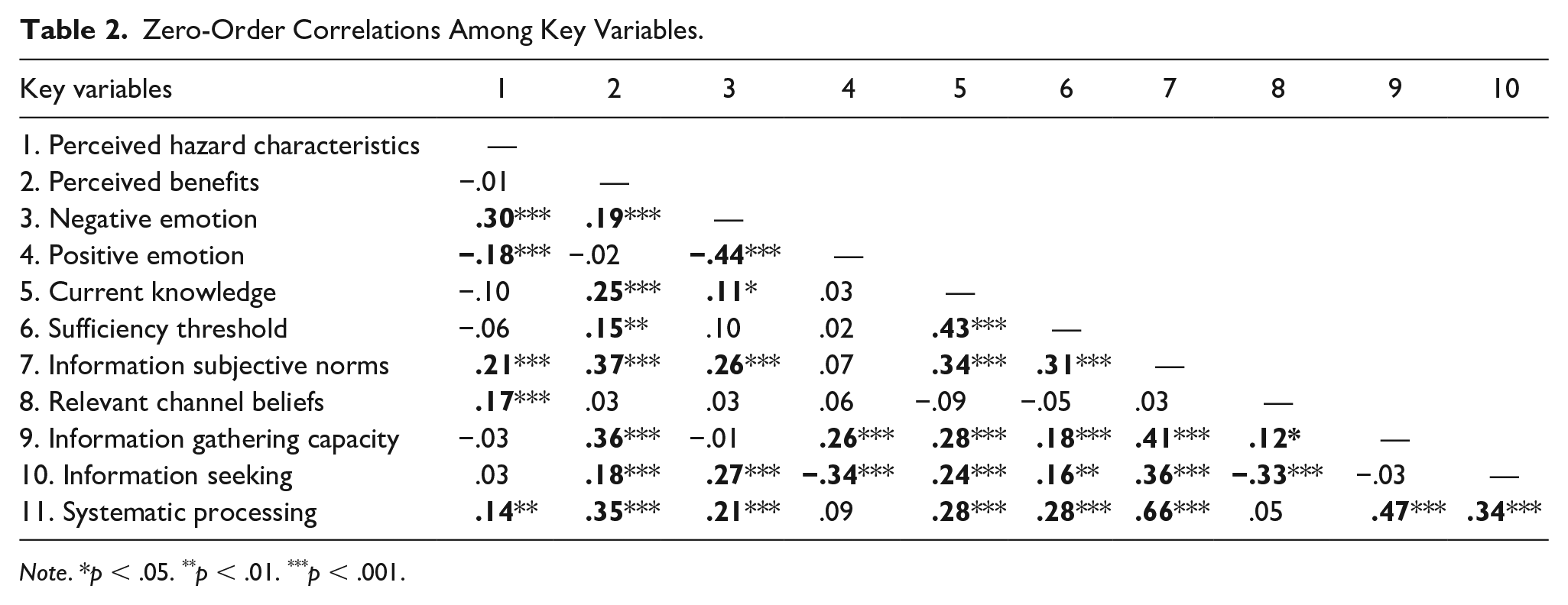
Note. *p < .05. **p < .01. ***p < .001.
Information Insufficiency
Consistent with the measurement strategy used in RISP research (Griffin et al., 2008), information insufficiency was measured with two items. First, perceived current knowledge about the vaccine scandals was assessed on a scale ranging from 0 (knowing nothing) to 100 (knowing everything). Information sufficiency threshold was then measured on the same scale, evaluating the amount of information that participants needed to achieve sufficient understanding about the vaccine scandals.
Perceived Hazard Characteristics
To assess this construct, both perceived risks related to vaccine safety and perceived benefits of vaccination were measured (Wang et al., 2018). In particular, six items were used to assess perceived hazard characteristics related to vaccine safety (M = 3.25, SD = 0.65, α = .78) and three items were used to assess participants’ perceived benefits of vaccination (M = 4.06, SD = 0.58, α = .71).
Affective Response
We assessed both negative and positive emotions using 15 items that are frequently used in emotion research (Nabi et al., 2018). To assess negative emotion, we measured fear (M = 3.69, SD = 0.96, α = .81), anger (M = 4.15, SD = 0.94, α = .89), worry (M = 4.25, SD =1.00), guilt (M = 2.87, SD = 0.95, α = .67) and sadness (M = 3.54, SD = 0.94, α = .76). We also assessed hope to measure positive emotion, which was measured with two items (M = 2.28, SD = 1.09, α = .73). Overall, participants reported relatively high levels of negative emotion (M = 3.62, SD = 0.79, α = .91, 13 negative emotions) and low levels of positive emotion (M = 2.28, SD = 1.09, α = .73, hope and optimism).
Information Subjective Norms
Consistent with RISP research (Griffin et al., 2008), three items were used to measure information subjective norms (M = 4.11, SD = 0.58, α = .71).
Relevant Channel beliefs
Six items adapted from past research (Griffin et al., 2002) were used to assess participants’ beliefs about information regarding the vaccine scandals on mass media and social media (M = 3.21, SD = 0.61, α = .75). To ensure proper understanding from the participants, we offered specific examples for each type of media, such as the popular social media platform Weibo.
Perceived Information Gathering Capacity
Four items (Griffin et al., 2008) were used to measure participants’ perceived information gathering capacity (M = 3.67, SD = 0.59, α = .65). These items cover capacity related to both information seeking and information processing.
Information Seeking
Six items adapted from past research (Griffin et al., 2008) were used to assess information seeking. On reliability check (a = .74), these six items were averaged into an index for information seeking (M = 4.04, SD = 0.57).
Systematic Processing
To measure systematic processing, we adapted five items from previous research (Griffin et al., 2008) to evaluate the extent to which participants carefully evaluated existing information about the vaccine scandals (M = 4.11, SD = 0.43, α = .67).
Vaccination Intention
Three items adopted from past research (Rothman et al., 1999) were used to evaluate participants’ vaccination intention (M = 4.20, SD = 0.60, α = .81).
Control Variables
Besides demographic variables such as age, gender, education and household income, we also controlled for whether participants have completed all mandatory childhood vaccines for their children (36.4% have). 2
Analysis
We first used hierarchical ordinary least squares regression to test the hypotheses and then ran a path analysis to evaluate overall model fit to the data. 3 Due to the relatively small sample size, the path analysis only included key predicting variables. In the regression analysis, all demographics and other control variables were entered in the first block, current knowledge was entered in the second block, followed by perceived hazard characteristics, as well as negative and positive emotions, informational sufficiency threshold was entered in the fifth block, followed by informational subjective norms, relevant channel beliefs, and perceived information gathering capacity in the sixth block. The interaction term between relevant channel beliefs and perceived information gathering capacity was entered in the final block. 4 This approach allowed us to evaluate the relationship between the independent variables and the dependent variables by incrementally controlling for other variables (Cohen et al., 2003). We also used PROCESS macro (Hayes, 2018) Model 1 to further evaluate and visualize the interaction effect, using the Johnson-Neyman method.
Results
We first hypothesize that controlling for the antecedent variables, current knowledge (H1a) and informational subjective norms (H1b) will be positively related to information sufficiency threshold. Path analysis results indicate that current knowledge (Β = 0.40, β = .37, p < .001, 95% confidence interval (CI): [0.28, 0.52]) and informational subjective norms (Β = 5.40, β = .16, p < .01, 95% CI: [2.07, 8.72]) are both significantly related to sufficiency threshold. 5 Thus, H1 is supported (Figure 3).
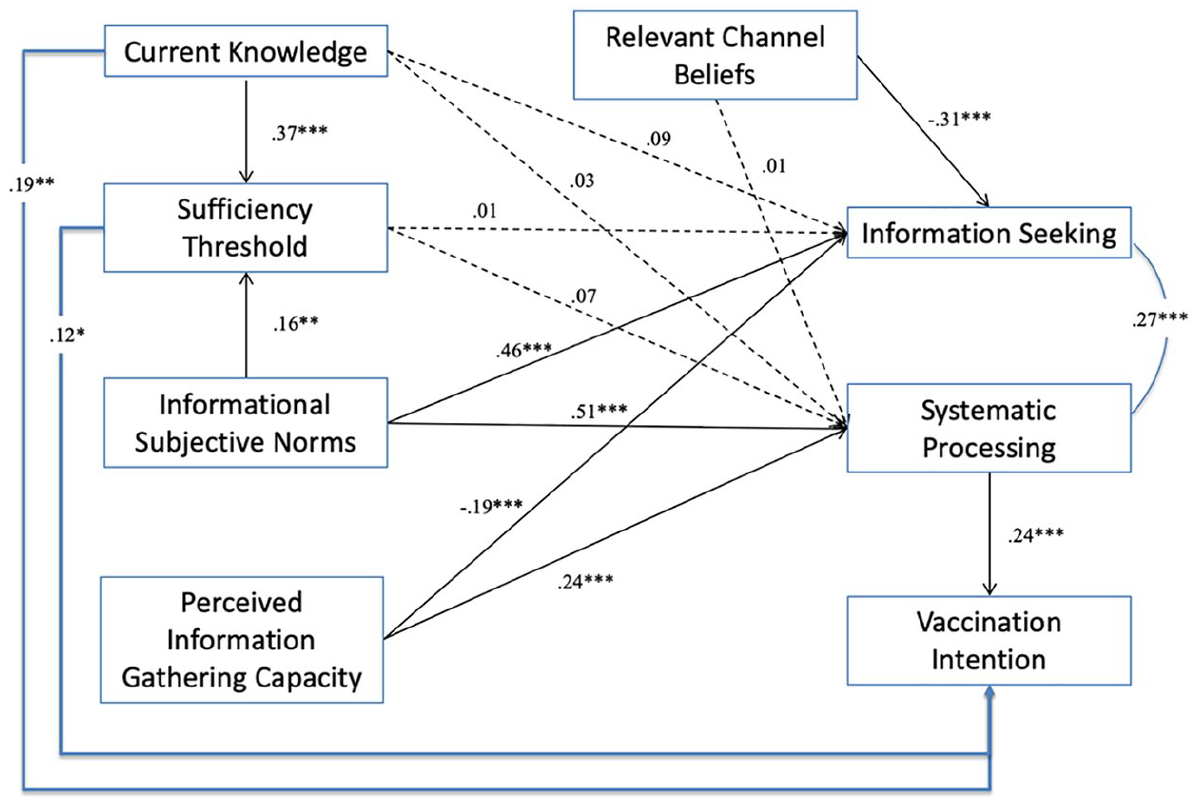
Standardized coefficients based on path analysis (n = 344).
The second hypothesis states that controlling for the antecedent variables, as well as current knowledge, information sufficiency threshold will be positively related to information seeking (H2a) and systematic processing (H2b). Results indicate that information sufficiency threshold is not significantly related to information seeking (Β = 0.00, β = .01, p = .86, 95% CI: [−0.003, 0.004]) and systematic processing (Β = 0.00, β = .07, p = .20, 95% CI: [−0.001, 0.004]). Thus, H2 was not supported.
The third hypothesis states that informational subjective norms will be positively related to information seeking (H3a) and systematic processing (H3b). Results show that informational subjective norms are positively related to information seeking (Β = 0.47, β = .46, p < .001, 95% CI: [0.36, 0.58]) and systematic processing (Β = 0.39, β = .51, p < .001, 95% CI: [0.29, 0.48]). 6 Thus, H3 was supported.
The fourth hypothesis states that relevant channel beliefs will be negatively related to information seeking (H4a) and systematic processing (H4b). Relevant channel beliefs are negatively related to information seeking (Β = −0.29, β = −.31, p < .001, 95% CI: [−0.39, −0.20]), supporting H4a. However, H4b is not supported (Β = 0.01, β = .01, p = .79, 95% CI: [−0.05, 0.06]).
The fifth hypothesis states that perceived information gathering capacity will be positively related to information seeking (H5a) and systematic processing (H5b). Results indicate that perceived information gathering capacity is negatively related to information seeking (Β = −0.19, β = −.19, p < .001, 95% CI: [−0.28, −0.09]) but positively related to systematic processing (Β = 0.17, β = .24, p < .001, 95% CI: [0.11, 0.24]). Thus, H5a is not supported, but H5b is supported.
The first research question is focused on the interaction between relevant channel beliefs and perceived information gathering capacity. Using PROCESS macro Model 1, with the other three significant predictors of seeking controlled for as covariates (vaccine status, positive emotion, and informational subjective norms), we found a significant interaction in the model with information seeking as the dependent variable (Β = −0.08, β = −.14, p < .01, 95% CI: [−0.13, −0.03]). Spotlight analysis with Johnson-Neyman method indicates that the negative relationship between relevant channel beliefs information seeking was significant among participants who scored higher than 3.0075 on perceived information gathering capacity (Figure 4a and b). The interaction effect is not significant in the model with systematic processing as the dependent variable (Β = 0.01, β = .04, p = .41, 95% CI: [−0.02, 0.05]).
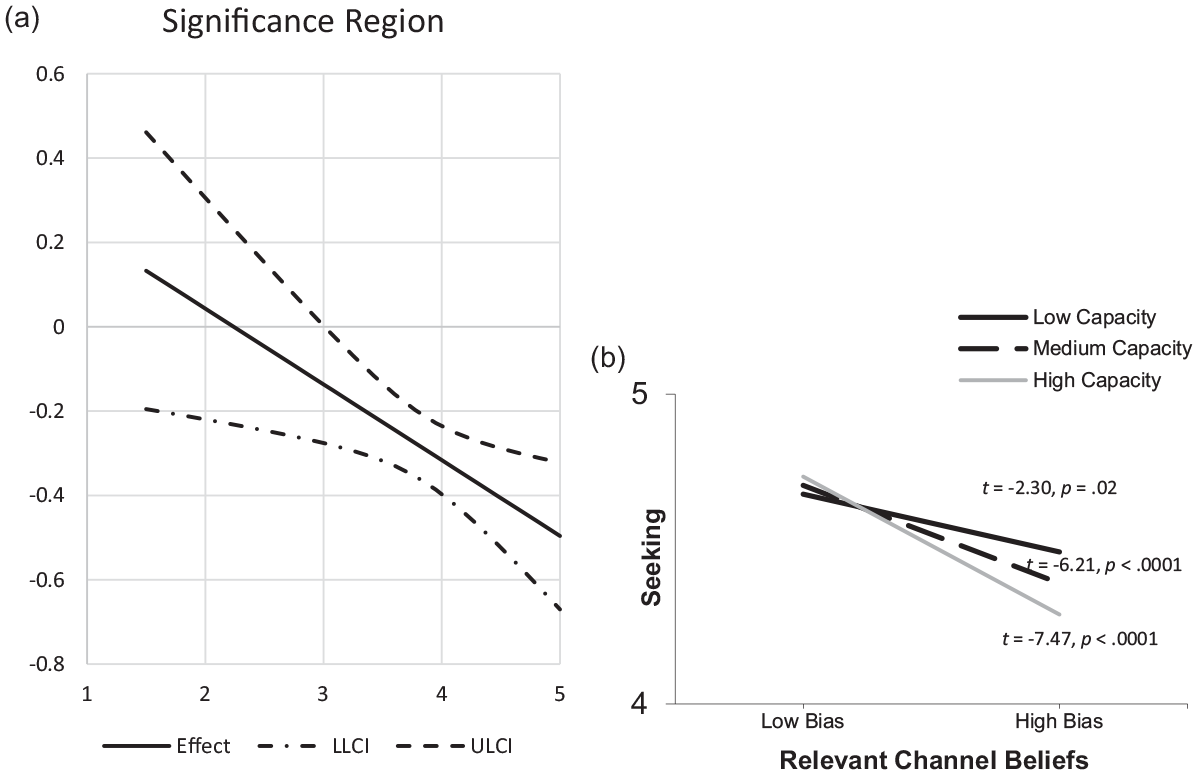
(a) When perceived information gathering capacity has a score greater than 3.075, the effect of relevant channel beliefs on information seeking was negative. This is where the upper confidence interval (upper dashed line) crosses 0 on the vertical axis. (b) Perceived information gathering capacity moderates the relationship between relevant channel belief and information seeking.
To address RQ2 and RQ3, only positive emotion is negatively related to information seeking (Β = −0.16, β = −.29, p < .001, 95% CI: [−0.21, −0.10]), but neither perceived hazard characteristics nor perceived benefits are significantly related to information seeking or systematic processing (Supplemental Appendix B, available online).
Last, we inquired whether systematic processing will influence Chinese parents’ intention to vaccinate their children in the future (RQ4). We found that systematic processing is positively related to vaccination intention (Β = 0.35, β = .24, p < .001, 95% CI: [0.21, 0.50]). 7
Overall, based on path analysis results, the theoretical model accounts for 21% of the variance in information sufficiency threshold, 32% of the variance in information seeking, 47% of the variance in systematic processing, and 18% of the variance in vaccination intention. The path analysis demonstrates excellent model fit to the data (model fit indices: χ2 = 14.239, df = 8, χ2/df = 1.780, p-close = .076, root mean square error of approximation [RMSEA] = .048, 90% CI: [.000, .087], comparative fit index [CFI] = .988, Tucker-Lewis index [TLI] = .960, standardized root mean residual [SRMR] = .017), with path coefficients largely consistent with regression results. 8
Discussion
Grounded in the RISP model, this study makes three theoretical contributions to existing literature. First, as proposed in the RISP model, perceived hazard characteristics influence information seeking and information processing indirectly through the more central motivational factors—information insufficiency and informational subjective norms. When these antecedent variables are assessed along with the key predictors in the model, they are not significantly related to information seeking or systematic processing. Second, this study includes a more sophisticated operationalization of emotion than most RISP-based studies (see, e.g., Griffin et al., 2008) because vaccine scandals can induce strong affective responses among Chinese parents. Interestingly, accounting for negative emotion, positive emotion (i.e., hope) is negatively related to information seeking. This result supports existing research that positive emotion can motivate or deter communication behavior (Chadwick, 2015). However, the negative relationship identified here may be unique to the current research context, which we will detail below. Third, this study reveals, for the first time in RISP-based research, that perceived information gathering capacity moderates the relationship between relevant channel beliefs and information seeking. That is, Chinese parents who perceive themselves to have the highest ability to obtain information about the vaccine scandals are least likely to seek information from the media if they view these information channels as biased. This finding supports the cost versus benefit calculation involved in media selection that Chaffee (1986) proclaimed three decades ago. That is, even in the information age where people can easily access information, when it comes to an important risk topic, people still carefully evaluate different information channels to determine where to devote time and energy to acquire the most valuable information.
This finding should convey hope for communication practitioners because it illustrates that they can deliver important risk information to help people navigate the complex information landscape, even when they feel less equipped to do so. In this research context, informational subjective norms are consistently related to sufficiency threshold, information seeking, and systematic processing. This result indicates that risk communication messaging can encourage people to inform themselves on this issue by mentioning that socially important others would like them to stay informed. Thus, to encourage Chinese parents to continue to vaccinate their children, communication messages should encourage perceptions related to both descriptive and injunctive norms (Lapinski & Rimal, 2005) by highlighting the importance of herd immunity, which is essentially how vaccination prevents the spread of contagious diseases in a population. For example, communication messages can highlight the fact that almost all Chinese parents vaccinate their children (descriptive norms) or that not vaccinating your children is disapproved by others (injunctive norms). Results from this study suggest that these messaging strategies can encourage Chinese parents to evaluate their existing knowledge about the vaccine scandals, seek additional information, and process this information more carefully.
To this end, communication messaging also needs to urge Chinese parents to validate the information they encounter to develop greater knowledge about the vaccine scandals because health literacy related to this issue is fairly low at this point (Wang et al., 2018). For instance, parents should seek vaccine-related information through credible sources such as the Chinese Center for Disease Control and Prevention. Moreover, when encountering information on social media, they should think about it carefully and validate it through credible sources. This seems especially important for participants in our study because parents who still need to complete their children’s vaccination report lower information sufficiency threshold. Parents who have completed their children’s vaccinations probably desire more information about the vaccine scandals because they want to make sure their children have been properly inoculated against diseases. In contrast, those who report a lower sufficiency threshold may be in denial or attempt to shield themselves from anxiety and concern. This same group of people, however, are more likely to seek information and vaccinate their children in the future. Because completing required vaccination is a prerequisite for attending school in China, Chinese parents have to vaccinate their children. However, they can choose between free domestic vaccines or paying for imported ones, which means they will probably seek more information to make these important decisions.
Another encouraging result from this study is the positive relationship between current knowledge and sufficiency threshold, as well as the positive relationship between both of these two variables and vaccination intention. These findings indicate that Chinese parents who are knowledgeable about the vaccine scandals are open to additional information, and this existing knowledge does not deter them from vaccinating their children. Joining existing empirical evidence (see, e.g., Griffin et al., 2008), the positive relationship between current knowledge and sufficiency threshold suggests a fundamental mechanism that is consistent with the classic knowledge gap hypothesis (Tichenor et al., 1970). That is, individuals who possess knowledge about a social issue also desire more information, perhaps because they have a higher need for cognition (Cacioppo & Petty, 1982) or because they are better equipped to deal with new information, which makes it possible to develop greater information sufficiency. Future research based on the RISP model should consider controlling for need for cognition as an individual characteristic that may directly influence information insufficiency. In terms of practical implication, addressing accuracy motivation, communication messages can strategically increase Chinese parents’ information insufficiency by highlighting the gap between existing knowledge and accurate information. For instance, it may be worthwhile to debunk the myth surrounding the 2018 vaccine scandal regarding the safety of substandard DPT vaccines. By alerting Chinese parents that what they have heard about the vaccine scandals may not be accurate, it seems possible to motivate them to make more informed decisions about vaccination. In this research context, this seems to be a crucial risk communication task because overall, participants reported very similar levels of current knowledge and information sufficiency threshold (see Supplemental Appendix A, available online).
The lack of significant findings related to risk and benefit perceptions seems counterintuitive at first glance, but these results are actually consistent with the theoretical underpinning of the RISP model. As shown in Table 2, both risk perception and benefit perception are significantly correlated with informational subjective norms. That is, Chinese parents who perceive greater risks about vaccines safety and greater benefits of vaccination also believe that others expect them to stay on top of information about the vaccine scandals. These two variables, therefore, appear to exert indirect influence on information sufficiency, information seeking, and information processing through informational subjective norms. Indeed, further analyses using Model 6 in PROCESS indicate that informational subjective norms mediate the relationship between risk perception and vaccination intention (Β = 0.04, β = 0.05, 95% CI: [0.01, 0.08]), as well as the serial mediation path from risk perception to negative emotion to intention (Β = 0.02, β = 0.02, 95% CI: [0.01, 0.04]). In contrast, informational subjective norms only mediate the relationship between perceived benefits and intention (Β = 0.09, β = 0.08, 95% CI: [0.04, 0.15] but not through positive emotion. These results support the consideration of both perceived risks and perceived benefits when evaluating ordinary citizens’ risk perception about complex issues such as vaccination. Risk and benefit perceptions not only contribute to people’s understanding of these issues but also help them monitor popular opinions in their social environment by providing a quasi-statistical sense (Noelle-Neumann, 1991). This said, the negative relationship between perceived risks and vaccination intention supports the premise of this study, which is to evaluate communication behaviors through the RISP model because risk perception is an important determinant of vaccination intention. Practically, this result also suggests that Chinese policy makers and communication practitioners need to closely monitor public risk perception surrounding the vaccine scandals and vaccination in general.
Related to emotional responses, when controlling for negative emotions, hope is negatively related to information seeking. This finding suggests that Chinese parents who feel more hopeful are less likely to seek information about the vaccine scandals, perhaps because they are generally optimistic that the Chinese government will deal with this crisis. This result is unsurprising given the general confidence that most Chinese people have in the Chinese government to maintain public health and the high vaccination rate in China. In comparison to past research involving American participants where negative emotions have shown a direct relationship with information seeking (Griffin et al., 2008), a possible explanation is that in a quintessential collectivistic culture (Hofstede, 1993), social norms are much more effective in influencing Chinese parents’ communication behaviors as compared with emotions. This result is consistent with past cross-cultural studies (Yang, Kahlor, et al., 2014).
The most important insight from this research is the significant interaction between relevant channel beliefs and perceived information gathering capacity on information seeking. We also found that participants with higher perceived information gathering capacity were more likely to process information systematically but less likely to seek information. The latter result probably indicates a certain degree of information fatigue. Together, these results suggest that Chinese parents who view information about the vaccine scandals in the media as biased and incomplete are less likely to seek information on this topic actively, and this relationship is particularly strong among participants who believe they know how to access and understand information about the vaccine scandals. Similar rationale can be found in other communication theories. For instance, the situational theory of problem solving (Kim & Grunig, 2011) indicates that people selectively invest their cognitive efforts in a problem only when they perceive the efforts to be worthwhile. That is, more active problem solvers tend to economize and optimize their cognitive resources in problem solving by judging the relevance and value of the information. They are also more specific and systematic in dealing with new information to reduce information overload. For communication practitioners, this finding suggests that tailored information of high relevance to difference audiences should be provided to the public to mobilize sufficient public attention and societal resources to solve a social problem (Kim & Grunig, 2011).
Last, the significant, positive relationship between systematic processing and vaccination intention attests to the utility of the RISP model in behavioral formation. That is, Griffin et al. (1999) has clearly explained how the RISP model is connected to attitude and behavior through the mechanism depicted in the TPB. In particular, when people process relevant information systematically, they should develop more persistent attitude that is resistant to counter persuasion and subsequently influences behavioral formation. In this study, although we did not directly measure attitude, the relationship between systematic processing and vaccination intention is meaningful. This relationship has also been documented in previous research related to other risk contexts such as climate change (Yang, Rickard, et al., 2014). Together, this result suggests that it is important to continue to explore motivational factors for information processing behaviors because they may serve as direct impetus for important health and environmental behaviors in modern society.
While reviewing these results, it is also important to point out limitations herein this research. First, due to the difficulty to reach certain demographic groups via an online survey, our sample overrepresented Chinese parents with higher education and higher household income, so readers should be careful not to overgeneralize our findings. Past research has to deal with similar issues because it is extremely difficult to recruit Chinese participants with lower socioeconomic status through online panels (Wang et al., 2018). Second, with a cross-sectional survey, no causality in the proposed relationships can be established. Future research should consider longitudinal designs to track how perceived hazard characteristics, communication behaviors, and vaccination intention evolve over time. Third, although we try to consider a variety of negative emotions and two positive emotions, they were analyzed as two composite indices instead of discrete emotions. Future research should explore how each set of negative emotions separately because appraisal theories would predict that different negative emotions will influence information seeking and information processing in different ways (see, e.g., Tiedens & Linton, 2001). Last, since we only focused on information seeking and systematic processing, we are unable to reveal the roles of information avoidance and heuristic processing in this context because the absence of information seeking and systematic processing does not necessarily indicate information avoidance and heuristic processing.
Despite these limitations, the most interesting finding of our study is the moderating effect of perceived information gathering capacity on the relationship between relevant channel beliefs and information seeking, which is the first time empirical research unveils this relationship. This result suggests that while attending to social norms, Chinese parents are calculative and deliberate when seeking information about the vaccine scandals. This is welcoming news from a communication standpoint because although living in a highly censored media system, Chinese parents do not simply believe everything they encounter in the media about this important social problem. Rather, those who engage in careful and systematic processing of relevant information are more likely to express an intention to vaccinate their children in the future, perhaps because they are able to understand that the substandard vaccines involved in the most recent vaccine scandal are ineffective, yet at the same time, not directly harmful. In other words, the repeated vaccine scandals did not appear to quiver Chinese parents’ fundamental confidence in vaccination. Nonetheless, the negative relationship between hope and information seeking and the negative relationship between perceived hazard characteristics and vaccination intention suggest that public health officials and communication practitioners need to carefully monitor public risk perception about vaccine safety, foster social trust, and encourage Chinese citizens to develop greater literacy about this issue.
Supplemental Material
sj-docx-1-scx-10.1177_1075547020983589 – Supplemental material for Information Seeking and Processing in the Context of Vaccine Scandals
Supplemental material, sj-docx-1-scx-10.1177_1075547020983589 for Information Seeking and Processing in the Context of Vaccine Scandals by Janet Z. Yang and Zhuling Liu in Science Communication
Footnotes
Declaration of Conflicting Interests
The author(s) declared no potential conflicts of interest with respect to the research, authorship, and/or publication of this article.
Funding
The author(s) received no financial support for the research, authorship, and/or publication of this article.

Notes
Author Biographies
References
Supplementary Material
Please find the following supplemental material available below.
For Open Access articles published under a Creative Commons License, all supplemental material carries the same license as the article it is associated with.
For non-Open Access articles published, all supplemental material carries a non-exclusive license, and permission requests for re-use of supplemental material or any part of supplemental material shall be sent directly to the copyright owner as specified in the copyright notice associated with the article.
