



Abstract
This study examines how members of the public frame artificial intelligence (AI) along with how news use predicts “frames in mind” for AI. The study also tests whether news use, science fiction viewing, and discussing technology influence attitudes toward AI independently and in conjunction with one another. The analyses use data from a nationally representative online panel survey. Respondents invoked social progress and Pandora’s box frames for AI, and technology news use predicted mentioning each frame. Use of technology news also predicted change in support for AI, while science fiction viewing and discussing technology were conditionally related to such change.
Keywords
As applications of artificial intelligence (AI) become increasingly widespread in society, public opinion toward this technology may carry important consequences for its development, adoption, and sustainability. By way of precedent, research has found that attitudes can shape individual behaviors and public policy regarding other emerging technologies (Brossard & Nisbet, 2007; Goidel & Nisbet, 2006; Nisbet, 2005; Scheufele & Lewenstein, 2005). Recent surveys show that members of the U.S. public perceive both potential benefits and risks of AI (Northeastern University & Gallup, 2018; West, 2018; Zhang & Dafoe, 2019). These surveys also reveal that opinions about AI differ across political and demographic lines. Yet existing research has paid less attention to the potential for different forms of communication to shape public attitudes toward AI or their potential to interact with one another in doing so.
Although multiple types of communication could influence such attitudes, the following account focuses on three that stand out as plausible suspects: news coverage, science fiction, and interpersonal discussion. Previous research has shown that each of these factors can shape attitudes toward other emerging technologies (Besley & Shanahan, 2005; Brossard & Shanahan, 2003; Ho et al., 2013; Lee & Scheufele, 2006; Liu & Priest, 2009; Nisbet & Goidel, 2007). In the case at hand, research highlights how news and science fiction offer storylines for understanding AI. For example, news coverage could encourage audience members to see the technology as a tool of progress—or, alternatively, as an existential threat to humanity (Broussard et al., 2019; Chuan et al., 2019; Obozintsev, 2018). Similarly, science fiction films and television programs could reinforce impressions of AI as menacing or benign (Nader et al., 2022; Obozintsev, 2018; Perkowitz, 2007). At the same time, members of the public may also draw on interpersonal conversations to make sense of technology (Gamson, 1992), including AI (Cui & Wu, 2021).
By examining these possibilities, the present study advances knowledge about what shapes public opinion toward AI while extending broader theoretical accounts of communication and attitudes toward emerging technologies. It draws on framing theory (Entman, 1993; Gamson & Modigliani, 1989; Reese, 2001) to consider how members of the public think about AI as well as how news media use predicts audience members’ “frames in mind” and attitudes regarding AI. In looking at the effects of science fiction viewing and talking about technology on attitudes toward AI, the study also builds on accounts of how specific media genres (Besley & Shanahan, 2005; Nisbet & Goidel, 2007) and interpersonal communication (Gamson, 1992; Ho et al., 2013; Liu & Priest, 2009) can influence attitudes toward science and technology.
Furthermore, the present study develops a model of interactive communication effects on attitudes toward emerging technologies. While most studies of communication effects on such attitudes focus on independent effects, a small body of research highlights the potential for communication processes to interact with one another in shaping public opinion (Ho et al., 2013; Liu & Priest, 2009). Extending this logic, the following account considers how news frames, science fiction portrayals, and interpersonal conversations may resonate with and reinforce one another in ways that condition their effects. Specifically, it examines the potential roles of (a) news use in moderating science fiction viewing effects; (b) news use in moderating interpersonal communication effects; and (c) science fiction viewing in moderating interpersonal communication effects.
Building on previous analyses of cross-sectional data from a nationally representative survey about AI (Bingaman et al., 2021), the present study uses panel data from the same source to test how media use and interpersonal communication predict attitudes toward AI. A look at open-ended comments from the first wave shows that respondents invoked general thoughts about technology, specific examples and uses of AI, and science fiction portrayals along with social progress and Pandora’s box frames for AI. Further analyses demonstrate that news use predicts invoking each frame and that invoking these frames predicts attitudes toward AI. Analyses of the panel data show that news use predicts change in attitudes toward AI and that all three communication variables interact in predicting such change. These findings suggest that multiple forms of communication may carry important implications for public opinion about emerging technologies, both separately and in conjunction with one another. News consumption shapes attitudes about AI, but its impact should be considered within a broader set of communication factors: news frames may resonate with and reinforce science fiction portrayals and interpersonal conversations—which can also interact with each other.
Media Frames, News Use, and Attitudes Toward AI
The present study’s theoretical account begins by considering the potential role of communicative messages in providing audience members with frames for making sense of and forming attitudes toward AI. A frame, as defined by Gamson and Modigliani (1987), is “a central organizing idea or story line that provides meaning to an unfolding strip of events, weaving a connection among them. The frame suggests what the controversy is about, the essence of the issue” (p. 143). Frames consist of metaphors, catchphrases, images, and other symbolic devices that people can use to construct meanings of topics such as emerging technologies (Gamson & Modigliani, 1989). Entman (1993), in turn, writes that the framing process involves “select[ing] some aspects of a perceived reality and mak[ing] them more salient in a communicating text, in such a way as to promote a particular problem definition, causal interpretation, moral evaluation, and/or treatment recommendation” (p. 52). Frames exist on multiple levels: in communicative texts, such as news stories, Hollywood films, television dramas, and interpersonal conversations; in the minds of audience members; and as part of a broader culture (Entman, 1993).
Framing theory highlights a set of key questions about the framing process (Chong & Druckman, 2007a, 2007b; Reese, 2001; Scheufele, 1999), including what frames media use to portray issues (media framing), what forces shape media frames (frame building), what frames members of the public use to understand issues (frames in mind), how framing in communication influences frames in mind (frame setting), and how frames shape attitudes and behavior (framing effects). Research on media framing has identified common patterns in framing across science and technology-related topics as well as issue-specific nuances in such framing (Nisbet, 2009), while research on frame building has demonstrated that media norms, values, routines, and sources all serve to shape how the media present issues (Scheufele, 1999), including ones related to emerging technologies (Gamson & Modigliani, 1989; Nisbet et al., 2003).
Research on frame setting and framing effects, in turn, has shown that exposure to framing can shape how audience members understand issues and form opinions (Chong & Druckman, 2007a, 2007b; Scheufele, 1999). Though frames may appear in multiple forms of communication—including science fiction media (Delgado et al., 2012) and interpersonal discussion (Gamson, 1992)—most of the existing work in this area focuses on news framing. For example, studies have shown that exposure to news coverage with an overall positive valence of framing can foster relationships between news media use and support for a range of emerging technologies (Besley & Shanahan, 2005; Brossard & Shanahan, 2003; Lee & Scheufele, 2006; Liu & Priest, 2009). Furthermore, exposure to specific news frames can shape public attitudes toward such technologies (Cobb, 2005; Druckman & Bolsen, 2011; Ho, 2021), though framing effects may vary depending on other message characteristics (e.g., source and tone), receiver characteristics, and contextual factors such as competitive framing (Chong & Druckman, 2007a, 2007b; Coleman et al., 2011; Holton et al., 2014).
Building on these findings, the present study looks at multiple steps in the framing process for AI, starting with what frames members of the public might hold in mind when thinking about the topic. Previous research has identified a number of frames—including the social progress frame and the Pandora’s box frame—as common features in news coverage across a variety of technologies. As defined by Nisbet (2009), the former casts new technologies as solutions to problems and tools for improving life. For example, an April 26, 2020, CBS News story described a “band of doctors and hi-tech wizards . . . attack[ing] the coronavirus [through] the computing power of artificial intelligence.” Meanwhile, the Pandora’s box frame presents new technologies in terms of out-of-control or catastrophic effects. For example, a June 2, 2020, New York Times piece raised the prospect of a “malevolent artificial intelligence gone amok.” Journalistic norms, values, and pressures help explain why news outlets “hype” the benefits of new technologies (Broussard et al., 2019, p. 678) or cast them in “doomsday terms” (p.687).
As Gamson and Modigliani (1989; see also Reese, 2001) observe, frames are not merely synonymous with positive or negative stances on an issue. Any given frame may suggest a range of positions on an issue—though a single position may dominate within media messages—and there can be multiple “pro” and “con” frames for any given issue (Nisbet, 2009). As a case in point, consider the public accountability/governance frame, which emphasizes “issues of control, transparency, participation, responsiveness, or ownership” in policy or research related to the public interest (Nisbet, 2009, p. 18). In the context at hand, this frame could justify funding AI research to promote national security (as in an August 26, 2020, Washington Post article) or banning governmental use of AI-driven facial recognitional technology to prevent racial discrimination (as in a June 9, 2020, New York Times article).
Even so, the social progress and Pandora’s box frames stand out in public discourse as common rationales for supporting and opposing AI, respectively (Bingaman et al., 2021). The former frame typically suggests a positive evaluation by presenting AI as benefiting society, while the latter typically suggests a negative evaluation by presenting AI as unleashing dangers upon society. Recent analyses have found that news about AI tends to frame the technology more positively than negatively, with social progress frames overshadowing Pandora’s box frames (Chuan et al., 2019; Fast & Horvitz, 2017; Obozintsev, 2018). In keeping with this, coverage from the time frame of the present study (March 17–October 2, 2020) included both social progress and Pandora’s box frames but featured the former more often than the latter (55% vs. 33%). 1 Previous research also indicates that coverage featuring these frames has highlighted a set of specific benefits and risks within the context of AI, including new jobs and improved well-being for social progress framing along with job losses, invasion of privacy, and threats to human existence for Pandora’s box framing (Chuan et al., 2019). To explore what frames members of the public hold in mind for AI, the present study asks:
Research Question 1 (RQ1): How do members of the public frame AI in their own words?
In examining the frame-setting process for AI, the present study considers the potential for news media use to predict audience members’ frames in mind. Given that both social progress and Pandora’s box frames appear in news coverage of the issue (Chuan et al., 2019; Obozintsev, 2018), that exposure to frames in coverage can increase their availability and accessibility in receivers’ minds (Chong & Druckman, 2007a, 2007b), and that exposure to technology news in general tends to go hand in hand with exposure to news about specific forms of technology (Besley & Shanahan, 2005; Ho et al., 2013), this study tests the following hypothesis:
Hypothesis 1: Following technology news will be positively related to invoking (A) the social progress frame for AI and (B) the Pandora’s box frame for AI.
The next hypothesis focuses on the potential links between individuals’ frames in mind and their attitudes (Scheufele, 1999). Given that the social progress frame provides a positive interpretation of AI, one would expect holding this frame in mind to predict positive attitudes toward AI. By contrast, its rival frame presents a negative interpretation of the technology; thus, holding the Pandora’s box frame in mind should predict negative attitudes toward AI. Consistent with these expectations, one recent experimental study found that participants exposed to a social progress frame expressed more support for AI, relative to those exposed to a Pandora’s box frame (Bingaman et al., 2021). Thus, the present study hypothesizes the following:
Hypothesis 2: (A) Invoking the social progress frame will be positively related to support for AI, whereas (B) invoking the Pandora’s box frame will be negatively related to support for AI.
As Figure 1 illustrates, this theoretical model also implies two indirect relationships: following news about technology should be positively related to support for AI through social progress framing in mind but negatively related to support for AI through Pandora’s box framing in mind.
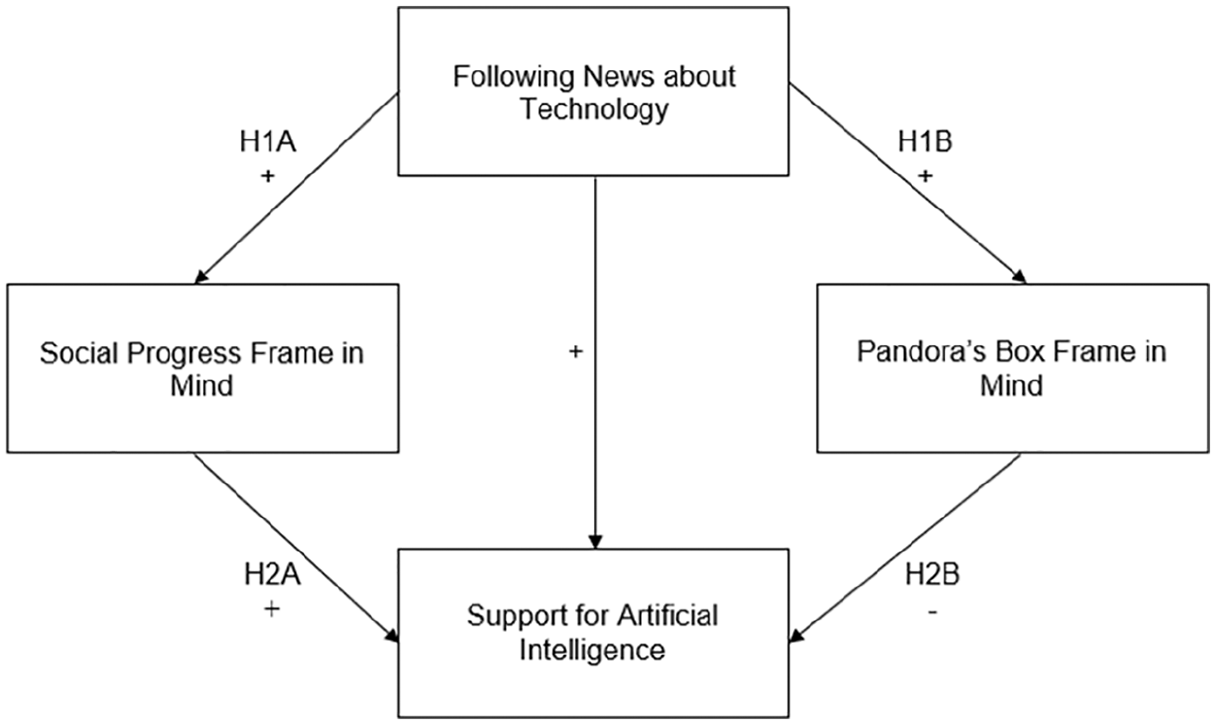
Theoretical model of following news about technology, frames in mind, and support for artificial intelligence.
What, then, would one expect regarding the total relationship between following news about technology and support for AI? A large body of public opinion research demonstrates that, all else being equal, greater exposure to information in public discourse fosters greater agreement with the net valence of the messages in that discourse (Zaller, 1992). This pattern reflects the tendency of audience members to form their opinions based on the most accessible considerations in memory along with the tendency of frequent and recent exposure to increase the cognitive accessibility of a given consideration. In the context of competitive framing environments—where media coverage features opposing frames such as the social progress and Pandora’s box frames—the same logic suggests the “loudness hypothesis,” whereby the frame that appears more often in coverage will tend to shape opinion (Chong & Druckman, 2007b). Consistent with this premise, news coverage featuring predominantly positive framing can foster links between news use and support for emerging technologies (Besley & Shanahan, 2005; Brossard & Shanahan, 2003; Lee & Scheufele, 2006; Liu & Priest, 2009). Given that news coverage has tended to frame AI positively (Chuan et al., 2019; Obozintsev, 2018), the present study posits that the overall relationship between technology news use and support for AI will be positive. To provide stronger evidence for a causal relationship between the former and the latter, the study focuses on the role of technology news use in explaining change over time in such support (Finkel, 1995). This strategy also builds on previous theoretical arguments that communication effects on public opinion—including framing effects—can reflect dynamic cognitive processes such as the integration of new information in mental structures (Lecheler & De Vreese, 2011) and reinforcement of media use (Myers & Hmielowski, 2021).
Hypothesis 3: Following technology news will predict positive change in support for AI.
Science Fiction Viewing and Attitudes Toward AI
As with news coverage, entertainment media depictions may also influence attitudes toward AI. One line of research on the role of such media in shaping public opinion focuses on the potential for overall television viewing to cultivate attitudes, including attitudes toward science and technology, through exposure to the medium’s dominant portrayals (Dudo et al., 2011; Gerbner, 1987; Nisbet et al., 2002). However, another line of research suggests that genre-specific viewing can produce stronger effects on attitudes (Potter, 1993). For example, previous studies have found that science fiction viewing shapes attitudes toward a range of emerging technologies (Besley & Shanahan, 2005; Brewer & Ley, 2021; Nisbet & Goidel, 2007). Such influence may reflect the “naturalizing” effect of “perceptually realistic” portrayals (Kirby, 2003, p. 273) along with psychological transportation induced by science fiction narratives (Green & Brock, 2000). In addition, science fiction can convey frames about emerging technologies to audience members (Delgado et al., 2012). For example, Frankenstein’s monster provides an archetype of the Pandora’s box frame (Gamson & Modigliani, 1989; Nisbet, 2009).
In portraying AI, science fiction films and television programs have long provided depictions of it as menacing (Nader et al., 2022; Obozintsev, 2018; Perkowitz, 2007). Hollywood’s foundational portrayal of the technology came in 1968 with the murderous HAL-9000 from 2001: A Space Odyssey. The Terminator franchise introduced another prominent depiction of AI in the form of Skynet, a sentient defense system that takes over the world and attempts to wipe out humanity—a classic Pandora’s box scenario. More recent examples in the same vein include the Machines from the Matrix franchise, the robots from I, Robot, and Ultron from Avengers: Age of Ultron. At the same time, Hollywood films and television shows have also portrayed helpful and even heroic examples of AI working for social progress (Nader et al., 2022; Obozintsev, 2018; Perkowitz, 2007), including Data from the Star Trek franchise, the Mecha from A.I.: Artificial Intelligence, and Jarvis from the Marvel Cinematic Universe franchise.
Previous qualitative accounts suggest that negative portrayals of AI may overshadow positive ones in science fiction (Obozintsev, 2018; Perkowitz, 2007), but these studies do not provide systematic analyses of such portrayals. Thus, the present study poses a research question about how viewing the genre will shape change in attitudes toward technology:
Research Question 2 (RQ2): Will science fiction viewing predict change in support for AI?
An alternative—or additional—possibility is that the relationship between science fiction viewing and attitudes toward AI will depend on news media exposure. Framing research suggests that media discourse, particularly news discourse, tends to dominate how members of the public construct the meanings of issues and that mutually reinforcing interpretations of issues are especially powerful in shaping public understandings (Gamson, 1992). Consistent with this, one experimental study found that exposure to images of AI—including menacing science fiction examples such as Skynet and Ultron or benign helper robots—interacted with exposure to frames for AI: Those who received social progress frames with benign images reported the highest level of support, whereas those who received Pandora’s box frames with menacing images reported the lowest support (Bingaman et al., 2021). Drawing on the concept of frame resonance (Gamson, 1992), the authors speculate that “the resonances between these pairings helped audience members interpret their implications for evaluating the issue” (Bingaman et al., 2021, p. 396). If so, then news coverage may provide audience members with frames for making sense of and drawing conclusions from science fiction portrayals of AI. Indeed, news stories often invoke—and sometimes reinterpret—the frames suggested by these fictional portrayals (Obozintsev, 2018). Given that news coverage has tended to frame AI positively in terms of social progress, exposure to technology news—and, thus, news frames for AI in particular—could reinforce favorable science fiction images of AI while dampening the resonances of negative science fiction images. Thus, the present study tests the following hypothesis:
Hypothesis 4: Following technology news will moderate the relationship between science fiction viewing and change in support for AI, such that those with higher levels of technology news use and science fiction viewing will hold particularly positive attitudes toward AI.
Interpersonal Communication and Attitudes Toward AI
Although members of the public may use media messages to make sense of and evaluate AI, they could also do so by engaging in interpersonal discussions about technology. For example, focus group research has found that people develop understandings of topics such as nuclear energy (Gamson, 1992) and genetic technologies (Bates, 2005) through conversations with peers. In talking about these issues, members of the public actively draw on not only media discourse but also “popular wisdom” along with their own values, experiences, and reasoning abilities (Gamson, 1992, p. 117). Furthermore, research has found that interpersonal communication can shape how people form attitudes about a range of issues (de Vreese & Boomgaarden, 2006; Price et al., 2005). Building on this logic, some studies have posited that talking about science and technology may foster support for emerging technologies (Ho et al., 2013; Liu & Priest, 2009) by providing information and facilitating connections to existing knowledge. Thus, the present study asks the following question:
Research Question 3 (RQ3): Will talking about technology predict change in support for AI?
Another possibility is that the relationship between talking about technology and support for AI will depend on media exposure. Gamson (1992) found that members of the public invoked news frames in talking with one another about technology, reflecting the potential for such frames to provide bases for conversations. Subsequent research has built on a reinforcing model of interpersonal influence (Liu & Priest, 2009) to argue that talking about science and technology should reinforce support for emerging technologies when media messages about them are largely positive. By a parallel logic, Ho et al. (2013) observe that interpersonal communication could magnify negative views of new technologies “provided that the risk about a particular issue is made salient in the mass media” (p. 610). In short, the reinforcing model suggests that the impact of talking about technology will reflect the nature of the news media discourse from which members of the public draw interpretations: Favorable coverage of AI should foster more supportive discussions, whereas negative coverage should foster more oppositional discussions. Given that news coverage has tended to frame AI positively, this study posits that interpersonal communication and news use will interact to reinforce support for AI:
Hypothesis 5: Following technology news will moderate the relationship between talking about technology and change in support for AI such that those with higher levels of technology news use and interpersonal communication about technology will hold particularly positive attitudes toward AI.
Conversations about technology could also reinforce the resonances—and accompanying evaluations—that science fiction portrayals of technology convey. Gamson (1992, p. 118) points out that the “public discourse that people draw on” to discuss and make sense of issues is “much broader than the news and takes many forms.” For example, the participants in his focus groups invoked portrayals from Hollywood films in talking about nuclear energy. Likewise, the participants in Bates’ (2005) focus groups invoked science fiction depictions when discussing—and forming understandings of—genetic technologies. In both cases, discussants cited examples that served to make risks salient and thereby reinforced negative interpretations of the technology. A similar pattern could emerge in conversations about menacing examples of AI in science fiction films and movies. If so, then interpersonal communication and science fiction exposure may interact to reduce support for AI. However, members of the public who watch science fiction could also discuss more benign depictions, resulting in conversations that reinforce support for AI. Thus, the present study asks a research question about the potential for interpersonal communication and genre-specific viewing to interact in shaping attitudes:
Research Question 4 (RQ4): Will science fiction viewing moderate the relationship between talking about technology and change in support for AI?
Figure 2 illustrates the study’s model of how following news about technology, science fiction viewing, and talking about technology may shape support for artificial intelligence over time both separately and in conjunction with one another.

Theoretical model of following news about technology, science fiction viewing, interpersonal communication, and support for artificial intelligence over time.
Method
The analyses for this study drew on original data from an online panel survey designed by the authors and fielded by the National Opinion Research Center (NORC). A representative sample of 1,936 adult U.S. residents were initially interviewed from March 17 to 27, 2020, and then 1,205 of these respondents (62% of the first wave sample) were reinterviewed from September 21 to October 2, 2020. The respondents were sampled from NORC’s AmeriSpeak panel. The study was approved by the Institutional Review Boards of NORC and the authors’ institution.
Thoughts About AI
The first wave of the survey asked respondents, “When you think about artificial intelligence, what is the first thing that comes to mind?” An initial examination of respondents’ open-ended answers identified five categories—general comments about science and technology, specific examples of AI, social progress frames, Pandora’s box frames, and science fiction portrayals—as well as subcategories within each category. Two coders independently categorized all answers; each answer could fall into multiple categories. 2 Table 1 presents frequencies and intercoder reliability coefficients for the five categories and the most common subcategories.
Content Analysis Results for Open-Ended Responses (2020 NORC Panel Survey).

Note. N = 1,936. Percentages in bold reflect the proportion of total open-ended responses. NORC = National Opinion Research Center.
Attitudes Toward AI
Each wave of the survey included three questions measuring attitudes toward AI. These asked respondents how much they supported or opposed “the development of artificial intelligence,” “public funding for research on artificial intelligence,” and “banning artificial intelligence altogether.” For each wave, an index for attitudes toward AI was created by reverse coding the third item and then averaging across the 3 items (Wave 1, full sample: Cronbach’s α = .77; Wave 1, panel sample: Cronbach’s α = .78; Wave 2, panel sample: Cronbach’s α = .80; see Table 2 for the coding, means, and standard deviations of these and other variables in the analyses).
Descriptive Statistics for Key Variables (2020 NORC Panel Survey).

Note. Table entries are means, with standard deviations in parentheses, except for dichotomous variables. NORC = National Opinion Research Center; AI = artificial intelligence.
Communication Variables
The first wave of the survey included a series of questions measuring the study’s key communication variables. These items asked respondents how often they “read, watch[ed], or listen[ed] to news about technology,” how often they “watch[ed] science fiction shows and movies,” and how often they “talk[ed] to family members, friends, or co-workers about new kinds of technology”: nearly every day, a few times a week, a few times a month, or less often. 3 The questions about news use and interpersonal discussion asked about “technology” rather than AI specifically. Given that general measures of following news about technology and talking about technology are strongly related to topic-specific measures and reflect the same underlying constructs (Besley & Shanahan, 2005; Ho et al., 2013), respondents who followed news about or talked about technology in general should have been particularly likely to encounter news about AI and to discuss AI, respectively.
Control Variables
Wave 1 of the survey also measured other factors that can predict attitudes toward emerging technologies (Akin et al., 2021; Brossard & Nisbet, 2007; Ho et al., 2008; Lee & Scheufele, 2006; Nisbet, 2005; Nisbet et al., 2002), including overall television viewing; party identification; political ideology; deference to scientific authority (captured through an index consisting of three items derived from Brossard and Nisbet [2007]; Cronbach’s α = .81); attendance at religious services; reliance on technology in daily life; gender; age in years; self-identification as Black, as Hispanic, and as Asian American; education; and income.
Results
The first set of analyses used data from the full Wave 1 sample to examine how respondents framed AI in their own words, how news use predicted invoking specific frames, and how invoking specific frames predicted attitudes toward AI. The second set of analyses used data from the panel sample to test how following technology news, viewing science fiction, and talking about technology predicted change in attitudes toward AI.
Wave 1 Analyses: Frames in Mind, Frame Setting, and Attitudes
As Table 1 shows, almost half of all Wave 1 respondents (48%) provided general comments about science and technology such as “robots,” “computers” “machine learning,” “automation,” “data,” and “algorithms” when asked for their thoughts about AI. Another 9% cited specific uses of AI such as self-driving cars and facial recognition or specific examples such as Alexa and Siri.
Respondents also invoked social progress frames (9%) and Pandora’s box frames (13%) when describing their thoughts about AI (RQ1). The most common subcategories for the social progress frame were general comments about AI being helpful or improving the future along with specific comments about improving jobs. The most common subcategories for the Pandora’s box frame were specific concerns that AI would take over the world or result in an existential threat to humanity, threaten privacy as a “Big Brother,” or cause job losses, along with general comments about the technology being frightening or scary. In contrast to news stories about AI, respondents’ open-ended answers were more likely to include Pandora’s box frames than social progress frames (z = 4.45; p < .01).
In addition, 11% of respondents mentioned science fiction portrayals of AI. Many of these respondents cited depictions of menacing AIs in films and television programs such as the Terminator franchise, 2001: A Space Odyssey, and I, Robot. However, a few respondents cited positive science fiction portrayals such as Data from the Star Trek franchise and the Mecha from A.I.: Artificial Intelligence.
A pair of logistic regression analyses tested whether following technology news predicted invoking a social progress frame and whether following such news predicted invoking a Pandora’s box frame (for each, 0 = no; 1 = yes). The model also included science fiction viewing (another potential source of media messages about AI) and the demographic variables. As Table 3 reports, following technology news was positively related to invoking a social progress frame (first column: b = .24; Wald = 6.20; odds ratio = 1.27; p < .05) and positively related to invoking a Pandora’s box frame (second column: b = .29; Wald = 14.19; odds ratio = 1.34; p < .01). Thus, the results yielded support for both H1A and H1B: Technology news use was associated with citing two frames that frequently appeared in news coverage of AI. Put another way, the findings are consistent with a frame-setting function of news media in the context of AI.
Predicting Wave 1 Thoughts About AI (2020 NORC Panel Survey).

Note. Table entries are logistic regression coefficients, with standard errors in parentheses. AI = artificial intelligence; NORC = National Opinion Research Center.
p ≤ .05. **p ≤ .01.
Science fiction viewing did not predict invoking either frame, suggesting that watching this genre does not, in and of itself, translate into thinking of the technology as a tool of progress or Pandora’s box. As one would expect, however, such viewing did predict invoking science fiction portrayals (third column: b = .28; Wald = 6.20; odds ratio = 10.02; p < .01). In addition, following technology news was negatively related to invoking science fiction portrayals (b = −.19; Wald = 5.19; odds ratio = .83; p < .05). Neither technology news use nor science fiction viewing predicted offering general comments about science and technology or invoking specific uses or examples of AI.
The next analysis used Ordinary Least Squares (OLS) regression to test whether respondents’ frames in mind predicted their Wave 1 attitudes toward AI. The key independent variables in this analysis were the indicator variables for invoking a social progress frame and invoking a Pandora’s box frame. The model also included the indicator variable for whether the respondent mentioned a science fiction portrayal, along with the key communication variables—following news about technology, science fiction viewing, and talking about technology—and background factors that may predict attitudes toward AI.
As Table 4 shows, the measures of framing in respondents’ open-ended answers predicted attitudes in the expected directions. Consistent with H2A, respondents who invoked a social progress frame held particularly favorable attitudes toward AI (b = .39; p < .01). Consistent with H2B, those who invoked a Pandora’s box frame reported particularly negative attitudes toward AI (b = −.26; p < .01). Meanwhile, invoking a science fiction portrayal was not significantly related to support for AI.
Predicting Wave 1 Attitudes Toward AI (2020 NORC Panel Survey).

Note. Table entries are ordinary least squares coefficients with standard errors in parentheses. AI = artificial intelligence; NORC = National Opinion Research Center.
p ≤ .05. **p ≤ .01.
This analysis also reveals how other variables were related to contemporaneous opinion. The findings for the background factors were generally consistent with previous research (Cui & Wu, 2021; Northeastern University & Gallup, 2018; West, 2018; Zhang & Dafoe, 2019). Republican party identification (b = −.03; p < .01) and attendance at religious services (b = −.02; p < .01) predicted opposition to AI, while deference to scientific authority (b = .27; p < .01) and reliance on technology (b = .11; p < .01) predicted support. Women were particularly likely to oppose AI (b = −.21; p < .01), as were respondents who self-identified as Black (b = −.19; p < .01) or Hispanic (b = −.12; p < .05). Education (b = .18; p < .05) and income (b = .02; p < .01) were positively related to support for AI. Among the communication factors, following technology news (b = .11; p < .01) and talking about technology (b = .06; p < .05) both predicted Wave 1 support for AI whereas science fiction viewing was not significantly related to such support.
A supplementary mediation analysis found a positive indirect relationship between following technology news and support mediated by invoking a social progress frame (p < .05) and a negative indirect relationship between following technology news and support mediated by invoking a Pandora’s box frame (p < .01). Both results are consistent with the theoretical model presented in Figure 1. This analysis also found a positive direct relationship between following technology news and support (p < .01), yielding a positive total relationship between following technology news and support (p < .05). Given that news framing of AI was more positive than negative, the latter result is consistent with the “loudness” hypothesis of framing effects.
Panel Analyses: Explaining Change in Attitudes
The next set of analyses used the panel data to test how the Wave 1 communication variables and background variables predicted Wave 2 attitudes, controlling for Wave 1 attitudes. By estimating the extent to which the independent variables explained change in attitudes, this approach provided clearer tests of causal relationships than the cross-sectional analysis (see Finkel, 1995). Table 5 presents the results of a hierarchical OLS regression with two blocks of variables. The first column reports the results from a model (Model 1) that included Wave 1 attitudes toward AI, the key communication variables, and the background variables (which could also plausibly predict change in attitudes across waves) in the first block of variables. The second column reports the results from a model (Model 2) that added three multiplicative terms in a second block: science fiction viewing × following news about technology, talking about technology × following news about technology, and talking about technology × science fiction viewing.
Predicting Wave 2 Attitudes Toward AI (2020 NORC Panel Survey).

Note. Table entries are ordinary least squares coefficients with standard errors in parentheses. AI = artificial intelligence; NORC = National Opinion Research Center.
p ≤ .05. **p ≤ .01.
The results from Model 1 provide tests of whether the key communication variables predicted change in attitudes toward AI. Consistent with H3, following technology news was associated with positive change in attitudes (b = .10; p < .01). Compared to respondents who followed technology news less than a few times a month, those who followed technology news almost every day reported around a third of a point more positive change on a 5-point scale (.30). This relationship suggests that exposure to news media coverage—which tended to frame AI positively—fostered support for the technology. By contrast, neither science fiction viewing (RQ2) nor talking about technology (RQ3) significantly predicted change in attitudes toward AI.
Among the other variables in Model 1, several emerged as significant predictors of change in attitudes. Republican party identification predicted negative change in attitudes toward AI (b = −.04; p < .01), whereas deference to scientific authority predicted positive change (b = .13; p < .01). Women reported more negative change than did men (b = −.22; p < .01). Self-identification as Black (b = −.24; p < .01) and as Hispanic (b = -.25; p < .01) also predicted negative change in attitudes, whereas education predicted positive change (b = .05; p < .05). Wave 1 attitudes toward AI strongly predicted Wave 2 attitudes (b = .48; p < .01), suggesting a degree of stability in individual-level opinion.
Model 2, in turn, tested whether the key communication variables interacted in predicting change in attitudes toward AI. Consistent with H4, following news about technology moderated the relationship between science fiction viewing and change in attitudes (b = .06; p < .05). Figure 3 illustrates this interaction, along with the corresponding Johnson−Neyman region of significance (Hayes, 2017). Among respondents who never followed news about technology, science fiction nonviewers and regular viewers differed little in predicted support for AI: 2.33 versus 2.40. Among respondents who regularly followed technology news, however, the difference between science fiction nonviewers and fans was more than half a point: 2.30 versus 2.89. The interaction was significant when following news about technology ≥.96—or, in substantive terms, among those who followed such news at least a few times a month.

Attitudes toward artificial intelligence, by science fiction viewing and following technology news (vertical line indicates Johnson−Neyman region of significance).
The results also yielded support for H5: following news about technology moderated the relationship between talking about technology and change in attitudes toward AI (b = .05; p < .05). Among the respondents who followed technology news the least, the gap in support between those who never discussed technology and those who regularly discussed it was small: 2.39 versus 2.28 (see Figure 4). Among technology news “junkies,” however, this gap was around third of a point: 2.36 versus 2.70. The interaction was significant when following news about technology ≥.2.31—that is, among those who frequently followed technology news.

Attitudes toward artificial intelligence, by talking about technology and following technology news (vertical line indicates Johnson−Neyman region of significance).
In response to RQ4, the analysis demonstrated that science fiction viewing moderated the relationship between talking about technology and change in attitudes toward AI (b = −.09; p < .01). Among science fiction nonviewers, those who never talked about technology and those who regularly talked about it differed little in their support for AI: 2.59 versus 2.48 (see Figure 5). Among science fiction fans, the gap in support approached a full point: 2.65 versus 1.77. The region of significance included values of science fiction viewing ≥.70, encompassing those who watched science fiction at least a few times a month.

Attitudes toward artificial intelligence, by talking about technology and watching science fiction (vertical line indicates Johnson−Neyman region of significance).
The first block of variables explained almost half the variance in the dependent variable. The second block—the three multiplicative terms—explained an additional percentage point. Adding the latter variables significantly increased the variance explained (p < .01), but by a relatively small magnitude. Thus, it is important not to overstate the extent to which the communication variables interacted in explaining attitude change. Still, the findings do suggest that these variables shaped attitudes toward AI partly in conjunction with one another.
Conclusion
This study examined how media use and interpersonal communication shape public opinion about AI. The results demonstrate that following technology news, viewing science fiction, and talking about technology predicted attitudes about AI—sometimes separately and sometimes in conjunction with one another. As such, the findings speak to theoretical accounts of how news framing, genre-specific viewing, and interpersonal discussion can influence attitudes toward emerging technologies. The results also point to new directions for research on the interplay between these forms of communication in the context of AI and beyond.
Building on framing theory (Entman, 1993; Gamson & Modigliani, 1989; Scheufele, 1999), the study investigated how members of the public framed AI in their own words. The analysis of open-ended comments showed that many respondents thought about AI in terms of general science and technology concepts or specific uses and examples. At the same time, respondents invoked two frames that frequently appeared in news coverage: the social progress frame, which casts AI in a positive light, and the Pandora’s box frame, which presents AI in negative terms. The analysis also showed that respondents invoked some of the same benefits and risks that news coverage of AI has highlighted (Chuan et al., 2019), including jobs for the social progress frame as well as existential threats to humanity, invasion of privacy, and job losses for the Pandora’s box frame. Thus, the findings reveal issue-specific nuances in how members of the public draw on common frames to make sense of AI.
Unlike news outlets, which have tended to frame AI more in terms of social progress (Chuan et al., 2019; Obozintsev, 2018), the respondents in this study were somewhat more likely to frame the technology as a Pandora’s box. The contrast here may reflect how members of the public actively draw on a range of resources besides media coverage—including cultural resonances and their own reasoning abilities—to make sense of technologies (Gamson, 1992). At the same time, following news about technology predicted invoking both the social progress frame and the Pandora’s box frame, consistent with arguments that news coverage can serve a frame setting function for audience members (Scheufele, 1999).
The findings are also consistent with the study’s model of framing effects on opinion (Scheufele, 1999). As one would expect based on this model, invoking the social progress frame predicted contemporaneous support for AI whereas invoking the Pandora’s box frame predicted opposition. Given the use of cross-sectional data in this analysis, the results do not reveal whether respondents used the frames as reasons or rationalizations for their attitudes. However, the findings do suggest that the frames in respondents’ minds were linked to their opinions. Furthermore, the results reveal two indirect relationships posited by the study’s model: following technology news use was positively related to support for AI through invoking the social progress frame and negatively related to support through invoking the Pandora’s box frame.
Looking at the overall role of technology news use, the respondents who followed such news more closely—and, thus, presumably received greater exposure to positive framing of AI in news coverage—were particularly likely to express contemporaneous support for AI and demonstrate positive change in support. The latter effect was modest rather than large: the difference between seldom following technology news and following it regularly translated into around a third of a point difference on a 5-point measure of support for AI. Still, this pattern reinforces previous findings that exposure to social progress framing versus Pandora’s box framing can influence support for AI (Bingaman et al., 2021) and provides new evidence in support of the “loudness hypothesis” regarding competitive framing effects (Chong & Druckman, 2007b). In addition, the results here extend previous findings that positive framing of emerging technologies can foster relationships between news use and support (Besley & Shanahan, 2005; Brossard & Shanahan, 2003; Lee & Scheufele, 2006; Liu & Priest, 2009).
Turning to the role of science fiction, the open-ended responses show that members of the public invoked film and television depictions of threatening AIs—and a few friendlier ones—when asked for their thoughts about the topic. The analyses of attitudes toward AI yielded no evidence of an overall relationship between science fiction viewing and contemporaneous opinion or change in attitudes, which may have reflected the presence of both menacing and benign portrayals of AI in science fiction (Nader et al., 2022; Obozintsev, 2018; Perkowitz, 2007). However, following news about technology moderated the relationship between science fiction viewing and change in attitudes. This finding dovetails with arguments that exposure to news frames for AI can help audience members interpret menacing or benign images of the technology (Bingaman et al., 2021). Given the generally positive framing of AI in news coverage, technology news use among science fiction fans may have reinforced Hollywood’s depictions of benign AI while suggesting that its menacing portrayals were implausible or exaggerated.
A similar pattern emerged for interpersonal communication. Though talking about technology predicted contemporaneous support for AI, it did not predict change in such support. At the same time, following technology news moderated the relationship between talking about technology and change in support for AI. This interaction is consistent with a reinforcing model of interpersonal influence on attitudes toward emerging technologies (Liu & Priest, 2009; see also Ho et al., 2013), in which discussion bolsters support when coverage tends to be positive. In the case at hand, exposure to technology news—and, presumably, positive framing of AI—may have provided audience members with social progress frames that served as the bases for conversations about the technology’s benefits to society (see Gamson, 1992).
The third interaction revealed by the analysis stands in contrast to the other two: Science fiction fans who regularly talked about technology were particularly likely to shift away from supporting AI. Previous research has shown that members of the public draw on fictional portrayals, including examples from science fiction, to discuss and make sense of technologies (Bates, 2005; Gamson, 1992), but what could account for the direction of the interaction here? One possibility is that menacing science fiction portrayals prompted more interpersonal discussion than did benign ones—perhaps because of their cultural resonances (see Gamson, 1992) and/or because the more dramatic nature of threatening depictions made them appealing fodder for conversation. Such conversations, in turn, could have reinforced opposition to AI.
Among the background values examined, party identification and deference to scientific authority predicted both contemporaneous attitudes and change in attitudes toward AI. 4 The first result is consistent with previous findings that Democrats are more likely than Republicans to support AI (Northeastern University & Gallup, 2018; West, 2018; Zhang & Dafoe, 2019) and that partisan cues can shape public opinion toward science and technology (Ho et al., 2008; Nisbet, 2005; Rekker, 2021). Similarly, the finding that deference to scientific authority predicted support for AI replicates previous findings that this value fosters positive views of emerging technologies (Akin et al., 2021; Brossard & Nisbet, 2007; Lee & Scheufele, 2006), including AI (Cui & Wu, 2021). Consistent with earlier research (Northeastern University & Gallup, 2018; West, 2018; Zhang & Dafoe, 2019), several demographic factors also predicted support for AI.
To be sure, the current study is not without its constraints. One limitation revolves the measures for the key concepts, including frames in mind. The survey offered respondents one text box in which to provide open-ended comments about AI, and many answers consisted of a single word or brief phrase. Thus, the results may understate the extent to which members of the public hold the social progress and Pandora’s frames in mind—particularly given that a specific frame can be available in memory even when it is not cognitively accessible at a particular point in time (Chong & Druckman, 2007a). Thought listing measures and in-depth interviewing could yield a fuller picture of how members of the public frame AI. Moreover, such approaches might capture other dimensions of framing that appear in news coverage of AI, including societal versus personal framing and episodic versus thematic framing (Chuan et al., 2019).
Future research could also expand on the study’s other measures. Given that the analyses relied on broad self-reports for the communication variables, measures capturing more finely grained aspects of and time frames for news use (e.g., consumption of and attention to specific programs along with specific social media platforms or accounts), science fiction use (e.g., consumption of specific films and television programs along with books), and interpersonal communication (e.g., with different types of discussion partners) could provide a richer portrait of how these factors shape attitudes toward AI. For example, differences across media outlets in frames for AI or differences across social media platforms in affordances for communicating about it (see Treem & Leonardi, 2013) could carry consequences for public attitudes about the technology. Similarly, future research could supplement the present study’s focus on general support for AI by exploring how communication factors predict attitudes about specific AI applications (such as self-driving cars, voice-activated personal assistants, and facial recognition algorithms) along with specific hopes and fears about the technology (such as whether it will improve jobs or potentially threaten the future of humanity).
Another limitation revolves around the extent to which one can derive inferences about communication effects from survey data. The analyses presented here incorporated panel data and, thus, provide relatively strong evidence of causal relationships; even so, future studies using experimental designs could test the conditions under which, and mechanisms by which, media messages and interpersonal communication shape attitudes toward AI and other emerging technologies. For example, such research could examine the psychological moderators and cognitive mediators of such effects (Chong & Druckman, 2007a). Similarly, future research could explore how discussions involving different combinations of perspectives (Druckman & Nelson, 2003) and types of partners (Price et al., 2005) moderate these effects.
Finally, the present study focused on one year and one public. Just as aggregate opinion about AI can differ across both time (Zhang & Dafoe, 2019) and populations (Johnson & Tyson, 2020), the relationships observed here between communication factors and attitudes toward AI may vary along these dimensions. Thus, future research could test whether the present study’s findings generalize across time and accompanying shifts in public debate (e.g., increasing public discussion of “algorithmic justice” and systemic discrimination related to AI) as well as across nations with different cultural landscapes, media environments, and regulatory frameworks.
Given that the impact of AI is almost certain to grow across many aspects of life, the results of this study provide important foundations for understanding how the public will make sense of and respond to the technology’s increasing role. At the theoretical level, the findings illuminate how news framing, science fiction viewing, and interpersonal communication can shape public opinion toward emerging technologies, both separately and jointly. As such, they provide support for a model of interactive communication effects that draws on the concepts of frame resonance and reinforcing interpersonal influence.
In substantive terms, the results highlight the importance of looking at multiple forms of communication when considering the potential trajectory of attitudes toward AI. Recent accounts argue that news coverage and Hollywood portrayals of the technology have presented both “hype” about its possibilities (Broussard et al., 2019, p. 678) and “doomsday” scenarios about its dangers (p.687) even as AI itself has begun to shape journalism and other forms of communication (Guzman & Lewis, 2020). The findings here suggest that messages from media producers and interpersonal discussion can influence public attitudes toward AI—and, by implication, its development and sustainability. In particular, presenting social progress frames may bolster support for AI. However, the results also point to potential limits on social progress framing effects. Despite the relative prominence of such framing in news coverage of AI, members of the public are more likely to invoke Pandora’s box frames—a pattern that could, in part, reflect wider technological pessimism and anxieties (see Szollosy, 2017). Moreover, science fiction viewing and interpersonal discussion can work together to erode support for AI. Thus, it is important for researchers and communicators to consider news framing, science fiction portrayals, and interpersonal conversations as influences that not only condition one another but also play out within a broader set of communicative and cultural forces.
Footnotes
Declaration of Conflicting Interests
The author(s) declared no potential conflicts of interest with respect to the research, authorship, and/or publication of this article.
Funding
The author(s) disclosed receipt of the following financial support for the research, authorship, and/or publication of this article: This study was funded by a grant from the Charles Koch Foundation. The authors bear all responsibility for the study’s design and conclusions.
