



Abstract
A 2 (jargon vs. no jargon) × 3 (motive: control vs. accuracy vs. impression) between-subjects experiment examined the impact of jargon and processing motive in correcting climate change misinformation and promoting policy support. The results revealed a positive effect of jargon use when participants were asked to focus on accuracy during information processing. This effect was mediated by reduced anger, increased systematic processing, and enhanced perceptions of message credibility. However, jargon had a negative effect when no specific motive was induced, and it did not make a difference in correction outcomes when participants were asked to focus on making positive social impressions. These findings provide theoretical implications for information processing and practical insights for addressing misinformation in the context of climate change.
A substantial body of scientific evidence highlights the significant contribution of human activities to climate change (Rosenzweig et al., 2008). Despite the broad consensus within the scientific community regarding the anthropogenic causes of climate change, public perceptions remain extremely polarized (Myrick & Comfort, 2020). The prevalence of misinformation about climate change has adversely affected the public understanding of its causes, severity, and potential solutions, consequently limiting individuals’ willingness to take action to alleviate the problem (Marlon et al., 2022). The resulting misconceptions and polarized beliefs have hampered public support for the necessary measures required to tackle climate change.
Numerous studies have attempted to counteract the effects of misinformation (e.g., Huang & Wang, 2022; Lewandowsky et al., 2012; Walter & Murphy, 2018). However, rectifying misbeliefs stemming from misinformation exposure is challenging due to confirmation bias, a cognitive bias that predisposes individuals to favor information consistent with their beliefs and discount attitude-incongruent information (Ecker et al., 2022). Confirmation bias is closely related to the defense motive for information processing, which emphasizes defending one’s self-concept and values (Zhou & Shen, 2021). This is particularly evident in highly politicized issues such as climate change, where individuals often align their positions on the matter with their political identities and worldviews (Myrick & Comfort, 2020).
Besides the defense motive, the literature has identified two other primary motives for information processing (Chaiken et al., 1996). The accuracy motive emphasizes achieving accurate judgments and truth, while the impression motive centers on creating positive social impressions. Considering the role of the defense motive in perpetuating confirmation bias, this study examines whether priming alternative motives for information processing can improve the effectiveness of misinformation correction. To clarify, this study does not aim to compare the accuracy motive directly against the impression motive. Rather, our primary interest lies in examining how priming each of these motives may counteract the negative influence of a defense motive, which may be exhibited among individuals who hold preexisting misbeliefs about climate change. We seek to understand how the accuracy and impression motive can independently mitigate the effects of a possible defense stance when correcting misbeliefs.
In addition, this research explores the effect of jargon in misinformation correction. Although it is generally believed that jargon hinders public access and understanding of scientific information (Bullock et al., 2019), it may offer some benefits for misinformation correction. For instance, jargon is linked to a scientific language style, thereby signaling expertise and credibility (Hurwitz et al., 1992). Language complexity may also encourage analytic reasoning and reduce intuition-based defensive responses (Alter et al., 2007).
As processing motives are associated with distinct cognitive styles and foci during information processing (Bohner et al., 1995), they may moderate the effects of jargon in misinformation correction. By bridging the research on processing motives and jargon effects, this study investigates their combined influence on policy attitudes and intentions regarding climate change mitigation using an experimental approach.
Confirmation Bias in Misinformation Correction and Motives for Information Processing
Misinformation is defined as unverifiable false information that contradicts scientific consensus (Walter & Murphy, 2018). It can have a “continued” influence on perceptions even after attempts to correct it, as confirmation bias drives individuals to dismiss corrective messages that contradict their preexisting beliefs (Lewandowsky et al., 2012). Confirmation bias may manifest in various forms, including selective information exposure, attention, utilization, and biased perceptions (Knobloch-Westerwick et al., 2020; Zhou & Shen, 2021). Individuals tend to appraise attitude-congruent information as more credible, useful, and valuable (Meppelink et al., 2019), and assign greater weight to it in decision-making (Talluri et al., 2018). Conversely, they tend to avoid the message or generate heightened defensive reactions when confronted with dissonant information (Ecker et al., 2022).
Confirmation bias is linked to the defense motive for information processing, which emphasizes defending one’s values and worldviews over the consideration of alternative perspectives (Hart et al., 2009). This motive often leads to the dismissal of corrective messages, especially when it comes to issues that are intertwined with ideological convictions, such as climate change (Hmielowski & Nisbet, 2016). Individuals tend to align their beliefs on the issue with their political identities and dismiss scientific evidence that challenges their worldviews, as a means of reinforcing their self-concept (Benegal & Scruggs, 2018). Zhou and Shen (2021), for instance, observed that driven by a strong defense motive, climate change deniers processed information in a biased manner, assigning more favorable ratings to attitude-consistent messages, while evaluating attitude-inconsistent messages in a less favorable manner.
Given the influence of the defense motive, it is worth exploring whether emphasizing other motives for information processing during exposure to corrective messages can reduce confirmation bias and enhance correction effectiveness. The Heuristic-Systematic model (Chaiken et al., 1996) identifies two other motives that drive information processing: the accuracy motive and the impression motive.
The accuracy motive reflects the goal to reach precise and well-founded conclusions through information processing, while the impression motive urges individuals to gather information to create a positive social impression (Chen et al., 1996). Individuals motivated by accuracy prioritize the pursuit of truth, and those driven by the impression motive concentrate on conforming to social norms and enhancing their social interactions (Nan et al., 2018). If the accuracy motive is rendered more salient when individuals process corrective messages regarding climate change, their focus may shift from protecting their preexisting beliefs to seeking the truth. When the impression motive is more prominent, individuals may process corrective information to meet their social needs rather than uphold their own beliefs. As climate change has become a moralized issue in public discourse (Zhou & Shen, 2021), recognizing the human contribution to climate change and endorsing relevant policies may be viewed as social norms to which one should conform. Taken together, priming the accuracy or impression motive may shift individuals’ focus when they process corrective messages. This potential shift may consequently reduce confirmation bias and increase their receptiveness to correction messages. Therefore, we propose the following research questions:
Research Question 1: Will priming accuracy motive lead to a more favorable (a) attitude toward and (b) intention to support policies for mitigating climate change (than control)?
Research Question 2: Will priming impression motive lead to a more favorable (a) attitude toward and (b) intention to support policies for mitigating climate change (than control)?
Influence of Jargon in Science Communication
Jargon refers to the specialized terminology used by a specific domain or discipline, often serving as a means of communication among experts in the field (Bullock et al., 2019). Jargon enables professionals to efficiently communicate complex ideas, demonstrate their expertise and proficiency, and foster a shared identity with their peers (Sharon & Baram-Tsabari, 2014). However, when engaging with a broader, nonexpert audience, using jargon can be problematic. The literature in science communication suggests that jargon often creates barriers for individuals who may lack the necessary background knowledge to process crucial information that can inform their decision-making (Krieger & Gallois, 2017). Employing jargon when communicating important social issues may undermine the public’s ability to make well-informed decisions, leading to biased opinions and actions (Shulman et al., 2020). Bullock et al. (2019), for instance, found that the inclusion of jargon obstructed the processing of scientific information and reduced participants’ favorable perceptions of emerging technologies and their intentions to adopt them.
The negative influence of jargon may be linked to several psychological mechanisms. First, the complexity and inaccessibility of jargon may lead to decreased processing fluency (Adair, 2022; Koch & Forgas, 2012), a challenging experience that can trigger negative emotional responses such as anger (Shulman et al., 2021). According to the feelings-as-information perspective, the raised anger may serve as an affective heuristic and bias one’s judgments during information processing (Shulman et al., 2021). This may be particularly evident when individuals encounter messages that correct their preexisting beliefs about climate change. Driven by the defense motive and confirmation bias, these individuals may lean heavily on the anger heuristic and engage in message derogation and rejection (Meppelink et al., 2019; Zhou & Shen, 2021). Second, the negative effect of jargon may also be explained by perceptions of message credibility. One experimental study demonstrated that jargon use in speeches, particularly by speakers with a foreign accent, significantly reduced perceived message credibility (Dayton & Dragojevic, 2023). This can be a barrier to positive attitude change. Third, jargon may impede systematic processing, which is crucial for deep and comprehensive information processing that contributes to long-term attitude change. The heuristic-systematic processing model posits that systematic processing requires sufficient cognitive resources and knowledge (Chaiken et al., 1996). Jargon, with its semantic complexity, demands higher cognitive resources and specific knowledge for comprehension (Shulman et al., 2020; Tolochko et al., 2019), thus potentially diminishing the likelihood of systematic processing. Given the above reasoning, we propose the following:
Hypothesis 1: Jargon will lead to a less favorable (a) attitude toward and (b) intention to support policies for mitigating climate change.
Hypothesis 2: The negative effects of jargon on (a) policy attitude and (b) intention will be mediated by anger.
Hypothesis 3: The negative effects of jargon on (a) policy attitude and (b) intention will be mediated by systematic processing.
Hypothesis 4: The negative effects of jargon on (a) policy attitude and (b) intention will be mediated by perceived message credibility.
Combined Effects of Jargon and Processing Motives in Misinformation Correction
Although it is generally advised to avoid jargon when delivering scientific information to the public, implementing this advice, particularly in the context of misinformation correction, can be challenging. Precision and accuracy are crucial when addressing misinformation, as debunking false claims often requires presenting compelling scientific evidence to make powerful rebuttals (Ecker et al., 2022). This may include detailed descriptions of research methods, procedures, scientific findings, and statistics. It is sometimes difficult to find plain language alternatives that allow for the same level of detail and accuracy (Smith & Merkle, 2021).
Moreover, jargon may offer some advantages in misinformation correction. First, evidence suggests that simple language and the resulting processing fluency may reinforce preexisting prejudices, as the ease of cognitive processing can lead to overconfidence in one’s judgments (Lick & Johnson, 2015). By contrast, the complexity of jargon may cause disfluency and encourage individuals to process attitude-inconsistent information more effortfully and analytically, thereby reducing confirmation bias (Hernandez & Preston, 2013). Second, establishing authority and signaling expertise are important for correcting misbeliefs as it involves audiences with certain levels of prior knowledge on the subject (Vraga & Bode, 2017). Research has found that language style demonstrating expertise and credentials can enhance perceived credibility (Hurwitz et al., 1992), whereas corrective messages presented in a lay style may be perceived as less credible, thus limiting correction effectiveness (Huang & Wang, 2022; Vraga et al., 2019).
Although jargon effects are well-documented (Shulman & Bullock, 2019), there is limited research directly examining the role of jargon in the context of misinformation correction. Furthermore, the effect of jargon may vary depending on individual motives for information processing. Different motives are associated with distinct information processing styles and varied levels of cognitive effort (Nan et al., 2018), which may trigger diverse reactions to jargon.
There is preliminary evidence that jargon effects may be contingent on the manner of cognitive processing. For instance, Shulman et al. (2021) found that the impact of jargon was moderated by the urgency of the topic being discussed. When discussing urgent topics, the use of jargon did not significantly influence persuasion outcomes. However, as time passed and participants’ motivation regarding the topic declined, the effects of jargon increased. This implies that jargon may function as a cognitive heuristic and its effect is qualified by the level of cognitive effort. As processing motive often determines the manner of cognitive processing (Chaiken et al., 1996), it may present a boundary condition for jargon effects. We will explain the specific patterns and mechanisms below:
Hypothesis 5: Processing motive will moderate jargon effects on (a) the attitude toward and (b) intention to support policies for mitigating climate change.
Specifically, a prominent accuracy motive may reduce the experience of anger in response to corrective messages containing jargon. This is because the accuracy motive emphasizes the need for gathering objective information and facts for accurate conclusions (Bohner et al., 1995). Accuracy-motivated individuals are often more open-minded toward opposing viewpoints, valuing logical reasoning and truthfulness (Winter et al., 2016). They are less likely to focus on defending their self-concept or freedom of choice when confronted with difficult-to-process information that challenges their beliefs. This tendency decreases the likelihood of negative emotional responses to such information (Dillard & Shen, 2005). In this study context, the reduced experience of anger may enable accuracy-motivated individuals to form more favorable attitudes and intentions toward policies that mitigate climate change.
Moreover, jargon-laden messages contain complex language that requires additional cognitive effort and resources for effective processing (Bullock et al., 2019). Although this presents barriers to systematic processing, especially among individuals with limited cognitive resources (Chaiken et al., 1996), it aligns well with the cognitive approach of accuracy-motivated individuals. These individuals are predisposed to engage in systematic processing to fulfill their accuracy goals (Kim & Paek, 2009). The presence of jargon may also induce processing disfluency, which has the potential to stimulate analytic reasoning and systematic processing (Alter et al., 2007). This further highlights the compatibility between jargon-laden messages and the cognitive approach of accuracy-motivated individuals. It is thus plausible that under the accuracy motive, jargon could enhance systematic processing, thereby facilitating persuasion.
The literature suggests that accuracy-motivated individuals may also engage in heuristic processing, searching for heuristic cues that signal accuracy and objectivity (Nan et al., 2018). Language style is frequently evaluated as one such cue (Sparks et al., 1998). As jargon is part of a scientific language style, individuals may view it as an indicator of expertise and credentials and use it as a cue to evaluate the credibility of the information (Hurwitz et al., 1992). Consequently, unlike those who perceive jargon as disruptive to their cognitive processing, individuals driven by the accuracy motive may consider corrective messages containing jargon as more credible, resulting in more favorable persuasion outcomes. Given the above reasoning, the following hypotheses are proposed:
Hypothesis 6: Processing motive (accuracy vs. control) will moderate the indirect effects of jargon through (a) anger, (b) systematic processing, and (c) message credibility, such that they will be positive under the accuracy motive but negative for the control condition.
A heightened impression motive may also mitigate the negative impact of jargon. When individuals are driven by an impression motive, they are more inclined to maintain harmonious relationships and create favorable social impressions (Chen et al., 1996), even in the face of attitude-incongruent information. This inclination may lead them to assess whether the information aligns with social norms they should adhere to, rather than reacting negatively to it (Nan et al., 2018). Empirical evidence suggests that socially oriented individuals, who are concerned with maintaining positive relationships with others, are less likely to experience or be influenced by negative emotions like anger in conflicting situations (Larsen, 2000). Consequently, they may be less susceptible to the anger elicited by jargon and thus more receptive to messages containing jargon. Therefore, we propose:
Hypothesis 7: Processing motive (impression vs. control) will moderate the indirect effects of jargon through anger, such that they will be positive under the impression motive but negative for the control condition.
In addition, it is plausible that inducing an impression motive can change how individuals perceive the credibility of messages containing jargon. Although direct empirical evidence is lacking, the literature on impression management suggests that intelligence and knowledge are associated with positive social characteristics and are highly desirable traits in social interactions (Murphy, 2007). Given that jargon could signal knowledge, expertise, and a certain level of prestige (Hirst, 2003), individuals driven by an impression motive may assign greater value and credibility to messages containing jargon, enhancing message acceptance.
Moreover, the impression motive may potentially influence the depth and manner of information processing. We posit that individuals may engage in more systematic processing of jargon-rich messages when striving to appear knowledgeable for impression management (Murphy, 2007), as this can provide them with the means to reinforce their perceived intelligence and social standing. In this context, jargon does not merely serve as a linguistic tool but becomes a symbol of intellectual capability and social prowess, thereby affecting how the information is processed and received. Due to the limited empirical testing of these relationships, we propose the following research question:
Research Question 3: Will processing motive (impression vs. control) moderate the indirect effects of jargon through (a) perceived message credibility and (b) systematic processing?
Method
Study Design and Sample
A 2 (jargon vs. no jargon) × 3 (motive: control vs. accuracy vs. impression) between-subjects online experiment was conducted. The study was approved by the IRB committee of the researchers’ institution (STUDY00003785). To identify participants holding misbeliefs regarding climate change, we employed a filter question asking about the extent to which they agreed that human activities contribute a great deal to climate change. Only those who indicated “strongly disagree” and “somewhat disagree” were eligible for participation. Those who indicated “strongly agree” and “somewhat agree” were screened out. Two attention-check questions asking participants to select a specific option (e.g., “please select ‘strongly agree’ in this line to demonstrate your attention.”) were included. Those who failed either one of the attention checks were excluded from the sample.
Through Qualtrics panels, 370 participants completed the experiment (51.1% Females; Mage = 54.49, SDage = 17.48). The majority identified as Caucasian (86.5%), followed by African American (7.0%), Hispanic/Latino (3.8%), Asian and Pacific Islander (1.6%), and other ethnicities (1.1%). In terms of education, 41.1% had some college or an associate degree, 34.3% held a bachelor’s degree or higher, 22.7% were high school graduates or equivalent, and 1.9% did not complete high school. The mean of political orientation on a scale from 1 = extremely liberal to 7 = extremely conservative was toward the conservative end (M = 4.86, SD = 1.86).
Stimuli and Manipulations
Stimuli
To mitigate the potential impact of a single-message design on the results, each participant was exposed to two corrective messages (see Figure 1) during the experiment. One message debunked the myth that the Earth’s climate has always changed and global warming is natural, while the other message countered the myth that global warming is only partially caused by humans. Both messages were posted by a fictitious Facebook account, Climate Brief. The presentation order of the two messages was randomized to minimize potential order effects.
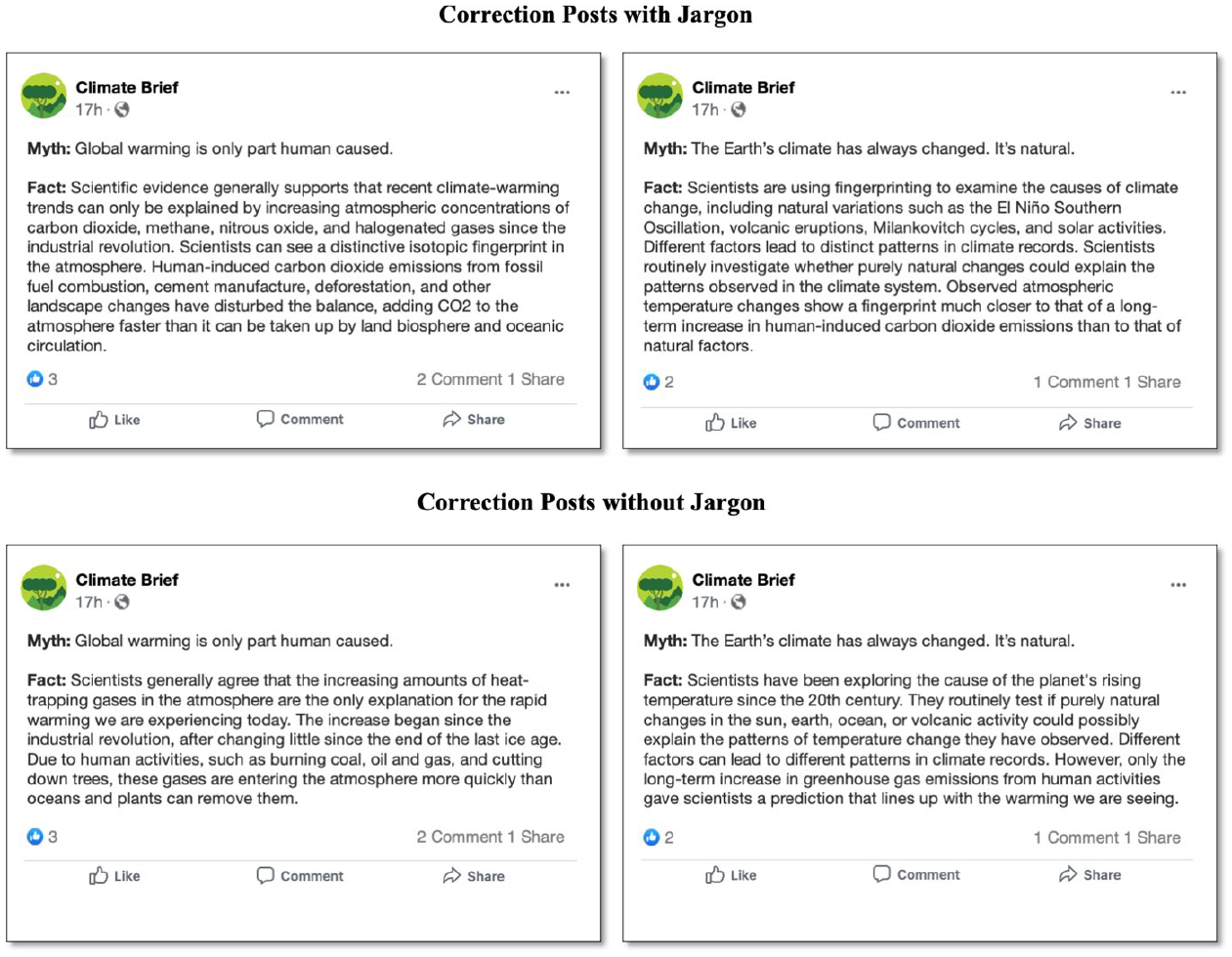
Message Stimuli.
Jargon
The two messages were either written with or without scientific jargon. For the message debunking the myth that global warming is natural, the nonjargon version stated that natural changes do not explain the temperature patterns we observe, and only human-caused greenhouse gas emissions do. The jargon version conveyed the same idea but used scientific terms like “fingerprint,” “El Niño Southern Oscillation,” and “human-induced carbon dioxide emissions.” For the message debunking the myth that global warming is only partly caused by humans, the nonjargon version explained that the dramatic increase in heat-trapping gases since the Industrial Revolution is due to human activities like burning fossil fuels and cutting down trees. The jargon version conveyed the same idea but used terms such as “carbon dioxide,” “halogenated gases,” “distinctive isotopic fingerprint,” and “fossil fuel combustion.”
Processing Motives
Following prior research (Winter et al., 2016), participants were primed with either an accuracy motive, an impression motive, or no induction (control). In the accuracy motive condition, participants were informed that the study aimed to understand people’s skills in finding and using accurate information for decision-making. They were instructed to collect and use accurate information to make judgments. In the impression motive condition, participants were informed that the study aimed to understand people’s ability to be likable in social situations. They were asked to collect and use information for making good impressions during conversations with others about climate change. Participants were informed that their ability to show the requested skill (i.e., accuracy or impression) would be assessed in the study. These instructions were bold and highlighted in a different color than other texts of the instructions to improve participants’ attention.
Participants in the control condition did not receive any motive induction.
Procedure
Upon agreeing to participate and answering the filter question, participants were randomly assigned to one of the six conditions and received an induction for processing motive (or no induction for the control group). They were then asked to read two posts about climate change, either with jargon or in lay language, as they normally would on Facebook. Subsequently, they completed a questionnaire assessing their policy attitude and intention, as well as responses to the posts, such as anger, systematic processing, and perceived message credibility, along with demographic questions. Finally, they were thanked and compensated.
Measures
Anger
Participants reported how much the posts made them “irritated,” “angry,” and “annoyed” (1 = none of this feeling, 7 = a great deal of this feeling) (Shen & Dillard, 2007) (α = .94, M = 3.01, SD = 1.96).
Message Credibility
Participants rated the posts on a 7-point Likert-type scale in terms of how much they agreed that the posts were “accurate,” “authentic,” “believable,” “reputable,” and “objective” (Appelman & Sundar, 2016) (α = .95, M = 4.13, SD = 1.69).
Systematic Processing
Participants indicated their agreement on a 7-point Likert-type scale with five statements, such as “I thought about what actions I might take based on the information,” and “I thought about how the information related to other things I know” (Oh et al., 2019) (α = .81, M = 5.01, SD = 1.29).
Policy Attitude
Participants rated how much they believed that climate change policies were harmful/beneficial, foolish/wise, bad/good, and undesirable/desirable on a 7-point semantic differential scale (Blankenship et al., 2015) (α = .94, M = 3.77, SD = 2.01).
Policy Intention
Participants indicated their agreement on a 7-point Likert-type scale with three statements: “I intend to support climate change mitigation policies in the near future,” “I plan to support climate change mitigation policies,” and “I am going to make an effort to support climate change mitigation policies” (Shen & Dillard, 2007) (α = .96, M = 3.39, SD = 1.99).
Manipulation and Randomization Check
To avoid sensitizing participants (O’Keefe, 2003), we did not perform direct checks of manipulation effectiveness in the experiment. We asked participants in the treatment groups at the end to identify their task in the study (i.e., collecting the most accurate information or collecting information to make a good impression on others). About 83.4% of participants (206 out of 247) correctly remembered the instruction they received.
The message difference in jargon use was confirmed through a pretest with an MTurk volunteer sample (n = 60). Participants rated the degree to which they agreed that the messages contained “unfamiliar information,” “difficult language,” and “a lot of jargon” (α messgage1 = .87; α messgage2 = .80). They perceived significant differences between the two jargon messages and the two corresponding messages drafted with plain language., For the first set of messages: Mjargon = 3.68, SDjargon = 1.45 vs. Mno jargon = 2.38, SDno jargon = 1.61; t(58) = 3.29, p = .002. For the second set of messages: Mjargon = 4.31, SDjargon = 1.21 vs. Mno jargon = 2.80, SDno jargon = 1.52; t(58) = 4.24, p < .001).
Randomization checks suggested that the experimental conditions did not differ significantly on the demographic variables (age, gender, ethnicity, education, and political orientation) and levels of agreement with the filter question. Therefore, their effects were not statistically controlled.
Results
RQ1 and RQ2 asked if priming accuracy or impression motive would result in a more favorable (a) attitude toward and (b) intention to support policies for mitigating climate change. Two-way ANOVAs suggested that the main effect of processing motive was nonsignificant on policy attitude, F (2,364) = 0.88, p = .41, or policy intention, F(2,364) = 0.72, p = .49. Post hoc comparisons using Sidak adjustment further revealed no significant differences in policy attitude between the accuracy motive (M = 3.61, SD = 1.95) and control condition (M = 3.76, SD = 2.06, p = .94) and between the impression motive (M = 3.95, SD = 2.02) and control condition (p = .81). Similarly, there were no significant differences in policy intention between the accuracy motive (M = 3.22, SD = 2.06) and control condition (M = 3.40, SD = 2.00, p = .90) and between the impression motive (M = 3.53, SD = 1.99) and control condition (p =.92). In addition, there were no significant differences in policy attitude (p = .46) and intention (p = .55) between the accuracy and impression motive condition.
H1 predicted the main effect of jargon on (a) policy attitude and (b) intention. Two-way ANOVAs revealed that the effect of jargon use was nonsignificant on policy attitude, F (2,364) = 0.06, p = .80, or policy intention, F (2,364) = 0.01, p = .92. H1a-H1b was not supported.
H2-H4 predicted that the effect of jargon on (a) policy attitude and (b) intention would be mediated by anger, systematic processing, and perceived message credibility. Indirect-effect analyses were conducted using PROCESS Macro (Model 4) with 5,000 bootstrap samples and 95% CI (Hayes, 2018). Results suggested that neither anger (B < .001, SE = .01, 95% CI [−.026, .028]), systematic processing (B = .01, SE = .02, 95% CI [−.027, .063]), nor perceived message credibility (B = .14, SE = .14, 95% CI [−.143, .415]) served as significant mediators of the jargon effect on policy attitude. Similarly, anger (B < .001, SE = .01, 95% CI [−.024, .029]), systematic processing (B = .03, SE = .04, 95% CI [−.040, .105]), and perceived message credibility (B = .13, SE = .13, 95% CI [−.121, .391]) were not significant mediators of the jargon effect on policy intention. Therefore, H2-4 were not supported.
H5a-b predicted an interaction effect between processing motive and jargon on (a) policy attitude and (b) intention. Two-way ANOVAs revealed that the interaction effect was significant on attitude toward policies for mitigating climate change, F (2,364) = 4.76, p = .009, partial η2 = .03. Cell means were reported in Table 1 and plotted in Figure 2. Post hoc comparisons with Sidak adjustment were conducted. First, we compared motive effects when jargon was and was not used. When the correction posts did not contain jargon, participants primed with the accuracy motive indicated a significantly less favorable attitude (M = 3.22, SD = 1.96) than those in the control condition (M = 4.14, SD = 2.11, p = .01) and those primed with the impression motive (M = 4.03, SD = 1.97, p = .02). No significant difference was found between the impression and the control condition (p = .76). When the correction posts contained jargon, a marginally significant difference in attitude was found between the accuracy condition (M = 4.00, SD =1.93) and the control condition (M = 3.36, SD =1.99, p = .07). No other group difference was significant. Second, jargon effects on policy attitude under different motives were also examined. In the control condition, posts with jargon led to a significantly less favorable attitude (M = 3.36, SD =1.99) than posts without jargon (M = 4.14, SD =2.11, p = .03). When primed with the accuracy motive, participants indicated a significantly more favorable attitude after reading the posts with jargon (M = 4.00, SD =1.93) than without jargon (M = 3.22, SD =1.96, p = .03). Jargon use did not lead to a significantly different attitude when participants were primed with the impression motive (p = .66). H5a was supported.
Means of Outcome Variables by Experimental Conditions.

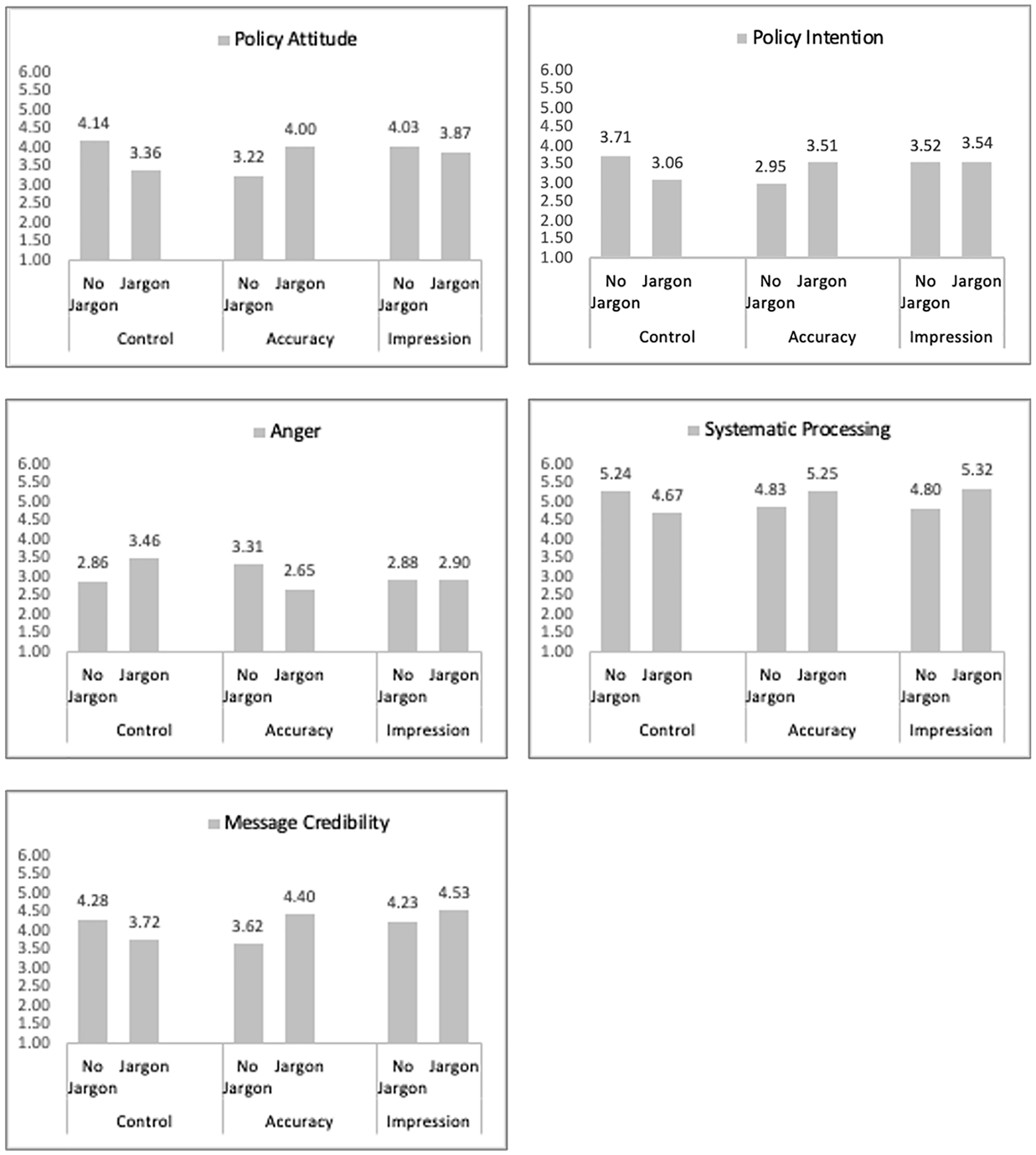
Mean Differences Between Jargon and No-Jargon Conditions Under Different Processing Motives.
There was also a marginally significant interaction effect between processing motive and jargon on policy support, F (2,364) = 2.90, p = .06, partial η2 = .02. When the correction posts did not contain jargon, participants primed with the accuracy motive indicated a significantly less intention (M = 2.95, SD =1.98) than those in the control condition (M = 3.71, SD = 2.01, p = .03). No other group difference was significant. When the correction posts contain jargon, no group difference was significant. We also examined the jargon effect on policy support intention under different motive conditions. In the control condition, the mean difference in intention between the condition without jargon (M = 3.71, SD = 2.01) and the condition with jargon (M = 3.06, SD = 1.99) approached statistical significance (p = .06). Jargon effect was nonsignificant when participants primed with the accuracy motive (p = .11) or the impression motive (p = .96). Given the marginally significant result, H5b was not fully supported.
Both H6a and H7 predicted that processing motive would condition the indirect effects of jargon through anger. Indirect-effect analyses (Model 8) were conducted with processing motive analyzed as a multi-categorical moderator using indicator coding. This approach enabled separate comparisons of the indirect paths for two contrasts: first, between the accuracy motive and the control condition, and second, between the impression motive and the control condition. Results showed that when comparing the condition primed with accuracy motive and the control condition, the moderated mediation was significant on policy attitude, B = .45, SE = .20, 95% CI [.099, .861], such that for the control condition, jargon use increased the experienced anger, which subsequently decreased policy attitude, B = -.22, SE = .13, 95% CI [−.433, -.021]; for the accuracy condition, jargon use decreased the experienced anger, which subsequently enhanced policy attitude, B = .23, SE = .14, 95% CI [.010, .470]. The moderated mediation was also significant on policy intention, B = .45, SE = .19, 95% CI [.118, .844], such that for the control condition, jargon use increased the experienced anger, which subsequently decreased policy intention, B = -.22, SE = .12, 95% CI [−.421, -.025]; for the accuracy condition, jargon use decreased the experienced anger, which subsequently enhanced policy intention, B = .23, SE = .14, 95% CI [.019, .470]. Specific path coefficients were reported in Figure 3. Therefore, H6a was supported.
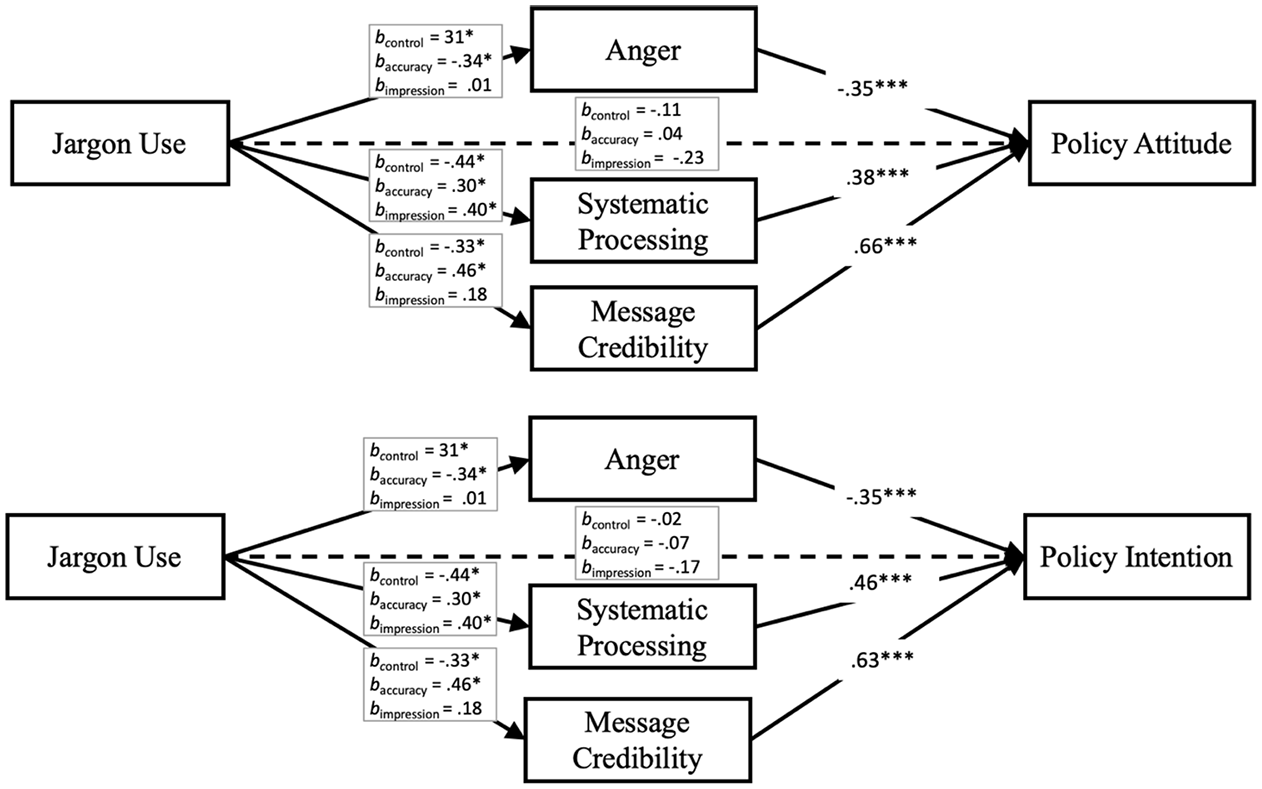
Statistical Diagram of the Moderated Mediations (H6-H7 and RQ3).
When comparing the condition primed with impression motive and the control, the moderated mediation was nonsignificant on policy attitude, B = .21, SE = .18, 95% CI [−.133, .582], or policy intention, B = .21, SE = .18, 95% CI [−.126, .561]. Therefore, H7 was not supported.
Both H6b and RQ3b proposed that processing motive would condition the indirect effects of jargon through systematic processing. Similarly, analyses revealed that when comparing the accuracy motive and the control condition, the moderated mediation was significant on policy attitude, B = .56, SE = .20, 95% CI [.194, .989], such that for the control condition, jargon use decreased systematic processing, which subsequently reduced policy attitude, B = -.35, SE = .14, 95% CI [−.634, -.084]; for the accuracy condition, jargon use increased systematic processing, which subsequently enhanced policy attitude, B = .25, SE = .13, 95% CI [.045, .534]. The moderated mediation was also significant on policy intention, B = .65, SE = .23, 95% CI [.215, 1.135], such that for the control condition, jargon use decreased systematic processing, which subsequently reduced policy intention, B = -.40, SE = .16, 95% CI [−.731, -.098]; for the accuracy condition, jargon use increased systematic processing, which subsequently enhanced policy intention, B = .28, SE = .15, 95% CI [.053, .610]. Therefore, H6b was supported.
To answer RQ3b, analyses indicated that when comparing the impression motive and the control condition, the moderated mediation was significant on policy attitude, B = .66, SE = .22, 95% CI [.262, 1.091], such that for the control condition, jargon use decreased systematic processing, which subsequently reduced policy attitude, B = -.35, SE = .14, 95% CI [−.634, -.084]; for the impression condition, jargon use increased systematic processing, which subsequently enhanced policy attitude, B = .31, SE = .15, 95% CI [.032, .628]. The moderated mediation was also significant on policy intention, B = .76, SE = .25, 95% CI [.296, 1.266], such that for the control condition, jargon use decreased systematic processing, which subsequently reduced policy intention, B = -.40, SE = .16, 95% CI [−.731, -.098]; for the impression condition, jargon use increased systematic processing, which subsequently enhanced policy intention, B = .36, SE = .18, 95% CI [.026, .731].
H6c and RQ3a proposed that processing motive would condition the indirect effects of jargon through perceived message credibility. Results suggested that when comparing the accuracy motive and the control condition, the moderated mediation was significant on policy attitude, B = 1.16, SE = .37, 95% CI [.422, 1.885], such that for the control condition, jargon use decreased perceived message credibility, which subsequently reduced policy attitude, B = -.49, SE = .25, 95% CI [−.990, -.011]; for the accuracy condition, jargon use increased perceived message credibility, which subsequently enhanced policy attitude, B = .67, SE = .26, 95% CI [.157, 1.203]. The moderated mediation was also significant on policy intention, B = 1.15, SE = .37, 95% CI [.427, 1.898], such that for the control condition, jargon decreased message credibility, which subsequently reduced policy intention, B = -.48, SE = .26, 95% CI [−.985, -.004]; for the accuracy condition, jargon use increased message credibility, which subsequently enhanced policy intention, B = .67, SE = .27, 95% CI [.145, 1.198]. Therefore, H6c was supported. Table 2 presents a summary of hypothesis testing.
Hypothesis Testing.
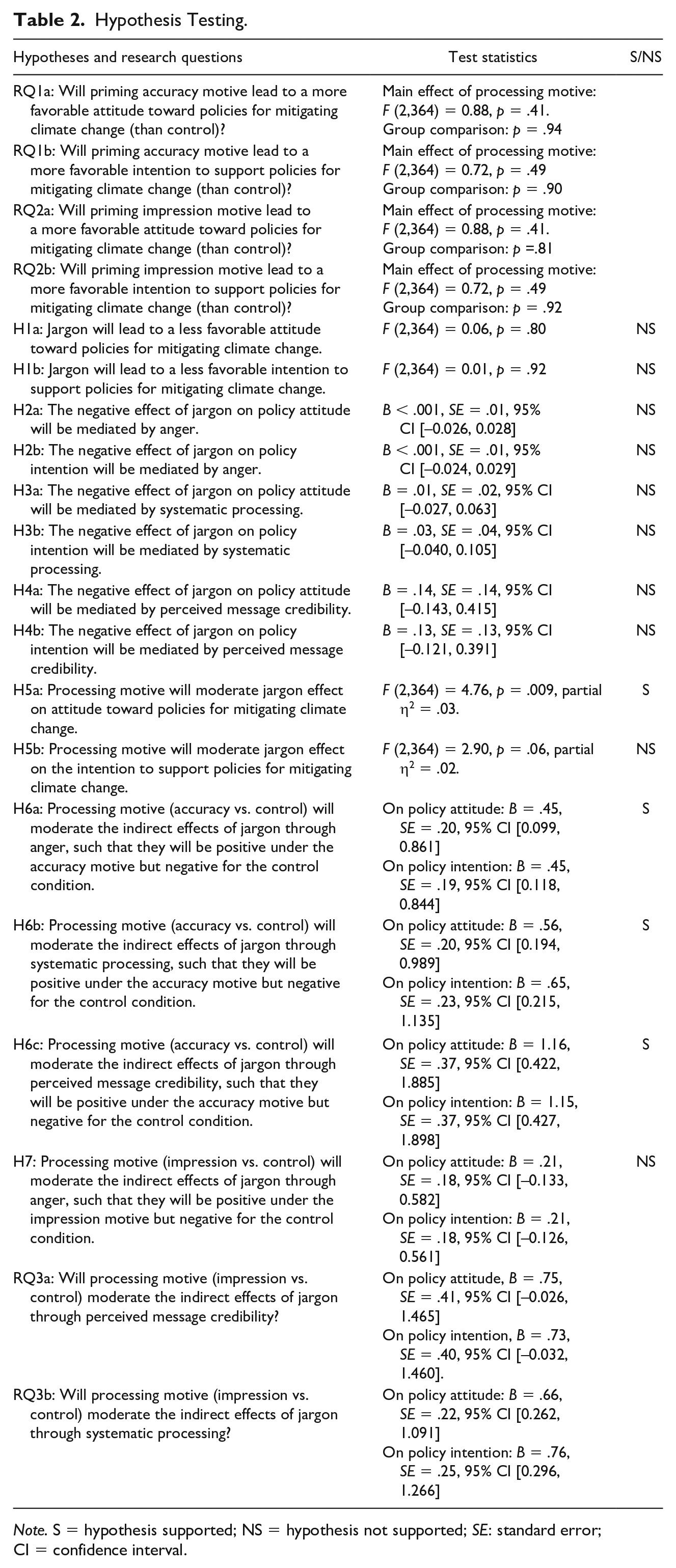
Note. S = hypothesis supported; NS = hypothesis not supported; SE: standard error; CI = confidence interval.
To answer RQ3a, analyses indicated that when comparing the impression motive and the control condition, the moderated mediation was nonsignificant on policy attitude, B = .75, SE = .41, 95% CI [−.026, 1.465], or on policy intention, B = .73, SE = .40, 95% CI [−.032, 1.460].
Discussion
This study extends research on processing motive and jargon to the context of misinformation correction. It investigates whether priming different information processing motives can offer persuasive advantages among individuals who hold misbeliefs regarding climate change and whether jargon holds psychological appeal under certain processing motives. By examining these questions, this experiment offers valuable insights into the interplay between these two factors in misinformation correction, with implications for message design and communication strategies that promote policy support for climate change.
Specifically, our findings expand the understanding of jargon effects by demonstrating that jargon can have both positive and negative impacts on misinformation correction, depending on the processing motive of the audience. Jargon may foster attitude change when individuals are primed with an accuracy motive. This implies that individuals who are driven to seek accurate information are more inclined to appreciate messages containing jargon, despite the language complexity and processing disfluency, ultimately leading to increased support for climate change policies. Thus, jargon may serve as a valuable tool for communicators aiming to engage audiences who prioritize accuracy and truth.
Taking a step further, the study identified several psychological mechanisms underlying the positive impact of jargon under the accuracy motive. The benefits of jargon can be attributed to reduced anger, increased systematic processing, and heightened message credibility perceptions among those motivated to seek accuracy. It is probable that messages containing jargon align with the cognitive processing approach when individuals are accuracy motivated. The use of jargon leads to a disfluent processing experience that demands considerable cognitive effort and resources (Krieger & Gallois, 2017). This is compatible with motivated, analytical processing that aims to attain objective information, accurate reasoning, and sound conclusions (Chaiken et al., 1996). With an emphasis on accuracy, individuals are also less likely to experience negative emotions and rely on them for judgments when processing attitude-incongruent messages that are difficult to process (Bohner et al., 1995). Moreover, jargon may contribute to the scientific style of corrective messages and signal credentials and expertise, thus serving as a credibility heuristic for judgment making. Interestingly, the simultaneous presence of the three mediating processes suggests that accuracy-motivated individuals may engage in both systematic and heuristic processing to fulfill their desire for truth and accuracy (Nan et al., 2018).
Conversely, the study uncovered a negative impact of jargon when there was no specific motive induction, consistent with previous findings on jargon effects in general (Bullock et al., 2019; Shulman et al., 2020). It has been suggested that beliefs about climate change are often closely tied to ideological convictions (Zhou & Shen, 2021). Thus, a strong defense motive may dominate information processing when individuals are exposed to opposing viewpoints on this issue. Under this scenario, our results indicate that using jargon may be counterproductive. It may intensify confirmation bias and defensive reactions to corrective messages, including heightened anger, diminished effortful information processing, and hampered perceptions of message credibility.
Contrary to our expectations, no significant jargon effect on policy attitude or intention was observed when participants were primed with an impression motive. Based on the cell means of anger (Table 1), the focus on gathering information for social goals and impression management seemed to reduce anger during message exposure in general, but this was not dependent on jargon use. The findings also suggest that the presence of jargon in corrective messages may stimulate systematic processing among individuals motivated by the desire to make a positive social impression. Despite this potential for increased depth of information processing, we did not observe a corresponding positive impact on persuasion outcomes. This discrepancy points to the possibility of other negative psychological pathways that might cancel out the benefits of systematic processing under the impression motive. Such findings underscore the need for further research to explore and identify these counteracting influences. Moreover, for impression-motivated individuals, heuristic cues indicating social approval of message content or social norms might be more crucial for their decision-making. Future investigations should further explore social cues that may be impactful for individuals who have an impression motive for information processing.
This study offers practical suggestions for campaigns aiming to correct misinformation and promote support for climate change policies. Specifically, communicators should assess their audience’s motives and tailor the style of corrective messages accordingly. Contrary to the assumption of a negative jargon effect, using jargon can be advantageous when individuals prioritize accurate information. However, for audiences with other motives, simplifying complex terms and using accessible language may be more effective. Importantly, since an accuracy motive can enhance the effectiveness of jargon-containing messages, communicators should consider strategies to evoke this motive in their audience before presenting complex scientific information. Our findings also underscore perceived message credibility and anger as critical cognitive and emotional factors that determine correction effectiveness. Communicators should pay more attention to strategies that can boost message credibility and manage the negative emotions of audiences during misinformation correction.
This study has several limitations that should be acknowledged. First, the motive induction in the experiment may be somewhat artificial. Although this is an established procedure used in prior research (Winter et al., 2016), it may not accurately resemble real-life scenarios. For instance, accuracy motives might be elicited through social media quizzes, while impression motives might be prompted by engaging participants in supportive online conversations with others. Future research should explore and test more realistic ways to provoke different motives so that the findings can better inform misinformation correction efforts in real-world settings. In addition, the impression motive prime did not include specific information about potential reference groups and the prevailing opinions within these groups. As the reference group’s beliefs can significantly influence one’s motivation to either conform with or mask their beliefs for the sake of a positive social impression, future studies should explore how this factor may condition the effects of the impression motive. This can offer deeper insights into the interplay between social influence, personal beliefs, and impression management strategies in the context of misinformation correction.
Second, several findings related to policy support intention were marginally significant or nonsignificant, though mean patterns were in predicted directions. This raises concerns about statistical power. Post hoc power analysis suggested that the sample was limited in detecting small effects (i.e., a power of .34, >.99, >.99 for detecting effect sizes of f = .10, .25, and .40, respectively). Future research may consider replicating the design with a larger sample size.
Third, the study only examined the immediate effects of jargon and processing motives. It is reasonable to assume that any advantage of jargon may diminish over time due to its inherent disadvantage in information retention (Sweller, 1994). Future research should re-examine these factors using a longitudinal design.
Also, although processing fluency is an important mechanism for understanding jargon effects (Shulman et al., 2020), it was not directly measured in our research. Our study primarily focused on systematic processing, message credibility, and anger, given their more direct relevance to our research objectives concerning the moderating effects of impression and accuracy motives in the context of misinformation correction. We recognize, however, that incorporating measures of processing fluency could have provided a more comprehensive understanding of the immediate cognitive responses to jargon.
To conclude, this study sheds light on the interplay between processing motives and jargon in correcting misinformation and fostering support for climate change policies. The findings highlight the importance of tailoring message strategies to the specific motive of the target audience to maximize correction effectiveness. Further research along this line is needed to deepen our understanding of how audience factors and message strategies together impact misinformation correction. This knowledge will contribute to a more comprehensive approach to effectively counteract misinformation and encourage evidence-based decision-making on climate change and other pressing social issues.
Footnotes
Declaration of Conflicting Interests
The author(s) declared no potential conflicts of interest with respect to the research, authorship, and/or publication of this article.
Funding
The author(s) disclosed receipt of the following financial support for the research, authorship, and/or publication of this article: This work was supported by AEJMC Mass Communication & Society Division Faculty Research Award Program.
