



Abstract
This systematic literature review presents an interdisciplinary overview of theories tested in experiments on the effects of communicating uncertainty. Using a machine learning-aided pipeline, we selected and manually coded 413 experimental studies. We discuss core assumptions and predictions of the main theories of uncertainty communication. Most normative theorizing (e.g., Bayesianism, Expected Utility Theory) is rooted in Probability Theory, which is only suitable for addressing shallow and medium uncertainty. This explains the underrepresentation of experimental research into deep uncertainty communication. To foster a more comprehensive understanding of uncertainty communication effects, we identify research questions and theories deserving greater attention.
Introduction
How to communicate uncertainty can be a hard nut to crack for many professionals. Uncertainty communication is a central part of science communication (Gustafson & Rice, 2020) but also plays a major role elsewhere. Think of doctors communicating the risk of an illness to patients, experts communicating uncertainty about the future to policy makers, and meteorologists forecasting extreme weather events to the TV-watching public. How should professionals anticipate how people will understand and respond to uncertainty communication? Multiple fields of research, ranging from economics, psychology, and medical communication to crisis communication, have studied the effects of how uncertainty is communicated. They have focused on effects such as financial decision-making and trust in science. Previous literature reviews, such as by Liu et al. on crisis communication and Sopory et al. on public health communication, noted, however, that much of the research into uncertainty communication for their fields is largely undertheorized (Liu et al., 2016; Sopory et al., 2019). We add to these reviews by adopting an interdisciplinary focus and spelling out causes and consequences of the lopsidedness of current literature. Adding to this observation, available studies usually conceive uncertainty as mere probability (Kalke et al., 2021). Yet, uncertainty can go much deeper than that. Knight already noted this distinction and contrasted uncertainty with risk: he conceived of risk as quantifiable and uncertainty as non-quantifiable (Knight, 1921; Van der Bles et al., 2019). In this article, as we will explain below, we do not explicitly distinguish both notions, but treat them as levels on a continuum, with shallow uncertainty (resembling Knightian risk) on the one end and deep uncertainty (equal to Knightian uncertainty) on the other end (Bevan, 2022; Kwakkel et al., 2010; Walker et al., 2003).
This being said, many publications do not explicitly distinguish between different types of uncertainty (De Groot & Thurik, 2018). This is problematic from a practical as well as a scientific perspective. In the real world, uncertainty is often not communicated in terms of probability, especially in the case of crucial decisions (Derbyshire, 2017). Dice rolls and weather forecasts are a matter of risk, and wars and pandemics are objects of uncertainty. This matters a lot for governments and businesses: the kind of uncertainty that is present should inform the way decisions are made. For example, probabilistic forecasts can be appropriate in the case of risk and can be met by straightforward decision-making. In the face of fundamental uncertainty, however, other communication methods are better, such as scenarios. For example, exploratory scenarios on climate mitigation policies may support reasoning about plausible but not predictable developments, such as: What would be the consequences for these policies if international cooperation would break down, or increase dramatically? (Maier et al., 2016). Decisions based on scenarios should be more open to surprises and setbacks (Derbyshire, 2017). Hence, too much focus on probability may limit our understanding of the effects of uncertainty communication (Volz & Gigerenzer, 2012). Considering these challenges, it is hard to keep the overview of what ground is covered by theories currently in use to explain the effects of how uncertainty is communicated. That is the issue we tackle in this article.
We present a systematic literature review of the use of theories for experiments testing the effects of uncertainty communication, across disciplines. It is guided by the following research question: Which theoretical frameworks have been tested experimentally to explain the effects of how uncertainty is communicated? The article makes two main contributions. First, we show how the core ideas of dominant normative theories for experiments in the social sciences, such as Expected Utility Theory (EUT) and Bayesianism, are based on the axioms of Probability Theory. Since probability cannot cover unquantified levels of uncertainty, these normative theories are by definition tied to shallow levels of uncertainty. Subsequently, we describe how empirical theories, such as Cumulative Prospect Theory (CPT), follow these norms based on probability theory. This translates to research practices strongly lopsided toward shallow uncertainty: many theories cannot relate to deeper levels of uncertainty. This is a missed opportunity: if research is to inform practitioners with effective reasoning techniques regarding (deeper levels of) uncertainty, we need theories to explain how individuals respond to and reason about these deeper levels of uncertainty. Second, we support researchers in navigating this vast, interdisciplinary body of research with discussions of the core assumptions and predictions of theories (Campbell et al., 2014). More in particular, we bring existing but implicit theoretical competition to light, highlight research questions that deserve more research, and identify which theories could inform these questions. We also propose largely unnoted theories that may foster theory diversification and refinement (Seuring et al., 2021).
We focus on the use of theory in experimental studies into the effects of how uncertainty is communicated. The scope of application spans communication across disciplines (including diverse fields such as medical and public policy sciences). As a matter of fact, much of the research into uncertainty communication is experimental. Examples are experiments on how people understand verbal uncertainty expressions (Bonnefon & Villejoubert, 2006; Budescu et al., 2009), how members of the public respond to uncertainty frames (Gustafson & Rice, 2019), or how policymakers understand uncertainty in environmental assessments (Wardekker et al., 2008). Moreover, experimental designs by nature require a relatively explicit description of theory and assumptions and allow for comparison across a diversity of disciplines. As we will explain, our systematic literature review includes any experiment that studies the immediate and individual-level effects of uncertainty communication. To obtain such a comprehensive overview, we rely on automated decision-making by using a machine learning tool for selecting literature (van de Schoot et al., 2021).
This literature review can be read as a call to match our theoretical accounts of how people reason about uncertainty with how the human brain functions. On this basis, strategies for communicating and reasoning about uncertainty information can be developed and further fine-tuned. We advise practitioners to diversify communication strategies depending on the level of uncertainty they assess to be present.
In the next section, we start by spelling out the theoretical foundations of uncertainty communication research, with a focus on the levels of uncertainty. This is followed by the “Method” section; we adhere to the Preferred Reporting Items for Systematic Reviews and Meta-Analyses (PRISMA) principles of reporting on systematic literature reviews (Page et al., 2021). Next, we discuss the main theories in the literature and how these relate to certain research questions. We show how the dominance of Probability Theory as a normative framework relates to a lopsided literature, with almost all research devoted to shallow uncertainty. To counter this, we highlight “hidden gems” of theories: hardly used but promising in terms of explanatory power and interdisciplinary potential. We conclude the article with a call for diversifying theory in terms of the levels of uncertainty and research questions they cover.
The Theoretical Foundations of Uncertainty Communication Research
Frank Knight influentially defined risk as referring to measurable and/or knowable probabilities, while he took uncertainty to refer to unknowable and unmeasurable probabilities (Knight, 1921). In a small world, the options and their probabilities are known, so Knight would speak of risk. Dice rolls and lotteries are paradigmatic examples. In the real world, however, most options and probabilities are unknown, so there is Knightian uncertainty (Savage, 1954). This fundamental distinction between measurable and unmeasurable uncertainty forms a common thread throughout much thinking on it. More specifically, it concerns the precision by which the probabilities and options can be denoted (Bevan, 2022).
Rather than considering the differences between uncertainty and risk as a clear-cut, black-and-white distinction, we prefer to think of it as a continuum between risk and uncertainty, or between shallow and deep uncertainty. To capture different possible manifestations of uncertainty in literature, we follow an adapted version of the Walker framework, which is a comprehensive and authoritative typology of uncertainty (Kwakkel et al., 2010; Walker & Marchau, 2003). Compared with other typologies (Skinner et al., 2014), this framework offers a clear description of possible levels of uncertainty between the two ends of the continuum (shallow, medium, and deep uncertainty) that does not mix up communication forms or methods of dealing with uncertainty with the actual specificity of the knowledge that is communicated. Whenever uncertainty is communicated, it can be classified along one of the uncertainty levels. We return to these levels in the “Method” section.
Uncertainty and its related concepts—risk, probability, and ambiguity—have been defined in many ways, giving way to some definitional pitfalls. First, risk can also be defined as “adverse consequences under uncertainty,” with “quantified risk” as its measurable form (Kadvany, 1996). Second, the term ambiguity, too, has been used for describing an unknown probability (Desrochers & François Outreville, 2020), but also as a situation with multiple possible meanings and understandings (Renn et al., 2011). To be inclusive, we studied publications adhering to all sorts of definitions of these terms.
Method
This article aims to provide an overview of the use of theories for experiments on the effects of uncertainty communication. In this section, we detail how we approached the systematic literature review and explain our key choices.
Eligibility Criteria
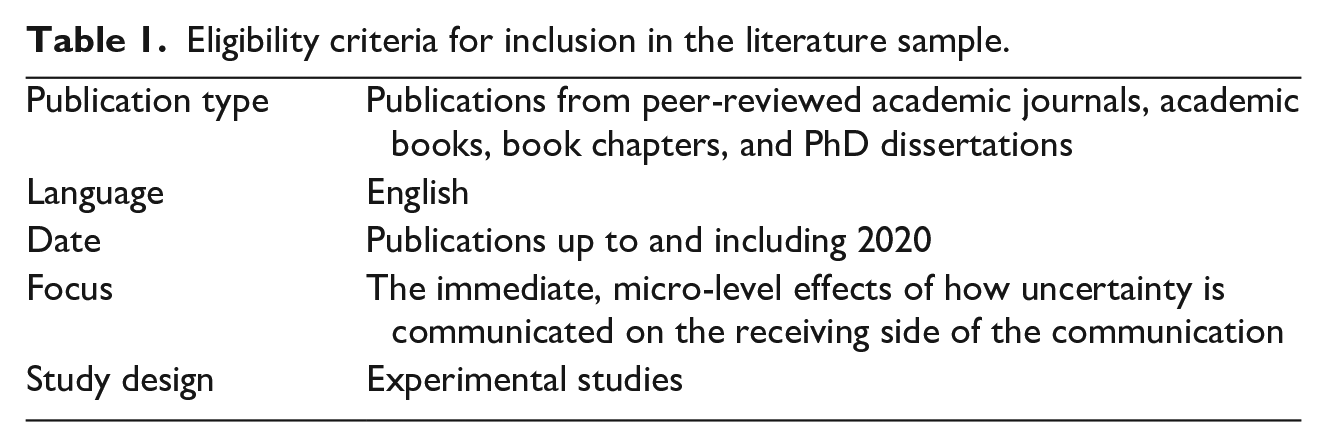
We include literature inventoried in Web of Science published from 1900 until and including 2020. We included all document types, ranging from articles, books, book chapters, data papers, discussions, editorial material, and proceedings papers. Early-access publications were excluded to prevent double hits. First, to be included the paper had to be an original analysis. Mere replications or re-analyses were excluded. Second, we only included experimental studies, for reasons mentioned in the introduction. This means that studies had to test the effects of two or more conditions. Third, we focus on immediate effects rather than long-term consequences, yet we excluded publications exclusively focusing on neural effects, such as brain section activation. Experimental studies in the sample could be both single and repeated-measures studies and could be within-subjects as well as between-subject designs. Fourth, we included only articles that focus on situations where individual humans receive some kind of uncertainty communication and where the measured effects are also at the individual level. It is crucial that the study should cover the effects of how uncertainty is communicated; the mere presence of uncertainty in the experimental conditions was not sufficient. For example, we included many studies investigating the effect of communicating uncertainty with graphs, pictures, maps, or otherwise. Table 1 summarizes the eligibility criteria.
Eligibility criteria for inclusion in the literature sample.
Search Strategy
We took the following steps to uncover as many relevant publications as possible. We applied a set of search terms in English using Web of Science (see Supplemental Appendix A). Our strategy was twofold. We identified an initial list of relevant search terms based on a preliminary investigation of potentially relevant studies. We complemented this list with additional search terms inspired by another literature review on communicating uncertainties about natural hazards, such as disseminat* and messag* (Doyle et al., 2019).
To produce a comprehensive overview, we proceeded with several steps (see Figure 1). Our initial query in Web of Science led to 157,397 results. As Web of Science only facilitates downloading the first 100,000 hits, we decided to narrow our analysis to these 100,000 references, which Web of Science identified as most relevant. In the second step, we evaluated the relevance of publications by reading the titles and abstracts of search hits. For this, we made use of a machine learning-aided pipeline applying active learning (van de Schoot et al., 2021). The algorithm predicts which studies have the best chance of being relevant. Before the systematic search, we carefully selected a sample of 35 studies that we conceived to be of strong relevance. Guided by this set of 35 studies, the algorithm presented us with what it ranked as the next most relevant study. Two researchers systematically evaluated the relevance of the record together and the software presented the next record. For feasibility reasons, we decided to stop after an initial scanning of 1,200 references, which should give us a good indication of the theories circulating in different fields and enable us to identify relevant trends. With the 1,200 references at our disposal, we screened each of them again, with particular attention to the abstract. In case of doubt, we also checked the full text of the article. This more in-depth screening resulted in a subset of 428 references, which we subsequently narrowed down to a final set of 413 publications, after excluding another 15 references that eventually did not match our eligibility criteria (Table 1). You will find the preselected sample of 35 in Supplemental Appendix C and the final sample of 413 studies in Supplemental Appendix D.
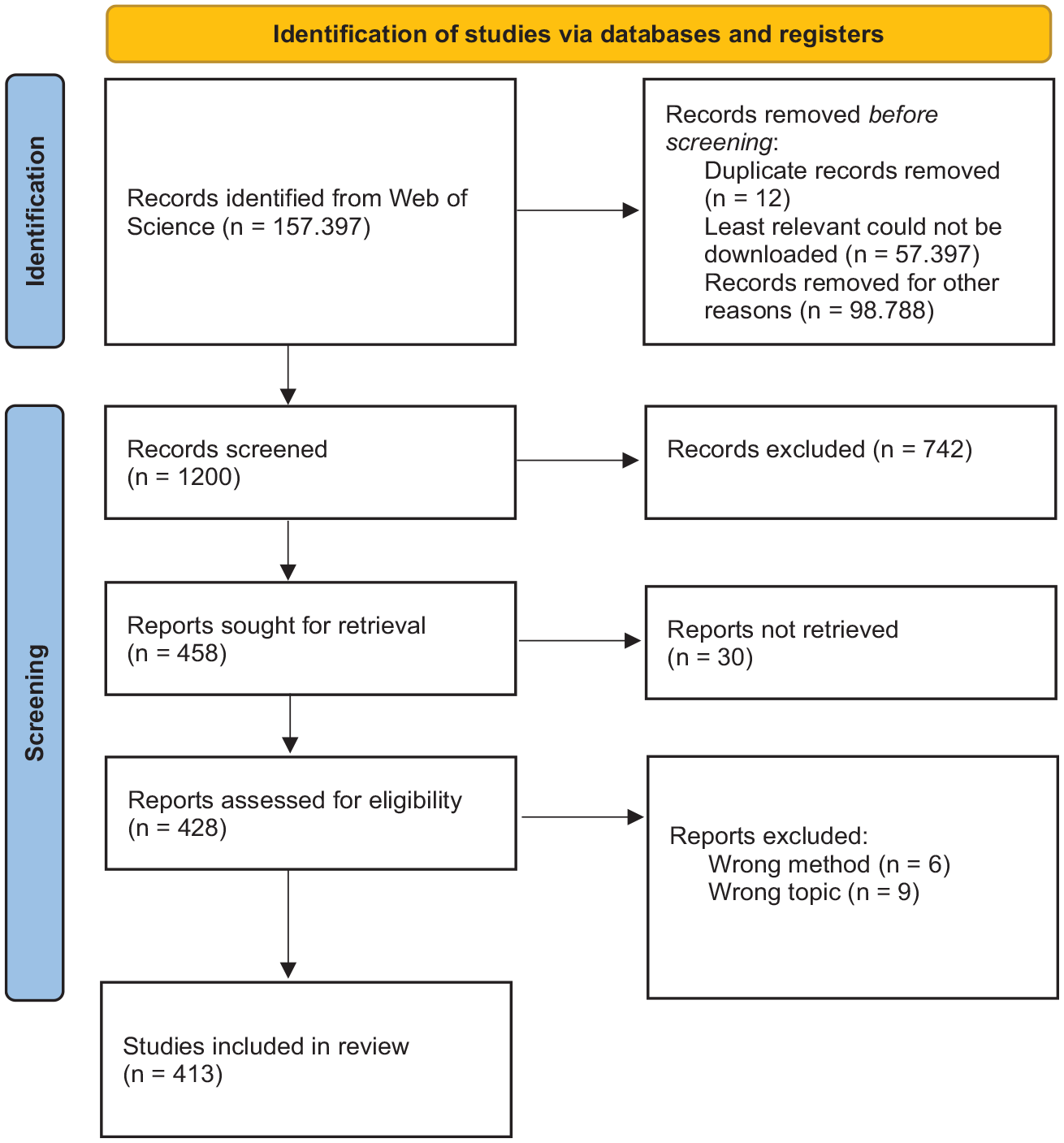
PRISMA Flow Diagram.
Figure 1 displays our systematic search in terms of the PRISMA flow diagram.
Analysis
We analyzed the content of the publications by applying an extensive coding scheme. This coding scheme was iteratively adapted but consistently applied (see Supplemental Appendix B). In case of doubt, we discussed coding results with the full research team, that is, all co-authors of this publication. Two coding categories are central to our analysis and thus deserve more explanation here: the theories used and the levels of uncertainty.
Theories Used in the Articles
We are interested in theoretical explanations of the effects of uncertainty communication. For this, we distinguish two classes of theories: normative and descriptive. Normative theories offer benchmarks of how one should ideally respond to uncertainty. They can be used to evaluate participant responses to uncertainty communication (Lejarraga & Hertwig, 2021). Descriptive theoretical frameworks explain and/or predict causal mechanisms. In defining these, we follow thinking on middle-range theories and mechanism-based theories, originally from the field of sociology (Geels, 2007; Hedström & Ylikoski, 2010). This means that we conceive such theories as simple yet precise accounts of the explanatory factors of human action. In other words, each theory offers a “set of explanatory tools” (Hedström & Ylikoski, 2010) that not only predicts the “what” and “how” but also explains the “why” (Whetten, 1989).
To code the theories used in the articles, we encountered three challenges: (1) Theories were mentioned but not really used to support the main arguments; (2) No theory was (explicitly) mentioned, but its central ideas were implicitly used and referred to; and (3) No theories were explicitly or implicitly referred to, but an argumentative structure with some generalizability to it was present. These challenges resonate with previous literature reviews of theory (Campbell et al., 2014). As our goal was to map the use of theory regardless of the quality of argumentation, we coded only explicit theory mentions. In case Challenge 1 applied, studies were included nonetheless. Although name-dropping can occur, the mentioned theory may still have influenced the experimental design and interpretation, albeit more implicitly. It was not our intention to rule out studies based on their quality of their reasoning, however.
Levels of Uncertainty
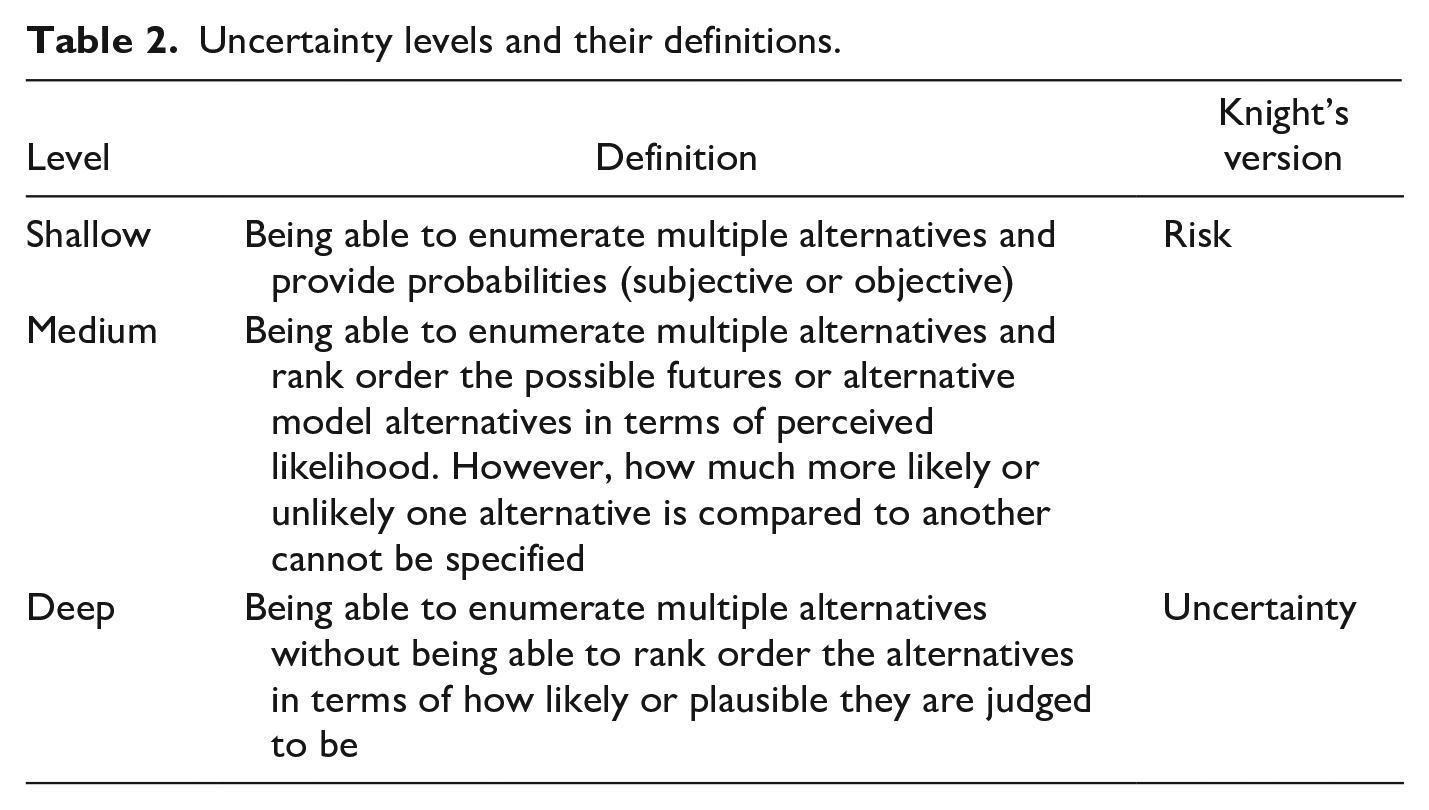
To make sense of different levels of uncertainty, we follow Walker et al.’s (2003) seminal framework on uncertainty. They define the uncertainty level as “where the uncertainty manifests itself along the spectrum between deterministic knowledge and total ignorance” (p. 4) and distinguish between no uncertainty, shallow, medium, deep uncertainty, and/or total ignorance. Shallow uncertainties, such as those involved in a fair die roll, are measurable. Medium uncertainty describes the situation in which multiple options can be rank-ordered in terms of assessed probability, but in which they cannot be described more precisely than that. Deep uncertainty, such as the outbreak of future pandemics, means that options can be thought of without the possibility of meaningful quantification in probabilistic terms.
Table 2 displays the levels of uncertainty, their definitions, and to what Knightian concept they correspond. The level definitions are cited from the slightly adapted version of the Walker framework by Kwakkel et al. (2010, p. 308).
Uncertainty levels and their definitions.
Results
In the “Results” section, we present an overview of theories that were most frequently used and which levels of uncertainty were studied the most. We also provide an overview of which research questions are typically addressed by which theories. Subsequently, we include a brief description of these main theories, showing how these theories deal with the uncertainty levels.
Overview of Theory Use
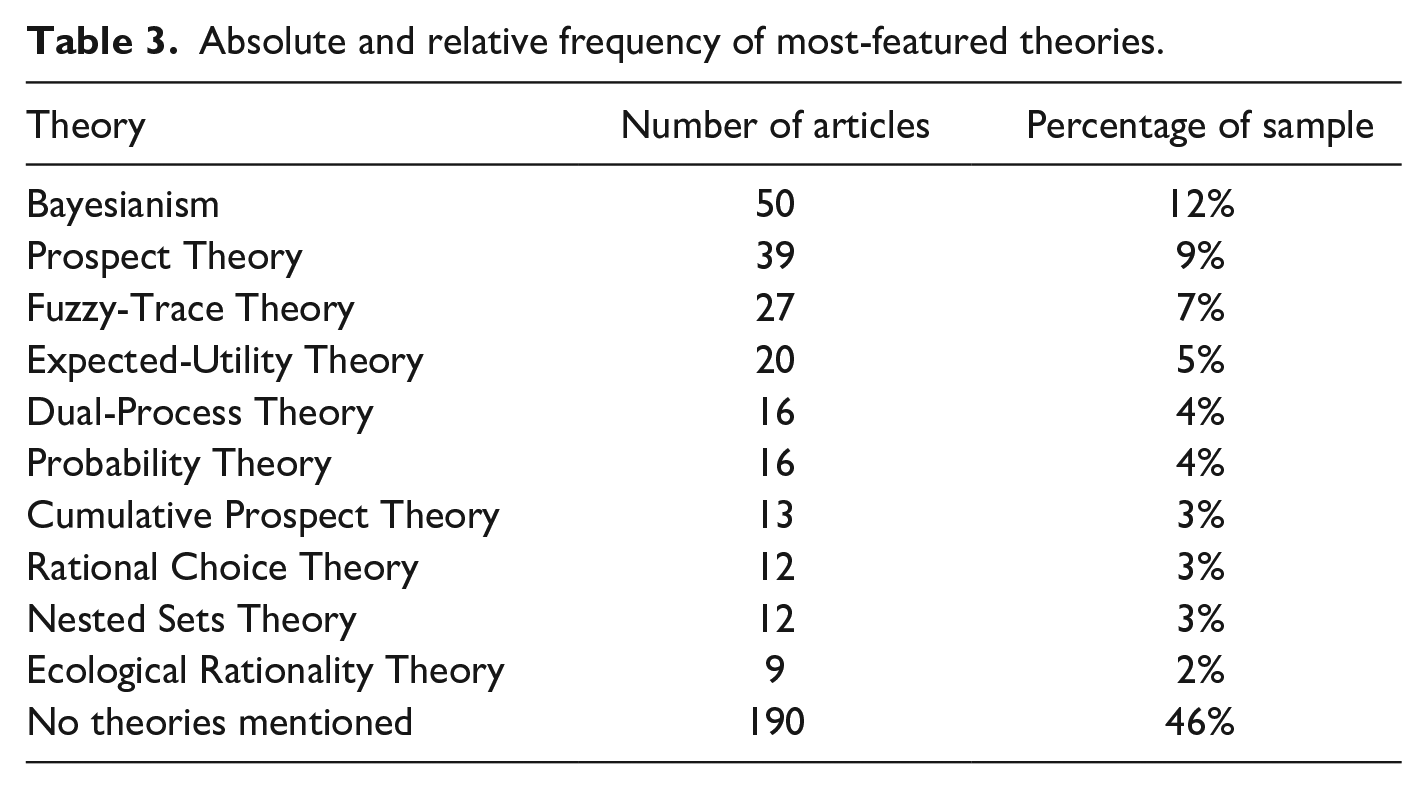
Table 3 displays the number of publications that explicitly mentioned a theory. Note that these are not mutually exclusive: multiple theories may occur in a single publication. Only 10 theories made it beyond getting mentioned in nine or more articles. Over a third (190) of the studies did not mention any theory explicitly.
Absolute and relative frequency of most-featured theories.
In Table 4, we display the disciplines we encountered in our sample. It shows how much uncertainty communication research is rooted in either medical or psychology research. Disciplines were coded based on the Web of Science research areas. The table also highlights the theories that were most used by these disciplines. There seems to be common theoretical ground between disciplines: a combination of (Cumulative) Prospect Theory (PT), Expected Utility Theory (EUT), and Bayesianism sets the tone in most disciplines.
Number of sample studies per discipline, and their most-featured theories.
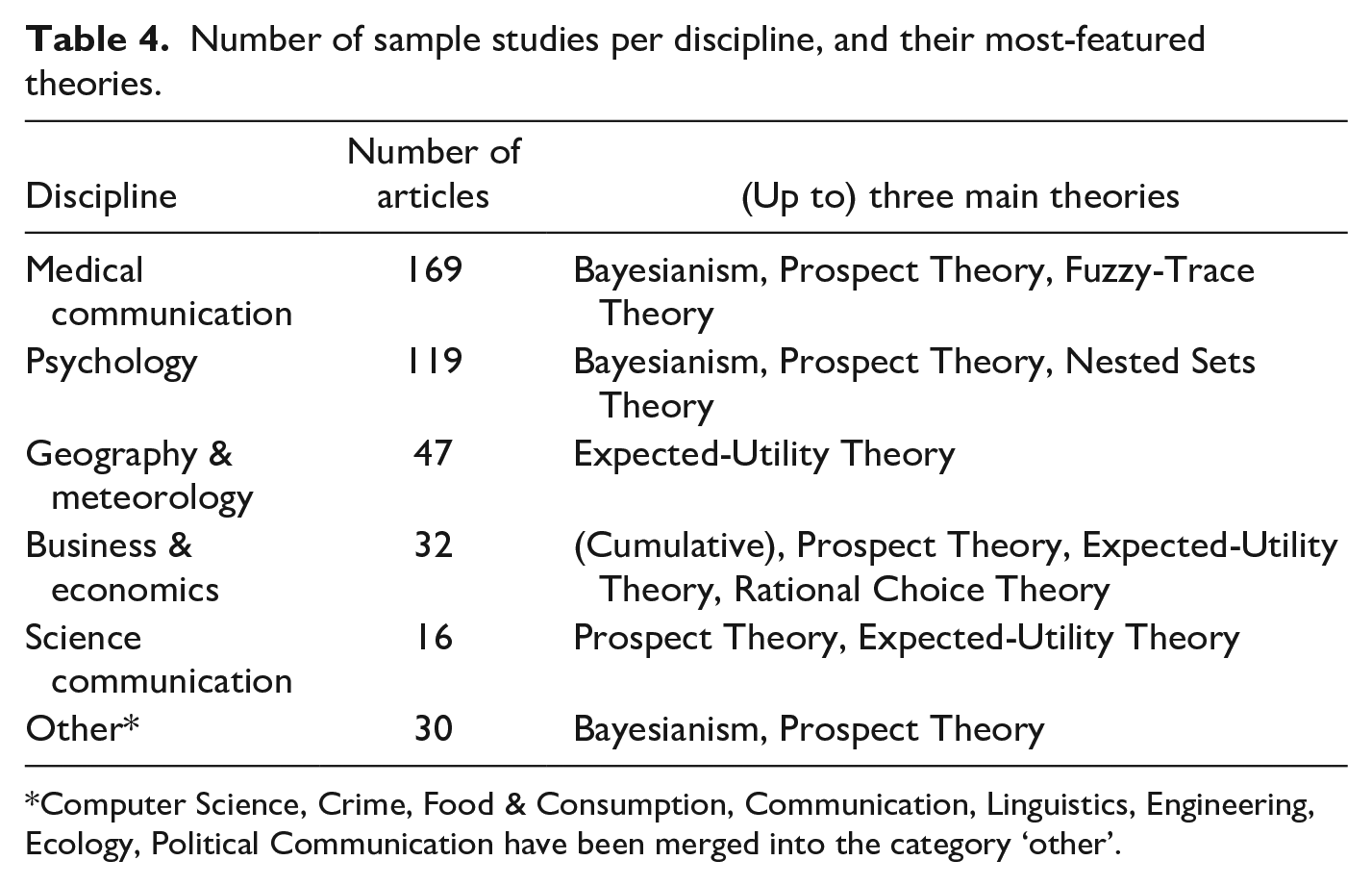
Computer Science, Crime, Food & Consumption, Communication, Linguistics, Engineering, Ecology, Political Communication have been merged into the category ‘other’.
Given the broad formulation of search terms and the width of the initial sample of studies used to train the algorithmic pipeline, we believe that this large proportion of health communication research is representative of the full body of literature.
Variables That Were Studied
All independent variables were coded under the following categories: communicator, format, framing, and other information about the uncertainty. This shows that most research looked at the effects of uncertainty format (304) and/or framing (61), with few studies taking into account communicator characteristics (14). Also, in the “other information” category, we found few references to variables such as social or cultural context.
We coded and categorized all dependent variables that were studied in the included publications as behavior and decision-making; cognition; emotion; or trust. Behavior and decision-making is about how individuals behave or what they decide in response to uncertainty communication, cognition refers to how people perceive and understand uncertainty, emotion to how people feel about the uncertainty, and trust is about the extent to which people trust the information.
Our analysis reveals a strong tendency toward behavior and decision-making (included in 204 publications) and cognition (330). This stands in contrast with emotion (68) and trust (37). In the discussion, we mention how other theories might facilitate the study of these variables. Numeracy (104) was the most featured covariate, apart from standard demographics such as age and gender.
Levels of Uncertainty
Publications may study one or more levels of uncertainty. For example, an experimental study on the effects of a physician communicating high or low uncertainty tested the effects of verbal and non-verbal uncertainty communication. The physician could express uncertainty in one of two ways: either “There are three scenarios when I perform the procedure. The first is the most likely and happens in most of my cases” or “There are three scenarios when I perform the procedure and I cannot predict what is going to happen in your case” (Blanch-Hartigan et al., 2019). We coded the first one as shallow uncertainty since the physician mentions the most likely option. We deem the second one as medium uncertainty: All the outcome options are known but cannot be judged on probability. So, this study is coded as “shallow/medium.” The following visualization includes all possible codings and their number of occurrences. 1 The figure shows that most studies focus solely on shallow uncertainty (288), followed by shallow/medium (59) and medium (44).
Types of Theories
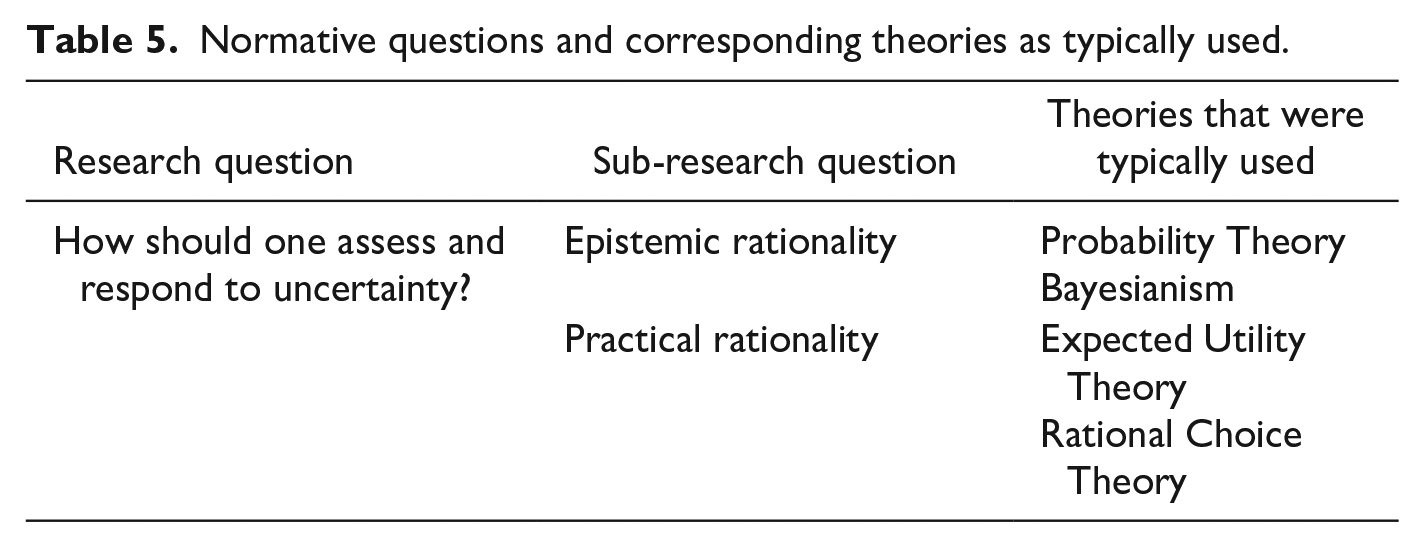
Experimental studies using theories can be organized by the types of questions they address, which may be normative and/or descriptive. Table 5 displays the theories that postulate norms for thinking and acting in response to uncertainty information. Normative research questions are about how the receiver of uncertainty should assess uncertainty and respond to it. The difference between the epistemic and practical classes of normative theories hinges on the following point. Probability Theory and Bayesianism are by definition blind to utilities, they merely formulate the mathematical structure defining coherent statistical reasoning. 2 EUT and Rational Choice Theory (RCT) formulate rules for how a rational individual should think and act in the presence of probabilities and utilities.
Normative questions and corresponding theories as typically used.
Apart from the normative side, we distinguish some classes of theories based on the empirical research questions they are generally used for. These can be seen in Table 6. For the types of research questions, we draw inspiration from the seminal Lasswell model of communication (Lasswell, 1948), applied to uncertainty communication (Van der Bles et al., 2019). Each class of research questions comes with types of independent variables. For example, an individual variable can be a participant’s numeracy or uncertainty orientation. The content variable relates to what is communicated (e.g., the object or source of uncertainty) and the format of uncertainty relates to how it is communicated (e.g., numerical/visual or in print/verbal conversation; Van der Bles et al., 2019).
Empirical questions and corresponding theories as typically used.
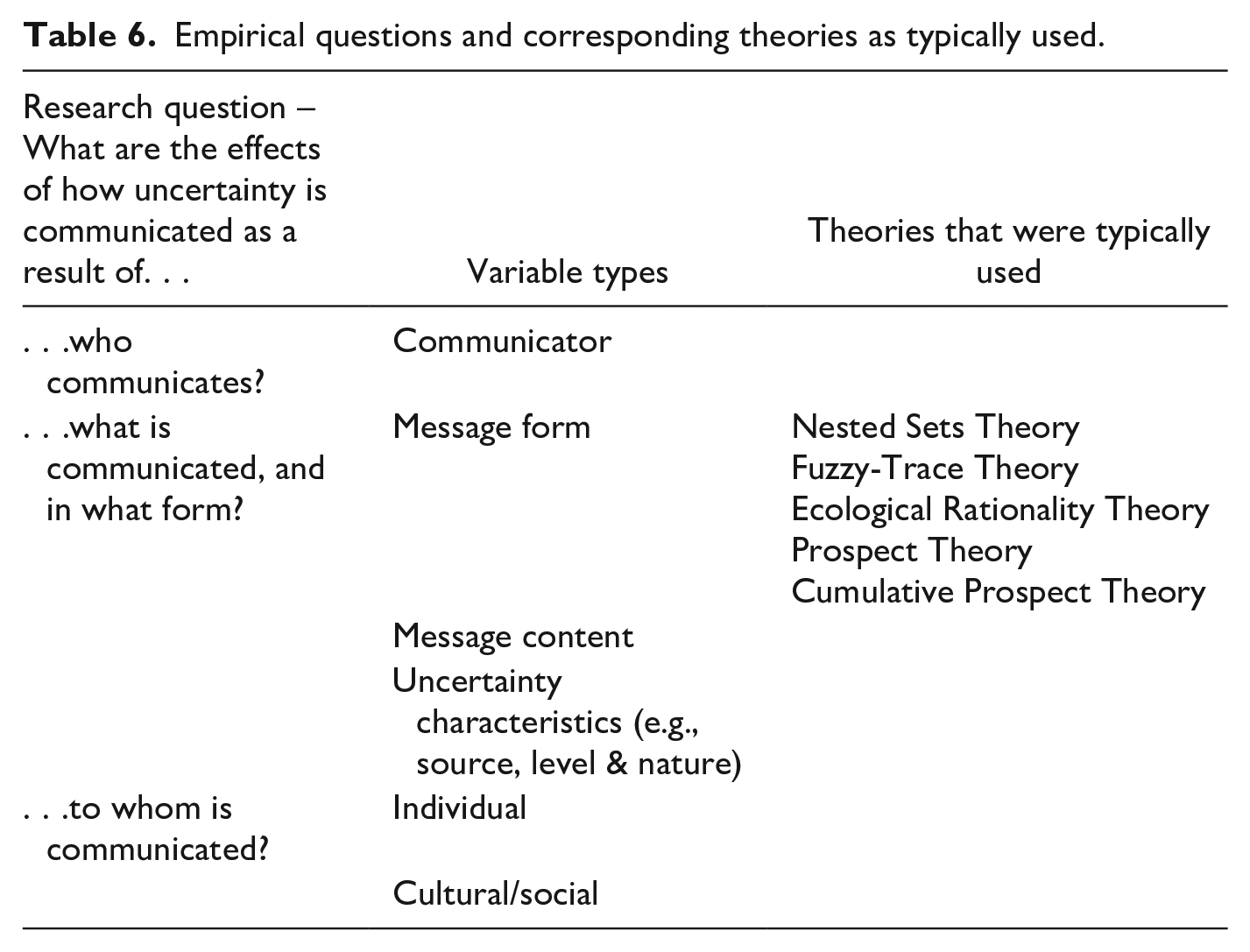
Note that the table highlights how theories are used in practice in the sample, not necessarily how they were intended to be used or could be used.
Description of Theories
The following sections briefly describe the core ideas of major theories, their relations to other theories, usage in our sample of articles, and which levels of uncertainty they could cover. We start with the normative theories.
Probability Theory
Mathematical Probability Theory originated in the 17th century with the writings of Pascal on games of chance, such as dice rolls. Kolmogorov (1956) was the first to give Probability Theory an axiomatic basis, which forms the basis of its contemporary status as a branch of measure theory. Probability is a real-valued function that assigns non-negative values to all events and a probability of 100% to the full sample space, which holds all options in it. The combined probability of mutually exclusive events is the sum of their probabilities. By interpreting Probability Theory as governing degrees of certainty, between 0% and 100%, uncertainty is something that can be quantified.
In the literature in our sample, Probability Theory is not explicitly used to formulate precise norms. Rather, the theory is mentioned as the reference point of what constitutes coherent probabilistic reasoning. For example, a study investigating optimal forms of communicating forensic evidence uncertainty mentions Probability Theory and Bayesianism as standards, since these provide a “coherent logical foundation for forming opinions in the forensic sciences” (Martire et al., 2013, p. 197). What is more, probability is omnipresent in the literature in yet another way: it provides the language for other theories. Just like RCT, it forms one of the cornerstones of normative theories such as Bayesianism and EUT (Todd & Gigerenzer, 2012).
Since Probability Theory represents probability values as numbers, it can be used to represent shallow uncertainty. Deeper levels of uncertainty, however, cannot be meaningfully expressed in numbers, so Probability Theory and its offspring (Bayesianism and EUT) are limited in meaningfully representing medium or deep uncertainty (Spiegelhalter & Riesch, 2011).
Bayesianism
Bayesianism is a theory that prescribes how rational individuals should update their prior probabilities when new evidence arrives. It assumes that individuals start with the prior probability (which may be entirely subjective or informed by an objective base rate), for instance, the probability of having diabetes Pprior(diabetes). Bayesianism requires that individuals update, or conditionalize, their prior probabilities according to Bayes’ rule when they obtain new evidence, for example, a positive diabetes test. This conditionalization allows one to obtain the posterior probability. For instance, the posterior probability of having diabetes after receiving a positive diabetes test is obtained as Pposterior(diabetes) = Pprior(diabetes|positive diabetes test).
Bayesianism, as it features in the sample for this review, forms the normative framework for how individuals should update their probability assignments after receiving a new piece of information. Usually, studies would try to find out how the communication format of uncertainty could move individuals toward reasoning more closely aligned with Bayesian rules. See, for example, this study on the tree diagram and unit square formats (Böcherer-Linder & Eichler, 2017) or this study on visual aids for patients (Garcia-Retamero et al., 2015). Repeated research following the heuristics-and-biases approach has established that people usually perform poorly with Bayesian statistics. Many individuals neglect the base rate and focus too much on the new piece of information. This even goes for professionals such as physicians (Casscells et al., 1989).
Following up on this, we found plenty of experimental research testing ways of improving the quality of people’s reasoning when faced with Bayesian evidence. As a result, it is now broadly accepted that Bayesian reasoning can be facilitated with pictorial aids and by using frequencies instead of probabilities (Brase & Hill, 2015). Especially the now seminal finding that natural frequencies support Bayesian reasoning (Cosmides & Tooby, 1996; Gigerenzer & Hoffrage, 1995) has stirred quite some follow-up research. A typical example is the study by Johnson and Tubau (2013), who studied the impact of numeracy, problem complexity, and a frequency/probability format on Bayesian reasoning. Generally speaking, it has become clear that the communication format and experimental setting matter for Bayesian reasoning: If participants get the opportunity to learn or experience a probability instead of having it spelled out in text, they perform better (Lejarraga & Hertwig, 2021). The relative ease of understanding a probability forms the point of departure for two major theoretical accounts explaining the effect of natural frequencies: Ecological Rationality Theory (ERT) and Nested Sets Theory (NST). These will be discussed later.
For Bayesian reasoning, the options and probabilities need to be known or reasonably estimated, since it builds on the language of Probability Theory to describe uncertainty. As a result, Bayesianism is tied to shallow uncertainty by construction. In other words, applying Bayesianism to (deeply) uncertain problems is “utterly ridiculous” (Savage, 1954, p. 16; Volz & Gigerenzer, 2012).
Rational Choice Theory
Rational preference theories are a family of theories, of which RCT is the most well known. Most applications of RCT seem to ignore the diversity and refer to it as the received view (Herfeld, 2020). In this view, rationality dictates that “an agent’s choices reflect the most preferred feasible alternative implied by preferences that are complete and transitive (that is, choices reflect utility maximization)” (Green, 2002, p. 46). According to RCT, individuals driven by self-interest want to maximize utility and to that end, make a cost-benefit assessment to make a decision. As we found it in the sample of literature, RCT is now mainly used as a normative theory, to show whether and how much individuals depart from the ideals of rationality.
As an example, we mention a study on how the labeling of financial products affects lay people’s choices. The study finds that labels, as obliged by Spanish regulation, widen the gap between the rational norm and actual choices. In other words, the warning labels push participants toward decisions against their interest, which was not quite the intention of these labels (Gómez et al., 2016). Another study nicely illustrates how RCT is often conflated with mere cost-benefit thinking by mentioning theories of rationality as “economic models of rational choice” (Savelli & Joslyn, 2013, p. 527).
By itself, RCT is blind to levels of uncertainty as it does not rely on axioms for uncertainty or probability. However, the theory forms a cornerstone of theories that are single-mindedly oriented at shallow uncertainty: Bayesianism and (Subjective) Expected Utility Theory (Ulen, 1990).
Expected Utility Theory
EUT is a collection of theories that was popularized by the mathematician Von Neumann and the economist Morgenstern (Fishburn, 1981; Von Neumann & Morgenstern, 1944). EUT supposes that individuals can assess or estimate the probabilities of outcomes when they have to choose between uncertain options (Patt, 2007). By using mathematical rules, individuals can determine which strategy maximizes their gain and reduces their loss. The mathematical rules are described in terms of Probability Theory and the assumed goal of utility maximation rests on RCT. In short, The expected utility of an act is a weighted average of the utilities of each of its possible outcomes, where the utility of an outcome measures the extent to which that outcome is preferred, or preferable, to the alternatives. The utility of each outcome is weighted according to the probability that the act will lead to that outcome. (Briggs, 2019, paragraph 3)
To illustrate how this works, take a situation in which an individual is offered a gamble. The atomic utility for each outcome would be monetary gain or loss. A rational individual should accept to engage in the gamble if the total utility of the outcomes is positive, reject it if it is negative, and be neutral if it is null. Subjective Expected Utility Theory (SEUT) is the subjective offspring of this theory; it occurs in three of the sampled publications. It builds on EUT but assumes not only personal utilities but also subjective probabilities (Fishburn, 1981; Savage, 1954).
In the sample, EUT was almost invariably used normatively. The normative stance of EUT is that how uncertainty is communicated should not have effects: Individuals should not be responsive to, for example, the source and mode of communication. Many experimental studies in the sample show how individuals deviate from this norm. For example, how the uncertainty is framed matters for people’s probability estimates and their motivation to respond (Patt, 2007), and medical choices deviate more from EUT expectations than monetary choices (Lejarraga et al., 2016).
In contrast to how it is regularly used, EUT started as a descriptive theory. In this role, it received so much refutation that by now it has become marginal (Harless & Camerer, 1994; Starmer, 2000). This shift from a descriptive to a normative role can be explained by the influence of the Ellsberg paradox (in the sample, 17 studies cited Ellsberg). In 1961, Ellsberg demonstrated the effect of aversion toward vague or unknown probabilities, in other words: non-shallow uncertainty (Ellsberg, 1961). His thought experiment, which has since been confirmed experimentally, contradicts classic EUT predictions, which state that there should be no rational preference for one or the other. Ellsberg’s assertion that there are information positions between Knightian risk and uncertainty (Ellsberg, 1961) seems to support the view of levels of uncertainty, in which informativeness about probabilities and options is seen as a continuum.
EUT builds on Probability Theory, which impoverishes its ability to incorporate deeper levels of uncertainty. Modifications to accommodate imprecise probabilities, such as interval probabilities or sets of probability functions, may help to represent medium uncertainty but not deep uncertainty. In line with SEUT, individuals may assign probabilities themselves, but this is not feasible if not all options are known, as is the case with deep uncertainty. So, both EUT and SEUT cannot deal with deep uncertainty (Davidson, 1991).
Ecological Rationality Theory
ERT is a normative extension of Bounded Rationality (Simon, 2000; Todd & Gigerenzer, 2012). Research in line with the concept of Bounded Rationality focuses on how humans reason in the real world, with incomplete information and in limited time. Ecological rationality is achieved when the heuristics of individuals match the environment as much as possible for a certain problem or task.
ERT departs sharply from traditional theories of rationality and utility maximation: “The term ‘ecological’ signals that the yardstick for rationality is some measure of success in the external world, instead of some measure of internal consistency, as in most traditional theories of rationality” (Todd & Gigerenzer, 2012, p. 489). More traditional theories, such as EUT or PT, focus on optimizing strategies, but according to ERT, this is not feasible in the real world. In the external world, possible outcomes and their probabilities often cannot be known or calculated, for example, due to constraints in terms of time and available cognitive capacity. Illustrative of the difference with the traditional conception of rationality is that ERT, unlike RCT, entails that the format or framing of uncertainty information should affect decisions, because ERT holds that rationality depends on the match between decisions and context.
In the sample, ERT was always pitted against NST as a rivaling explanation for why some individuals reason more often in a Bayesian way when uncertainty is communicated with certain representations and/or visualizations (in the sample, all articles featuring ERT mentioned NST as well). For example, some studies aim to explain why individuals reason more often in a Bayesian way when uncertainty is communicated as frequencies rather than probabilities (see, for example, Reani et al., 2019; Sirota et al., 2015). ERT explains this by pointing at the “naturalness” of natural frequencies: This format matches with how humans perceive probability in the real world and how they have been evolutionary adapted to it. In contrast, NST holds that a frequency format is just one of the formats that could help humans see the nested-sets structure (Barbey & Sloman, 2007; Brase, 2021; Brase & Hill, 2015). This descriptive use of ERT departs from its initial goal, which was normative.
As mentioned, ERT focuses on how individuals handle uncertainty in the case of unknown options and probabilities. In other words, the “ecology” is often deeply uncertain; ecological rationality is then about rationally matching reasoning and deciding within a particular context. According to ERT, the use of “fast-and-frugal” heuristics can lead to better decisions than would have been the case if they strictly adhered to traditional norms of rationality and utility maximation (Luan et al., 2019). ERT is one of the few theories that can explain how individuals respond to and reason about deeper levels of uncertainty; we will expand on its potential for future research in the discussion section. Interestingly, this potential is not yet exploited: None of the included articles featuring ERT studied deeper levels of uncertainty.
Dual-Process Theories: CPT, Fuzzy-Trace Theory, and NST
Dual-Process Theories form a family of theories stipulating the existence of two cognitive processes taking place in the human mind. They go most famously by the names of System 1 and System 2 (Kahneman, 2011), but other Dual-Process Theories adopted other names, such as gist-based and verbatim in Fuzzy-Trace Theory (FTT; Reyna & Brainerd, 1995). The first system is considered “intuitive.” It is rapid, unconscious, effortless, and has an infinitely high capacity in the sense that there is no cognitive limitation (like memory, for instance). The fast decisions based on this system are said to be easily tricked by systematic biases. System 2 is qualified as “analytical.” It is slow, deliberate, effortful, and conscious and depends on working memory capacity. When facing a cognitive phenomenon, individuals rely immediately and naturally on System 1. If some effort and intellectual resources are available, individuals can trigger System 2 to overpass the prior impressions created by System 1. This process is generic and is found to be the cornerstone of many Dual-Process Theories.
Dual-Process Theories are designed to be descriptive, explanatory theories. One may notice that System 2 does bear quite a resemblance to a rational, calculative mind (see, for example, Zikmund-Fisher et al., 2008). However, some proponents of the dual-process approach have argued that rationality is not a property of a subsystem and can only pertain to the outcomes of both systems together (Evans & Stanovich, 2013).
Dual-Process Theories have received quite some criticism. In itself, Dual-Process Theory forms a “pair of black boxes” (Gigerenzer & Hoffrage, 2007), which offers little explanatory power (Grayot, 2020).
In the sample, some studies used insights from the general dual-process literature without mentioning other theory names. An interesting example on responses toward volcanic crisis situations found that policymakers and scientists differ in their processing of uncertainty information. Here, Dual-Process Theory was applied by interpreting anxiety and feelings of losing control as the affective processing system, as opposed to more logical responses to the information that is present (Doyle et al., 2014). However, the most profound influence of this approach seems to work through a set of theories that adhere to the basic premise of two cognitive systems, for example, such as in Eichler et al. (2020). In the literature we considered, we found the following dual-process-like theories: CPT, FTT, and NST. PT and CPT were initially conceived without mentioning Dual-Process Theories, but they have later been acknowledged to fall under this theoretical umbrella (Grayot, 2020; Kahneman, 2011, p. 281).
(Cumulative) Prospect Theory
Developed by Tversky and Kahneman (1974; Kahneman, 2011), PT proposed a new framework for describing decision-making under uncertainty. Essentially, it forms a behavioral, dual-process adaption of (Subjective) EUT: It describes how individuals assign utilities to uncertain options. Kahneman and Tversky noticed that in experiments with lottery choices, participants often do not follow the choices deemed optimal by EUT. They saw a profound asymmetry between losses and gains in gambles: Losses were felt much more negatively than gains were experienced positively. Moreover, there is a diminished sensitivity at high gain/loss values, in line with the diminished marginal utility as already observed by Bernoulli in 1738 (Bernoulli, 1738; Briggs, 2019). The pleasure one experiences when winning 100 euros is greater if this person has no money than if they already have 1,000 euros in their pocket. In other words, the utility as perceived by individuals is not absolute but relative to a personal reference point.
As an improvement of their model, Tversky and Kahneman (1992) proposed the CPT which includes the idea that low probabilities are often overweighted and high probabilities are underweighted.
PT and CPT presently belong to the most influential theories: They were relatively often applied in the sample. Its main function is to explain why for many individuals, losses weigh heavier than gains, and why framing the same uncertain message as gain/loss influences the receiver’s interpretation of the message (see, for example, Harrington & Kerr, 2017). An interesting application of this theory studied risk aversion among US federal wildfire managers when presented with dilemmas affecting costs, property damage, and firefighter fatality risks (Hand et al., 2015). While the study corroborates CPT, we assess it also illustrates the limits of its scope: In the complex and often fast-evolving reality of wildfires, risks regarding factors such as fatality risks will not or cannot always be expressed in probabilities.
PT and CPT are rooted in EUT and have often been tested in the context of experiments with lottery choices (Volz & Gigerenzer, 2012). Via EUT they build on Probability Theory, so their explanatory power is by design limited to shallow uncertainties.
Fuzzy-Trace Theory
FTT has been developed in 1995 (Reyna & Brainerd, 1995) to explain reasoning and memory processes. Since 2012, this theory does seem to be gaining increasing traction, with 23 out of 27 articles featuring FTT published from that year on. Here, the two cognitive systems are defined as a gist-based intuition and a detail-oriented verbatim process. The first one pertains to the extraction of a vague and general meaning of a sentence. The second pertains to an accurate and analytical understanding of numbers, figures, and probabilities. For instance, when people are presented with a sentence like “it is 5% likely to rain,” the verbatim judgment will focus on the literal value of 5% to have a precise and genuine representation of the probability, whereas the gist will discard this number and sum up the sentence as “it is unlikely to rain.” People make decisions by considering the simplest amount of meaning required, namely by prioritizing the gist over the verbatim (Steinhardt & Shapiro, 2015). The framing of information can enhance either of the processes. For example, numerical information may alert the verbatim process, while verbal information favors the activation of gist-based reasoning. This is why the format of information can steer decision-making by determining which cognitive process is activated. FTT states that both processes develop with age, but gist-based intuition becomes the dominant way of processing at an adult age and, more surprisingly, the predominant expert mode of reasoning in comparison with novices.
The theory can explain the effects of uncertainty information. A typical example in our sample is a study on how to communicate the side effects and benefits of medicines transparently without diminishing the willingness to take the medication (Blalock et al., 2016). Based on FTT, the authors predicted that verbal side-effect information would lead to a categorical gist formation (“it is risky to take this medicine”) and thus decrease the willingness to take the medicine. By the same mechanism, verbal benefit information would benefit this willingness. The results confirmed these expectations. In the sample, hypotheses based on FTT sometimes competed with deductions based on Foreground:Background Salience Theory. This theory holds that risk perceptions are influenced by the relative salience of the foreground (numerator) of numerical risk information versus the salience of the background (denominator) (Stone et al., 2018).
Can FTT predict the effects of deeper levels of uncertainty? In our sample, we find that FTT is mostly used for shallow uncertainty: Out of 27 articles citing FTT, only three cover medium uncertainty and none cover deep uncertainty. However, we see no theoretical reason as to why FTT would be bound to shallow levels of uncertainty. On the contrary, there could be potential to connect FTT to all levels of uncertainty. For instance, a research question could be: Does the level of uncertainty that is conveyed affect whether gist or verbatim memory is used when making a decision?
Nested Sets Theory
Another offspring of Dual-Process Theory is the NST (Barbey & Sloman, 2007). Critics, however, have argued that the dual-process is not intrinsic to NST and that the theory would be better off without building on it (Mandel, 2007). NST posits that uncertainty information should make nested sets relations clear to facilitate rule-based, logical reasoning (Sloman et al., 2003). The focus on reasoning on the nestedness of probability points to its normative departure and its aim to facilitate Bayesian reasoning. Most studies in the sample tested the effects of different formats of presenting the nested sets structure, such as visually versus textually (Böcherer-Linder & Eichler, 2019) or with frequencies versus percentages (Lesage et al., 2013).
NST aims to explain why, in a Bayesian context, people understand uncertainty better when expressed in fractions (natural frequencies) instead of percentages (probabilities). Its core assertion is that Bayesian uncertainty information should make the nested set’s character as salient as possible to facilitate clear reasoning. As we found it in the sample, it does not delve very deep into the mechanisms underlying this explanation. NST competes with the Ecological Rationality framework to explain how frequencies facilitate Bayesian reasoning (Brase, 2021). NST could also compete with FTT regarding the mechanisms underlying base-rate effects (Reyna & Mills, 2007), but we found no articles in the sample explicitly featuring both NST and FTT.
As NST responds to the norm of Bayesianism, we do not see how it could provide a fruitful tool for analyzing the effects of deeper levels of uncertainty.
Discussion and Conclusion
With this systematic literature review, we investigated how theories have been used in experimental research studying the effects of how uncertainty is communicated. We unearthed an abundance of references and mapped some general trends in the literature, crossing many boundaries between disciplines.
In the discussion, we highlight many opportunities for future research, especially relevant theories. First, we discuss research questions and theories, building on the typology in Table 6. For each of the types of research questions, we highlight some examples of theories that we encountered in the literature sample and which deserve more attention. Second, we discuss how uncertainty levels were studied in the literature, and how this relates to trends in theory use. Third, we relate theory use to discipline. Subsequently, we discuss limitations of the study and offer some concluding remarks.
Given the limited scope of the current dominant theories in the literature, they offer great potential for future research, as we illustrate below. At the very least, these mentioned examples of theories show that theoretical frameworks do exist that may predict the consequences of non-shallow uncertainty communication.
Based on the classification of empirical questions and (potential) theories as illustrated in Table 6, we highlight some of our main findings. Not all types of research questions received equal attention. For some research questions, we encountered the use of multiple theoretical frameworks. In contrast, other questions seem to have found fewer or no “matching” theories. Although some of these research questions may feature in a number of publications, no systematic theorizing has received sufficient attention to connect these findings. For some of these white spots on the maps, we know no suggestions for useful theories. We hope this overview proves supportive of researchers forwarding theoretical alternatives for these gaps. Also, our theory suggestions are based on our vision on what is currently missing and does not build on extensive field-specific knowledge. Other researchers may be better equipped to come up with more suitable alternatives. Our main hope for this overview is that it could foster diversification.
Take, for example, the branch of questions on the effects of the format of uncertainty communication. Most theories deal with explaining framing and frequency/probability effects. Inspiration can be drawn, however, from other fields to explain the effects of visual uncertainty visualizations, such as risk maps, graphs, and pictures (Severtson & Vatovec, 2012). For example, the field of semiotics could support developing a theoretical framework on how symbols convey meaning by representing some concept (Maceachren et al., 2012).
Apart from the format, some articles in the sample tested the effects of different types of actors communicating uncertainty. For example, it has been found that a doctor’s gender did not affect patients’ trust or their intention to seek a second opinion after hearing about uncertainty (Blanch-Hartigan et al., 2019). Researchers studying such phenomena could look in the direction of credibility research to find theoretical underpinnings for the effects of the communicator (Jensen, 2008).
Then, there are individual-level differences, which were often taken into account as control variables in the sample. Future research could delve into the theoretical foundations of numeracy and literacy (Lipkus & Peters, 2009) to formulate more precisely which role these traits play. Numeracy as a background variable was often tested for in our literature sample but hardly substantiated with theoretical reasoning. In its current use, it seems tied to shallow uncertainty levels, with its focus on understanding numbers. In the form of a more fleshed-out theory of literacy regarding health, finances, graphs, and so on, it could explain the role of individual skill differences in dealing with uncertainty communication. As such, it could be broadened to be not only about understanding numbers but also other forms of communication, including graphical ones.
Another direction would be to follow Uncertainty Orientation Theory (UOT), which states that individual stances toward uncertainty determine the style of uncertainty information processing (Rosen & Knäuper, 2009). To explain cultural differences in uncertainty communication uptake, one may take advantage of insights from the Cultural Theory of Risk (Tansey & O’Riordan, 1999).
Some theories seem especially suitable to address responses to subjective uncertainty. Protection Motivation Theory (PMT) aims at explaining how people respond to threats, which could be fruitful in the context of risk communication (Lindell & Hwang, 2008). Uncertainty Management Theory (UMT) and Problematic Integration Theory (PIT) focus on how individuals cope with subjective uncertainty and the cognitive tension that may come with it (Bradac, 2001). UMT could match with medical uncertainty communication research as it could acknowledge uncertainty not only as a characteristic of information but also as a lived experience (Bradac, 2001; Sopory et al., 2019). This could also support more research into trust and emotion as dependent variables, which could use more attention.
Central to this literature review stands the concept of uncertainty depth: Which levels of uncertainty have been studied, and how does this relate to the theories that were used? As Figure 2 revealed, shallow uncertainty received by far the most attention across disciplines.
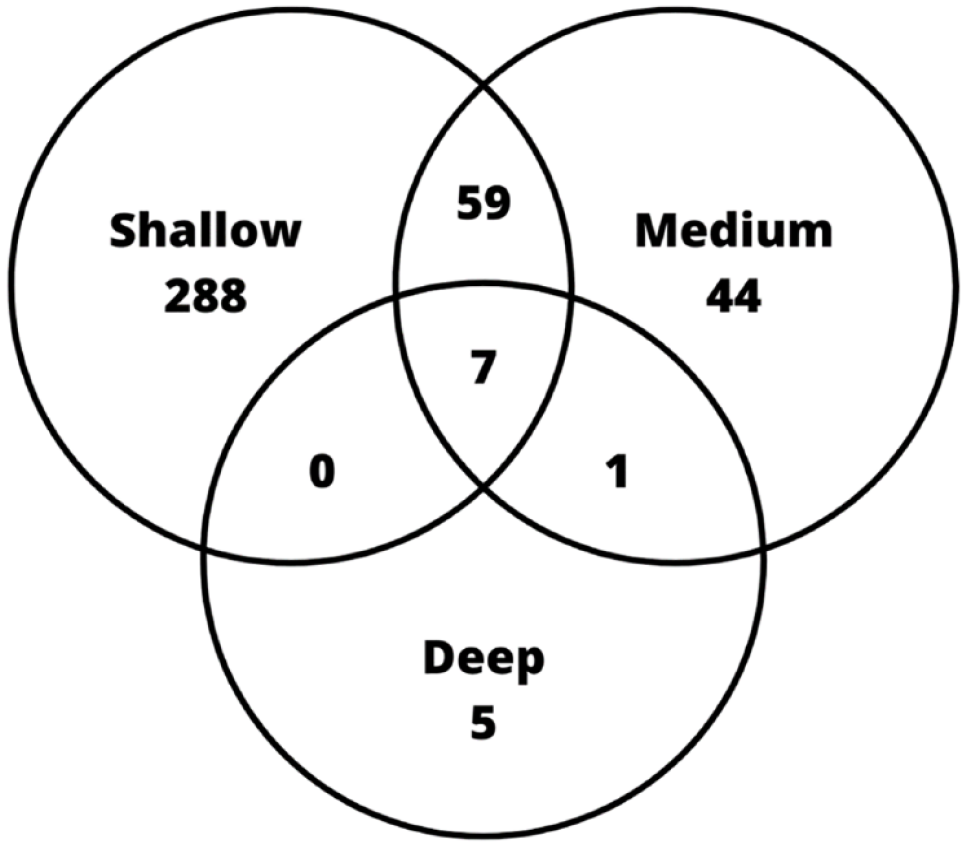
Number of Studies for Each Level of Uncertainty.
Part of this may be explained by pragmatic reasons: Shallow uncertainty is easier to test experimentally than medium or deep uncertainty. In addition, it is probably also a mere consequence of theory usage. Much research is devoted to assessing and improving an individual’s performance when faced with uncertainty information. This necessarily implies some standard that is to be met. Among the normative theories that provide these standards, we encountered a monoculture of quantified, shallow uncertainty. Probability Theory, Bayesianism, EUT, and RCT set the tone (especially in some fields), and since all of these build on Probability Theory, they are necessarily bound to shallow uncertainty. Most descriptive theories are used to explain whether and how people meet these standards. ERT is a normative framework designed to handle a broader array of uncertainty levels, and FTT is a descriptive theory that is often used for and is capable of explaining the effects of unquantified uncertainty. In short, finding and testing normative theories that can handle deeper forms of uncertainty, like ERT, could especially serve to broaden the scope of uncertainty research. This point echoes a previous call for more “large worlds” uncertainty research (Volz & Gigerenzer, 2012). With the support of more diverse theoretical frameworks, research can generate more insights into how individuals intuitively deal with uncertainty that is not shallow and thus support more effective techniques for communicating and dealing with deeper levels of uncertainty.
In our list of 413 publications, we found 189 publications that did not mention theories at all. Part of these simply lacked theoretical arguments and explicit substantiation; others did have theoretical sections but did not mention theory names. The former mainly occurred in medical communication literature. The latter seems common in research on the effects of graphical and geographical uncertainty communication, a field that often relates to crisis research. This is probably mainly due to the pragmatic approach in these disciplines, yet it hampers the translation of insights into mechanisms and assumptions. As a result, many researchers risk reinventing the wheel.
Most disciplines do not bring forth theories that make it beyond their own field of study. We find that only a few descriptive theories cross the border between disciplines, most notably CPT and FTT. This indicates that theories originating in behavioral economics and psychology overgrow theories that emerged from other fields, which leads to a monoculture of theories. This could be a cause of the strong focus on cognitive and behavioral dependent variables in the literature. We speculate that more theorizing from other fields, such as medical communication, could lead to diversification of dependent variables studied, such as emotional responses toward uncertainty messages.
This systematic literature review arguably has a broad scope and, relatedly, aims to show trends in a vast body of literature. Consequently, there are some limitations to it. First, it would be impossible to include all studies eligible for inclusion. While our results should not be considered exhaustive, we used a sorting algorithm to help us in prioritizing our selection and we are confident that our sample is indicative of broad trends in the literature. Second, as described in the “Method” section, coding theories comes with many trade-offs. Many valid and interesting theoretical frameworks were not included in the analysis simply because we could not track an explicit theory name. We distinguish two types of articles that do not feature any explicit theory name. The first category of studies simply do not present any theoretical framework at all, but instead jump from a short introduction to the “Method” section. Examples of these were often found in the health communication literature (see, for example, Jefferies-Sewell et al., 2015; Steiner et al., 2003). The second category pertains to publications that did include substantial theorizing, but did so independently from theories with names, for example, the publication by Renooij and Witteman (1999). We argue that this may be a limitation to the literature in general: A clear theory name could help spread its core ideas across disciplines. Third, it should not come as a surprise that fashion does play a role in theory mentions. We noted many instances of PT and CPT in which these theories did not play a significant role in the central argument of the publication. Theoretical “name-dropping” may thus lead to overestimating the true impact of these theories. Fourth, little is known about developments of theory usage over time. Future research might delve into how the use of theories changed over time, and how this relates to the focal points of the literature into the effects of uncertainty communication.
We conclude with a call for more diversity in the use of theories in uncertainty communication research. First, we would like to see a broader array of research questions addressed. The role of the communicator, the characteristics of the uncertainty evidence, and the cultural context of uncertainty communication deserve more attention. Second, a greater diversity of normative frameworks, less tied to Probability Theory and thus to shallow uncertainty, can increase diversity in terms of what types of uncertainty are studied. Many aspects of real life are deeply uncertain; studying these uncertainties can greatly boost the external validity and relevance of uncertainty research. Third, we should look for more theories from fields outside behavioral economics. Fields such as medical communication can do more to bring in their own, unique theoretical contribution, thereby diversifying the whole of research into uncertainty communication. Interdisciplinary research teams could prove a fruitful way forward for such diversification.
Supplemental Material
sj-docx-1-scx-10.1177_10755470241231290 – Supplemental material for Theories of Uncertainty Communication: An Interdisciplinary Literature Review
Supplemental material, sj-docx-1-scx-10.1177_10755470241231290 for Theories of Uncertainty Communication: An Interdisciplinary Literature Review by Wouter Lammers, Sacha Ferrari, Sylvia Wenmackers, Valérie Pattyn and Steven Van de Walle in Science Communication
Research Data
sj-xlsx-2-scx-10.1177_10755470241231290 – Theories of Uncertainty Communication: An Interdisciplinary Literature Review
sj-xlsx-2-scx-10.1177_10755470241231290 for Theories of Uncertainty Communication: An Interdisciplinary Literature Review by Wouter Lammers, Sacha Ferrari, Sylvia Wenmackers, Valérie Pattyn and Steven Van de Walle in Science Communication
Footnotes
Acknowledgements
The authors wish to thank prof. dr. Astrid Kause, prof. dr. Klaus Fiedler, prof. dr. Gaël Le Mens, dr. Yasmina Okan and Olaf Van der Veen for their valuable comments.
Declaration of Conflicting Interests
The author(s) declared no potential conflicts of interest with respect to the research, authorship, and/or publication of this article.
Funding
The author(s) disclosed receipt of the following financial support for the research, authorship, and/or publication of this article: The authors received funding from the KU Leuven Special Research Fund (BOF), grant C14/20/029 (‘How policy-makers use uncertainty information: An empirical study of civic epistemologies’).

Notes
Author Biographies
References
Supplementary Material
Please find the following supplemental material available below.
For Open Access articles published under a Creative Commons License, all supplemental material carries the same license as the article it is associated with.
For non-Open Access articles published, all supplemental material carries a non-exclusive license, and permission requests for re-use of supplemental material or any part of supplemental material shall be sent directly to the copyright owner as specified in the copyright notice associated with the article.
