



Abstract
Previous research on climate change consensus messaging has mostly taken place in controlled lab settings. In this field experiment, we engaged U.S. residents (N = 158) in brief doorstep conversations on climate change. Research assistants read a script about the scientific consensus (treatment) or basic facts about climate change (control) and then provided participants with a magnet containing the same information. The consensus message had a significant positive effect on consensus estimates (β = 0.45) and belief in climate change (β = 0.41), but not on other downstream attitudes or behavior. These results mostly align with theory and have implications for consensus messaging.
Introduction
Despite the near-unanimous scientific consensus that humans are causing climate change (Cook et al., 2016), widespread misperceptions about the scientific consensus on climate change remain in the United States (Leiserowitz et al., 2024), Europe (Duffy et al., 2022), and elsewhere (Većkalov et al., 2024). Initial correlational evidence suggested that beliefs about the scientific consensus were correlated with other climate beliefs and attitudes (Ding et al., 2011; Hornsey et al., 2016). Subsequent experiments provided support for the causal role of perceived scientific consensus in shifting beliefs about climate change (Lewandowsky et al., 2013; van der Linden et al., 2015). The Gateway Belief Model (GBM) is a theory of attitude change that delineates how second-order normative beliefs (i.e., beliefs about what other groups believe)—such as the perceived consensus among climate scientists—impact downstream private beliefs and emotions about climate change, situating perceived agreement as the key “gateway” cognition (van der Linden, 2021; van der Linden et al., 2015). According to the GBM, learning that climate scientists agree about the evidence facilitates greater belief that climate change is happening and human-caused, more worry about climate change, and changes in these beliefs and emotions in turn predict greater support for climate action (van der Linden et al., 2019).
Despite early questions about the GBM (e.g., Kahan, 2015), recent meta-analyses have found consistent support for the prediction that consensus messaging increases perceived consensus as well as belief in climate change (Rode et al., 2021; van Stekelenburg et al., 2022). For example, van Stekelenburg et al. (2022) found a medium to large effect of climate consensus messaging on perceived scientific consensus (g = 0.56) and a small but significant effect on belief in climate change (g = 0.12). These findings align with predictions from the GBM that consensus messaging most directly impacts perceptions of scientific consensus, with smaller effects on downstream climate attitudes (van der Linden et al., 2019). Recent large-scale and pre-registered global studies add to these aggregate findings, providing support for consensus messaging across a range of countries in both the Global North and South (van Stekelenburg et al., 2024; Većkalov et al., 2024). Finally, a meta-analysis of the structural model of the GBM also confirmed significant direct and indirect effects of the scientific consensus message on private attitudes and support for climate action (Rode et al., 2025). Accumulating evidence therefore suggests a robust link between consensus messaging and perceived scientific consensus, with smaller effects on belief in climate change and policy support.
Another crucial feature of the consensus message is that—contrary to the motivated cognition of expert consensus account (Kahan et al., 2011)—early research found that highlighting the scientific consensus reduced ideological polarization by increasing acceptance of climate facts among liberals but especially conservatives (Lewandowsky et al., 2013; van der Linden et al., 2014). Researchers testing consensus messaging, therefore, often examine whether the effectiveness of this strategy is moderated by political ideology. While some studies have found that consensus messaging increased conservatives’ feelings of psychological reactance (Chinn & Hart, 2023; Ma et al., 2019, although c.f., van der Linden et al., 2023), meta-analyses find no evidence of moderation by political ideology on climate beliefs (Rode et al., 2023; van Stekelenburg et al., 2022). However, estimates from the recent large global studies provide conflicting evidence. For example, Većkalov et al. (2024) found that consensus messaging was more effective at impacting perceived consensus for conservatives and those with low trust in climate science, whereas van Stekelenburg et al. (2024) found that the strategy worked for both liberals and conservatives but was more effective at impacting perceived consensus for the former. In a more targeted investigation, Goldberg et al. (2022) screened participants according to their prior attitudes via the Global Warming’s Six Americas segmentation and found the greatest treatment effects among the “doubtful” and “dismissive” groups, which tend to be more conservative. Overall, the evidence seems to suggest that the consensus message either works equally well across the political spectrum or slightly better for conservatives.
The Current Research: A Consensus Messaging Field Experiment
Despite the large number of consensus messaging studies described above, nearly all were conducted in controlled lab settings. To our knowledge, the current study is the first to test consensus messaging in a field experiment with door-to-door canvassing. Researchers have advocated that consensus messaging as a strategy is now well described in terms of cognitive and emotional mechanisms but should be tested in the field (van der Linden, 2021) and that studies should evaluate how the context in which a consensus message is delivered might impact its effectiveness (Bayes et al., 2023), such as through videos (Brewer & McKnight, 2017). Ultimately, the main purpose of this research is not only to advance knowledge about climate cognitions but also to inform real-world campaigns that seek to promote climate solutions. To this extent, it remains to be seen whether consensus can be effectively communicated in the field.
With online lab studies, data collection is quick and easy, but data quality has been scrutinized (e.g., Peer et al., 2022; Webb & Tangney, 2024). Importantly, all opt-in online panels or crowdsourced platforms face the obstacle of self-selection: participants who join online platforms to participate in studies may behave differently from people in more naturalistic settings. Field experiments are costly and time-intensive but can help reduce some of this selection bias by approaching people in their everyday environments. In particular, its reliance on face-to-face, interpersonal discussion between canvassers and participants may be a more engaging experience than simple exposure to a (mediated) message such as in an online experimental setting, with research pointing to its effectiveness in contexts ranging from building support for transgender rights (Broockman & Kalla, 2016) to voter mobilization (Gerber & Green, 1999). In addition, an in-person messenger of consensus is likely to be someone from the same neighborhood, potentially strengthening the trustworthiness of the information and signaling a relevant social norm.
Therefore, we conducted a field experiment to test whether the predictions of the GBM would replicate in this type of study.
Given the aforementioned discussion of political ideology, we also tested whether participants’ political ideology would moderate the effect of the consensus message.
We tested these research questions with door-to-door canvassing of households, engaging treatment-group participants in a conversation about the scientific consensus on human-caused climate change. We then assessed whether this intervention influenced participants’ beliefs and attitudes toward climate change as predicted by the GBM.
Method
Participants
We recruited 158 participants in a major suburban county in the mid-Atlantic region of the United States. It is home to a highly educated and comparatively wealthier population than the nation as a whole (Carnes et al., 2025). While a historically conservative/Republican area on the state and national level, it has become increasingly more Democratic-leaning and politically heterogeneous (Yumang, 2021). Participants were evenly split between male (52%) and female (48%), highly educated (16% high school degree, 18% some college, 35% college degree, 31% graduate degree), and politically diverse (34% liberal, 45% moderate, 20% conservative), with an average age of 46.61 years (SD = 17.72).
Procedure
From February to April 2016, 14 students from a large university in the eastern United States canvassed approximately 158 households (one participant per household) located near campus. Upon initial contact, the research assistants identified themselves as nearby university students who, as part of a class project, were talking with area residents about climate change. They offered residents a free pen as a thank you in advance and provided additional background information as required by the university’s human subjects review committee (e.g., voluntary participation). During the time of the study (Spring 2016), roughly 70% of Americans believed that global warming is happening (Leiserowitz et al., 2016), which is the same as recent estimates (70% in Spring 2024, Leiserowitz et al., 2024). Yet since 2016, more Americans have recognized the existence of an overwhelming scientific consensus on climate change (Leiserowitz et al., 2016, 2024). We return to this issue of timing in the discussion, but note this as important context for the current study.
Households were randomly assigned into the control or treatment condition using random numbers. After providing consent, participants responded to three pre-test questions about their perceptions of the scientific consensus around climate change. For participants in the treatment condition (“consensus”), the researchers then read a brief statement about the 97% scientific consensus (Supplement). They then distributed a small refrigerator magnet with the 97% consensus above an image of 97 out of 100 silhouettes colored in to visualize a 97% consensus (Figure 1A). The second (“control”) condition focused on the mechanisms underlying climate change (Supplement). A refrigerator magnet was also distributed in this condition, but this magnet included diagrams of the greenhouse effect with no mention of consensus (Figure 1B). Immediately after reading the message, participants were asked a variety of questions related to climate change adapted from van der Linden et al. (2015) and a few demographic questions. The researchers used paper versions of the experimental protocol to record respondent answers.
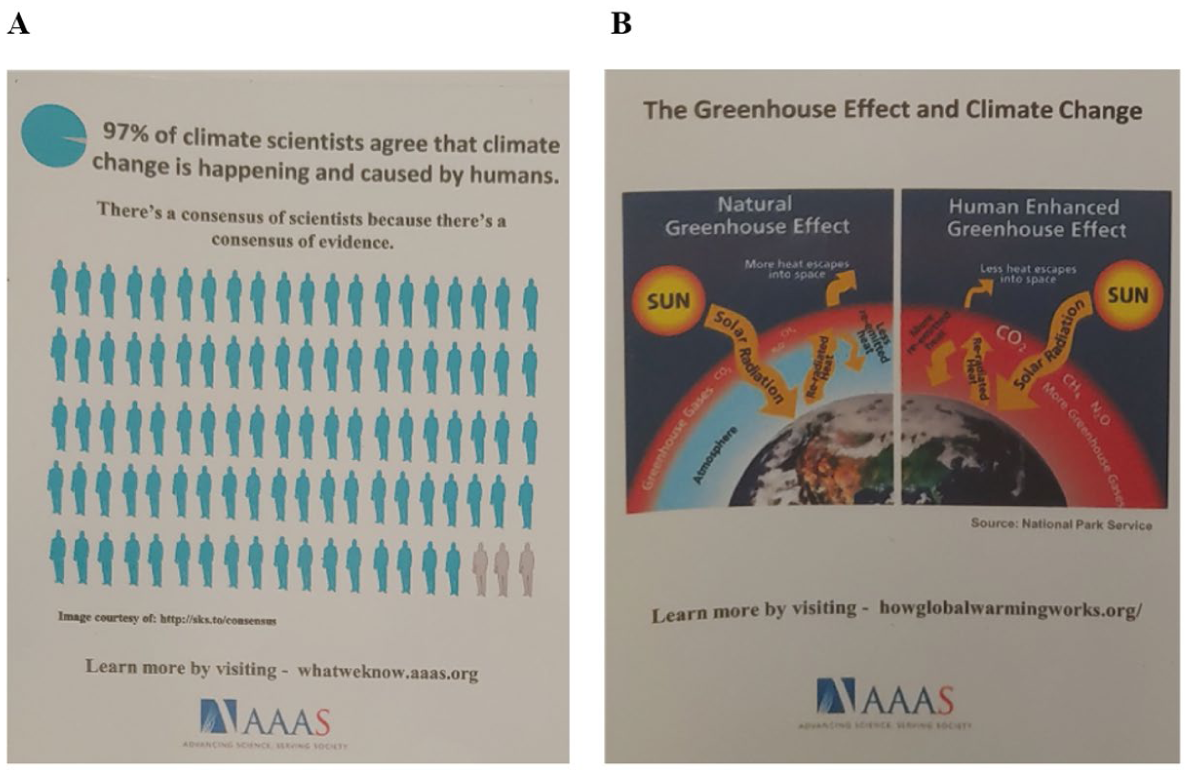
Refrigerator magnets used in the field experiment. Images of the refrigerator magnet in the consensus treatment (A) and the control condition (B).
Measures
Pre-Test
Before message exposure, participants first responded to their perceptions of the scientific consensus (see Supplement for wording of all questions). Participants also reported their familiarity with climate change (pre-test) and their certainty about their consensus estimate (pre- and post-test), but we do not analyze these here given our focus on the GBM variables (see Supplement for analyses of these variables).
Post-Test
After describing the control or consensus information, the research assistants asked about the core GBM variables, each phrased similarly on a 0 to 100 scale (see Supplement): perceived scientific consensus (again), whether climate change is happening, whether it is human-caused, how worried participants are about it, and how much the government should do to address it. As an added behavioral measure, we also offered participants the chance to become “a friend” of the university’s climate change research center and receive periodic updates about the center’s research. To do so, participants were given a postcard that they could mail back with support boxes checked. We coded this variable as 1 to indicate the postcard was returned and 0 for when the postcard was not returned. Finally, research assistants recorded participants’ political ideology (0 Very liberal to 100 Very conservative; M = 45.15, SD = 27.13), gender (observed by researcher), age (open-ended), and education (highest level of education, open-ended). Descriptive statistics for the dependent variables split by condition are shown in Table 1.
Means and Standard Deviations for the Control and Treatment Groups.
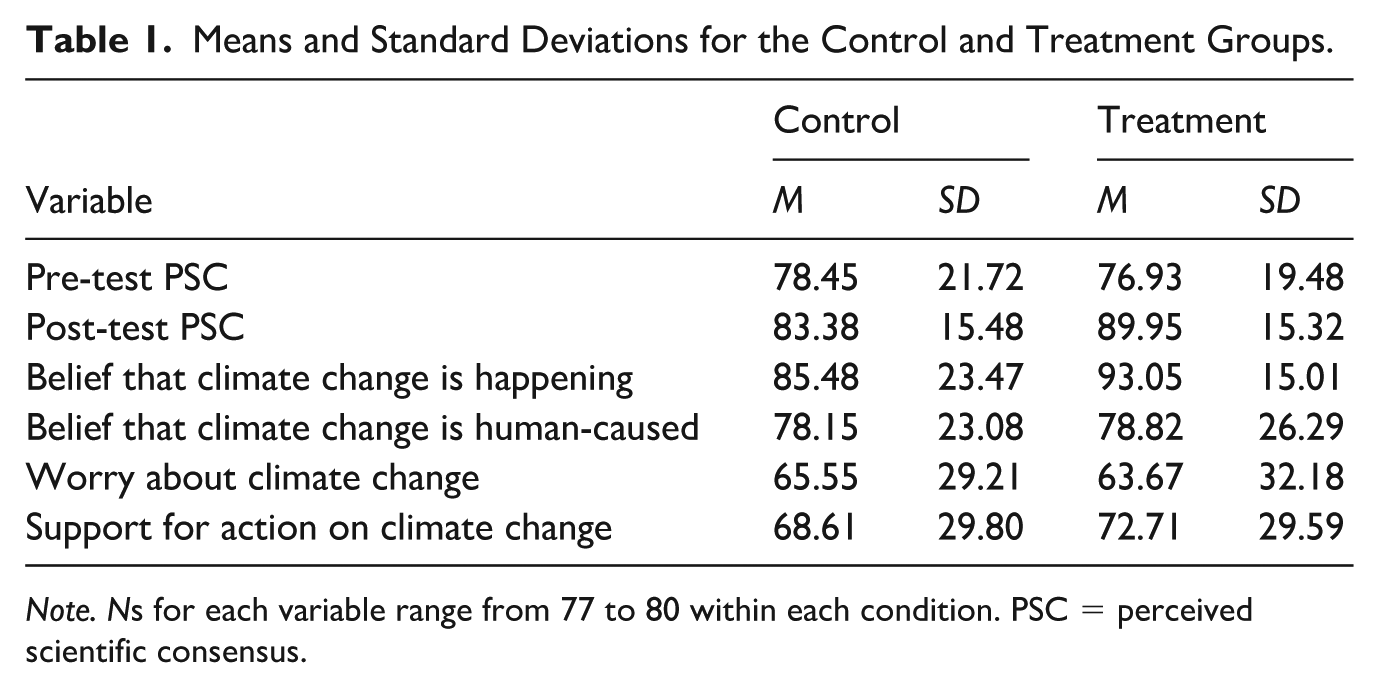
Note. Ns for each variable range from 77 to 80 within each condition. PSC = perceived scientific consensus.
Analyses
For our main analyses, we standardized the dependent variables and conducted linear regressions (logistic for the postcard outcome) with each dependent variable predicted by demographic covariates (age, gender, and education), pre-test perceived scientific consensus (standardized), and condition. The effects of condition therefore represent the standardized effect of receiving consensus information, adjusting for demographics and pre-test differences in perceived scientific consensus. We analyzed the interaction between condition and political ideology in a similar manner: standardized and adjusting for demographic covariates and pre-test perceived scientific consensus. Because we analyzed the six dependent variables separately, resulting in six treatment-control comparisons, we adjusted the p-values for the effect of condition using the Holm method (Holm, 1979) to keep the family-wise error rate under .05. We used this same adjustment for the six tests of the condition by political ideology interaction. Our data and materials can be found on the Open Science Framework: https://osf.io/uybzv/.
Results
On average, participants perceived a strong scientific consensus, believed that climate change is happening and human-caused, were worried about climate change, and supported action on climate change (Table 1). Adjusting for demographics and pre-test perceived scientific consensus, participants who received the consensus magnet had significantly higher estimates of the scientific consensus on climate change than those in the control condition, β = 0.45, 95% CIBCa = [0.18, 0.71], SE = 0.14, p = .006 (Table 2). In addition, the treatment group had significantly higher belief that climate change is happening than the control group, β = 0.41, 95% CIBCa = [0.12, 0.74], SE = 0.15, p = .038, adjusting for pre-test perceived scientific consensus and demographics. There were no other significant differences for the other three continuous dependent variables (Table 2). Figure 2 illustrates the distributions of the control and treatment groups for perceived scientific consensus, and the Supplement includes the distributions for the other dependent variables. Finally, only 15 participants (less than 10%) returned the postcard to learn more about climate change. This behavioral measure did not significantly differ between treatment (7 returned) and control (8 returned), b = −0.10, odds ratio (OR) = 0.90, SE = 0.62, p > .99. In the Supplement, we also analyze the results using only the post-test scores and without adjusting for demographics. The pattern of results is the same—significant effect of condition on perceived scientific consensus (d = 0.43) and belief that climate change is happening (d = 0.39)—with similarly sized effects.
Linear Regressions Adjusting for Pre-Test Perceived Scientific Consensus and Covariates.
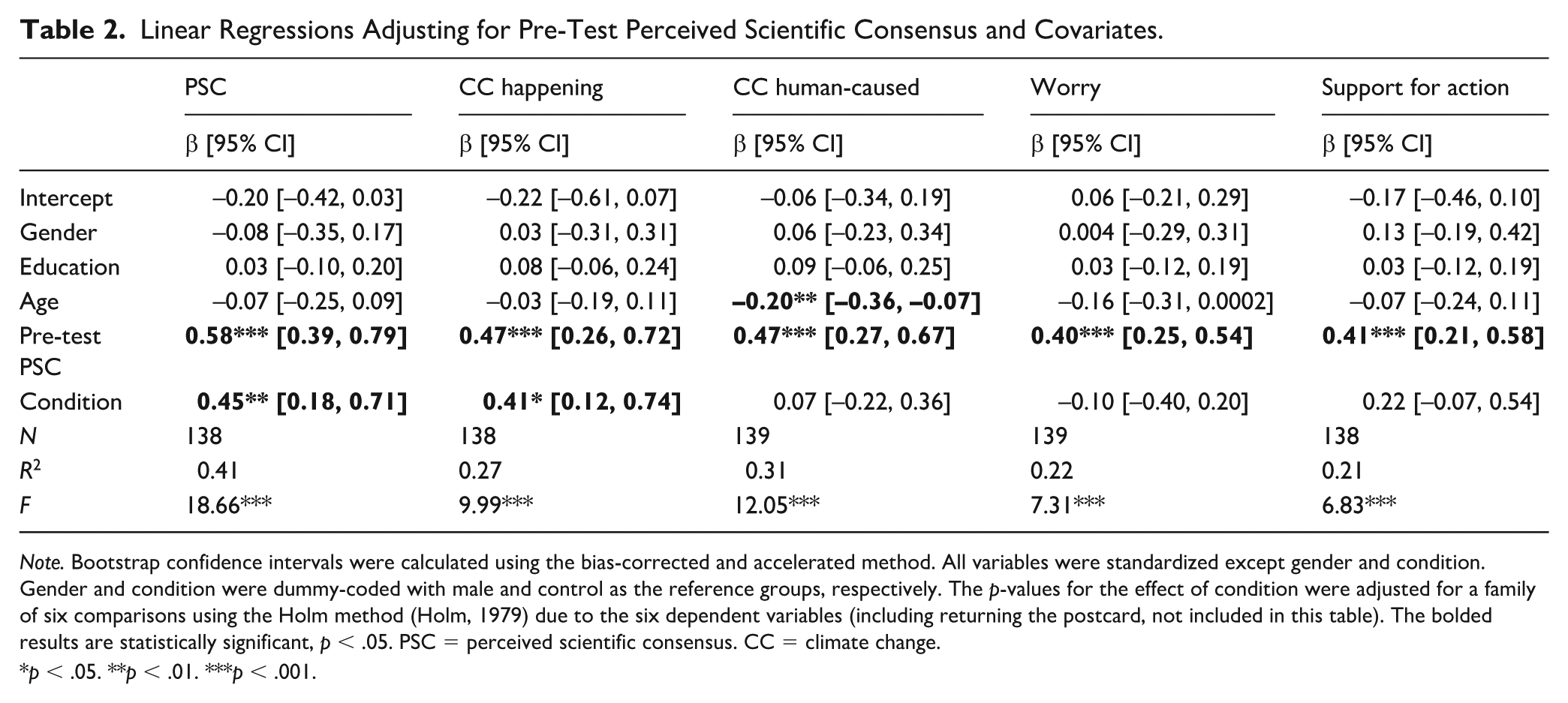
Note. Bootstrap confidence intervals were calculated using the bias-corrected and accelerated method. All variables were standardized except gender and condition. Gender and condition were dummy-coded with male and control as the reference groups, respectively. The p-values for the effect of condition were adjusted for a family of six comparisons using the Holm method (Holm, 1979) due to the six dependent variables (including returning the postcard, not included in this table). The bolded results are statistically significant, p < .05. PSC = perceived scientific consensus. CC = climate change.
p < .05. **p < .01. ***p < .001.

Distributions for perceived scientific consensus for the control and treatment groups.
As is common for studies testing the GBM, we also evaluated whether the treatment effects were moderated by political ideology (Table 3). For belief that climate change is happening, we found a significant ideology by condition interaction, such that ideology (conservatism) was a significant negative predictor of belief in the control condition (β = −0.45, 95% CIBCa = [−0.77, −0.19], SE = 0.12, p < .001) but nonsignificant in the treatment condition (β = 0.01, 95% CIBCa = [−0.13, 0.17], SE = 0.12, p = .90). In other words, consensus information depolarized participants on the belief that climate change is happening (Figure 3). There were no other statistically significant interaction effects (Table 3).
Interaction Between Experimental Condition and Political Ideology.

Note. Bootstrap confidence intervals were calculated using the bias-corrected and accelerated method. All variables were standardized except gender and condition. Gender and condition were dummy-coded with male and control as the reference groups, respectively. The p-values for the interaction effect were adjusted for a family of six comparisons using the Holm method (Holm, 1979) due to the six dependent variables (including returning the postcard, not included in this table). The bolded results are statistically significant, p < .05. PSC = perceived scientific consensus. CC = climate change.
p < .05. **p < .01. ***p < .001.
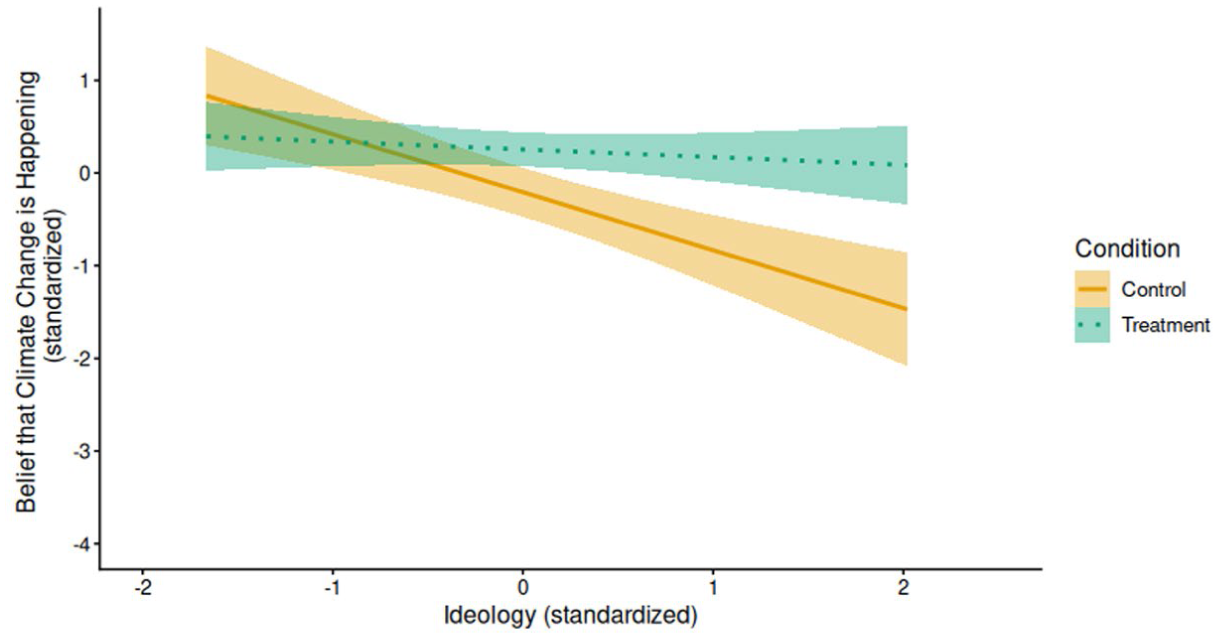
Interaction between ideology and condition for belief climate change is happening.
Discussion
The current findings align well with previous research on consensus messaging, with the strongest effect on perceived consensus (β = 0.45) and smaller effects on downstream beliefs and attitudes. This field experiment is the first to provide evidence that the scientific consensus can be effectively communicated in a more ecologically valid real-world environment. In addition, the observed interaction effect corroborates established (van der Linden et al., 2019) and recent (Rode et al., 2025; Većkalov et al., 2024) evidence that consensus messaging depolarizes partisans, such that the effect is stronger for conservatives than for liberals. Yet the previous mixed findings on the presence of this interaction effect (Rode et al., 2023; van Stekelenburg et al., 2022) suggest that it may depend on the attributes of the specific experiment. Alternatively, ceiling effects may be at play since liberals have little room for upward movement in climate change beliefs. Given the study’s low statistical power to detect effects beyond the main effect on perceived consensus, larger field experiments are needed to confirm the existence of impacts on downstream climate attitudes and clarify the robustness of the interaction with political ideology.
An important context for this study is that all participants were residents of one county in the mid-Atlantic. Geographically downscaled estimates (via multilevel regression and poststratification) of average consensus messaging effects for this state predicted a 13.94 percentage point change in people’s understanding of the consensus (Zhang et al., 2018). We observed a very similar effect (13% pre-post increase in the treatment group compared to 5% pre-post increase in the control group) in line with these predictions, despite participants having higher initial estimates of consensus in the current study (treatment group change from 77% to 90%). Notably, the area has a much higher percentage of residents with a college degree than the United States in general and a 2023 median household income nearly 70% higher than the U.S. median (U.S. Census Bureau, n.d.-a; U.S. Census Bureau, n.d.-b). While this sample was not representative of the United States, previous research has demonstrated the effectiveness of consensus messaging in representative samples (e.g., van der Linden et al., 2019). In addition, we tested a different aspect of the messaging strategy’s external validity, specifically generalizability to a different setting (Sherman, 2024).
Our results demonstrate the benefits of communicating consensus outside of controlled lab settings. This generalizability—that a consensus message can be effective with real people in their home environments—is particularly important for this messaging strategy. The strategy requires broad application since misperceptions about the scientific consensus remain widespread (Leiserowitz et al., 2024). Yet it may be increasingly difficult to communicate simple messages in the current online political environment amid broad-scale attacks on science and climate science in particular (Oppenheimer & Yohe, 2025). In addition to politically congruent messengers of consensus (e.g., a Republican messenger to a Republican audience; Benegal & Scruggs, 2018), the current strategy suggests that face-to-face conversations with local neighborhood messengers of consensus information might be particularly effective.
However, there are several limitations that constrain our conclusions, the first being low power. With 158 participants, the study had 80% power to detect a treatment-control difference of d = 0.45. Based on meta-analytic effect size estimates for perceived consensus (g = 0.56) and belief in climate change (g = 0.12; van Stekelenburg et al., 2022), our study was adequately powered to detect a difference for perceived consensus (94% power) but underpowered to detect differences in beliefs (12% power). Since effects for worry and support for action tend to be even smaller (Rode et al., 2021; Većkalov et al., 2024), our study was also underpowered to detect small effects on these downstream attitudes (additional Bayesian analyses in the Supplement). However, we note that the control condition provided basic scientific information about climate change and as such serves as a more stringent control than the typical no-information control group in consensus experiments (van der Linden et al., 2015), which could have reduced any differences between conditions. This comparison represents the difference between general messaging about climate change that participants are likely to receive and consensus messaging specifically.
A second limitation is that the data were collected in early 2016 within a much different political environment. 1 On the one hand, this different context might suggest that participants would be more politically polarized today and perhaps respond differently to a message on climate change. On the other hand, research since 2016 finds similar effects of consensus messaging (e.g., van Stekelenburg et al., 2022; Većkalov et al., 2024). Despite the older data, the study is still relevant as a pilot test of a novel canvassing-based consensus messaging intervention. Third, the research assistants were all students at a local university using the cover story of a class project. Participants may have been more skeptical of the message had it come from a political organization. Indeed, real-world discussions about climate change are likely to occur with friends and family or due to canvassing from political organizations. Our current design limits the conclusions we can draw about the impacts of in-person consensus communication beyond the setting of college student messengers. This specific canvassing setup may also have been conducive to demand effects. Participants may have been particularly acquiescent when faced with student messengers from the local university. Unlike online studies that take place anonymously behind a screen, the current study may have led to greater pressure on participants to conform to the consensus message or mask their true skeptical feelings about climate change. At the same time, a general demand effect of higher climate attitudes is unlikely because of the presence of climate change information in the control condition. Indeed, participants in the control condition had a slight increase in perceptions of consensus, but those in the treatment condition had an even stronger increase. In addition, participants in the treatment condition also reported more belief in climate change than those in the control condition, which suggests that treatment condition participants were not simply parroting back consensus information to the messengers. A recent study found little evidence of memory or demand effects within climate change consensus experiments and demonstrated that people did not simply repeat back “97%” but actually showed real belief change (Geiger et al., 2026). Finally, the fact that our findings were similar to those found in online lab studies suggests a limited impact of experimenter demand. More field experiments on this topic are needed to investigate the current effectiveness of this in-person strategy and to continue exploring innovative ways of presenting climate consensus information.
The current findings are particularly important with the increase in untrustworthy online information and artificial intelligence (AI)-generated content. In-person interactions could stimulate further conversations on climate change, which are especially powerful for generating further attitude change (Goldberg et al., 2019). Whereas online interventions end after the audience moves to the next post or website, in-person messaging involves potential for deeper engagement and conversations (e.g., Broockman & Kalla, 2016). Our study provides initial evidence for the benefits of in-person consensus communication, but larger and newer tests of this canvassing strategy are needed to robustly assess its effectiveness. Developing and testing field experiments can help uncover new ways of effectively communicating information about climate change.
Supplemental Material
sj-docx-1-scx-10.1177_10755470261442409 – Supplemental material for Consensus Messaging Shifts Beliefs About Climate Change in a Field Experiment
Supplemental material, sj-docx-1-scx-10.1177_10755470261442409 for Consensus Messaging Shifts Beliefs About Climate Change in a Field Experiment by Jacob B. Rode, Christopher Clarke and Sander van der Linden in Science Communication
Footnotes
Acknowledgements
We thank the following research assistants for their work collecting data: Beatriz Vianna, Laura Moore, Kyla Hickman, Katelyn Faretra, Synaca Norman, Joe Lazarony, Joel F. Hyde, Lema Mansoury, Joshua Stickles, Sultan Ahmed, Leigh Yeatts, Kaela Moore, Makaeda Fekede, and Christian Wilhite.

Ethical Considerations
The study was approved by the George Mason University Institutional Review Board.
Consent to Participate
All participants provided informed consent to participate.
Consent for Publication
Not applicable.
Funding
The authors received no financial support for the research, authorship, and/or publication of this article.
Declaration of Conflicting Interests
The authors declared no potential conflicts of interest with respect to the research, authorship, and/or publication of this article.
Notes
Author Biographies
References
Supplementary Material
Please find the following supplemental material available below.
For Open Access articles published under a Creative Commons License, all supplemental material carries the same license as the article it is associated with.
For non-Open Access articles published, all supplemental material carries a non-exclusive license, and permission requests for re-use of supplemental material or any part of supplemental material shall be sent directly to the copyright owner as specified in the copyright notice associated with the article.
