



Abstract
Paideia Seminar is a method for facilitating Socratic discussions about different types of texts, whether they be texts in the literal sense of the word or any other object that represents ideas or values. In this article, we describe how teachers can implement Paideia Seminar to spark deep thinking and rich discussion among early elementary students using works of art as the focus. The value in using images for Socratic discussion with younger students is that the barriers of literacy are removed, allowing students with big ideas to participate regardless of their literacy level. This strategy is especially useful for challenging gifted thinkers who are not yet proficient readers. Here we describe the process of developing and facilitating Paideia Seminars with art in early elementary settings. Resources, ideas, and sample seminar plans are also provided.
As a gifted resource teacher who worked with Kindergarten through third grade students in and out of their regular classrooms, I (Kristina Paul) was always in search of fresh strategies and innovative resources for challenging bright, young students. During these early schooling years, when literacy skills are so different from one student to the next, I often found myself working with children who had big ideas and an insatiable curiosity, but had yet to unlock the reading code. I was always searching for methods that would facilitate high-powered thinking within my students without the need for them to read.
“Paideia Seminar can be focused on many different “texts,” such as pictures, songs, poems, speeches, or even mathematical formulas.”
Having tried many approaches in a variety of group settings, I soon came to favor one method for opening the door to student discourse around big ideas. My method of choice was Paideia Seminar (Adler, 1982), a form of the Socratic method that enables teachers to engage students of all abilities and developmental levels in thinking deeply about ideas and concepts. Paideia Seminar can be focused on many different “texts,” such as pictures, songs, poems, speeches, or even mathematical formulas. I preferred the use of great pieces of art as the center of our discussions. By using Paideia Seminars focused on visual objects, any concerns about uneven levels of literacy within the group of young students fell away. The careful selection of artwork and the thoughtful crafting of discussion questions using the Paideia Seminar format allowed me to offer hungry young minds a hearty meal on which to chew. In this article, I, with the help of my coauthor, Juliana Tay—an experienced art educator—provide classroom teachers and gifted resource teachers with an overview of the Paideia Seminar method for young students using pieces of art as the centerpiece of discussion.
Paideia Seminar
Paideia Seminar, a form of Socratic discussion, originates from the work of Mortimer Adler (1982), who, in his book The Paideia Proposal, outlined his vision for school reform. The word Paideia means “the upbringing of a child” (National Paideia Center, 2003) and reflects Adler’s idea that school should be a place for preparing individuals for a lifetime of learning. The seminar experience is just one piece of Adler’s vision for how instruction should be delivered in school; also included are didactic instruction and intellectual coaching (National Paideia Center, 2003). Paideia Seminar is Adler’s take on the Socratic method, used for prompting “collaborative, intellectual discussion facilitated by open-ended question about a text” (p. 7).
During Paideia Seminar, students come together in a circle and, through a set of carefully planned, open-ended questions the teacher has prepared in advance, discuss the big ideas and values represented in a text. The text need not be an actual piece of text made of words and sentences; rather, it can be anything in which ideas or values are embedded. For example, seminar plans might be based on objects (e.g., currency, postage stamp, Girl Scout badge), works of art (e.g., painting, stained glass window, pottery, jewelry), or images (e.g., photograph, scientific diagram, graph, mathematical formula).
The teacher’s role in Paideia Seminar is that of designer and discussion facilitator. She selects a text that will elicit rich conversation and then carefully crafts a series of questions to engage students in dialogue about the ideas and values represented in the text. The planning of questions for Paideia Seminar should not be taken lightly; the teacher must take the time to consider the text through multiple lenses and be willing to think very carefully about how to craft open-ended questions that will prompt the students to arrive at interesting places in their thinking. Detailed instructions for selecting texts and for developing four types of seminar questions are discussed later in this article. In addition, the National Paideia Center offers a comprehensive set of resources for understanding and planning a seminar, including sample seminar plans, videos of seminars with students, and advice for planning and implementing seminars. These resources are available at www.paideia.org/about-paideia/socratic-seminar/.
Why Discuss Art?
Paideia Seminar discussions expand students’ comprehension of ideas, concepts, and values related to the curriculum. If children are to build deep understanding of the big ideas and themes we teach, it is important that we provide representative examples from which they can build their understanding. Eisner (2001) stressed the unique contribution of sensory experiences for concept formation of abstract ideas: It is easy to see how such concrete concepts as dog or chair, red or blue, depend upon sensory information. But what about such abstract concepts as justice, category, nation, infinity? I would argue that these words are nothing more than meaningless noises or marks on paper unless their referents can be imagined. (p. 311)
Students can experience abstract ideas and values through the concrete examples illustrated in artwork, thereby deepening their understanding through conversation and personal contemplation.
By coaching young students to develop good conversational skills, we may also influence literacy development, cognitive development, and overall achievement (Dickinson & Tabors, 2001; Hertzog, 2014; Seifert, 2012). Researchers exploring the conversational lives of young children at home and at school found that rich language interactions facilitated literacy development (Dickinson & Tabors, 2001). In addition, research on cognitive development in young children suggests extended conversation plays a critical role in helping students develop new vocabulary, gives students a chance to practice complex discourse genres, and aids in overall cognitive development (Seifert, 2012). Hertzog’s review of research on the intersection of early childhood education and gifted education, highlighted that the development of oral language in early childhood—skills such as vocabulary development and conversation—influences the overall achievement trajectory of students (Hertzog, 2014). A good Paideia Seminar prompts students to think deeply and to engage in rich conversation, which may in turn aid in the cognitive and academic lives of young students.
The Paideia Seminar method is good for all students, but it may be an especially effective educational experience for young, gifted children. Very few empirical studies are available to inform our research-based understanding of giftedness in early childhood (Hertzog, 2014). A qualitative study with 15 gifted children aged 6 months to 8 years old conducted by Harrison (2004) sheds light on the thinking processes of young, gifted children. The findings from her study showed that before entering formal education, these young gifted children had exhibited characteristics such as having an exceptional memory, asking questions, expressing the need for explanations, developing new ideas and testing them, and exhibiting advanced mastery in many areas. Harrison highlighted the need to move away from classroom paradigms in which the teacher is the expert to environments in which the student–teacher relationship is more collaborative. Paideia Seminar provides the type of environment recommended by Harrison (2004) and encourages the expression of the characteristics she identified in her sample of students. This form of Socratic discussion provides a supported environment in which students drive the conversation and formulate their own theories and ideas based on the information given. The discussions that follow allow the students to form complex connections between concrete visual representations and the abstract concepts they represent. This process can be challenging for all students, but especially for young, gifted students.
Selecting Art for Seminar
The National Paideia Center suggests four guidelines for selecting a text for seminar (National Paideia Center, 2003). First, a good text will contain a collection of ideas and values, not just one single idea or concept. Second, there should be an appropriate level of challenge in interpreting the image. The text should not be so straightforward that it can be understood with a quick glance, but instead have room for curiosity and deeper consideration. The third element to consider is the level of relevance to the students’ lives, as well as to the curriculum. Will the students be able to identify with the image? Is there a connection between the ideas in seminar and the ideas learned at other times in the classroom? Finally, one should consider the level of ambiguity in the text. The artwork should have the potential to be interpreted in many different ways and from several different perspectives.
There are various avenues to consider when searching for art to use for seminar. First, consider talking with the people in your community who are knowledgeable about art and may have access to artwork or prints. These local experts—art teachers from your school or local high school, art gallery owners, art history professors at local colleges, or art museum educators—have a wealth of knowledge about art and may help you identify specific works or artists that embody the theme or idea that you have selected for your seminar. They may even have prints they would be willing to let you borrow.
A variety of online resources can support your search, including teacher resource centers on museum websites, art databases, art poster companies, and online auctions. If you have a specific painting or artist in mind, you can conduct targeted searches of the Internet using Google Images (http://images.google.com). Once you have the search results for the work, select “Search Tools” from the menu at the top of the window to filter the results by size, which will help you find the highest quality image available. Select the highest quality image and note your choice of “View Website” or “View Image” in the preview pane. By selecting “View Image,” you will be provided with a browser window that displays the image only, whereas “View Website” will return the image in situ complete with any accompanying text or information.
At other times, you may need to browse collections of artwork to find a piece that suits a particular theme or idea, in which case the use of an online art database or art museums’ teacher resource site might be helpful. Figure 1 provides a selection of websites useful for these purposes.
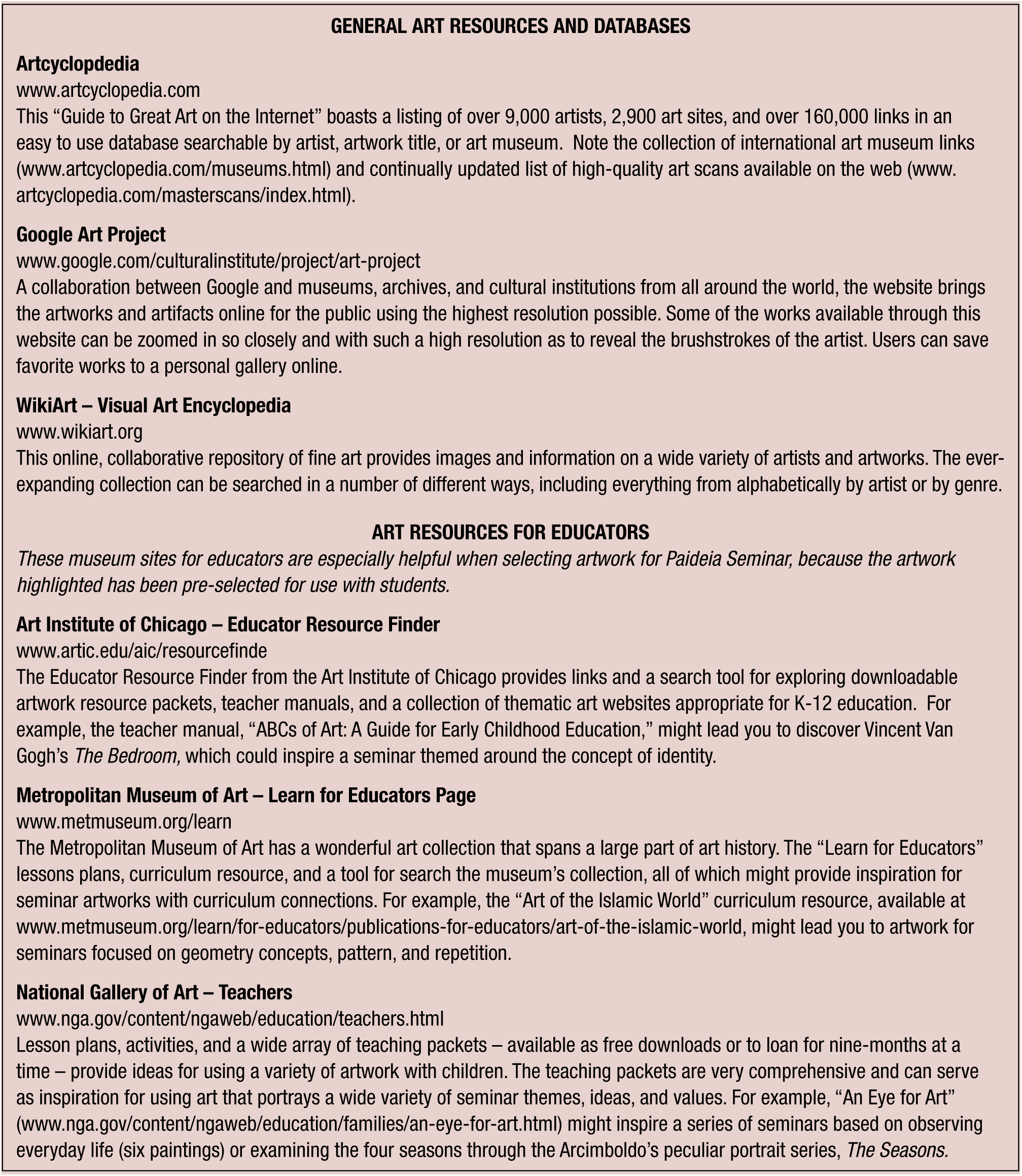
Online resources for selecting art.
Identifying Key Ideas and Developing Questions
Once the image has been selected, it is time to carefully consider the ideas represented in the image. You may have purposefully selected the artwork to complement a predetermined idea or concept, but it is important to explore all of the ideas presented in each image, which may create new avenues for discussion. The ideas and values you identify should be broad and span across time and discipline. Figure 2 is a list of the types of ideas and values you might encounter in the works of art for your seminar, and Figure 3 provides a sample set of artworks and corresponding ideas and values.
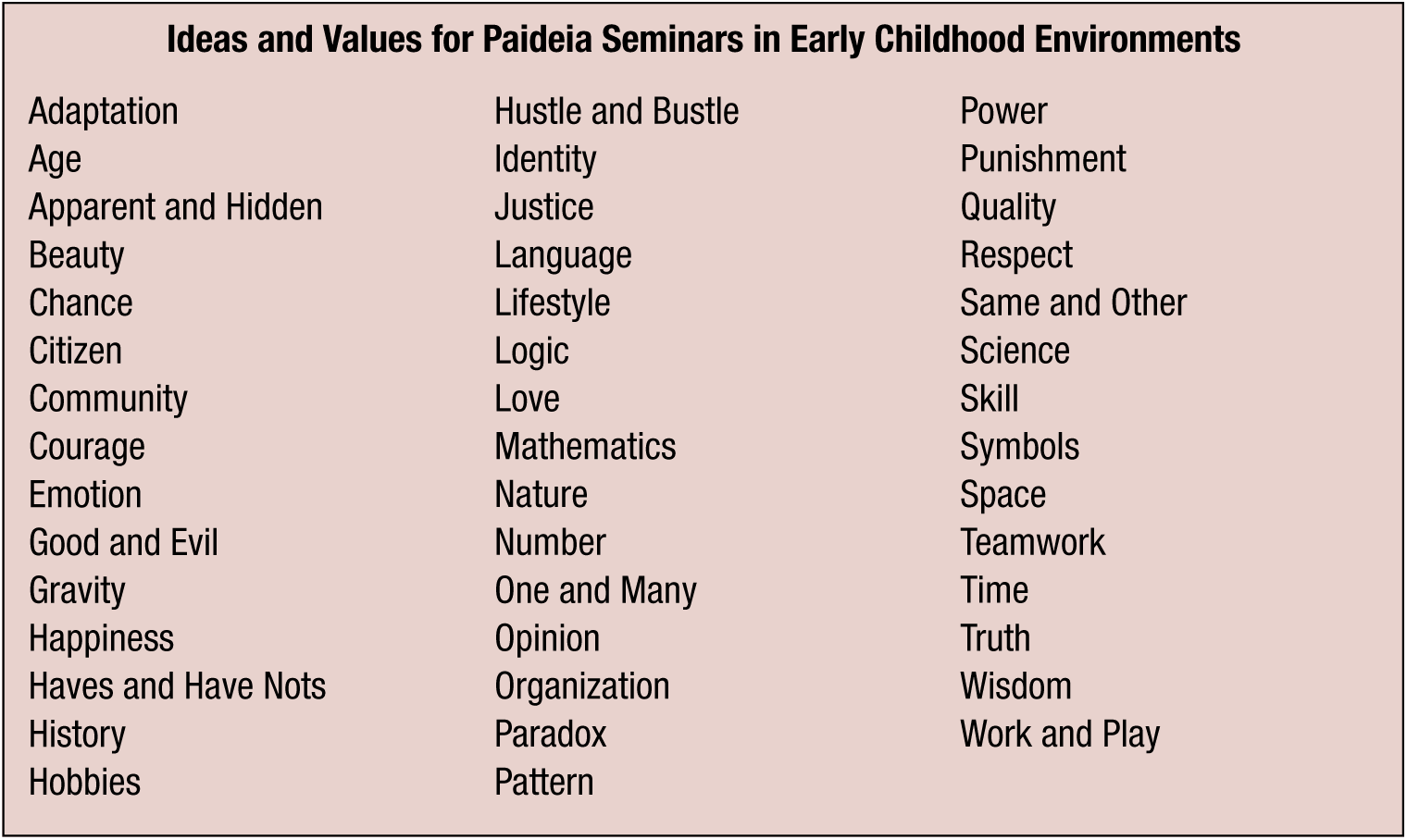
Ideas and Values for Paideia Seminars in early childhood.
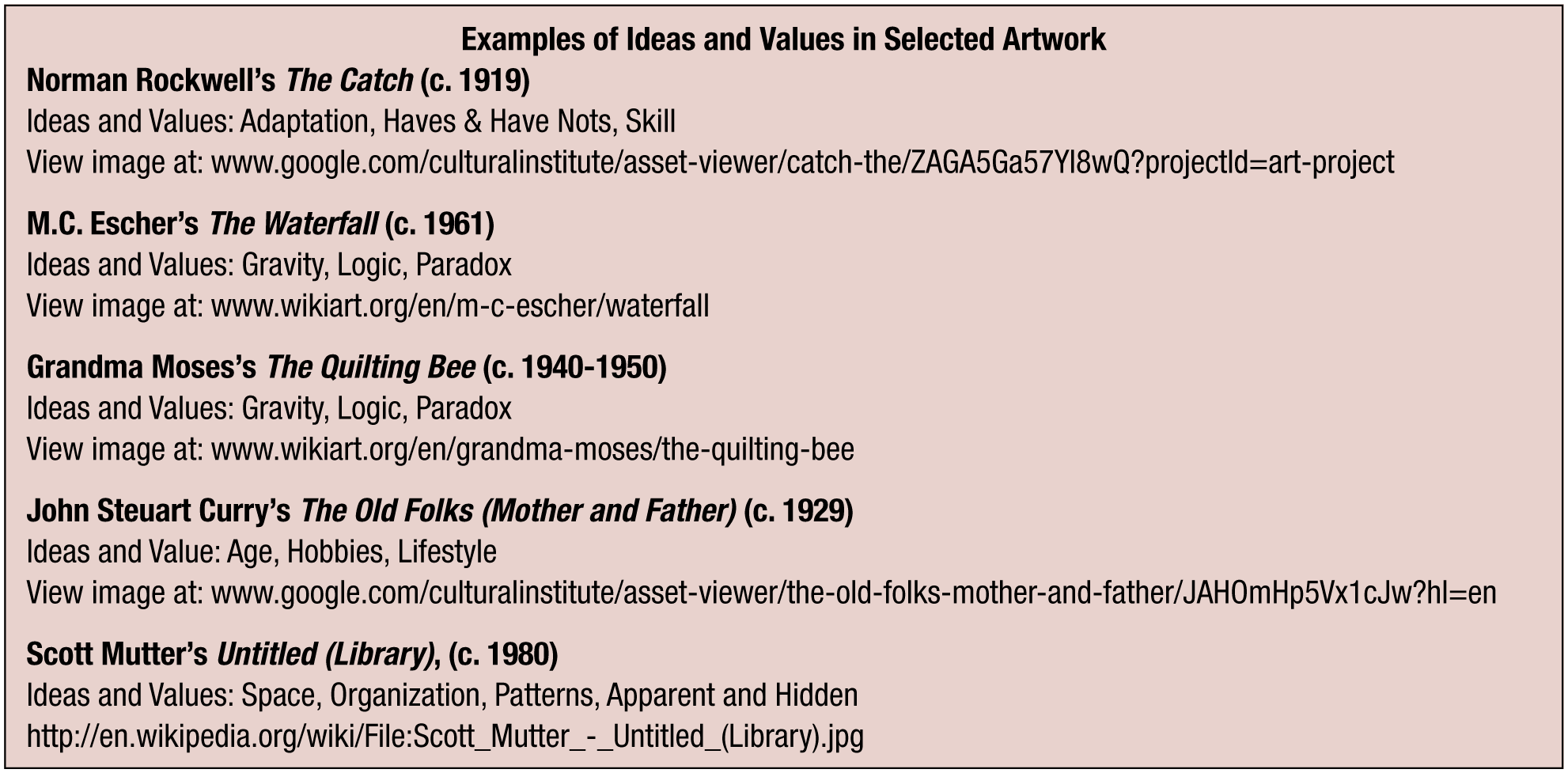
Sample seminar texts with ideas and values.
After identifying the ideas and values of your text, it is time to write the questions guiding the seminar. Paideia Seminar plans should include four types of questions: opening questions, core questions, follow-up questions, and closing questions. As you read about each type of question below, refer to the sample seminar plans provided in Appendix A to C to see examples of each type of question in relationship to an actual text. The texts we have selected for the sample seminar plans are Norman Rockwell’s New Kids in the Neighborhood (c. 1967, see Appendix A), Grandma Moses’s The Quilting Bee (c. 1940-1950, see Appendix B), and M. C. Escher’s The Waterfall (c. 1961, see Appendix C). URLs to these works of art are included with the seminar plans.
Opening questions ask students to focus on the text and are usually done in a round-robin style, thereby providing an opportunity for all students to contribute right away and to identify the main ideas in the text. Opening questions should elicit very brief responses and be crafted so that there are no right or wrong answers. The goal of the opening question is to get students thinking about the text, give them an easy access point into the conversation, and prompt them to identify, as a group, the main ideas presented in the text. An example of an opening question is to ask the students to identify their favorite part of the picture or the part they think is the most important. Another strategy is to ask them to give a one-word answer for how the picture makes them feel. Yet another approach is to ask for one word they think of when they look at the picture. Again, the goal is to get a personal response from each student and to engage each student immediately in a question in which every person can be correct.
Core questions are the meat of the seminar experience. Core questions should lead students into thinking about the ideas and values by asking them to analyze the details of the text. The goal of core questions is to have students discuss the text in detail, share their observations and insights, and stay firmly grounded in the text. The format of core questions may vary to include free response questions, pair-share questions, or round-robin questions, but it is always a good practice to give students up to 1 min of think time before opening the conversation. Core questions will likely be more directed and focused than opening or closing questions, but they should still be open enough to elicit a variety of perspectives.
Follow-up questions are used at any point in the discussion and are meant to help students clarify their thoughts or to help the group delve more deeply into an idea or question. “Can you tell me more about that idea?” and “What did you mean when you said . . . ,” are both standard follow-up questions that could be used during the seminar.
The final type of question—the closing question—is intended to elicit personal responses to the ideas from the text. The closing question should prompt students to reflect on the text and the seminar experience and then apply the ideas in a personal way. The closing question should be open-ended in the same way as the opening question and provide an opportunity for each student to have a personal response that is neither right nor wrong.
The overall goal is to develop a set of four to five questions that will spark deep thinking about the ideas and values in the text and to get students to engage in active dialogue. The National Paideia Center (2003, p. 34) recommends using the following to evaluate the quality of the seminar questions you develop:
Are they open-ended? How many correct responses can you imagine for each question?
Are they clear? Will they be easy for young students to understand exactly what you are asking?
Are they thoughtful? Do they require analysis, synthesis, or evaluation?
Do the questions fit into the seminar question types (opening, core, and closing) as written?
Will the opening question elicit participant identification of the main ideas?
Will the core question(s) require close analysis of the text?
Will the closing question encourage participants to think of real world applications of the ideas and values in the text/dialogue?
As you begin implementing seminar with young students, you may find five questions are too much to handle for students with short attention spans; however, students will develop their self-regulatory skills with time, practice, and coaching. As you plan your first few seminars, develop an opening question, three core questions, and a closing question, but be flexible in your expectations for using all of your planned core questions. Determine which of the core questions are the most important, and prepare yourself for the need to drop the others and skip ahead to the closing question.
Preparing Students
It may be helpful to provide a preview of the picture for a few days before the seminar. Exposure to the art before the seminar prompts students to begin thinking about the picture on an independent level, thereby readying their minds for seminar. Students may become curious about the picture and begin forming questions in their minds. Perhaps spontaneous small group discussion may occur. Prior thinking about the text will prepare students for a higher level of engagement in seminar.
Seminar expectations are different from other classroom expectations for discussion, where students may be accustomed to raising their hand to speak and directing their comment to the teacher. It will take some time for the students to become accustomed to the new routines and patterns of seminar. Once the students become accustomed to the flow of seminar, they will surprise you with the level of student-focused discussion that emerges. Even young students are capable of high-level dialogue; they just need to learn the guidelines and expectations for what that dialogue looks like.
Teachers can help facilitate this shift in the students’ minds by changing the way they respond during seminar. The focus is on the students and the text at hand, not the teacher. By refraining from making eye contact with the students who are speaking, seminar facilitators disengage themselves from the conversation as a discussant. Students will be uncomfortable with this at first, but a gentle reminder that seminar is a time to learn from each other—not the teacher—will help them along their way to becoming effective seminar participants.
Consider displaying a poster with pictorial representations of the expectations for seminar. The guidelines of talk, speak, listen, and no hand raising are manageable for young children. Talk with the students before seminar and discuss each of the items on the poster. During seminar, you may need to offer a gentle reminder of one of the rules for seminar; a quick tap on the poster will remind students of the expectations.
Facilitating the Seminar
There are several steps to beginning a Paideia Seminar with young students. First, make sure you and all seminar participants are seated in a circle at the same height, thereby visually representing equality among the seminar participants and facilitator. Second, remind students of the rules of seminar and give clear guidelines for the ways you expect them to contribute to the group conversation. They will need to be reminded that seminar is a time for them to talk to one another, not to the teacher, and to consider and respond to one another’s ideas. Give them examples for how they might talk to one another respectfully, such as agreeing with someone’s ideas (“I agree with Susan’s idea, because . . . ”), asking a clarifying question (“Jared, will you please tell me more about your idea? I don’t understand”), adding onto an idea (“Honesty’s comment made me think about . . . ”), and politely disagreeing (“I don’t agree with Jason because . . . ”). These types of examples will help students understand the ways in which they can be active, respectful members of the seminar conversation.
High quality digital images of your seminar text, in this case artwork, can be displayed for the group using a Liquid Crystal Display (LCD) projector or SMARTboard. We recommend using Google Chrome as a web browser, which provides “Presenter Mode” (Mac) and “Full Screen Mode” (PC) as viewing options, thereby allowing you to display your image free of toolbars or other visual clutter that might distract students from the image.
Another option is to locate and display a poster showing the selected artwork. The benefit of using a poster is you can easily display the image for extended periods of time leading up to the seminar without occupying technology equipment. Popular art poster companies for educators include Crystal Productions (www.crystalproductions.com), Huffman Art (http://huffmanart.com), and Art Image Publications (www.artimagepublications.com/store/index.php/).
Students should come to seminar having spent time considering the piece of art you have selected. Even so, provide time at the beginning of the seminar for students to focus on the artwork with 1 to 2 min of think time and then start the seminar using your planned questions as a map for facilitating the conversation.
Students will likely need considerable coaching during the first few seminars you conduct. Be prepared to remind them of the seminar rules and the expectation that they are to engage in conversation with one another. Use visual clues to communicate these expectations, such as avoiding eye contact with students who are talking or pointing to the rules poster with your finger or even your gaze. If you find that the students are having a hard time discussing one another’s ideas, provide them with prompting questions such as, “Does anyone agree or disagree with Kevin’s comment?” or “What do you think about Taylor’s answer?”
Another approach to helping students grasp the idea of student-driven conversation is to compare it with a situation they already understand. Talk with them about their conversations at, for example, the lunch table, on the bus, or on the playground. The topic of conversation in these places may be different, but the actions are still the same; students talk with one another, and their conversations usually do not include the adults who are there to supervise. The adults are there to observe, to be helpful to students, and to make sure that the students are safe. It is the same with seminar, except during seminar, the teacher provides a topic and guiding questions for the conversation. Once the topic is established, the students should talk with one another and allow the teacher to be an observer.
You may also encounter issues with student participation in which a handful of vocal, outgoing students may attempt to dominate the conversation. In such cases, I usually provide a verbal reminder, such as, “I can see that many of you are thinking very carefully about our conversation, but some of you are still very quiet. I’d like each of you to speak at least once during our conversation.” Another strategy is to provide each student with three to five counters (e.g., plastic discs, beans, snap cubes). With each contribution to the conversation, the student places a counter under his or her chair until all of the counters are “spent.” These tangible participation reminders will assist shy students in increasing their participation and will assist overly eager students with regulating their participation so each contribution really counts.
Extending Thinking After Seminar
After seminar has started, extend students’ thinking by providing opportunities for personal or group responses to the experience. The post-seminar experience you design will depend on the content of the seminar, but you may want to consider such activities as personal responses through art, role-playing a scene that emerges from seminar, or asking the class to develop an action plan for tackling an issue that emerged during seminar, such as a recycling campaign, to raise awareness about a relevant issue that emerged during seminar. Get parents involved in the discussion by sending home a letter that describes the seminar experience, lists questions asked, summarizes the ideas presented by the students, and provides a few follow-up questions parents can use to continue the discussion at home.
Paideia Seminars based on interesting pieces of art offer great opportunities to stretch young students’ minds, prompting them to think critically and to learn important conversational skills that aid in literacy development. Art can open the door to big ideas, and the structure of Paideia Seminar provides an easy-to-use framework for fostering high-end learning in your early childhood classrooms.
Footnotes
Appendix
Conflict of Interest
The author(s) declared no potential conflicts of interest with respect to the research, authorship, and/or publication of this article.
Funding
The author(s) received no financial support for the research, authorship, and/or publication of this article.
Bios
Kristina Ayers Paul, PhD, is an assistant professor of Gifted, Creative, and Talented Studies at Purdue University.
Juliana Tay, MS, is a doctoral student in Gifted, Creative, and Talented Studies at Purdue University.