




Abstract
Using data from teacher interviews, classroom observations, and a professional development workshop, this article explains how one component of the schoolwide enrichment model (SEM) has been implemented at a culturally diverse elementary school serving primarily Latina/o and African American students. Based on a broadened conception of giftedness, the SEM incorporates enrichment clusters, which are designed to expose students to a variety of topics that would not ordinarily be covered in the regular curriculum. The goal of enrichment clusters is for students to engage in active learning under the direction of the cluster facilitator, who encourages inductive and cooperative approaches to problem-solving and higher order thinking skills. At our investigation site, enrichment clusters are inclusive of all students, providing access to gifted methods and challenging curricula for Latina/o and African American students, who are typically underrepresented in gifted programming.
Keywords
The SEM (Schoolwide Enrichment Model) promotes diversity and excellence in education by holding high standards for all learners, regardless of age, ethnicity, gender, education, or socioeconomic conditions. Knowledge is power only for those who can use it to change their conditions.
“Hi, Mrs. Bentley,” Natalie cheerfully exclaimed, catching me in mid-yawn. By the middle of the week, the early morning cafeteria duty had begun to catch up with me. Even the smell of freshly baked cinnamon rolls didn’t jolt me into gear. I’ve got to get to bed earlier, I thought to myself.
“Hi, Natalie! How are you this morning?”
“Great!” she replied energetically, her dark hair framing her smiling face.
“Our goal was to examine an alternative approach to gifted education that shows sensitivity to cultural and linguistic differences.”
The cafeteria was soon abuzz with students. Spanish words and phrases permeated the room. As more students trickled in to the cafeteria, the energy level in the building rose. It was a contagious liveliness. They’re hyped up because it’s cluster day. I thought. Hopefully my extra hours of planning this weekend will be worth it.
I casually meandered to a table filled with boys. They were animated, telling jokes in Spanish.
“You guys sure are lively today! Are you excited about clusters?”
“Of course, Mrs. Bentley! We’re always excited about cluster day!” Luis replied, practically shouting over the cafeteria noise.
That’s a good reminder . . . the students really do respond well to clusters. The endless hours spent in workshops, compiling cluster options, tallying survey responses, scheduling and rescheduling clusters, are worth it. The preparation can be draining, but it’s worth it to see the students this motivated.
Excitement and anticipation filled the air. It was a tangible energy—similar to the excitement that occurs when snow flurries fall from the sky in the South. If enthusiasm were a substance, you could bottle it up this particular Wednesday morning. It’s cluster day, and the students’ enthusiasm makes it all worth it . . .
Morris Elementary School opened approximately 5 years ago as a public charter school in a small southeastern university town. Because of the highly diverse student population (see Table 1), the school system’s leaders and personnel wanted to promote equity in education, using social justice and critical pedagogy as guiding forces. The schoolwide enrichment model (SEM) was chosen as a way to meet this philosophy and was integral to the school’s governing charter. The primary reason the school chose to implement the SEM was to increase students’ access to enriched curricula, opening more educational opportunities for students from diverse backgrounds to participate in enhanced scholastic and community endeavors. While the school continued to operate a traditional gifted education program, the program was based on SEM principles and designed to identify and serve traditionally underrepresented populations.
Student Demographics/Gifted Enrollment
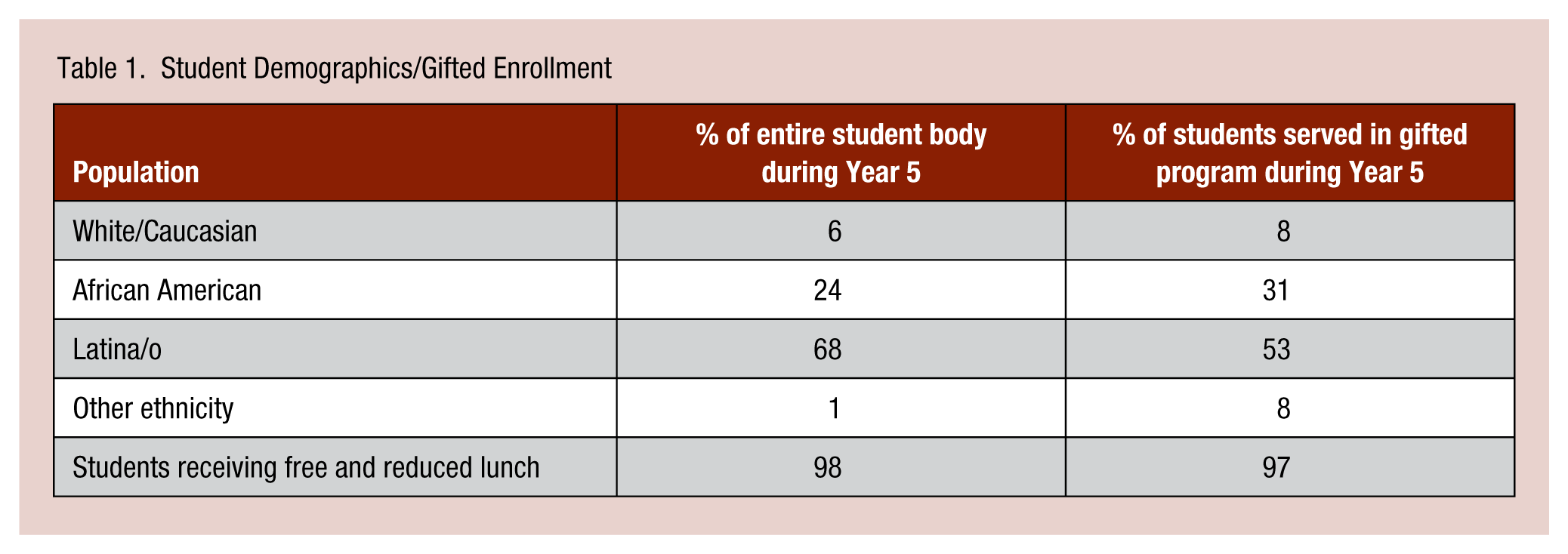
The first year Morris Elementary School opened, only 3% of students within the school were identified gifted according to the state’s gifted procedures. Within 5 years of the school’s implementation of SEM, the population of identified gifted students had more than doubled to 7% of the school’s population. Enrichment clusters, a component of the SEM and the focus of this study, played an integral role in providing all students with enriched experiences and teachers with authentic opportunities to see the manifestation of gifted behaviors in students.
Introduction
Children from culturally and linguistically diverse (CLD) backgrounds often encounter a number of challenges in today’s schools. Along with the obvious language and cultural obstacles they face, some of these students must deal with negative attitudes toward their ways of communicating and deficit perceptions of their academic capabilities (Cahnmann, 2006). As critical educators concerned about equal access to challenging curricula for all students, we wanted to further explore gifted education models that enhance the learning opportunities for all students, including those typically underserved in gifted programming. At Morris Elementary School, all students are invited to participate in enrichment clusters through the implementation of the SEM (Renzulli & Reis, 1997). According to greatschools.org, a site that reports on schools and their demographics, 68% of the students at the school are Hispanic/Latina/o. (Note: Government agencies report these students as Hispanic, but most of them self-identify as Latina/o. We use Latina/o to represent both Latino and Latina.) In addition, 24% of the students are African American, 6% are White, and 1% are either multiracial or another ethnic category. Therefore, the school serves a mostly Latina/o population, with 98% of the student body receiving free or reduced-price lunch.
Because of our concern with the issue of underrepresentation of CLD learners in gifted programming, we sought innovative schooling models that address the need for increasing participation of underrepresented groups in gifted curricula. The driving question behind our research is one addressed by other gifted education scholars: How do schools improve access to gifted education methods for CLD students (Ford, Grantham, & Whiting, 2008)? Our goal was to examine an alternative approach to gifted education that shows sensitivity to cultural and linguistic differences (Ford et al., 2008).
Site Selection
We chose Morris Elementary as the site of our qualitative case study for several reasons. First, Morris Elementary is a school with a predominantly Latina/o population, many of whom are second-language learners from a low socioeconomic background. These factors make the students at Morris Elementary an ethnically, linguistically, and economically diverse group using the SEM, thus providing us with an ideal site for our study. This group of students is also representative of the fastest-growing population in the United States and therefore warrants further educational study (Abellan-Pagnani & Hébert, 2013; U.S. Census Bureau, 2010). According to the 2014 report of the U.S. Census Bureau, of the roughly 32.5 million elementary school students in the United States, more than 8 million are Hispanic (U.S. Census Bureau, 2014). In addition, we chose the school because they utilize enrichment clusters, a component of the SEM, which we wanted to further explore to learn their impact on CLD learners and their access to more challenging curricula. Finally, the implementation of the SEM at Morris Elementary resulted in an increase of students identified for gifted programming within the school, as cited earlier, increasing from 3% to 7% of the student body over a 5-year period. Furthermore, the representation of CLD learners in gifted programming at this school is more closely aligned to the total student population than in many schools with diverse learners (see Table 1 for statistics).
Conceptual Framework
The lens we used to explore this topic is critical theory with a focus on critical pedagogy. Our hope is that this article serves as an advocacy piece that enlightens educators on the SEM, which offers an alternative approach to enrichment. Working within the critical theory tradition involves exploring subjective lifeworlds, much like working within interpretive traditions, but brings a critical eye and an ethical tone to its analysis (Prasad, 2005). Because critical theorists are concerned not only with how things are but also how they might or should be, critical researchers often view themselves as activists working to create a better world for all (Bronner, 2011). In this article, we are not suggesting that schools replace traditional gifted programs, but that they consider offering an option that gives more students the benefit of enriched curricula. As critical theorists, our ultimate goal is to improve the school experience for students, and we feel that the SEM is one model that lends itself to equal access in education because it gives students opportunities they might not otherwise have in schools.
To begin our case study inquiry process and explore how the SEM functions specifically at Morris Elementary, we observed enrichment clusters in action on two different occasions and in several classrooms, taking detailed field notes about what we noticed about collaborative learning and product-based instruction. Our time at the school observing clusters lasted approximately an hour each visit. In addition, we attended a workshop, led by the school’s enrichment specialist, designed for teachers to learn more about the SEM and enrichment clusters. During this workshop, we gained insight into the philosophy that drives the SEM and its implementation practices. Finally, we interviewed four classroom teachers, one English to speakers of other languages (ESOL) teacher, and one enrichment specialist using a semi-structured interview guide to learn more about their experiences with the model. Each interview lasted approximately 30 to 45 min and was audio recorded for later transcription (see Table 2).
Data Collection
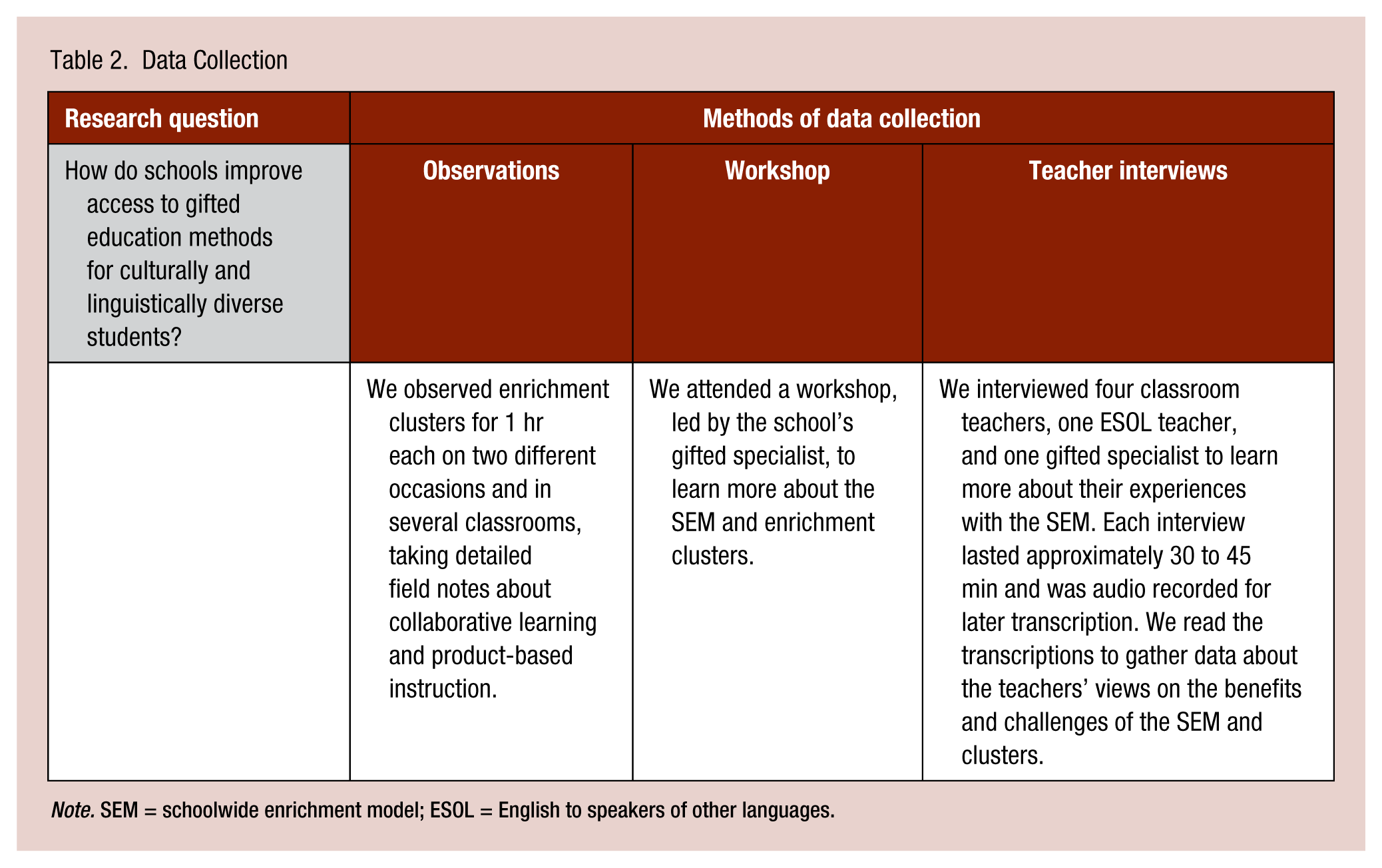
Note. SEM = schoolwide enrichment model; ESOL = English to speakers of other languages.
Our data analysis process began when we took field notes during each interview and classroom observation, making note of significant questions and insights. Together, we reviewed our observation field notes and highlighted recurring themes. We also listened at least once to the audio-recorded interviews we conducted to be sure we had not missed significant responses during the actual interview itself. This gave us a second chance to notate important thoughts and ruminate on repeating ideas. Furthermore, we read through each interview transcription wholly to refamiliarize ourselves with the data. This gave us an opportunity to highlight the key and repeating elements of our participants’ subjective experiences about the SEM and enrichment clusters, which helped us identify trends within and across the interviews. This data analysis gave us a deeper understanding of the benefits and challenges of the SEM, as well as enrichment clusters.
Overview of the SEM
This article explains the SEM—a program designed to increase student access to inviting and enjoyable spaces in schools that encourage learners to reach their full potential—and elaborates on enrichment clusters, which are one component of the SEM (Renzulli & Reis, n.d.). In addition, we give voice to practicing teachers who facilitate this model at their CLD school on a regular basis, illuminating the benefits and challenges of this model. We approached the inquiry with a critical lens to showcase a program model in gifted education that has resulted in more equitable access and outcomes for CLD students.
Based on a broadened conception of giftedness, which recognizes that there are many types of intelligence and that gifted behaviors can be developed through systematic enrichment opportunities, the SEM incorporates enrichment clusters, designed to expose students to a wide variety of topics that would not ordinarily be covered in the regular curriculum (Renzulli & Reis, n.d.). Enrichment clusters are comprised of students sharing common interests who meet weekly to work with an adult who shares their interests and who has some degree of expertise in the area, or is willing to develop expertise in the area. The ultimate goal of learning through enrichment clusters is to promote independent and active learning (Renzulli, Gentry, & Reis, 2014). This goal is reached under the direction of the cluster facilitator, knowledgeable about gifted instructional approaches, who facilitates inductive and cooperative approaches to problem solving and application of higher order thinking skills in creative and productive situations (Renzulli & Reis, n.d.). Practices utilized in enrichment clusters then often transfer into the regular education classroom, encouraging teachers to address required standards through student interests, advanced methodologies, and problem-solving strategies (Reis, Gentry, & Maxfield, 1998).
Justification for the SEM and Enrichment Clusters
As the number of CLD learners continues to rise significantly in many American schools, so does the need to ensure that equal opportunities exist for those students to gain access to enriched curricula. Research on the underrepresentation of CLD students in gifted programming has become more prevalent as the landscape of American schools changes. According to Harris, Rapp, Martinez, and Plucker (2007), English language learners (ELLs) are seriously underrepresented in gifted and talented programs due to identification practices that were implemented decades ago that fail to take into account the linguistic and cultural diversity of students attending today’s schools. In fact, CLD students are underrepresented in gifted programs by greater than 40% nationwide (Ford et al., 2008). This can create a disadvantage for diverse students because they sometimes lack access to gifted programming and teaching methods that are challenging, engaging, and rigorous (Ford, 2013).
There are a plethora of reasons that lead to underrepresentation, but researchers feel that a deficit view of diverse students contributes most heavily to it (Ford & Grantham, 2003). Furthermore, scholars suggest that other contributing factors to underrepresentation include the use of traditional assessments and the lack of teacher referrals (Ford et al., 2008). Intelligence testing has been a key factor in identification of gifted students, even though intelligence tests measure “familiarity with American culture and English proficiency, not intelligence” (Ford & Grantham, 2003, p. 218). This practically guarantees low test scores for immigrants and other culturally diverse students who are “unfamiliar with U.S. customs, traditions, values, norms, and language” (p. 218). Therefore, we need to continue to find alternative means for assessing students’ abilities that go beyond traditional tests, particularly for ELLs.
Many believe that ELLs do not qualify for gifted programs because they may have difficulty communicating their learning in a way that is valued by traditional educators (Olthouse, 2013). Bernal (2009) and Peterson (2009) argued that this underrepresentation is likely due to the fact that teachers are not aware of what intelligent behaviors look like among ELLs who often do not demonstrate their abilities in ways that grab the attention of mainstream teachers. Sometimes gifts and talents reveal themselves differently in students from other cultures, perhaps because the term “gifted” is a social construct, and its definition may vary depending on one’s culture. Being gifted, therefore, is not easily measured by tests and/or checklists (Ford et al., 2008). For instance, code switching, using more than one language in conversation, may be an indicator of giftedness (Abellan-Pagnani & Hébert, 2013). This is something mainstream educators may not be aware of, and that traditional gifted assessments and checklists do not measure or include.
As more CLD learners enter American schools, the issue of underrepresentation in gifted programming is becoming more critical. The SEM is one intentional enrichment model that can have far-reaching positive effects upon the development of gifted traits in all students and their access to enriched curricula that develop critical thinking skills and efficacy in problem solving. In addition, as teachers work with students in an area of interest and strength in enrichment clusters, often times, gifted behaviors are demonstrated that may not manifest in more traditional school settings (Renzulli et al., 2014), thus increasing the referral of students who are traditionally underrepresented in gifted programs.
Description of the SEM and Enrichment Clusters
The SEM is a result of over 30 years of field tests and research, and is designed to promote school improvement through the development of unique programs to serve students based on student needs and faculty strengths (Renzulli & Reis, n.d.). It “infuses the regular curriculum” (Kloosterman, 2002, p. 184), and, while it is not meant to replace existing school structures, the goal of the SEM is to “influence and improve them” (p. 196). The SEM suggests that educators strive toward creating schools with inviting and enjoyable spaces that encourage learners to reach their full potential. Students may possess “schoolhouse giftedness,” which is most easily measured using cognitive ability tests or “creative-productive giftedness,” which involves “putting one’s abilities to work on problems and areas of study that have personal relevance to the student and that can be escalated to appropriately challenging levels of investigative activity” (Renzulli & Reis, n.d., para. 13 and 15). Thus, the SEM addresses the needs of gifted students—those who qualify for gifted services based on testing, data, and other criteria—while providing challenging learning experiences for all students.
Over three decades of research on the SEM has shown its success in “developing interests, talents, and higher order thinking skills, not only in high ability students, but also in all students and at all educational levels” (Kloosterman, 2002, p. 181). Research has shown that enriched learning opportunities allow gifted characteristics to manifest unexpectedly in students who are sometimes overlooked for gifted programs (Kloosterman, 2002). Therefore, the use of the SEM in schools is beneficial to the entire student population.
Because Morris Elementary School uses the SEM, all students at Morris Elementary participate in Type I and Type II enrichment experiences and have the option to participate in Type III activities as well. Type I activities include general exploratory experiences that often center on exposure and interest. Type II activities include group-training activities where facilitators focus on creative thinking and problem-solving strategies. Type III enrichment opportunities include individual or small-group investigations of authentic problems (Kloosterman, 2002).
At Morris Elementary, for example, Type I activities include guest speakers, educational videos, field trips, and opportunities to learn from experts. Type II activities involve participating in lessons on creative problem-solving skills with a focus on fluency, flexibility, originality, and elaboration with the goal of developing these gifted-oriented traits in students. Type II training also develops process skills needed to be successful in today’s society, such as critical thinking skills, research skills, communication skills, and problem-solving strategies. Students who decide to participate in Type III enrichment experiences go a step further and develop individual or small-group projects that are interest based and student selected with the goal of solving a real-world problem. These enrichment experiences, often reserved in traditional settings for only those students formally identified for gifted programming, are offered to all students at Morris Elementary with the philosophy that gifted traits can be cultivated and developed.
With a belief that systematic enrichment opportunities can foster gifted behaviors, the SEM incorporates enrichment clusters, a component of the SEM “designed to expose students to a wide variety of disciplines, topics, occupations, hobbies, persons, places, and events that would not ordinarily be covered in the regular curriculum” (Renzulli & Reis, n.d.). The enrichment clusters are comprised of students sharing common interests who meet weekly to work with an adult who shares their interests and who has some degree of expertise in the area. Enrichment clusters tap into students’ creative-productive abilities, allowing facilitators to more easily notice students’ passions and talents that lie beyond traditional schoolhouse giftedness (Renzulli et al., 2014). We were fortunate enough to spend the majority of our time at Morris Elementary observing enrichment clusters in action and talking to teachers about them.
Enrichment Clusters and Critical Pedagogy
Enrichment clusters parallel the Freirean concept of “problem-posing” education (Freire, 2005, p. 79), in which teachers and students are co-investigators of authentic and meaningful problems that arise from their everyday experiences. This approach to learning results in students who are able to think more critically and creatively about the world they inhabit. According to Renzulli, “Knowledge is authentic and project-based, rather than being storage- and retrieval-based” (McLester, 2012, p. 70). To produce creative thinkers, leaders, and problem solvers, we as educators need to advocate for methods that go beyond traditional instruction and encourage creative problem solving.
The critical praxis element of enrichment clusters occurs when students take on problem-solving roles and develop products to positively affect real-world issues. For example, students in the Page Turners Cluster who sought to promote literacy in their community visited the local public library, as well as a Little Free Library©, to gain background knowledge about available literacy outreach opportunities and to brainstorm ways for increasing opportunities for community members. Students ultimately decided to help families obtain library cards and start a Little Free Library© where individuals could leave a book and take one in return from a conveniently placed library box. In another cluster filled with passionate writers, students dealing with issues related to immigration wrote narratives sharing their stories anonymously with national news stations, so as to give the public perspective into the experiences of immigrant children.
Furthermore, the SEM is a vehicle for ensuring a uniformly sound and equitable curriculum that provides for all students services that are normally reserved for only students who qualify for gifted programming. The goal of the SEM was to promote both challenging and enjoyable learning across demographic differences, resulting in “a rising tide lifts all ships” approach (Renzulli & Reis, n.d.). The SEM stimulates talent development by recognizing the following principles: Each learner is unique, and therefore, all learning experiences must be examined in ways that take into account the abilities, interests, and learning styles of the individual. Learning is more effective when students enjoy what they are doing, and therefore, learning experiences should be constructed and assessed with as much concern for enjoyment as for other goals. Learning is more meaningful and enjoyable when content (i.e. knowledge) and process (i.e. thinking skills, methods of inquiry) are learned within the context of a real and present problem; and therefore, attention should be given to opportunities to personalize student choice in problem selection, the relevance of the problem for individual students at the time the problem is being addressed and authentic strategies for addressing the problem. Some formal instruction may be used in enrichment learning and teaching, but a major goal of this approach to learning is to enhance knowledge and thinking skill acquisition that is gained through formal instruction with applications of knowledge and skills that result from students’ own construction of meaning. (Renzulli, 1994, p. 204)
Enrichment clusters also help students view themselves as empowered agents of social change in their school and community because they provide students with meaningful opportunities to engage in authentic activities and reflect on how they have enhanced the world around them. For example, entrepreneurial skills were learned when students organized fundraising activities that helped students attend an overnight field trip. Another group of students explored political issues as part of the Election Connection cluster, and when they found out that only a small percentage of Latina/o individuals who were eligible actually registered to vote, created a website to share with their community that gave an overview of the candidates, information about registering to vote, and a persuasive element to encourage people to exercise their right to vote.
When teachers use a problem-posing approach with students through critical pedagogy, where the teacher is not the primary source of knowledge and critical thinking is promoted through dialogue between students and the teacher, teachers foster a higher level of critical thinking among their students (Cowhey, 2006). If students have more opportunities to use problem-solving and creativity skills in the classroom, they will be better prepared for real-world endeavors. For instance, one engineering cluster decided to address the issue of a needed pedestrian walkway along a nearby bridge. The students in this group integrated engineering skills by creating plans for a new bridge, building a model bridge, and presenting their plans at the Cluster Fair and with a local engineer. This activity is an example of critical pedagogy because students were able to identify a problem, develop a plan for alleviating the problem, and articulate their plan to enact change. By allowing small-group interaction and dialogue among students and teacher, enrichment clusters better prepare students for higher levels of education, and therefore give them a wider range of opportunities as future students and leaders. This critical pedagogy opens students’ minds to life possibilities available to them because they have reflected on their role in transforming society.
The SEM is an important step toward equity in education for all students. Altman (2012) stated that we have an ethical obligation to teach, advise, and care for every student who walks through our doors, no matter what they look like, where they come from, what languages they speak at home, and whether they have social security numbers. (para. 7)
It is our job as educators to provide students with the best education possible. Because many CLD students encounter challenges due to the language barrier, they are often not referred for traditional gifted programs as teachers focus more on areas of need versus student strengths. However, because cluster groups provide small-group interaction with the teacher and creativity exercises for all students, teachers are more likely to notice if a student with a language barrier has traits of giftedness.
Description of Enrichment Clusters in Action
Teachers and administrators at Morris Elementary School adopted the SEM to provide their students—including students typically underserved—access to challenging and meaningful curricula. Research shows that CLD students are often denied access to challenging curricula and are underrepresented in gifted programs by greater than 40% nationwide (Ford et al., 2008). Other researchers have shown that percentage to be as high as 70 nationwide (Harris, Plucker, Rapp, & Martinez, 2009; Harris et al., 2007; Matthews & Kirsch, 2011). In traditional schooling, enrichment activities are exclusive, mandated only for those elite students who demonstrate traditional gifted characteristics and qualify for gifted services based on mandated assessment results. In a school such as Morris Elementary that uses the SEM, enrichment opportunities are inclusive, allowing all students access to challenging, engaging curricula. To serve their student body effectively—including the majority CLD population—the SEM is inclusive of all students in the school. Furthermore, the implementation of the SEM, combined with teachers’ training in gifted education, allows for teachers to more easily notice gifted traits and behaviors in students who might otherwise be overlooked.
All students are invited to participate in enrichment clusters based upon their interests and those expressed by the faculty. At the beginning of the school year, teachers request a cluster to facilitate based on areas of expertise as well as student interests and their own interests. Adults in the building fill out and create an advertisement that piques the interest of students. Students then select their top choices for clusters they wish to participate in out of the 20 or so offered for each grade-level band, and clusters are formed based on student responses to surveys. Teachers try to match each student with one of his or her top five or six choices. Then, the students, with facilitation from the teacher, decide upon a real-world problem or theme to explore and create curriculum and activities to delve more deeply into the topics. The cluster groups meet 1 day each week for 1 hour. The school schedule is built around enrichment clusters taking place 1 day a week. Clusters typically range from 10 to 12 weeks per semester depending on school holidays and semester start/end times.
Teachers do not have predetermined lesson plans for their clusters at the beginning of the semester. However, students and teachers collaborate to build a plan for enrichment clusters. Each week is then dedicated to reaching the goals students and teachers establish. Students and teachers determine a culminating project—generally a school or community enhancement project, a service-learning opportunity, creative thinking task, or problem-solving activity. Each week, students spend time in their self-selected cluster groups addressing themes revolving around school or community enhancement, such as health and wellness, gardening, literacy, life science, entrepreneurship, culture and diversity, engineering, activism, and the arts. Students receive small-group instruction based on research skills, problem-solving skills, and targeted product development. Some cluster groups take field trips to observe how their topic functions in the real world, whereas others bring these aspects into the classroom, through supplies, technology, and guest speakers.
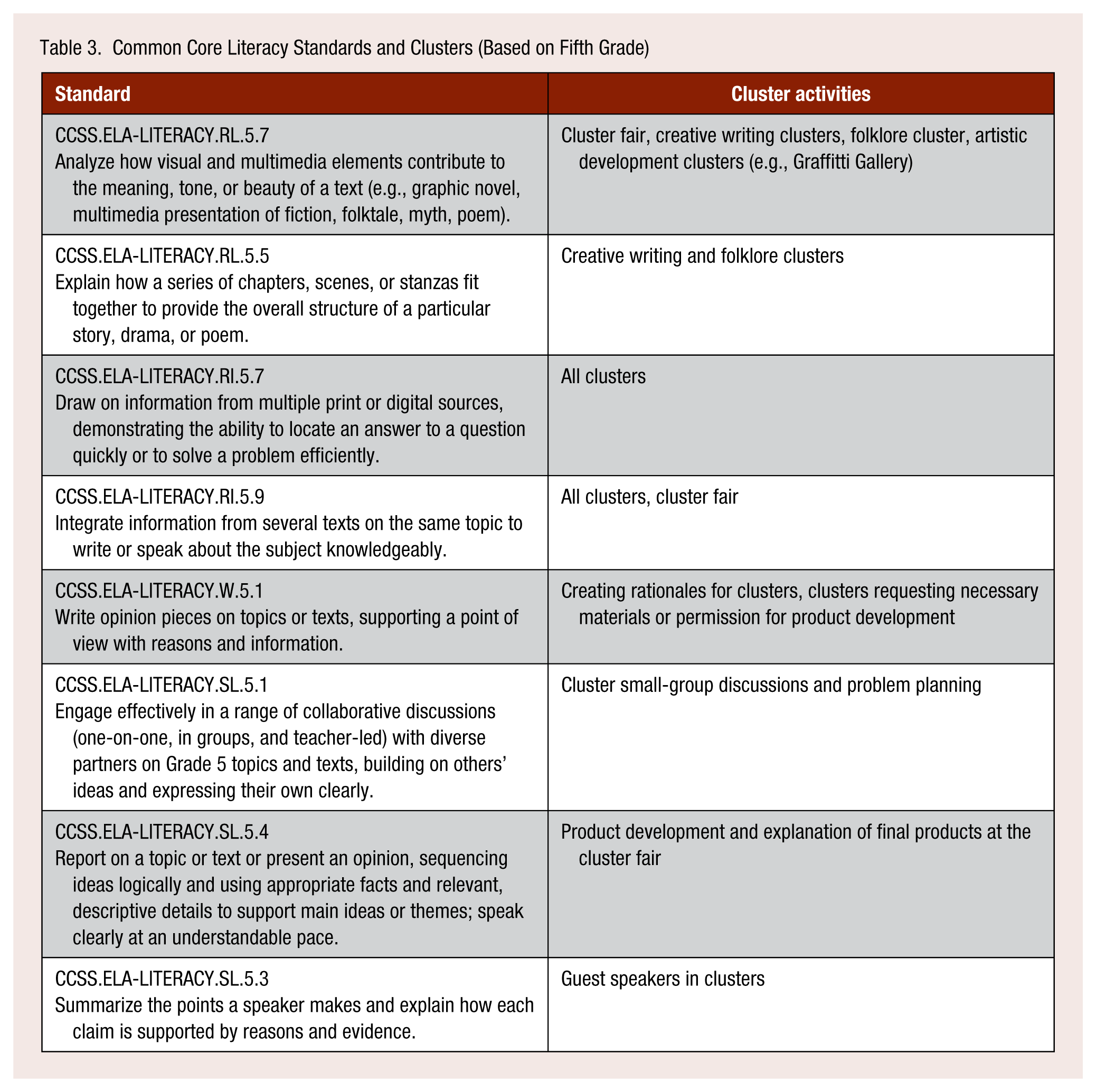
While the primary focus of enrichment clusters is on developing real-world problem-solving and critical thinking skills, the thematic cluster groups also address Common Core Georgia Performance Standards (CCGPS) for each grade level. In other words, the ultimate goals of planning for clusters are the real-world application and critical transformation components; however, because teachers realize the importance of the CCGPS, they address standards amid the process as the cluster plans unfold. Depending on the group’s theme, certain content standards are more directly targeted than others. For example, several cluster groups focus on literacy, so the reading and language arts CCGPS are more prevalent in those clusters. Another cluster involves sewing, so students draw heavily on mathematics concepts related to measurement. Other clusters focus on cultural diversity and highlight Social Studies standards. Furthermore, several cluster groups revolve around engineering, which brings in math and science standards. All clusters develop communication and higher order thinking skills, especially because cooperative learning is the essence of the cluster model. The goal is for all clusters to create active learners who become adept at applying creative thinking skills, critical thinking skills, problem-solving skills, and leadership skills in real-world contexts.
Benefits of Enrichment Clusters
Through our observations and interviews, we identified several advantages of implementing enrichment clusters within the SEM (see Table 3). Clusters positively affect the students at Morris Elementary in many ways and foster a sense of community of belonging among students and faculty. While cluster training and implementation are time-consuming, teachers at the school reported significant benefits of clusters for students.
Common Core Literacy Standards and Clusters (Based on Fifth Grade)
Enrichment Clusters Increase Exposure to Environments Outside of School and Home
The majority of students who attend Morris Elementary are CLD, and most come from lower socioeconomic backgrounds. Therefore, they are not always afforded opportunities for exposure to environments outside of their school and home. During our interviews, teachers reported that one of the primary advantages of enrichment clusters is the increased exposure students receive to places or topics outside of their school and neighborhood, which in turn enhances their knowledge of the world as well as their vocabulary. One teacher stated that students are able to hear about jobs their parents or people in their neighborhoods don’t have. Another teacher discussed the fact that many of her students come from low-income families and lack access to resources that might be available to other students in the district. Therefore, the SEM is crucial for providing increased access and exposure to hands-on learning opportunities that go beyond traditional curriculum, exposing students to more career options and helping them think about what careers they might like to pursue.
Through clusters, the students at Morris Elementary become more aware of their role in the school and surrounding community. Project-based learning opportunities, field trips, and guest speakers help students see how they can get involved in and improve their school and local community. Examples of guest speakers who encourage community service include people from the local animal shelter, recycling center, public library, and the nearby university. As a Professional Development School, Morris Elementary has access to local university experts who willingly provide their time and expertise to students. Therefore, students have interviewed collegiate coaches and professors on topics pursued in enrichment clusters. Exposure to cultural events and community organizations is necessary for building background knowledge for students at Morris Elementary and allowing them to see how they can participate in effective service-learning projects. In addition, many of these guest speakers develop long-term relationships with the clusters and support students through the completion of the final product.
For example, one cluster’s goal was to learn more about endangered sea turtles, so students visited a local nature center to observe a sea turtle and learn more from a naturalist. Students then decided to form a relationship with a sea turtle rescue center in the state and raise money to adopt one of the sea turtles. The students updated the school through the morning announcements on the sea turtle’s recovery and were excited to see its successful release after several months of care. One teacher described inviting guest speakers from the community to enhance her cluster activities. For her story-retelling cluster, she invited a storyteller from the local library who talked with the students about the art of storytelling using puppets or other household items. For previous clusters, she invited a cafeteria worker to share about nutrition and food safety and a lifeguard to talk about water safety.
Enrichment Clusters Develop Student Agency
Through the cluster process, students critically examine problems in their school, community, and world and often address social issues, such as immigration, bullying, homelessness, and animal activism. Students feel successful and valuable as they work together to transform the world and change lives. In every cluster, students engage in service-learning projects where they create products—websites, videos, pictures, prototypes, school gardens, clubs, and so on—that address the problems they posed at the cluster’s onset to improve their school and/or surrounding community.
One teacher described her sewing cluster in which students hemmed aprons for the cafeteria workers and made pillows to make the front office chairs and couches more comfortable and appealing to visitors. These tangible products in use help the students see the direct connection between their learning, their actions, and their impact on the school or community. Students in the gardening cluster maintain a garden for the school where vegetables are grown and used to feed students, staff, or guests at special events (see Figure 1). In the process of sustaining the garden, students learn more about nutrition and gardening and realize that their work can improve the nutrition of others. Recently, another cluster worked with a grant team to design a plan for shade trees on the playground, and then organized a day for families to come to the school and plant the trees. These students and their siblings can now watch these trees grow over the years, knowing that they played an active role in the betterment of the school. Realizing that their actions can have a positive impact on the school and community is motivating for students and helps them feel that they can contribute successfully and significantly to society.
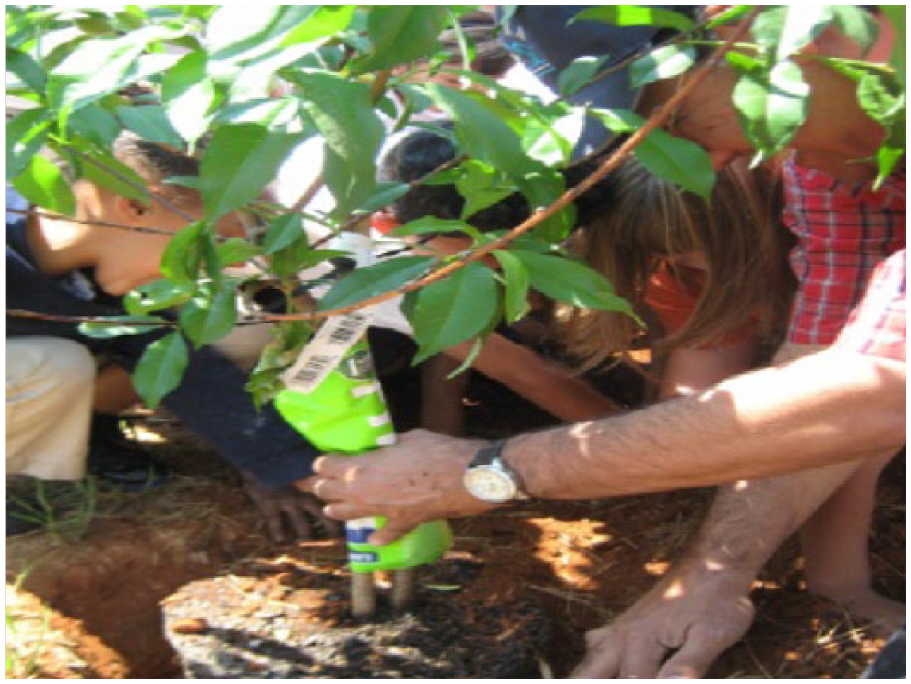
Students get their hands dirty working in the school garden.
Enrichment Clusters Improve Communication Skills
At the close of the cluster sessions, students showcase their cluster products at an enrichment cluster fair. The cluster fair provides students an opportunity to share products with an authentic audience. Typically, parents, teachers, students, and other community members attend the cluster fair, which is conducted similarly to a science fair. Rather than teachers doing the explaining at the cluster fair, students are expected to take the lead in educating others about the cluster, its problem, and its resulting product. Specifically, students must elaborate on how their product affects society, the school, and/or the community. Students become adept at communicating the impact their praxis has had on the school and/or community, therefore encouraging others to support service-learning projects.
One of the teachers we interviewed cited that student communication skills improve as a result of clusters, specifically through guest speaker interviews. She stated, “They’re bringing in an outside view as well, and the children actually get a chance to see how to interview someone and how to listen but have a list of questions ready in their heads too.” Students learn to distinguish between relevant and irrelevant questions and practice their interpersonal skills with an adult outside of their school and community.
Enrichment Clusters Emphasize Student Choice, Strengths, and Interests
Several teachers indicated that students enjoy the choice element of clusters, as it provides an opportunity for students to take ownership over their learning. Students get to vote on their clusters, and therefore can choose clusters that match their interests and strengths. High-interest topics stimulate student creativity and conversation. Clusters provide a change of pace for students because cluster activities are highly student driven and focused on student choice and student-led experiences. Students are able to negotiate among themselves roles in establishing the project and its creation. In addition, students have a chance to build on their strengths and interests, as the cluster work is divided among students according to their talents and expertise. For example, if one student is a skilled researcher, he or she might be in charge of locating relevant information on the topic or finding contact information for experts in the field. If another student has above-average interpersonal skills, he or she might be in charge of contacting people with the support of the teacher to invite them to share their expertise. Division of labor is used to promote student success and accountability, with students knowing that their peers are counting on them to fulfill their responsibilities. This setting allows leadership characteristics to emerge as students learn how to delegate tasks appropriately.
Enrichment Clusters Build Relationships and a School Community
Enrichment clusters allow students and teachers to forge new connections—connections that they may not have formed otherwise—with one another. Teachers make connections with other teachers based on the discovery of common interests. Students connect with other teachers and students because of shared passions. Clusters are multiaged and span across grade levels, allowing new mentorships and friendships to develop as a result of working together collaboratively. Such groupings and interactions create a positive environment with students and teachers who know that there are others in the building they can relate to and talk to. These relationships formed between teachers and students across grade levels give the school a more tight-knit feel and provide students with a comfortable and stable learning environment. A teacher eloquently highlighted the importance of building relationships: “Having that relationship already developed . . . makes it more of a community and more of a family than just a generic, very sterile environment.”
One teacher in particular talked about the SEM’s impact on parent involvement. She explained that there is “a massive amount of parent involvement, maybe not monetarily, but in presence.” She also discussed how teachers get to know more parents because of their interaction with more students through clusters. In addition, the cluster fair helps facilitate this involvement because parents are invited to participate as audience members when students share about their clusters. She added, “This model really does build a community. And also I think that our English learner population, because they are primarily Latina/o and Hispanic, they’re very family driven, very family oriented, and they make an effort.” The community built between students, teachers, and parents benefits the school atmosphere, as all feel a sense of partnership and belonging.
Enrichment Clusters Validate Home Cultures
Clusters give teachers an opportunity to validate the students’ home cultures, which fosters a sense of belonging for students (Blanco-Vega et al., 2008, as cited in Abellan-Pagnani & Hébert, 2013). For instance, one cluster focused on the art of interior design and invited students to create a patch representing their home culture that would be added to a group quilt, to be hung in the school’s lobby. Another cluster, The Travelling Iron Chefs, explored popular cuisine from countries around the world and created a food stand where other students could try these foods and learn information about the various countries studied. These cluster groups, therefore, reinforced the students’ home cultures and contributed to a school community that values diversity.
Enrichment Clusters Infuse Other Content Areas
A few teachers reported that they believe teachers have a tendency to approach their instruction for other content areas with methods similar to those used in clusters. The cluster approach infuses instruction in other content areas, encouraging teachers to utilize collaborative or individual projects, creative thinking, and problem solving. As part of the charter, each staff member is required to receive gifted certification, provided at no cost by the district, within 3 years of employment at Morris Elementary. One teacher noted that she uses a similar problem-solving format in her content area classes, and she stated that as a result of her gifted and SEM training, along with her experience with clusters, “I feel like my instruction in my classroom changed. The last few years, I’ve started doing more projects, letting kids have different products and choosing how they want to show their learning.” Another teacher reiterated these same realizations about the influence clusters have on her teaching: “I try to include some of the cluster type aspects into the classroom as much as I can. And we’ve talked about that throughout our school, too, that cluster things shouldn’t just be limited to clusters.” She added that higher order questioning techniques have become “second nature” for her as a result of her SEM experience. Finally, teachers understand the need for accelerating and enriching the curriculum, as a result of their SEM and gifted training. One teacher noted, “I feel that because we are an SEM school the importance of that (acceleration and higher order thinking skills) is highly regarded by all teachers, not just the gifted teachers.”
Some teachers also see a link between clusters and real-world application of content area knowledge. For her sewing cluster, one teacher discussed the direct connections students discover between sewing and the measuring concepts present in mathematics: They finally have a use for it, a real-world connection for why you need to look at all those lines on a tape measure or a ruler. I think that gives them some real life practice in concepts that they’ve learned.
Another teacher noted that the same real-world application of measurement applies as well in the cooking cluster. These practical showcases of real-world knowledge are enhanced by the smaller student–teacher ratio provided by clusters. Students are able to make connections to the curriculum and see how their ideas and efforts manifest into products that affect others.
Enrichment Clusters Increase Attendance
According to the school’s gifted education specialist, cluster days yield higher attendance rates than regular school days, with typically between 97% and 99% of the student body present. Teachers believe that this positive attendance trend exists because students do not want to miss out on the rich and interactive learning that takes place during their cluster time. Students look forward to the hands-on activities and kinesthetic learning that they know will occur, and they enjoy the activities they take part in selecting and designing. Enrichment clusters are a welcome enhancement to the sometimes utilized teacher-directed activities. The choice given to students from start to finish of clusters gives them ownership of the learning process, resulting in increased enjoyment and engagement, making school a place they desire to be.
The Challenges of Enrichment Clusters
While there are many advantages to offering enrichment clusters, teachers frequently expressed that there are also some drawbacks to consider.
The ones that teachers were most vocal about centered on time, preparation, scheduling, and expenses. The preparation necessary for enrichment clusters is extensive for teachers, especially with all of the demands put on them with accountability and a new curriculum. While teachers readily pointed out these challenges of clusters and how clusters make their jobs more difficult, most teachers easily recognized that the student benefits of clusters override the challenges (see table 4).
Benefits and Challenges of the Schoolwide Enrichment Model
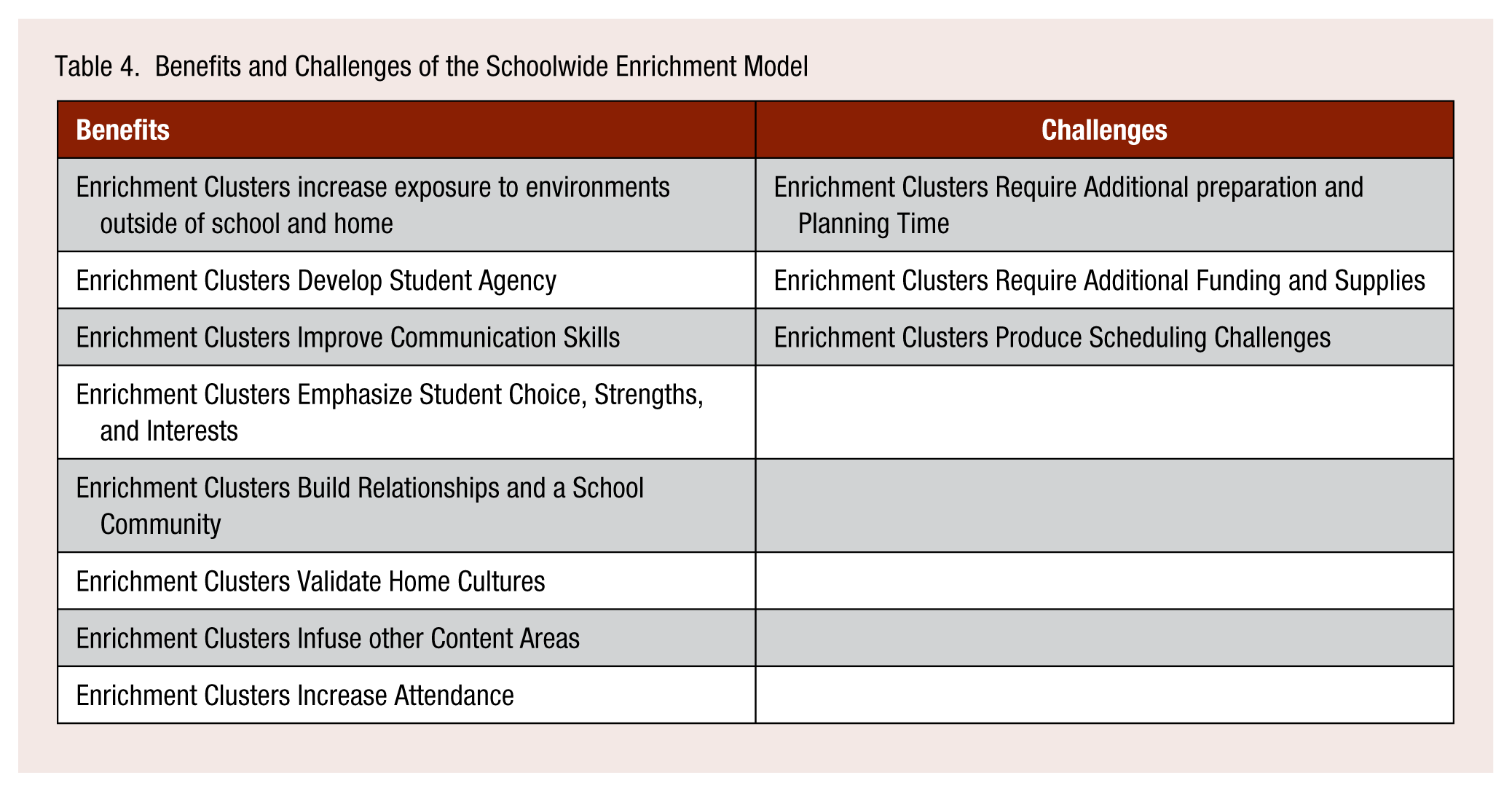
Enrichment Clusters Require Additional Preparation and Planning Time
Teachers reported that enrichment clusters require an extensive amount of preparation time both before they actually begin and while they are in process. Prior to the implementation of enrichment clusters, all staff members fill out surveys indicating their areas of interest and expertise and describe a potential cluster focus. This may prove to be difficult and time-consuming for some teachers who struggle to find a specific area of expertise outside of the traditional curriculum. One teacher noted that her colleagues generally enjoy clusters more if they can settle on a topic that they like, are interested in, have a passion for, and are good at. She also stressed the importance of sticking with a cluster over time, so that the cluster has established routines and goals and can essentially “run itself.” For teachers, choosing a cluster requires substantial forethought, as comfort level with the topic and implementation as well as the teacher’s passion for the topic may greatly affect the ultimate success of the cluster.
After the teachers give their input on areas of expertise and/or interest, the gifted specialists develop a list of cluster topics to share with the students, while teachers create advertisements and problem scenarios for their cluster (see Figure 2). It is vital that teachers accurately convey the overall topic of their clusters, so that students can cast informed votes for their top cluster choices. Upon survey completion, where students circle their top five or six cluster choices, the gifted specialists assign students to one cluster of their choice and create class rosters for each cluster, making sure that no cluster exceeds 17 students, with most clusters containing 14 to 15 students. Cluster assistants must also be assigned to clusters with more than 10 students. Assistants are also matched with topics of their choice when possible. Matching students to their top choices is cumbersome and time-consuming. Furthermore, when planning for clusters, teachers often have to accommodate students of differing grade levels and ability levels and adjust to students with whom they don’t regularly work.
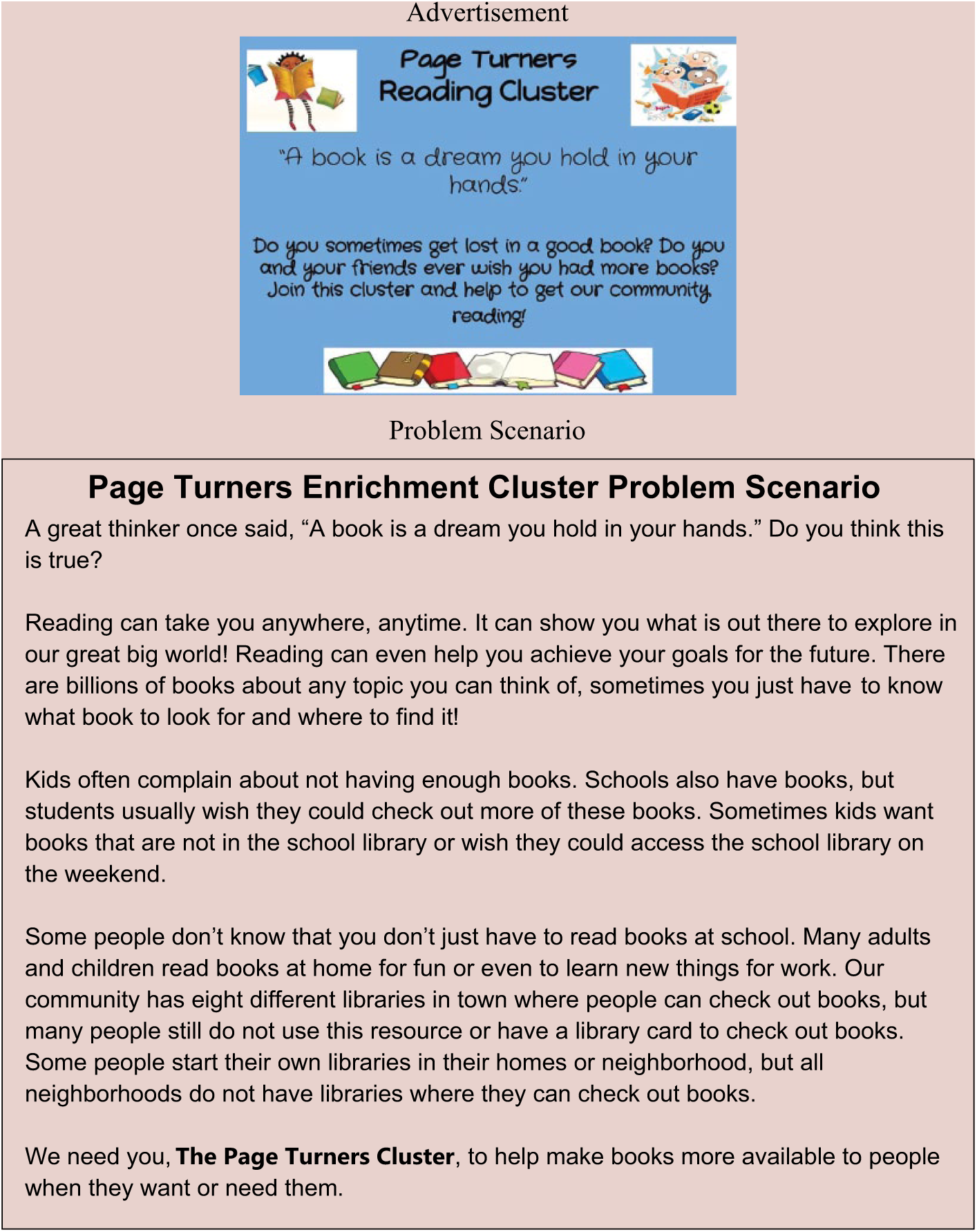
Sample cluster advertisement and problem scenario.
While enrichment clusters are being created, facilitators must plan activities to build background knowledge on the topic and think about possible paths their cluster might take. To build sufficient background knowledge, facilitators must do research and possibly contact other experts or consider field trips that will be beneficial. This research takes time, which is often hard to find as teachers already have limited planning time during the school day.
Enrichment Clusters Require Additional Funding and Supplies
Cluster facilitators must purchase and gather supplies and equipment they will need for their cluster, so that they are prepared for possible products that might be created. Sometimes, gaining the financial resources for these supplies can be a challenge, especially during a period in which schools are short on funds. Often, securing grant funding becomes a necessity to continue the implementation of clusters. Morris Elementary has acquired several grants that have sustained their work for several years. However, with that funding drawing to a close, additional time must now be spent in researching and preparing new grant applications. If funds are limited, teachers may have to utilize their own funds to purchase cluster supplies, which is difficult in light of the fact that teachers receive very minimal financial support for supplies.
Enrichment Clusters Produce Scheduling Challenges
Scheduling is perhaps one of the most challenging aspects of enrichment clusters. Matching students to their top clusters can be overwhelming with large numbers of students as popular clusters begin to fill up. In addition, when new students come into the school, they have to be scheduled into a cluster of interest, which is sometimes difficult as many clusters are already full. Scheduling field trips and guest speakers is also complicated. Field trip planning involves being sensitive to students’ school schedules as well as the schedules of the locations being visited. Scheduling guest speakers is a challenge because it is often difficult to coordinate times that work for both the students and the guest speaker, and sometimes the expert doesn’t live nearby. Fortunately, media such as Skype™ and Face Time™ provide reasonable alternatives to face-to-face meetings and help alleviate some scheduling difficulties. Although scheduling time for field trips and speakers is time-consuming for teachers, they find that these activities provide enriching experiences for their students, who often lack exposure to communities outside of their immediate neighborhoods.
Furthermore, teachers cite the challenging impact clusters have on their daily and weekly schedules, as they interrupt the “flow” of the school day and week. Because cluster days are a diversion from the normal routine and traditional curriculum, cluster days are more difficult to manage timewise. Teachers have found that it becomes less disruptive to the flow of the week to have cluster days later in the week, such as on a Thursday. Morris Elementary offers clusters once a week, but many other schools consider alternate means of implementation, such as daily sessions over a shorter period of time.
Closing Thoughts and Considerations
Our primary goal in this article is to explore one school’s implementation of SEM enrichment clusters and to inform administrators, educators, parents, community members, and students about the benefits and challenges of this program’s implementation. If more stakeholders are aware of alternative gifted programming models, such as the SEM and how components such as enrichment clusters can benefit students, hopefully, more schools will be open to implementing this equitable social justice pedagogy. In turn, more schools with students otherwise underserved by gifted programs will benefit from exploring innovative practices such as the SEM, resulting in increased student engagement and a more diverse manifestation of gifts and talents as students explore high-quality problem-based curricula. While teachers report that the implementation of the SEM can be taxing, they value the philosophy that underlies the SEM and its benefits for students. Our hope is that educators across the nation will adopt the belief, as supported by Renzulli, that the key to educational reform for both struggling and gifted learners is developing each individual’s strengths and talents (McLester, 2012). Through our work as educators, our passion is to ensure equal access to challenging curricula for all students, and we believe that the SEM and enrichment clusters are a progressive step in this direction.
Footnotes
Conflict of Interest
The author(s) declared no potential conflicts of interest with respect to the research, authorship, and/or publication of this article.
Funding
The author(s) received no financial support for the research, authorship, and/or publication of this article.
Bios
Jennifer K. Allen holds a BSEd in early childhood education from the University of Georgia (UGA) and an MEd in reading instruction from the University of West Georgia. She holds an endorsement for gifted education, English for speakers of other languages (ESOL), and reading instruction. She taught elementary school students for 10 years, working in second-, fourth-, and fifth-grade classrooms and in the gifted resource setting. She is currently working on her PhD in language and literacy education at UGA, and as a graduate teaching assistant, she teaches an elementary language and literacy course for undergraduate students.
Margaret A. Robbins holds a BSEd in English education from UGA and a MAT from UGA in English with an additional focus on gifted education, along with a creative writing certificate from Kennesaw State University. She holds in-field endorsements for gifted education and ESOL. She taught high-school students English and ESOL for 3 years and middle school reading and language arts (including gifted courses) for 7 years. She is currently a PhD student in the Language and Literacy Education department (RWCLDL focus) at UGA and a graduate assistant for the Red Clay Writing Project and the English Education focus area.
Yolanda Denise Payne has a BS in elementary education from Mississippi University for Women, an MS in Instructional Technology from Mississippi State University, and an EdS in curriculum and instruction from the University of Florida. She has over 13 years of teaching experience and has worked as an elementary school teacher, adjunct professor, and media specialist. She is currently a full-time teacher pursuing her PhD in the Language and Literacy Education department at UGA.
Katherine Backes Brown has a PhD in educational psychology with an emphasis in gifted and creative education from UGA. She has taught for 10 years as both an elementary teacher and enrichment specialist in public schools. In addition, she teaches as an adjunct professor at UGA in the Department of Gifted and Creative Education.