



Abstract
Until recently, reading instruction for early grades has focused on fiction. However, the Common Core State Standards and the Next Generation Science Standards both emphasize the reading of nonfiction texts to gain specific skill sets for analyzing information. Research has shown that gifted students and children with culturally/linguistically diverse backgrounds may find nonfiction texts more engaging to their interests than fiction. Nonfiction can activate prior learning and encourage students to learn to categorize and synthesize information, especially when combined with scientific inquiry. In this article, the authors explore the new standards-based emphasis on reading nonfiction, the skills built by students’ reading nonfiction with a focus on gifted students from culturally/linguistically different and economically disadvantaged families, and we share one approach to including nonfiction in elementary classrooms through the U-STARS~PLUS Science & Nonfiction Connections, a program for recognizing and supporting underrepresented gifted populations.
“As scientists use texts to mediate and inform their own inquiry, nonfiction texts may teach students to do the same in their own work.”
With the growing emphasis on reading within the content areas, it is essential that we introduce young learners early to high-quality nonfiction reading. Gifted students are traditionally thought to be readers. Indeed, one of the defining characteristics of giftedness historically has been voracious and advanced reading at early ages (Martin, 1984). However, not all gifted students are early readers. Gifted children from culturally/linguistically different backgrounds, children from economically disadvantaged families, and children with learning disabilities may struggle with reading despite having high potential for excellence. Often, their gifts are not easily seen and must be intentionally nurtured (Coleman & Shah-Coltrane, 2010b). Thus, a cornerstone of the U-STARS~PLUS is the connection between literacy and science through the use of both fiction and nonfiction (Coleman & Job, 2014; Coleman & Shah-Coltrane, 2010a).
In this article, we explore the new standards-based emphasis on reading nonfiction, the skills built by students’ reading nonfiction with a focus on gifted students from culturally/linguistically different and economically disadvantaged families, and we share one approach to including nonfiction in elementary classrooms through the U-STARS~PLUS Science & Nonfiction Connections (Coleman & Job, 2014).
Current Emphasis on Nonfiction in Standards-Based Education
The Common Core State Standards (CCSS) for language arts (Common Core State Standards Initiative [CCSSI], 2010), adopted by 45 states, emphasize the use of nonfiction texts in helping students become researchers as they read. The CCSS also privilege nonfiction as the bridge to students’ building of analytical writing skills. The increased focus on STEM (science, technology, engineering, and math) curriculum in schools connects well with the emphasis on reading nonfiction works (Zollman, 2012).
Traditionally, it has been common practice for up to 90% of literature read in the elementary classroom to be fiction (Dreher, 1999). However, it has become increasingly apparent that relying on only fiction for young students’ reading contradicts the standards-based curriculum that has been a major component of school reform. As Moss (2005) notes, the general purpose of literacy instruction for K-fourth grades is to “break the code” of phonemics and reading for fluency, but from fifth grade on, students are expected to read for content. However, the skills-based standards that have entered elementary school curriculum requires students to do much more than just break the code of what they are reading. Young learners are now required to comprehend the content of their reading and to work with this information to develop their own ideas.
Moss (1991, 2005) identifies the necessity of content-area literacy in students’ learning, which she identifies as, A cognitive and social practice involving the ability and desire to read, comprehend, critique, and write about multiple forms of print, including textbooks, novels, magazines, Internet materials, and other sociotechnical sign systems conveying information, emotional content, and ideas to be considered from a critical stance. (p. 47)
In today’s information-based society, children must be conversant with many forms of print materials, including narrative stories, reports, blogs, magazine articles, online posts, technical reports, and numerous other modes of communication. For today’s students, literacy is defined much more broadly, and relying on only fiction creates a barrier to understanding other forms of print communication (Doiron, 1994). In addition, content-area literacy includes knowledge needed for academic discussions, such as understanding vocabulary that one uses to talk about math (e.g., fraction, sum), science (e.g., hypothesis, life cycle), and history (e.g., chronology, culture). Reading nonfiction helps students to build this vocabulary within the academic content areas (Lutz, Guthrie, & Davis, 2006; Moss, 2005; Palmer & Stewart, 2005). This type of literacy also prepares students to tackle more complex interdisciplinary projects where they need to draw on knowledge of various content areas and use multiple ways of thinking (Doiron, 1994; Feng, VanTassel-Baska, Quek, Bai, & O’Neill, 2005).
Currently, 43 states are implementing the CCSS in some form. These standards have a distinct focus on informational and nonfiction text (CCSS, 2010). Teachers are required to introduce not only storybooks in the kindergarten classroom but also informational texts as well. Informational texts are described as:
Biographies and autobiographies
Books about history, social studies, science, and the arts
Technical texts, including directions, forms, and information displayed in graphs, charts, or maps
Digital sources on a range of topics (CCSS, 2010)
The CCSS utilize qualitative, quantitative, and task-matching measures of text complexity for choosing texts for students, asking teachers to choose texts based on interest level, Lexile scores, and knowledge demands—all factors lending themselves to nonfiction work. In addition, the skills taught through the CCSS require teachers to integrate nonfiction into their classrooms beginning in kindergarten. A third of the new kindergarten literacy standards are devoted to “Informational Text,” with standards such as, “With prompting and support, identify the reasons an author gives to support points in a text” and “With prompting and support, identify basic similarities in and differences between two texts on the same topic” (CCSS, 2010).
The Next Generation Science Standards (NGSS; 2013) also emphasize the skill sets students need to accurately comprehend and analyze nonfiction works. The NGSS are designed around three dimensions: practices (behaviors for scientific inquiry), crosscutting concepts (across all domains of science), and disciplinary core ideas.
Supporting science learning with nonfiction literacy is essential for fulfilling the NGSS framework. Nonfiction texts give students a broad background in the concepts they are studying and allow them to investigate in depth that which they find through their own inquiry in experiments (Short & Armstrong, 1993). Nonfiction texts also teach students how to organize around patterns and systems, as is noted by the NGSS. As scientists use texts to mediate and inform their own inquiry, nonfiction texts may teach students to do the same in their own work (Pappas, 2006).
Encouraging Gifted Student Readers Through Nonfiction
Despite common conceptions of gifted students as avid readers, nearly 20% of gifted students express negative attitudes toward the act of reading (Martin, 1984). Among the reasons they state for disliking reading, disinterest in the material and finding the literature to be a waste of time are most cited. Indeed, Leal and Moss (1999) find that elementary school–aged gifted children primarily want to read out of a desire to learn as well as to be entertained. For high-potential students from economically disadvantaged backgrounds, ambivalence for reading may be more complex. For many of these students, reading may be difficult, they may not have a reading culture at home, and in spite of their abilities they may be behind their peers in acquiring reading skills (Kirk, Gallagher, & Coleman, 2015). Blair (2014) notes that in homes challenged by economic hardship, children may be exposed to higher stress, may face food insecurities, and may experience greater levels of disorganization than students from more economically secure households; all these challenges can hinder academic success. Other difficulties may present obstacles for literacy in particular.
Despite the importance of reading in the content areas, research shows that students spend less than 4 min a day reading nonfiction (Goodwin & Miller, 2012). The focus of reading with young children is on fictional literature such as stories and poems, and 90% of general literacy curriculum in elementary school is composed of fictional books (Dreher, 1999). The emphasis on fictional reading is exacerbated because primary school libraries often carry relatively few informational texts compared with fictional texts (Goodwin & Miller, 2012; Harvey, 2002; Palmer & Stewart, 2003). The almost exclusive focus on fictional narratives in elementary classrooms may contribute to the dislike some gifted students feel toward reading. Students tend to prefer nonfiction reading to fiction when given the choice (e.g., Leal & Moss, 1999; Martin, 1984; Moss, 2005).
Nonfiction encourages students to read by activating their prior knowledge and allowing them to explore their own interests. Nonfiction also acts as an authentic way of introducing content material into the classroom, answering student questions in straightforward ways (Camp, 2000), which is another important teaching strategy for diverse students (Blair, 2014). Moreover, studies in nonfiction reading (Kletzien & Dreher, 2004; Pappas, 1993) have shown that students as young as kindergarten age can access nonfiction texts as well as they can fiction texts, debunking the myth that fiction is necessary in early years because children can only process narrative literature in those years.
Reading preferences among gifted students may trend toward nonfiction, but they still prefer books with specific elements of literature. Gifted students show strong preferences for nonfiction selections that have narrative elements, such as The Magic Schoolbus series (Leal & Moss, 1999; Stein & Beed, 2004). They also like books with numerous visual aspects (such as photos and graphs) and special features highlighting unusual facts (Doiron, 1994; Reutzel & Cooter, 2009). Just like fiction, nonfiction chosen for the elementary classroom is most effective when it is well written and engaging (Bamford & Kristo, 1998; Camp, 2000; Reutzel & Cooter, 2009).
The type of nonfiction discussed here should not be confused with traditional textbooks. Textbooks may contribute to students’ dislike of nonfiction if relied on exclusively, as they may present information in a dry and boring way, offering few interesting structures (Rice, 2002). Much of the nonfiction for young children centers on trade books that combine some elements of fictional literature with a strong content focus.
Using nonfiction in the classroom opens up curricula to critical literacies and skill sets that may not otherwise be activated. In sum, Dorn and Soffos (2005) identify the goals of reading nonfiction as
Inquiry
Activation of prior knowledge
Identification of complex text features and structures
The connection of inquiry purposes with navigating text
Feng et al. (2005) find that integrating nonfiction with science instruction develop students into learners who could read for sustained periods of time, navigate rigorous curricula, and write persuasively, a craft requiring evaluation of various facts and sources. Lutz et al. (2006) also find that integrating reading with science instruction increases students’ growth in reading comprehension and strategy use. These are crucial skills for the young student.
Building Skills Through Nonfiction
Although we read all fiction books in much the same way, taking in its entirety for the story, reading nonfiction can occur in many different ways; for example, skimming for content, skipping to a part to find necessary information, and deep reading for high-level concepts (Dorn & Soffos, 2005). We also need different skill sets when we are reading nonfiction. Figure 1 shows the different skill sets needed for reading fiction and nonfiction.
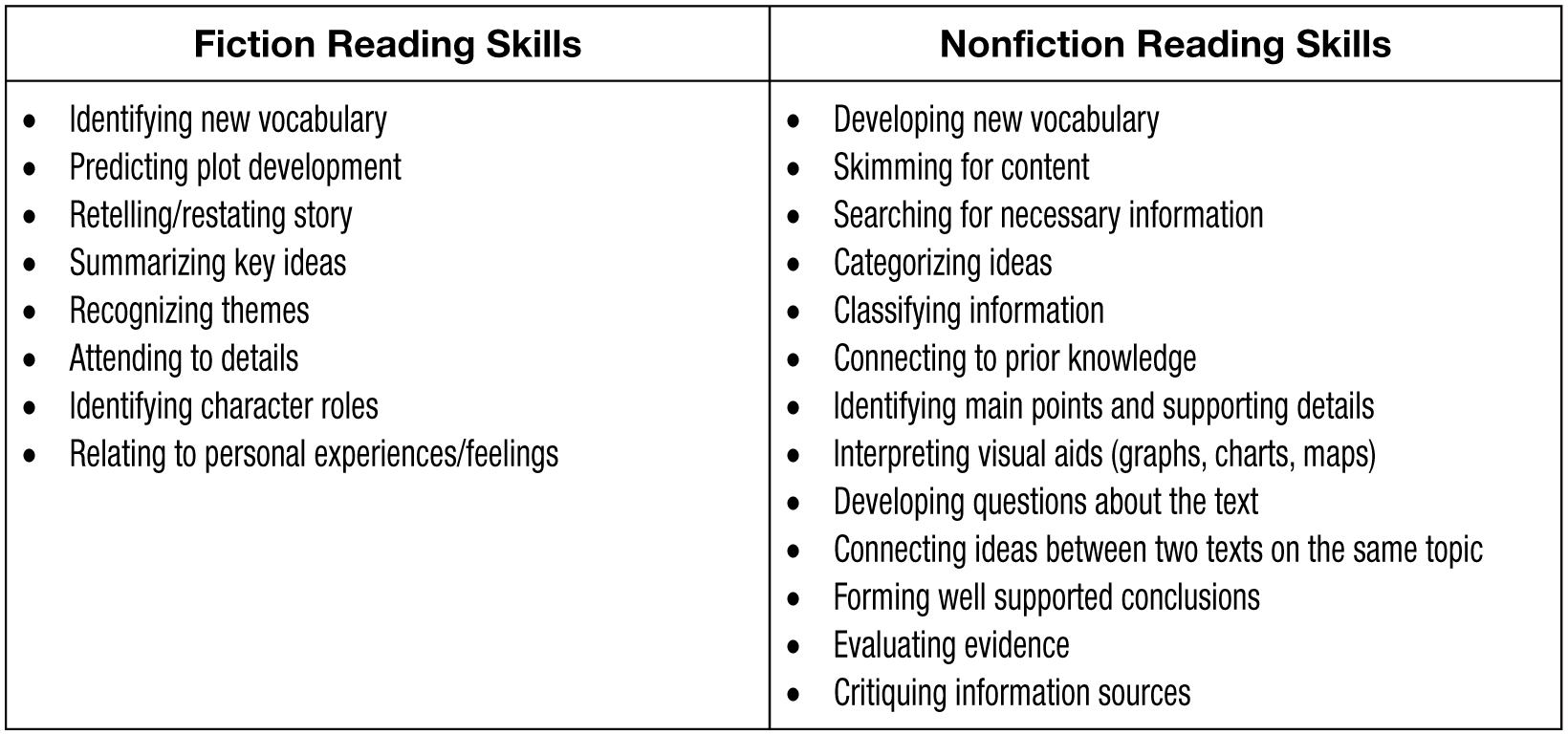
Comparison of skills needed for reading fiction versus nonfiction.
Reading nonfiction builds academic vocabulary, connects students to real-world questions and content, and assists in cross-curricular learning (Flowers & Flowers, 2009). Implementing nonfiction curricula allows for multiple modes of thinking, as well as smoother pathways to learning and self-efficacy, teaching students how to search out the information they are interested in learning (Duke, Bennett-Armistead, & Roberts, 2002).
Nonfiction and Vocabulary
One of the strongest arguments for teaching literacy through nonfiction is its ability to build vocabulary for students from linguistically/culturally different and economically disadvantaged backgrounds. In STEM topics, for example, students need to have appropriate scientific language (Zollman, 2012) and by reading nonfiction science books about animals, for instance, student see words such as “species,” “herd,” and “migration” used in authentic ways. Exposure to these books allows them to grasp the vocabulary in context and to use their language in future learning.
Nonfiction and higher level thinking
Working with nonfiction literature allows students to display all six levels of intellectual behavior in Bloom’s taxonomy. Nonfiction particularly lends itself to classification and organizational activities that require understanding, application, and analysis (Camp, 2000; Doiron, 1994; Dorn & Soffos, 2005), all necessary areas of emphasis for direct instruction for students of diverse backgrounds (Blair, 2014). In using the facts they take from nonfiction to develop graphic organizers and categorize information, students build their analysis skills (Camp, 2000; Dorn & Soffos, 2005). They move from narrative ways of thinking (e.g., “This happened, then this happened”) that constitutes “remembering” in Bloom’s taxonomy to conceptual thinking (“I can explain what a life cycle is”) that constitutes the higher levels of Bloom’s (Lutz et al., 2006).
Nonfiction also gives students the opportunity for high-level questioning, allowing them to investigate their own interests as well as their own preconceived notions of what they may have thought they had known about the topic (Martin, 1984; Stein & Beed, 2004). In addition, nonfiction opens the door for students from diverse backgrounds to share their prior knowledge with their peers, encouraging all the students in the class to value diversity and multicultural backgrounds.
Casteel and Isom (1994) identify a strong connection between science processing skills and nonfiction literacy skills, with overlaps in gathering and organizing data, drawing conclusions, and constructing responses. Nonfiction introduces students to complex modes of thought, such as using evidence to prove a theory and explaining a concept through deductive reasoning, that are not typically explored in fiction (Doiron, 1994; Livingston, Kurkjian, Young, & Pringle, 2004). Once students are in this conceptual mode of thinking, they can interact with their peers in working with these concepts and show more independence in learning (Kletzien & Dreher, 2004; Lutz et al., 2006), as well as better social skills and self-esteem (Rice, 2002).
Building writing skills
Perhaps one of the most significant paradoxes in elementary education is that although we rely on narrative fiction in teaching children to read, the majority of writing that we ask them to do (both in early grades and later on) is expository writing (Bryce, 2011). One of the components of expository writing that reading nonfiction teaches children is using organizational features (Palmer & Stewart, 2005). Much of the instruction concerning nonfiction literature centers on learning to identify and use complex text elements (e.g., headings, tables of contents, glossaries, graphs) and various text structures (e.g., chronological, categorization, characterization, cause-effect, problem-solution; Dorn & Soffos, 2005). Reading nonfiction prepares students for writing their own inquiry-based products (Kletzien & Dreher, 2004; Tower, 2000) in ways that nonfiction does not.
The evaluative skills operationalized by students in using nonfiction texts are especially critical in preparing students from diverse backgrounds for gifted curriculum in inquiry-based science. According to Blair (2014), many students from diverse backgrounds need direct and explicit instruction in literacy skills that students from middle socioeconomic status backgrounds have already acquired before entering school. If a student has not developed his or her evaluative skills, deciding on content for a research project may prove itself impossible (Tower, 2000).
U-STARS~PLUS: One Approach to Nonfiction for Young Learners
The U-STARS~PLUS Science & Nonfiction Connections (Coleman & Job, 2014) integrates high-quality nonfiction texts with inquiry-based science. The materials include 33 complete lessons for Grades kindergarten through 3, each exploring one nonfiction book on the same topic as a corresponding U-STARS~PLUS Science & Literature Connections (Coleman & Shah-Coltrane, 2010b). The topics cover a wide range of scientific topics, including ecosystems, astronomy, animals and insects, and scientific processes. Each lesson provides a list of the topics, a generalization of the major idea for inquiry, a summary of the book, and the Science & Literature Connections (Coleman & Shah-Coltrane, 2010b) correlation. The lesson plans are aligned with the CCSS and the NGSS.
Each lesson provides a concept map to outline the major ideas and understandings that students can garner from the nonfiction book. Concept maps are a significant tool line helping students “learn how to learn” (Novak, 1990, p. 29). Concept maps assist students in meaning making and problem solving (Novak, Gowin, & Johansen, 1983). Concept maps also help teachers develop instruction that builds from one idea to the next (Beyerbach, 1988). Teachers can use the concept maps to develop materials beyond what is provided in the Science & Nonfiction Connections (Coleman & Job, 2014) book depending on the levels and needs of the students. Teachers in the younger years may rely on reading storybooks from start to finish, but they can read sections of nonfiction books aloud as well, especially as they relate to class content. Many of the books in the U-STARS program have narrative organization that work well with read aloud while others, like the one featured in the lesson plan below, are more research oriented.
Teachers of students with gifts and talents have numerous tools they may use to differentiating the curriculum to meet the capacities of those students. Among those tools are curriculum compacting, tiered assignments, learning centers/stations, independent/small group projects, and questioning for higher level thinking skills (Kirk et al., 2015). The Science & Nonfictions Connections (Coleman & Job, 2014) curriculum utilizes these differentiation strategies in both its “Thinking Questions” sections and its follow-up activities. It is important to note that Science & Nonfiction Connections is supposed to supplement and extend the teacher’s current science curriculum units, rather than act as stand-alone activities. The teacher can differentiate for her student needs by using only certain levels of the Bloom’s questions or choosing to have students complete a project in a small group rather than individually or as a class.
The “Thinking Questions” sections of each lesson follow the revised Bloom’s taxonomy (Armstrong, n.d.), described earlier, to promote higher levels of thinking and deeper understanding of the concepts. The questions ask students to improve the nonfiction reading skills discussed earlier, including classification and ordering. Students are also asked to categorize facts and interpret charts and graphs, diversifying their reading skills. The questions prepare students for deeper scientific inquiry as they analyze the text that they have read.
The lesson plans culminate in follow-up activities for students to complete individually or in groups, depending on the teacher’s plans and the standards she is addressing in the unit. The activities are science-focused but interdisciplinary, asking students to draw on skill sets from language arts, math, and fine arts. The activities are high-level and allow students to exhibit their creativity and talents in their work. These activities build students’ capacities in several areas, including inquiry processing, creative and persuasive writing, engineering, and data interpretation. The lesson plans meet several NGSS and CCSS (2010) for literacy and mathematics. The sample lesson below illustrates each component of the lessons and provides a template for teachers wishing to develop similar lessons for nonfiction books.
Integrating Nonfiction in Ms. Brown’s Second-Grade Classroom
Ms. Brown believes that teaching nonfiction is essential. Because she has a limited amount of time, her preferred approach is to integrate content!! Her students love learning interesting things about their world, and science is a big favorite with them. Ms. Brown, however, loves teaching reading and writing, and she is less confident in science and math so the integrated format of U-STARS~PLUS is a win-win for her and her students. In her recent unit on “Weather All Around Us,” she was delighted to find both fiction and nonfiction readings she could use with her class. She utilized elements of the U-STARS~PLUS program to extend her unit with the objective of understanding the causes and effects of weather patterns, which are standards in the NGSS.
She started her unit by reading Cloudy With a Chance of Meatballs, a favorite book of hers, and guided the students though a discussion of what weather is by using the questions provided through all stages of Bloom’s taxonomy (Science and Literature Connections; Coleman & Shah-Coltrane, 2010b). Using the ideas in the lesson for the Kids Book of Weather Forecasting, she assigned her students a weather log to document the daily weather for 3 weeks (Coleman & Job, 2014; Coleman & Shah-Coltrane, 2010a). On the second day, she did a book-talk walking through the Kids Book of Weather Forecasting. She shared the authors and illustrator, walked through the table of contents, and reading the first few pages and asked the basic knowledge-level questions, which acted as a formative assessment to check for understanding. She talked about how this book is a nonfiction book that is chock-full of facts and information and showed her students the index and how it can be used to locate some fun facts. She indicated that the book was going to be in the science learning center that would open on the third day and that students were going to have a chance to use the book for research and activities.
On the next day, she introduced the science learning center. In the science learning center, Ms. Brown put the book and some question cards she developed using the Thinking Questions from the lesson (see below). She asked that her students use the index to locate the answers to the questions and place the page number beside their answers. The other activity she decided her students would love doing was making weather instruments. She selected the Rain Gauge, Barometer, Wind Vane, Anemometer, Beaufort Scales, and Psychrometer and asked each student to use their center time to research these (using the Kids Book of Weather Forecasting) and to select the instrument they would like to make. She placed her students in “expert” cooperative learning groups based on their choice of weather instrument. The cooperative learning groups were responsible for building their instruments, using these to collect and document the weather for 2 weeks, analyze their data, create charts/graphics to show their data, and summarize and report their findings. After the 2 weeks, she planned to re-form the cooperative learning groups, using the jigsaw technique, to include one member with each type of weather instrument. The task of these new groups would be to explore the relationships and weather patterns across the data. She would use the application and analysis questions in the lesson to jumpstart the discussions. In this Unit, her students would be reading nonfiction and practicing research techniques; creating hands-on instruments; collecting, compiling, analyzing, and reporting data; writing reports; and making presentation. At the end of the unit, the students compiled their work into a weather portfolio, and Ms. Brown was able to check for the math, writing, and science skills outlined in the standards that accompanied the activities. She also gave the common assessment developed by her school to test for understanding of the unit as a whole.
Throughout the unit, her students would be practicing content skills in reading, writing, and math, and using the process skills of research, cooperation, observation, and measurement. They would be using higher level thinking, problem solving, and creativity—and best of all, they would be having fun while learning!!
The following figures show the sample lesson Ms. Brown used to supplement her unit on weather. It is an example of the types of lessons and activities found in Science & Nonfiction Connections. At the end of the sample lesson, Figure 2 shows how each activity and lesson connects with CCSS and NGSS.
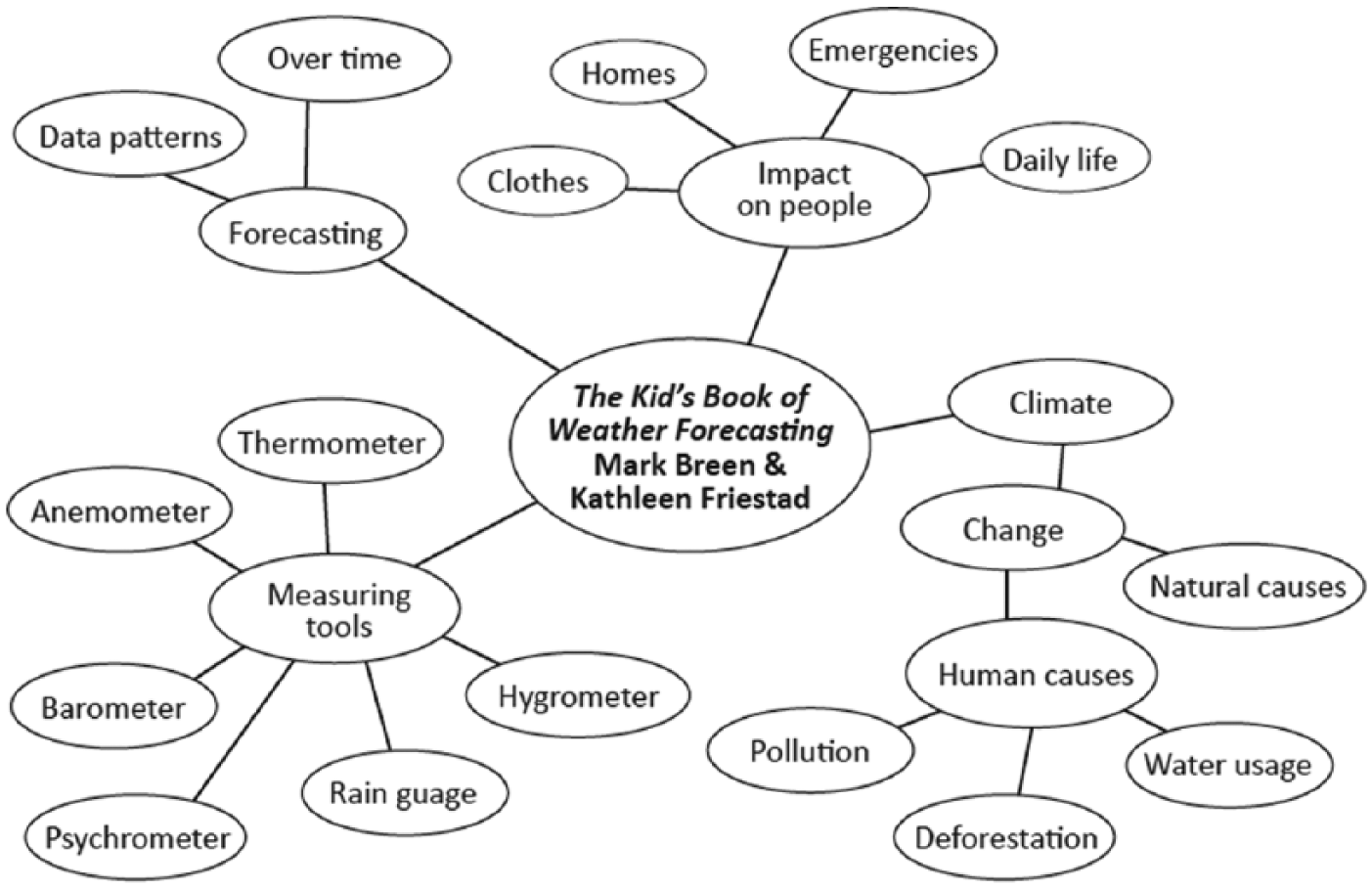
Concept map.
Sample Lesson: The Kids Book of Weather Forecasting (Breen & Friestad, 2008)
(This lesson is reprinted with permission from U-STARS~PLUS Science & Nonfiction Connections, by M. R. Coleman & J. Job, 2014, pp. 47-52. Copyright 2014 by the Council for Exceptional Children)
The Kids’ Book of Weather Forecasting
Written by: Mark Breen and Kathleen Friestad
Illustrated by: Michael Kline
Published by: Ideals Publishing Corporation, 2008
Pages: 141
Lexical Score: NA
ISBN: 978-0-8249-6823-6
Major Topics
Weather, atmosphere, energy from the sun, weather forecasting
Generalization
Students will learn that weather affects all living things in positive and negative ways.
Summary
Weather affects everyone every day. Measurements of the air, sun, wind, and rain can help us understand and forecast the weather. Simple measurement instruments we can make ourselves allow us to collect data, analyze the information, look for patterns, and make predictions for future weather. Observing the weather is fun, helpful, and important.
Science & Literature Connections Book Correlation
Cloudy With a Chance of Meatballs
Written by: Judi Barrett
Thinking Questions Based on Bloom’s Taxonomy
Knowledge/remember
What does a meteorologist do? List the four main components of weather (air, sun, wind, water). What is the atmosphere? Define weather and climate. Tell what is measured by each of the following instruments: rain gauge, hygrometer, psychrometer, barometer, and anemometer.
Comprehension/understand
How does weather affect us every day? Why is it important to have accurate forecasting for weather events? Describe a time when a weather forecast was helpful to you or your family.
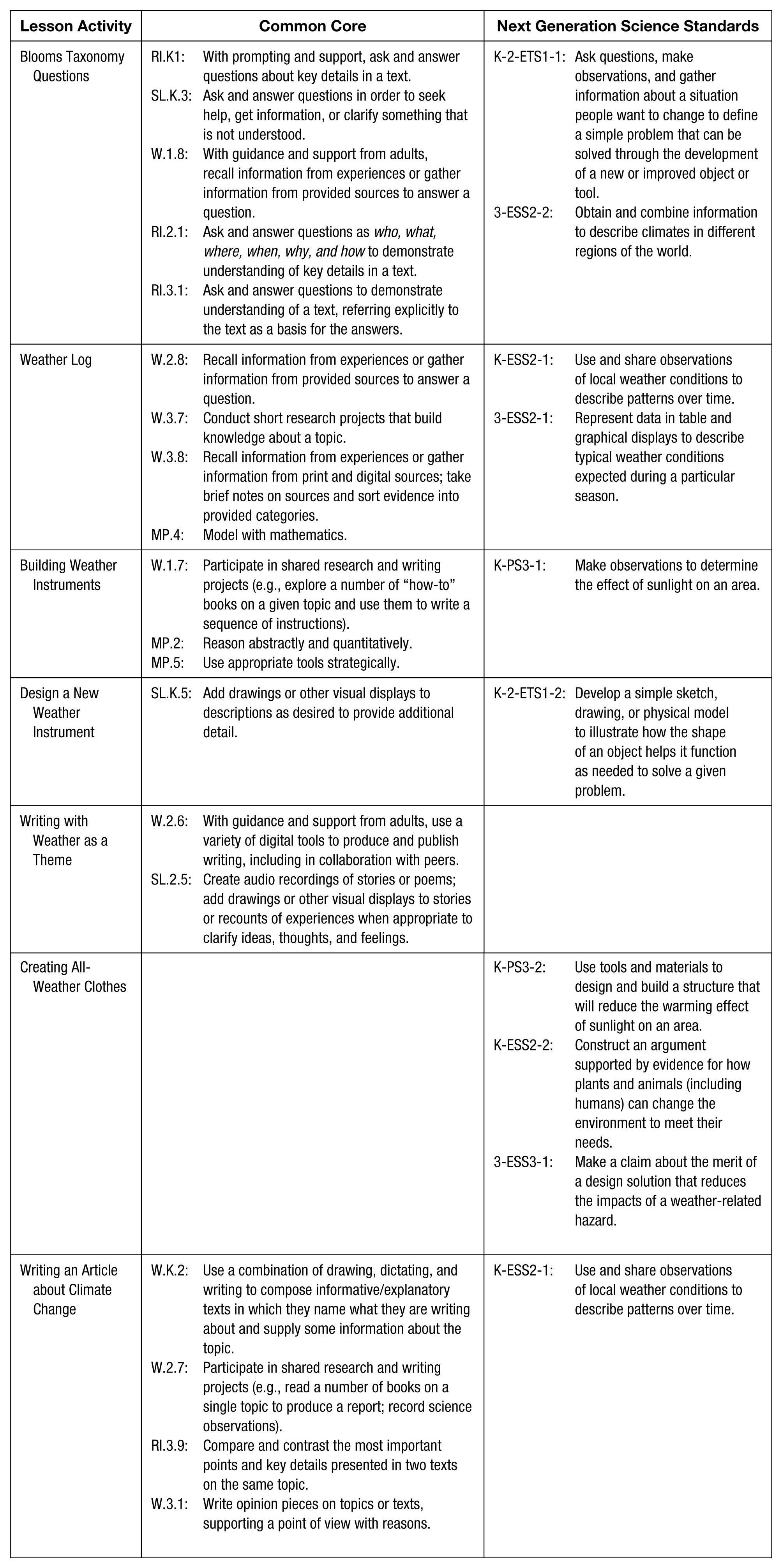
Standards met by the sample lesson.
Application/apply
How do special instruments help us forecast the weather? What instruments are key to weather forecasting (thermometer, rain gauge, hygrometer, psychrometer, barometer, and anemometer).
Analysis/analyze
How are weather patterns related to climate and seasons? Why are the seasons different on the same day depending on where in the world you live? Compare the seasons in your town today with those in the opposite hemisphere. (If you are in the Northern Hemisphere, what is the weather like for you? What season is it in the Southern Hemisphere?) Why might people want to travel to another hemisphere for their winter vacation?
Synthesis/create
If you could design a new weather instrument, what would it be and what would it do? How does the overall weather pattern affect the clothes we wear? Can you create an all-weather outfit? How about an all-weather house?
Evaluation/evaluate
What is your favorite season? What criteria did you use to pick your favorite season? Compare and contrast your criteria with someone else’s. What human activities add to our changing climate (e.g., polluting, cutting down trees, using water)? If people continue to abuse the environment, what do you predict will happen to the global climate?
Follow-Up Activities
Keep a weather log for 1 month looking at cloud cover, rainfall, temperature, wind, and other weather factors that interest you. Use your weather log to identify patterns for the month. Compare your data with data from a previous year (see almanacs, print or online, for example, http://www.almanac.com/weather/history) to see how your month differs. Compare your averages for the month with averages from several past years (e.g., average rainfall and temperature). Is your month’s data similar to other years? How do they differ?
Build weather instruments shown in the book and use them to track and log the weather. Look for patterns in the weather and compare them with past years. How do the shapes of these tools help them do their job?
Design a new weather instrument. Draw or sketch your instrument to show how it works. What does it do and why is it important? Write out a plan to try and convince a company to make and sell your product.
Write a poem, song, or short story using weather as the theme. What kinds of weather are you describing? How does it make you feel? What happens during different kinds of weather?
Create all-weather clothes, homes, or vehicles. What will you need to have to adjust the temperature, moisture, wind, and sun exposure? Make a model or sample of your design and explain how it works.
Research climate change and the causes associated with it. Write a newspaper article stating your view and giving data to show how and if people are contributing to climate change.
Conclusion
The increased emphasis on nonfiction literacy in the CCSS (2010) provides a welcome opportunity for teachers to engage students with informational texts, texts that they may prefer over fiction books. Research has shown the importance of using nonfiction literacy skills to support building strong scientific inquiry skills in primary grades (Bryce, 2011; Casteel & Isom, 1994). The use of nonfiction may be of particular benefit for gifted culturally/linguistically different and economically disadvantaged students. Elementary schools need to ensure that their libraries and classrooms provide students with high-quality, interesting nonfiction trade books to encourage their reading progression and diversification. The U-STARS~PLUS Science & Nonfiction Connections (Coleman & Job, 2014) offers teachers one approach for integrating science and nonfiction reading in their classrooms.
Footnotes
Conflict of Interest
The author(s) declared no potential conflicts of interest with respect to the research, authorship, and/or publication of this article.
Funding
The author(s) received no financial support for the research, authorship, and/or publication of this article.
Bios
Jennifer Job, PhD, is an assistant professor of curriculum studies in the School of Teaching and Curriculum Leadership at Oklahoma State University. She serves on the editorial board of the Journal of Curriculum Theorizing. Her articles have been published by the High School Journal, National Teacher Education Journal, Gifted Child Today, and Critical Literacy: Theories and Practices. She assisted Mary Ruth Coleman on the U-STARS~PLUS project for 3 years. Currently, she is the co-founding instructor for the PowerUp! project in Oklahoma City, a program promoting self-advocacy in students with exceptionalities.
Mary Ruth Coleman, PhD, is a senior scientist, Emerita at the Frank Porter Graham Child Development Institute at the University of North Carolina at Chapel Hill. She served three terms on the Board of Directors for the Association for Gifted (TAG), one of which she was president, and three terms (9 years) on the Board of the National Association for Gifted Children. She was the president of the Council for Exceptional Children in 2007. She has authored numerous publications and is a coauthor with James Gallagher of the seminal textbook, Educating Exceptional Children–14th Edition. She currently directs U-STARS~PLUS—a multi-state effort to address the under representation of racially, ethnically, and linguistically different students within gifted education.