



Abstract
A persistent problem in the field of gifted education has been the lack of categorization and delineation of gifted programming options. To address this issue, we propose Unified Program Design as a structural framework for gifted program models. This framework defines gifted programs as the combination of delivery methods and curriculum models. By considering both the delivery methods and the curriculum, coordinators and teachers will be able to visualize the available options that address each component, making designing and describing gifted programs more consistent. Implications for research, evaluation, and program practice are also discussed.
“What is your district’s gifted program?” This question is not often considered challenging to answer. Some gifted coordinators confidently respond with the type of curriculum they use (e.g., Mentoring Mathematical Minds or William and Mary Units). Other coordinators discuss how their program is organized (e.g., pullout program), and others still respond with complete program models (e.g., Schoolwide Enrichment Model) that address both curriculum and program delivery methods. While all of these responses answer the question, they represent different program components and are not necessarily comparable or complete. These three different types of responses represent the fractured perception of what a gifted program is. Perhaps worse than the ambiguity surrounding the term “gifted program” is the lack of awareness that such ambiguity exists. This ambiguity leads to issues in program planning and development as well as research within the field.
As an example of practical difficulties, the first author was hired by a school district to provide consultation on program options, so she prepared a presentation on gifted systems, like the Schoolwide Enrichment Model, Levels of Service, and the Autonomous Learner Model (ALM), thinking those models address everything a district would need, including a theoretical anchor, program organization, and curriculum guidance. After assembling this information, the administrator previewed the presentation and called in a panic. He reiterated that he wanted to know about “gifted programs.” Then he added, “like pullout programs, self-contained classrooms, and cluster grouping.” It became clear that “gifted program” was not a consistently defined construct.
This anecdote exemplifies current publications in the field. For example, the U.S. Department of Education commissioned research to examine gifted programming (Callahan, Moon, & Oh, 2013). The initial survey addressed program delivery options, philosophical approaches, and specific curricular materials. Interestingly, the philosophical approaches contained options that overlapped and addressed different components of programming, reflecting the current texts in the field, rather than a comparable set of choices. For example, Bett’s ALM was grouped with the Parallel Curriculum Model (PCM). One addresses curriculum only (PCM) while the other provides a system for both delivery methods in addition to curriculum (ALM). Therefore, the purpose of this article is to propose a definition of “gifted program” and a schema for organizing the various models that could guide conversations regarding gifted program development.
To establish foundational definitions, we would like to employ a metaphor. Consider the elements of a story. Stories have characters, settings, plots, and themes. Any of those elements could be analyzed separately, yet good stories seamlessly integrate each component, demonstrating their dynamic relationships. Successful stories are internally consistent, such that characters’ behaviors reflect their experiences within their setting. Using this metaphor, we propose that a district’s comprehensive gifted system (full story) should reflect a theoretical framework (theme), which would guide in the identification students (characters) and the provision of an appropriate delivery structure (setting) with purposeful curriculum (plot). (See Figure 1 for the diagram examining the gifted system.) We prefer the use of “gifted system” to describe the full story because it conveys dynamic relationships among components, whereas “gifted program” tends to convey the practical services provided to students. In this metaphor, “gifted program” would refer to both the setting (delivery method) and the plot (curriculum).

Gifted system framework.
Many theorists and researchers have proposed different gifted models for districts to use in designing their gifted system. Models are defined as proposed structures/skeletons, guiding the creation of gifted systems or components of these systems. Most gifted models function like mathematical models. Mathematical models provide both constants and variables. For example, in the equation “y = 2x,” “x” could represent any number, but 2 is constant. The outcome “y” will change based on the relationship between 2 and “x.” This mathematical model directly applies to gifted models. Each gifted model delineates specific constants while allowing districts freedom to contribute their own variables. However, theorists, researchers, and authors commonly describe gifted models without clarifying where their model fits within the broader story. Some models tell the whole story. Others provide guidance with the plot, while others suggest only the themes. Specific models may provide guidance for either one component (e.g., curriculum) or multiple components (e.g., delivery methods and curriculum), without specifying the model’s focus and limitations.
All of these models could be helpful, but if practitioners do not see where the model fits within the broader story, it can lead to an incomplete, indefensible, or overly complicated gifted system. To address this issue, we propose that theorists and researchers explicitly delineate the purpose and limitations of their models. One method could include using profile cards, like those in Figure 2. In the future, textbooks may consider using a profile card for each model. If publications do not specify, practitioners should determine which of these components are addressed within the model they are considering.
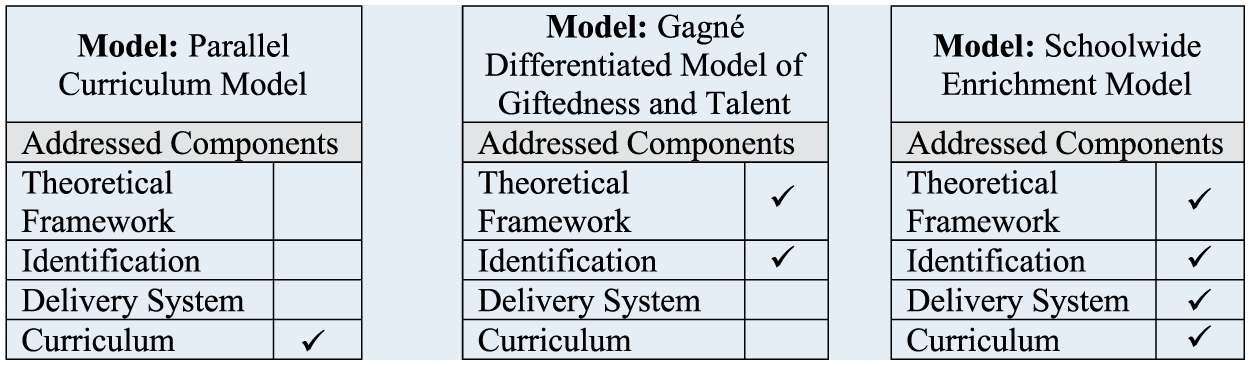
Sample profile cards for gifted models.
Currently, texts on this topic either provide a comprehensive step-by-step approach to designing full gifted systems (e.g., chapter 4 in Davis, Rimm, & Siegle, 2010; Eckert & Robins, 2016) or they present multiple models in the field (e.g., chapter 7 in Davis et al., 2010; Renzulli, Gubbins, McMillen, Eckert, & Little, 2009). Rarely, however, do authors embed an examination of models within the discussion of building a gifted system. Furthermore, within the model presentations, it is not clear what aspects of the gifted system each model addresses. For example, Davis et al. (2010) presented 10 “curriculum models” and include Schoolwide Enrichment Model alongside PCM. This does not falsely represent either model, as both models address how to design curricular experiences for gifted students. However, the Schoolwide Enrichment Model also discusses how to organize and identify students for services, whereas the PCM provides no concrete information on student grouping or delivery methods. Therefore, these two models are not equivalent program options, even though they are presented in the same list.
As another example in the literature, Renzulli and colleagues (2009) delineated the difference between administrative models (i.e., organization of programs) and theoretical models (i.e., conceptual underpinnings of programs), yet they did not organize their edited book using these distinctions. Furthermore, they did not provide guidelines on how to select from the models to create a comprehensive and defensible gifted system. This edited book included authors’ conceptions of giftedness (Gagné), models for reversing underachievement (Rimm), cluster grouping (Mann & Gentry, 2008), and Levels of Service (Treffinger & Selby, 2009). Again, they are all useful for developing gifted and talented systems, but a district should not decide between Gagné’s conception and Treffinger’s Level of Service. Neither Davis et al. nor Renzulli et al. would advocate for that type of decision, but without clear organization of these lists, it is not obvious that they are not equivalent options.
Focusing on the Gifted Program
This current article limits the main discussion to gifted programs, not the full system. In an ideal world, we would always describe the full story/system, acknowledging interconnectedness, but limiting the discussion may yield both practical communication efficiency and philosophical/research focus. The problem is that practitioners and researchers often limit the conversation without acknowledging the limits, and in some cases, they may not even realize that they are doing so. We find it beneficial to focus on answering the following question: “What is your gifted program?”
The complexity presented in the aforementioned texts, perhaps, prevents districts from considering specific models. Recently, the U.S. Department of Education commissioned research to examine gifted programming, and the results indicated that 30% of schools did not use any framework to guide their programming. When districts did report on models, the elementary and middle school programs employed Tomlinson’s Differentiation Model, Renzulli’s Enrichment Cluster Model, and Kaplan’s Depth and Complexity, and the high school programs reported using Advanced Placement frameworks (Callahan et al., 2014). The survey itself provided a list of these models, so respondents may have been influenced by the titles. For example, respondents know they differentiate, enrich, and/or increase depth and complexity, but are they using those specific models? Furthermore, those options do not address a conception of giftedness, yet they are titled the theoretical foundations. One concern throughout the field is that gifted programs lack theoretical foundations, so this is an important research question to pursue further.
This survey also examined program delivery methods, finding that districts often reported pullout and homogeneously grouped classes and relied primarily on a single method of delivery, which indicated a pervasive understanding that all gifted students could be served through a single program delivery option (Callahan et al., 2014). This study also reported curricular materials used, but, interestingly, the options reported were not grounded in traditional gifted education curriculum models. For example, the report mentioned LEGO robotics and Destination Imagination but did not report curricular frameworks such as PCM or Integrated Curriculum Model.
Collectively, these results speak to the need for an organizational framework for gifted programming as well as a more specific conceptualization of what curriculum in gifted education should include. In addition, the limited variety of delivery options and reliance on one method in a “one-size-fits-all” (Callahan et al., 2014, p. 7) fashion speaks to the necessity of exploring multiple and flexible delivery methods. Finally, within this report, these areas (framework, delivery, and curriculum) were discussed separately; information was not provided about how these areas are combined within the current educational system to build a gifted program.
Without a clear conception of what a gifted program is, individuals with training in certain models may believe the only way to construct a program is through a complete model, addressing both curriculum and delivery methods. Many school districts’ approach to programming seems like a patchwork of services and philosophies, which makes the selection of a deliberate model appealing. Furthermore, comprehensive models have distinct benefits, like varying degrees of empirical support and specific implementation instructions/timelines, but they also have drawbacks. Their foundational definitions may be inconsistent with the district consensus or state mandates. In general, they may not offer the flexibility that districts require for designing a program that meets their populations’ needs.
Districts that do not adopt a complete program model should not feel as if they are missing a defensible program, yet these districts must deliberately select both a curricular framework and necessary delivery methods that align with their theoretical foundation. This combination would allow a district to create a customized program integrating existing, quality models that address curriculum and/or delivery. Many program design templates exist with an overwhelming set of steps, and we would like to provide guidance to simplify program design. Again, program design is situated within the gifted system. Ensuring internal consistency among these pieces is essential in developing appropriate programming, but the program itself needs to address two main questions: How are services delivered (e.g., delivery method)? What happens within those services (e.g., curriculum)? A program cannot be described without including information addressing both delivery methods and curriculum. Research (described below) demonstrates how both of these components influence the efficacy and outcomes of the program. Furthermore, these two components are consistent with National Association for Gifted Children (NAGC) program standards, which examine both grouping practices and curriculum. Thus, the rest of the article is devoted to examining these two components, using the organizational schema, Unified Program Design.
Unified Program Design
Unified Program Design is a model to unify existing models by delineating what is needed to describe a gifted program and how existing models address these different components. Unified Program Design is visually represented in Figure 3. This figure illustrates the two main components of a gifted program (delivery method and curriculum) as well as the nature of a complete program, which incorporates both design components. Specifically, delivery methods address how the gifted program will be administered, and curriculum reflects content and pedagogy embedded within the program. By synthesizing these two concise and essential components, Unified Program Design provides a framework for organizing existing program models. For example, some models primarily answer the curriculum question (e.g., PCM), and therefore, those models would only be represented in the curriculum section of the diagram. To create a complete program, districts would need to supplement that model with delivery methods.
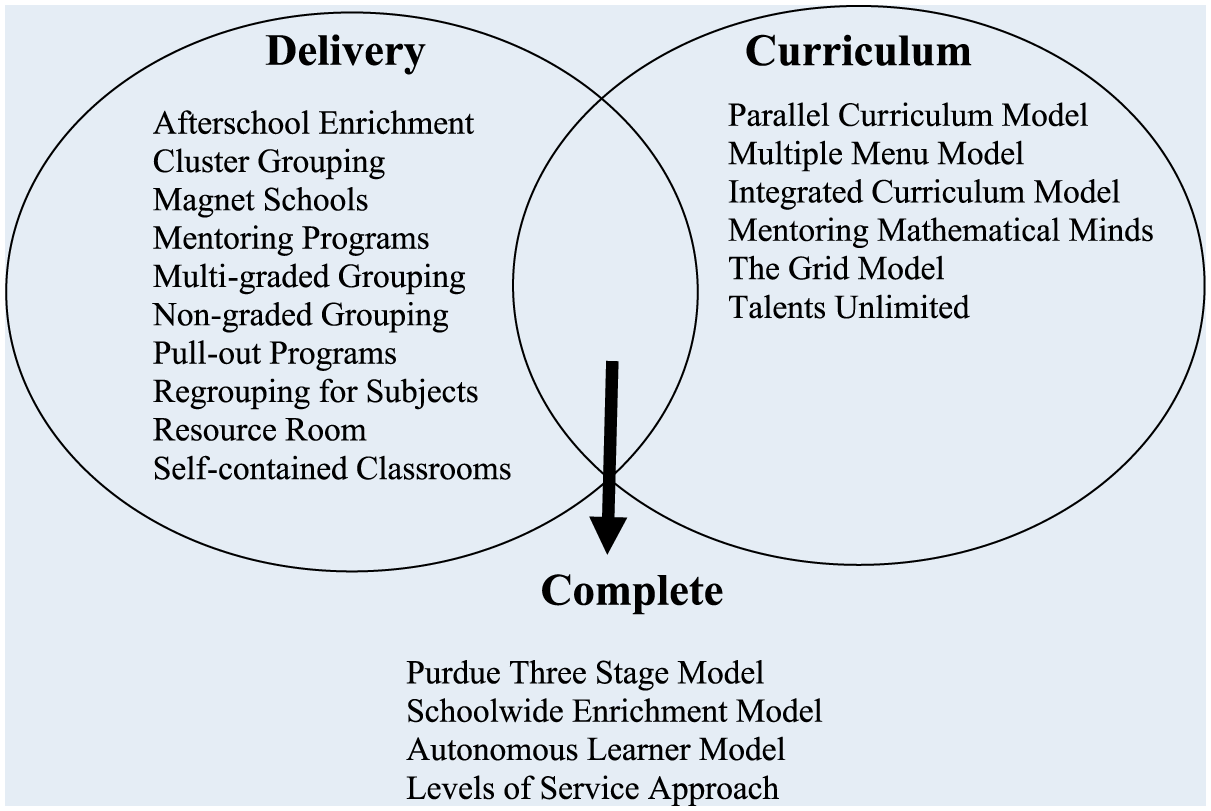
Unified Program Design with examples.
In addition to organizing and suggesting comparable program options, Figure 3 also distinguishes between the classifications of those options. Those familiar with certain curriculum models might question the assignment of those models to the curriculum only side, rather than displaying them as complete models. However, the distinguishing factor between a complete model such as the Purdue Three-Stage Model or the ALM and a curriculum model such as the PCM or Multiple Menu Model is the inclusion of delivery method within its main components. More specifically, several curriculum models have been applied using different grouping strategies (e.g., Integrated Curriculum Model within self-contained classrooms or Talents Unlimited within enrichment clusters), or they vaguely include “grouping” in their descriptions (e.g., PCM says that grouping should be a key component of curriculum). These discussions of grouping do not provide sufficient detail for the actual division and organization of students into groups. Thus, we did not classify these models as complete. In contrast, the ALM, for example, specifically describes organization into pullout or resource classes as well as incorporates components addressing timing, space, and mentorships into its implementation rubric. Therefore, the distinguishing factor between curriculum and complete models is the detailed and practical description of grouping structure such that it could be realistically applied to organizing students within a class, school, or district.
Delivery Methods Within Unified Program Design
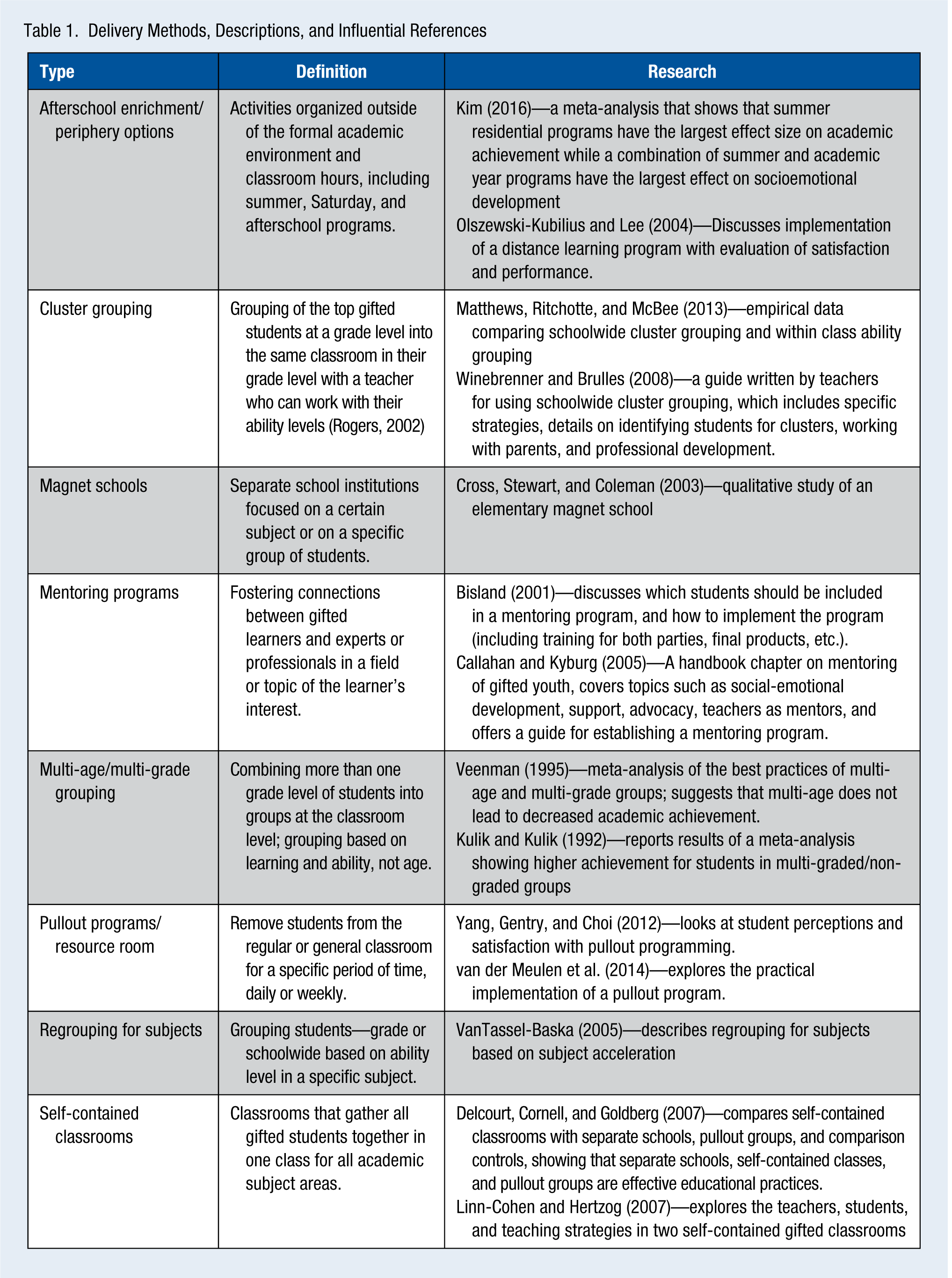
The aforementioned administrator wanted a presentation addressing only the delivery methods, which is an important component of gifted programs (just not the only component). In Unified Program Design, the delivery method addresses gifted program structure, namely, student grouping and time allocation. Table 1 illustrates the myriad of options for delivery methods in gifted programs. Examples of delivery methods include pullout classes, self-contained classrooms, and cluster grouping. To further complicate this discussion, a district will need to select multiple delivery methods to address different degrees and domains of giftedness as well as different developmental factors. Designing a continuum of delivery methods or services is essential to meet the needs of the gifted population. For example, one student may attend a class that is one grade level above her age, whereas another student’s needs might be met in a cluster group at grade level.
Delivery Methods, Descriptions, and Influential References
Delivery methods address both student grouping and time allocation. First, grouping structure refers to the organization and division of students within programs. Students can be grouped based on ability levels, subject area, or grade/ages; groups can be homogeneous or heterogeneous. The delivery method, and, more specifically, the grouping structure within the delivery method, determines the peer groups with whom gifted students interact during the academic day and within the educational environment. Great debate exists on whether gifted students should spend the majority of their time with intellectual or age group peers.
Studies typically associate homogeneous grouping (not tracking) with academic benefits, while affective and social benefits have had inconclusive findings or have been associated with more heterogeneous grouping styles. More specifically, higher academic achievement has been associated with homogeneous grouping (such as pullout grouping, separate self-contained classes, and separate schools for gifted; Adams-Byers, Whitsell, & Moon, 2004; Delcourt, Cornell, & Goldberg, 2007; Rogers, 2007). Furthermore, Adams-Byers et al. (2004) illustrated through interviews with gifted students that they themselves perceived homogeneous grouping as beneficial to their academics because of the challenge, fast pace, and discussion it affords. Within that same study, gifted students preferred time with intellectual peers (homogeneous grouping) despite their own perceptions of the social and emotional advantages of time with same-age peers, including the opportunity to help others and to be around more peers with greater diversity (Adams-Byers et al., 2004). Rogers (2007) reported that peer-dyads of mixed high and low ability student pairs led to no academic gain for either ability level. Gifted students in homogeneous groups have been shown to have lower self-concept than those in heterogeneous groups (Delcourt et al., 2007), but over time, self-concept may rebound (Gibbons, Benbow, & Gerrard, 1994). Collectively, these findings illustrate the resilient debate and somewhat conflicting evidence between the academic, social, and emotional advantages and disadvantages to both grouping styles. The implemented delivery methods will demonstrate districts’ inherent belief system on which side of the debate they fall. The grouping structure will dictate the degree of socialization gifted students experience with grade-level and intellectual peers.
Melser (1999) proposed a resolution to the debate between grouping styles by advocating that grouping styles should be utilized with flexibility. This solution may be one approach that districts can take within the implementation of their program design. This method also supports the idea that gifted students are a heterogeneous group, and multiple delivery methods should be available.
Furthermore, Rogers (2002) proposed an additional social group for gifted students: adult mentors. The pairing of gifted students with adult mentors has been associated with a number of educational, affective, and social benefits. Gifted students are often paired with adult mentors who are able to provide specific content expertise as well as guidance for creating purposeful life goals and careers (Pleiss & Feldhusen, 1995). Mentorships provide students opportunities to engage in deep relationships, nurturing affective and social development (Pleiss & Feldhusen, 1995). In more recent literature, Little, Kearney, and Britner (2010) developed and implemented a summer mentorship program and illustrated that students positively endorsed the mentorship program and showed higher levels of self-perceived job competence, research skills, and self-concept for these areas. Mentoring can provide academic and affective developmental benefits, and should be considered as another delivery option.
Beyond grouping methods, delivery methods also address time allocation, specifically how the school day is divided. For example, certain options cover the full academic day (magnet schools) while others cover only a specified amount of time in the academic day such as academic periods (regrouping for subjects, subject-skipping, pullout options, and some non-graded or multi-age classes). Time is a variable within each delivery methods option, and districts should be deliberate about time allocation when planning gifted programs for specific students. Furthermore, time is likely an important variable to be considered in gifted program research. Pullout classes that meet for 1 hr a week may produce very different outcomes than those that meet for 2 hr a day. Eventually, research may be able to determine how much time is needed to make a difference, providing empirical support for Gallagher’s (2000) concept of non-therapeutic dosage. (Gallagher claimed that if only a small amount of time was spent in gifted programming, it would not be enough to make a difference, like giving 5 mg of cortisol when 50 mg is necessary to treat an asthma attack.) Currently, no specific guidance on this time debate exists.
Overall, districts should consider their grouping philosophy and resources when deciding on delivery methods. Again, providing multiple delivery methods will be the best way to meet varied students’ needs. Furthermore, the NAGC program standards offer guidelines on selecting appropriate delivery methods as well. Specifically, the standards suggest students should interact with individuals with diverse abilities (1.3.2/4.4.1), participate in outside of school learning experiences (1.4.2), and work with intellectual and creative peers as well as same-age peers (4.2.2). Furthermore, the standards suggest that educators use multiple acceleration options (5.1.1); multiple forms of grouping, including clusters, resources rooms, special classes, or special schools (5.1.3); and individualized learning opportunities like mentorships, online courses, or independent studies (5.1.4). These delivery methods, however, are only one component of the gifted program.
Curriculum Within Unified Program Design
Many districts spend considerable time and debate determining how their program will be administered, yet the success of different delivery options likely depends on what happens within the program (Brown & Stambaugh, 2014). Kulik and Kulik’s (1992) seminal analysis of multiple grouping studies suggested that the presence of accelerated and enriched content was more instrumental for academic growth than the grouping approach itself. Simply grouping the high performing students yielded 1 month additional academic growth, while grouping with enriched content yielded 4 to 5 months of additional growth, and accelerated curriculum provided an additional year. Districts may use these findings to support the provision of these curricular options within the regular classroom, which would be a misguided interpretation. Most heterogeneously grouped classes provide little differentiated learning opportunities (Reis et al., 2004; VanTassel-Baska & Stambaugh, 2005; Westberg & Daoust, 2003). Collectively, research would suggest that the combination of appropriate grouping and targeted curriculum would yield the most academic growth.
Many authors define curriculum differently, so within this article, we define curriculum as the combination of content and pedagogy within the classroom. Districts may use different methods in designing gifted program curriculum. First, districts may prescribe specific strategies, like differentiation, content acceleration, or enrichment. Differentiation alone is a scary strategy to anchor a gifted program. As previously mentioned, differentiation is rarely done, as it is incredibly time consuming and challenging to consistently implement (Archambault et al., 1993; Azano et al., 2011; Firmender, Reis, & Sweeny, 2013; T. R. Moon, Tomlinson, & Callahan, 1995; Reis et al., 2004; Westberg, Archambault, & Brown, 1997; Westberg, Archambault, Dobyns, & Salvin, 1993). Acceleration and enrichment are potentially more successful strategies for gifted curriculum, yet they are broad and may be interpreted in multiple ways. If districts decide to forego a specific curriculum model, they should operationalize those strategies to ensure program unity and provide guidance for teachers. Telling teachers to accelerate or enrich the curriculum is like telling someone to find buried treasure without a map. There are so many possibilities it may be overwhelming to begin.
Beyond prescribing specific strategies, districts may adopt established operationalized curriculum models (e.g., Integrated Curriculum Model, PCM; see Table 2). Specific strategies (e.g., acceleration and enrichment) provide the foundation for gifted curriculum models, yet the curriculum models provide specific examples and methods for implementation. It is important to remember curriculum models, like other gifted models, propose both constants and variables. Curriculum models provide specific constants that should be present in all gifted students’ learning experiences, but they also allow freedom through potential variables, including students’ needs and interests. Some students may need to move at a faster pace or in greater depth than other gifted students, but all students should experience the curriculum model’s constants.
Curriculum Model Options, Descriptions, and Influential References

Note. PCM = Parallel Curriculum Model; ICM = Integrated Curriculum Model.
For example, the PCM includes four constants, referred to as parallels: core, connections, practice, and identity (Tomlinson et al., 2009). The Core Parallel is the underlying content, process skills, and overarching concepts that anchor the unit. The Connections Parallel encourages linking content across disciplines, time periods, and perspectives, and the Practice Parallel encourages students to assume the role of a practicing professional. Finally, the Identity Parallel promotes the connection of the content to the student. Students consider how the content affects them and where they would fit within the discipline. These four parallels are the constants, but teachers could use them to create or redesign a unit to address any set of standards from ancient Egypt to linear algebra. Individual students may need to move at a faster pace through the Core Parallel or explore different content within the Connections Parallel, but each student explores core concepts and makes connections.
The PCM is only one of many models. Other curriculum models include Integrated Curriculum Model, Multiple Menu Model, and Kaplan’s Grid Model, and yet other curriculum models are embedded within the complete program models (discussed below), like Schoolwide Enrichment Model or the ALM. Despite the quantity of models, even they share several constants. Each model emphasizes the importance of authentic discipline problems, products, and methodologies by placing students in the role of a practicing professional. The models all advocate for overarching concepts that link the unit of study to the larger body of knowledge. For example, the concept, change, can be seen within a history unit, as events and people alter culture, but change can also be seen as anchoring concept within botany, as plants change based on environmental conditions. Several curriculum models also promote advanced or accelerated content, and others encourage student metacognition, independent investigations, and exploration of a wide variety of topics. Several models also discuss the importance of developing student motivation and affective development.
If many gifted curriculum models promote similar ideals, why would it be advantageous to select one? Selecting one model to anchor a program provides a common structure and language for all stakeholders. While many models share constants, they use different vocabulary, like Schoolwide Enrichment Model refers to the development of process skills as Type 2 opportunities, PCM would embed process skill development within the Practice Parallel, and the Integrated Curriculum Model would place it under processes/products. Furthermore, there are nuances within the models that may make consistent implementation and communication more challenging. Using similar structure and language promotes an integrated program while still allowing teachers the freedom to adjust the variables.
Then, how would a district choose a curriculum model? First, districts should analyze the models to determine which one most philosophically aligns with their mission, definition of gifted, and school culture (embedding it within the gifted system). Furthermore, different models provide different amounts of structure and guidance for implementation. Curriculum committees should analyze multiple models and their resources to determine which would provide the appropriate district alignment and the necessary practical scaffolding to help teachers be successful. It is possible that one model alone will not address all the district’s ideals. In that case, the district could still adopt a model and incorporate the missing pieces.
In addition, some models have commercially available, packaged curricular options. The Integrated Curriculum Model is likely the most popular model for commercially designed units. These units are published through Prufrock Press and Kendall Hunt. Other commercially distributed units are discipline specific. For example, Mentoring Mathematical Minds provides high-quality math curriculum for elementary students, and Junior Great Books has been used for years in gifted programs as challenging literature curriculum. However, if a district adopts different curriculum for different disciplines, it may still be helpful to develop a set of interdisciplinary constants and language to anchor all curricula.
Furthermore, NAGC program standards provide guidance on what constants should be included within the gifted program curriculum. Specifically, curriculum should develop students’ social/career awareness (1.8.2), contain a continuous scope and sequence (3.1.2), and provide conceptually challenging content (3.1.4). Furthermore, curriculum should contain critical and creative thinking strategies (3.4.1/3.4.2) and culturally relevant connections (3.5.1/3.5.2/3.5.3). Many of the common gifted curriculum models demonstrate each of these components.
Combining Elements to Create Complete Programs
Within a Venn diagram, each element has distinct features and an overlapped section represents the combination of those features. A Venn diagram was intentionally chosen to represent our framework both to illustrate the importance of delivery and curriculum as separate components and to show the goal of synthesizing them in a complete program.
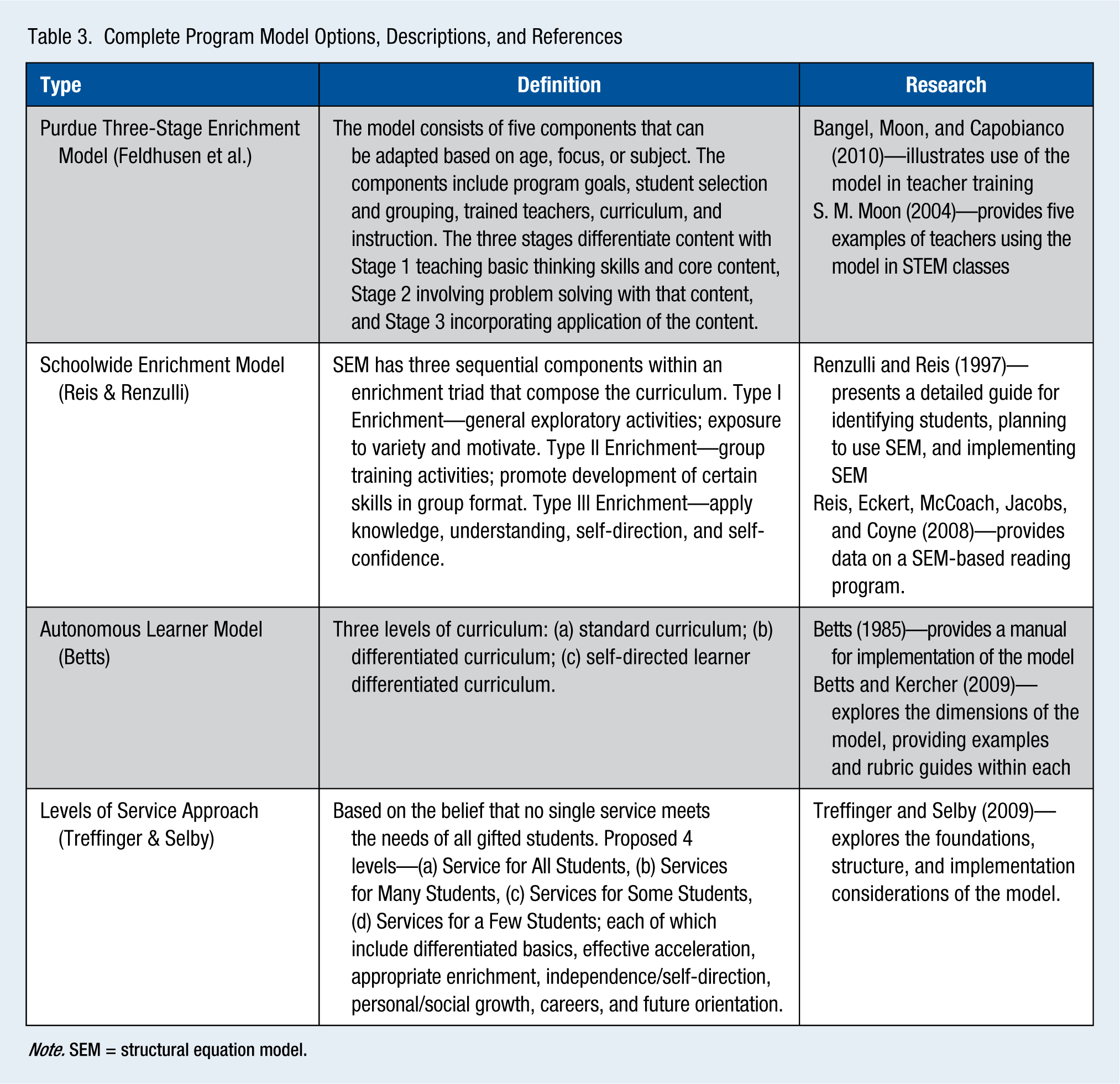
A complete program answers both “How will the program be structured?” and “What curriculum will be implemented?” Several examples of complete program models have been proposed and explored within the literature in the field of gifted education, including Schoolwide Enrichment Model and ALM. These models are presented in Table 3, which includes the model, its description, and research reporting its use.
Complete Program Model Options, Descriptions, and References
Note. SEM = structural equation model.
Our proposed definition of a gifted program includes delivery and curriculum. While complete program models include both of these elements, alternatively district-designed options can also address both elements. More specifically, gifted programs can be designed to include options from the list of delivery systems (see Table 1) as well as an option from the list of curriculum models (see Table 2). In that way, gifted programs can combine these elements into a complete program even if they are not employing one of the complete program models (as listed in Table 3).
The combination of delivery methods and content elements create a complete gifted program by providing guidelines on what will be covered within programs and how that material will be delivered. Careful and deliberate choice of both delivery methods and curriculum can create a unique and complete gifted program. Furthermore, these options can be flexibly synthesized to more directly address the unique needs of a school, district, and its gifted students. In the design and implementation of gifted programming, meeting student needs is a primary concern. These needs exist not only for the population of gifted students but also for each student at the individual level. At the individual level, each student has different needs and characteristics that should be addressed and accommodated for within gifted programming. This framework permits the flexibility to design appropriate programs using combinations of curriculum and delivery options that are most efficient for each student’s individual learning and social-emotional needs.
Using This Framework
The Unified Program Design and its implications are relevant for practitioners (teachers, program planners, administrators, and evaluators) as well as researchers. Each group may utilize the framework to inform their practice. Even if a district-wide gifted program does not exist, teachers may use this framework to consider grouping and curricular options at a classroom level. By being aware of all the systems and models, they can make an informed decision of which framework would best meet the needs of their students. They may find the curricular models particularly helpful to consider, as many tend to be lacking that element (Callahan et al., 2014). Even though teachers are required to address certain standards, they have the freedom to address them using a variety of strategies. Gifted curriculum models provide both freedom and structure. By considering and choosing a curriculum model conducive to gifted programming, teachers, even in general education, can set the foundation for developing critical and creative thinkers.
In addition to teachers, program evaluators and coordinators should use this model to guide their work. The tables in this article serve as a resource for options within each of the main components. Evaluators and those involved in program planning committees can utilize this model in ensuring that both the delivery system and curriculum within a gifted program are clearly delineated and in alignment with the district’s overall gifted system, which includes the theoretical framework and identification procedures. As research has not yielded a “best” program model recommendation, Unified Program Design serves as a resource to help districts systematically choose the necessary components from multiple options in the field.
Finally, for researchers, Unified Program Design serves as an initial organizational structure to define the construct of interest, specifically gifted programs. This framework can provide guidance as researchers develop surveys to probe more deeply into the types of program administered. Being able to define a district’s gifted program in a succinct manner using a few variables may address several issues presented in current research. For example, Adelson, McCoach, and Gavin’s (2012) work examined a large national dataset and found that gifted programs did not have an effect on either gifted or non-gifted students’ achievement or attitudes. They acknowledged, however, that using a pre-existing database, they were unable to differentiate among the types of programs being implemented or the amount of time students spent within the program. They hypothesized that likely the type of program would influence its efficacy. Therefore, they suggested future research examine the outcomes of different programming models. To do that, however, the field needs to determine the essential components of a program to guide appropriate data collection. If the gifted field wants to partner with large national data collections, we need to simplify how we design programs. Unified Program Design allows for the differentiation of programs based on their delivery method and curriculum to determine program efficacy. This framework promotes not only the differentiation of these elements but also calls for their measurement as well, allowing for comparison within and between programming options and for different combinations of delivery and curricular options.
The process of preparing materials to present the Unified Program Design led to another benefit for researchers in the field of gifted education. In creating Tables 1 to 3, literature concerning curriculum models, comprehensive models, and delivery systems was explored and reviewed. The “references” column within each of these tables was constructed with the requirements of including a foundational text that provided knowledge about the basics of the model or system and offered guidance in implementation as well as including a practical, exemplary implementation of the model or system. These tables provide basic, necessary information for implementation as well as a practical example. While these tables do not include an exhaustive or extensive list of the materials available regarding the systems and models presented, the process of preparing them provides valuable information about the nature of the existing literature in the field of gifted education. Areas of limited and outdated research can be identified using the process that constructed the Unified Program Design. For example, research in the areas of resource rooms for gifted students and the use of the Kaplan Grid model appears to be both limited and outdated. Furthermore, new areas of research can be proposed such as the previously mentioned comparisons of models and the construction of surveys and measurements. The obvious, overarching yet absent research should compare the various combinations and models to determine which combination is most effective under certain conditions.
Overall, the gifted field has been extremely prolific in the design and creation of models. This is helpful as districts have different student populations and different philosophical perspectives, yet it has resulted in confusion in what a model is and which model or models a district should adopt. Specifically, districts have struggled to select the appropriate model or combination of models to create a complete gifted program. Unified Program Design addresses this struggle by delineating the essential components of a program and organizing the various models by the components they emphasize. Hopefully, in the future, when asked to describe their gifted program, coordinators will provide an answer that integrates both the delivery system and curriculum.
Footnotes
Conflict of Interest
The author(s) declared no potential conflicts of interest with respect to the research, authorship, and/or publication of this article.
Funding
The author(s) received no financial support for the research, authorship, and/or publication of this article.
Bios
Lisa DaVia Rubenstein, PhD, is an associate professor at Ball State University. She previously worked as a classroom teacher and a research assistant at the National Center for the Gifted and Talented at the University of Connecticut. Currently, she directs the undergraduate gifted and talented program at Ball State University, and her research examines motivation, creativity, and talent development.
Lisa M. Ridgley, MA, is currently a graduate student in the Educational Psychology doctoral program at Ball State University. She previously worked as a graduate assistant at the Center for Gifted Studies and Talent Development at Ball State University.