



Abstract
Gifted middle school students in sixth, seventh, and eighth grades engaged with a community activism curriculum designed and implemented by the author, their gifted education facilitator, as part of their gifted programming. This authentic learning experience asked students to follow a creative problem-solving process that fostered thoughtful problem-solving and successful action plans. Participating students reported feeling empowered by the experience of creating lasting positive change in their community and even altered their own expectations of learning experiences in school. This article explores the perspective of the practitioner and ways of successfully implementing such a curriculum.
“Exposing gifted students to social capital acquisition and dedicating their gifts to working toward the benefit of others were enlightening and powerful.”
In an effort to transform practice and the services provided to gifted middle school students, practitioners must examine the needs of their unique students and the access they might have to developing authentic learning experiences that take students outside the four walls of a traditional classroom—both literally and figuratively. Most educators tend to embrace the notion that their greatest responsibility is to contribute to the development of well-rounded citizens and individuals who think critically as members of society. To become these well-rounded citizens, as children, our students need opportunities for leadership and choice in their own educational decision making. They need to experience the process of truly examining and solving a problem. Through advocacy for others and working toward lasting change, students should experience empowerment in the school setting.
The authentic learning experience explored in this article provides gifted students with an opportunity for examining their communities and realizing their potential as capable leaders and activists, even as children. As interviews and student journal entries revealed, many students experienced growth in their confidence and their understanding of their ability to create change. When students are tasked with identifying important problems and making positive change, this group proved that they are powerful and engaged.
The Intersection of Giftedness and Activism
It is well documented that the use of activism as learning experience produces beneficial results for activist students and also the recipient communities in which change is made (Renzulli, 2002; Terry, 2003; Terry, 2008; Terry, Bohnenberger, Renzulli, Cramond, & Sisk, 2008). Ideally, children are an investment in which parents, teachers, family, friends, and community members can contribute thereby ensuring a learning environment that offers not only safety but also fosters discovery and exploration (National Association for Gifted Children [NAGC], 2013, 2014). Unfortunately, the education system of today all too often inadvertently encourages passivity in students rather than requiring them to be engaged learners working toward something greater than efforts toward their own benefit. Daniels and Ahmed (2015) suggest that today’s schools allow for students to be passive bystanders to their own learning, wasting critical-thinking skills, and unable to take action toward solving problems of significance. Students must feel empowered to take risks in the classroom. They must find their individual voices within the classroom and greater school setting, and hopefully, educators work to create an ideal microsociety in their classrooms and schools, in which their students understand that they are valued and empowered and have influence (Levinson, 2012). When students lack such experiences in their school years for creating lasting change in their communities or coming to understand their own influence in society, they are less likely to be sensitive to social injustices and other significant problems found in society (Stewart, Webster, & Bai, 2013). Efforts to squelch the passivity and instead nurture a generation of “upstanders” will contribute to deeper learning for students and greater benefit for society (Daniels & Ahmed, 2015).
As a society, we should be concerned that gifted and talented children grow up to elect to use their gifts and talents for the betterment of the world in which they live. At present,though, no one can explain why some very bright individuals choose to work for the greater good of society and others dedicate their life’s work to their own benefit (Renzulli, 2002; Terry et al., 2008). The acquisition of social capital is an important step in changing the world, and such cooperation for the greater good can be introduced to children from a young age.
The implementation of community activism as curriculum holds the potential to address gifted students’ academic and affective needs as it provides students with the opportunity to think critically as they solve complex problems but also to learn about their communities, interact and engage with diverse populations, exercise empathy, and develop intense care for others. These opportunities for growth likely have some effect on students’ self-concepts—an individual’s cognitive view of herself, as constructed by internal and external comparisons (Gore & Cross, 2014; Huitt, 2011; McCoach & Siegle, 2003). The literature generally views self-concept as a construct in which specific domains culminate into an overarching global concept of self (Cross, O’Reilly, Mihyeon, Mammadov, & Cross, 2015; Rinn, Mendaglio, Rudasill, & McQueen, 2010; Rudasill & Callahan, 2008; Vogl & Preckel, 2013). Although gifted students’ self-concepts tend be stronger and less variable than those of the general population (McCoach & Siegle, 2003; Rudasill, Capper, Foust, Callahan, & Albaugh, 2009), they do experience a decrease in adolescence (Bain & Bell, 2004). To combat this decrease and encourage the acquisition of social capital (Renzulli, 2002), it is important that our gifted populations have opportunities to increase self-concept, use their gifts and talents for the greater good, and exercise their co-cognitive components of giftedness (Renzulli, 2002).
Community Activism as Gifted Education Curriculum
To address more effectively the unique needs of my particular students, I designed and implemented a community activism curriculum that provided my gifted education middle school students with authentic, empowering learning experiences that led to new expectations of learning. Through problem-solving that exposes children to a real, dimensional world outside of school, one that is flawed and challenging, students are presented with authentic learning experiences that not only exercise their critical-thinking ability but also challenge them to create positive change that impacts others. Using a tailored creative problem-solving process, students are given guidance in tackling important problems from beginning to end that require them to navigate difficult situations independently.
Creative problem solving (CPS) is widely used as a method for solving problems in the real world, so it naturally lends itself to valuable learning experiences for adolescents as well. A CPS model was modified to fit the needs of a specific gifted education program and its students as they sought to solve community problems in grade-level teams. Implementing the action is often the final step in many CPS models; however, in an education setting, this is not always current practice. Beyond implementing action, this curriculum required my students to reflect, evaluate, and adjust their action plans based on what they saw as their successes and failures, and then students were expected to share their work with others during a family presentation night hosted in conjunction with the school’s English for Speakers of Other Languages Program.
Each grade-level activism team identified a community issue important to them and then developed essential questions to guide their work. The student-created essential questions were established:
Sixth-Grade Activism Team: How do we get devices and the Internet access to all students who need them?
Seventh-Grade Activism Team: How can we prevent distracted driving in our community?
Eighth-Grade Activism Team #1: How can we provide financial guidance to the underserved residents of our community?
Eighth-Grade Activism Team #2: How can we reduce the amount of plastic used in local cafeterias?
Once grade-level teams had established the questions that would guide their action, students followed these steps in problem-solving:
Identify the problem
Research the problem
Formulate challenges
Generate ideas
Combine and evaluate ideas
Draw up action plan
Implement action plan
Reflect, evaluate, and adjust
Share results and new understandings
Students worked toward understanding their chosen community problems, reached out to community organizations for information and support, worked together to identify and develop an action plan that they felt would make a difference and that had not been previously attempted, and implemented the action plan with the help of community partnerships. Throughout this process, students were expected to submit weekly journal entries detailing their progress, feelings, concerns, and collaboration. They had many opportunities to communicate with their peers in class, as well as outside of class, both in-person and through the use of an online classroom forum. The online classroom provided opportunities for group chats, one-on-one messaging, e-mail service, class polls, calendar reminders, and one-way journal entries shared with the facilitator. This constant expectation of self-reflection and project evaluation increased productivity and quality of work, and the expectation that students would adjust their approach when they were not seeing success made for a more fruitful experience.
At the conclusion of the semester, students hosted their parents and families for a presentation night that provided the opportunity for students to share their work with an audience, communicate their problem-solving, and make others aware of community problems. The curriculum provided for small-group and one-on-one interviews, conducted throughout the project implementation, which revealed insights into students’ growth and evolving understandings of themselves and the world around them.
Curriculum Implementation
Most of my middle school students came into my programming with little prior knowledge of activism or misconceptions regarding activism. Students tended to think of activism as synonymous with volunteer work or they had little idea of what the word meant. An important first step was identifying their prior knowledge or lack thereof and then to ensure that all students had the same understanding of what activism is and how they might become activists themselves, even as children. Any educator working to provide a community activism experience to their students must begin with a foundation of activism, its significance, and a vision for children’s ability to be activists in their own communities. Providing access to models of impactful activism and showcasing the work of young activists can be a powerful early message in the learning experience. Ensuring the students see their activist work as possible is necessary—and sometimes a battle. Guest presenters, such as local nonprofit organizers, initiated some of the discussion of activism and challenged students to think beyond volunteerism. Their expertise legitimized the notion of activism and made the task of considering activism more serious for my students. These very active, prominent community members challenged my students to think beyond themselves and their very specific interests to identify issues in their communities that could use their help. I am a firm believer in using other expert resources to challenge my students, to provide a fresh face and a fresh perspective, and to bring some of the outside into our school and our programming. Any contact that can be made, prior to instruction, with stakeholders in the community is significant, as they can be powerful allies in providing transformative learning opportunities for students. In addition, many community members are more than willing to give of their time and expertise, especially when it is for the benefit of the community’s youth.
A general familiarity with CPS is also necessary for students as they initiate activism projects. Although it was difficult for students to conceptualize each step of our CPS process, it was helpful that they knew we were going to take things one step at a time. Their familiarity hinged on my constant reference to the process, descriptions of next steps as we discussed vision for the project, and displays of our process placed prominently in our physical classroom and on our online classroom so that we had easy access (see Figure 1). Following our CPS process kept students moving forward and ensured that they thoroughly considered their ideas before implementation. Students’ utilization of the process provided an organization to their projects that was easy to manage and a helpful guide.

Students followed a modified creative problem-solving process that fits their needs and kept them moving forward toward creating lasting change in their community. This checklist was displayed prominently in the physical classroom and also in the online classroom so that students were constantly reminded of their progress.
CPS in Activism
Identify the problem
In this first step, students should work to identify the problem that they feel they should tackle through the rest of the process. Once they have identified the problem, they also write their essential question as a team, the question that will guide all their work from that point forward. The essential question should be simple but communicate the students’ ownership regarding what they can accomplish. An example might be, “How can we reduce the amount of plastics being used in local school cafeterias?”
Research the problem
Before jumping to solutions—which students find really tough not to do—students should research the problem that they have together identified. Students consider—What causes this problem? What are contributing factors? Are other groups already working to solve this problem? What solutions have been attempted successfully and unsuccessfully in the past? What resources might be needed to further understand this problem? Students should consider how the results of this research inform their next steps. Students must understand that if another group or organization attempted a specific solution, and it was unsuccessful, they will likely need to take a different approach to be successful themselves.
Formulate challenges
The formulating challenges step asks students anticipate obstacles and to think about what they have learned from their research and to then formulate creative challenges out of the issues that exist behind their identified problem. This makes the identified issue less of a problem and more of a challenge to tackle. This step often feels encouraging to students and challenges them to look at the community issue in a variety of ways and from a variety of perspectives while being prepared for obstacles that are likely to arise.
Generate ideas
Idea generation is brainstorming the way we tend to think of brainstorming. There are no rules when it comes to brainstorming and what a good idea is, and it is imperative that students understand this and are open to one another. It is a tough thing for some students to not immediately determine whether or not an idea is a good one.
Combine and evaluate ideas
In this phase, the students go back through their brainstorming to determine whether or not an idea seems plausible and valid. They ask themselves: Will this possible solution really solve the problem? Is this something we could actually implement? How will we know if this worked? When students have trouble determining the pros and cons of competing ideas, they can establish an evaluation chart (see Figure 2).
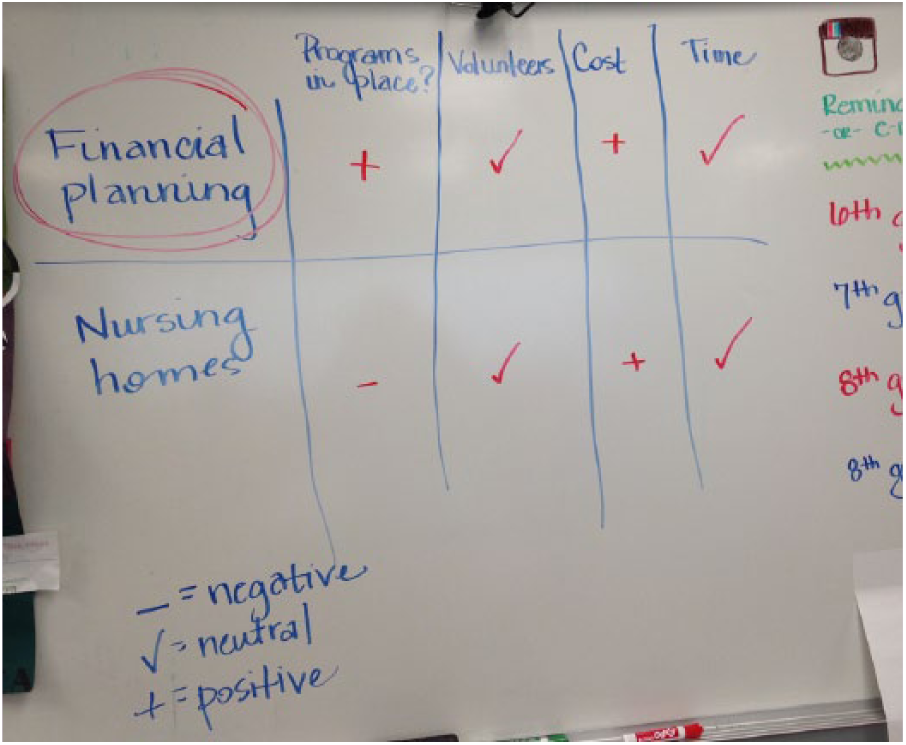
Creating a table like this one assisted students in evaluating their ideas and making objective selections for moving forward in the problem-solving process.
Draw up an action plan
Drawing up the action plan is often where students’ minds go as soon as a problem is identified. Unfortunately for them, though, until they have done all the previous steps, drawing up an action plan is often futile. Once students have evaluated research, really combed through solution ideas, and decided on a plan that might actually work, they are ready to start solving. The action plan should be specific, include miniature deadlines along the way for time management purposes, and establish criteria for evaluating its success.
Implement the action plan
Implementing the action plan is the most fun part for the students. This is where students are most hands-on, increase investment in the project, and feel pride in their efforts. It is also where students start to see their success and their impact, which is very empowering.
Reflect, evaluate, and adjust
In my mind, problem-solving should never end with action plan implementation. What about all the ways that the action plan could be improved? What have we learned from the first experience? That is why my students were asked to constantly evaluate their work, their team’s progress, and the ways in which they had been successful or not. Students kept online journals about their ideas, feelings, thoughts, and understandings of their progress throughout the process. At different points during the action plan, including at the conclusion of the project, students should be asked to verbally and in written form reflect on their experience, evaluate their effectiveness, and either implement or plan for future action.
Share results and experience with others
A tremendous part of the learning experience for my students should be their ability to communicate and share their learning with others. This leads to accountability, the spread of activism and student empowerment, and further pride in their work. In addition, their efforts to share with others educated their audience about community issues and created a new awareness in the community.
One Story of an Empowered Activism Team
Students were introduced to the concept of activism by a guest speaker, the director of a local organization whose purpose is to provide resources of all kinds to those in need within the community. She engaged students in an activity that asked them to consider problems they have noticed in their school, their neighborhoods, and their city. In groups, organized by grade level, kids collaborated to brainstorm as many issues as they could identify. Issues ranged from pet homelessness to child safety to social opportunities for the elderly. Students were tasked with continuing to consider their communities and the problems they notice over the weekend so that we could continue to discuss their thoughts at the start of the following week.
CPS Step 1: Identify the Problem
My eighth-grade students returned to school Monday afternoon with a comprehensive list of community issues they were interested in potentially tackling, some seemingly ridiculous, some significant. Because it was important that I had as little influence on their actual problem selection as possible, I led the class through discussion of each idea on this list, in hopes that together they would identify a problem that truly needed solving, would engage them and sustain their passion, and could see results of the students’ efforts. Identifying the problem proved more difficult than I had anticipated, as different students possessed different preferences and perspectives, and students were likely to advocate solely for the problems they had determined themselves. Once students had eliminated various issues and determined two final problems they were interested in solving, it became apparent that discussion was not leading to a clear decision.
Because the CPS process can be implemented flexibly, I suggested that we move on to our second step—but with two potential community problems in mind, rather than one. To eventually identify our problem, the one on which we would focus our efforts, my students had to continue through the process and make a determination for themselves.
CPS Step 2: Research the Problem
The student activists had determined that they were most interested in either working to provide financial guidance to those who do not have such resources or providing a solution to the shortage of social interaction that elderly people in our community experience, especially once they no longer live in their own homes or care for themselves. To ensure that the students made an educated decision, they researched the two community issues. This research involved not only understanding the problem but also understanding any efforts that have been attempted at alleviating the problem in the past. It is important that their research provides context. Students researched answers to the questions: Why does this problem exist? What has already been done to solve this problem? What has been effective, and what has been ineffective? This information influenced their understanding of the problem and also guided them in their thinking about potentially solving these problems. Once the group was knowledgeable regarding the two issues, we moved on to formulating challenges.
CPS Step 3: Formulate Challenges
At this point in the process, I asked students to consider the possibility of challenges they might encounter in solving the problem. What obstacles could they face? What should they be prepared for? Students collaborated to make a list. Ultimately, they determined that if they pursued providing financial guidance to community members in need, they may be up against funding issues, difficulty soliciting others in the community to help them, challenges getting the word out, and trouble locating event space that would be well-trafficked but also cost-effective. Their second potential community issue—the lack of social opportunities for the elderly—presented its own challenges, including that a solution may be more time-intensive than they would be able to commit to during the school year, trouble soliciting help from others in the community, difficulty with transportation, and financial limitations.
CPS Step 4: Generate Ideas
Armed with an understanding of potential challenges, students worked together to once again brainstorm. This time, the kids considered possible solutions to the issues they had identified not simply to solve the problem but to help them understand which issue they might be most successful at addressing. In response to the first community issue they had identified—the fact that many members of their community are in need of financial guidance but do not have the resources to pursue financial advice—students proposed that they plan, recruit for, and host a free, public event downtown that would allow community members to sit down, one-on-one with certified, local financial advisors to discuss whatever financial issues were helpful. This would include such things as basic budgeting, debt management, investment, and even retirement planning. They envisioned using a well-trafficked space that would be affordable and easily accessible for much of the community.
To help solve the issue of the community’s elderly having few social opportunities, the students proposed that they would create and manage a volunteer network for students in the community that would match kids with elderly residents at local assisted living and skilled care facilities. Their idea was to coordinate social activities in which young people could accompany elderly people, providing both parties with opportunities to socialize among one another and their own peers. The kids identified the value in encouraging relationships between the elderly and youth, and they recognized that there is a need for organized volunteer opportunities.
CPS Step 5: Combine and Evaluate Ideas
Although they had roughly mapped out potential action plans for each of the proposed community problems, my students still had trouble deciding where they wanted to place their focus moving forward. To facilitate some decision making, I led them through an evaluation exercise using an evaluation chart (see Figure 2). Using straightforward methods of evaluation, students assigned different values to a set of criteria they felt were important in moving forward. In this case, the students examined whether programs were already in place within the community to address the two issues, how difficult it would be to solicit community help and volunteers, the cost of their potential solutions, and how much time they would need to commit to the problems. When they were done, it was clear which issue they were most committed to, and the process eliminated any argument or doubt. The students confidently moved forward with the issue of community members lacking access to financial guidance.
CPS Step 6: Draw Up an Action Plan
Based on their previous opportunities to generate action ideas, the students felt fairly committed to hosting a free, public financial advice event. At this point, it was important that my students had well-defined roles within their teams, so they engaged with a job application process. They received job descriptions, which I had created for them, and completed applications to be hired for those positions. Each student would have an official role within their team based on their strengths and preferences, and this helped to organize the flow of the project, ensured that everyone had ownership and impact, and assisted in the ultimate success of their work. Students submitted completed job applications to me, and I hired them based on what I knew to be true of their strengths, as well as what their applications told me about their preferences and expectations of the project.
Moving forward, students met in small cohorts according to their roles in the team. Our project manager began leading our class meetings and delegating to-dos when needed. It was clear who would be in charge of spreading the word, soliciting community volunteers, planning the details of the event, and so on. From that point forward, students could more definitively plan for action.
CPS Step 7: Implement the Action Plan
Students called and visited various financial advising firms in the community to share their vision of the free event with professionals who might be able to help. They solicited the commitment of five financial advisors who were willing to give up a day to provide free services to community members who needed financial guidance. The students worked with the advisors to find and develop materials that would be helpful for community members to have as they made progress through their advising appointments. Students assembled folders containing all these materials to hand out to the visitors at their event.
To fund their event—the costs of which might include venue fees, T-shirts for all those volunteering, printing costs, advertising costs, and the costs of assembling financial materials—students put on a concession stand at a local tournament, where they earned more than US$300. In preparing for this concession stand, the students made all decisions about the items to sell, made cost comparisons at different retailers, budgeted for and purchased the food items, and decided upon reasonable prices that would also allow for profit. In addition, the students solicited donations from local businesses, including financial advising firms, from which they received US$500 in donations.
Ultimately, the public library’s auditorium was the perfect venue for hosting the event. Located downtown, the area is heavily trafficked, the library is easily accessible to all populations of the city, and is frequented by families and community members in need. The fees for the venue were costly, so the students took the initiative to contact library administrators and explain their project and their event. The library agreed to waive all fees, and the students were able to host their event at the public library at no cost. In addition, they requested a donation of seven dozen doughnuts from a local bakery, which was kindly granted, and they were able to offer every patron a free doughnut upon arrival for financial advice.
The students printed fliers, which they distributed on foot and posted in local downtown businesses, contacted the local newspaper and television stations with event information, and spread the word about their event via social media. On the day of the event, the students were able to provide a T-shirt to every volunteer that featured a logo they had designed themselves. The kids welcomed approximately 60 community members to their event, individuals and families who might not have otherwise had access to financial guidance. The students admitted all who were interested, at no cost and no questions asked. The professional financial advisors who lent their services were steadily busy for the 4-hour event, and they assisted a greatly diverse group of people.
CPS Step 8: Reflect, Evaluate, and Adjust
At the conclusion of the event, the students were clearly proud of what they had accomplished. The event having been held on a Sunday, the kids were able to come to school the next day and process their thoughts on the event, its success, and the ways in which they might have changed things. During that next class meeting, they shared their pride in the success of the event, their surprise at the number of people who they were able to help, and their appreciation to the volunteer advisors. They were already looking to the future and hoping to work together on a second, similar event in high school.
The students agreed that they could have made changes to make their event more successful and ensure those who needed the help they offered had access. Students made lists of organizations they would contact in the future, such as the community’s homeless shelter, the domestic violence center, and the local housing authority. They noted what they felt went well and what could be improved.
CPS Step 9: Share Results and New Understandings
The week following the students’ event, we had a planned parent night where the kids’ parents came to the school for refreshments and to learn about their children’s activism projects. The students created a video about their event, including the process they went through to determine the problem, plan the solution, and implement the action. The students began by speaking briefly about the experience and then presenting their audience with the video. The students answered questions about their activism at the conclusion of the video.
The fact that the students knew all along that they would be presenting their work to an audience ensured a sense of accountability. Immediately after reflecting on their experience, they were working to determine how best to share their work—its successes and its challenges—with an audience. They could not simply host the event and be done with it, they had to sufficiently reflect on their work to share with others and evaluate for themselves. Sharing their work was empowering, as it forced them to look at what they accomplished from the outside a bit more than they had, and they received the positive feedback and accolades for their efforts that they deserved. In addition, they drew attention to a community issue that deserves to be seen and addressed. Their work fueled an interest, for most of the students, in continuing as activists in this same way but also in new ways.
For the Educator: Planning for Facilitation
The role of the teacher in the implementation of community activism projects should be as facilitator, organizer, and general guide. Students must select the issues or their buy-in will be weak. Students must think of solutions or their buy-in will be weak. The action must be taken by the students or their buy-in will be weak. There is little room for teacher-centered activities or traditional, direct instruction because those approaches detract from the entire purpose of authentic learning experiences. Rather than being the traditional teacher, the educator must take on responsibilities in planning and organizing so that the students are presented with authenticity in their learning. The teacher must work to bring the real world to the students’ learning and the students to the real world.
The educator should take several steps in planning for community activism projects. First, a great deal of time should be spent on such projects because applying timelines to solving such large problems as community issues is counterproductive. In fact, my students who experienced the least success in these projects are those whose time on their projects ran out because of school’s dismissal for summer break. Tight deadlines and time constraints do not always provide helpful structure when they are applied to young student activists learning how to contribute to lasting change for the first time. The educator should ensure that there is plenty of time to dedicate to the activism projects and that the time allotted can be flexible and used for a variety of purposes.
In addition to evaluating time, the educator should evaluate her resources. Who in the community could be called upon to share their expertise? What kinds of community partnerships could be formed throughout the course of the projects? Technological resources should be considered, as well. In my particular case, I had students on one team working during different class periods, so efficient and effective communication became a concern. Evaluating and building an online classroom for the purpose of the team activism projects can be very beneficial to the team’s efforts and the success of their projects. My students used a site that allowed for class chats, e-mail, message boards, a team calendar, checklists, polls, and journal entries. This platform allowed us to communicate across class periods at all times of day, and I was able to assess their progress and provide feedback as they made their way through the CPS process and toward implementing their action plan and reflection.
Organizing these projects will require some delegation of roles. Although it is important that students continue ownership in this aspect of their projects, also, the process for determining who does what can be planned ahead of time by the facilitator. Although I could not entirely anticipate the various tasks that would be involved in any one project—because I could not anticipate every community issue my students might select for problem-solving—I did feel that I could anticipate types of responsibilities that would need to be tackled no matter the chosen problem. I knew each team would need some sort of project manager to lead the team and ensure that progress was being made. I knew each team would need someone to effectively tackle research, someone to communicate with outside entities, and someone to deal with budgeting and finances. With these overarching roles in place, each team could decide more specific roles and how many people might be needed in different areas of expertise. I had designed job applications that required students to consider their strengths and interests, as well as list references and sell their abilities, prior to determining who would take on which roles. Students applied for two jobs they were interested in, and I hired them. From that point on, everyone had a very specific job to do for their team’s efforts, and this helped them to function more effectively and more efficiently.
Planned daily check-ins with each team helped me, as facilitator, to understand where my students were at with their projects and how I could help guide them if they needed assistance. Checking in on their progress via our online classroom allowed me to provide timely, helpful feedback and also further understand my students’ thought processes as they tackled messy problems in new ways. Completing interviews with individuals and small groups of students was also an invaluable way of further understanding my students’ experiences and helping them to process their learning, and these should be planned for and prioritized whenever possible. Both the facilitator and the students feel the benefits of a facilitator’s planning and organization, as students can focus on their problem-solving and the teacher can focus on the students’ needs.
Anticipating Challenges
Students were given ample time to brainstorm, debate community issues of interest, consider their own strengths and the strengths of their team, and determine possible resources moving forward in their problem-solving. I fully recognize the flexibility I have as a gifted education facilitator in my particular school district and my particular school that many educators do not. My classes are small, and I am given the autonomy I need to develop and implement my own curricula that I feel will meet the needs of my students. I am encouraged to bring community members into my classroom to share their expertise, and I am supported in taking students off campus to engage with new people and in new environments. If these supports are not in place for other educators, I am certain that they can anticipate some challenges that I did not encounter.
Student Reflections of Activism
Throughout the implementation of the activism projects and at the conclusion of the projects, the students were interviewed about their experiences and their feelings about what they accomplished. For the students who experienced the most success, judged by whether or not they felt they had actually helped people and worked toward a solution to their targeted issue, they shared very positive reflections that suggested gained confidence and growth. Repeatedly, the importance of authentic learning experiences and the ownership they had over their own learning was reported as impactful. One eighth-grade student said, “You let us do things that we thought were a good idea. You let us be in charge.” The empowerment gained by making decisions regarding their own learning and the ways in which they could be active citizens of their communities made an impression. “We did it! We’re a group of eighth-graders, and we did it,” one student responded.
Although students may not have explicitly defined authentic learning experiences as having real-world implications, they did understand the value in learning real-world skills. An interview with an eighth grader revealed that the students’ event, which provided free professional financial advice, did not just teach skills in event planning but instead “it’s learning how to do things in life.” In the job application and hiring processes, students took on a variety of roles and some were given true leadership positions for the first time in their lives. One female student, an eighth grader on the financial guidance team, explained, I trusted [my teacher] because [she] had put me in that position, so I was like, well, [she] thinks I can do this, so I need to step up to the plate and do this well and be okay with [my role].
The student’s insecurities regarding her leadership abilities in the beginning were ultimately driven out by her team’s successes and new confidence in what she could accomplish as a leader.
Activism is not just for gifted students, and the responsibility of social justice and civic engagement does not fall upon only the brightest adults. All students, just as all adults, benefit from experiences that give them glimpses at community issues, people of other backgrounds, the importance of civic engagement, and their responsibilities as crusaders of social justice within our society. Unfortunately, many general education classrooms cannot afford the time, manpower, and resources that are required of truly engaging, deep service-learning experiences. Gifted education programming settings tend to lend themselves to the flexibility and student focus of such projects. One of the eighth-grade participants reported, I think the community activism [project] was really great for our community and for myself. . . . It helps the [students] who sort of have that desire to do [greater good], and if they never got the opportunity to do that, then they may not, you know, something may not happen in the future that would have happened if they had done the project. . . . This project can definitely be used to improve leadership and teamwork and give more opportunities to people generally. It may not directly show itself in the successes of a person on society or for themselves, but even if they never realize that it helped them, it just might.
Conclusion
Although I feel that implementation of this community activism curriculum was largely successful and transformative for many of my students, I know that I did not reach every single one. Some of my students experienced more success through these projects than others, and some of my students grew more than others as a result of their roles in creating change in their community. Some students felt disappointment in the outcomes of their projects—or lack thereof. A variety of factors likely contribute to these differences in results, including team dynamics, the community issue selected, the student’s individual receptiveness to collaborative work, and the natural timelines of the school year that, for some, became problematic as we neared summer break. However, during interviews, many students expressed new feelings of empowerment and confidence in their ability to truly create lasting, positive change. This effort at exposing gifted students to social capital acquisition and dedicating their gifts to working toward the benefit of others was successful for some and less so for others, but the successes were enlightening and powerful, and many students expressed new expectations of their educational experiences in the school setting. One student put it simply: “I learned that this is a good way to learn.”
Footnotes
Conflict of Interest
The author(s) declared no potential conflicts of interest with respect to the research, authorship, and/or publication of this article.
Funding
The author(s) received no financial support for the research, authorship, and/or publication of this article.
Bio
Ashley D. Beason-Manes, PhD, is a middle school gifted education facilitator who works directly with sixth, seventh, and eighth-grade students providing original gifted programming and Individualized Education Program management in the Lawrence Public Schools. She is also the sponsor for a variety of competitive activities for her students, including Future City, National History Day, and Model United Nations. She recently earned her doctorate in Curriculum and Instruction at the University of Arkansas with emphases in gifted education and English education, and her research interests include social justice education, gender in gifted education, and addressing social and emotional needs in gifted students. She can be reached at