




Abstract
This article discusses bullying among the author’s gifted sixth graders within their general education classes, in situations where the gifted were both victim and bully. There are few studies of the gifted child as bully. Using depth psychology, visual arts, and writing, the students constructed the bully and victim using torn paper and writing from both the perspective of the bully and victim. The author and her students charted the three stages of stress and specific ways to avoid or ameliorate these situations. The author contends that using creative art and depth psychology principles and respecting the unique psychology of the gifted student were pivotal in understanding this situation and determining helpful solutions. These include getting plenty of sleep, writing in a journal or diary, doing something physical such as dancing or sports, or talking to a friend.
“The use of art and the principles of depth psychology were crucial in drawing out an underlying cause of the bullying issue.”
The Dangerous Myth
I sometimes feel like I am the strongest and best person, but other times I feel left out and lonely. I want people to know I exist and it seems like the only way to get their attention is to make them cry.
The subject of bullying entered my classroom one September afternoon when a colleague stopped by to tell me that bullying was on the rise in our sixth-grade classes. The general education and special education teachers were concerned that gifted students were a considerable part of the problem. Observations of these students within my gifted classroom confirmed this fact, but I had not addressed the issue because the bullying was extremely subtle and, I thought, “normal behavior” for preteens.
This belief that bullying is “normal behavior” is, as I found out, one of the most dangerous myths about bullying. According to Garbarino and deLara (2002), adults who do not do anything to stop bullying behavior or act as though it is a normal part of childhood are sending a clear message to students: Live with it. Victims then lose faith in the ability of adults to assist them and thus feel helpless.
For teachers and parents of gifted children the issue of bullying is two-sided—gifted children are victims and bullies. A quick literature study of giftedness and bullying reveals that the gifted child tends to be the victim. Cross (2001b) said that not only are gifted children bullied by their gifted and nongifted classmates, but also by adults who feel threatened by their presence. Many teachers feel unprepared for gifted children in their regular classroom. I have observed that gifted students who challenge answers, ask difficult questions or exhibit impatience with other students can anger teachers into using rejection behaviors, unreasonable expectations or belittling statements, as well as nonverbal indications of disapproval.
The research on gifted children as bullies is scarce. Peterson and Ray (2006b) surveyed 432 gifted eighth graders in 11 states to explore the frequency and consequences of bullying. However, they found no studies in the literature specifically on bullying among gifted children, even in the face of growing research on bullying in general. More than 10 years after their study, I searched and found a number of articles discussing bullying of gifted students (Peters, 2012), including treatment on SENG’s website (Supporting the Emotional Needs of the Gifted, www.sengifted.org), the website for the Davidson Institute (www.davidsongifted.org), and Hoagies Gifted Page (www.hoagiesgifted.org). These articles offer advice for parents, teachers, and children, focusing on the gifted child as the victim in the bullying cycle. The research by Peterson and Ray (2006a, 2006b) and Cross (2001b) was among only a few articles suggesting that gifted children can be bullies. So my question remained: Why were the gifted children in my sixth-grade class bullying others? Cross’s definition of a bully provided some insight: A bully is a person who uses any approach at his or her disposal including, but not limited to, intimidation (physical, emotional, verbal), positional authority, relational authority, or societal authority to create limiting effects on another’s behaviors, thoughts or feelings. (p. 43)
By defining bullying in this way, Cross encourages a focus on the intentions of the bully, rather than the bully’s efforts (what we see him or her do). Bullying is about control. The popular students often wield control, and the students in question were popular in their class. The subtlety with which my students were bullying one another was, in my opinion, based on established traits of gifted children, including the ability to notice discrepancies and attacking small errors, advanced verbal ability (Piirto, 1999), sophisticated verbal humor, a know-it-all attitude, impulsivity, and a tendency to want to dominate others (Guilbault, 2008). Gifted students are also shrewd about the proximity and acuity of the teacher, and although I tried to monitor the climate of the classroom constantly, many times I was vaguely aware that something unknown and ominous passed between students during class.
The bullying I observed was in three forms. A seemingly simple game of isolation was being played out at the beginning of every class when students choose seats in the classroom. “Saving” seats and rejecting certain students became a way to form and re-form shaky alliances during class. Another was a power play through a game created by one of the female students in the class that involved writing the name of an undesirable boy on a girls’ hand (or the opposite for a boy) and daring them not to look at it. Another was the presence of a scapegoat in the class, a verbal and excitable boy who elicited groans and rolled eyes whenever he answered a question. Other forms of bullying were occurring elsewhere in the school, but I decided to tackle the ones I saw within my classroom. I wanted to explore the question: What did the experience of bullying look like in the lives of these gifted children? It was time for a frank conversation about bullying.
Using Art to Identify the Bully and Victim
He is “quiet, mean to others, cries because of feelings that were hurt, scared, frightened, hurt, ashamed, unliked, feels like no one likes him.” ~Mary, writing as victim
I planned the bullying discussion and gathering of data using visual art as a vehicle, respecting Eisner’s (2008) stance “that the arts are largely forms that generate emotion” (p. 3). The arts are invaluable tools for drawing out feelings and beliefs about difficult social and emotional issues and allow the creator to produce symbols of both external and internal realities. Creating images of the bully and victim allowed students to put a face on the concept of bullying “as a dynamic product of [their] interaction with the world” (Weber, 2008, p. 43). The image became more than paper and glue, it represented all of the students’ past interactions in the bullying scenario.
I began the discussion by telling the class that their sixth-grade teachers were concerned about incidents of bullying. We talked about the roles within the bullying scenario: the bully, the victim, and the witness, and they were able to name many examples of stories, books, and movies where these players were present. A recent incident in which a student brought a knife to school arose, and I asked the students which player in the scenario was more apt to bring in a weapon to school—the bully or the victim? We discussed recent violent school events in the news, and I talked about the first three bullying situations I had observed within our classroom, being general enough in my discussion to protect the identity of the scapegoat, asking students in each case who was the bully, the victim, and the witness.
I used a technique with these students adapted from Cameron’s (2016) The Artist’s Way, using art to draw out and define inner thoughts and emotions. Armed with construction paper, glue, and their journals, I asked them to create the bully on one half of the paper. They were to meditate silently on a fictional name for the bully, his or her behavior, and his or her feelings. After the students conjured the bully up in their minds, they were to create the bully using torn paper and glue, and write first-person statements about the bully’s feelings and motivations in their journals. After completing the task for the bully’s side, they meditated on the nature of the victim and created the victim in the same way. The torn paper activity is not only very satisfying tactilely, but also keeps students from focusing on the exactness of the artwork. They are free to create abstract images.
Deeply embedded in these roughly constructed images are powerful personal experiences. Students take what they know and have lived and put them into their paper creations, then confront those experiences. By giving a face to both sides of interaction (the bully and the victim), they are also able to step into the experience of the “other” and, as Atticus Finch told Scout in To Kill a Mockingbird, “You never really understand a person until you consider things from his point of view. Until you climb into his skin and walk around in it” (Lee, 1960, p. 73).
Archetypes, Image, and Metaphor
The bully and the victim are both archetypal images; that is to say they are universal symbols or motifs that exist in our inherited memory, much like the hero, the villain, and the trickster. In this activity, I employed Swiss Psychoanalyst Jung’s (1969) belief that “an archetypal content expresses itself, first and foremost, in metaphors” (p. 157). Once the metaphor or image is in place, it opens itself to interpretation by students to help shed light on our current bullying problem. Gifted students enjoy working through these kinds of ideas. Using the terms archetypes, image, and metaphor and discussing the basics of Jung’s work is a powerful way to pull the intellectual and the imaginational together.
This kind of discussion and activity, outlined by Allan and Bertoia (1992) and Ganim (1999), uses the arts as a therapeutic and counseling tool. I used similar ideas and visual arts with undergraduate teacher education students in forming their educational beliefs, outlined in “What matters: Using arts-based methods to sculpt preservice teachers’ philosophical beliefs” (Groman, 2015). In this type of exercise, the image then becomes an entity more easily confronted than the shaky concept behind it, and the discussion that follows can open children to the problem and how it can be solved. A mindful teacher, even one without a counseling or an arts background, can use the images within the art to open up the inner workings of individuals and groups through written exercises, stories, and personal myths as well as open forum discussion. Although still a teacher in South Dakota, Jean Peterson, now one of the leading names in social and emotional needs of gifted students, created small group discussion experiences for gifted teens. Peterson (2008) emphasized that the focus of these types of discussions were not to “‘fix’ group members” (p. 4), but were designed to elicit introspection, reflection, and provide gifted students a forum to articulate their feelings in the presence of a caring adult. Teacher facilitators do not need a psychology degree to establish a compassionate presence and a safe environment for expression through talking, writing, and image.
When we allow an image into the classroom, we honor the principles of depth psychology. Depth psychology is one of a number of psychologies (including transpersonal psychology) that recognizes the unconscious as a driving force in our lives and behaviors. As such, it views human experience as multidimensional and respects the notion that the ego, “our daytime ‘I’ is not the master of the psychological house” (Reynolds & Piirto, 2005, p. 165). The unconscious, the soul, traditions of myth, art, and story are all elements of the transpersonal self. Society’s growing awareness of depth and transpersonal psychology traditions can be seen in the increase of mindfulness, meditation, and yoga in mainstream understanding. Likewise, schools are embracing mindfulness as a vehicle for stress reduction and community building. These practices are depth psychology in action. Reynolds and Piirto (2005, 2007) have connected depth psychology to gifted education. They believe that the principles of depth psychology are important for teachers of the gifted for three reasons. The first reason is our work as teachers and the value we place upon it. When we care for the soul cradled within these archetypal images, we move from the passing on of knowledge to the act of connecting students to the greater experience of being alive. This act of connection echoes the true root of the word educate, as educare, to bring out from, and is the process of authentic teaching.
The second reason to include depth psychology in the gifted classroom is that it respects and works with the unique psychological structure of the gifted student. As creative and quirky students attempt (or fight) the system of “one test fits all” education, they often find themselves in a strange land, one where they do not quite fit. “Depth psychology approaches to the mystery of giftedness and talent honor the unknown, with its shadows and deep wells beneath the surface and do not rest on the merely quantifiable” (Reynolds & Piirto, 2005, p. 5).
Sidebar 1: The Sacred La
The Sacred La came to me through my high school orchestra director. Every day he would point to me as our rehearsals began and say, “Miss Groman, please present us with the Sacred La.” An “A,” which historically is a “La” on the solfege scale, would sing out from my bassoon and the entire orchestra would tune to that one note. The stringed instruments could then use their “A” to tune the rest of the strings on their instrument. As I began to work with depth psychology principles, I realized the significance of this metaphor as similar to the idea of Hillman’s Acorn, the Greek’s Daimon, and Piirto’s Thorn. The Sacred La is what we discover as our one Truth that, once found, can tune the strings of the rest of our being. This translates to our personal life as well as to our life as an educator, one who leads others out from lesser meanings to greater ones. It is in this Truth that we can help our students to find the purpose and meaning of their talents and gifts.
Finally, depth psychology honors giftedness as something divinely separate from the person in the sense that it is a driving, protecting source that also holds intention and meaning. This is the Daimon (Jung, 1975), Thorn (Piirto, 1999), or the Incurable Mad Spot (Reynolds, 2001), which I call the Sacred La (Sidebar 1). Once recognized and honored, this entity lives and breathes within the life of the student, translating into purpose.
What Makes a Bully?
After completing the artwork, we shared our pieces and writings about the bully and the victim by placing the image in the middle of the circle and telling the artist what we saw within it. This process, feeding-back, is one of the core attitudes of creativity (Piirto, 2004). We do not ask the artist what he or she meant; we simply interpret what we see, finishing by allowing the artist time to discuss his or her meaning. Figures 1 and 2 are examples of student artwork with their comments about the feelings and behaviors of the bullies: I think my life is fun. It’s cool to make fun of other people to hurt their feeling as long as I’m happy. They think I’m mean and I think they’re jealous. I am the best and most perfect person in the universe. ~Tammy, writing as a bully He deceives people. He helps to make everyone feel good and then turns around and stabs them in the back. He feels misunderstood because everyone knows what he has done in the past. ~Annette, writing as a bully
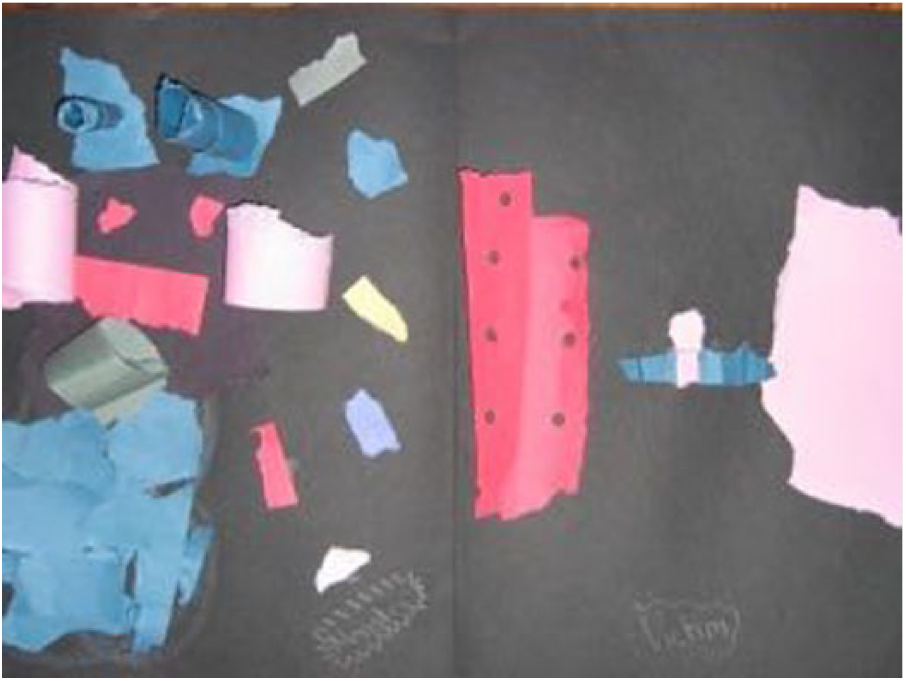
Bully and victim created by Julie.

Bully and victim created by Tammy.
Through our discussion of the art, I thought that the students would begin to see the victim’s point of view and realize that bullying hurts others. Surprisingly, most of our discussion focused on the bully, because many of the students identified with the bully. By identifying and discussing both the bully’s feelings and behaviors, the students and I discovered that the bully was once a victim who “had enough.” These students told me they believed that many victims could not take the pressure of being picked on, so they, in turn, became bullies to deal with this rage and anger. We talked about the shape of this behavior, how it became a cycle, around and around: Bullies created bullies out of victims.
Rage, Wisdom, and the Gifted Student
I am “destructive, absent minded. I feel misunderstood” ~Randy, writing as a bully
Cross (2001a) stated that rage in gifted students is caused by mixed messages received from adults about giftedness. They are encouraged to do well in school, but often the tacit understanding is that “giftedness does not exist, does not matter or that gifted students are already advantaged” (p. 36). This, coupled with taunting received from classmates about being smart and different, creates a great deal of rage in gifted students.
Freeman (1998) stated that one of the goals of gifted education is to instill wisdom and compassion. He contended that wisdom can enhance seemingly negative gifted characteristics and can create kinder and inwardly healthier gifted children. For example, he thought that the intelligence of gifted children often creates bullies, yet this intelligence, tempered with wisdom, can also create leaders. The gifted child often wants to dominate or bully others. This trait, tempered with wisdom, teaches the child to be generous to others.
After I had shed some light on the causes of the bullying, I hoped that our discussion and the solutions elicited from students would instill wisdom and compassion and make them guardians for a safer classroom and school. We determined that bullies are created from victims, but what experiences, feelings, and behaviors compel individuals to bully others?
The Kitchen, the Oven, the Freezer
I hurt people’s feelings and break their hearts. I don’t care what other people say. I am the only one that matters on this earth! People call me Blender Kid because I take their hopes, hearts and dreams and squish them like blenders. ~Tammy, writing as a bully
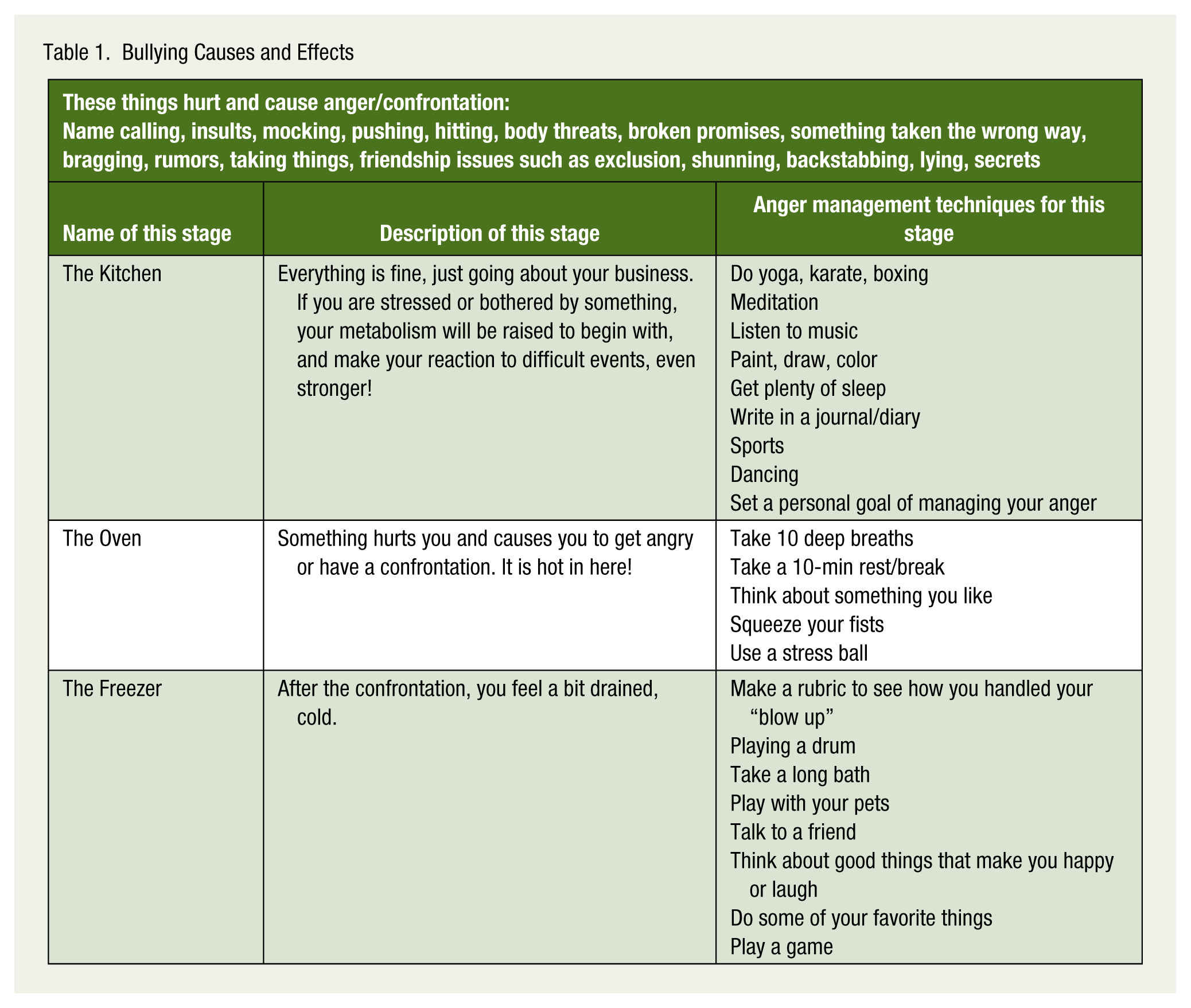
Surprised and inspired by this new understanding of how bullies are created, I decided to talk about what kind of victimization bothers these particular gifted sixth graders. We discussed and listed on a chart things that made them angry and hurt, which in turn caused them to lash out at one another. These were eventually placed on a final chart to remind them of the things good friends do not do to one another. The next step was to talk about ways of dealing with their anger. I used Fighting Invisible Tigers by Hipp (1985) to discuss with them the effect of short-term stress on metabolism.
The students described the following scenario: Before the stressful situation, people move along as usual and suddenly something happens that hurts or makes them angry and their metabolism kicks into gear, their heart rate and blood pressure rise, making it difficult to think clearly. At this point, it is crucial to make good choices in what they will do. When the crisis is over they feel drained and exhausted.
We talked about this process and compared it to the way bullies finally get to the victim and they snap, causing their metabolism to climb, and making them do and say unreasonable and hurtful things. We divided the process into three stages, creating a catchy name for each stage, so we could refer to them easily as problems came up. We called the first stage (while things were going along as usual) “The Kitchen,” the second stage (when reacting to the stress) “The Oven,” and the third stage (when the crisis is over) “The Freezer.” We then described each stage and listed what they could do during each one to stay relaxed and less prone to losing their temper when confronted with a stressful situation. Table 1 presents their insightful and positive solutions.
Bullying Causes and Effects
In Closing
I’m nice, I try hard, find the good things about something. I try my hardest, but someone always tells me that it’s wrong, or it should be better. ~Susan, (who used her own name as the victim) writing as victim
We fine-tuned the diagram, and I word-processed and forwarded it to the counselor to use as she discussed the bullying situation with the sixth-grade classrooms. The students were proud of their artwork and the diagram they had created together, especially, once they saw it word-processed and copied for their use. I immediately saw improved behavior within my classroom. I noticed that the students I suspected to be bullies were more accommodating to others, even protecting and nurturing a new student. The victimized students seemed to feel safer and I felt as if we had conquered a real problem in the room. Overall, too, students were excited that their chart was given to the counselor to use with other classes; they felt a strong sense of accomplishment and community.
Peterson and Ray (2006a, 2006b) had a number of suggestions for teachers as they monitor their classrooms and students elsewhere in the school. These include watching for overt and subtle bullying, including nonphysical bullying such as name-calling, and intervening immediately. Encouraging prosocial behavior through psychoeducational and affective curriculum is also a proactive step in preventing bullying.
Bullying, teasing, verbal and physical violence of children against children are major concerns for anyone working in the school environment. Although there is a great deal of research and opinion on bullying, if gifted children are mentioned at all, it is to present them as victims. I continue to be surprised that so few studies mention the phenomenon of gifted children as bullies, but I am heartened by the strong research by Peterson and Ray (2006a, 2006b), and hope that we continue to ask students the crucial questions that allow us to determine the roots of bullying and its prevention. We still have so much to learn, especially, if we want our gifted children to realize their full potential as learners and compassionate citizens.
Although confronting bullying in the classroom and in the school, the use of art and the principles of depth psychology were crucial in drawing out an underlying cause of the bullying issue, at least as it appeared in our context. Once the image emerged from deep within the gifted bullies and victims, we could face the issue together and I could work with students to find a solution they could identify with and follow. If we can teach children real-life problem-solving techniques and the wisdom of true compassion toward one another, we will have accomplished something great indeed.
Footnotes
Conflict of Interest
The author(s) declared no potential conflicts of interest with respect to the research, authorship, and/or publication of this article.
Funding
The author(s) received no financial support for the research, authorship, and/or publication of this article.
Bio
Jennifer L. Groman, PhD, is a teacher, singer, and songwriter. As a teacher she has worked with students from 2 years old to the graduate level, in general education, talent development education, creativity studies and songwriting, reading and math intervention. She has worked at the state level as a talent development coordinator and teacher trainer and at the local level in arts administration. As a singer, she has performed music from big band jazz to rock to bluegrass to indie, with four self-produced albums of her own music. She is an assistant professor and director of the graduate program in talent development at Ashland University, and a visiting lecturer for the talent development program at McNeese State University. She lives in Wooster, Ohio.