




Abstract
Although K-12 schools and universities are two separate and distinct systems, fundamentally both have the same broad goal: the education of students. This leads one to ponder, “How can these two entities work together to promote, foster, and support this goal?” In this article, I share and discuss the key elements for building a successful school–university collaborative partnership. A type of partnership that includes ongoing commitment founded on mutually beneficial goals, trust, equitable decision making, and communication. A partnership that produces high-quality research, improves educational practices in schools, and contributes to the field.
“This collaborative partnership is initiated to further knowledge in the field as well as to improve teaching and learning in schools”
Although K-12 schools and universities are two separate and distinct systems, fundamentally both have the same broad goal: the education of students. This leads one to ponder, “How can these two entities work together to promote, foster, and support this goal?” Over the years, schools and universities have joined for various purposes and alliances have evolved into a number of different forms. The purpose of this article is to share and discuss some of the tenets that lead to a successful school–university collaborative partnership (SUCP). The following articles center on a successful 3-year SUCP between The Center for Gifted Education (CFGE) and Paradise Valley Unified School District (PVUSD). Each is written to provide the perspective and work of those participating in this collaborative partnership.
What Is a Collaborative Partnership?
Partnership is an agreement where two or more people or groups work together to accomplish a goal (Turley & Stevens, 2015). However, partnership can describe a range of interrelationships from the most superficial to the most complex. These can range from symbolic to meeting some externally imposed need, to offering a one-sided service, to exchanging services, to working on separate goals using same resources, to achieving shared goals, values, and products.
The kind of school–university partnership being discussed in this article is on the more complex end of the continuum—one that leads to collaboration. This type of partnership includes ongoing commitment founded on mutually beneficial goals, trust, equitable decision making, and communication (Kezar, 2007). Most commonly, this collaborative partnership is initiated to further knowledge in the field as well as to improve teaching and learning in schools. For instance, the collaborative partnership can focus on piloting curriculum, examining new instructional strategies, or exploring new assessment approaches.
In addition, SUCP usually has a more complex configuration. Rather than having a simple and straightforward configuration in which university professors work directly with classroom teachers in the school, there is involvement of classrooms, whole schools, and the network of schools. This complex configuration most commonly includes a small group of university faculty working with teachers, principals, and district administrators to carry out relatively complex tasks at various grade levels.
The Core of SUCP
The core of SUCP is the critical bridge of theory and research with implementation and practice (Walsh et al., 2000). As schools constantly seek to find new instructional strategies, curriculum, and assessment to support student growth, universities seek to identify new approaches based on theory and research and to evaluate innovation in practice (Levin, 2013). In reality, the situation is based on two assumptions: (a) although schools have the capacity to design, implement, and evaluate instruction, curriculum, and assessment, they lack the resources to evaluate their effectiveness and (b) although universities have the capacity to design, implement, and evaluate instruction, curriculum, and assessment, they lack the naturalistic environment to conduct their study. For this reason, SUCP can become “win-win” for both partners, yielding advances in practice, research, and theory (Coburn & Penuel, 2016).
SUCP includes three systems: (a) schools/districts, (b) universities/departments, and (c) the joint entity recognized as the collaborative partnership (Baker, 2011). The structure of these three systems is distinct because differences between universities and schools are engraved in their culture (Hartman, 2017). These cultural differences relate to work tempo, work focus, rewards, degree of power, and autonomy. On one hand, schools are described as a culture of practice and, on the other hand, universities are described as cultures of research and theory. Teachers teach when the bell rings; faculty tend to do research on the day that accommodates their schedule. So how do these two unique systems work together to create a successful system for collaborative partnership?
Key Elements to Building a Solid Foundation for SUCP
One of the most difficult hurdles in making school-university partnerships work is helping people to realize that it is not just a bag of tricks, a list of “how-to-do-its.” Rather, it is an amalgam of principles and concepts, beliefs and values, conditions and process, people and programs, and hard work—work that is not neatly packaged for implementation elsewhere, but that originates and develops and improves in context. (Sirotnik, 1991, p. 15)
An SUCP involves merging two systems (i.e., schools/districts and universities/departments) to create the third one (Baker, 2011). There is no universal formula for developing this system. Effective practices are developed progressively on site over time (Coburn & Penuel, 2016). However, just like any type of partnership, SUCP goes through phases. Several key elements identified in the literature provide the road map to blend, develop, and build this new school–university collaborative system (see Table 1). Most of the key elements focus on strategies for bridging the two systems to create a viable merged system. I strongly suggest for those who would embark on such efforts to be mindful of the stages, as well as take to heart and adopt the following key elements. To understand how these phases and elements unfold in real life, the following article will describe in detail the development of a 3-year SUCP between The CFGE and PVUSD.
School–University Collaborative Partnership Phases
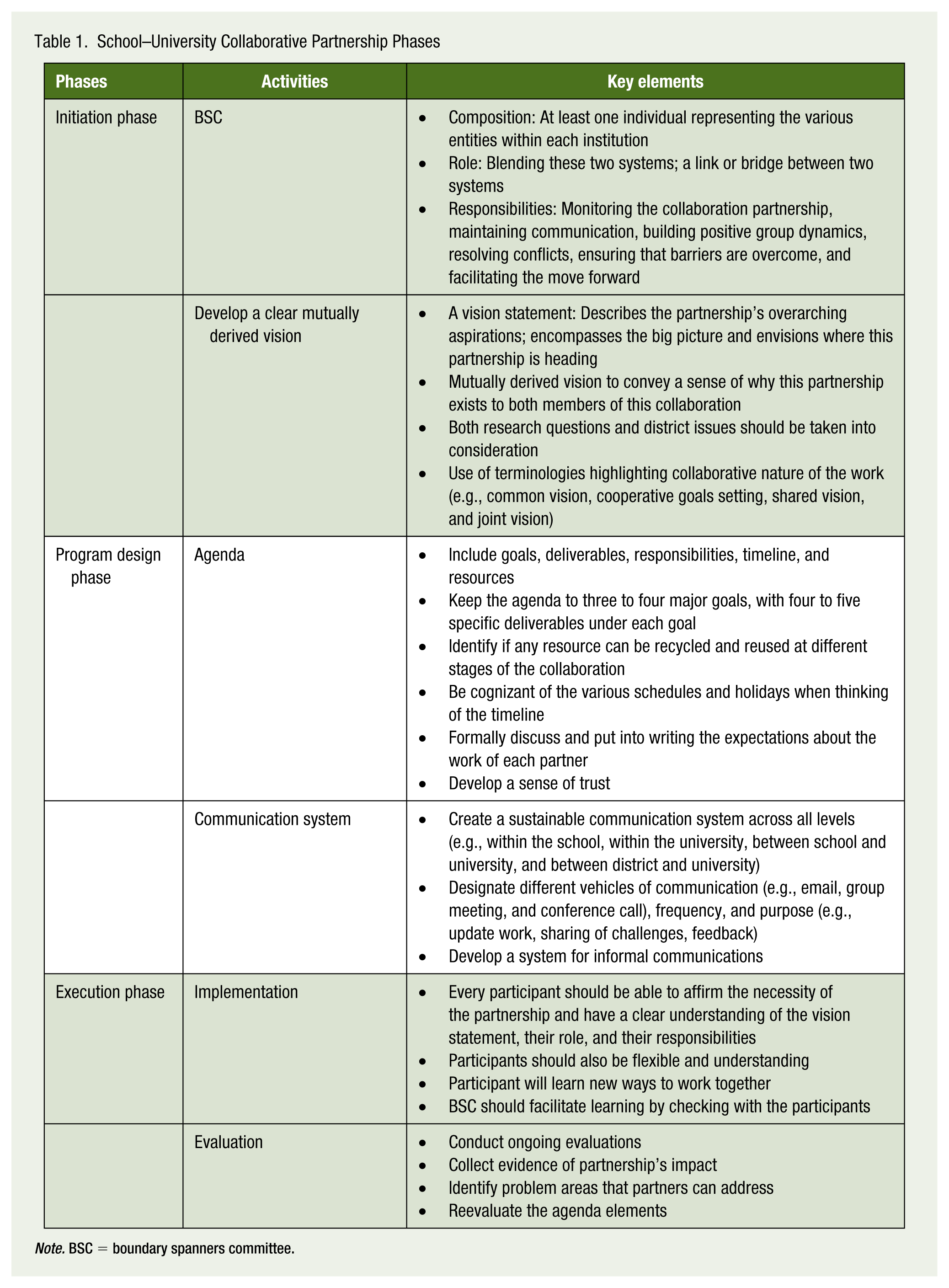
Note. BSC = boundary spanners committee.
Initiation Phase
The initiation phase is where everything begins from just an idea sparking in one person’s mind to suggesting it to colleagues, to contacting other institutions, to embarking on an SUCP. Most commonly, a written proposal is submitted from one institution to another to identify if there is any interest in forming a collaborative partnership (Fueyo & Lewis, 2002). Once interest has been shown, then the partnership should begin by establishing a boundary spanners committee (BSC) and developing clear mutually derived vision.
Establish a BSC
A BSC is a group of individuals whose roles and responsibilities include building a “bridge” and sustaining the connection between two systems (Kousgaard, Joensen, & Thorsen, 2015; Stevens, 1999; Weerts & Sandmann, 2010). First, it is important to recognize that I am talking about a committee and not one individual. Although a simple, charismatic individual may have considerable influence on a partnership, the presence of one leader, no matter how effective, is insufficient for such a complex partnership (Coburn & Penuel, 2016; Hartman, 2017). However, it is common to have an initiator in any kind of partnership. For an SUCP, this initiator should reach out to appropriate stakeholders to form a BSC, often described as liaison or convener.
The purpose of having a BSC is not to encourage hierarchical leadership but to play the role of blending these two systems. (Kezar, 2007; Peel, Peel, & Baker, 2002; Sirotnik, 1991). To do so, the “right” people need to participate in this committee—individuals who represent the various perspectives of those affected by this collaborative partnership (Baker, 2011; Kousgaard et al., 2015; Stevens, 1999). The BSC should include diverse representation in terms of roles, responsibilities, gender, ethnicity, race, language, or other characteristics. The spanners are making decisions influencing them as well as the population within both systems involved in this partnership. The diverse representation can avoid facing hidden barriers related to mismatch and clash in perspectives (Baker, 2011; Clark, 1999; Kezar, 2007). In terms of roles and responsibilities, this committee should include at least one individual representing the various entities within each institution involved in this partnership. For example, a good combination to form a BSC includes a gifted coordinator representing the district office, a program facilitator representing the teachers, a university faculty with expertise in research design, and a university faculty with expertise in curriculum development and implementation. With this configuration—which should also include diverse representation of gender, ethnicity, race, and language—various perspectives may be represented and ambiguity is diminished. Any questions, comments, concerns, or directions for either the university or the public schools goes directly to the BSC; they then determine who should be involved in solving each situation (Peel et al., 2002). This BSC serves as a link or bridge between two systems, speaking both languages and helping them to understand each other (Clark, 1999; Kezar, 2007).
A BSC may be the most critical element in helping two distinct systems to understand each other, creating an SUCP, and facilitating movement across the phases. (Firestone & Fisler, 2002; Kezar, 2007; Sirotnik & Goodlad, 1998). The BSC should take responsibility for monitoring the collaboration partnership, maintaining communication, building positive group dynamics, resolving conflicts, ensuring that barriers are overcome, and facilitating the move forward (Kezar, 2007). A variety of partnerships fail because they had no BSC to play this role. In fact, it is important to have the right people on this committee to take the responsibility for leading the effort in his or her system and accomplish the purpose of this partnership (Sirotnik, 1991).
Develop a clear mutually derived vision
Once the BSC has been established, a good first step is to formulate a vision statement. A vision statement should serve as a description of the partnership’s overarching aspirations (Fuentes & Spice, 2015; Hartman, 2017; Opolot-Okurut & Bbuye, 2014). It encompasses the big picture and envisions where this partnership is heading. For this reason, the vision statement should be mutually derived to convey a sense of why this partnership exits to both members of this collaboration. The vision statement will then be broken down into small pieces or components to serve as a tool for strategic decision making and developing goals in the next phase.
To ensure a mutually derived vision, both research questions and district issues should be taken into consideration. In other words, the research questions should be thought of as how the district could feasibly move forward with the findings, as well as the district issues should align and inspire potential impact in the field of education. Terminologies such as “common vision” (Anyon & Fernandez, 2007), “cooperative goals settings” (McNall, Reed, Brown, & Allen, 2009), “shared vision” (Buly, Coski, Aucutt, & Finch, 2015), and “Joint Vision” (Reardon & Leonard, 2017) are prevalent and encouraged in the literature. The vision statement should reflect the collaborative nature of the work, as well as align with both the school and university systems to ensure that the work that will be conducted is integrated within and supported by the systems. Successful partnerships reach agreement early on about the vision of the partnership (Reardon & Leonard, 2017).
Program Design Phase
After the initial phase, the heavy lifting begins. At this time, it is crucial to solidify the partnership and make sure the shared vision will be accomplished. The focus of SUCP is not one classroom but rather to a more complex consideration of the classroom, the whole school, and the network of schools. The BSC is central in the program design phase and should conduct intensive planning to develop a well-defined agenda and a communication system.
Agenda
The agenda should go beyond the shared vision to outline how the partnership can best work together (Buly et al., 2015; Butcher, Lchini, Ball, Barkle, & Martin, 2016; Coburn & Penuel, 2016); however, its development should stem from the shared vision to include but not be limited to
Goals that describe the elements necessary to accomplish the vision statement;
Deliverables that are specific steps, products, outcomes, or tasks that must be completed to reach the goal;
Responsibilities that define the role and duties of each individual;
Timeline that outlines what should be accomplished by a certain time; and
Resources that outlines the budget, materials, and location.
When establishing the goals and deliverables, it is important to consider the old saying: “Don’t bite off more than you can chew.” The tendency is to want to solve all the world’s problems at once. Partnerships work best when they have three to four major goals, with four to five specific deliverables under each goal (Coburn & Penuel, 2016; Fuentes & Spice, 2015). The agenda should highlight the small steps that need to be taken toward addressing the vision statement.
Any expectation needs to be clarified as well: Who will monitor what? Who will implement what? When should specific deliverables be reached? What materials are needed? What are associated budget items? In other words, the roles, responsibilities, timeline, and resources, should be also be part of the agenda. These expectations should (a) specify the support mechanism, (b) create a climate of mutual accountability, and (c) foster trustworthy relationships (Fueyo & Lewis, 2002; Kezar, 2007).
When assigning responsibilities, the BSC should examine their resources and timeline to determine how each party can contribute (Opolot-Okurut & Bbuye, 2014; Turley & Stevens, 2015). These three items go hand in hand. When thinking of resources, try to identify if any can be recycled and reused at different stages of the collaboration. When thinking of the timeline, be cognizant of the various schedules and holidays. Through this process, expectations about the work of each partner should be formally discussed and put into writing. Getting the right people to participate to accomplish the deliverables is critical. The more spread around, the better off the partnership will be. Authentic partnerships between schools and universities require mutuality in role and relationships (Walsh & Backe, 2013; Weerts, 2007). Truly collaborative relationships are based on coconstruction rather than being powered; they are oriented toward building and working together. At the heart of developing mutual relationships is the formation of trust (Peel et al., 2002; Thorkildsen and Stein, 1996; Walsh & Backe, 2013; Weerts, 2007).
Each participant should have the same clear understanding of the collaboration’s vision and goals. In addition, each participant should be aware of how his or her efforts and efforts of others will contribute to the vision. Trust is often lost in collaborative efforts when decision-making processes appear not to be mutual, decisions appear to be capricious, or one partner waits an inordinate amount of time for decisions to be made (Hartman, 2017; Walsh & Backe, 2013; Weerts, 2007). The success of the partnership is hinged on each partner trusting the other to do his or her part. No one should feel the need to point fingers and blame others for situations that arose in this joint venture.
Although this may sound like tremendous amount of work, this process saves times in the long run. It creates a mutual culture that avoids misunderstanding. The extended planning time helps the school and university to understand each other’s culture, develop trust, and learn to work and avoid barriers together (Buly et al., 2015; Thorkildsen & Stein, 2015; Walsh & Backe, 2013; Weerts, 2007).
Communication system
SUCPs are sustained through communication. For this reason, a major step is creating a sustainable communication system across all levels (e.g., within the school, within the university, between school and university, and between district and university). Communication gaps or poor communication is noted as one of the most frequent reasons for a partnership to fail (Anyon & Fernandez, 2007; Baker, 2011; Buly et al., 2015; Chu, Jones, Clancy, & Donnelly, 2014; Clark, 1999; Kezar, 2007). One solution to these problems is to develop a communication plan as part of the partnership’s program design (Hartman, 2017; Kezar, 2007; Sutherland, 2017; Turley & Stevens, 2015). A communication plan designates different vehicles of communication (e.g., email, group meeting, and conference call), frequency, and purpose (e.g., update work, sharing of challenges, feedback).
While formal communication built into a communication plan is important, informal communication is just as significant (Kezar, 2007). This is often where honest exchange occurs and problems are identified early. The BSC plays a key role in this type of communication, informally checking with various members of the partnership. While informal communication is too hard to plan, it should exist. Successful partnerships have noted it as one of the key factors that organizations need to consider as it helps them to understand each other and identify problems early (Hartman, 2017; Kezar, 2007; Sutherland, 2017; Turley & Stevens, 2015).
The sum total of these practices helps the two systems to move from two distinctive cultures toward a new shared culture with a common vision and mutual understanding of the issue. It also addresses the challenges that destroy partnerships, such as incompatible goals, lack of trust, and infrequent communications.
Execution Phase
The last phase of the partnership is the execution. At this phase, the collaboration is focused on the implementation and evaluation of the program that has been designed. Often, the collaboration flounders if the execution phase begins with inadequate planning, limited clarification of role and responsibilities, and an absence of a communication system.
Implementation
From the outset of this stage, every participant should be able to affirm the necessity of the partnership and have a clear understanding of the vision statement, his or her role and responsibilities (Anyon & Fernandez, 2007; Baker, 2011; Hartman, 2017; Kezar, 2007; Sutherland, 2017; Turley & Stevens, 2015). Such focus will help the agenda unfold. However, all participants should also be flexible and understanding. Unfortunately, the collaborative partnership rarely flows as smoothly as the description on paper (Baker, 2011; Hartman, 2017; Turley & Stevens, 2015). Participants should have a “We can do it, we can make it work” mind-set. The flexibility should be driven by the conviction for the partnership and by the vision statement.
At this stage, learning is particularly important (Turley & Stevens, 2015). Each participant must learn new ways to work together—exchanging information, implementing new procedures, and engaging in constant communication. New habits are being developed. Through this learning, the new shared culture emerges. The BSC should facilitate learning by checking with the participants to troubleshoot issues as they emerge (Walsh & Backe, 2013). In addition, communication is significant at this point. The partnership vision and goals need to be continually reiterated and clarified.
Evaluation
Evaluation is essential to maintaining partnerships and serves a variety of important purposes (Clark, 1999; Fueyo & Lewis, 2002; Kezar, 2007; Thorkildsen & Stein, 1996; Walsh & Backe, 2013). First, evaluation helps partners determine if they are creating a shared culture within the vision statement and if their processes are aligned. Second, partners will not understand if they are closer to achieving their goals unless they conduct ongoing evaluations. Partnerships are often difficult and laborious to maintain. Without evidence of the partnership’s impact, it is often difficult to keep both systems involved and to maintain momentum toward creating a new culture and working through the stains of culture clash. Although evaluations may not always show success, they can identify problem areas that partners can address, allowing them to get closer to meeting their goals and developing a mutual culture. Identifying a problem might sometimes be discouraging and hence lead to punitive actions such as pointing fingers toward one individual or pulling out of the partnership. For this reason, it is crucial to understand that the intent of ongoing evaluation is to identify issues early on and be proactive. The ongoing evaluation should be a tool that develops a dynamic decision-making process rather than judging the situation as “good” or “bad.” Third, evaluation helps identify whether participants understand their roles, if the structure in place is clear, communication is working, and appropriate resources are available for the partnership to work.
Partnerships should continuously build on past success and use past failures as a guide to identifying what they should avoid. Evaluation is a reality check to ensure that partnership activities are on target (Fuentes & Spice, 2015; Fueyo & Lewis, 2002; Kezar, 2007; Thorkildsen & Stein, 1996; Walsh & Backe, 2013). Incorporate systematic procedures for justifying and initiating changes in goals, deliverables, and timelines. Project objectives and goals need to be continually reiterated, clarified, and, at times, renegotiated.
A large number of elements are to be considered when developing an SUCP. I shared some of the main conditions necessary to create and sustain a successful collaborative partnership. An awareness of the importance of planning is crucial to the success of the partnership, as well as viewing planning and implementation as separate developmental stages within the formation of the partnership (Anyon & Fernandez, 2007; Baker, 2011; Chu et al., 2014). I would also like to emphasize that an SUCP should be viewed as coalition. When developed, there should be respect for the wants and needs of all players to create a climate of respect, collaboration, and trust. Otherwise, the chances of success are minimal.
Concluding Thoughts
For real improvement in the field, university and school districts cannot afford to simply collaborate for occasional research projects (Coburn & Penuel, 2016). There should be a formation of a long-term partnership centered on mutual commitment to produce high-quality research, improve educational practices in schools, and contribute to the field. When established properly, an SUCP can help solve many of the problems that educators face. As Dixon and Ishler (1992) stated, a collaborative partnership between universities and schools is a “time for reevaluation and renewal, an opportunity for reflection, and a mechanism for preventing a return to the old ways” (p. 32). Both university faculty and school personnel need to recognize the value of such partnership. However, these partnerships are not common because of time, funding, and resources needed to initiate and support these partnerships (Dixon & Ishler, 1992).
In the past, federal funding was provided to support partnerships between educators and other organizations. As an example, in 1999, the U.S. Department of Education’s Office of Special Education Programs provided funding for the Individuals With Disabilities Education Act (IDEA) Partnership, a partnership between professional and family organizations to support practices and research-based interventions by connecting research, policy, practice, and people (IDEA Partnership, 2014). Within the next 15 years, more than 50 organizations joined IDEA Partnership to improve outcomes for all students by bridging the work of decision makers, researchers, and stakeholders in education (IDEA Partnership, n.d.). With the strength of the partnerships, IDEA Partnership was able to support practice changes that have been called landmark changes in the education of students with disabilities. Unfortunately, IDEA Partnership came to a close by the end of 2016 due to limited available funding. However, their work and accomplishments have been made available to the public by the National Association of State Directors of Special Education (n.d.) and can be found at http://www.nasdse.org/Projects/IDEAPartnership. Leading by Convening is a document detailing the kind of collaboration that IDEA Partnership believes is necessary to achieve change in educational practice (IDEA Partnership, 2014).
Given this past success, leadership is needed to form a new national network to support work between university faculty and school personnel in the general field of education. This network could facilitate the sharing of information about the most effective ways to collaborate. Such efforts might include hosting a conference for university and school representatives or opening an online forum for exchanging strategies for creating and maintaining these types of partnerships. Working toward establishing a national network is important because it might be the only way to support work between school personnel and university faculty, reducing the current gap between research and practice.
Footnotes
Conflict of Interest
The author(s) declared no potential conflicts of interest with respect to the research, authorship, and/or publication of this article.
Funding
The author(s) received no financial support for the research, authorship, and/or publication of this article.
Bio
Yara N. Farah, PhD, received her doctorate in educational psychology from Baylor University, specializing in gifted education and measurement. She has a master’s degree in special education, mild to moderate, from California State University Northridge (CSUN, ’11) and a bachelor’s degree in elementary education, with a minor in psychology and a minor in philosophy, as well as a diploma in special education from the American University of Beirut (AUB, ’09). For the past 3 years, she coordinated and provided research support for the partnership between Center for Gifted Education at the College of William and Mary and a large school district in Arizona. Since 2013, she has served on the board of directors for The Association for the Gifted (TAG)—Council for Exceptional Children (CEC). Previously, she worked as a special education teacher in international baccalaureate schools and as a paraprofessional in fully inclusive classrooms.