



Abstract
In this article, an honors college student reflects on being gifted. In reflecting on her giftedness, she expresses her conceptions of various characteristics of giftedness that she has experienced through drawing. These drawings and associated captions are featured in this text, and the student discusses her process of experiencing the characteristics and developing the artworks. One of her honors thesis committee members provides connections to the literature for each of the issues the student discusses.
As a former teacher of gifted students, and as a current teacher educator, the experiences reflected in the work and reflections of a college student shed further light on the extraordinary phenomenon of giftedness. Jade is an honors college student—now a senior—who was tasked with completing an honors college project consisting of a paper and/or a creation. She sought to express her experiences of being gifted through art. Jade is a student at the same institution where I am a faculty member, though our paths had not previously crossed. She sought me out due to my background in gifted education and asked if I would serve as an advisor on her honors project. What follows is her introduction and discussion of the pieces she created for this honors college project.
Drawing From Gifted Experiences
I tested as gifted at the age of 11. As a perfectionist, I take pride in my work and am reluctant to take on a project that I would not be able to commit to wholeheartedly. Although it causes me to produce high quality work, it also holds me back from challenging myself, or may lead to procrastination. While I enjoy a challenge, I must be able to accept it with confidence, or I may not take it up at all in fear of failure.
This feeling that I am not good enough to meet the expectations of myself and others has limited many of my experiences. As such, I was late to refine one of my most cherished abilities: drawing. When I sketched in secret, my drawings never came out as I envisioned, so I never showed anyone my work; when I did, I would rarely get the response I wanted. Still, I was determined to improve and I became my harshest critic. Perhaps it was my giftedness in art that helped my abilities progress rapidly, and suddenly I was receiving praise from the very people who had critiqued that my work was subpar. But then, I started to feel bored; the assigned projects were too simple and I wanted to expand my creativity. I turned to art for my honors college thesis project, knowing that it would encourage me to consider how to represent abstract concepts in visual form.
As a biomedical sciences major and a psychology minor, I am very much invested in the objectivity of science and the subjectivity of the human experience. I see art as therapeutic and a way to remind myself that every person has their own story. For this project, I chose to tell mine.
The literature surrounding giftedness identified various traits that gifted children may experience (Clark, 2012). Some characteristics I related to, whereas others were more obscure to me, but nonetheless offered insight into how these characteristics affected the maturing mind, or how they may be brought about due to experiences. As I poured through publications in gifted education, I identified four common traits that seemed to impact my life the most: dealing with high expectations (Betts & Neihart, 1988), desiring to be challenged (Sisk, 1988), monitoring stress (Mendaglio, 1994, 2016), and recognizing the effects of strong empathy (Lovecky, 1992). These four in particular were a part of my personality for as long as I can remember. As a result, they either independently or collectively influenced my perception of my surroundings. Each of these became a theme of my respective artwork.
The fifth subject was less of a characteristic of gifted children, and more of a recurring theme that I noticed in the literature. Researchers (Mendaglio, 2016; Sisk, 1988; Whitmore, 1980) often concluded their publications with recommendations to parents and educators on how to best nurture a gifted child. I was fortunate enough to attend a school that was specifically designed for gifted students. It was an environment that felt personalized, and I thus grew to meet my potential. I chose to make that a topic of my art, as well, to convey the importance of proper education for developing children.
With people who are gifted comprising such a small percentage of the population, their experiences are too often overlooked and underrepresented. While it is advantageous to gather data from large groups and identify patterns, sometimes case studies are better suited to investigate a particular characteristic. My story may be representative of one person’s perspective, but sharing a story that I know so thoroughly may shed some light on a human experience that others can relate to or have yet to encounter.
Discussion
Through this arts-based research project, I discovered that many of my perspectives are not necessarily attributed to a particular aspect of my upbringing, nor even a developmental disorder. Rather, my giftedness left me predisposed to comprehend the world in a certain way, and those around me fostered it, shaping me into a person who, though flawed, I can be proud of. Investigating this topic also shed light on an area of giftedness that I would argue deserves further investigation: How gifted children can become more independent in nurturing and understanding their gifted side, rather than relying on the school system and other adult figures to recognize their giftedness and offer the proper resources for them.
Creating the artworks was an interesting process. Previously, my art consisted of assignments from class, random thoughts that I wanted to execute, or sketches that remain exclusive to my eyes. True to form, I procrastinated on the rough sketches, frustrated that the visuals were not coming to me as easily as I expected they should. At times I would stare at the page, pencil in hand, trying to force creativity out of myself. Other times I could feel my brain inching closer to the image that I was reaching for but could not quite grasp. Sometimes my sketches were too literal or limited to school, failing to be relatable to the masses. My biggest fear was coming off as pretentious, as my goal was to convey a challenge that I felt was too often disregarded as insignificant due to all the advantages that gifted children reap otherwise, similar to how people react to “first-world problems.” In actuality, those struggles are just as defining, especially as they manifest early in life.
The drafts evolved at different stages. Expectations went through several rough sketches, but the final draft is nearly identical to the product presented in this column. Assembling it was a deviation from how I normally conduct my art, as it is usually methodical and meticulous. Expectations was a reversal of what I was comfortable with; it was gloomy, unnerving, abstract, and disordered. I found myself having to withhold from making the lines cleaner. By the time I began to paint, I was more accustomed to the new style and freely moved the brush, unafraid to mix the watercolor and be experimental. It was liberating. Expectations (see Figure 1) subverted what others familiar with my art presumed I would produce.

Expectations (Brunicardi, 2018, p. 3).
Boredom (see Figure 2) required slightly more effort. Early sketches involved a clock, but I had trouble deciding how to incorporate it. I began to experiment with other representations of time, such as shadows, afterimages, sand, and so on, but to no avail. It was only when I decided to stop trying to force creativity, when an idea arose. I was catching up with an old friend in a café and was lamenting to him about my artist’s block. I doodled what I already had in mind: a figure digging himself out of an apple. Although we both felt the image was intriguing, I told him about wanting to pay homage to Salvador Dali’s melting clocks, and I continued to sketch whatever came to me, my mind beginning to numb as the anxiety of not finishing my thesis in time built. I realized that one of my clocks resembled the face from The Scream by Edvard Munch, and I instantly felt connected to it. Boredom was conceived under the very conditions that it represents.

Boredom (Brunicardi, 2018, p. 4).
From sketching Boredom came the foundation for another installation: Education (see Figure 3). As the majority of my boredom was related to schoolwork, or lack thereof, I included an apple in several of my sketches. Although it was not integrated into the actual image for Boredom, I felt that there was still more to be explored with the apple. First, the many colors applied in the drafts of what would become Education distinguished it from the other pieces that I envisioned at that point in time. I felt that until this piece, I was portraying giftedness as a burden, which, despite its challenges, was far from how I viewed it. Utilizing this piece offered a chance to acknowledge the benefits that I gained from my giftedness. It also allowed me to explore a more interpretive approach to art. The red apple is commonly associated with education, but despite that color’s depiction in popular culture, the apple comes in a variety of colors, each with its own unique taste. None is necessarily wrong or best, but eating each is a different experience. Drawing from Andy Warhol’s signature pop art, Education contrasts the potential for each student to be developed as an individual with the mass production that the school system inflicts on its students.
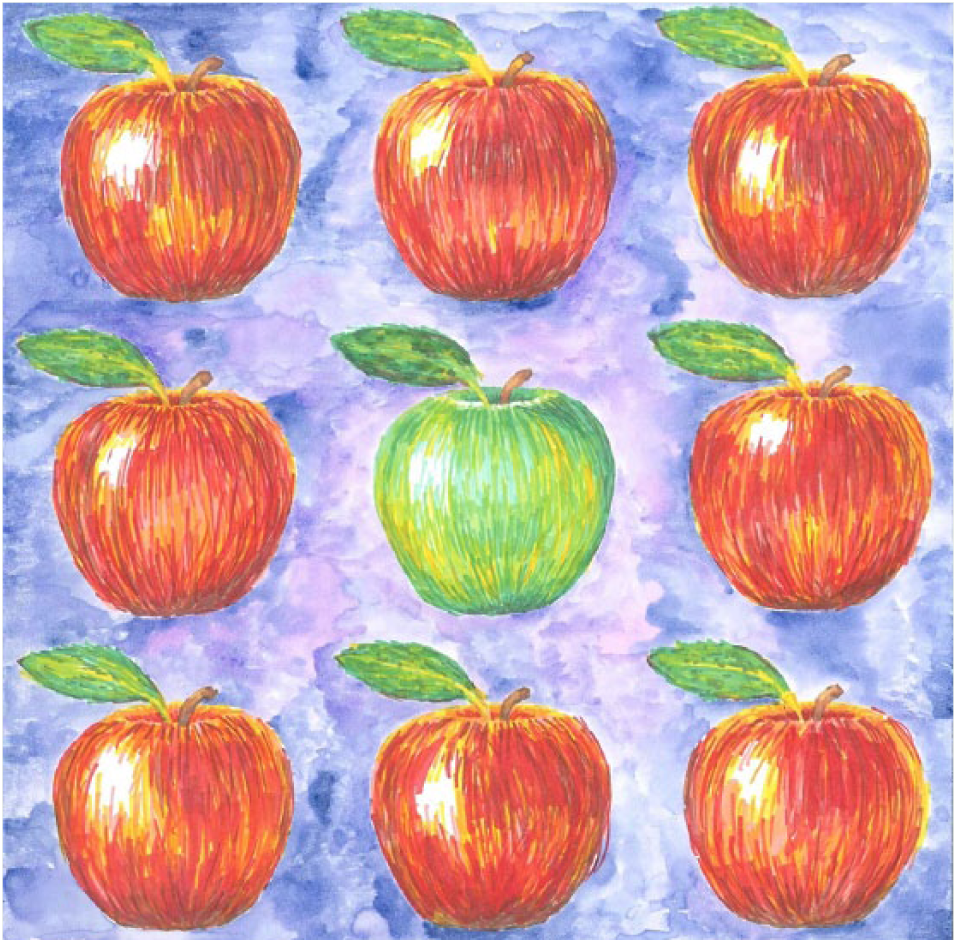
Education (Brunicardi, 2018, p. 5).
Anxiety (see Figure 4) was the first to be finalized, as it was devised years ago, but that does not imply that it was the easiest to execute. Conversely, it was the last one to be completed due to the complexity of mimicking real-world proportions. This was made more troublesome due to the woman’s unusual pose, for which there were practically no perfect imitations to use as reference. Attempting to capture the specific anatomy and gesture became a main technique employed in this installation. In one draft, her head was too big; in another, her knee was positioned too low. The outline was painstakingly penciled four times, each with miniscule adjustments along the way. It was frustrating having to restart repeatedly, but the proper framework was eventually set. The repetitive process made me all the more reluctant to begin both the penciling and the inking stages when the time came. Anxiety was a mental battle to overcome my fear of failure.
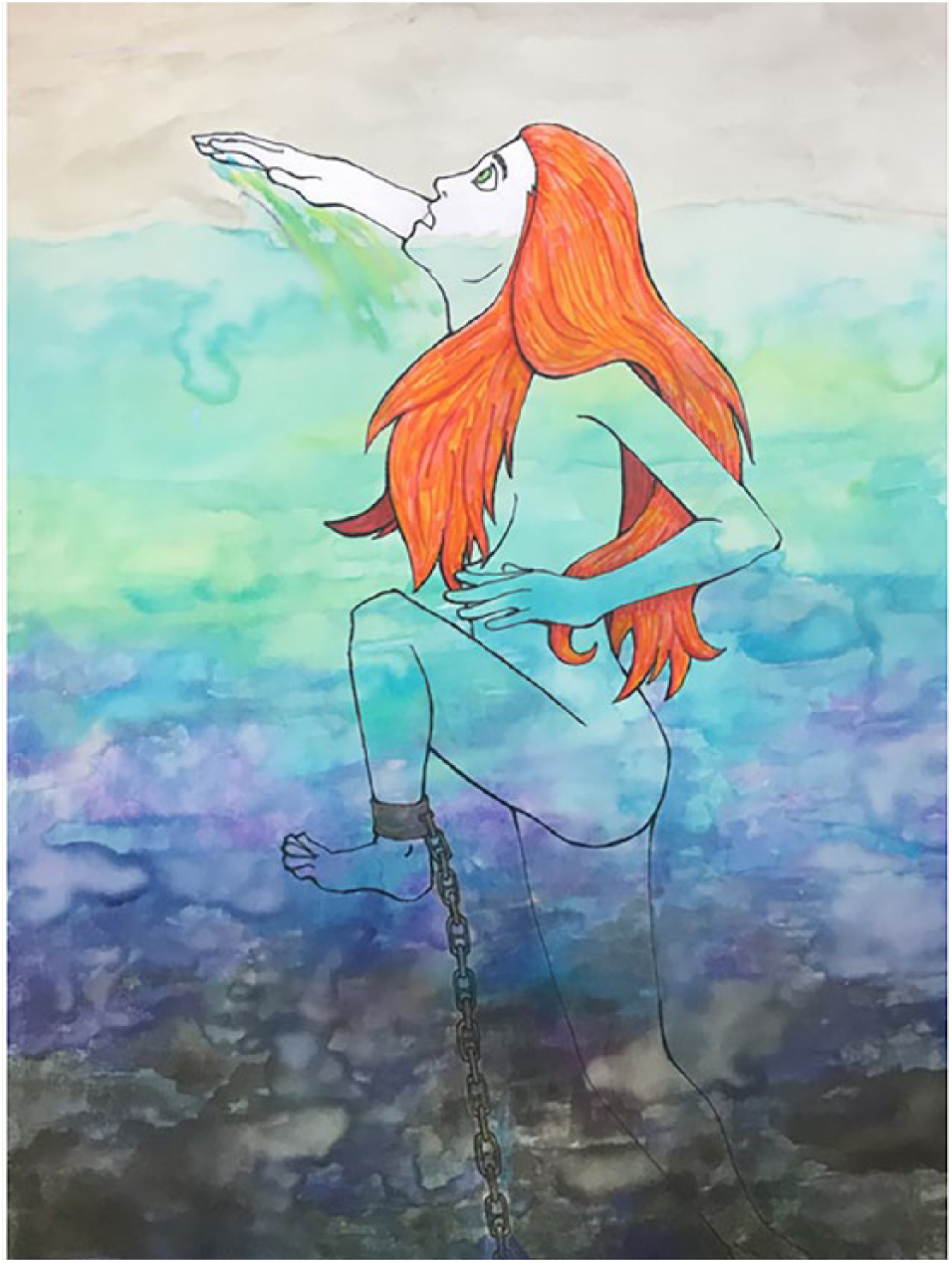
Anxiety (Brunicardi, 2018, p. 6).
Empathy (see Figure 5) became my favorite piece, in part due to the creative process that I underwent to achieve the eventual image. Initially, it was the last one to have a sketch that I was satisfied with. Empathy was such an abstract concept that I rarely ever saw in physical form. I searched through the Internet to find inspiration and eventually came up with the idea of a heart stuck in a brain. My scientific background prompted thoughts about the string-like texture of the corpus callosum that connects the two hemispheres of the brain and how shoving a human heart between them would give a stretchy appearance. I loved the concept, but in practice, I failed to capture the mutual strain caused by the two organs, so I began to revise the design. Coincidentally, I was shadowing a neurosurgeon at the time, and as a result, I was exposed to many magnetic resonance imaging (MRI) scans to observe tumors. That was when I became obsessed with the idea of representing the battle between emotions and logic by depicting the heart as a tumor. Yet unlike a tumor, both are necessary to sustain life. I was captivated with how it would look recreated, so I completed a sketch as soon as I could. As desperately as I wanted to use this image, I was worried that it would be difficult for the average viewer to pinpoint what it was. I showed it to several people outside of the medical field, and it seemed legible. The creative process, the techniques involved, and the incorporation of the various disciplines that I love make Empathy my favorite piece.

Empathy (Brunicardi, 2018, p. 7).
The obstacles did not stop once the five pieces were decided upon. Combining the high expense of art materials with the budget of a student who practices art as a hobby results in limited access to supplies. Despite my 24-pack of Prismacolor markers, I still did not have all the colors that I envisioned to include in the project. Thus, I had to improvise, often opting for pen-and-ink techniques rather than alternative forms of color. The watercolor also had less hue range than anticipated, but I once again adjusted to my restrictions to capture the overall tone that I was aiming for in that artwork. My perfectionism also came into play numerous times, manifesting as frustration due to the lack of supplies at my disposal, hesitance to start in fear of making errors, annoyance with the minor mistakes I made along the way, the numerous times I redrew the pencil layout for the final work, or dissatisfaction with how deep my darks were.
Aside from the challenges faced in the creative process, merely reviewing my work was taxing. Each time I revealed my artwork, be it drafts or the finished project, I was very vulnerable. Every drawing was an insight into my psyche, leaving me feeling exposed. But fortunately, I was surrounded by people who were supportive and provided honest feedback that helped my thesis evolve and developed me into a better artist.
Conclusion
Art is a creative outlet that repeatedly encouraged me to challenge what I know. My art teacher in high school was the first to push me outside the familiar. It was during those few years when I evolved as an artist, shifting from still-life drawings to original pieces. In college, my thesis chair served as a major inspiration for this project. He taught me how to reflect on my life experiences and their impact on me as a person, and to incorporate those perspectives into my artwork. I am thankful to have access to educators who are well-versed in the artworld and are supportive of my pursuit of self-discovery through art.
As I read through the literature, I repeatedly nodded in agreement with most of what was published, be it how gifted children responded to stress or how their behavior was affected by the information they processed. However, there were other behaviors that made sense psychologically, but did not apply to me, such as disciplinary issues. This concept explained how gifted children may not be able to reach their full potential if their unique way of thinking is not cultivated properly, whether it is by their parents or their educators. I personally did not experience this in part not only because I had that strong support system but also because acting out is not part of my personality. Therefore, it is important that each child is tended to on an individual basis.
Giftedness takes many forms, making it a difficult discipline to study. Some signs of giftedness may not be as recognizable as others, so it is crucial that society, especially educators and parents, take notice of the minute signs that a child might be gifted and offer him or her the opportunities to nurture that rare mind, rather than punish him or her for something that he or she has yet to realize can be a major advantage in life. At the same time, gifted children should be reminded to develop their own interests outside of academia to foster a more balanced lifestyle. Encouraging them to push themselves outside of their comfort zone will allow them to become accustomed to normalcies that they otherwise rarely experience due to their giftedness, such as failure, and instead help them to overcome those weaknesses in their own way. I hope to continue to give back to the gifted community in some form, perhaps by revisiting my high school for the gifted and speaking to the students about the challenges they are sure to face in the future.
Linking Jade’s Work to Gifted Education
As Jade notes in her discussion of the connections between her art and its representation of giftedness, she read several works in gifted education to learn terms and theories that are common to the field to have an informed dialogue about her experiences. Perfectionism was one of the most dominant themes Jade discusses, particularly when she mentions her efforts to produce high quality work, which may be viewed as striving to attain high standards, sometimes known as adaptive perfectionism (Rice & Ashby, 2007), though more recently recognized as perfectionistic strivings (Stoeber & Otto, 2006). At times she struggled with procrastination and fear of failing, which are forms of maladaptive perfectionism (Rice & Ashby, 2007), or more recently recognized as perfectionistic concerns (Stoeber & Otto, 2006). She also mentions that she feared not meeting the expectations of others—known as socially prescribed perfectionism (Hewitt & Flett, 1991). Researchers have also identified subgroups of perfectionists, including one group that sets high standards for performance while not being overly self-critical of their performance, a second group that also sets high standards for their performance but is highly self-critical, and a third group that has perfectionistic strivings at low levels (Dickinson & Ashby, 2005). A thoughtful professional learning experience for educators may be to examine Jade’s statements throughout her writing above and consider publications about perfectionism (such as Neumeister, 2018; Stoeber & Otto, 2006) and discuss whether Jade presents as exhibiting perfectionistic strivings or perfectionistic concerns.
There has been great interest in understanding the prevalence of perfectionism among gifted learners (Neumeister, 2018); findings to date suggest that students who are gifted are not more likely to have perfectionistic tendencies than individuals not identified as gifted. While the literature reflects numerous studies about prevalence, there is a paucity of work addressing interventions for students who are plagued with maladaptive perfection. However, recent work by Mofield and Chakraborti-Ghosh (2015) details the effectiveness of their affective curriculum to reduce unhealthy (or maladaptive) perfectionism and increase healthy (or adaptive) perfectionism with gifted learners in middle school. For students like Jade, who appear to have been beset by perfection for many years, an introduction to perfectionism, including its benefits and challenges, as well as strategies for managing the difficulties of unhealthy perfection, would be helpful through gifted education seminars, pull-out classes, or other venues where students who are gifted are afforded opportunities to learn more about self-care.
Jade also alludes to boredom. She links boredom with “schoolwork, or lack thereof,” which may suggest that she, like other gifted learners, simply did not feel sufficiently challenged in school (Preckel, Gotz, & Frenzel, 2010). While boredom has been discussed as an emotion that can be experienced by anyone, students who are gifted may be particularly susceptible if they are not appropriately challenged in school (Gallagher, Harradine, & Coleman, 1997), and boredom may serve as a precursor to underachievement (Gentry, Gable, & Springer, 2000). Based on their interviews with 10 gifted underachieving high school students who had dropped out or been suspended from school, Kanevsky and Keighley (2003) found that the primary reason these students had been disenchanted with school was boredom. This boredom was traced to five interdependent features, each of which had some bearing on whether the students engaged in learning or were bored by schooling. These features included control (students’ need for self-determination in learning), choice (or explicit opportunities to select on one’s learning options), challenge (learning opportunities that provide sufficient difficulty with novel learning approaches), complexity (learning that incorporates abstraction and sophistication), and caring (educators who are passionate about working with gifted learners, who are innovative in their instructional approaches, respectful and thoughtful of all learners, and committed to high-quality student interactions and job performance). Jade’s preference is to learn through experiences that challenge her in an environment with educators who cultivate her interests and seek to enhance her well-being and academic growth. According to the literature, she is not alone in these desires, and they do not cease once she graduates from high school. As shown in this work, she clearly has a continued thirst for growth, is reflective, and, as a senior in college, is aware of her talents and gifts and seeks to understand how to continue to use these as she forges ahead into her graduate studies, career, and life.
Another consideration in Jade’s work is her attention to empathy. She acknowledges that empathy was an aspect of giftedness that appeared in the literature and intrigued her, leading her to create her favorite of the pieces. Empathy has been examined in various studies, including an investigation of 974 Israeli students in Grades 5 through 12, including 330 students in self-contained gifted classrooms, 178 students in pull-out programs, and 466 students not identified as gifted (Shechtman & Silektor, 2012). Based on findings from self-report surveys of cognitive empathy (“Sometimes I have difficulty understanding the other’s point of view,” Shechtman & Silektor, 2012, p. 65) and emotional empathy (“Sometimes I do not feel the sorrow that others experience,” Shechtman & Silektor, 2012, p. 65), students identified as gifted—regardless of service placement—had significantly higher emotional empathy scores than non-gifted students. In addition, middle-school students who were gifted had higher cognitive and emotional empathy than non-gifted students. While Shechtman and Silektor provide one of the few empirical investigations of empathy among gifted learners, the construct of empathy has been examined in various discussions, particularly those involving affective development of the gifted. Mendaglio (1995), for example, proposed a conception of sensitivity that fused multiple psychological themes, including empathy, into a single conception. While the field of gifted education has theorized about the role of empathy among individuals who are gifted, empathy remains an area to be explored empirically.
Jade’s artwork provides a vivid expression of her experiences as a gifted learner. She recalls dealing with others’ expectations, experiencing boredom at school, making sense of how to graphically represent anxiety and empathy, and recognizing that the source of boredom had been school, which led her to select an iconographic image for her depiction of it. In discussing the development of these installations, we learn a little about the artist and her perfectionism, though we learn just enough about the creation of the artworks themselves to wonder more about those experiences represented in the first four works with which Jade says she most identifies. The final installation, Empathy, is unique in that, as she indicates, it is not a trait she feels to the degree others who are gifted may feel. However, what she found intriguing is evident in her development of it and her excitement in developing a piece that is interdisciplinary, taps her creativity, and capitalizes on her scientific background. Even in saving this work for the last to be discussed, she builds to this crescendo of drama in her collection, reveling in her thought process, goals for the work, tensions in presenting the vision, and executing the abstract concept in art.
Having seen her works, I was impressed with each one and admired her talent and creative expression. To read her thinking about the works provides an even greater understanding of the importance of these pieces for her as an artist and as an individual coming to terms with how giftedness has shaped her and continues to influence her development.
Footnotes
Conflict of Interest
The author(s) declared no potential conflicts of interest with respect to the research, authorship, and/or publication of this article.
Funding
The author(s) received no financial support for the research, authorship, and/or publication of this article.
Bios
Jade Brunicardi is a student majoring in biomedical sciences and minoring in both psychology and geology in the College of Arts and Sciences at the University of South Florida (USF). She is also a student of the Honors College at USF, for which she wrote “Drawing from Gifted Experiences” as her Honors College Thesis. She is graduating in Spring 2019, after which she intends to go to medical school to pursue neurology and research. Her previous research experience includes two summer internships at the National Institutes of Health.
Elizabeth Shaunessy-Dedrick, PhD, is professor of gifted education in the College of Education at the University of South Florida, where she serves as the program coordinator for the Gifted Education Program and the EdD in Program Development in Educational Innovation. She is the Co-PI of a grant funded by the U.S. Department of Education’s Institute for Education Science to investigate the development of an intervention to support AP and IB students’ academic success and emotional health. With colleagues, she recently co-edited the APA Handbook of Giftedness and Talent (Pfeiffer, Shaunessy-Dedrick, & Foley Nicpon, 2018).