




Abstract
This article presents a view of barriers to effective gifted program evaluation resulting from ineffective tools for measuring growth in gifted students and the human barriers confounding the evaluation process. The role of advocacy in the design, implementation, and utilization of evaluation studies is examined. Long held beliefs and biases related to gifted education are recognized as influencing program evaluations. The recognition of the strengths and challenges inherent in the educational role of specific stakeholder groups is presented. Suggestions for developing an emerging cadre of advocates for gifted education are detailed.
“BUILDING STRONG ADVOCACY FOR GIFTED EDUCATION MAY NOT ONLY ENHANCE THE EVALUATION PROCESS BUT ALSO THE READINESS TO IMPLEMENT RECOMMENDED CHANGES.”
In an era of accountability, the evaluation of programs for the gifted is complex and fraught with educational, cultural, and political challenges. Gifted program evaluation can be perceived as unnecessary and unwanted as well as methodologically too complex. Yet, such evaluations can be important tools in engendering recognition and support for those already identified as gifted as well as the many thousands in this nation whose gifts and talents are unrecognized and untapped (Olszewski-Kubilius & Clarenbach, 2012). Support for any gifted program relies on the strengths of all stakeholders and the reduction or elimination of barriers to documenting effective practices.
To be effective, gifted program evaluations must be developed with the recognition of common challenges in the field. VanTassel-Baska (2006), reporting on a decade of evaluation research, suggests such challenges include a lack of credibility related to multiple conceptions of giftedness and multiple models of service, research limitations that fail to demonstrate the importance of gifted education, and charges of elitism. Two specific barriers that stem from these issues are the varying degrees of stakeholder awareness of and commitment to serving the needs of gifted and talented students and the limitations on assessing and reporting the growth of students through standard status models of achievement (McCoach, Rambo, & Welsh, 2013). Consideration of stakeholder group perspectives and multiple approaches to assessment may be important in expanding program advocacy and program improvement (Renzulli, 2012; Roberts & Siegle, 2014).
Gifted Evaluation at State and Local Levels
Program evaluations provide states and local school boards with reports on the progress of the district in meeting goals or maintaining compliance with policies (VanTassel-Baska, 2006). Without any federal requirements or guidance, planned evaluations may differ greatly from state to state and from district to district due to differing goals, policies, resources, evaluation expertise, context, selected methodologies, and time constraints (Brown, Avery, VanTassel-Baska, Worley, & Stambaugh, 2006; VanTassel-Baska, 2009, 2018). A number of states and school districts enact policies for gifted education that require some form of evaluation. Program evaluations may be planned on a cyclical basis, annually or every 35 years.
The current status of gifted program evaluations in the nation has been examined in two recent studies: one analyzing state reporting and the second a survey of district gifted programs. First, a biennial report prepared jointly by the National Association for Gifted Children and the Council of State Directors of Programs for the Gifted (NAGC & CSDPG, 2015) detailed program reports from 40 states. Of those reporting, 32 mandate evaluations but only half of those require a specific report to be submitted. Frequently, such reports include information such as service delivery options, teacher training, and general demographic information on identified students. Only seven of the 40 states require any measures of gifted students’ academic progress. In the second study (Callahan, Moon, & Oh, 2017), researchers surveyed respondents from 1,566 different school districts and discovered that fewer than 50% of those surveyed reported having a program evaluation requirement or any strategic plans to monitor and report on the quality of their gifted program services. Both studies make clear that program evaluation is under-utilized as a tool to improve gifted programs and services.
Barriers to Effective Gifted Program Evaluation
Consideration of barriers is a critical step in the design, development, implementation, and use of program evaluations. Planners can improve the evaluation process by purposely seeking specific evidence of student growth related to gifted program participation. They can also expand efforts to ensure stakeholders understand the goals of programming for gifted students, the value of the evaluation process, and the important role each stakeholder plays in promoting positive results.
Evidence of Student Progress as a Barrier
Without documentation of the value of gifted services, school boards and policy makers may perceive services for gifted and talented students as a luxury that can be cut when budgets are tight (Pfeiffer, 2002). Decision makers also need to have documentation that program goals are met and that students receiving services are positively impacted as a result.
Too often, program evaluations emphasize the easy path to data collection and analysis, evidence of the processes of program development (e.g., How many students were identified? What is the ethnic distribution? What specific program models are used? What funds are expended? How much training has been provided?). These data show evidence that a program exists, but they do little to reveal the impact on student progress. Consequently, state legislatures and local school boards rely on their limited individual knowledge of gifted programs and gifted students as well as staff reporting on program status, and results from Advanced Placement course testing (Hunsaker, 2000). Specific norm-referenced assessments are used in the identification process but have no or limited roles in programming assessments (Cao, Jung, & Lee, 2017; Pfeiffer, 2015).
Of particular significance in program evaluations is the availability of assessment data that are aligned with the NAGC Gifted Programming Standards (NAGC, 2010), specifically Standard 2.4. Learning Progress and Outcomes. This standard requires evidence of advanced and complex learning to document student progress. The standard suggests use of pre- and post-assessments, performance-based assessments, differentiated product assessments, out-of-level standardized assessments, and the use of assessments to develop individualized student profiles to guide planning.
The varied forms of assessment as specified in the NAGC Standards, however, appear to have limited use in gifted program evaluations. Examples of such measures, along with benefits and barriers to use, are highlighted in Table 1. The list is offered to provide a few examples that are currently in use in schools and could offer promise for expanded use in providing data within gifted program evaluations. Such assessments should be aligned with program goals, anticipated student outcomes, and selected and used in the context of curriculum and service options.
Assessment Measures Recommended in National Association for Gifted Children Standards
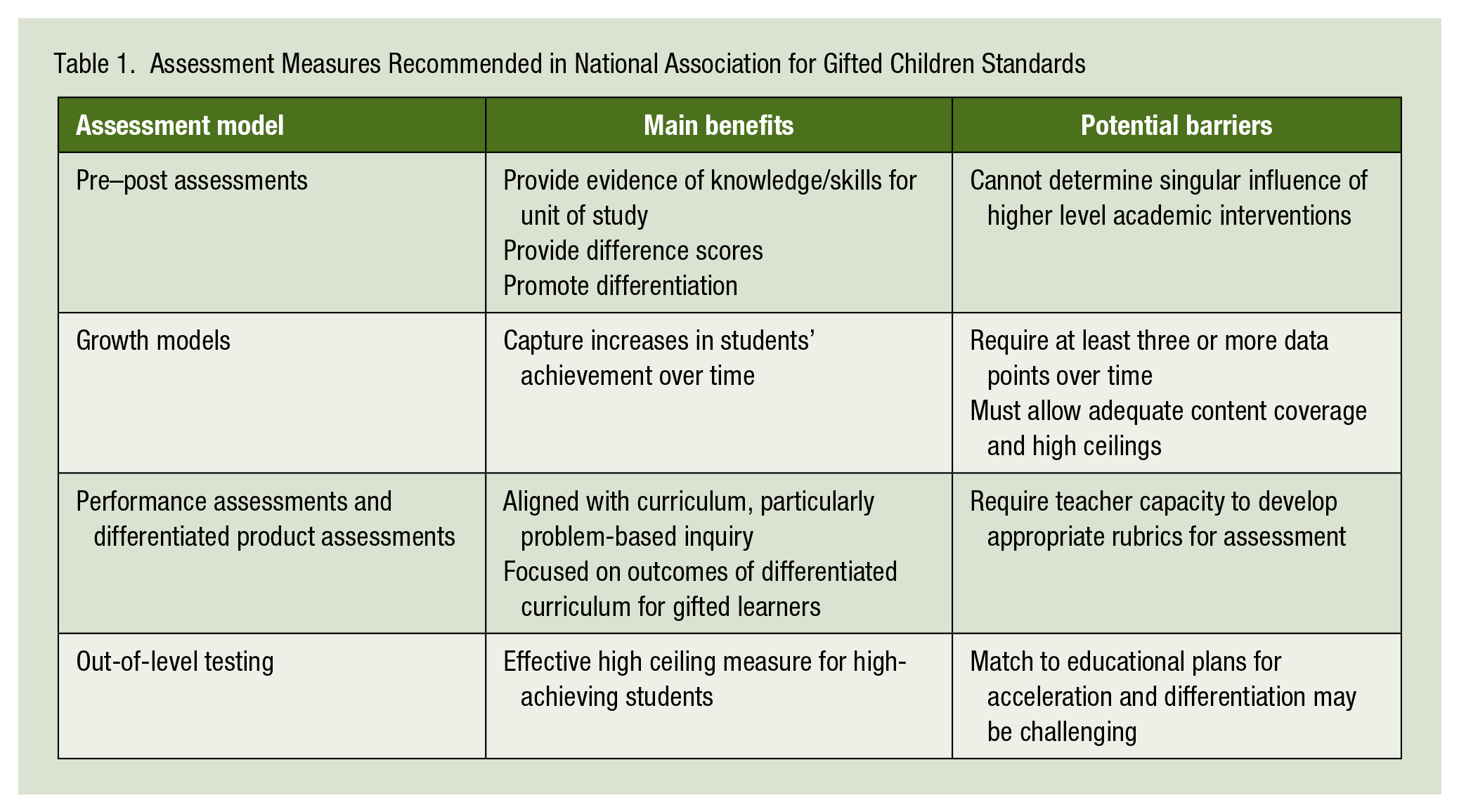
Pre–post assessments are frequently supported as effective in differentiating instruction for gifted learners. Students and teachers can see the difference between their initial measure of knowledge and skill, often at the beginning of a unit of study, and their performance at the end of the study. In addition, teachers often use the results of pre-assessment to determine needs for adjustment in their instructional plans, depending on the results of the assessment. The challenge in using only pre- and post-assessments is the inability to determine which specific academic interventions might have influenced the change (McCoach, Rambo, & Welsh, 2013). Yet they do offer useful data on higher level growth in content-specific areas.
Assessments that measure student growth over time offer important evidence of the impact of students’ educational placement (NAGC, 2008; Ryser & Rambo-Hernandez, 2014). Along with pre- and post-assessments, growth models provide an accountability measure of school effectiveness, which document students’ achievement over time using comparable assessments (McCoach et al., 2013). Growth models are more equitable as a measure when comparing gifted program effectiveness across schools within a district, particularly those with varying levels of socioeconomic status (McCoach et al., 2013). Thus, growth models can be a fairer accountability measure than a single point in time assessment.
Performance assessments direct students to create a product or develop a response that demonstrates their ability to apply specific knowledge and skills. These tasks may be used on a pre–post basis or as a time series in addition to being used as a one-time product indicator. Performance tasks are generally highly engaging and meaningful to the students, often incorporating an authentic audience. Performance assessments are useful in determining authentic measures of growth in gifted students, allowing them to reveal their acquisition of higher level skills and content knowledge. Such assessments are often used in conjunction with additional short-term assessments such as quizzes and tests. Performance assessments are especially effective for judging project-based learning (VanTassel-Baska, 2014).
Out-of-level testing generally employs the use of standardized, norm-referenced tests that were designed for a different age group or grade level. The rationale for out-of-level testing is the recognition that grade/age level tests may not have a sufficient ceiling to measure the advanced abilities and achievement of gifted students (McBee, 2006; Warne, 2012). Such testing is most frequently used in consideration of student acceleration or aspects of differentiation of the curriculum (Rambo-Hernandez & Warne, 2015). The use of out-of-level testing is well supported by experts in gifted education (Warne, 2012) and has been used most successfully for content-based acceleration.
In spite of the availability of alternative forms of assessment for use with gifted students, additional knowledge and skill development must occur for widespread use in these accountability measures recommended by the standards. As noted earlier in this article, specific evidence of students’ learning progress is absent from all but seven of the states reporting information compiled in the NAGC State of States report (NAGC & CSDPG, 2015).
Stakeholder Knowledge and Perceptions as Barriers
In gifted program evaluations, data-gathering about program services offered is often followed by surveys, interviews, and focus groups where stakeholders are asked to express their views and opinions. The awareness, knowledge, and perspectives of stakeholders are tapped through these processes.
A challenge frequently cited as a barrier to gifted program effectiveness is the lack of understanding the nature and needs of gifted children (Borland, 2009). Along with this barrier is the perception of gifted programs as elitist. This notion is particularly prevalent in districts where there is considerable disparity between well-funded schools in affluent communities and communities with limited resources and poorly funded programs (Yeung, 2014). Differences in cultural experiences and opportunities prompt the notion that gifted programs do not reflect our democratic society and are unnecessary exaggerations of the disparity in cultural experiences and opportunities. This pattern of thought is present in many school communities, resulting in the prevalence of misunderstandings and the growth of myths related to gifted learners (Portešová, Budíková, & Juhová, 2014; Yeung, 2014). For example, many people, teachers and school leaders included, believe myths surrounding gifted students, such as the following:
Gifted students can make it on their own and do not need special services.
Gifted students will be fine in the regular classroom with the regular curriculum.
Acceleration is harmful to gifted students.
Gifted students always get good grades.
Gifted students excel in all areas.
Gifted programs deny special treatment to other learners.
Gifted students are all happy and well-adjusted.
All gifted students are the same.
Rooted in these beliefs is the lack of understanding necessary for ensuring the support and advocacy required to sustain and improve gifted programming. Stakeholders with misperceptions may view a program evaluation as unnecessary. School board members may consider evaluations from a cost/benefit perspective and limit funding. Principals may dismiss the evaluation activity as a necessary but unuseful intrusion. Teachers may feel threatened and less than willing to actively participate in evaluation activities. Program evaluation design and results may be clouded by the presence of these misunderstandings and misguided perceptions of gifted learners and gifted programming. Thus, evaluations may be perceived negatively by stakeholders, even before the evaluation plan is established or the first data sets are gathered.
Each stakeholder group brings significant strengths to the evaluation challenge, and individuals within each group can use these strengths in a positive manner for program improvement. The implementation of each gifted program relies on the strengths of all stakeholders and the reduction or elimination of barriers to providing and documenting practices. The evaluation implementation may be substantially influenced by the perceptions held by specific stakeholders and their motivation to enact and/or enhance the program offerings or to maintain the current school culture for gifted youngsters (Robinson, Cotabish, Wood, & O’Tuel, 2014). Evidence that supports alignment with NAGC programming goals (NAGC, 2010) as well as local goals may be depressed by the very nature of the readiness and abilities of the stakeholders to promote best practices in gifted education.
Table 2 details the strengths of each stakeholder group in supporting gifted learners and gifted programming. It also suggests barriers that may influence the advocacy of each group. Each of these groups plays a critical role in the local implementation and evaluation of gifted programs.
Gifted Education Stakeholder Strengths and Barriers

Teachers are the most significant agents of change in the school’s instructional program (Hattie, 2003). Their support of all the children in their classrooms requires incredible time and energy. Their responsibility and commitment to ensuring every child meets standards means that much of their efforts will naturally go toward developing plans and modifying curriculum to ensure that those children who need more support will get that extra time and effort. When some children appear to already have the requisite knowledge, it is a natural inclination to give a sigh of relief and provide little attention to modifying their learning processes. Without a deep understanding of how that lack of attention impacts the gifted child’s learning trajectory, there is little commitment from the teacher to change (Hansen & Feldhusen, 1994). Limited understanding of differentiation and a lack of proper curriculum materials compound the problem. Teachers are quite familiar with some forms of assessment as they document the progress of their students and experience the assessment of their own work through the teacher evaluation process. However, they may not be aware of best practices in documenting progress in gifted learners. Gifted program evaluation may also surface opinions and misconceptions about gifted identification and programming. In particular, teachers may be unfamiliar with evidence of giftedness in diverse populations including economic, ethnic, and racial diversity as well as English language learners (Olszewski-Kubilius & Clarenbach, 2012; Wyner, Bridgeland, & Dilulio, 2007) and with appropriate evidence of progress in their programs.
Required participation in surveys, focus groups, and classroom observations as part of an evaluation may create anxiety in teachers who know they are expected to differentiate for identified students but daily face the challenges of time and resources. Teacher perceptions of gifted programs may also be negatively impacted by their own belief in many of the myths associated with gifted learners (Portešová et al., 2014; Roberts & Siegle, 2012).
Gifted resource specialists play different roles within different schools. Some provide thinking skill lessons to every child in every classroom. Some pull out small groups of gifted learners to engage them in learning activities that are likely not tied to the overall program of studies for a grade or content area. Some work within classrooms with clusters of gifted learners, support, and supplement the regular classroom learning activities with more challenging work. Because of their multiple roles, gifted resource specialists may be perceived negatively by other faculty members who find limited value in the program and resent having children pulled out of their classes. Changing expectations for their role to a consultant collaboration model and a lack of related professional development on collaboration and co-teaching may surface additional insecurities and confusion (Kirschenbaum, Armstrong, & Landrum, 1999; Landrum, 2001).
Principals are the great defenders of their schools. They take pride in so many positive things that occur every day, but an evaluation of the gifted program often gives them pause. Sometimes they wish the gifted program would just go away. They often believe the myth that “all children are gifted,” not recognizing that it is not a designation/label but rather a recognition of evidence of ability and success beyond what is expected for any individual child (Cross, 2002; Portešová et al., 2014). Demands from parents for the gifted label can also be exhausting. Even when their demands come from genuine concern for a child’s learning path, aggressive parents sometimes are quite intimidating to principals. Pressure from the district to ensure that all children meet standards and that remedial steps are being taken is real and time-consuming. This pressure means that attention to the needs of children who generally already exceed standards is quite limited. It is easier to bear with the few parents who are super advocates for their children as this behavior often surfaces only during “identification time” than to engage in a thorough education about gifted program issues.
Parents, particularly those from minority groups, may feel isolated from gifted programs, relying on their children’s comments to form opinions about the value of the services their children may receive (Smith & Smith, 1997). Communications with families about gifted programs and services are often lacking (Damiani, 1996; Huff, Houskamp, Watkins, Stanton, & Tavegia, 2005). Frequently, parents are not a significant voice in the identification process and, consequently, see their child’s selection or non-selection for a gifted program as a very personal matter and only through their own experiences. Results of a national study by Schroth and Heller (2008) showed that educators did not support the use of parent nominations for identifying gifted students. Yet, McBee (2006) found that most parents are able to accurately evaluate their child’s ability. When the identification process is not transparent, misunderstandings may emerge, often getting in the way of parent concerns and insistence that they are correct and the school is wrong in seeing their child’s gifts and talents. Issues most often emerge from identification processes that are not aligned with NAGC Gifted Programming Standards (2010), which support known best practices in gifted identification.
Of all the stakeholder groups who have significant untapped potential for advocating for gifted children, school counselors are high on the list. In spite of the fact that counselors receive little to no training in the specific nature and needs of gifted children, they are well skilled in the developmental and cognitive profiles of children. This ability enables them to be keen observers of children who are “out of sync” and strong advocates for the voice of gifted students (Peterson, 2008; Peterson & Morris, 2010). Like teachers who want to exert energy on helping every child succeed, counselors deal most often with social and emotional issues that typically surface in children and interfere with their academic progress. While gifted children may not have any more issues than their age peers, they are likely to have different issues stemming from intensity, sensitivity, moral concerns, unique interests, and career/college transitions (Kennedy & Farley, 2018; Peterson, 2008). Counselors can use their professional skills to directly support common problems seen in gifted youngsters.
Gifted students themselves can erect barriers to school support. For some, this may be because they are more comfortable being invisible rather than voicing their interests and needs (Cross, Coleman, & Terhaar-Yonkers, 2014). For others, frustration with instruction that is not matched to their needs may result in underachievement and/or poor behavior and, consequently, a lack of recognition as a gifted learner (McCoach & Siegle, 2003). Some gifted children feel that they must be gifted in all areas or they are not really gifted. Students can be taught skills of self-advocacy in a direct manner and can also provide substantial evidence of support/non-support in evaluations of gifted programs (Kitsantas, Bland, & Chirinos, 2017; Peterson, 2008).
School board members, having the greatest power to provide necessary resources for gifted programs, are, nonetheless, often limited in their support due to a lack of understanding of the need or a lack of evidence showing gifted programming has resulted in growth beyond what would typically be expected for learners. The lack of specific goals and benchmarks for gifted programming as well as measurable student outcomes is a true stumbling block to their support.
Pathways to Strong Advocacy
To address the needs of key stakeholder groups in school districts to understand and support gifted programs and services, a multi-pronged approach is needed, one that involves targeted professional development and greater personal connection and collaboration on the needs of the population. The pathway to advocacy can be quite similar for each of the stakeholder groups. Figure 1 suggests a way to think about and plan for effective advocacy among stakeholder groups, particularly in efforts to ensure that evaluations are supported and evaluation recommendations are well received and considered for implementation. Stakeholders will be at different stages in the process and therefore will have differing needs for support as they move toward strong advocacy postures. Although advocacy is important at any time, preparing for a program evaluation may highlight its importance.

Pathway to advocacy and action in gifted education.
Supported by theories of change that model learning processes (Desimone, 2009; Guskey, 2002), the pathway to advocacy suggested here builds upon each individual’s readiness as well as the learning context available to each group. Personal interests, beliefs, and motivations play crucial roles in the process as do interactions with others. Although presented as a linear model, the dynamic nature of learning cannot be ignored. For example, for some individuals, collaborative practice may occur prior to the deepening of understanding. For others, advocacy emerges out of a personal issue such as parenting a highly gifted child, and this advocacy leads to the quest for more knowledge and skill. In offering the pathway, the intent is to recognize that truly strong and informed advocacy requires each of the dimensions across the path.
The first stage, awareness, is a crucial one. No matter the stakeholder role, being aware of the real presence and needs of gifted learners must come first. This often must be in concert with actions to dispel myths held about gifted learners. Direct connections with gifted children, conversations with those who know them, exposure to case studies, information sessions, or targeted professional training can begin the process. When giftedness becomes very real to a person through connections with gifted individuals, the interest in knowing more about them and the motivation to understand them becomes real. A study of preservice teachers showed a significant positive correlation between support for gifted programming and strong personal interactions with gifted individuals, suggesting that personal interactions with gifted individuals may challenge negative beliefs about gifted people previously held (Jung, 2014). Thus, personal contact with gifted students, conversations with them, and opportunities to see them working in their area of talent, all may help to overcome these perceptions.
Understanding of giftedness is not immediate but rather grows over time and real experiences. This stage includes knowing the common characteristics of individuals who are gifted and how these characteristics differ from the norm. Understanding of the diversity among gifted and talented students (Ford, 2014) is also important to combat the perception that there is one type of giftedness. Such understanding should include varied manifestations of giftedness including underachievement and twice-exceptional gifted. Recognition of the challenges gifted learners face academically, socially, and emotionally expands the individual’s ability to envision daily life at school for children who are sometimes misunderstood and frustrated. It is essential that sufficient time is spent at this stage. Professional development sessions for educators, parents, and school board members are essential in building such understanding. Such sessions need a targeted focus, however. Use of case studies of gifted learners with particularized areas of need such as twice-exceptional learners or those who come from poverty can help dispel the myths about who the gifted are.
Building knowledge and skills through multiple forms of professional development supports readiness of educators to directly address the nature and needs of gifted children. In a vacuum, without a true awareness and understanding of gifted learners, professional development can be seen as a requirement, a disjointed set of experiences, and an interesting set of teaching ideas (often perceived as useful for all learners rather than offering unique and needed challenges for gifted learners). Teachers need to learn about and experience models and strategies shown to be highly effective in offering depth and complexity of content as well as higher order processing. Even though teachers in general have positive attitudes toward gifted students, they may have different attitudes about what programming should be provided and how it should be delivered (McCoach & Siegle, 2007; Troxclair, 2013).
When professional development builds upon a real understanding of who needs support and how that support can be effective, those who receive training are then ready to apply their knowledge and test their new skills directly and together. Support for the adoption of new instructional practices and the provision of resources for their implementation can greatly impact teacher readiness to use newly developed skills (Robinson & Kolloff, 2006).
Collaborative practice in support of gifted learners is a powerful contrast to the singular teacher, alone in the classroom, trying to remember how/what to do for an individual or small group of gifted students. Collaborative practice may be provided in the form of partnerships, mentorships, coaching, or small sharing groups. The gifted program specialist can play a key role in this phase, providing opportunities to model and coach effective strategies aligned with teachers’ current readiness and need in support of gifted students. Bringing in other educators to the collaborative group (ELL, special education, counselors, administrators) may strengthen the earlier phases of advocacy for all participants. Encouraging and facilitating parent support groups strengthens communications and understanding as well as practical skills in parenting gifted children.
Those who have come to understand the nature and needs of gifted learners and recognize the justification for different learning options become strong advocates for gifted programming. They are ready to add this notion of “need” to their already deep commitment to ensure every child is moving forward, not sitting in stagnation. Using advocacy at the district and school levels, stakeholders can begin to collaborate in the implementation of evaluation recommendations.
Evaluation: A Process for Positive Change
Effective program evaluations can provide evidence of need and evidence of success, both of which can go a long way to promoting strong programming and appropriate funding for gifted students. Barriers to effective evaluations of gifted programs may arise because of misperceptions held by stakeholder groups about gifted students, the program provided, and lack of understanding best practices in gifted education. Moreover, the current culture is a strong driver for maintaining the programs and processes already in place.
Two paths converge in support of dynamic and meaningful gifted program evaluations. The first path is the evidence of growth in the recipients of gifted services (Callahan et al., 2017; Plucker, Makel, Matthews, Peters, & Rambo-Hernandez, 2017; Ryser & Rambo-Hernandez, 2014; VanTassel-Baska, 2014, 2018). Measuring gifted student outcomes is a part of demonstrating best practice. Gifted students should be learning at different levels and sometimes in different areas of the curriculum as well. Program effectiveness can only be demonstrated through evidence of such growth. Based on a lack of awareness, knowledge, and related skills in gifted education, often those stakeholders who most want to support good gifted programs cannot. Thus, the second path should focus on gifted program advocacy for all involved stakeholders (Arensman, van Waegeningh, & van Wessel, 2018). Building strong advocacy for gifted education may not only enhance the evaluation process but also the readiness to implement recommended changes. These are challenges to all gifted programs as they face the challenge of program improvement.
Footnotes
Conflict of Interest
The author(s) declared no potential conflicts of interest with respect to the research, authorship, and/or publication of this article.
Funding
The author(s) received no financial support for the research, authorship, and/or publication of this article.

Bio
Janice I. Robbins, PhD, is an assistant professor at the College of William & Mary in Virginia. Formerly, she served as curriculum chief and gifted program coordinator for the Department of Defense Education Activity (DODEA) as well as school principal and coordinator of gifted programs in Fairfax County, VA.