



Abstract
Project OCCAMS (Online Consortium for Accelerating Middle School) developed and piloted an accelerated curriculum through a design-based research approach combining the Integrated Curriculum Model, principles of culturally responsive instructional design, and extensive compacting. The program created a pathway for diverse middle school students to complete a 3-year course of study in English Language Arts (ELA) in only 2 years and enter high school a year advanced of grade peers in language arts. Curricula were developed through collaboration of two university-based gifted education centers and a large urban school district. The program was designed primarily to serve students from subgroups underrepresented in gifted education who demonstrated advanced learning potential but did not yet meet state criteria for formal gifted identification. Evaluation data indicate participating students, as a group, made more rapid achievement gains in language arts than local comparison groups and equal to a comparison group of students formally identified as gifted participating in a regional talent search program. The use of a common online learning platform facilitated implementation by providing forums for collaboration and support among educators at multiple schools and universities and opportunities for continuous observation and data collection and allowed frequent iteration of the curriculum.
Introduction
A major challenge within the field of gifted education has been and continues to be the under-representation of whole groups of students, mainly students from low-income families and students of color, within gifted programs. While under-representation is reflective of broader issues within society, including poverty, disparities in educational opportunities, and systemic racism, the field of gifted education must work to ensure its core practices are inclusive and equitable (Olszewski-Kubilius & Corwith, 2018; Peters, 2021).
The field of gifted education has historically focused on the identification of students who demonstrate high cognitive ability and achievement and does that quite well in schools where services are available given current, typical practices that emphasize high scores on ability and/or achievement tests. The challenge for the field is identifying students with potential who do not necessarily demonstrate high academic achievement but could do so if given the right opportunities and supports. These opportunities must be designed to address disparities that exist among high scorers by race and socio-economic status, beginning at school entry and continuing to grow throughout schooling (Olszewski-Kubilius & Corwith, 2018; Plucker et al., 2013).
Students who come from lower income families and students of color are especially at risk for the development of their talents for several reasons. They are significantly less likely to be referred by educators for assessment for gifted services (Card & Giuliano, 2015) and even if identified, are less likely to be placed in appropriately advanced programming (Peters & Engerrand, 2016). For example, a study in Ohio by the Fordham Foundation found that 34% of top scoring students who came from lower income families were identified as gifted compared to 54% of top scoring students from higher income families (Imberman, 2021).
National data show that educators are largely untrained in gifted education in general and, in particular, are not aware of the characteristics of culturally and economically diverse gifted students (McBee et al., 2016; Neumeister et al., 2007; Rinn et al., 2020), which greatly hinders identification when teacher referral is part of the process. Additionally, most identification protocols rely on high scores on achievement and ability tests, which are significantly affected by opportunity to learn (Olszewski-Kubilius & Corwith, 2018).
Additionally, schooling does little to nurture the talents of high achievers from lower income families. Research studies have shown that low-income students who are high performers at school entry or in the early elementary grades lose ground in school and are more likely to fall from top levels of achievement compared to their more advantaged peers (Wyner, et al., 2007; Xiang et al., 2011). The recent study by the Fordham Foundation found that early high achievers in Ohio—students in the top 20% of achievement in third grade who were identified as gifted—fared better in terms of academic achievement, ACT scores, and college attendance compared to early high achievers who were not identified as gifted, attesting to the importance of identification and services (Imberman, 2021). However, gifted identification and services are largely under local control and states vary widely in their policies, some requiring only identification, some only service, and very few both (Rinn et al., 2020), with similar variation in funding for programs. For example, in the state of Ohio, identification is mandated by state law, but services are not.
This article describes Project OCCAMS (Online Curriculum Consortium for Accelerating Middle School Students), a 5-year, collaborative intervention designed to address systemic disparities and specifically enable middle school students who did not meet their state’s criteria for gifted services to qualify by involving them in an intense, accelerated, online, 2-year language arts program. The framework that guided the intervention revolved around the intersection of three key areas—a talent development conception of gifted education services, the Integrated Curriculum Model, and culturally responsive curriculum and instruction.
The Talent Development Framework
The Talent Development Framework.
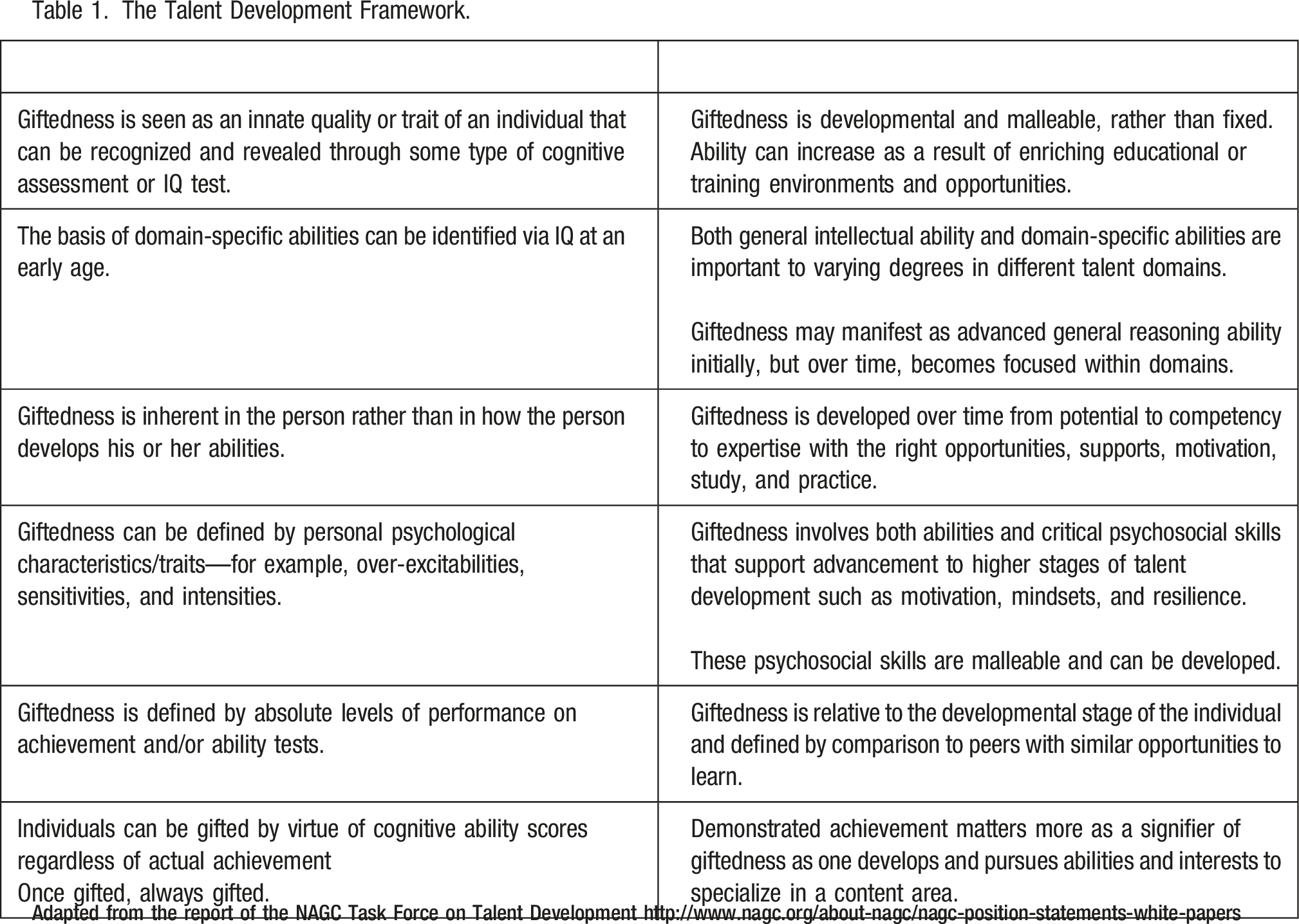
Adapted from the report of the NAGC Task Force on Talent Development http://www.nagc.org/about-nagc/nagc-position-statements-white-papers
The talent development framework has important implications for identification and programming for gifted services, specifically that equitable identification practices must take into consideration students’ opportunities to learn. For students who come from poverty and/or for any reason and have had fewer opportunities to engage in early learning opportunities within their homes, schools or communities; advanced ability may not be demonstrated in achievement levels on tests or within the classroom, which are typically required for gifted services. Potential for high achievement is present but is not obvious and will not be apparent via traditional approaches to identification. For these students, an approach that reverses the process of “identify, then provide services” to “provide services, then assess for placement” is more equitable and appropriate. Casting a wide net via the use of broad cutoffs on assessments and looking for students who achieve at relatively higher levels compared to peers from similar circumstances coupled with advanced enrichment and intense front-loading (e.g., talent development learning activities) can help students both demonstrate and develop their advanced abilities.
Newer research has demonstrated the promise of several of these more equitable approaches to identification. These include universal screening combined with generous cutoffs (Card & Giuliano, 2015), which involves assessing all students for potential rather than relying on teacher referral as a first step; the use of local norms, which involves using school or district norms rather than national norms to identify students with advanced learning potential (Peters & Gentry, 2012); and performance-based assessments coupled with teacher observations (VanTassel-Baska et al., 2007). Other efforts have focused more on programming models including providing students with significantly more opportunities to learn through supplemental programming, so as to enable them to “catch up” with their more advantaged peers and demonstrate their exceptional ability (Olszewski-Kubilius & Clarenbach, 2012). Research on these front-loading program models (Horn, 2015; Horn et al., 2021; Olszewski-Kubilius et al., 2017; Stambaugh & Olszewski-Kubilius, 2020) show promise in terms of increasing the numbers of historically underrepresented students who qualify for gifted services (Olszewski-Kubilius, et al., 2018). However, the field is still in need of documented successful approaches to broadening the pipeline of talent development for students who have traditionally been marginalized in education and in society.
Much of the focus of preparatory type intervention models in the field that are aimed at increasing the pipeline of talented students have been implemented at the elementary grades, which is logical given that systemic disparities are present at school entry (Olszewski-Kubilius & Corwith, 2017). While best practices for identification include that assessment for talent be ongoing and continuous to capture “late bloomers” (Olszewski-Kubilius & Clarenbach, 2012), there are currently few models for identifying potential and preparatory type programs at the middle school level or beyond. As a result, if students are not identified during the elementary school years, there is little opportunity that they will be targeted for gifted services later in their school careers. Lower prior academic achievement is the most critical factor in the under-enrollment of students of color in advanced high school classes such as AP and dual enrollment (Xu et al., 2021).
The Integrated Curriculum Model
To scaffold these marginalized students to reach the level of achievement required for access to gifted services, a systematic, empirically supported approach is necessary. The intervention for this project was built on the Integrated Curriculum Model (ICM; VanTassel-Baska, 1988, 1998, 2018; VanTassel-Baska & Stambaugh, 2006), which emphasizes the development of advanced content knowledge, using higher-order thinking processes, organization of content around a concept or theme with application to real-world issues and problems. Numerous curriculum units in different subject areas (e.g., science, social studies, language arts) have been developed using the ICM, and a significant number of studies support its efficacy with high-ability learners, including those from low-income backgrounds. Several studies focused specifically on the ICM-based William & Mary language arts curriculum used in this project.
In one study of students in grades 4–6, use of the William & Mary language arts curriculum in an experimental group was associated with significant pre- to post-test gains in persuasive writing (ES = .99) and linguistic competency (ES = 1.57; VanTassel-Baska et al., 1996). This was in contrast to the comparison group, which saw no gains in these language arts skills. In a large-scale study of these language arts units, with more than 2,000 gifted students in grades 2–8 (VanTassel-Baska, Zuo, et al., 2002), medium (.07) to large (.24) effect sizes were found for differences in pre- to post-test gains on a measure of literary analysis and persuasive writing in a matched-comparison subsample (n = 366) of treatment and comparison-group students. In an examination of a subsample of students from high and low SES families (n = 171), the low-SES students’ scores in both literature and writing assessments were not significantly different from the high-SES students following the use of the W&M curriculum units, even though their pre-test means had been lower. This indicated greater improvement among the low-SES high ability students with the use of the W&M units.
Disadvantaged high-ability students were the focus of more recent large-scale studies of W&M curriculum units developed according to the ICM. A 3-year Javits-funded project (Project Athena; VanTassel-Baska et al., 2005, 2009) included a study of the effectiveness of the W&M language arts curriculum among 2,771 students in 11 Title I elementary schools. Additional reading comprehension scaffolding materials (i.e., Jacob’s Ladder units) were included. The implementation of this curriculum in the experimental classes resulted in significant gains for all students, including gifted learners, high readers, promising learners, and typical learners. Critical thinking, in particular, had significantly higher gains among students in the experimental group (η2 = .037) over the 3 years of the study, increasing the likelihood of their later identification for gifted services. The need for additional scaffolding materials to support the less able students participating in Project Athena indicated the importance of including such scaffolds in the online curriculum of the current project.
William & Mary curriculum units have also been successfully adapted for use, on a small scale, in online learning environments for middle school students. For example, two units have been used in courses offered by the Wisconsin Center for Talented Youth since 2009. Students participating in these courses reported that they experienced appropriate levels of academic and intellectual challenge and were highly engaged online (R. Vonesh, personal communication, March 10, 2015).
Culturally Responsive Curriculum and Instruction
Principles of culturally responsive instruction (Hammond, 2014) and culturally-sustaining pedagogy (Paris, 2012) complemented the ICM in guiding curriculum choices and revisions for Project OCCAMS. Consistent with the pedagogy of talent development, which emphasizes viewing students with a focus on their interests, strengths, and potentials (vs. deficits), culturally responsive instruction theorists assert that curriculum should be welcoming and affirming of students across cultural backgrounds by taking “asset-based” approaches and ensuring diverse cultures are reflected in the curriculum itself with individual representatives of cultures portrayed in complex (non-stereotypical) ways and through multiple voices (Hammond, 2014).
Additionally, many culturally responsive instructional design frameworks emphasize providing intellectual rigor as a key feature to signaling respect to students and their cultures (e.g., Collins, 2020; Wallace et al., 2022). Collins’ “Culturally Responsive Multi-Tiered System of Support” (CR-MTSS) framework (2020) connects culturally responsive instruction to a Bloom-inspired taxonomy of thinking. At higher levels in Collins’ adaptation of Bloom’s taxonomy, the framework emphasizes (a) evaluation and critique, being able to explore issues from “multiple and/or opposing” cultural perspectives and relationships between theories, (b) the use of enrichments that call on students to “translate and integrate” concepts and theories from multiple cultural perspectives, and (c) the creation of “culturally responsive products” and solutions to problems. Collins’ CR-MTSS taxonomy can be used as a lens for reflection and self-critique for curriculum designers who are using the Integrated Curriculum Model to help ensure both rigor and cultural responsiveness of curricular materials. By focusing on the ICM’s “Issues and Themes Dimension” and “Process-Product Dimension” (VanTassel-Baska, 2023), specifically, the ICM can be used as a foundational design model for advanced learners adaptable to diverse learning environments and new approaches to instructional delivery.
Hammond (2014) also emphasizes “information processing” in her framework of culturally responsive instruction. This includes design features such as connecting content to culturally relevant examples and metaphors from students’ lives and communities and providing students authentic opportunities to process new content using their own language, experiences, and preferred media as reference points in academic work and class discussion while cultivating supportive relationships to ensure students feel supported as they connect their lived experiences outside of school to academic content.
Supporting the development of transmedia literacy in alignment with Ohio and Common Core academic content standards was a design goal of Project OCCAMS from the beginning and was pursued through activities that leveraged the affordances of the online curriculum to expose students to recurring themes using multiple media, assignments that called on students to synthesize information from different sources in multiple media forms, and enabling students to respond to text using digital tools and media. However, the integration of technology had the effect of enhancing culturally responsive information processing and community building. Some teachers noted that some students who were quiet and shy in face-to-face discussion flourished in the online environment given time to develop and refine their thoughts until they were confident sharing. The social media-inspired user interface of the online platform also seemed to invite students to make connections between their personal experiences and the experiences of characters and biographized individuals encountered in course texts. One teacher noted that some students spontaneously connected their experiences during the first full year of the COVID-19 crisis to course themes of identity, heroism, and sacrifice from various texts and seemed to benefit from having models who experienced and grappled with hardship.
Information processing in a shared online space, however, did require learning and adaptation on the part of both students and educators. For example, possibly in responsive to the social media-like interface of the online learning platform, when students were first given access to it many responded by first using it like they did other social media—as a forum for having fun and sharing with and performing for their friends. This prompted class discussion and navigation of what was considered “appropriate” in the online course space. Additionally, some teachers responded to early casual student activity by trying to impose rules of formal academic writing in online discussions and would respond to student posts with writing feedback and critique versus engaging with students’ ideas expressed in non-academic language with casual attention to grammar and spelling. This kind of feedback had a chilling effect on online discussions and university researchers noted a switch from relatively free-flowing discussions to discussion boards becoming a series of manicured traditional 3-paragraph essays from some students and other students largely disappearing from discussion except where required. Ultimately, out of concern for protecting “space for student voice and agency” as recommended in the Hammond CRT framework, it was decided to intervene with teachers and recommend that they only engage students’ ideas in online discussions but refrain from giving critical feedback on writing mechanics outside of formal academic writing assignments. Designers clarified that discussion boards were intended to be spaces for dialog akin to class discussions in traditional environments where ideas are debated but use of informal language is considered normal. This negotiation of new norms eventually resulted in a healthy balance that reduced a barrier to discussion participation while ultimately reinforcing transmedia literacy skills.
It should be noted that while culturally responsive teaching and “critical race theory” share a common acronym (CRT), they are not related frameworks. Critical race theory is a theoretical perspective for studying history and sociology through the lens of systemic racism. Culturally responsive teaching is more closely related in philosophy to the Universal Design for Learning (UDL) framework which emphasizes the pragmatic reality that each student brings to the classroom a unique set of interests and experiences that have shaped how they see the world and the relevance of the curriculum. When used effectively, culturally responsive curricula and instructional practices benefit all students (Aronson & Laughter, 2016) by inviting them to bring their cultural perspectives and language into the classroom and creating environments where diverse perspectives are valued. Students from all backgrounds increase cultural competence to allow them to better understand and collaborate with others who are different and to discuss and debate diverse perspectives critically and with intellectual rigor without damaging relationships or compromising the experience of safety in the learning environment (Figure 1). Project OCCAMS design framework.
Project Impact
The combined use of the Integrated Curriculum Model with culturally responsive practices and the extended connections to the curriculum and learning community provided by the online platform have resulted in a successful and sustainable program model that has continued and expanding in Columbus City Schools beyond the lifecycle of the public and private grants that supported its initial development and pilot implementation. Following the initial pilot in four schools, a fifth district school adopted and implemented the program at the conclusion of the grant and the district is planning expansion to 1–2 additional schools in the 2023–2024 academic year. Additionally, the district’s dedicated “gifted academy” that had previously offered the Project OCCAMS program as an alternative option to its regular language arts course sequence adopted Project OCCAMS as its default curriculum. A majority of families opted into the program after its first year of implementation as the traditional model no longer had a critical mass of families and needed to reassign teachers in order to meet demand for the program.
A major driver of the program’s growth and popularity in the district has been the academic success of participating students compared with other students in the district as well as its ability to meet the needs of high potential students from underrepresented subgroups who initially do not meet state criteria for formal gifted identification that would make them eligible to receive traditional gifted services. Indicators of participation in Project OCCAMS positively impacting academic growth in language arts include • local MAP RIT data that demonstrated pilot cohorts grew at faster rates than similar peers; • the scores of Project OCCAMS students, who took the ACT in grade 7 or 8 above grade level, made slightly more growth than a similarly diverse comparison group comprised entirely of identified gifted students and students who had previously scored at or above the 95th percentile on a nationally normed achievement test; and • Project OCCAMS eighth graders outperformed district ninth graders overall as well as the ninth grade cohort at the district’s highest performing high school on the state English Language Arts I end-of-course exam despite the fact that OCCAMS students had received one full year less instruction and were on average 1 year younger than the comparison ninth grade cohorts.
For more detailed information on achievement outcomes of Project OCCAMS, see the article by Bright and Calvert in this issue.
A second driver of the program’s sustainability in the district has been the shared commitment to the project by participating district teachers. A key feature of the design-based research approach (van den Akker, 2013) adopted for program development is that interventions are not developed in isolation and then introduced into pilot settings but rather are co-developed in the intervention context with involvement by both researchers and practitioners. Pilot teachers’ expertise related to the cultures of their schools and the families they served, knowledge of state curriculum standards, knowledge of actual district capacity to support technology-enhanced instruction, and their ability to identify and articulate needed revisions to versions 1 and 2 of the curriculum, in addition to student survey feedback, determined priorities for curriculum revisions and student and teacher support enhancements that significantly improved the program. Pilot teachers also became informal ambassadors for the program who voluntarily took on active roles in recruiting new participants and advocating for the program with leadership in their respective schools. Additionally, the initial group of pilot teachers have mentored two early career teachers assigned to teach Project OCCAMS-based language arts courses in additional schools.
Implications
Project OCCAMS further demonstrates the value of “frontloaded interventions” that provide access to rigorous, compacted instruction in students’ areas of relative strength prior to formal gifted identification as a strategy for narrowing “excellence gaps” in achievement in diverse schools and increasing equitable participation in advanced coursework. In this case, students who previously could not be identified as gifted in accordance with state criteria nonetheless grew in language arts achievement at a faster rate than formally identified students participating in talent search assessments and were ultimately successfully accelerated, thereby placing them on track to Advanced Placement and dual enrollment coursework in high school.
Additionally, Project OCCAMS suggests approaches allowing practitioners, curriculum designers, and evaluation researchers to collaborate on an ongoing basis may ultimately result in the creation of more sustainable interventions in urban schools. Being able to draw upon local teachers’ and gifted coordinators’ expertise and experience on an ongoing basis ultimately led to a program supported by teacher “buy-in” to the extent that it has continued to operate and grow continuously through the loss of grant funding, turnover at the district coordinator and senior administration levels, and a highly disruptive global pandemic. Use of online learning platforms to facilitate co-creation of educational resources, support implementation of novel interventions, and providing a forum for peer-to-peer sharing of effective practices across schools also merits further research.
Footnotes
Acknowledgments
The authors would like to acknowledge the Jack Kent Cooke Foundation for its financial support of Project OCCAMS and Columbus Public Schools for its commitment to the project and ongoing partnership.
Declaration of Conflicting Interests
The author(s) declared no potential conflicts of interest with respect to the research, authorship, and/or publication of this article.
Funding
The author(s) received no financial support for the research, authorship, and/or publication of this article.