




Abstract
Online learning plays a significant role in supporting students during their academic endeavours at high school. More specifically, online resources and applications can be used to engage and motivate gifted students to achieve their goals and further work is needed to understand gifted boys’ perspectives of online learning at school. This is especially so for gifted boys who may be at greater risk of underachieving and disengaging at school. This exploratory study interviewed four gifted boys (14–15 years old) attending one independent high school in Australia, to investigate how they used online learning in their classrooms. The boys were interviewed in pairs using a semi-structured approach that prompted them to share their perspectives and experiences of online learning and discuss the types of online activities and applications they used in their classrooms. Overall, the boys highlighted the importance of not disregarding traditional teaching methods but integrating both online learning activities and traditional face-to-face activities in a balanced way that sustained their motivation, provided opportunities to work with challenging problems, and would support characteristics of gifted learners. The boys also shared that building trust between teacher and student was essential to ensure their engagement. Practical recommendations for teachers are also discussed.
‘The gifted boys felt very positive overall about the opportunities that were provided to them when they engaged in online learning’.
Introduction
In Australia giftedness is generally defined as potential where gifted students show potential in the top 10% of their age peers as defined in the Differentiating Model of Giftedness and Talent (DMGT) (Gagné, 2021). However, giftedness in the Australian context has a long history of being misunderstood and ill-defined (Ronksley-Pavia, 2023). Gifted students, particularly boys, may struggle with disengagement (Cooper, 2005; Fong & Kremer, 2020; Landau & David, 2005; Ronksley-Pavia & Neumann, 2020) and underachievement at school (McCoach & Siegle, 2003; Siegle, 2018). Research on academic underachievement in gifted students has shown that it is a significant problem, affecting boys two to three times as much as girls (Desmet & Pereira, 2022; Gilar-Corbi et al., 2019). Reasons for this include boys feeling unchallenged in their schooling, which may reduce their self-esteem; gifted boys may spend more time devoted to outdoor activities or extracurricular activities and have more difficulty managing their time and being self-regulated and organised.
Online learning has potential to enhance gifted boys’ engagement and academic success because it provides flexibility in the pace of learning, can cater for different learning preferences and interests, and can provide more depth of learning. Therefore, online learning may offer opportunities for gifted boys to learn at their own pace in more personalised ways and explore topics of interest more deeply. Online platforms are often rich in advanced subject content and specialised areas that gifted students might not usually be able to access in their school libraries or classroom. Online learning can connect gifted boys with access to experts in the field fostering engagement through motivating mentorship in online collaborative environments (Thomson, 2010; Xu et al., 2024).
Giftedness and Underachievement
Research indicates that up to 50% of gifted children underachieve at some point in their schooling, making this a significant concern that affects students across all socioeconomic groups and geographical areas (Siegle, 2018). This prevalence is particularly concerning given that underachievement represents individual loss of potential and societal waste of intellectual resources (Ronksley-Pavia & Neumann, 2022). The complexity of gifted underachievement stems from its multifaceted nature, with Siegle (2018) identifying 17 different types of underachievers, based on various categorical frameworks, emphasising that students who underachieve differ more from each other than students who achieve differ from each other. The traditional definition of underachievement involves a discrepancy between potential and performance (Reis & McCoach, 2002), though this can manifest in various ways including high IQ with low achievement test scores, high IQ with low grades, or high achievement test scores with low grades (Siegle, 2018).
The gender disparity in gifted underachievement is well-documented, with gifted underachievers being identified as male at two to three times the rate of gifted girls (Matthews & McBee, 2007; Siegle, 2018). This disparity may be partially attributed to underachieving gifted boys drawing more attention through acting out behaviours, conversely gifted underachieving females may be overlooked as they do not tend to act out (Siegle & McCoach, 2012). While gifted student underachievement is complex and a result of many different factors (Ronksley-Pavia & Neumann, 2020), there are some commonalities that have been uncovered which are specific to gifted boys, such as a lack of academic challenge leading to disengagement and ‘boredom’ at school (Potts, 2019; Tomlinson, 1997). Studies indicate that gifted students can become easily disengaged in learning environments that do not offer sufficient challenges, or where there is a mismatch between the content and their abilities and/or potential (Schueler & West, 2023).
Underachievement among gifted boys still presents a persistent challenge in secondary education, often leading to disengagement and reduced academic progress compared to other gifted students. McCoach and Siegle (2003) identified key differences between high-achieving and underachieving gifted students, noting that underachieving gifted students tended to demonstrate lower levels of motivation, goal valuation, self-regulation, and more negative attitudes towards school. These factors are particularly relevant to gifted boys, who may struggle with traditional classroom expectations that do not align with their interests or learning pace. Experiencing a lack of challenge and autonomy may contribute to academic underperformance despite high potential. Exploring ways to enhance gifted boys’ self-regulation may assist in addressing underachievement (McCoach & Siegle, 2003).
Furthermore, research has identified factors contributing to gifted underachievement that are particularly relevant to boys. Peer influence represents a significant concern, with underachieving gifted adolescents reporting peer group influence as the primary obstacle to their achievement (Clasen & Clasen, 1995). Additionally, inappropriate classroom environments contribute to underachievement, with 61% of classroom teachers lacking training in meeting the needs of advanced students (Robinson et al., 2007), and many gifted students already knowing up to half of the material before the school year begins (Reis et al., 1993). Perfectionism also plays a crucial role, with gifted students potentially avoiding challenging tasks to protect their ‘gifted’ identity, leading to patterns of underachievement. Research suggests that programs addressing both academic and social needs of gifted children can address underachievement (Matthews & McBee, 2007), potentially positioning online learning as a valuable intervention when appropriately designed. Therefore, online learning could be harnessed to engage gifted boys by enhancing the quality of gifted education practices in high school and this has potential to transform and enhance learning experiences for gifted boys (Chen et al., 2013; Tomlinson, 1997).
Online Learning
Online learning in classroom environments has been viewed as ‘an umbrella term that refers to any instructional practice that uses digital technology to connect teachers and students’ (Potts, 2019, p. 60). It also includes digital resources and practices, software, learning platforms, and student data management systems (Evergreen Education Group, 2015). Online learning in classrooms has the potential to engage gifted learners across four key engagement dimensions: behavioural, affective, social, and cognitive and can assist students in critical and creative thinking (Ronksley-Pavia & Neumann, 2020; Xu et al., 2024). Online learning can facilitate gifted students’ engagement through personalised learning experiences that cater to their current level while extending and challenging them further (Potts, 2019).
Digital technologies and online learning can also be leveraged to (re)engage gifted students who may be at risk of underachievement (Neumann & Ronksley-Pavia, 2020). When online learning activities are designed appropriately, engagement can be enhanced through team building activities and collaborative projects while providing freedom and autonomy through student access to diverse and stimulating learning spaces (Neumann & Ronksley-Pavia, 2020). As online learning is increasingly used by schools it is important to gather further insights on the experiences and perspectives of gifted learners (Potts, 2019; Swicord et al., 2013). By listening to the voices of gifted boys a better understanding can be gained about how online learning may be leveraged to engage and support gifted boys in high school
Given the contributing factors to underachievement, particularly peer influence, inappropriate classroom environments, perfectionism, and lack of challenge, there is a clear need for educational interventions that can address these underlying factors. Online learning presents a promising avenue for simultaneously addressing the contributing factors. For example, online platforms can provide the personalised challenge and accelerated pace that gifted boys often lack in traditional classroom settings, while also offering opportunities for autonomous learning that may assist in circumventing negative peer influences on academic achievement. Moreover, online learning environments can be designed to promote metacognition through adaptive challenges and immediate feedback mechanisms (Xu et al., 2024).
Present Study
Underachieving gifted boys may benefit from classroom learning environments that promote autonomy, relevance, personalised challenge, and authentic experiences (Siegle, 2018). Online learning platforms offer such opportunities by supporting students to move at their own pace, explore topics of personal interest, and bypass the boredom often associated with repetitive or unchallenging classroom tasks (Chen et al., 2013; Xu et al., 2024). For gifted boys, who may be more motivated by interactive or technology-rich learning formats, online learning may re-engage their academic curiosity and support the development of self-regulatory skills, crucial for addressing patterns of underachievement (Chen et al., 2013; Neumann & Ronksley-Pavia, 2020). Therefore, the present study explored the perspectives of gifted boys about online learning in the classroom and the ways that teaching and learning practices could be leveraged to support and engage them. Hearing the insights from gifted boys will help inform approaches for future online learning practices that aim to sustain engagement and support academic achievement. The following three research questions guided the study: (1) What types of online learning applications and activities do gifted boys use in their high school classroom? (2) What are gifted boys’ perspectives of online learning in their high school classroom? (3) What practical recommendations can be made for supporting gifted boys’ online learning in high school classrooms?
Participants
Overview of Participants and Gifted Identification Methods.
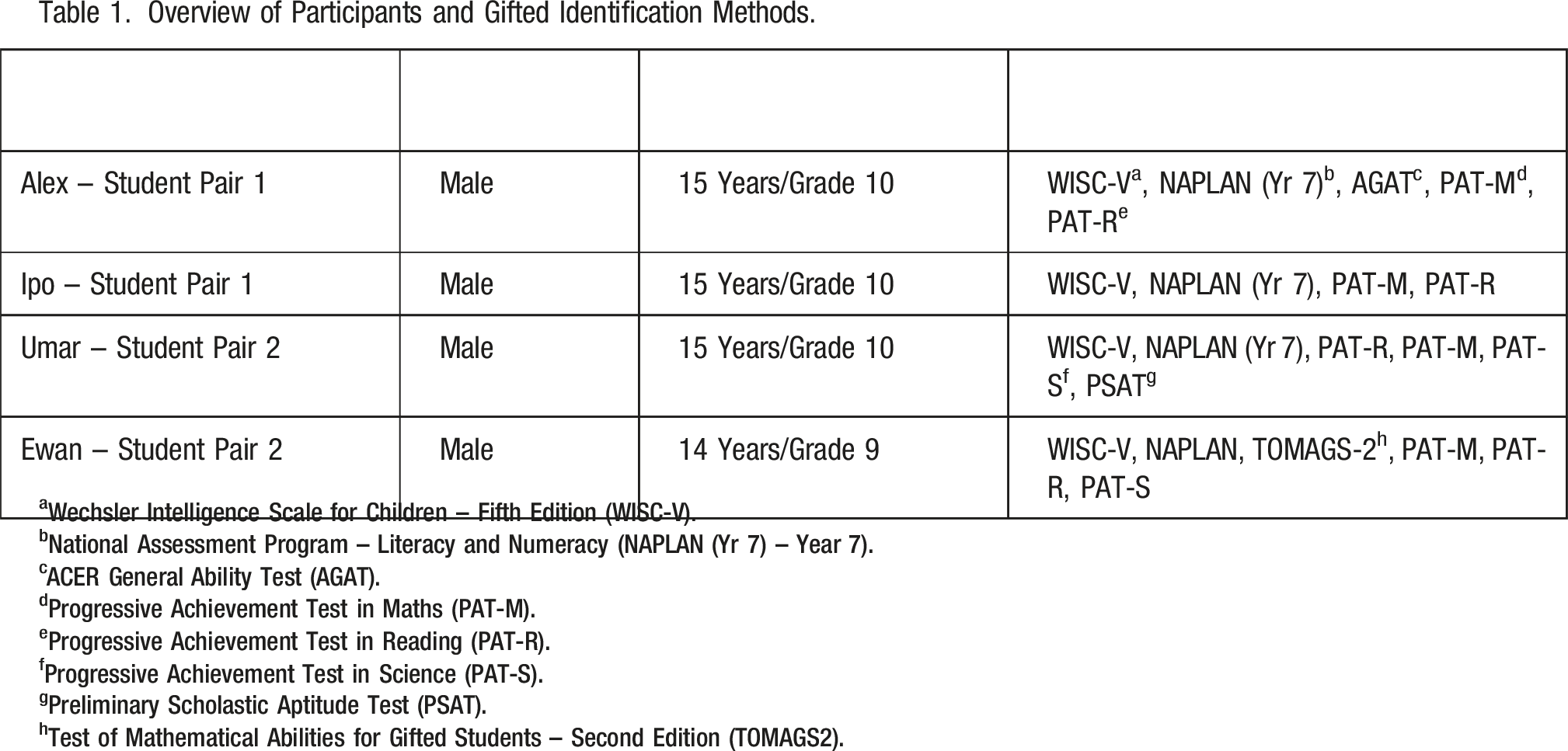
aWechsler Intelligence Scale for Children – Fifth Edition (WISC-V).
bNational Assessment Program – Literacy and Numeracy (NAPLAN (Yr 7) – Year 7).
cACER General Ability Test (AGAT).
dProgressive Achievement Test in Maths (PAT-M).
eProgressive Achievement Test in Reading (PAT-R).
fProgressive Achievement Test in Science (PAT-S).
gPreliminary Scholastic Aptitude Test (PSAT).
hTest of Mathematical Abilities for Gifted Students – Second Edition (TOMAGS2).
These holistic identification processes align with current practices for identifying gifted students (Ronksley-Pavia, 2023). The school’s approach to identifying academic giftedness focused on high-ability students. The school’s program aimed to ensure that identified gifted students received targeted support through a comprehensive gifted and talented education program. The program was specifically designed to cultivate abilities into competencies grounded in Gagné's Differentiating Model of Giftedness and Talent (DMGT) (Gagné, 2021), employing a comprehensive evidence base to identify students’ academic potential and capabilities, subsequently providing access to accelerated learning pathways.
Procedure
Ethics approval was gained from the university ethics committee (2020/949), followed by permission from the principal and lead teacher of gifted students at the school. The school staff assisted in advertising the study and distribution of consent forms to parents of gifted students was made through the school email. Parents of four gifted boys provided consent for their child to participate, and each student provided their assent to participate, completing demographic questions (e.g. age, gender, grade level).
Participating students were interviewed during a free period in their weekly timetable. This interview time and day was convenient, flexible, and selected by the students and school to ensure it did not interfere with their regular classroom learning activities. The boys were grouped into pairs and participated in a one-hour online interview via Zoom that was set up by the researcher who was online. Each pair of students completed the Zoom online interview on a computer in a quiet room free from distractions, near their regular classroom area. The researcher joined and conducted the interview online remotely from their office.
A descriptive qualitative method was used that employed reflexive thematic analysis (Braun & Clarke, 2006) to analyse semi-structured interviews (Newby, 2014; Smedsrud, 2018; Swicord et al., 2013). This qualitative method allows participants to express their response in their own ways and pace, and each interview in the present study was conducted with two students. A semi-structured interview approach in pairs can create a more comfortable and less intimidating environment to allow students to express themselves freely (Guthrie, 2020). The questions that the researcher asked the students were: What kinds of online activities do you do at school? In what ways are your learning needs as a gifted student helped by online learning activities that you do at school? What does your teacher do to support you during online activities? What are the main challenges and barriers of using online learning at school? What are the main benefits of using online learning at school?
The researcher was trained and experienced in conducting semi-structured interviews and waited until each student had provided their response, then in a natural and informal way prompted the students to expand further to ensure they had the opportunity to voice their perspectives, respond to each question, and elaborate on their responses. The latency time before the students were prompted by the researcher was approximately 2–3 seconds to allow sufficient time for the students to provide a response. For example, after asking a question the researcher paused for 2-3 seconds and then said, ‘Please describe this further’, or asked, ‘Are there any further comments you would like to share about your online learning experiences at school?’ to encourage and extend the students’ responses. This approach allowed the students to express their experiences and personal opinions (Newby, 2014).
Data Analysis
Following the completion of the interviews, the audio was transcribed by a trained transcription specialist. A thematic analysis approach adapted from Braun and Clarke (2006) was used: 1. transcript familiarisation; 2. Data sorting; 3. Generating and identifying initial themes; 4. Discussing and reviewing themes to ensure agreement; and 5. Refining and naming themes. The qualitative data analysis underwent a ‘case-by-case’ analysis, whereby each interview transcript was analysed, then general themes were identified across both the transcripts. This process supported the capture of unique nuances in participant responses. More specifically the authors both read the interview transcripts to become more familiar with the data while making relevant notes. The first author then organised the transcripts for facilitating the identification of general themes and sub-themes: the gifted boys’ perspectives of online learning in the classroom, the types of online learning applications, and their perspectives on the main benefits and barriers of online learning. These initial themes represent shared meaning as central concepts that were identified from the data.
The authors reviewed and discussed patterns and the interpretation of the data through an iterative process, with final themes and sub-themes further checked, refined, and named. Following the thematic analysis, representative example quotes from the transcripts were selected through an iterative process that captured segments of text which directly expressed ideas related to the emerging themes. From that data of quotes, those that most distinctly illustrated the essence of each theme were then selected as example quotes. These selected examples were discussed and agreed on by each researcher.
Results and Discussion
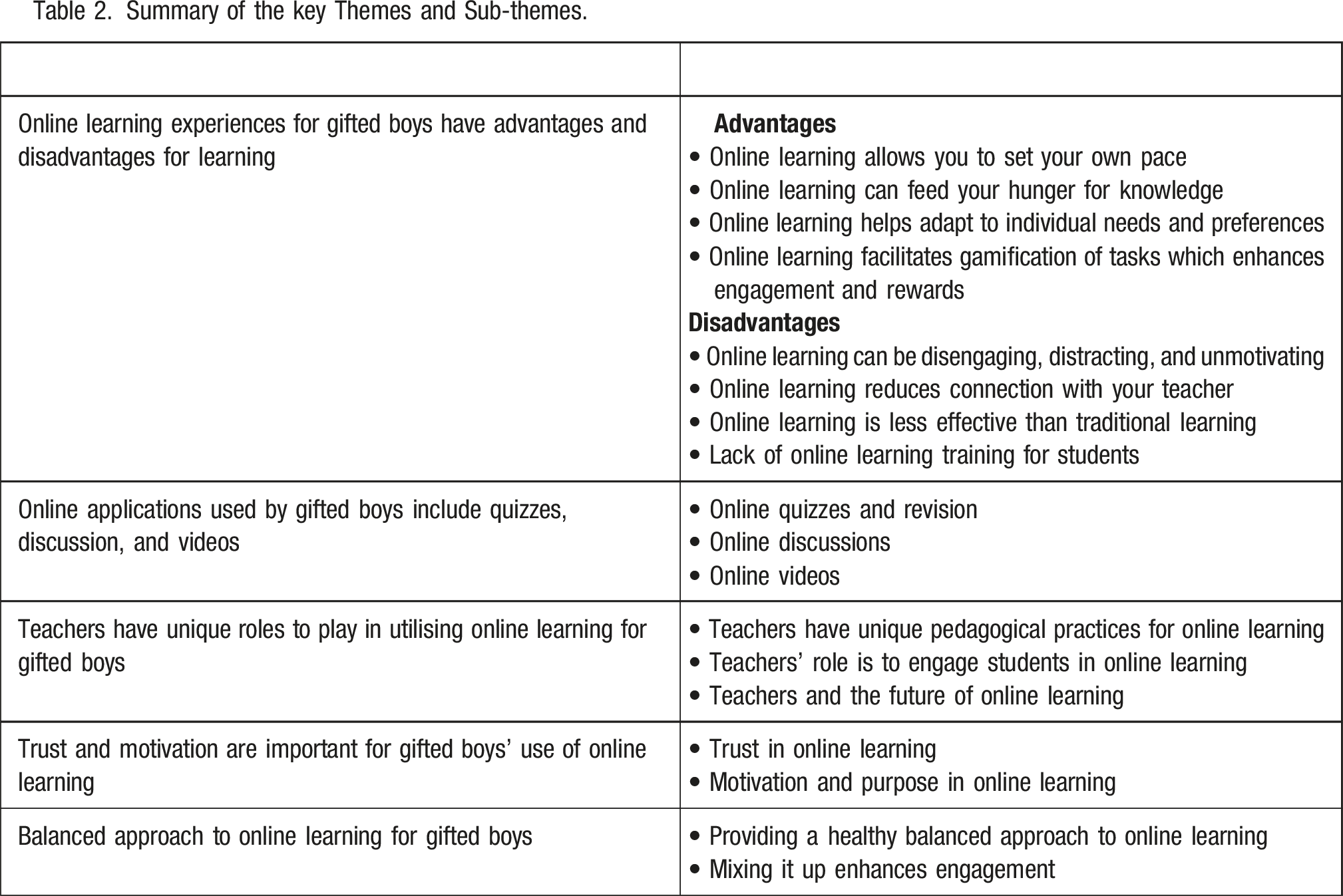
Summary of the key Themes and Sub-themes.
Online Learning Experiences
The gifted boys felt very positive overall about the opportunities that were provided to them when they engaged in online learning. Previous studies have described the advantages of online learning, such as the way online learning can engage and personalise learning experiences to support gifted students that further extend and challenge their learning (Matuga, 2009; Schueler & West, 2023). Other research has suggested that online learning may support student-centred approaches to learning and critical and creative thinking (McKoy & Merry, 2023; Potts, 2019). For example, in this current study the boys shared how they liked online learning because it enabled individual students to set their own learning pace:
Umar: ‘Because you can set your own pace…. I think any activity that’s interacting with other students, especially when you’re in an accelerated gifted class and you can all have this interaction with really high-level integration, you’re able to enjoy that’.
The boys indicated that their giftedness prompted an urge to seek out new information on specific topics that interested them. Thus, online learning provided a way to address their individual learning characteristics. For example, a student said:
Ewan: ‘With tools like the internet and researching a topic like World War II, you can easily snowball your knowledge, you’re focusing on the Eastern Front – then you click ahead to the Western Front or some specific aspect and it’s like the thirst for knowledge that comes in handy later on, but also an interest in quite a lot of simply random things that I don’t think will ever be applied but gives a unique perspective into some other topic’.
The boys also viewed online learning as a way for gathering deeper and more critical details about a range of topics. This allowed them to extend themselves in meeting their individual academic needs, goals, and preferences.
Ewan: ‘For gifted students, the rewards are obviously even more. I mean the student can go deeper into some topic that they’re interested in for whatever subject that they’re doing. I think there is great potential from certain online technologies to be very successful for students in the way that they can adapt to the skill level of the person using them’.
Research on the benefits of gamification of learning through online digital activities has been found to have a positive effect on the attitudes of gifted students for subjects such as mathematics (Yildiza & Yaman, 2024) and solving real-world problems (McKoy & Merry, 2023). The boys also emphasised this point, stating that when online learning activities were designed as games it increased their enjoyment and excitement during learning. They also commented on how online learning facilitated gamification of tasks, which enhanced their engagement
Ewan: ‘To gamify some tasks, it really makes the students engage more and make the thing somewhat like competitive, at a level where people can understand and also compete within their circles…It really is one of the best ways to engage a classroom with a boring topic. Like a history quiz might seem terrible, but once you put some Kahoot onto it, some nice music, some competitive things, it’s whoever clicks fastest, whoever knows the answers. So students are rewarded. Also, it allows gifted students to come up with their own solutions to problems. I think online activities that allow you to do that are the best’.
Although the boys discussed several benefits of online learning, they also pointed out some of the disadvantages of overuse of online learning in the classroom. Previous work investigating potential challenges of online learning, such as becoming disengaged or distracted and maintaining interactions and communication with the teacher (Thomson, 2010), connects with the participants’ experiences in relation to overuse of such approaches. As such excessive use of online learning in the classroom could have similar effects and should be cautiously considered in teacher planning of activities. In the current study, the boys indicated that online learning could also contribute to student disengagement and a reduction in their motivation to continue with an online computer-based task. For example, a student said:
Ipo: ‘If it’s really important, I’ll switch on immediately, but if not, I’ll switch off. That’s what I tend to do a lot in online activities, I guess…. and reengaging a student in online learning I think is like pretty impossible. A student has to motivate themselves. With online learning you lose the authority and lose the drive that the teacher directly gives you. I think online learning for us is an unprecedented level of distraction and the possibility to veer off track’.
The boys were also very vocal about the importance of being connected with their teacher during learning, feeling that sometimes online learning tasks lessened the opportunity for communicating with their teacher about immediate issues and questions they had. One of the boys said:
Alex: ‘It’s hard to connect with your teacher with online learning because your teacher isn’t talking to you all the time’.
It was also interesting that the boys discussed how they valued traditional learning approaches that were not online or computer-based, believing that online learning may not be as effective as traditional pedagogical approaches (e.g. face-to-face class discussions), and they did not always look forward to online learning activities saying:
Alex: ‘It’s [online learning] not something that I would not look forward to. Like, it’s just there. If I do it, I do it and it’s fine. Traditional learning is sometimes more effective than online learning’.
The boys suggested that there was a lack of training provided to gifted students at school in order for them to fully harness the benefits of online learning for extending their knowledge. For example, one student said:
Umar: ‘Just being able to research something correctly. Like being able to Google something correctly, like you can’t just type in the question. There are different key words that you can use to search by source and there is no class that teaches you how to research something online. It’s probably the most essential skill in the 21st century’.
It seems that the boys felt there was an additional need to upskill students in using online learning tools and applications, especially in their high school years when research work becomes more prominent in assignments and school work.
Online Applications
The boys shared their knowledge about a range of online learning applications they used in class to support their knowledge acquisition and assessment work. Similar to other online resources and tools reported by previous digital technology studies of gifted children (McKoy & Merry, 2023; Neumann & Ronksley-Pavia, 2020), the boys said they engaged in online quizzes, watched online videos, and used online platforms for class discussions (e.g. Canvas), and question and answer activities (e.g. Education Perfect).
Alex: ‘They use Canvas to create discussions, and we have to respond to questions and it’s where all our assignments are based. And Education Perfect – that software’s good in a variety of different ways in that it helps students learn and everything like that, but I wouldn’t say it’s particularly engaging…Through Canvas it's like the teacher creates a discussion and then you can post your reply to the discussion’.
The students were also enthusiastic about using some online applications that allowed them to play competitive games with each other (e.g. Kahoot, Squizya, Dash, Jeopardy). These online applications motivated them to keep learning, especially for revising and retaining information and knowledge on particular topics. The online quizzes contained interactive features that delivered the questions and answers in varied ways.
Alex: ‘Then there were some interactions, like SQUIZYA, it’s similar to Mathletics, where there’s a lot of questions and you just do them and when it’s moderated correctly, it can be useful because it’s very fun to do and it’s a more engaging way of revising’.
Umar: ‘Kahoot which you might have heard of, I’ll just explain it briefly. It’s just a very simple sort of quiz format in that the teacher can either create her own quiz or just look at one that’s been made up by another teacher and then it’s just a series of questions… That’s quite good at bringing out students’ competitive elements… Also, Dash just in a similar way to Kahoot does timed questions and you’re racing against other students in the class’.
Umar: ‘We played the game of Jeopardy with the economics terms, and I was genuinely enjoying it to the point where it’s like if I did not have this test tomorrow, I would still be doing it just because it was just that much of a blast’.
For some of the gifted boys who were considering post-school study in such areas as medicine, talked about online revision tests that could help them revise and practice for special external entry exams.
Alex: ‘For the UCAT [Medicine] exam, it is all online, so they have a question bank where you can just click any question, you can do all these different aspects, so it can help with the UCAT exam’.
Umar: ‘Khan Academy has SAT prep. It takes in the results from a practice SAT you do and then gives you catered learning based off the questions you got wrong on the test. Well instantly that becomes my level of difficulty’.
The boys also valued watching online videos through YouTube, discussing how they were engaging and the higher quality produced videos included diagrams to visualise different concepts across the curriculum learning areas. YouTube has been shown to be increasingly popular with gifted students and used in classrooms to support student learning and extension of content, skills, and concepts (Ceylan & Topsakal, 2021).
Alex: ‘YouTube now is the sort of thing when everything’s flashing, you tend to stay engaged, right? So the use of videos and YouTube can be effective, because we use that in physics, for example, and that keeps people engaged. The videos use a lot of diagrams and pictures to explain things. That’s just effective, especially for boys. My physics teacher uses it a lot and my biology teacher as well’.
Teachers’ Unique Roles in Online Learning
It is well established that teachers play an important role in supporting, engaging, and motivating gifted students in their learning to achieve their academic goals through online and face-to-face activities (Ronksley-Pavia & Neumann, 2022; Thomson, 2010). However, there is limited research that has asked gifted boys their views of a teacher’s role in supporting them through online learning (Ceylan & Topsakal, 2021; Thomson, 2010). The boys in the present study said that teachers had their own unique pedagogical practices for facilitating online learning experiences, explaining that it cannot be assumed that all teachers will like using it, or be adept at using online tools in their teaching. It seemed that the boys understood that it takes time for teachers to adapt to new ways of online learning and that more time was needed to support teachers to build and grow their skills for digital and non-traditional teaching approaches. The boys were not critical of teachers who did not frequently use online learning in their classroom practice, but rather they were accommodating of them.
Ipo: ‘It just depends on which teacher and their own personal way of teaching as every teacher is different. Our math teacher doesn’t really rely on online resources that much. She’s very old-school, yeah. Other different teachers rely more on online resources to engage the students more…But I think that’s something [online learning] that teachers will come to grow and adapt to because obviously there’s still old-fashioned teachers, but as time goes on I think, my own prediction would be [a lot more online oriented]’.
However, the boys believed it was the teachers’ role (whether using online or face-to-face teaching methods), to engage them and that it was the student’s role to learn the content, even if it could be delivered in more engaging ways.
Umar: ‘I would say that it's the teacher’s job to ensure that the content is engaging, as engaging to every student as possible and it’s the student’s job to just learn the content regardless of how engaging it is…..Regardless of what your teacher’s currently doing, students will need to adapt and will need to put the hard work in regardless’.
A futuristic perspective was also evident in the conversations with the boys, and they discussed how the use of artificial intelligence (AI) in education may supersede current online learning applications as it could potentially be tailored to be more personalised for each gifted student. Therefore, it was thought that a teacher’s role could be shifted in the future to being more of a supervisor or overseer who could step in when a student had a problem. The increased personalised use of AI for supporting gifted learners has also been suggested by researchers (e.g. Ronksley-Pavia et al., 2025).
Umar: ‘The way I see the future of education going especially with online activities is that it will be tailored for every student and that kind of assumes machine learning and sorts of artificial intelligence gets to that point, where the teacher will just be a supervisor of a classroom where if something goes wrong, the teacher can explain it to the student’.
Trust and Motivation
Building trust between students and teachers is important to consider. For example, how much autonomy a teacher is willing to provide a gifted student may influence student engagement and self-directed learning (Thomson, 2010). The value of trust was evident in interviews with the boys, especially in the context of online learning with the establishment of trust being a key ingredient to independent online learning. The idea of providing innovative ways for students to show the knowledge they had gained seemed to appeal to these gifted boys. Learning environments that build in opportunities for gifted students to direct and lead their own learning paths, alongside timely guidance from their teacher, were discussed by the boys:
Alex: ‘Once we’ve been given that trust, we can start doing independent learning… When you’re doing online learning and you have a teacher to trust you to do online activities, you can sort of loosen up the leash a bit’.
Ewan: ‘By giving the student a computer, the teacher is inherently trusting them somewhat and some students deserve that trust, some don’t, but more often than not, gifted students do deserve that trust and are the better for it…When I have more autonomy, it’s great. It feels like we’re trusted. We do the things we want to do and as long as we get the work done and we show that we have that knowledge and we are trusted, we can do it’.
Some gifted students have cognitive abilities that prompt them to exercise a critical approach prior to participating in classroom tasks (McKoy & Merry, 2023). With gifted students seeking a clear purpose and understanding of what they are learning and why, influences their motivation and academic achievement (Matuga, 2009). The boys emphasised the importance of being provided with explanations and practical reasons for why they were engaging in online learning and the provision of this influenced their motivation.
Umar: ‘I always struggle with something where I feel like it’s not applicable and there’s like no reason I should be doing it in terms of getting the motivation… We said before that one of the trademarks of giftedness you could say would be having a higher level of self-determination and work ethic. But I feel like my interest instantly evaporates as soon as I’m doing something [that] I feel like has no practical benefit and I haven’t been justified the reasons behind that’.
This suggests that teachers should ensure they provide gifted boys with a solid explanation and justification for the reasons and rationale underpinning their pedagogical decisions and selection of online learning activities.
Balanced Approach to Online Learning
Previous research examining online learning and traditional learning approaches for gifted students has shown that integrating both physical and virtual worlds can create positive academic outcomes (Xu et al., 2024). The boys in the present study explained that using a combination of both online and traditional teaching methods provided them with the best of both worlds:
Ipo: ‘I think what needs to happen for a lot of teachers is to realise a healthy balance between face-to-face and online resources…I think there needs to be a good balance of appeal and engagement through both traditional and more modern online learning, as long as there’s a good personality and approach from the actual teacher as well’.
However, when asked if they preferred online or face-to-face learning, some of the boys said they would select online learning due to its flexible nature and the greater potential and range of learning opportunities it might provide to a gifted student.
Umar: ‘Yeah, a bit of both is always best. You want the best of both mediums, but if we had to choose between a world where it’s only online activities and a world that was only pen and paper, I would say that you would want to choose online because pretty much anything you can do pen and paper, for the most part, you can do online whereas the reverse is not true…If you’re just doing the same math textbook every class, that’s not particularly engaging. If you move it online, that’s not engaging but if you can provide sort of a mix of that, it can be really effective’.
Practical Recommendations
Informed by the collective perspectives of the four gifted high school boys’ views of online learning we provide a summary of practical recommendations for teachers and school leaders. These suggestions may be useful to consider when making pedagogical decisions about using online learning in the classroom to support and engage gifted boys.
First, it is important to ensure that online learning tools selected for activities (e.g. quizzes, revisions, Questions and Answer, class discussion), can adapt to each student’s learning pace, supports knowledge acquisition, and depth and breadth of learning, as this can provide rewards and encourages engagement. This suggestion is useful for gifted boys because it can support personalised learning, and as many gifted boys seek autonomy in their learning, this approach respects their intellectual and often non-linear thinking patterns. Online learning can provide learning pathways at an accelerated pace that can more closely match their gifted characteristics (e.g. curiosity and problem-solving).
Second, provide gifted boys with ongoing opportunities to learn how to use online approaches more effectively (e.g. for research and revision activities) to fully harness the benefits of online learning. Developing online learning skills is important for gifted boys because experimenting with new multimodal content and ways to solve problems (e.g. on topics of interest or current issues), gives them time to independently and/or collaboratively reflect and explore ideas. Providing self-paced online learning opportunities may help to sustain their interest and motivation.
Third, value each teacher’s unique pedagogical approaches to online learning and provide teachers time to grow and learn more about using online learning to effectively support gifted students. In addition, highlight an expectation that it is the student’s role to learn the content even if it is not as engaging as they anticipated an online task or activity to be. Teachers can experiment with online learning platforms and modify repetitive tasks to be engaging, for example by integrating more complex content and material, personalised to each learner into the learning experience. This could assist in supporting gifted boys’ academic achievement and personal confidence.
Fourth, build gifted student-teacher trust relationships to foster student autonomy, independence, and self-directed learning. This is particularly essential for online learning as gifted students are unique in their intellectual and emotional needs. When trust is present gifted boys feel more understood, validated, and empowered to creatively engage with online learning platforms. Building student trust opens opportunities for gauging their unique interests, sharing knowledge, deepening conversations, and freedom to explore complex concepts without fear of judgement.
Lastly, aim to achieve and maintain a healthy balance of both face-to-face and online learning activities in the classroom to enhance engagement for gifted boys. This synthesis of both online and face-to-face learning may ensure that intellectual and social-emotional needs of gifted boys are met, with direct teacher feedback woven through online activities and experiences. This approach may support an accelerated pace and fosters opportunities to navigate complex topics that captivate gifted boys’ curiosity.
Future Research and Limitations
Due to the small and restricted sample size of participants from one high school, the findings cannot be generalised to other populations. Importantly, as this study included four gifted boys as participants, the practical recommendations presented should not be considered transferable until further wider research is conducted. The study may not have captured the full range of perspectives and experiences among gifted boys and should be interpreted with these limitations in mind. However, the purpose of qualitative research is not for generalisability, but for gaining in-depth understanding of a particular phenomenon (i.e., online learning experiences of gifted boys in one high school).
Demographic information including ethnicity, socioeconomic status, and specific test scores was not collected for the current study, potentially limiting our ability to understand how these factors might influence gifted boys’ online learning experiences and perspectives, which was beyond the scope of the study. Further research is needed to better understand the role that online learning might play in engaging and motivating gifted boys, for example, research that collects data on demographic factors (e.g. ethnicity, family socioeconomic status) and classroom curricula and environment (e.g. time students spend engaging in online learning in the classroom). This would help determine the extent that such external factors may influence gifted boys’ interactions with online platforms, how they navigate barriers and challenges and applications, and the effects this may have on teacher-student-peer relations, and academic learning outcomes. Increasing the participant numbers and using a mixed method approach (e.g. interviews + survey + action research), could further validate the findings. Longitudinal work could provide insights about how boys’ perceptions of online learning evolve over time and the effects that gender, SES, and giftedness may have on student academic and social-emotional outcomes. In addition, teachers should also be surveyed and interviewed to determine the extent that they utilised online learning activities in different subject areas. Such additional perspectives would help to examine the nature of what online platforms teachers use versus what gifted students access in the high school classroom. Such future research would be timely to investigate especially with the advent of Generative AI.
In addition, future research could explore new models of online and face-to-face classroom learning, such as hyflex learning. Hyflex learning has been conceptualised as a hybrid and flexible mode of learning that combines face-to-face classroom and online learning in flexible ways, where students have the option of attending classes in person or participating online depending on the schedules or the circumstances in their lives (Moldez, 2024; Wong et al., 2023). This mode has the potential to provide gifted high school boys with more autonomy and opportunities for self-paced higher order learning with the benefit of face-to-face social support from their teachers and peers. Hyflex learning may also enhance flexibility, supporting gifted boys to study more advanced topics, engage more freely in self-initiated creative projects, or take on more ownership of their learning. However, further research would be needed to determine the practicalities of adopting a hyflex model in high schools. For example, examining the impact on teacher workload where they need to manage two modes of instruction for students simultaneously in terms of consistency, depth of gifted student engagement, potential for technological distractions, and access to online applications would be important issues to consider.
Conclusion
This study explored how four gifted high school boys viewed online learning at their school. The boys reported using a range of different online applications to engage in class discussions, gamified quizzes, and exam revision. The use of online videos from YouTube was helpful in supporting the boys’ understanding of more complex concepts and topics. However, a mix of advantages (e.g. can support knowledge acquisition) and disadvantages (e.g. reduced connection with their teacher), for online learning tools were described by the boys. It was suggested that having more adaptive online applications with improved interactive features would be useful. The boys believed that each of their teachers was unique in the ways and extent that they used online learning in their class. Building student-teacher trust was an essential part of creating a positive online learning experience and the boys shared that this approach would also support their motivation for learning. Overall, the gifted boys believed that having a balanced approach to traditional and online learning would achieve the best of both worlds.
Footnotes

Funding
The authors received no financial support for the research, authorship, and/or publication of this article.
Declaration of Conflicting Interests
The authors declared no potential conflicts of interest with respect to the research, authorship, and/or publication of this article.