




Abstract
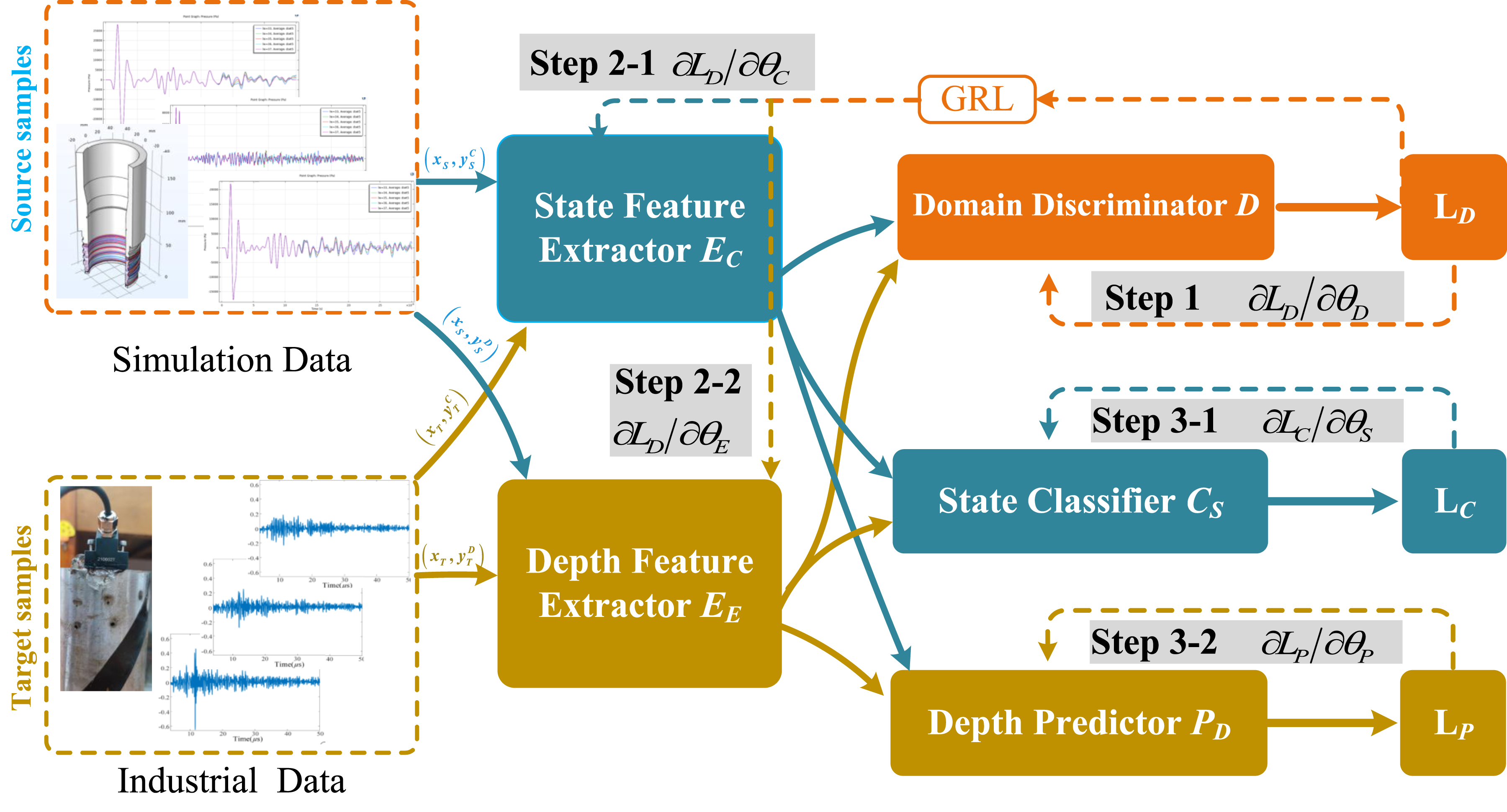
Drill pipes used in coal mines operate under complex cyclic loads and harsh environments, which makes fatigue cracks prone to initiation and growth at threaded joints and significantly threatens operational safety. However, in situ ultrasonic crack evaluation is challenged by strong noise, unstable coupling conditions, and the scarcity of labeled fatigue-crack samples. To address these issues, this paper proposes an ultrasonic intelligent detection method for fatigue cracks in coal mine drill pipes that combines physical simulation and a Multiple Target Transfer Network (MTTN). First, a multi-physics finite element model of bulk-wave propagation in threaded drill pipes is established, and a large-scale simulation dataset is generated by embedding cracks with various depths and positions. This physically based dataset provides accurately labeled ultrasonic echo signals and forms the source domain. Then, a small set of measured ultrasonic signals acquired from 4137H steel drill pipe joints with machined U-shaped slots is used as the target domain. An MTTN with dual feature extractors, a domain classifier, a crack-state classifier, and a depth predictor is constructed to jointly perform crack state identification and crack-depth estimation. Through adversarial domain adaptation, the feature distributions of the simulation and real domains are aligned, so that the model trained mainly on simulated data can be effectively transferred to field-like conditions. Experimental results show that the proposed method achieves 100% accuracy in crack-state recognition and, compared with the best baseline network, reduces the mean squared error of crack-depth prediction by approximately 43% and the mean absolute error by about 28%, while improving coefficient of determination R2 to 0.9497 and PICP to 0.9452. These results demonstrate that the proposed framework provides accurate and reliable quantitative evaluation of drill pipe fatigue cracks under coal mine conditions.
Keywords
Get full access to this article
View all access options for this article.