



Abstract
This study analyzed the frequency and correlates of criminal investigation of child maltreatment in cases investigated by child protective service (CPS), using national probability data from the National Survey of Child and Adolescent Well-Being. Criminal investigations were conducted in slightly more than 25% of cases. Communities varied substantially in percentage criminally investigated. Sexual abuse was the most frequent type of maltreatment criminally investigated followed by physical abuse. Logistic regression results indicated that criminal investigations were more likely when caseworkers perceived greater harm and more evidence; when CPS conducted an investigation rather than an assessment; when a parent or a legal guardian reported the maltreatment; and when cases were located in communities in which CPS and police had a memorandum of understanding (MOU) governing coordination. Most variation between communities in criminal investigation remained unexplained. The findings suggest the potential of MOUs for communities wanting to increase criminal investigation.
Keywords
High-profile cases of child maltreatment that are criminally investigated garner enormous attention. For example, a Google search on August 16, 2012, on convicted child sexual offender Jerry Sandusky yielded about 42,700,000 results. It is therefore ironic that studies of criminal investigation of child maltreatment are almost nonexistent. We lack data on how often child maltreatment cases are criminally investigated and in what circumstances. This article analyzed data from a national probability study on the frequency of criminal investigations of child maltreatment in cases investigated by child protective services (CPS) and what factors relate to whether a case is criminally investigated.
Criminal investigation is necessary for prosecuting child maltreatment. However, our society is interested in prosecuting some but not all cases. Most child maltreatment cases are less egregious than high-profile cases. More typical cases may elicit questions about whether law enforcement should get involved, particularly when child maltreatment occurs within families. Understanding the likelihood of criminal investigation and the factors that increase this likelihood is important for developing policy to promote a responsible and equitable criminal justice response to child maltreatment. These data could help professionals and the public make decisions about how best to align child protection and law enforcement practice with societal values and could inform the development of CPS–police coordination. Accordingly, the research questions that guided the study were as follows: (1) What was the rate of criminal investigations of child maltreatment in cases investigated by CPS? (2) How did this rate vary across communities? (3) What characteristics of the child, the maltreatment, the report, and the investigation were related to the likelihood of a criminal investigation in CPS cases? and (4) Were methods of coordinating CPSs and police related to the likelihood of a criminal investigation in CPS cases?
Data on criminal investigation in CPS cases are relevant for child welfare as well as criminal justice practice. Cross, Finkelhor, and Ormrod’s (2005) review found practice literature and research studies that suggest that police involvement can facilitate child protection practice. Using data from the first cohort of the National Survey of Child and Adolescent Well-Being (NSCAW), Cross et al. (2005) found that allegations were more likely to be judged as credible by CPS, and families were more likely to receive services, when there was a criminal as well as a child protection investigation. It is uncertain whether these associations with criminal investigation were causal; police involvement may have occurred only after the credibility of allegations was determined and when families received services for other reasons. Nevertheless, the possibility that criminal investigation affects child welfare outcomes makes it even more important to analyze data on how frequently and in what circumstances police investigate.
Professionals have differed on the value of prosecuting child abuse and neglect versus taking a therapeutic or family court approach (see Harshbarger, 1987; Levesque, 1995; Newberger, 1987; Peters, Dinsmore, & Toth, 1989), and it is likely that communities have philosophical differences on the value of criminally investigating child maltreatment. However, the lack of data on how often criminal investigation is actually pursued limits our ability to consider whether different policy choices are related to case outcomes. Communities differ in the extent to which they have invested in the special methods and training that criminal investigation of child maltreatment requires (see American Prosecutors Research Institute, 2004). Some communities have taken steps to increase the coordination of CPS and law enforcement with one goal being to increase the effectiveness of criminal investigation (Office of Juvenile Justice and Delinquency Prevention, 2000; Tjaden & Anhalt, 1994). However, we know of no empirical tests of the relationship between this coordination and actually initiating a criminal investigation.
Criminal Child Abuse and Neglect
When law enforcement investigates child maltreatment, it is because there is reason to believe a crime has been committed. However, not all child maltreatment is criminal (Myers, 2011) nor does law enforcement investigate every case that might literally meet the statutory definition of a crime. Some crimes that encompass child maltreatment apply to all ages, such as murder, manslaughter, and assault, but many specialized child maltreatment statutes have been passed as well (Myers, 2011; National Center for Prosecution of Child Abuse, 2013). States have multiple child maltreatment statutes. Some are omnibus statutes covering various forms of child maltreatment, while others address specific forms of maltreatment such as Internet stalking of a child or female genital mutilation. Determining whether a given child maltreatment report could constitute a crime requires some interpretation and judgment, as there are limits to how specific a statute can be and to how literally society wants to apply the law. Consider, for example, Connecticut’s General Statute § 53-20: Any person who, having the control and custody of any child under the age of nineteen years, in any capacity whatsoever, intentionally maltreats, tortures, overworks or cruelly or unlawfully punishes such child or intentionally deprives such child of necessary food, clothing or shelter shall be fined not more than five thousand dollars or imprisoned not more than five years or both (National Center for Prosecution of Child Abuse, 2013, p. 20).
A Connecticut assistant district attorney considering whether to file charges on this crime needs to judge whether an individual’s behavior constitutes maltreatment or deprivation and whether it is intentional. Moreover, jurisdictions in Connecticut obviously do not have an interest in filing criminal charges on every incident of child maltreatment that literally fits the terms of this statute. Despite the importance of discretion, professional texts on criminal investigation of child maltreatment lack discussion of the process of deciding whether a child maltreatment report indicates that a crime may have been committed and should be investigated (see, e.g., Cage & Pence, 2006; Pence, 2011; Pence & Wilson, 1994).
CPS–Law Enforcement Coordination
In most states, CPS is responsible for investigating reports of child maltreatment to insure children’s safety; usually CPS’ purview is limited to child maltreatment perpetrated by a caregiver, and law enforcement has sole responsibility for child maltreatment perpetrated by noncaregivers. In a few states, law enforcement has responsibility for investigating all child maltreatment, but these states have typically established separate civilian units for these investigations and uniformed officers either do not investigate or only investigate jointly with a civilian investigator (Cross, Finkelhor, & Ormrod, 2005). When both CPSs and law enforcement investigate child maltreatment, typically one agency receives a report and then communicates that report to the other agency. Most states have statutes requiring cross-reporting between CPS and law enforcement (Child Welfare Information Gateway, 2012). Law enforcement is required to report to CPS all cases within CPS’ purview (which usually involves maltreatment by a caregiver). Depending on the state, CPS is required to report to law enforcement in all cases, all cases that may involve crimes, or all cases meeting a harm threshold. In 26 states, CPS must report all noncaregiver allegations to law enforcement (Child Welfare Information Gateway, 2012). Many state statutes require a joint CPS–law enforcement investigation for cases that meet criteria for seriousness or criminality (Bollenbacher & Sakagawa, 2006; National Center for Prosecution of Child Abuse, 2013). Communities often develop joint investigation protocols even when states do not require it.
Yet communities have considerable latitude in deciding to cross-report or conduct a joint investigation. A Texas Department of Family and Protective Services (DFPS) manual illustrates the interplay between state and local control of criminal investigations in CPS cases (Texas DFPS, n.d.). It states that Texas state law requires a joint CPS–police investigation when “there is a report that alleges that a child has been or may be the victim of conduct that constitutes a criminal offense; and that poses an immediate risk of physical or sexual abuse of a child that could result in the death of or serious harm to the child” (Texas DFPS, n. d., p. 3). However, it also acknowledges local control, since it states that “[Multidisciplinary] teams should agree on a process for evaluating whether a report meets the criteria of a joint investigation, as well as a process for quick notification of other team members of such a report” (p. 6).
Many local CPS and police agencies have taken steps to improve coordination (Cross et al., 2005), which could influence both the extent to which CPS informs law enforcement of suspected abuse and the extent to which law enforcement, once informed, responds with a criminal investigation. CPS and police sometimes write a memorandum of understanding (MOU) to codify procedures for handling cases, which may increase criminal investigation because it may “guide the actions of all investigators, including those who are disinclined by temperament, prejudice or experience to cooperate with the other agency” (Cross et al., 2005, p. 225; see also Sheppard & Zangrillo, 1996). Many communities have established Children’s Advocacy Centers (CACs) that coordinate investigations and services responses to child maltreatment (see, e.g., Cross, et al., 2008). Cross, Jones, Walsh, Simone, and Kolko (2007) found that police were more likely to be involved in cases seen at a CAC than in comparison cases in non-CAC communities. Some communities conduct cross-training in which police and CPS professional learn about each others’ jobs, and some colocate police and CPS in the same office to promote coordination. In Newman and Dannenfelser’s (2005) survey, law enforcement and CPS respondents reported that CACs, cross-training, and colocation promoted collaboration.
Child Welfare Workers and Police as Street-Level Bureaucrats
Given the complexity of many allegations and the perhaps inevitable ambiguity of cross-reporting statutes and criminal law, CPS and police exercise some discretion about whether a criminal investigation takes place in child maltreatment cases. For many decades, professional discretion has been recognized as a fundamental feature of both public service delivery in general and police actions specifically (see, e.g., Brown, 1981; Davis, 1975: Groenevald, 2005; Hawkins, 1992; Lipsky, 2010; Sosin, 2010). Both child welfare workers and police are what have been called “street-level bureaucrats” (Lipsky, 2010) who actually influence policy, by making decisions “off in the quiet corners of the policy process” that affect “who gets what, where and how” (Keiser & Soss, 1998, p. 1133, citing Lasswell, 1936). The individual discretionary decisions of workers add up to the agency behavior and/or policy outcomes actually experienced by victims.
One factor in discretion is limited resources. Child welfare agencies may have limited time to coordinate with other agencies and may exercise discretion about when to contact law enforcement. Likewise, like all street-level bureaucrats, police investigators tend to have large caseloads relative to their responsibilities (Lipsky, 2010) and face trade-offs on allocating their time between different investigations. Law enforcement agencies have discretion about whether to develop specialized units to investigate child maltreatment and pay for and require officers’ time for training in this area, and they may not fund these activities, given limited resources.
Another factor underlying discretion is the presence of conflicting goals, a common condition of street-level bureaucrats (Lipsky, 2010; Sosin, 2010). Child welfare agencies have the mandate to protect children and report criminal child maltreatment to law enforcement, but they also value family engagement and may sometimes hesitate to contact law enforcement if they anticipate a negative reaction from families. Law enforcement agencies have the duty to enforce the law, but they may also have competing demands to respect constitutional rights and to follow community norms that may affect how and when they investigate child maltreatment. The discretionary behavior of police agencies and individual investigators is influenced by cultural norms (Brown, 1981), and societal differences on the value of a criminal justice response to child maltreatment are likely to result in differing behavior across police agencies. Moreover, law enforcement agencies may have competing organizational demands to clear cases in a timely manner or to meet organizational benchmarks on criminal justice statistics. Conflicting goals tend to lead agencies and its street-level bureaucrats to favor goals that they are directly accountable for and deemphasize other goals (Lipsky, 2010).
Frontline police investigators work very independently, deal with recalcitrant social problems that do not allow standard or easy responses, face ambiguous situations, and handle competing demands and therefore must exercise additional discretion above and beyond the discretion exercised by their agency (Brown, 1981; Groenevald, 2005). Even when supervisors try to guide behavior through policies and protocols, individual street-level bureaucrats, accustomed to autonomy and influenced by their own personal standards, may resist these efforts (Lipsky, 2010). Individual officers will vary in their values and beliefs regarding child maltreatment. Many police agencies have only a handful of law enforcement professionals who investigate child maltreatment, and the values and beliefs of a single officer could affect the overall rate of criminal investigation in CPS cases, particularly if he or she is a leader. In many ways, professional discretion may therefore influence the likelihood of a criminal investigation above and beyond formal mechanisms for coordinating child welfare and law enforcement.
Case Characteristics and Criminal Investigation
The likelihood of criminal investigation may depend on the characteristics of the abuse and the child victim. Type of maltreatment is a key factor. Sexual abuse typically meets criteria for a criminal offense, since the law specifically proscribes sexual activity with children and youth below the age of consent, whereas other types of maltreatment such as physical abuse do not always meet criteria for a criminal offense (Myers, 2011). Moreover, professionals may be more likely to consider sexual abuse a crime because of its violation of taboo, whereas physical abuse may often be excused as corporal punishment gone awry and severe neglect understood as the effect of poverty or parental mental illness or substance abuse. The severity of maltreatment may be a factor in deciding to initiate a criminal investigation, as Tjaden and Anhalt (1994) found that joint police–CPS investigations were more likely when maltreatment was more severe. The availability of evidence of maltreatment and age of the victim (and capacity to testify) may influence whether a criminal investigation will be considered fruitful. Previous research has linked evidence to CPS substantiation of maltreatment (Cross & Casanueva, 2009) and found that the likelihood of prosecution of child maltreatment was greater for older child victims (Brewer, Rowe, & Brewer, 1997; Cross, DeVos, & Whitcomb, 1994; Finkelhor, 1983; Tjaden & Thoennes, 1992). Reports from mandated reporters may be more likely to be criminally investigated because they are likely to have more information available to make decisions about an allegation (Cross, Goulet, Helton, Lux, & Fuller, 2015) and their reports may be more credible; on the other hand, reports from parents may be more likely to be investigated because maternal support is a factor in prosecuting child maltreatment (Cross, DeVos, & Whitcomb, 1994). The sex and race–ethnicity of the child may relate to professionals’ judgments of the heinousness of the maltreatment or the likelihood of a successful prosecution and therefore may be factors in the decision to conduct a criminal investigation. Cases involving girls have been found to be more likely to be substantiated by CPS than cases with boys (Cross & Casanueva, 2009; English, Marshall, Coghlan, Brummel, & Orme, 2002), although Tjaden and Anhalt (1994) found that cases involving boys were significantly more likely to receive a joint police–CPS investigation. There is evidence for racial disproportionality in several professional decisions related to child maltreatment (Harris & Hackett, 2008; Hill, 2006), and Miller and Cross’s (2006) review found that race-ethnicity was significantly related to outcomes in half of all studies in child maltreatment journals in which it was tested. The likelihood of criminal investigation may be different for children in poor and in rural communities. Research has shown that police are more likely to use their authority against suspects of lower social class (Skogan & Frydl, 2004), and police behavior differs between urban and rural communities; for example, rural policing has been found to be more informal and attentive to community concerns (Weisheit, Falcone, & Wells, 1996).
Previous Research on Rates of Criminal Investigation
The handful of studies that examine the frequency of criminal investigations in CPS cases report fairly high rates, but there is substantial variation between research sites (Cross, Jones Walsh, Simone, & Kolko, 2007; Tjaden & Anhalt, 1994). The samples are not representative of the entire population of cases investigated by CPSs. Most of this research focuses solely on sexual and physical abuse. Much of it was conducted in communities intentionally sampled for high levels of interagency coordination and police involvement and examined joint CPS–law enforcement investigations but not each agency separately (Cross et al., 2007; Tjaden & Anhalt, 1994). The multisite studies by Tjaden and Anhalt (1994) and Cross et al. (2007) found overall rates of joint investigations in sexual abuse cases of 65.9% and 72.6%, respectively, but this rate varied from 41.4% to 91.1% within the 13 sites of the two studies. Communities with children’s advocacy centers were substantially more likely to have joint investigations (81%) than were comparison communities (52%), but communities varied considerably in rates even within these two groups (Cross et al., 2007). Tjaden and Anhalt (1994) found that joint investigation rate for physical abuse cases ranged from 22.5% to 42.7% across three sites and was 34.4% overall. In Sedlak et al.’s (2006) study of a one-site CPS sample of serious maltreatment, police investigated in 71% of cases. Clearly, the available research is insufficient to tell us how frequently police investigate in CPS cases and what factors explain whether a case is criminally investigated. Research has focused on only selected forms of child maltreatment. No study has examined national data, and the communities studied are not representative of all communities; indeed Tjaden and Anhalt (1994) and Cross et al. (2007) intentionally sampled communities with high levels of interagency coordination and police involvement. The current analysis examines rate of criminal investigation in the NSCAW, a national probability study of children involved in CPS investigations.
Study Predictions
Because of local differences in philosophy and investment and the exercise of discretion, we anticipated that rates of criminal investigation in CPS cases would vary substantially across communities. We thought that methods of coordinating CPS and police would be likely to produce greater engagement by police in CPS cases and therefore higher criminal investigation rates. We anticipated that police would investigate child sexual abuse more frequently than other forms of maltreatment. Investigations would be more likely, we thought, when maltreatment was more severe and when there was more evidence. We expected that reports from mandated reporters would be more likely to be criminally investigated as would reports substantiated by CPS. We thought that cases with older child victims would be more likely to be investigated. We had no specific predictions about child’s gender, race–ethnicity, and urbanicity.
Method
The study analyzed data from the second NSCAW cohort (NSCAW II), which includes cases of alleged child maltreatment investigated or assessed by CPS in 2008 and 2009. NSCAW data are available from the National Data Archive on Child Abuse and Neglect (www.ndacan.cornell.edu). NSCAW employed two-stage random sampling. States requiring that the CPS agency first contact participants were excluded from the sampling frame. In the first stage, 82 primary sampling units (PSUs) were randomly sampled from 30 states. Each PSU was defined as the geographic area served by a single CPS agency. Within these PSUs, children were randomly sampled from all child maltreatment investigations or assessments that closed between February 2008 and April 2009. Sampling weights within NSCAW account for differential selection probabilities as well as potential bias resulting from survey nonresponse and thus yield estimates that are nationally representative (Dowd et al., 2010).
Baseline data collection occurred between March 2008 and September 2009, on average about 4 months after the completion of the child welfare investigation. For each case, the NSCAW research team interviewed the child welfare caseworker who conducted the CPS investigation, the child’s caregiver, the child’s teacher, and the children themselves (when child age allowed). Baseline caseworker interviews were administered using computer-assisted personal interviewing technology and included questions about the investigation, types of alleged maltreatment, and risk assessment. Caseworkers consulted the child’s case record as needed during the interview. When the investigating caseworker was not available, an ongoing caseworker completed the interview by consulting the case record. Each caseworker was only interviewed about one case. The local public child welfare agency director in each PSU was also interviewed about agency policies and practices, including different forms of collaboration with law enforcement. NSCAW II also includes census and other public use file data on the demographic characteristics of the PSU communities. Further details of NSCAW methodology are available elsewhere (e.g., Dolan, Smith, Casanueva, & Ringeisen, 2011).
Analytic Sample
The initial sample consisted of 4,255 cases involving suspicions of child maltreatment, that is, a report of maltreatment rather than child need for services or voluntary relinquishment. Since the NSCAW measure of criminal investigation does not specify that the criminal investigation conducted in the case focused on child maltreatment, we further restricted the operational sample to include only cases in which the criminal investigation was likely to pertain to child maltreatment rather than to criminal behavior co-occurring with child maltreatment (e.g., partner violence or making and selling controlled substances). Thus, cases in which the initial maltreatment report included allegations of exploitation, domestic violence, substance exposure, and/or substance abuse by a parent were excluded from the primary analytic sample. Application of these exclusion criteria reduced the primary analytic sample to 2,910 cases, although we also analyzed the original sample.
Descriptive comparisons (see Supplementary online Appendix) determined that the average percentage of cases receiving a criminal investigation did not differ significantly between the two samples (21% in the initial sample vs. 20% in the final analytic sample). Characteristics of children in the two samples also did not differ significantly (except on the type of maltreatment, per the selection process). Given little to no evidence of selection bias from creating the final analytic sample, only characteristics of the final analytic sample are reported. The mean child age in our analytic sample was 7.50 years (SD 4.46), with approximately 40% of children aged 0–5 years, 30% aged 6–10 years, and 30% aged 11–17 years. On average, half (51%) of children were male and just over half were racial/ethnic minorities, that is, 21% were African American, 26% were Hispanic, and 8% had other minority status (Native Indian, Native Alaskan, Hawaiian, Pacific Islander, etc.).
Measures
Case-level variables
The answer to the following caseworker question was used as the dependent variable: “Was there a criminal investigation regarding this [child protection] investigation?” (0 = no, 1 = yes). Primary type of alleged maltreatment (supervisory or physical neglect, physical abuse, sexual abuse, or other type of maltreatment such as emotional maltreatment) was an item on the caseworker interview. Severity of maltreatment was ranked from most severe (coded 5) to least severe (coded 1) as follows: (a) abuse in addition to at least one other type of maltreatment, (b) abuse only, (c) supervisory and/or physical neglect in addition to at least one other type of maltreatment excluding abuse, (d) supervisory and/or physical neglect only, and (e) other type of maltreatment (see Garland, Landsverk, Hough, & Ellis-MacLeod, 1996; Smith & Testa, 2002; Yampolskaya & Banks, 2006). An additional measure of severity was caseworker rating of the level of harm to the child, ranging from 1 = none to 4 = severe. Caseworker rating of the sufficiency of evidence to substantiate the maltreatment allegations ranged from 1 = no evidence to 5 = evidence was clearly sufficient. Caseworker assessment of level of risk and the CPS investigation substantiation decision were not used because they were highly correlated with level of harm. Whether the CPS case was handled as an investigation or an assessment (0 = investigation or assessment that later resulted in an investigation, 1 = assessment) was included. Maltreatment report source was categorized according to whether the initial maltreatment allegation was made by the child’s parent or legal guardian, a medical professional such as a physician, a teacher, or other education staff or another source such as a neighbor or an anonymous caller. Child age in years, child gender (0 = female, 1 = male), and child race-ethnicity (categorized as Non-Hispanic White, African American, Hispanic, or other race such as Native Indian or Asian) were also included. We had no specific predictions related to the latter two variables, but gender and race can have an impact on a wide range of professional judgments. Coding of race–ethnicity was based on questions in the child, caregiver, and caseworker interviews. If answers on race–ethnicity conflicted across the three interviews, the child’s response took precedence and then the caregiver’s.
PSU-Level Variables
All items on CPS–police collaboration from the CPS agency director survey were used, that is, presence of an MOU or other formal interagency agreement (yes/no), extent to which children's advocacy centers (CACs) were available to assist in the investigation process, cross-training (yes/no), and agency colocation with police (yes/no). The CAC availability scale was reverse coded to range from 1 = never to 4 = always. To control for effects of community characteristics, we included two PSU-level variables drawn from census and other public use data, namely, percentage of total population living in poverty and location in a nonmetropolitan area (0 = no, 1 = yes).
Data Analysis
NSCAW data have a hierarchical structure, with families and caseworkers nested within agencies. In initial analyses, a fully unconditional random effects model indicated significant variation across PSUs in percentages of criminal investigation, with an intraclass correlation coefficient of 11%. Additional analyses also indicated substantial variation in the percentage of cases that were criminally investigated across PSUs.
To better account for PSU-level variation, we experimented with random effects (i.e., multilevel) models. However, with unbalanced data such as NSCAW, estimations of coefficients and standard errors in multilevel models rely on large sample theory. Given the binary nature of the dependent variable, the relatively modest number of PSUs (80 PSUs, with an average group membership of only six cases) was causing biased estimates due to inaccurate assumptions about variable distributions (see Moineddin, Matheson, & Glazier, 2007; Raudenbush & Bryk, 2002). Consequently, to account for NSCAW’s complex survey design, we instead conducted logistic regression using the Stata 12.0 -svy- module (StataCorp, 2011), which allows for probability weights and stratification as well as correlations in outcomes across families served by the same child welfare agencies (see Chuang, Wells, Bellettiere, & Cross, 2013; Chuang, Wells, & Aarons, 2014 for similar NSCAW analyses). The svy module’s post hoc adjustment to standard errors resembles that used by the robust standard error procedure, differing only by a constant multiplier (DeLeeuw & Meijer, 2008; StataCorp, 2005). Marginal effects and predicted probabilities were calculated using the margins command. Finally, to determine effects of our sample exclusion criteria on study findings, we ran logistic regression models on both the initial and the final analytic samples (n = 4,255 and 2,910, respectively). Since the direction and significance of findings did not differ across the two samples (see Supplementary online Appendix), only results from the latter are reported subsequently.
We also conducted analyses to explore the possibility of using instrumental variables to establish that caseworker’s rating of harm affected criminal investigation rather than vice versa (Baum, 2006). Caseworker’s educational background, specifically whether the investigative caseworker had an master of social work degree, was identified as conceptually and empirically associated with caseworker’s rating of harm but not with whether a criminal investigation occurred. Although a second instrumental variable could not be identified, results of a regression-based test on exogeneity indicated that endogeneity was not present (see Supplementary online Appendix). Therefore, only logistic regression results are reported.
Results
In the entire NSCAW sample (N = 4,960), 27% of cases received criminal investigations, although some portion of these likely concerned criminal behavior other than child maltreatment. When we looked solely at our analysis sample that was created to focus on criminal investigation of child maltreatment (N = 2,520), 28% of cases received a criminal investigation. A criminal investigation was conducted in 11% of neglect cases, 24% of physical abuse cases, 54% of sexual abuse cases, and 16% of cases with other forms of maltreatment. As mentioned previously, the percentage of cases criminally investigated varied significantly across PSUs: approximately 28% of PSUs (n = 23) had criminal investigation rates less than 20%, 58% (n = 48) had rates between 20% and 40%, and 14% (n = 12) had rates greater than 40%. The percentage of cases criminally investigated within each PSU ranged from 0% to 75%. This wide range could not be ascribed solely to small numbers of cases per PSU because the wide distribution was maintained (0–70%) even when calculated for the 79 PSUs with at least 10 cases.
Table 1 shows the characteristics of the analysis sample and of subsamples with and without a criminal investigation. Physical abuse and sexual abuse were more prevalent in cases with a criminal investigation. Ratings of maltreatment severity, level of harm to child, and sufficiency of evidence were also higher in criminally investigated cases. Cases with criminal investigation were more prevalent in metropolitan areas and in PSUs with a formal CPS–police MOU.
Weighted Sample Characteristics.

Note. CI = confidence interval; CPS = Child Protective Service; MOU = memorandum of understanding. aRanked on a Likert-type scale ranging from 1 = Never to 4 = Always available to assist with the investigation process.
*Statistically significant differences in whether a criminal investigation occurred (p < .05).
Logistic Regression
Table 2 summarizes logistic regression results. Of the case- and PSU-level variables examined, six were significantly associated with odds of criminal investigation, namely, the primary type of alleged maltreatment, caseworker rating of level of harm to child, sufficiency of evidence, whether the case was handled as an investigation or assessment, maltreatment report source, and presence of a CPS–police MOU. To better illustrate magnitude of association, specific results are reported subsequently as predicted probabilities rather than odds ratios (Cameron & Trivedi, 2010).
Weighted Logistic Regression of Factors Associated With Criminal Investigation.
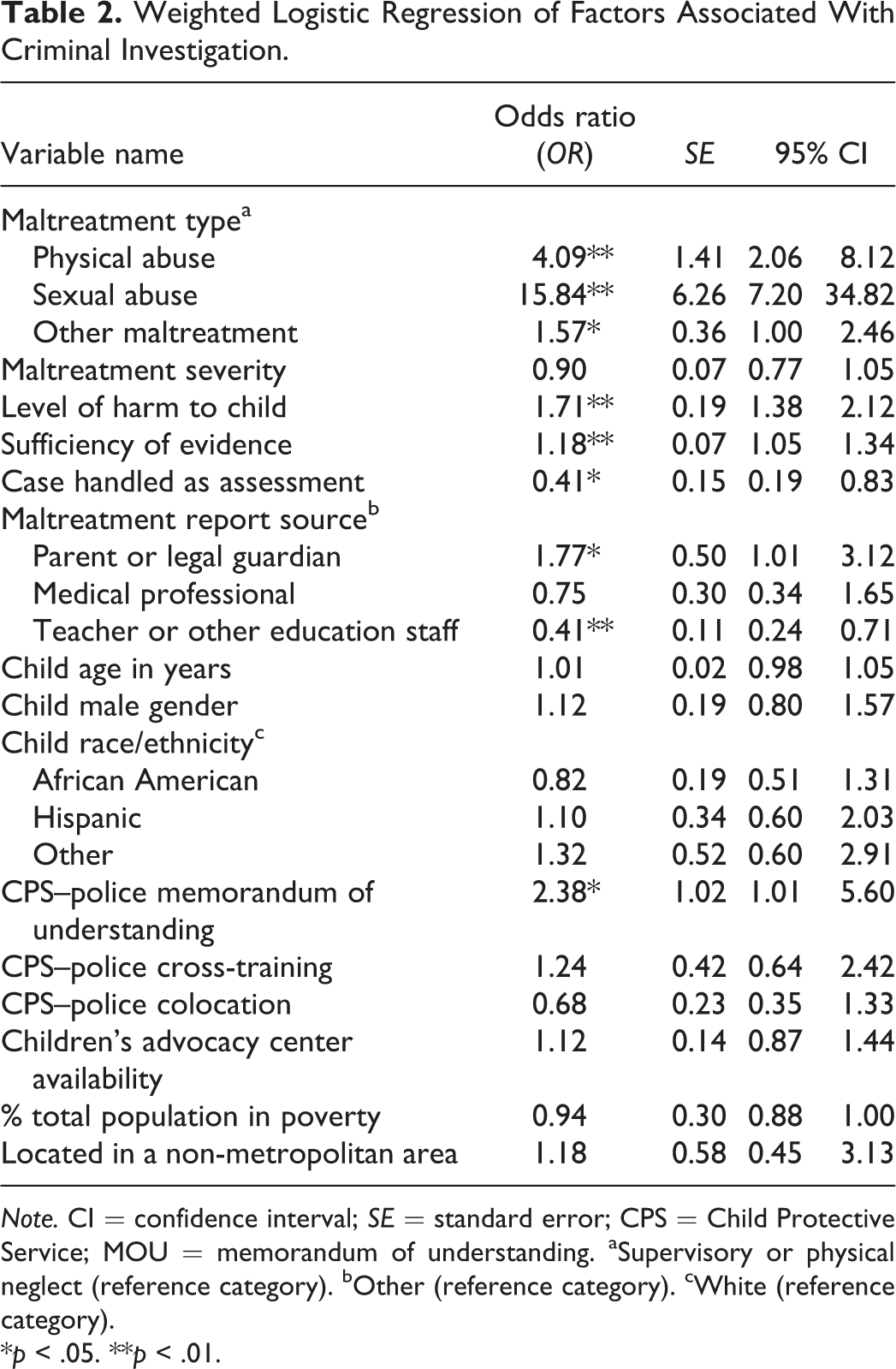
Note. CI = confidence interval; SE = standard error; CPS = Child Protective Service; MOU = memorandum of understanding. aSupervisory or physical neglect (reference category). bOther (reference category). cWhite (reference category).
*p < .05. **p < .01.
For cases in which the primary type of alleged maltreatment was neglect, the predicted probability of criminal investigation was 0.11. Compared to cases in which the primary type of alleged maltreatment was neglect, cases in which the primary type of alleged maltreatment was physical abuse or sexual abuse had a 19% and 46% higher probability of criminal investigation, respectively. For cases in which caseworkers rated the level of harm to the child as “None” or where caseworkers found no evidence of maltreatment, the predicted probabilities of criminal investigation were 0.13 and 0.15, respectively. All else being equal, a one-unit increase in caseworker rating of level of harm to the child (e.g., from “Mild” to “Moderate”) resulted in a 6% increase in the probability of criminal investigation, while a one-unit increase in caseworker rating of sufficiency of evidence (e.g., from probably sufficient to clearly sufficient) was related to a 2% increase in the probability of criminal investigation. The predicted probability of criminal investigation for cases handled as an investigation was .20. Handling a case as an assessment rather than an investigation was associated with a 9% decrease in the probability of criminal investigation.
Maltreatment report source was also significantly related to whether a criminal investigation occurred. The predicted probability of criminal investigation for cases in which the initial maltreatment report was made by neighbors, anonymous callers, or others was .21. Compared to these cases, cases in which the initial report was made by a parent or a legal guardian had an 8% higher probability of criminal investigation, while those in which the initial report was made by a teacher or other education staff had a 9% lower probability of criminal investigation. Finally, the predicted probability of criminal investigation for cases investigated or assessed in PSUs in which agency directors do not report a CPS–police MOU was .13. Compared to these cases, cases investigated or assessed in PSUs in which agency directors reported a CPS–police MOU had a 10% higher probability of criminal investigation.
Discussion
Criminal investigation is a consequential intervention that law enforcement undertakes in about 27% of all cases investigated by CPS in the United Sates and about 28% of cases in which the criminal investigation is likely to focus on child maltreatment, a meaningful minority of cases. Perhaps our most important finding is the variability in criminal investigation. No form of child maltreatment was consistently criminally investigated or not criminally investigated, and no single factor determined that a case was criminally investigated. This suggests that engagement of law enforcement in a criminal investigation depends on the specific policies, procedures, practice standards, and/or professional discretion that apply in a given case. Clearly, there is a much to learn about why and how child maltreatment cases are criminally investigated.
Community Variation
Communities varied enormously in the proportion of cases that were criminally investigated, and community difference explained a great deal of the variation in criminal investigation. Most of that variation between communities remained unexplained even when variables measuring law enforcement–CPS collaboration were taken into account. Several factors may contribute to community differences in the rate of criminal investigation. First, states differ in their statutes and policies on the definition of criminal child maltreatment, cross-reporting, and joint investigations.
A second factor may be the relationship between CPS and law enforcement in a community. Cross et al.’s (2005) research review notes that the professional literature has divergent descriptions of the relationship between CPS and police. Some sources describe a difficult relationship and others extol successful examples of CPS–police collaboration. Variability in the quality of this relationship across communities could be a factor explaining differences in rates of criminal investigation.
A third factor is likely to be various forms of discretion of local child welfare and police agencies and professionals in involving law enforcement in child maltreatment cases. Agencies are likely to differ in the priority they give child maltreatment versus myriad other crimes and the resources and training they devote to it; one key question is whether a specialized unit or officers is used. Philosophical differences between agencies and among individual professionals about the value of a criminal justice response to child maltreatment are likely. The CPS and law enforcement agencies in different communities may disagree on the circumstances in which they consider prosecution and therefore criminal investigation appropriate. While a plethora of research has examined police discretion and its relation to politics, police organizational structures, and characteristics of individual officers (see, e.g., Brown, 1981; Davis, 1975; Groenevald, 2005), we are aware of no research that has specifically examined police discretion on child maltreatment. Studies are needed, for example, on what factors influence police to pursue an investigation, how the police investigation is timed, (before, during, or after CPS investigation), how police investigations relate to the CPS investigation (e.g., the extent to which police rely on CPS questioning vs. asking questions themselves), and what influences the decision to file criminal charges in child maltreatment cases.
MOU
The odds of criminal investigation were significantly higher when communities had a police–CPS MOU. An MOU indicates a commitment of each agency to collaborate and specifies expectations and procedures for each. This could reduce the potential for practitioners to fail to collaborate due to unease with the partner agency or lack of knowledge and experience—an important factor, given the substantial turnover of child maltreatment investigators in both law enforcement and CPS agencies. The MOU variable may also function as a proxy. The document may not be a causal agent but instead an indicator of a coordinated interagency protocol and a positive CPS–police relationship. The other CPS–law enforcement collaboration variables do not capture presence of a protocol. CACs promote interagency coordination but some have limited law enforcement involvement (Cross et al., 2008).
Case Characteristics Associated With Criminal Investigation
The finding that sexual abuse was more likely to be criminally investigated than other forms of maltreatment, and physical abuse more likely than neglect is consistent with expectations. The effect is large, as sexual abuse cases make up 27% of cases with a criminal investigation but only 5% of cases without a criminal investigation. Nevertheless, because reports of neglect and physical abuse to CPS are much more common, there were more physical abuse cases investigated than sexual abuse cases and almost as many neglect cases. More research is needed on the criteria and procedures for investigating each type of maltreatment.
It is not surprising that caseworker ratings of harm are related to criminal investigation, as the degree of harm may affect professionals’ judgment of how egregious the maltreatment was and therefore deserving of criminal justice involvement. The significant association between caseworker rating of sufficiency of evidence and odds of criminal investigation may reflect the centrality of evidence to prosecution; CPS and/or police may decide it is not worthwhile to initiate a criminal investigation if evidence will not support probable cause. Some of the effect of harm and evidence may stem from their association with CPS substantiation of allegations (see Cross & Casanueva, 2009; Drake, 1996)—the substantiation decision may be a trigger to initiate a criminal investigation. It is also not surprising that cases handled as assessments rather than CPS investigations are less likely to have criminal investigations, since the assessment process eschews determination of culpability for child maltreatment (Fuller, 2014). The finding that reports from parents and legal guardians are more likely to lead to a criminal investigation and reports from teachers less likely may be a function of parents’ access to information and to the perception that parental support is important to prosecute child maltreatment (see Cross et al., 1994).
Limitations
Study limitations should be considered in interpreting the results. Measurement of criminal investigation is based on a single yes–no question asked of the CPS caseworker. The caseworker may not know about a criminal investigation that took place, although the effectiveness of a criminal investigation is questionable if the caseworker does not know about it. NSCAW has nothing about the nature or quality of criminal investigations. We lack information on timing: we do not know whether the criminal investigation occurred before, during, or after the CPS investigation, nor whether police or CPS was called first. We do not know the rationale for the investigation and whether the investigation was thorough or perfunctory. One might think the association of criminal investigation with memoranda of understanding means that communities that investigate more frequently do take them more seriously, but memoranda of understanding do not guarantee a high-quality investigation. Nevertheless, the substantial variation between communities in criminal investigation rate suggests differences in investment in responding to child maltreatment that we think are likely to correlate with quality as well. Another limitation is uncertainty about the direction of causality. Caseworkers’ judgments about evidence could lead to law enforcement becoming engaged in the case or law enforcement involvement could increase the available evidence. An MOU could promote criminal investigation or communities already committed to criminal investigation could be more likely to write MOUs. Reciprocal causation is also possible.
Future Directions and Practice Implications
Criminal investigations of child maltreatment deserve much greater attention. They occur in thousands of CPS cases across the country, and the consequences for alleged victims and perpetrators can be enormous. Professionals and the public need a better grasp of an intervention of such importance that is nevertheless poorly understood. Although we do not advocate a particular rate of criminal investigation, we do believe our findings indicate that communities should examine their rate. Calculating the rate of criminal investigation overall and for important segments of the population could inform the allocation of resources and training. If communities want to increase criminal investigation in CPS cases, developing an MOU may be valuable, since the odds of criminal investigation were significantly greater with an MOU. Although we cannot necessarily establish a causal link between MOUs and increased police investigation, even the effort to develop an MOU may highlight the community’s need regarding the criminal justice response and change criminal investigation rates.
Our biggest concern is the lack of policy attention to criminal investigation of child maltreatment. We invite practitioners and researchers to collaborate to study how the decision to initiate a criminal investigation is made. More research is needed on system interactions, the decision-making process, and quality of investigations. Developing ways for CPS and law enforcement agency to collect data on frequency of CPS referral to law enforcement and of law enforcement response is a key goal. We suggest including a provision for data collection and analysis in every CPS–police MOU and related policy documents. Child-serving agencies and advocates could initiate local studies of frequency of criminal investigation and begin a multidisciplinary conversation about standards and practices for pursuing criminal investigation. Children, families, and society will be better served by more attention to the role of law enforcement in a broad range of cases rather than just high-profile cases.
Footnotes
Acknowledgments
We wish to thank Megan Alderden for her assistance with the manuscript.
Declaration of Conflicting Interests
The author(s) declared no potential conflicts of interest with respect to the research, authorship, and/or publication of this article.
Funding
The author(s) received no financial support for the research, authorship, and/or publication of this article.
