




Abstract
Knowledge about the concordance of parent- and child-reported child physical abuse is scarce, leaving researchers and practitioners with little guidance on the implications of selecting either informant. Drawing from a 2008–2009 sample of 11- to 17-year-olds (N = 636) from Wave 1 of the second National Survey of Child and Adolescent Well-Being, this study first examined parent–child concordance in physical abuse reporting (Parent–Child Conflict Tactic Scale). Second, it applied multivariate regression analysis to relate parent–child agreement in physical abuse to parent-reported (Child Behavior Checklist) and child-reported (Youth Self Report) child behavioral problems. Results indicate low parent–child concordance of physical abuse (κ = .145). Coreporting of physical abuse was related to clinical-level parent-reported externalizing problems (
Keywords
Existing research has documented low to moderate correspondence between parent and child reports of child physical abuse (Chan, 2012, 2015; Jouriles, Mehta, McDonald, & Francis, 1997; Kolko, Kazdin, & Day, 1996; Tajima, Herrenkohl, Huang, & Whitney, 2004). However, knowledge about the factors underlying reporting discrepancies is limited, leaving researchers and practitioners with little information about the implications of selecting various informants’ reports of child physical abuse. Drawing from the second National Survey of Child and Adolescent Well-Being II (NSCAW-II), the current study sought to advance knowledge in this area by first examining the concordance between parent and child reports of physical abuse in a sample of older children (ages 11–17 years) who had recently experienced an investigation by child protective services (CPS). Second, this study sought to build knowledge about the relation between the correspondence of parent and child reports of physical abuse and child behavioral problems.
Parent and Child Concordance in Physical Abuse Reports
Child physical abuse is defined as intentional acts by a caregiver that cause actual or potential physical harm to a child (e.g., hitting, kicking, beating, stabbing, biting, pushing, strangling/choking, burning, and poisoning; Leeb, Paulozzi, Melanson, Simon, & Arias, 2008). This definition aligns with statutes guiding CPS practice of most states and territories within the United States, as well as the actual harm or imminent risk standards set forth in the federal Child Abuse Prevention and Treatment Reauthorization Act of 2010 (Child Welfare Information Gateway, 2014). However, it varies from some state statutes that specify the presence of a physical injury (Child Welfare Information Gateway, 2014).
Several studies have suggested the usefulness of parent report in detecting child abuse. National studies utilizing the Parent–Child Conflict Tactics Scale (PC-CTS; Straus, Hamby, Finkelhor, Moore, & Runyan, 1998), an instrument with severe and very severe physical assault subscales that align with definitions of physical abuse, have found substantially higher rates of physical abuse (severe physical assault: 49–110 per 1,000; very severe physical assault: 23 per 1,000) than reflected by CPS estimates (4–9.1 per 1,000; Straus et al., 1998). Furthermore, agreement has been found in couples’ reports of their own and their partner’s physical abuse of children (Lee, Lansford, Petit, Bates, & Dodge, 2012), and parent self-report measures have been shown to differentiate known abusive from nonabusive parents (Matthews, 1985). On the other hand, low internal consistency has been found on the parent-reported PC-CTS (Straus et al., 1998), tempering apparent benefits of improved detection. Social stigma and the threat of legal ramifications (i.e., official reporting, child removal) may inhibit parent reports of physical abuse (Knight et al., 2000).
Child report measures of physical abuse are generally less scrutinized than parent reports, and there is evidence of effective measurement through adolescent self-report (e.g., Crowley, Mikulich, Ehlers, Hall, & Whitmore, 2003). However, children, particularly at younger ages, may be inconsistent reporters (Quas, Davis, Goodman, & Myers, 2007) and prone to inaccuracy in responding to suggestive or abstract questions (Taber, 2010). Furthermore, children may be protective of parents or fear punishment, leading to underreporting (Della Femina, Yeager, & Lewis, 1990; Jouriles et al., 1997).
Studies comparing child and parent reports of parent-perpetrated physical abuse have found low to moderate parent–child agreement (i.e., kappa range: .16–.26, R range: .11–.20, ϕ = .27; Chan, 2012, 2015; Jouriles et al., 1997, Kolko et al., 1996; Tajima et al., 2004). Children reported higher levels of physical abuse than their parents did, with discrepancies most often due to children reporting when parents do not (Chan, 2012; Fung & Lau, 2010; Kolko et al., 1996). These findings are present in samples of adolescent-aged children in Hong Kong (Chan, 2012) and school-age to adolescent-aged children in the United States (Fung & Lau, 2010; Kolko et al., 1996). However, a minority of studies have found higher reports of physical abuse by parents than by children. One study, whose sample was drawn from children receiving services in child welfare and other programs, found higher rates of physical abuse based on prospective parent reports than retrospective adolescent reports (Tajima et al., 2004). Similarly, a study examining younger children ages 7–9 in treatment for externalizing problems found that children reported lower parental physical aggression than parents did (Jouriles et al., 1997). It is unclear whether measurement differences, namely, Tajima, Herrenkohl, Huang, and Whitney’s (2004) comparison of prospective parent and retrospective adolescent reports of physical abuse, or sample differences (e.g., the focus on younger or high-risk/clinical populations) may have influenced these results, warranting further research. Jouriles, Mehta, McDonald, and Francis (1997) suggested that parents in their sample may have reported physical abuse to show their attempts to discipline their children for their externalizing problems.
No known existing research has examined parent–child physical abuse reporting concordance in the context of a recent CPS investigation. Physical abuse reporting in this context is important to understand because of its practical significance and because of potential unique social desirability concerns. CPS investigation guidelines in the United States specify collateral interviews with offending and nonoffending parents, as well as initial interviews with children (DePanfilis & Salus, 2003). Reports of physical abuse gathered from these interviews influence decisions regarding substantiation and intervention, including out-of-home placement decisions, and further assessment and service referrals (DePanfilis & Salus, 2003). However, parents’ and children’s knowledge of the potential ramifications of being reported to CPS (e.g., the potential for child removal/out-of-home placement) based on their prior system involvement may influence whether they report physical abuse (Knight et al., 2000).
Parent–Child Concordance in Physical Abuse Reports and Child Behavioral Problems
The larger literature has established that interrater discrepancies in child behavioral problems and nonabusive parent behavior have substantive meaning beyond measurement error (De Los Reyes, 2011; De Los Reyes & Kazdin, 2005; Guion, Mrug, & Windle, 2009), but potentially meaningful factors that may explain parent–child physical abuse reporting concordance remain virtually unexplored. Substantial research has demonstrated an association between physical abuse and children’s internalizing and externalizing problems (Kim & Cicchetti, 2010; Lansford et al., 2002; Petrenko, Friend, Garrido, Taussig, & Culhane, 2012), with several studies suggesting differences based on the reporter of child behavioral problems. For example, a significant relation was found between mother-reported physical abuse and mother-reported internalizing and externalizing problems in the 11th grade (Lansford et al., 2002). In the same study, no significant relation was found between mother-reported physical abuse and child self-reported internalizing and externalizing problems (Lansford et al., 2002). Among a sample of adolescent children, Mahoney, Donnelly, Boxer, and Lewis (2003) found consistent links between child-reported physical abuse and both mother- and child-reported externalizing and internalizing problems but that mother-reported physical abuse was only linked to mother-reported internalizing and externalizing problems.
Both Mahoney et al. (2003) and Jouriles et al. (1997) suggested a potential link between physical abuse reporting and child behavioral problems, surmising that parents involved in clinical treatment may report more physical abuse because they believed that more child behavioral problems justify or necessitate their disciplinary efforts. However, only one identified study has examined parent–child concordance in reports of physical abuse in relation to child behavioral problems (Tajima et al., 2004). This study found the highest scores for various child behavioral problems for “yes parent–yes adolescent” (i.e., both parent and adolescent reported physical abuse) or “no parent–yes adolescent” (i.e., only the adolescent reported physical abuse) groups in a sample recruited from child welfare and other service programs (Tajima et al., 2004). However, Tajima et al. (2004) focused on measurement error as opposed to the potential influence of child behavioral problems to explain these findings. Tajima et al. concluded that the adolescent-reported retrospective measure of physical abuse exposure had stronger predictive validity than the prospective parent-reported measure of physical abuse but cautioned that shared method bias (i.e., the tendency of the same reporter to report both physical abuse and behavioral problems) may have affected results.
Attribution bias theory may help to explain reporter differences in the association between physical abuse and child behavioral problems. Prior studies on interrater discrepancies in reports of child behavior problems have used this theory to explain discrepancies as a function of informants’ differing beliefs about the causes of a behavior (De Los Reyes & Kazdin, 2005). When applied to physically abusive behaviors, attribution bias theory would suggest that a parent is more likely to attribute his or her own physically abusive behavior to the child’s behavioral problems, often related to parental perceptions regarding the child’s disposition. This proposition is consistent with prior studies observing associations between parent perceptions of higher levels of child behavioral problems and parent-reported physical abuse (Lansford et al., 2002; Mahoney, Donnelly, Boxer, & Lewis, 2003). Likewise, a parent whose child has significant behavioral problems may feel that their physically abusive behaviors are necessary and legitimate corrective discipline for an oppositional child (Jouriles et al., 1997; Mahoney et al., 2003). Children would be more likely to attribute their own behavioral problems to a family or contextual factor (e.g., punitive parenting) versus their own internal dispositions or tendencies (De Los Reyes & Kazdin, 2005), which could explain associations between child-reported physical abuse and child-reported behavior problems in prior studies (Mahoney et al., 2003; Tajima et al., 2004).
Research Questions
The current study addresses two distinct gaps in the literature: (a) the concordance of parent and child reports of current physical abuse in child welfare contexts and (b) the relation between concordance and parent and child reports of current child behavioral problems. Research questions are as follows:
Based on previous research (Chan, 2012, 2015; Jouriles et al., 1997, Kolko et al., 1996; Tajima et al., 2004), agreement between parent- and child-reported physical abuse was expected to be low. In line with explanations proposed by preliminary studies (Jouriles et al., 1997; Mahoney et al., 2003), reports of physical abuse by the parent only and by both the parent and child were expected to be associated with higher levels of parent-reported behavioral problems. In line with past research on the concordance of parent and child reports of physical abuse and child-reported behavioral problems (Tajima et al., 2004), reports of physical abuse by the child only and by both child and parents were hypothesized to be associated with higher levels of child-reported behavioral problems.
Method
Study Design and Sample
A cross-sectional, secondary data analysis of the NSCAW II was conducted using Wave 1 (baseline) data collected between April 2008 and December 2009 (Dowd et al., 2013). NSCAW-II is a longitudinal panel study of children residing in the United States who were investigated by CPS; children were interviewed within 4 months of a CPS investigation being closed (Dolan, Smith, Casanueva, & Ringeisen, 2011). The original study used a multistage, national probability sampling strategy, with 5,872 children ages 0–17.5 years sampled from 81 primary sampling units (81 counties across 30 states within the United States; Dowd et al., 2013).
NSCAW II used in-person interviews with multiple informants, including the sampled child and his or her caregiver (i.e., adult currently residing in the child’s household, “most knowledgeable” about the child, and who had coresided with the child for 2 or more months; Dowd et al., 2013). Automated computer-assisted survey interviewing (ACASI) technology was used to collect sensitive information from child and permanent caregivers (i.e., parent or legal guardian, as determined by the interviewers—these data were not collected from out-of-home caregivers). Although the goal of ACASI was to minimize social desirability bias, participants were informed that their answers would be reviewed and potentially reported to CPS (Dowd et al., 2013). Interview data were transmitted daily for review and evaluation of whether a report to CPS was required.
The study sample was selected to capture cases in which both children and their caregiver reported on physical abuse. The potential sample included 729 children identified in the CPS sample who (a) were 11–17 years old at Wave 1 (the age range for which children self-reported physical abuse) and (b) had a corresponding caregiver interview with a respondent identified as their biological parent or their legal guardian for at least 1 year prior to the Wave 1 interview date. (The term parent will be used for caregiver respondents for the remainder of this article.) The final analytic sample included 638 parent–child dyads with complete data; all cases with missing data were deleted casewise (n = 91). Missing data analysis indicated that sampled children with incomplete data were younger, t(727) = −2.00, p = .046; less likely to identify as White, non-Hispanic, χ2(3) = 11.12, p = .011; more likely to self-report severe physical assault, χ2(1) = 16.91, p < .001; and had higher parent-reported child internalizing behavior scores on average, t(727) = 2.350, p = .019. Table 1 details the analytic sample demographics.
Sample Characteristics.

Note. CBCL = Child Behavior Checklist; YSR = Youth Self Report.
Measures
Child behavioral problems
Child behavioral problems were measured by parent reports of the child’s behavior on the Child Behavior Checklist (CBCL; Achenbach, 1991a) and child self-reports of his or her own behavior on the Youth Self Report (YSR; Achenbach, 1991b). The CBCL is a 113-item parent rating of the child’s behaviors, designed to assess the child’s emotional, behavioral, and social problems. The YSR (Achenbach, 1991b) is almost identical to the CBCL in content and structure, thus allowing for comparison between two sources of information (Achenbach, 1991b). Child behavior problems were rated by parents and children aged 11 years or older using the following response categories on both scales: 0 = not true, 1 = somewhat or sometimes true, 2 = very true or often true. Standardized T scores from internalizing and externalizing subscales were used. The scales are normed to differentiate age- and gender-specific behaviors; standardized T scores less than 60 are considered normal, 60–63 borderline, and scores greater than 63 clinically elevated (Achenbach, 1991a, 1991b).
The internal consistency of the CBCL for the study sample was high (internalizing: α = .92; externalizing: α = .93). In addition, Nakamura, Ebesutani, Bernstein, and Chorpita (2009) observed strong evidence for the reliability, discriminant validity, and convergent validity of the CBCL among a clinical population of children and adolescents. The internal consistency of the YSR for the study sample was also high (internalizing: α = .91; externalizing: α = .90). Table 1 reports the mean, standard deviation, and range of scores for this sample.
Child physical abuse
Physical abuse was measured through parent and child reports of severe and very severe physical assault behaviors using the PC-CTS (Straus et al., 1998). Parents self-reported on eight types of severe/very severe physically assaultive behavior that they enacted toward the sampled child during the past 12 months; children reported on the same eight physical assault items enacted by any “parent or other adult living in the home” during the past 12 months. Less severe forms of corporal punishment that may not fall within the definition of physical abuse (e.g., spanking, pinching) were excluded (Straus et al., 1998). Response choices for both parents and children included 1 (1 time), 2 (2 times), 3 (3–5 times), 4 (6–10 times), 5 (11–20 times), 6 (more than 20 times), 7 (not in the past 12 months, but it happened before), and 8 (this has never happened). Responses of 7 or 8 were recoded as 0 to indicate no severe physical assault/very severe physical assault/overall physical abuse occurrence within the last 12 months; all other response choices (1–6) were recoded as 1 to indicate a report of at least 1 severe physical assault/very severe physical assault/overall physical abuse behavior during the last 12 months. Table 2 reports the percentage of parents and children reporting any severe physical abuse, very severe physical abuse, and overall physical abuse by item.
Parent–Child Concordance of Physical Abuse by PC-CTS Item.
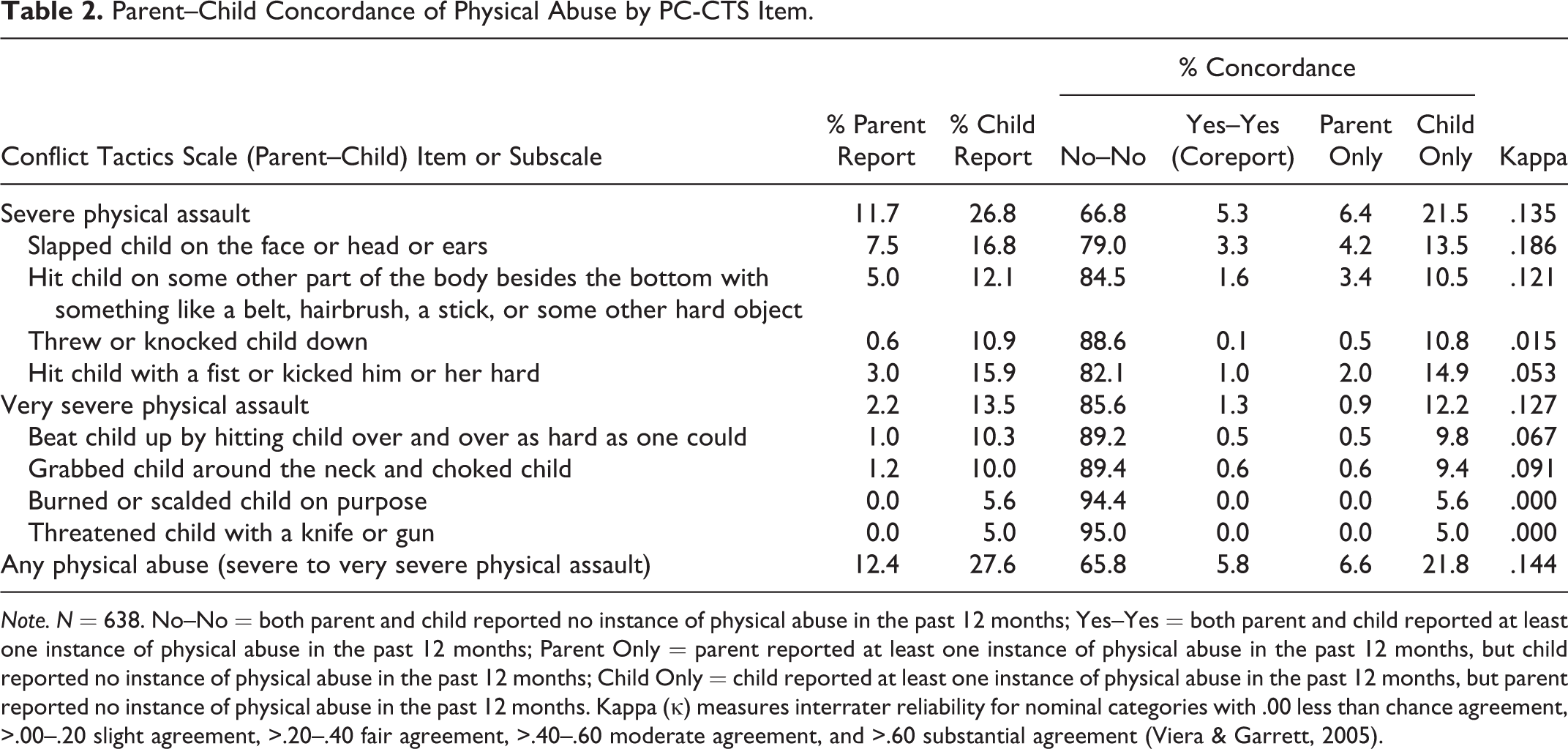
Note. N = 638. No–No = both parent and child reported no instance of physical abuse in the past 12 months; Yes–Yes = both parent and child reported at least one instance of physical abuse in the past 12 months; Parent Only = parent reported at least one instance of physical abuse in the past 12 months, but child reported no instance of physical abuse in the past 12 months; Child Only = child reported at least one instance of physical abuse in the past 12 months, but parent reported no instance of physical abuse in the past 12 months. Kappa (κ) measures interrater reliability for nominal categories with .00 less than chance agreement, >.00–.20 slight agreement, >.20–.40 fair agreement, >.40–.60 moderate agreement, and >.60 substantial agreement (Viera & Garrett, 2005).
Parent–child agreement
Parent–child agreement in physical abuse reports was categorized into four conditions: (a) no reports of physical abuse, (b) coreporting of physical abuse (both parent and child reported physical abuse), (c) parent-only reports of physical abuse, and (d) child-only reports of physical abuse. These categories were created for overall past-year physical abuse and at the item and subscale level. Overall agreement (no reports and coreports of physical abuse) and disagreement (parent-only reports and child-only reports of physical abuse) categories were also developed for the household composition analysis.
Household characteristics and demographics
The parent reported the number of adults (age 18 years or older) residing in the household of the sampled child. This information was dichotomized into households with a single adult (i.e., parent respondent only) and those with two or more adults. These categories allowed us to compare agreement between homes where (a) the child was likely to report on physical abuse only by the parent respondent and (b) the child could potentially report physical abuse by multiple adults residing in the home (i.e., abuse not captured by the parent measure). Finally, children self-reported their age in years, gender (0 = female, 1 = male), and race/ethnicity (Hispanic, non-Hispanic Black, non-Hispanic White, and non-Hispanic Other); parents self-reported their age in years, gender, race/ethnicity, relationship to child, and household income.
Analysis
Parent–child agreement in physical abuse
The agreement between parent and child reports of overall past-year physical abuse, severe and very severe physical assault, and individual items was evaluated using cross-tabulations. The kappa coefficient of agreement (κ; Siegel & Castellan, 1988) was used to assess interrater reliability between parents and children. Kappa values range from −1 (almost perfect disagreement) to 1 (almost perfect agreement), with a value of 0 suggesting agreement is likely due to chance. Kappa values of reliability across raters can be interpreted as (a) .01–.20 (slight agreement), (b) .21–.40 (fair agreement), (c) .41–.60 (moderate agreement), and (d) >.60 (substantial agreement; Viera & Garrett, 2005).
Parent–child agreement by household composition
χ2 analyses were conducted assessing differences in overall parent–child agreement in severe physical assault, very severe physical assault, and overall physical abuse based on the number of the adults residing in the household (i.e., 1 adult household compared vs. 2+ adult household). The analyses were conducted in order to assess potential differences arising from a child reporting physical abuse perpetrated by an adult within the household other than the responding parent.
Child behavior problems regressed on parent–child agreement
Using multivariate linear regression analyses, four models were assessed to examine the relation between child behavior problems (i.e., child-reported internalizing, child-reported externalizing, parent-reported internalizing, and parent-reported externalizing problems) and parent–child agreement in overall physical abuse. Dyads with no reports of physical abuse were identified as the reference group for all analyses. Control variables included common demographic and household characteristics associated with parent reports and child self-reports of behavior problems (e.g., De Los Reyes & Kazdin, 2005; Han, et al., 2012): child age, gender, and race/ethnicity; parent age and gender; and number of adults (≥18 years) residing in the household. The unstandardized βs were reported, given they provide a straightforward, practical interpretation of the effect of the categorical agreement categories on the standardized T scores (Breaugh, 2003). We computed the adjusted mean scores (
Results
Parent–Child Agreement in Physical Abuse
Table 2 details the concordance between parent and child reports of any physical abuse occurrence in the past 12 months. More children than parents reported at least one incident of any physical abuse (27.6% vs. 12.4%). Approximately 72% of parent–child dyads reported in the same way (5.8% affirmative, 65.8% negative). The reliability indicated slight agreement in reports of physical abuse between parents and children (κ = .144). Specifically, a total of 231 (34.0%) cases had child, parent, or both report at least one incident of physical abuse in the past 12 months, but only 39 (5.8%) of these cases had parent and child coreports of physical abuse. When agreement is assessed by severity subscales, reliability among reports of any severe physical assault (κ = .135) or any very severe physical assault (κ = .127) remained very low. Item-specific interrater reliability was also low, varying from no agreement (κ = .000) for “burned or scalded child on purpose” and “threatened child with knife or gun” to slight agreement (κ = .186) for “slapped child on the face or head or ears.”
Parent–Child Agreement by Household Composition
Analyses were conducted to evaluate potential differences in parent and child reporting based on the referent perpetrators (i.e., parents reported on own behaviors while child reported on parent or other adult living in the home). The results indicated no significant differences in parent–child agreement between 1 adult (n = 77) and 2+ adult (n = 561) households. The percentage of parents and children with concordant reports was roughly equivalent across households for any physical abuse (1 adult in household: 74.0%; 2+ adults in household: 71.3%), any severe physical assault (1 adult in household: 74.0%; 2+ adults in household: 71.8%), and any very severe physical assault (1 adult in household: 84.4%; 2+ adults in household: 87.2%). χ2 analyses supported the observation that the concordance did not significantly differ by the number of adults residing in the home for any physical abuse, χ2(1) = 0.247, p = .619; any severe physical assault, χ2(1) = 0.161, p = .688; or any very severe physical assault, χ2(1) = 0.448, p = .503.
Child Behavior Problems Regressed on Parent–Child Agreement
Table 3 shows the associations between parent–child agreement in physical abuse and parent-reported child behavior problems. Coreporting of physical abuse was related to significantly higher parent-reported levels of internalizing (B = 6.94, p < .001) and externalizing problems (B = 9.28, p < .001) as compared to the no reports of physical abuse group. Parent-only reports of physical abuse were significantly related to higher levels of parent-rated internalizing (B = 4.36, p = .019) and externalizing (B = 4.76, p = .012) problem T scores as compared to the no reports of physical abuse group. Child-only reports of physical abuse were related to significantly higher levels of parent-reported externalizing problems (B = 3.75, p < .001) as compared to the no reports of physical abuse group, but no differences were observed between these groups in parent-reported internalizing problems (B = 1.88, p = .094). Dyads where parents and children coreported physical abuse had clinically elevated estimated mean parent-rated externalizing problems (
Regression of Child Behavior Ratings on Parent–Child Concordance of Physical Abuse Occurrence.
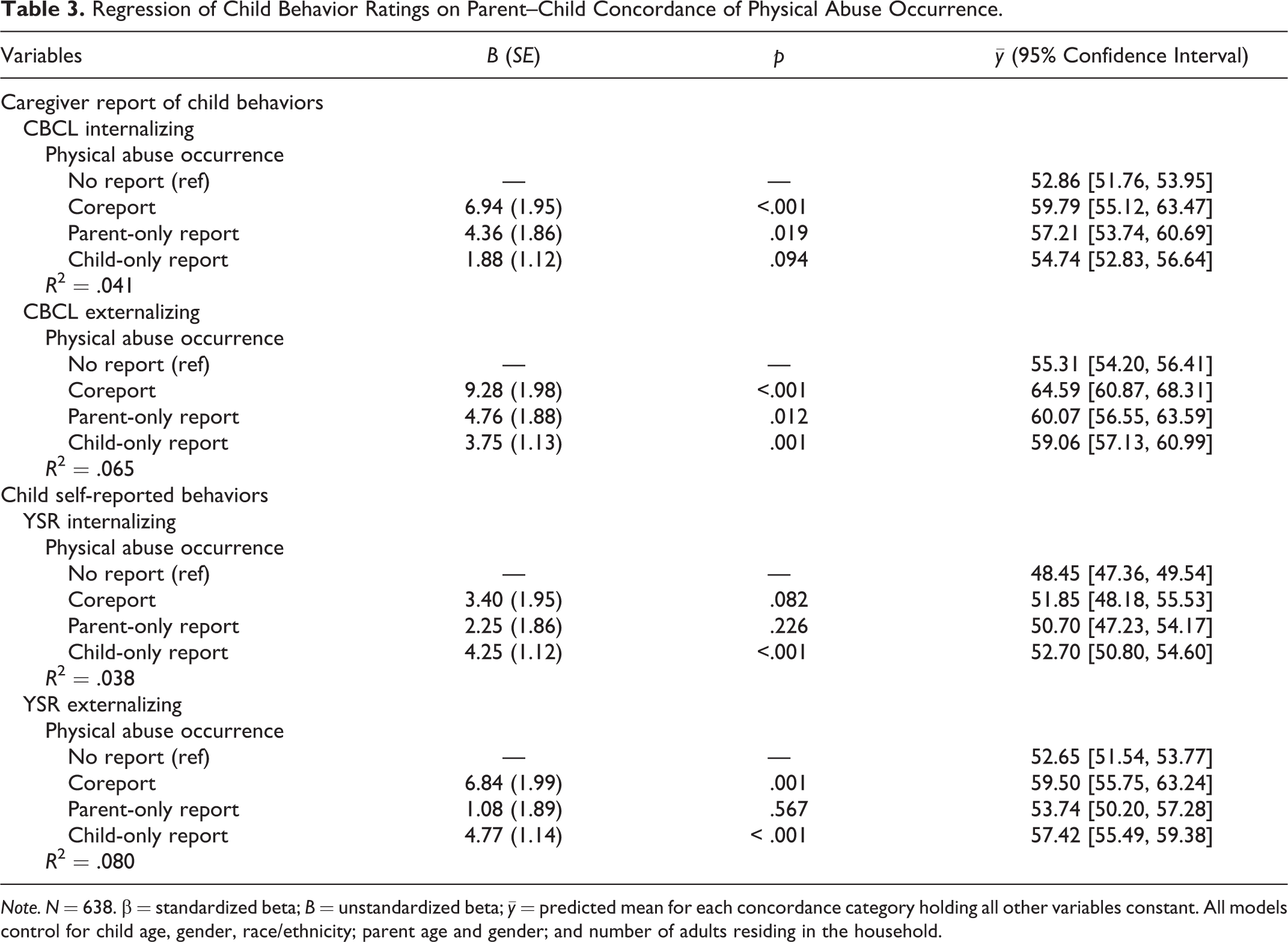
Note. N = 638. β = standardized beta; B = unstandardized beta;
Table 3 also shows the association between parent–child agreement in physical abuse and child self-reported behavior problems. Coreporting of physical abuse was related to significantly higher levels of child self-reported externalizing problems (B = 6.84, p = .001) but not internalizing problems (B =3.40, p = .082) as compared to the no reports of physical abuse group. Parent-only reports of physical abuse were not significantly related to child-rated internalizing (B = 2.25, p = .226) or externalizing behavior problems (B = 1.08, p = .567) as compared to the no reports of physical abuse group. Child-only reports of physical abuse were significantly related to higher levels of child self-reported externalizing (B = 4.77, p < .001) and internalizing behavior problems (B = 4.25, p < .001) as compared to the no reports of physical abuse group. No clinically elevated mean child behavior scores were observed within agreement categories.
Discussion
This study examined two gaps in the maltreatment literature: (a) the concordance of parent and child reports of physical abuse in a child welfare context and (b) the relation between parent–child agreement in physical abuse and parent- and child-reported behavioral problems.
Parent–Child Agreement in Physical Abuse
The current study corroborates prior research (Chan, 2012; Kolko et al., 1996) and supports study hypotheses in finding low levels of agreement between parent and child reports of physical abuse, examining occurrence in the past 12 months within the context of recent CPS investigation. Kappa estimates were slightly lower than observed ranges in previous studies (Chan, 2012, 2015; Kolko et al., 1996), indicating possible added social desirability concerns of the CPS investigation context.
Similar to previous findings (Chan, 2012; Fung and Lau, 2010; Kolko et al., 1996), children were more than twice as likely (27.6% vs. 12.4%) to report physical abuse than parents, with differences of more than 6-fold found for very severe physical assault (13.5% vs. 2.2%). In general and consistent with past research (Chan, 2015), levels of agreement were lower for more severe physical assault items. There are multiple reasons why parents may be reluctant to affirm their own physically abusive behavior (e.g., social desirability, fear of prosecution), and these issues may be heightened with more severe forms of physical abuse and in the context of recent CPS investigation. In a previous study of parent–child-reported victimization in China, agreement was lower for violence perpetrated by parents, suggesting social desirability effects (Chan, 2015). However, another study found that contrary to expectations, parents’ wish to be viewed positively was associated with higher parent–child agreement in physical abuse in a large Hong Kong sample (Chan, 2012). Beyond issues of social desirability in reporting, parent and children diverging reports in physical abuse may reflect unique perceptions of parenting behavior, with children more likely to perceive parent behavior in a negative (i.e., physically abusive) light. Reports of physical abuse in the CPS investigation context may also serve as a proxy for whether children and parents view various services and interventions as needed and desirable (De Los Reyes & Kazdin, 2005). These findings show that relying on either reporter in research and practice settings could lead to different conclusions regarding the incidence of physical abuse. Specifically, relying on parent report alone may result in underidentification of physical abuse, with underidentification and disagreement in reporting becoming more pronounced with more severe forms of physical abuse and, potentially, in child welfare contexts.
Interestingly, a small portion of the parents (6.6%) in this sample reported physical abuse that was not disclosed by the children. This suggests a subset of children may also be protective of abusive parents or, on the other hand, fear retribution or other reporting-related consequences––such as removal from the home––and therefore may be reluctant to report physical abuse of primary parents. As suggested by Jouriles et al. (1997), some parents may readily disclose physical abuse because they perceive it as justifiable or desirable discipline. These findings support best practice strategies that require separate parent and child investigative interviews. Caseworkers should be aware that parents may be hesitant to report physical abuse, particularly more severe forms of abuse, or may not have insight into their own behaviors. At the same time, relying solely on child reports of physical abuse may not be sufficient, given the findings of a small group of parent-only physical abuse reports.
Also of note is that the current study’s findings contradict two studies that observed higher reports of physical abuse by parents than by children (Jouriles et al., 1997; Tajima et al., 2004). Contextual or measurement differences may explain the differing relative levels of parent- and child-reported physical abuse. For example, past studies have not included families with recent CPS investigation (Jouriles et al., 1997; Tajima et al., 2004), have focused on children younger than ages 11–17 (Jouriles et al., 1997), and have not compared concurrent physical abuse reports (Tajima et al., 2004). In the current study context, fear or stigma surrounding the recent CPS investigation may have inhibited parent reporting relative to child reporting. Finally, divergent operational definitions of physical abuse may have altered findings. Tajima et al.’s measure of physical abuse did not include several of the acts included in the current study’s measure (i.e., choked, burned, threatened with gun/knife, threw down). Jouriles and colleagues (1997) used an earlier version of the PC-CTS with different items and examined acts by “mother or father” as opposed to “parent or other adult living in the home.”
Parent–Child Agreement by Household Composition
NSCAW survey instruments measuring physical abuse varied slightly for child and parent respondents. Parents reported only on their physically abusive behaviors toward the sampled child, whereas children reported on physical abuse perpetrated by the parent and any other adults in the home. Interestingly, parent–child agreement in physical abuse did not differ significantly based on the number of adults who resided in the home, suggesting that differences in survey instruments were not a primary factor influencing lack of agreement in physical abuse occurrence. However, because household data were current to the time of data collection and physical abuse measures were of past year, there is no definitive way to resolve differences in parent- and child-reported physical abuse measures.
Child Behavioral Problems Regressed on Parent–Child Agreement
This study’s examination of parent-reported behavioral problems in relation to physical abuse concordance represents a novel contribution to the literature. Prior research has examined parent-reported child behavioral problems in relation to parent- versus child-reported physical abuse (Mahoney et al., 2003) but not in relation to the concordance of parent and child physical abuse reports. Findings that all three agreement categories were significantly related to higher levels of parent-reported child externalizing problems support past research (Mahoney et al., 2003) but add additional clarification that associations between parent- and child-rated physical abuse and parent-rated child externalizing problems are not an artifact of overlap in parent and child physical abuse reporting. Furthermore, the current study found that parent reports of physical abuse (i.e., coreports or parent only) were associated with clinically elevated parent-reported externalizing problems.
This study also extends past research (Tajima et al., 2004) by examining the concordance of concurrently collected child- and parent-reported physical abuse in relation to child-reported behavioral problems. As hypothesized and consistent with past research (Tajima et al., 2004), child-only and coreports of physical abuse were significantly related to child-reported externalizing problems. Findings for externalizing problems are consistent with the propositions of attribution bias theory (De Los Reyes & Kazdin, 2005)––parents may more readily report physical abuse in the presence of clinical-level externalizing problems because they feel that their behaviors are justified. Children, on the other hand, may report parental physical abuse as a family or contextual factor contributing to their high externalizing problems.
Child-only reports were the only agreement group associated with higher levels of child-reported internalizing problems. With the methodological improvement of comparing concurrently collected physical abuse reports, this result diverges from Tajima et al.’s (2004) finding that higher levels of adolescent self-rated depression were significantly associated with parent-only and coreports of physical abuse but not child-only reports of physical abuse. Results suggest that disagreement in parent–child reports of physical abuse may be associated with child perceptions of higher levels of internalizing problems. Potentially relevant to this finding is theoretical work proposing that parent–child disagreement in child trauma exposure marks a lack of parental acknowledgment and support of children’s experience, placing children at risk for internal distress (Goodman, De Los Reyes, & Bradshaw, 2010). However, the applicability of this proposition for parent-reported physical abuse has not yet been considered, warranting further empirical verification and theoretical development. Alternatively, it is conceivable that children’s internalizing problems lead to negative distortions of their parents’ behavior, leading them to report physical abuse (De Los Reyes & Kazdin, 2005). Of note, as other models in this study, this model had a small effect size.
Parent-rated internalizing problems were associated with only parent-reported physical abuse (i.e., parent-only and parent–youth coreports). This finding is consistent with past work showing associations between parent-reported physical abuse and parent-rated internalizing problems (Lansford et al., 2002; Mahoney et al., 2003). However, this study’s analysis of agreement categories suggests that overlap between parent and child reports of physical abuse may have contributed to past findings of associations between child-reported physical abuse and parent-rated internalizing problems (Mahoney et al., 2003). This finding may indicate limitations of parent reports of child internalizing problems suggested by past research, which are not outwardly observable and therefore may not be apparent to the parent (Verhulst & van der Ende, 1992). The same pattern of findings was found for child-rated externalizing problems; consistent with past findings (Mahoney et al., 2003), significant results were found only with child-reported physical abuse. These findings of significant relations between only measures of the same reporter may suggest shared method bias (Galambos, Barker, & Almeida, 2003; Tajima et al., 2004).
Put together, findings show variations in the association between physical abuse and child behavioral problems based on the reporter of both phenomena. Caseworkers should consider whether physical abuse is coreported or parents and children disagree in their reports. Parent reporting, particularly when it concurs with child reporting, may be a marker of clinically elevated child externalizing problems that need further assessment. In contrast, disagreement in reporting may be a marker of child internalizing problems.
Strengths and Limitations
The strengths of this study include the use of nationally representative data, the large sample size, the inclusion of concurrently reported parent and child physical abuse, and the assessment of child behavioral problems from both the child and parent perspective. That being said, several limitations are also present. First, the cross-sectional nature of the study does not allow us to determine whether parent–child concordance of physical abuse affects child behavioral problems or vice versa. Longitudinal studies are required to examine these directional issues in relation to physical abuse concordance. Second, parent- and child-reported measures differed slightly and the small sample size of single-adult households precluded the selection of a subsample that would allow for a cleaner comparison of parent- and child-reported physical abuse. This limitation was addressed by examining whether concordance significantly differed by household type. In addition, the study findings may not be generalizable to different age groups (e.g., school-age children), children in out-of-home placement, non–child welfare samples, and other types of maltreatment. It is also unclear how missing data affected our findings. The approach of casewise deletion may have led to bias in the study sample with more older and non-White children in the study sample. In addition, our missing data analysis found that children who self-reported severe physical assault and whose parents reported higher levels of internalizing problems were more likely to have missing data. It is possible that physically abused children’s parents or children with higher levels of internalizing problems were less compliant with the data collection process. Thus, findings should be interpreted cautiously and need to be replicated. Finally, effect sizes in the relation between physical abuse concurrence and child behavioral problems were small, regardless of reporter.
Implications
Future research is needed to replicate these findings and to theoretically develop the application of attribution bias theory to parent–child concordance in physical abuse. There is a need for further research to clarify how reporting concordance dynamics may vary by different phenomena (e.g., physical abuse, other maltreatment types, nonabusive parenting behaviors, child behavior problems, and nonparent-perpetrated traumatic events) and among different samples. For example, there is a need to examine these dynamics among younger children for whom physical abuse reporting may differ. Further research is also needed to examine the direction of the physical abuse concordance–child behavioral problem relation.
The finding that parent reports of physical abuse may be related to their perception of their child’s externalizing behavior is potentially relevant to physical abuse prevention. If parents feel that physically abusive behavior is justified or unavoidable because of their child’s externalizing problems, cognitive behavior approaches and coaching in other disciplinary techniques may be helpful in reframing this mind-set or offering alternative solutions. Parent reporting of physical abuse may also indicate a level of self-acknowledgment and openness to intervention efforts that will facilitate family progress. The association between higher levels of child-reported internalizing symptoms and discordant child physical abuse reports also has potential clinical implications. Interventions to facilitate the shared acknowledgment of physical abuse and parent’s understanding of their child’s perspective may be protective of child internalizing problems.
Footnotes
Declaration of Conflicting Interests
The author(s) declared no potential conflicts of interest with respect to the research, authorship, and/or publication of this article.
Funding
The author(s) received no financial support for the research, authorship, and/or publication of this article.