



Abstract
This article reviews and critically evaluates available research on latent classes of maltreatment. Three major databases (PsycINFO, Web of Knowledge, and Academic Search Complete) were used to identify studies on latent classes of maltreatment published before June 1, 2016. Of 365 potentially relevant studies, 14 met inclusion criteria for review. Our analysis was guided by the following questions: (a) What observed indicators are being used to model classes of maltreatment? (b) What are the most commonly identified classes of maltreatment? and (c) What are the predictors and outcomes of classes of maltreatment? Across the studies, findings demonstrated how person-centered methods (i.e., latent class/profile analysis) may facilitate the study of maltreatment by concurrently addressing several methodological limitations common to the study of maltreatment, while also addressing heterogeneity in experiences of maltreatment. After providing an account of existing trends within the literature employing person-centered methodology in the study of maltreatment, we offer a critique of extant research, note recent methodological developments, and make numerous recommendations for future research using person-centered approaches to understanding maltreatment.
There has been considerable growth in the approaches used to capture the nature of child maltreatment. Historically, these approaches have commonly involved a focus on type of maltreatment (i.e., physical, sexual, and emotional abuse and neglect) as an organizing framework. They also often focus on single types of maltreatment in isolation or rely on classification based on the presence of any type of maltreatment. It is now becoming widely recognized, however, that in order to fully understand the causes and consequences of maltreatment, it is necessary to move beyond a focus on type and begin to approach maltreatment as a multidimensional construct that can be conceptualized across several dimensions including type, severity, frequency, and chronicity (Manly, 2005). Over the past two decades, research considering maltreatment as multidimensional has grown. Importantly, this line of research has linked dimensions of frequency (e.g., Jonson-Reid, Kohl, & Drake, 2012), severity (e.g., English et al., 2005), chronicity (e.g., Hecht, Cicchetti, Rogosch, & Crick, 2014), developmental timing (e.g., Thornberry, Ireland, & Smith, 2001), and co-occurrence of maltreatment types (e.g., Berzenski & Yates, 2011) to a range of developmental and behavioral problems. However, the complexities of conceptualizing maltreatment as a multidimensional construct make it challenging for researchers to comprehensively capture victim’s real-lived experiences of maltreatment and highlight the need for advanced methodological approaches to facilitate study of this complex phenomenon.
Although several methods can be employed in addressing this need, person-centered methods hold much promise for research attempting to comprehensively capture the nature of maltreatment. The potential this area of research has for extending existing knowledge and informing research and practice is substantial. Guided by a developmental perspective that stresses the importance of considering experiences of maltreatment at particular stages of development (Cicchetti & Toth, 1995; Manly, 2005; Scannapieco & Connell-Carrick, 2005), the current analysis summarizes extant literature employing person-centered methods to the study of maltreatment and introduces recent methodological developments. Before proceeding, we provide some basic information on person-centered methodology.
Person-Centered Methodology
Over the last decade, research has begun to emerge that adopts person-centered approaches to the study of maltreatment (Swartout & Swartout, 2012). Person-centered approaches aim to describe population heterogeneity across a set of observed characteristics or behaviors by identifying a small set of unique within-person patterns (Bergman & Magnusson, 1997; von Eye & Bogat, 2006). In contrast, more traditional variable-centered approaches, such as multiple regression or factor analysis, aim to describe relationships between variables. That is, variable-centered approaches reveal the associations between variables across individuals, whereas person-centered approaches reveal the patterns across variables within individuals.
Latent variable modeling (Collins & Lanza, 2010) is a general framework that models explicitly measurement error in individuals’ responses to questions about their characteristics or behaviors, while also potentially modeling structural relations among variables. This framework accommodates both variable-centered and person-centered methodologies. For example, factor analysis (Bartholomew & Knott, 1999) and structural equation modeling (Savalei & Bentler, 2006) are well-known variable-centered approaches that typically use continuous observed items to assess continuous latent factors and examine associations among the factors. These approaches serve as the basis for methods like growth curve modeling (Duncan, Duncan, & Strycker, 2013) that can be used to model development as a longitudinal trajectory. In contrast, latent class analysis (LCA) and latent profile analysis (LPA) are person-centered approaches that use categorical and continuous items, respectively, to assess categorical latent variables, called latent class variables (Roesch, Villodas, & Villodas, 2010). A latent class variable comprises a set of within-person patterns or profiles; it is considered multidimensional in nature because the items may stem from many different domains. These approaches serve as the basis for methods like latent transition analysis (Collins & Lanza, 2010) that can be used to model development as a stage-sequential process and associative latent transition analysis (Bray, Lanza, & Collins, 2010) that can be used to model associations among stage-sequential processes. The latent variable modeling framework also includes approaches that may be considered hybrid combinations of variable- and person-centered approaches, such as growth mixture modeling (B. Muthén & Muthén, 2000) that identifies types (i.e., classes) of longitudinal trajectories and factor mixture modeling (Lubke & Muthén, 2005) that identifies different types of factor structures.
In the current review, we focus on studies that have used LCA or LPA to study maltreatment. Although it is beyond the scope of this review to provide a complete introduction to latent variable modeling or LCA/LPA, the references above represent a good starting place to learn more about latent variable modeling. Below, we provide a brief introduction to LCA and LPA to provide context for our review of studies. Many introductory, advanced, and applied articles on LCA, LPA, and their extensions are available in the literature for interested readers (e.g., Collins & Lanza, 2010; Lanza, Bray, & Collins, 2013; Lanza & Cooper, 2016; Roesch et al., 2010; a list of recommended readings is available at https://methodology.psu.edu/ra/lcalta/bib).
LCA and LPA
Latent class and latent profile models posit that a categorical latent variable underlies the heterogeneity in a population’s responses to questions about characteristics or behaviors. That is, they posit that a population may be partitioned into a small set of homogenous, mutually exclusive, and exhaustive subgroups, called classes 1 (Lanza et al., 2013). Class membership is unknown and is inferred from individuals’ response patterns on any number of measured variables, called indicators. Often, LCA refers to models that include only categorical indicators and LPA refers to models that include only continuous indicators (or a combination of continuous and categorical indicators). However, LCA and LPA are both latent class models and the term LCA may be used appropriately to refer to class models with any types of indicators. Regardless of the types of indicators used, LCA attempts to maximize the homogeneity within subgroups and the heterogeneity between subgroups when identifying classes.
Model parameters
In LCA, there are two sets of parameters of most interest. The first are latent class membership probabilities that describe the distribution of the classes in the population, called latent class prevalences. The second are the item-response probabilities that describe the likelihood of particular responses to the indicators, conditional on latent class membership. For example, one item-response probability may be the probability of responding “yes” to an indicator about experiencing sexual abuse in the past year, conditional on membership in a “sexual abuse only” latent class. Item-response probabilities are conceptually similar to factor loadings in that they describe the strength of the relation between individuals’ responses and the latent variable, and item-response probabilities are used to interpret and label the latent classes. When continuous indicators are used, the item-response probabilities are replaced by item-response means (and variances); for example, the sexual abuse only latent class instead may have experienced a mean of six acts of sexual abuse in the past year.
Model fit and selection
Although LCA can be used as a confirmatory or exploratory procedure (Hagenaars & McCutcheon, 2002), LCA is often used in an exploratory manner where researchers are trying to determine the number of underlying latent classes. The typical exploratory approach requires fitting multiple models with increasing numbers of latent classes and then selecting the optimal model for interpretation. Classes are added until either an optimal model is identified using a variety of selection criteria or models become “underidentified” and the maximum likelihood solution is difficult or impossible to identify with confidence.
Absolute model fit refers to how well a model fits the data in an absolute sense. It is evaluated using a χ2 likelihood ratio test based on the log likelihood or G 2 fit statistic. However, most of the time we are unable to conduct this test and determine absolute model fit due to sparseness in the contingency table created by individuals’ indicator responses (Lanza et al., 2013). Instead, relative model fit criteria are used to determine whether one model fits relatively better than another based on a balance of model fit and model parsimony. That is, relative model fit criteria help us select an optimal model from a set by weighing improvement in fit as the number of classes increase with reduced parsimony as parameters are added. Fit criteria used in LCAs include the Akaike information criterion (AIC; Akaike, 1974), Bayesian information criterion (BIC; Schwarz, 1978), and sample size adjusted BIC (SABIC; Sclove, 1987). Lower values for the AIC, BIC, and SABIC indicate more optimal balance between fit and parsimony (Roesch et al., 2010); ideally, the model with minimum values for the AIC, BIC, and SABIC would be selected.
Because the fit criteria do not provide statistical tests for whether one model fits significantly better than another (e.g., a latent class model with k number of classes fits significantly better than a latent class model with k − 1 number of classes), two tests have been proposed in the methodological literature: the Lo–Mendell–Rubin adjusted likelihood ratio test (LMRT; Lo, Mendell, & Rubin, 2001) and the bootstrap likelihood ratio test (BLRT; McLachlan & Peel, 2000). The LMRT is based on the ratio of the log likelihoods from models with k and k − 1 classes. The BLRT bootstraps the difference in log likelihoods for models with k and k − 1 classes and calculates a p value for the observed difference. For both tests, the selected model is the last one for which the test is significant.
When the fit criteria and likelihood ratio tests do not all agree, it can be difficult to select the optimal model. Simulation studies (Dziak, Coffman, Lanza, & Li, 2012; Nylund, Asparouhov, & Muthén, 2007) have suggested that the minimum AIC represents the largest reasonable model, and the minimum BIC represents the smallest reasonable model. The SABIC and BLRT both tend to do well at selecting the optimal model, but the LMRT has not performed as well. In addition, entropy should not be used as a model selection index but rather an indicator of classification utility that ranges from 0 to 1, where values closer to 1 indicate higher utility and lower overall levels of classification error. Importantly, it is always critical to consider the theoretical interpretations of the models during the selection process, particularly when fit criteria do not agree (and/or they do not agree with the likelihood ratio tests) or when fit criteria do not minimize (and/or likelihood ratio tests do not become nonsignificant). High-quality measurement of the latent classes, separation of the latent classes (i.e., unique interpretations), and theoretical understanding should be emphasized when selecting a model (Collins & Lanza, 2010).
Model assumptions
Although LCA is a flexible approach in the sense that it can accommodate many different kinds of indicators simultaneously, it is important to note a few key distributional assumptions of the model. The distribution of the latent classes is assumed to be multinomial, as is the joint distribution of the indicators when they are all categorical. Therefore, assumptions of multivariate normality are unnecessary when all of the indicators are categorical (Collins & Lanza, 2010). However, when indicators are continuous, they are assumed to be normally distributed within classes. Violations of this assumption can lead to the extraction of spurious classes, similar to growth mixture modeling. In addition, similar to other latent variable models, LCA makes the assumption of conditional independence: Responses to indicators (whether categorical or continuous) are independent conditional on class membership. Although it is possible to relax this assumption and allow for residual correlations among indicators, this is not common practice.
Software
Many modern statistical software packages may be used to estimate latent class models and their extensions. The two most flexible packages that can accommodate both categorical and continuous items include Latent GOLD (Version 5.1; Vermunt & Magidson, 2013) and Mplus (Version 8; Muthén & Muthén, 1998–2012). LCAs with categorical items can also be fit using SAS (Version 9.4; Dziak et al., 2015), Stata (Version 15; StataCorp, 2007), and R (e.g., poLCA; version 3.4.1; R Core Team, 2013).
The Current Review
The purpose of the current review is to critically evaluate existing research employing latent class models in the study of maltreatment and to introduce recent methodological developments. A developmental perspective and the following questions served as a guide for the current review: (a) What observed indicators are being used to model classes of maltreatment? (b) What are the most commonly identified classes of maltreatment? and (c) What are the predictors and outcomes of classes of maltreatment?
Method
Conceptual Definition of Child Maltreatment
Child maltreatment is defined in the current investigation as an act of commission (i.e., to do something) and/or omission (i.e., fail to do something) by a parent or caregiver who has caused or has the potential to cause harm to a child (McCoy & Keen, 2013). In line with the World Health Organization’s definition of child maltreatment (Runyan, Wattam, Ikeda, Hassan, & Famiro, 2000), this includes experiences of physical, sexual, and emotional abuse and neglect. In addition, exposure to domestic violence (DV) is adopted in the current conceptual definition of maltreatment, which is theorized to involve exposure to interparental violence and/or maltreatment of a sibling. Research has recently begun to adopt exposure to DV in their definitions of maltreatment (R. C. Herrenkohl & Herrenkohl, 2009), which has been found to co-occur with other types of maltreatment (T. I. Herrenkohl, Sousa, Tajima, Herrenkohl, & Moylan, 2008; Higgins & McCabe, 2000) and increase the risk of similar adverse outcomes (Teicher, Samson, Polcari, & McGreenery, 2006).
Search Strategy
A comprehensive and systematic search for relevant studies published before June 1, 2016, was performed using major databases (PsycINFO, Web of Knowledge, and Academic Search Complete). Using a Boolean search strategy, abstracts were searched for a combination of key terms derived from the literature (2 [maltreatment and child abuse] × 3 [latent class, latent profile, and latent status]. Following the initial search, potentially relevant studies were identified by screening titles and abstracts. Identified studies were then assessed for inclusion. Relevant dissertations or theses were also included in this search.
Eligibility Criteria
Study selection was based on the following criteria: (1) The primary criterion for inclusion was that the study must have identified latent classes of maltreatment. Studies were excluded if variables other than those reflecting aspects of maltreatment were included as indicators of latent classes (e.g., bullying or community violence exposure), as this would alter the meaning and structure of resulting classes. (2) Studies must have reported how indicators of maltreatment were operationalized. (3) Studies adopting cross-sectional, longitudinal, or experimental designs were included. Designs were considered longitudinal if the observed indicators used to model the latent class variable and predictors or outcomes of class membership were assessed at different time points. Additionally, if studies used the longitudinal extension of LCA, latent transition analysis, then latent classes at baseline are reported in this review. (4) There were no temporal constraints on our search; therefore, qualified studies were included in the current review regardless of date. (5) Also, we did not constrain our search to a particular population; qualified studies were included irrespective of sample age, level of risk for maltreatment, and location of sample. Because a review of the extant research on latent classes of maltreatment has yet to be conducted, the decision to not constrain our review to a particular population was made in an attempt to capture as many studies as possible.
Evaluation of Potential Studies
Once the sample of studies was identified, a coding form guided the documentation of relevant information within each research study used in this investigation. This form coded characteristics related to the study (e.g., design), the sample (e.g., age, sex, and maltreatment status), the analytical approach (e.g., source of maltreatment, nature of the indicators used in the modeling of latent classes, characteristics of reference class used, whether measurement invariance was assessed across specified groups, and missing statistical indicators of model fit), and relevant data needed to review the predictors and outcomes related to class membership.
Study Selection
A total of 365 studies were identified through the initial database search (see Figure 1). Through screening of titles and abstracts, 23 studies were identified for possible inclusion in the current review. By applying the aforementioned inclusion criteria to the full texts of the 23 studies, 3 studies were excluded because they did not employ a person-centered statistical method and another 6 studies were excluded due to their use of nonmaltreatment indicators in modeling their latent variable. Consequently, a total of 14 studies were retained and included in the current review; 4 studies on children, 2 on adolescents, 3 on emerging adults or adults, and 5 using samples spanning multiple periods of development.
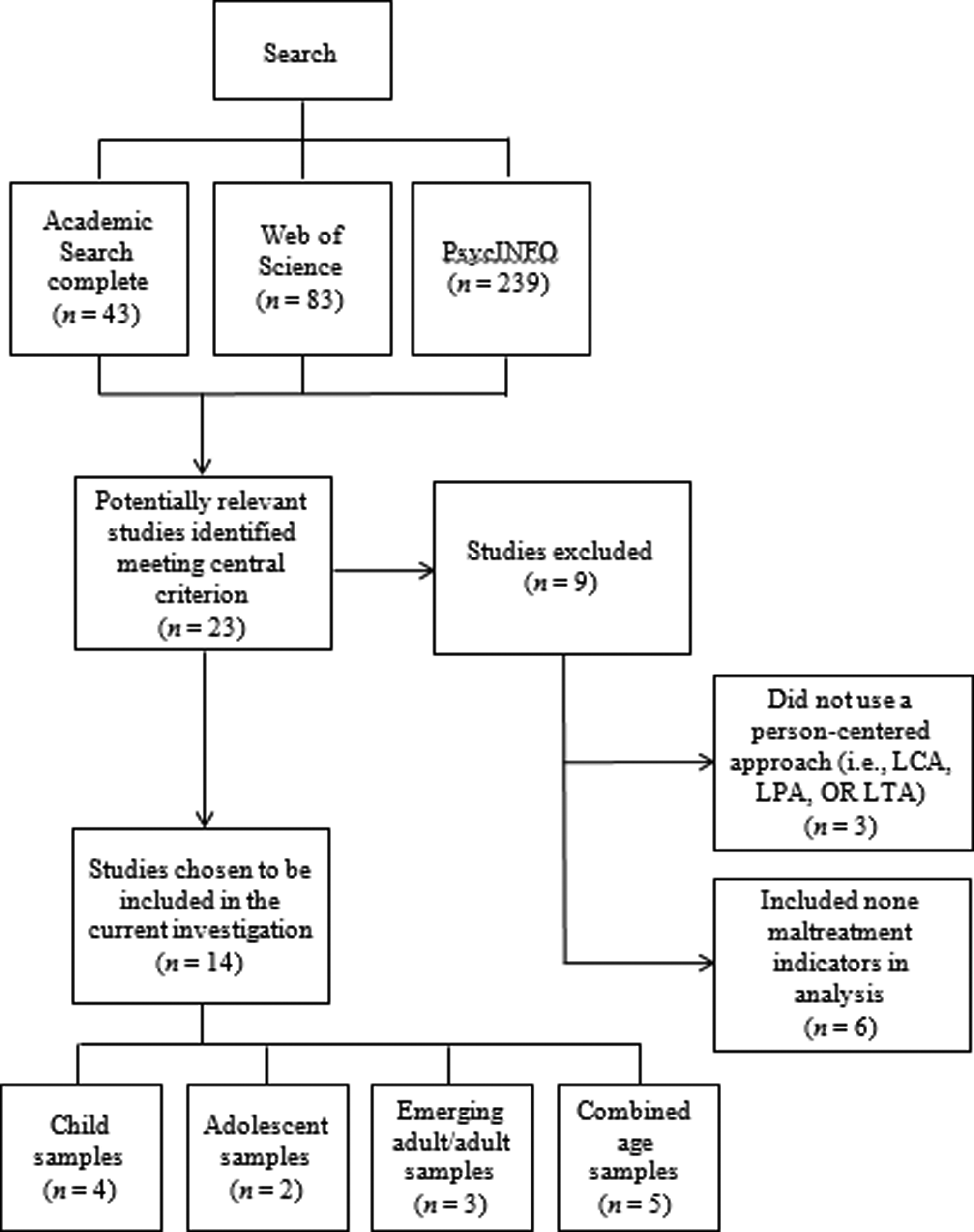
Flowchart showing the selection of studies included in the current investigation.
Review of Studies Using Child Samples (0–12 Years of Age)
Description of Selected Studies
As seen in Table 1, all of the studies using child samples were conducted in the United States, examined covariates or outcomes of latent class membership through cross-sectional designs, and used official case records to assess experiences of maltreatment (Kang, Bae, & Fuller, 2015; Pears, Kim, & Fisher, 2008; Petrenko, Friend, Garrido, Taussig, & Culhane, 2012; Villodas et al., 2012). Two of these studies employed LCA (Kang et al., 2015; Petrenko et al., 2012), one study LPA (Pears et al., 2008), and one study latent transition analysis (Villodas et al., 2012). All of the samples included male and female participants, and half included only maltreated children (Kang et al., 2015; Petrenko et al., 2012).
Frequencies Describing Study and Sample Characteristics.
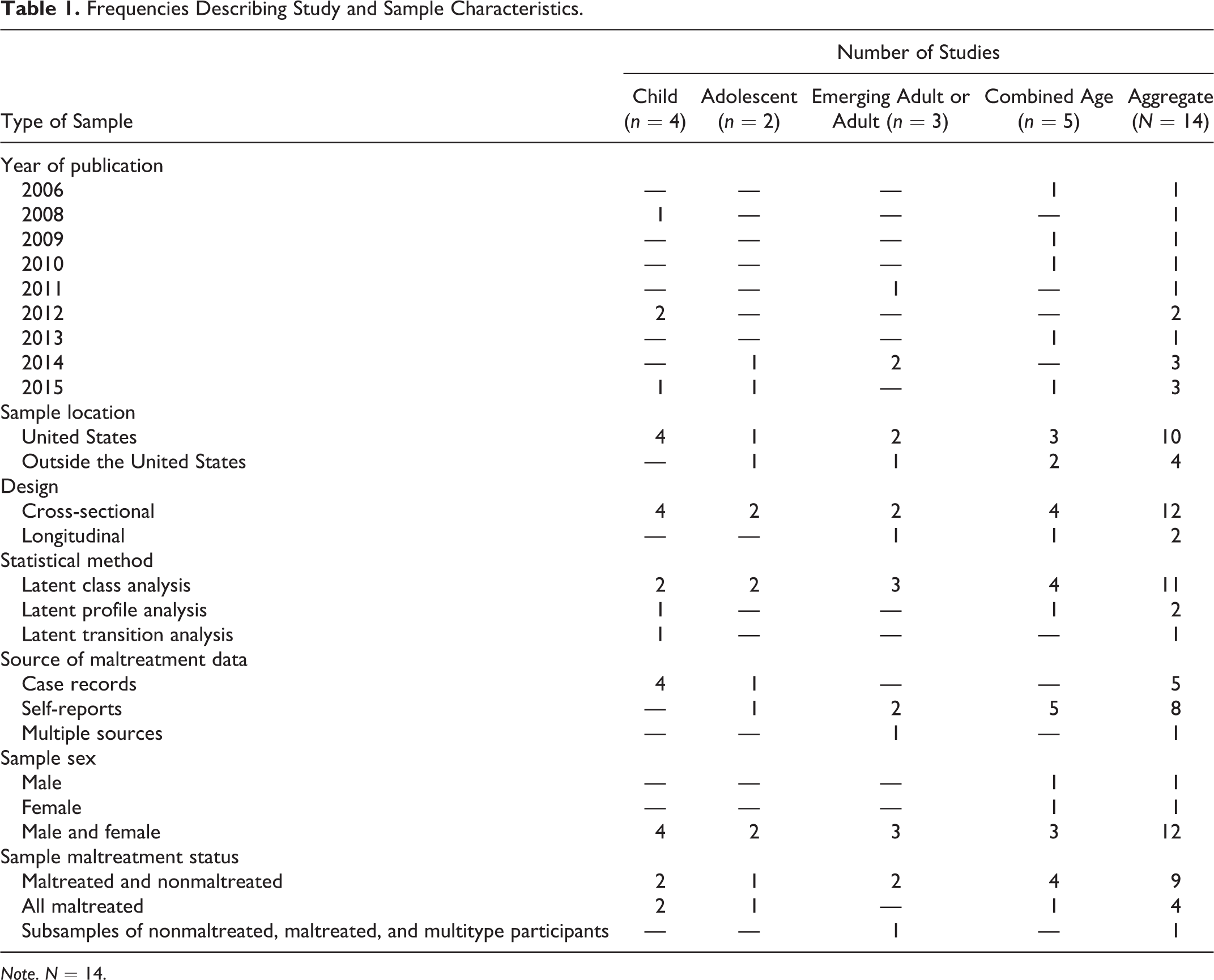
Note. N = 14.
What Observed Indicators Are Being Used to Model Classes of Maltreatment?
Table 2 presents the frequencies of observed indicators assessed and used to model classes of maltreatment. All studies using child samples used single indicators of maltreatment types experienced during childhood. Three studies used indicators that spanned more than one dimension of maltreatment, which included severity (Pears et al., 2008; Petrenko et al., 2012) and risk of harm (Kang et al., 2015). Two studies used binary (yes/no) indicators to model their latent classes of maltreatment (Kang et al., 2015; Villodas et al., 2012), followed by indicators based on multiple categories (Petrenko et al., 2012) and continuous indicators (Pears et al., 2008). For instance, Petrenko, Friend, Garrido, Taussig, and Culhane (2012) treated severity ratings of physical abuse, sexual abuse, physical neglect, and supervisory neglect as ordinal to model their latent classes of maltreatment.
Summary of Observed Indicators Used to Model Latent Classes of Maltreatment.
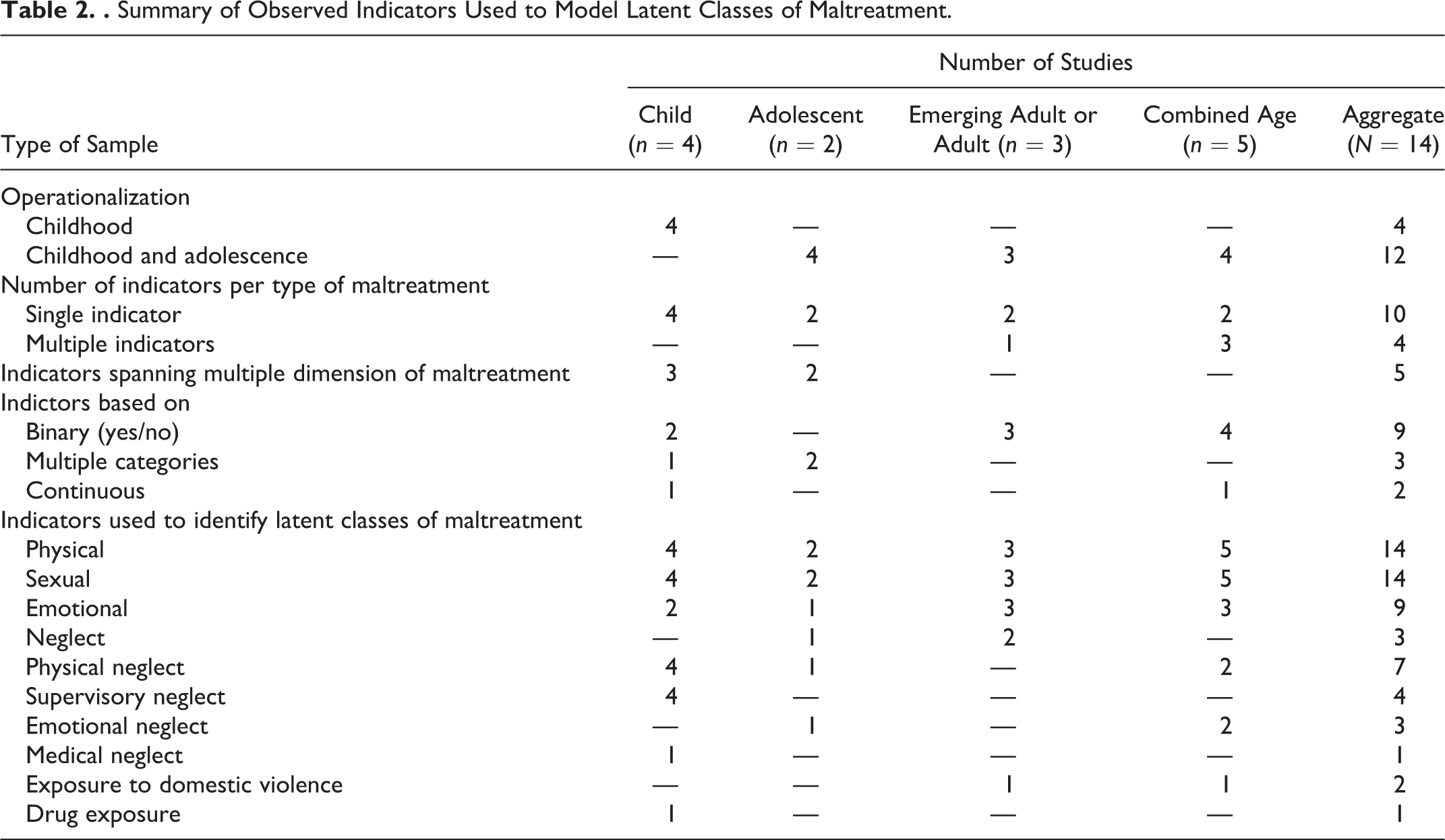
In regard to the type of maltreatment included in the latent class models, indicators of physical abuse, sexual abuse, physical neglect, and supervisory neglect were present in all of these studies (see Table 2). Two of the studies also included an indicator of emotional abuse (Pears et al., 2008; Villodas et al., 2012). Kang, Bae, and Fuller (2015) was the only study to have included indicators of medical neglect and drug exposure in their latent class model. Across all studies, three different combinations of maltreatment types were used in the modeling of their classes of maltreatment.
What Are the Most Commonly Identified Classes of Maltreatment?
Determining final class solutions
In determining their optimal latent class solution, not one study using child samples employed all of the indices and tests previously mentioned. As seen in Table 3, the studies varied widely on the statistical indicators included in their model selection process: two studies did not use AIC, one study BIC, two studies SABIC, two studies BLRT, and two studies did not include LMRT in determining their final class solution. It is worth noting that particularly high values of entropy were reported across these studies (M = .89, SD = .13).
Frequencies Describing Methods Employed by Studies Reviewed.
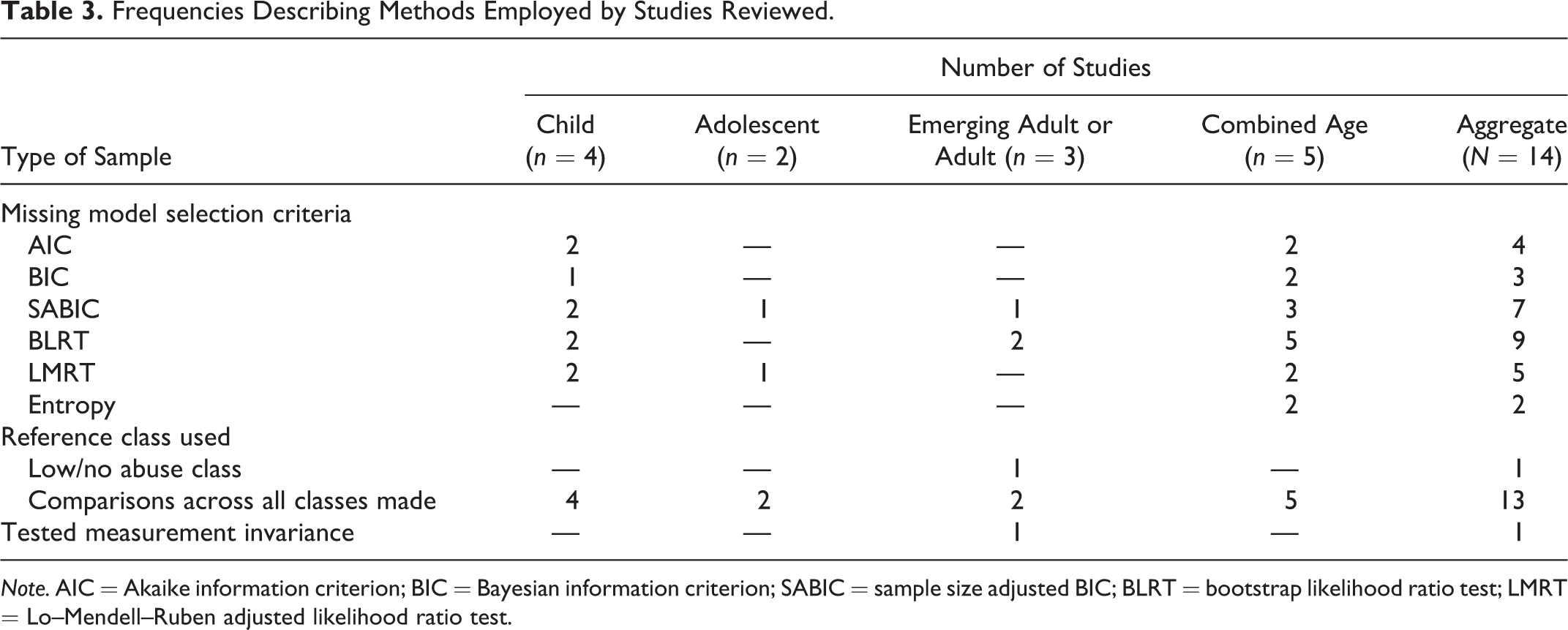
Note. AIC = Akaike information criterion; BIC = Bayesian information criterion; SABIC = sample size adjusted BIC; BLRT = bootstrap likelihood ratio test; LMRT = Lo–Mendell–Ruben adjusted likelihood ratio test.
Commonly identified classes of maltreatment
The final class solution varied across studies using child samples, ranging from three (Villodas et al., 2012) to five (Kang et al., 2015) latent classes. All of these studies employed analytical approaches that allowed for the effects of predictors or outcomes to be compared across all identified classes of maltreatment and not one study tested for measurement invariance (see Table 3). Regardless of the variety of indicators used and final class solutions identified across the studies, the following classes were most commonly identified (see Table 4).
Characteristics of Most Commonly Identified Classes of Maltreatment.

Note. Neglect (unless indicated) = physical, supervisory, medical, or emotional neglect. To assist with interpretation, probabilities ≥ .50 or above the sample mean were considered in labeling classes. Only classes identified by ≥2 studies are presented.
Physical abuse
All studies using child samples included an indicator of physical abuse. Of these studies, two identified a class of children characterized by experiences of physical abuse alone (Kang et al., 2015; Petrenko et al., 2012). These participants most often comprised the smallest class in their respective samples. As seen in Table 4, the probability of being classified into a “physical abuse” class was 3.5% and 12%.
Neglect
Of the four studies using child samples, all included an indicator of neglect when modeling their latent classes of maltreatment. Notably, all of the studies distinguished between subtypes of neglect and two uncovered more than one class characterized by the occurrence of some form of neglect (Kang et al., 2015; Petrenko et al., 2012). For instance, Petrenko and colleagues (2012) identified a class of children characterized by supervisory neglect and a class characterized by co-occurring physical and supervisory neglect. These children comprised the largest class in their respective samples. The probability of being classified into a class characterized by neglect ranged from 13.9% to 49.7%.
Emotional abuse and neglect
The two studies that included indicators of emotional abuse and some form of neglect in their modeling of maltreatment classes identified a class characterized by the co-occurrence of these types of maltreatment (Pears et al., 2008; Villodas et al., 2012). For instance, Pears, Kim, and Fisher (2008) found that 62% of the 117 maltreated preschool-aged foster children included in their study had experiences of maltreatment best characterized by co-occurring emotional abuse and supervisory neglect. Villodas and colleagues (2012) was the only study included in the current review to employ latent transition analysis. Their study of 788 children at risk for maltreatment identified a class at baseline (birth to age 4 years) with high likelihoods of experiencing co-occurring emotional abuse, physical neglect, and supervisory neglect. This class comprised 15% of the total sample of children. It is worth mentioning that somewhat similar patterns of co-occurring emotional abuse, physical neglect, and supervisory neglect emerged from the measurement models analyzed during early and late childhood in Villodas et al.’s (2012) study.
Physical and emotional abuse and neglect
Physical and emotional maltreatment were found to co-occur with neglect in both of the studies assessing these types of maltreatment. Classes characterized by co-occurring physical and emotional abuse and neglect emerged from Pears et al.’s (2008) study of maltreated preschoolers and Villodas et al.’s (2012) study of preschoolers at risk for maltreatment. The children classified into this class comprised 16% of their respective samples.
What Are the Predictors and Outcomes of Classes of Maltreatment?
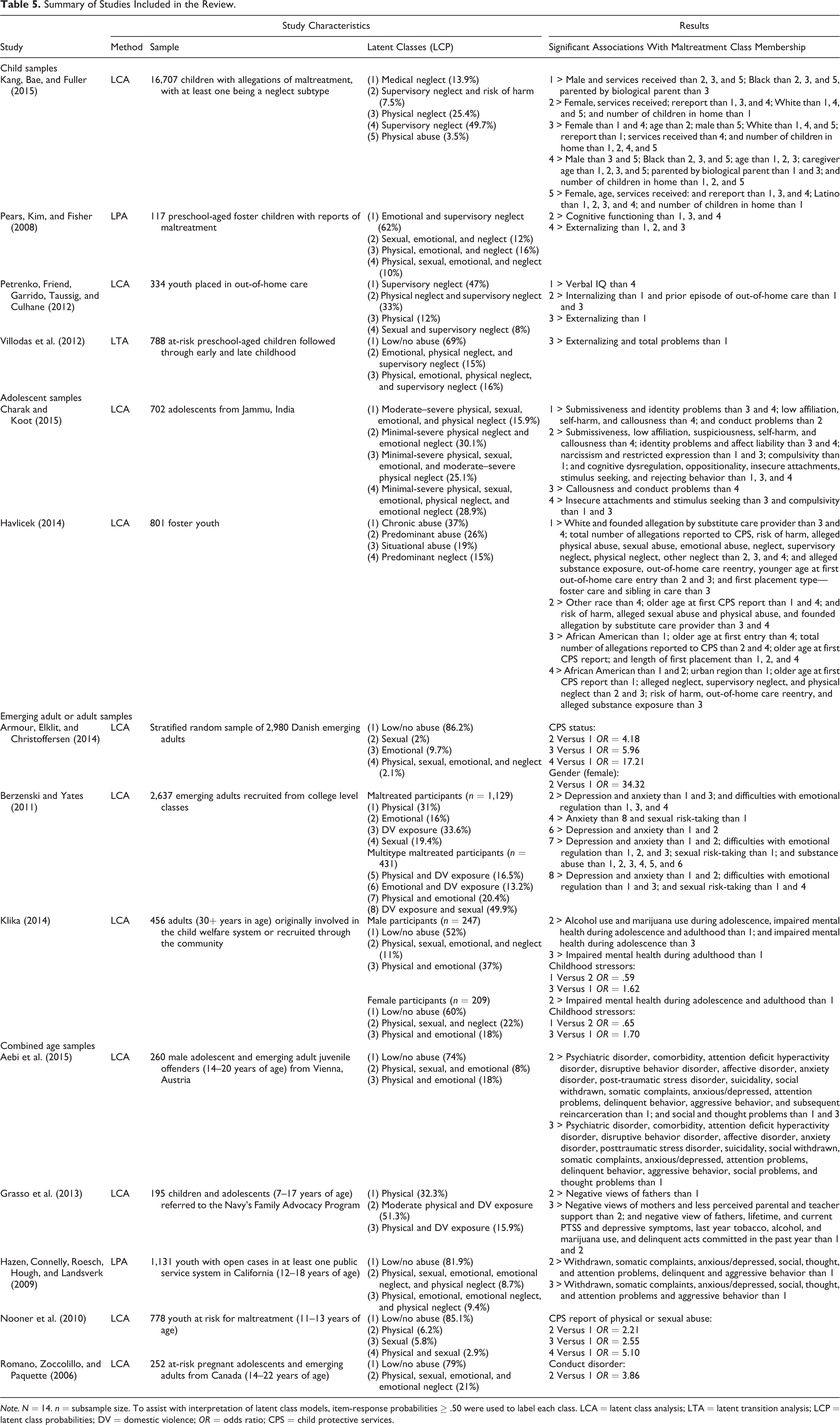
Table 5 provides a summary of the studies reviewed. Two of the four studies using child samples included predictors of class membership (Kang et al., 2015; Petrenko et al., 2012). Kang and colleagues (2015) found a range of characteristics describing their sample and their involvement in the child welfare system differentially related to memberships across identified classes. For instance, Kang et al. reported that children classified in a physical abuse class were more likely to be female, Latino, older, and to receive more child welfare services than children classified in a “supervisory neglect” class. Petrenko and colleagues (2012) reported that children classified in a “physical and supervisory neglect” class had a higher chance of having a prior episode of out-of-home care than children classified in a supervisory neglect or physical abuse class.
Summary of Studies Included in the Review.
Note. N = 14. n = subsample size. To assist with interpretation of latent class models, item-response probabilities ≥ .50 were used to label each class. LCA = latent class analysis; LTA = latent transition analysis; LCP = latent class probabilities; DV = domestic violence; OR = odds ratio; CPS = child protective services.
A range of outcomes related to class membership were examined across three of the studies (Pears et al., 2008; Petrenko et al., 2012; Villodas et al., 2012). Each of these studies reported significant differences on behavioral and/or mental health outcomes across classes characterized by varying experiences of maltreatment. For instance, Pears and colleagues (2008) reported that children classified in an “emotional abuse and neglect” class or a “physical and emotional abuse and neglect” class had lower cognitive functioning than children classified into a “sexual and emotional abuse and neglect” class. Villodas and colleagues (2012) also found greater levels of externalizing symptomatology among children classified in a physical and emotional abuse and neglect class when compared to those in classes characterized by low or no risk for maltreatment or co-occurring emotional abuse and neglect.
Review of Studies Using Adolescent Samples (13–18 Years of Age)
Description of Selected Studies
As seen in Table 1, studies using adolescent samples were conducted in the United States (Havlicek, 2014) and India (Charak & Koot, 2015). Both of these studies examined covariates or outcomes of latent class membership via cross-sectional designs, employed LCA, and used samples comprised of male and female adolescents. Havlicek’s (2014) study of maltreated adolescents used case reports to measure maltreatment, while Charak and Koot’s (2015) study of maltreated and nonmaltreated adolescents used self-reports.
What Observed Indicators Are Being Used to Model Classes of Maltreatment?
In modeling latent classes of maltreatment, both studies on adolescents used single indicators of maltreatment experienced during childhood and/or adolescence (see Table 2). These studies used indictors based on multiple categories to model their latent classes, which spanned multiple dimensions of maltreatment. Charak and Koot (2015) used three-level indicators based on severity (i.e., minimal, low, and moderate-severe) for each type of maltreatment assessed. In contrast, Havlicek (2014) used three-level indicators based on number of maltreatment types participants had experienced (i.e., one to two types, three to four types, and five and above types), predominant types of maltreatment (i.e., physical abuse, sexual abuse, or neglect), chronicity (i.e., one developmental period, two developmental periods, or three and above developmental periods), and number of perpetrators of maltreatment (i.e., one person, two people, or three or more people).
These studies ranged in the type of maltreatment included in their latent class models. Indicators of physical abuse and sexual abuse were present in each of these studies. Havlicek (2014) also included an indicator of neglect, whereas Charak and Koot (2015) distinguished between subtypes of neglect and included indicators of physical neglect and emotional neglect and an indicator of emotional abuse.
What Are the Most Commonly Identified Classes of Maltreatment?
Determining final class solutions
In determining their final class solution, Charak and Koot (2015) was the only study reviewed to have included all of the aforementioned fit criteria. In contrast, Havlicek’s (2014) model selection process did not include SABIC, LMRT, or entropy. It is worth noting that Charak and Koot (2015) reported a relatively low entropy value of .71 (see Table 3).
Commonly identified classes of maltreatment
Both studies using adolescent samples reported a four-class final solution. Each of these studies used statistical approaches that allowed for the effects of predictors or outcomes to be compared across all identified classes of maltreatment. Neither of the studies tested for measurement invariance.
The meaning and structure of identified classes varied across these studies presumably due to the variety of indicators used in modeling their latent classes of maltreatment. As seen in Table 5, experiences of maltreatment characterizing the classes of adolescents in Charak and Koot’s (2015) study ranged in severity and varied by type: (Class 1) moderate-severe physical, sexual, emotional, and physical neglect; (Class 2) minimal-severe physical neglect and emotional neglect; (Class 3) minimal-severe physical, sexual, emotional, and moderate–severe physical neglect; and (Class 4) minimal-severe physical, sexual, emotional, physical neglect, and emotional neglect. In contrast, experiences of maltreatment characterizing the classes of adolescents in Havlicek’s (2014) study included “chronic maltreatment” (i.e., multiple types of maltreatment, predominantly neglect, and perpetrated by three or more people over three and above developmental periods), “predominant abuse” (i.e., multiple types of maltreatment perpetrated by three or more people over three and above developmental periods), “situational maltreatment” (i.e., one to two types of maltreatment predominantly co-occurring with neglect, perpetrated by one person over one developmental period), and “predominant neglect” (i.e., three to four types of maltreatment predominantly neglect perpetrated by two people over two developmental periods).
What Are the Predictors and Outcomes of Classes of Maltreatment?
Both studies using adolescent samples included predictors or outcomes of class membership. Havlicek (2014) focused on covariates of class membership and found that a range of characteristics describing their sample and their involvement in the child welfare system differentially related to memberships across identified classes. In contrast, Charak and Koot (2015) included outcomes of class membership in their study and reported significant differences on behavioral and/or mental health outcomes across classes characterized by varying experiences of maltreatment. For instance, adolescents comprising a class characterized by moderate–severe physical, sexual, and emotional abuse and physical neglect were found to have more conduct problems than their counterparts comprising a class characterized by minimal-severe physical and emotional neglect (see Table 5).
Review of Studies Using Emerging Adult and Adult Samples (>18 Years of Age)
Description of Selected Studies
As seen in Table 1, two studies reviewed used emerging adult samples (Armour, Elklit, & Christoffersen, 2014; Berzenski & Yates, 2011) and one study an adult sample (Klika, 2014) to explore latent classes of maltreatment. Of these studies, two were conducted in the United States and one used a stratified random sample of 2,980 Danish emerging adults (Armour et al., 2014). All three studies employed LCA and one examined covariates and outcomes of class membership longitudinally (Klika, 2014). Two of these studies assessed maltreatment via self-reports (Armour et al., 2014; Berzenski & Yates, 2011), whereas Klika’s (2014) study on 456 adults relied on multiple sources to assess maltreatment. Male and female participants were included in all three samples, two studies included maltreated and nonmaltreated participants (Armour et al., 2014; Klika, 2014) and one study identified three latent class models using their full sample, then a subsample of maltreated participants, and a subsample of participants who had experienced more than one type of maltreatment (Berzenski & Yates, 2011).
What Observed Indicators Are Being Used to Model Classes of Maltreatment?
Two of the studies on emerging adults or adults used single indicators (Berzenski & Yates, 2011; Klika, 2014) and one multiple indicators of single maltreatment types (Armour et al., 2014) in modeling their latent classes. None of these studies captured other dimensions of maltreatment beyond type, and all of the studies assessed maltreatment experienced prior to assessment and used binary (yes/no) indicators to model their classes of maltreatment (see Table 2). All three studies included indicators of physical abuse, sexual abuse, and emotional abuse in their latent class models. Indicators of neglect were also present in two of these studies (Armour et al., 2014; Klika, 2014). Berzenski and Yates (2011) was the only study to include an indicator of exposure to DV, which was defined as seeing or hearing a parent hit or beat up the other parent.
What Are the Most Commonly Identified Classes of Maltreatment?
Determining final class solutions
As seen in Table 3, studies using emerging adult or adult samples most consistently included the fit indices and tests previously mentioned in determining their final latent class solution. Of these studies, two did not include BLRT and one SABIC in their model selection process in contrast to Klika’s (2014) study on 456 adults, which included all of the previously mentioned statistical indicators. Across these three studies, reported entropy values ranged from .74 to .94 (M = .87, SD = .12).
Commonly identified classes of maltreatment
Two of these studies identified four classes (Armour et al., 2014; Berzenski & Yates, 2011) and one study identified three classes among male and female participants (Klika, 2014). Two studies utilized analytical approaches that allowed for the effects of covariates or outcomes to be compared across all identified classes of maltreatment (see Table 3), and one study examined the effects of a predictor on class membership using a “low/no abuse” class as a reference group (Armour et al., 2014). Of these studies, one tested for measurement invariance across male and female participants. The following classes were most commonly identified across studies on emerging adults or adults (see Table 4).
Low/no abuse
Both of the studies including maltreated and nonmaltreated participants identified a class characterized by low probabilities of experiencing maltreatment (Armour et al., 2014; Klika, 2014). These participants comprised the largest classes in their respective samples. The probability of being classified into a low/no abuse class ranged from .52% to 86.2%.
Sexual abuse
All three studies included an indicator of sexual abuse in modeling their latent classes of maltreatment. As seen in Table 4, two of these studies identified a class characterized by experiences of sexual abuse alone. Participants classified into a “sexual abuse” class comprised 2% of a sample of 2,980 Danish emerging adults (Armour et al., 2014) and 19.4% of a subsample of maltreated emerging adults (Berzenski & Yates, 2011).
Emotional abuse
All three studies included an indicator of emotional abuse. Of these studies, two identified a class with high probability of experiencing emotional abuse alone. The probability of being classified into an “emotional abuse” class ranged from 9.7% to 16% (see Table 4).
Physical and emotional abuse
All three studies included indicators of physical and emotional maltreatment in their latent class models. Two studies uncovered a class characterized by the co-occurrence of these two types of maltreatment (Berzenski & Yates, 2011; Klika, 2014). Participants classified into a “physical and emotional abuse” class comprised 20.4% of a sample of 431 college students who had experienced multiple types of maltreatment (Berzenski & Yates, 2011) and 37% and 18% for males and females comprising a sample of children followed through adulthood (Klika, 2014).
Physical, sexual, and emotional abuse and neglect
The two studies that included an indicator of neglect in their latent class models of maltreatment identified a class characterized by experiences of co-occurring physical, sexual, and emotional maltreatment and neglect (Armour et al., 2014; Klika, 2014). One of the two studies identified this class among male but not female adult participants (Klika, 2014). These participants comprised 2.1–11% of their respective samples.
What Are the Predictors and Outcomes of Classes of Maltreatment?
Of the studies on emerging adults or adults, two examined predictors of latent class membership. Klika’s (2014) study of 456 adults reported that both male and female participants comprising classes characterized by co-occurring forms of abuse had higher levels of childhood stressors compared to their counterparts comprising low/no abuse classes. Klika’s study was the only one to test for measurement invariance across male and female participants. Because measurement invariance did not hold, different latent class measurement models were estimated for male and female participants. Klika’s findings suggested that sex differences in measurement were not strong; that is, a class characterized by co-occurring physical abuse, sexual abuse, and neglect emerged across both sexes, but this class also included co-occurring emotional abuse for males. Armour, Elklit, and Christoffersen (2014) did not test for measurement invariance across male and female participants but did include sex and child protective services (CPS) victimization status as covariates in their analyses. Their findings indicated that females were more likely than males to be classified into a class characterized by sexual abuse rather than no abuse (odds ratio = 34.32, confidence interval [19.03, 61.88]) and that CPS victimization status differentially related to memberships across identified classes.
Two of the three studies examined outcomes related to class membership (Berzenski & Yates, 2011; Klika, 2014). Klika’s (2014) findings indicated that when compared to a low/no abuse class, most classes characterized by co-occurring forms of maltreatment exhibited higher levels of behavioral problems and impaired health. For instance, findings from Klika’s (2014) study indicated that males comprising a “physical, sexual, and emotional abuse and neglect” class had significantly higher levels of substance use during adolescence and impaired mental health during adolescence and adulthood when compared to their counterparts comprising a low/no abuse class.
These studies also found significant differences on behavioral and mental health outcomes across classes characterized by varying experiences of maltreatment. For instance, Klika’s (2014) findings indicated that males comprising a physical, sexual, and emotional abuse and neglect class had significantly more impaired mental health than their counterparts classified in a physical and emotional abuse class. Likewise, Berzenski and Yates (2011) found that emerging adults comprising a class characterized by experiences of co-occurring physical and emotional abuse had significantly higher levels of substance use compared to classes characterized by physical abuse and exposure to DV, emotional abuse and exposure to DV, sexual abuse alone, exposure to DV alone, emotional abuse alone, and physical abuse alone.
Review of Studies Using Combined Age Samples (n = 5)
Description of Selected Studies
Five studies reviewed that comprised of individuals spanning multiple periods of development were identified (see Table 1). These study samples ranged in age from 14 to 20 years (Aebi et al., 2015), 7 to 17 years (Grasso et al., 2013), 12 to 18 years (Hazen, Connelly, Roesch, Hough, & Landsverk, 2009), 11 to 13 years (Nooner et al., 2010), and 14 to 22 years (Romano, Zoccolillo, Paquette, 2006). Of these studies, three were conducted in the United States, with the remaining two being conducted in Austria (Aebi et al., 2015) and Canada (Romano et al., 2006). All of these studies used self-reports to assess maltreatment and the majority examined predictors and/or outcomes of class membership via cross-sectional designs, only one examined outcomes of class membership longitudinally (Grasso et al., 2013). Four of the studies employed LCA and one used LPA (Hazen et al., 2009). Three of the study samples included male and female participants, one study focused only on female participants (Grasso et al., 2013), and one study male participants (Aebi et al., 2015). Lastly, four of these studies included maltreated and nonmaltreated participants, and one study included only maltreated participants (Grasso et al., 2013).
What Observed Indicators Are Being Used to Model Classes of Maltreatment?
Regarding the indicators used to model classes of maltreatment (see Table 2), all studies using samples spanning multiple developmental periods assessed maltreatment experienced prior to assessment. Two of these studies used single indicators of maltreatment types (Hazen et al., 2009; Romano et al., 2006) and three studies used multiple indicators of single maltreatment types (Aebi et al., 2015; Grasso et al., 2013; Nooner et al., 2010) to model their classes. For instance, Grasso and colleagues (2013) used LCA to explore response patterns across items assessing experiences of physical abuse (12 items), sexual abuse (6 items), and exposure to DV (8 items). Additionally, the indicators used in these studies did not capture other dimensions of maltreatment beyond type, and all but one study used binary (yes/no) indicators in modeling their latent classes (Aebi et al., 2015; Grasso et al., 2013; Nooner et al., 2010; Romano et al., 2006). Lastly, all studies included indicators of physical and sexual abuse in their latent class models. Three of the studies also included an indicator of emotional abuse (Aebi et al., 2015; Hazen et al., 2009; Romano et al., 2006), two studies used indicators of physical neglect and emotional neglect (Hazen et al., 2009; Romano et al., 2006), and one study included an indicator of exposure to DV (Grasso et al., 2013). Four different combinations of maltreatment types were used in these studies to model their classes of maltreatment.
What Are the Most Commonly Identified Classes of Maltreatment?
Determining final class solutions
Studies using samples spanning multiple periods of development varied on the fit criteria used in determining their final latent class solution (see Table 3). None of these studies included BLRT, two studies did not include AIC, two studies BIC, three studies SABIC, two studies LMRT, and one study did not include entropy in determining their final class solution. Across the four studies reporting entropy, values ranged from .93 to .97 (M = .96, SD = .03).
Commonly identified classes of maltreatment
The final class solutions reported across studies using samples spanning multiple developmental periods ranged from two to four classes. One study identified a two-class solution (Romano et al., 2006), three identified four classes (Aebi et al., 2015; Grasso et al., 2013; Hazen et al., 2009), and one study identified a two-class solution (Nooner et al., 2010). Each of these studies employed analytical approaches that allowed for the effects of outcomes to be compared across all identified classes, and none of the studies tested for measurement invariance. Despite the variety of indicators used and final class solutions identified across the studies, the following classes were most commonly identified (see Table 4).
Low/no abuse
All four studies identified a class characterized by no or low probabilities of experiencing maltreatment. These participants most often comprised the largest class in their respective samples. As seen in Table 4, the probability of being classified into a low/no abuse class ranged from 74% to 85.1%.
Physical, sexual, and emotional abuse and neglect
Two studies including indicators of physical, sexual, and emotional abuse and some form of neglect in their modeling of maltreatment classes identified a class characterized by the co-occurrence of these types of maltreatment (Hazen et al., 2009; Romano et al., 2006). Classes characterized by the co-occurrence of these forms of maltreatment emerged from studies on at-risk Canadian female adolescents (Romano et al., 2006) and youth with open cases in at least one public service system in California (Hazen et al., 2009). Participants classified into this class comprised 8.7% and 21% of their respective samples.
What Are the Predictors and Outcomes of Classes of Maltreatment?
Only one study using samples spanning multiple periods of development examined predictors of class membership (see Table 5). Nooner and colleagues (2010) used CPS reports to establish the validity of their latent classes of maltreatment, which were based on self-reports of physical and sexual abuse. They found that CPS reports of physical or sexual abuse victimization significantly increased the likelihood of being classified in classes characterized by self-reported physical abuse, sexual abuse, or co-occurring physical and sexual abuse compared to a low/no abuse class.
The majority of studies using samples spanning multiple developmental periods examined outcomes related to class membership (see Table 5). Overall, findings indicated that when compared to a low/no abuse class, classes characterized by any type of maltreatment exhibited higher levels of behavioral problems and impaired health. For instance, those comprising a physical, sexual, and emotional abuse and neglect class had significantly higher levels of internalizing symptomatology and behavioral problems (Hazen et al., 2009) and conduct disorder (Romano et al., 2006) when compared to their counterparts comprising a low/no abuse class. Fewer studies found significant differences in behavioral and mental health across classes characterized by varying experiences of maltreatment (Aebi et al., 2015; Grasso et al., 2013). For instance, Aebi and colleagues (2015) found that adolescents comprising a physical, sexual, and emotional abuse class had significantly higher levels of social and thought problems than their counterparts in a physical and emotional abuse class.
Discussion
This systematic review sought to provide an account of existing trends within the literature employing latent class models in the study of maltreatment. A total of 14 studies were reviewed. In the present section, we critique the research reviewed, note recent methodological developments, and make numerous recommendations for future research using person-centered approaches in the study of maltreatment.
Need for a Developmental Perspective
Of the studies reviewed, five used samples comprised of individuals spanning multiple periods of development and the vast majority of studies reviewed used cross-sectional designs. Only one study using a child and adolescent sample (Grasso et al., 2013) and one study using a sample of adults (Klika, 2014) examined predictors and/or outcomes of class membership via measures collected at different time points than the observed indicators used to model classes of maltreatment. These observations draw attention to the need for person-centered research on longitudinal predictors and outcomes of classes of maltreatment. It is also apparent that this line of research would be strengthened by a developmental focus that considers experiences of maltreatment and their predictors and outcomes during particular stages of child and adolescent development (Cicchetti & Toth, 1995; Manly, 2005; Scannapieco & Connell-Carrick, 2005). This is consistent with a developmental psychopathology perspective where maltreatment is conceptualized in terms of how it may be experienced at particular stages of development, which seems necessary for most effectively understanding its causes and consequences (Barnett, Manly, & Cicchetti, 1993; Cicchetti, 1996; Cicchetti & Toth, 1995). Epidemiological research on the prevalence of maltreatment has indicated that particular types are more prevalent across childhood (e.g., neglect) and others late childhood or adolescence (e.g., sexual abuse; U.S. Department of Health and Human Services, 2013). Consequently, the use of samples comprised of individuals spanning multiple periods of development may be a barrier to most effectively classifying experiences of maltreatment. Thus, a developmental focus may be critical to increasing the accuracy by which person-centered research is able to capture the nature of maltreatment, which has direct implications for how we understand related causes and consequences.
Need to Develop Guidelines for Indicators of Maltreatment
Operationalization of indicators
Consideration must also be given to the operationalization of maltreatment when modeling latent classes. All studies reviewed using adolescent samples, emerging adult or adult samples, or samples of individuals spanning multiple periods of development included lifetime measures of maltreatment. A developmental orientation to the study of latent classes of maltreatment calls for consideration to be given to children’s developmental status during assessment, necessitating researchers to consider the age span assessed (Barnett et al., 1993; Thornberry et al., 2001). Given that maltreatment may be expressed differently during childhood and adolescence (U.S. Department of Health and Human Services, 2013), practices of assessing lifetime experiences of maltreatment across multiple periods of development run the risk of misinterpreting the measurement structure of a latent class model of maltreatment. It follows that researchers employing latent class models to investigate the causes and consequences of maltreatment should restrict their operationalization of maltreatment to a single period of development. Prospective research designs may aid in strengthening this line of research by affording researchers more flexibility in how indicators of maltreatment are operationalized and at the same time reduce inaccuracies through distorted recall.
Indicators of maltreatment types
There is a growing consensus that research must approach maltreatment as a multidimensional construct in order to most accurately represent victim’s real-lived experiences of maltreatment (R. C. Herrenkohl & Herrenkohl, 2009; Higgins & McCabe, 2001; Swartout & Swartout, 2012; Teicher et al., 2006). A multidimensional view of maltreatment broadens conceptual definitions to include all types of maltreatment (Higgins & McCabe, 1998) but also underscores the need to consider other aspects of this complex construct beyond type. Indicators of physical and sexual abuse were included in all of the studies reviewed; however, these studies varied on whether or not indicators of emotional abuse, neglect, and exposure to DV were included. The studies reviewed included 10 different combinations of maltreatment types in the modeling of their classes of maltreatment. Not one study included indicators of all five types of maltreatment (i.e., physical, sexual, and emotional abuse, neglect, and exposure to DV) in their modeling of latent classes of maltreatment, and only seven studies included indicators of physical, sexual, and emotional abuse and some form of neglect. The failure to include an indicator of neglect by four studies reviewed is especially troubling, given that it is the most prevalent type of maltreatment and the least understood (U.S. Department of Health and Human Services, 2017). Overall, these findings have direct implications for the classes identified across the studies: The indicators used to model a latent categorical variable of maltreatment necessarily determine what patterns can emerge from the data being analyzed.
A common critique of past research on maltreatment is that focusing on single types of maltreatment in isolation fails to deal with the problem of co-occurring maltreatment types, thereby confounding the interpretation of results (Van Scoyoc, Wilen, Daderko, & Miyamoto, 2015). Although the present review shows that some progress has been made to address this issue, the lack of studies including all five types of maltreatment shows that this significant limitation persists. Even when studies include two, three, or even four types of maltreatment in the modeling of latent classes of maltreatment, researchers still fail to most accurately address the problem of co-occurring maltreatment types and still run the risk of confounding the interpretation of their results by overlooking subgroups of maltreated individuals with qualitatively different experiences of maltreatment. Diversity within process is a fundamental assumption of developmental psychopathology (Cicchetti & Rogosch, 1996; Cicchetti & Sroufe, 2000). Therefore, a development orientation in person-centered research examining classes of maltreatment should include a conceptual definition of maltreatment that consists of all five types of maltreatment; this allows for the emergence of 32 (5 binary items: 25) different experiences of maltreatment (see Figure 2). Ultimately, a lack of uniformity across the indicators used to model latent classes of maltreatment has hindered our ability to generalize findings across studies, develop more sophisticated theories, and better understand the shared and unique risks associated with particular experiences of maltreatment.
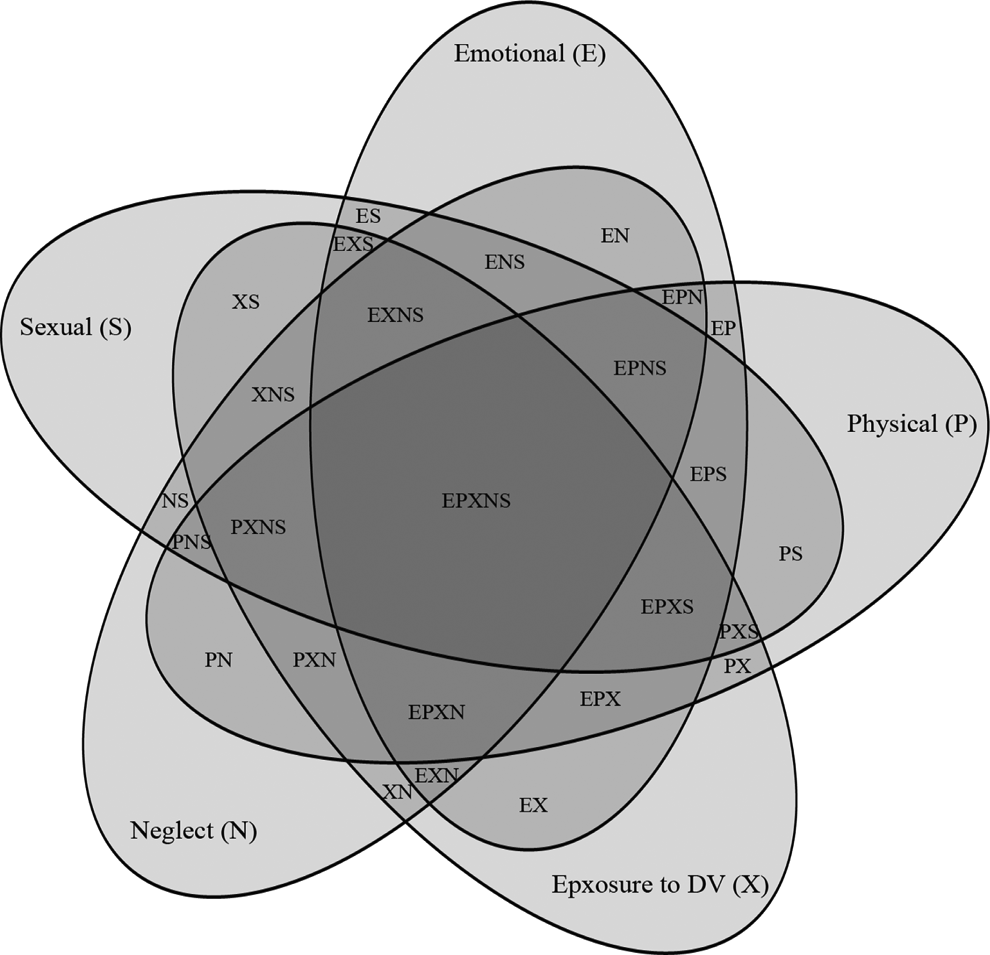
Multidimensional view of maltreatment: Potential classes that can result from five types of maltreatment.
Indicators tapping into other dimensions of maltreatment
Regarding indicators tapping into other aspects of maltreatment beyond type, only two studies on children (Pears et al., 2008; Petrenko et al., 2012) and one study on adolescents (Charak & Koot, 2015) included indicators of maltreatment that accounted for dimensions of type and severity. Havlicek’s (2014) study on adolescents was the only study to include indicators that spanned dimensions of maltreatment beyond type and severity in their modeling of classes of maltreatment. A developmental perspective emphasizes the importance of comprehensively defining the variable of interest (Cicchetti & Banny, 2014), which would involve selecting indicators that tap into all the dimensions of the construct being measured by latent class models. However, it remains to determine how best to achieve this when modeling a latent construct of maltreatment. What observed indicators of maltreatment best capture the multiple underlying dimensions of a latent maltreatment construct? Research has yet to adequately address this issue. Developing a sound understanding of which observed indicators of maltreatment best capture the multiple underlying dimensions of a latent maltreatment construct should be a priority in future research. Addressing this priority may offer direction for best practices and will have the potential to offer insight into dimensions of maltreatment beyond type that should be included in practitioners’ risk assessments.
Multiple indicators of single maltreatment types
This review also identified several studies that included multiple indicators of single maltreatment types in the modeling of latent classes of maltreatment. The use of multiple indicators of maltreatment types can pose a challenge to drawing comparisons with studies using single indicators of maltreatment types. In addition, using multiple indicators for a single type of maltreatment may pose a threat to the assumption of local independence. As classes are defined by their item-response probabilities, latent class models assume item responses are not dependent on each other (Collins & Lanza, 2010). However, if an individual has not experienced a particular type of abuse, it is likely that this would be reflected across multiple indicators assessing that particular type of abuse, and these responses would depend on each other. Despite existing methods of adjusting for local dependence in latent class models (Reboussin, Ip, & Wolfson, 2008; Sepúlveda, Vicente-Villardón, & Galindo, 2008), none of the studies reviewed that used multiple indicators of single types of maltreatment even mentioned local dependence. This suggests a need for greater sophistication in the use of LCA in maltreatment research.
Need for Clarity Regarding Maltreatment Status of Participants
Another important finding of the current review pertains to the maltreatment status of the participants. In addition to examining outcomes related to classes of maltreatment, Berzenski and Yates (2011) explored latent class models across three subsamples of college students characterized by varying maltreatment statuses. Their findings indicated that by focusing on participants with histories of co-occurring maltreatment types, also known as multitype maltreatment (Higgins & McCabe, 1998), latent class models were able to extract more meaningful patterns of comorbidity. Their study was the only one that explored latent classes across participants with histories of multitype maltreatment. The majority of the studies reviewed included participants with and without histories of maltreatment, and five studies restricted their sample to participants with identified histories of maltreatment.
Berzenski and Yates’s (2011) findings suggest that the practices noted above may restrict the types of classes that researchers are able to extract through latent class models. Given this implication, it is critical to replicate Berzenski and Yates’s (2011) findings. To date, this has not occurred. Determining the impact of a sample’s maltreatment status on the information extracted from latent class models may offer further direction for best practices within this area of research and result in greater clarity regarding the co-occurrence of maltreatment types.
Need to Follow Best Practices in Identifying Classes of Maltreatment
Systematic use of fit indices
We found that the statistical indicators used to determine final class solutions varied widely across studies reviewed. Only two studies, one on adolescents (Charak & Koot, 2015) and the other on adults (Klika, 2014), used all five commonly recommended statistical indicators (i.e., AIC, BIC, SABIC, BLRT, and LMRT) to inform their selection of the optimal final class solution. More studies reviewed used LMRT than BLRT when determining their final class solution, despite BLRT being identified as one of the most reliable indicators of model fit (Nylund et al., 2007). The wide variety of statistical indicators used to determine final class solutions across the studies reviewed may be a result of the statistical software packages used to estimate these models. Nevertheless, it is important for person-centered research on maltreatment to move forward in a more systematic fashion that will help ensure the validity and replicability of identified models. We therefore recommend that whenever possible researchers utilize and report all statistical indicators of absolute and relative model fit when determining a final class solution.
Ensuring class stability
The final class solutions reported across the studies reviewed ranged from two to five classes, with the vast majority of studies identifying three or four classes: studies on children identified three to five classes, studies on adolescents identified four classes, studies on emerging adults or adults identified three to four classes, and studies on individuals spanning multiple periods of development identified two to four classes. Two classes characterized by co-occurring types of maltreatment were identified across two studies on children, a class characterized by co-occurring emotional abuse and neglect and a class characterized by co-occurring physical and emotional abuse and neglect. Classes of maltreatment reported across the two studies on adolescents did not correspond due to the range of indicators used to model their latent classes. Two classes characterized by co-occurring types of maltreatment were identified across two studies on emerging adults or adults, a class characterized by co-occurring physical and emotional abuse and a class characterized by physical, sexual, and emotional abuse and neglect. Lastly, a class characterized by co-occurring physical, sexual, and emotional abuse and neglect was identified across two studies on individuals spanning multiple periods of development.
For many studies, participants comprising the above classes represented a significant proportion of their respective samples, yet several studies reported rather small latent class probabilities. Due to higher standard errors, lower latent class probabilities can jeopardize the stability of class solutions and could be considered spurious (Hipp & Bauer, 2006). For this reason, it has been suggested that latent class models containing classes with less than 5% of a sample should be validated by external variables (Roesch et al., 2010) or should be considered inadequate, regardless of the statistical fit of the model. Despite this limitation, the findings of our review align with a growing body of evidence indicating that children who are maltreated may experience more than one type of maltreatment (Arata, Langhinrichsen-Rohling, Bowers, & Farrill-Swails, 2005; Berzenski, Yates, & Egeland, 2014; Teicher et al., 2006). Research on the predictors and outcomes of maltreatment is in need of advanced methodology that can address the issue of co-occurring maltreatment types. As Manly (2005) so aptly noted in a commentary on advances in the measurement of child maltreatment, “because of the high frequency of multiple subtype co-occurrence, research on maltreatment requires a well-conceptualized and empirically sound rationale for handling comorbidity to prevent it from obfuscating distinctions among subtypes and the relative contributions of each” (p. 432). The classes reported across the studies reviewed here demonstrate how person-centered methodology, such as LCA, may be a viable option to address this concern.
Need to Examine Measurement Invariance
This review found six studies that examined predictors or covariates of class membership. Four of these studies successfully used characteristics describing a participant’s involvement in the child welfare system to validate their identified classes of maltreatment (i.e., CPS victimization status, total number of CPS allegations, prior episode of out-of-home care, services received, and age at first CPS report). Several studies also used participant’s ascribed characteristics, such as ethnicity–race and gender, as covariates of class membership. For instance, two studies reviewed found significant gender differences in latent class membership probabilities among emerging adults (Armour et al., 2014) and children (Kang et al., 2015), whereas two studies failed to identify any gender differences across classes of maltreated adolescents (Havlicek, 2014) and youth ages 11–13 years (Nooner et al., 2010). Of the studies reviewed that included gender and/or ethnicity–race as a covariate, not one tested for measurement invariance across gender or ethnic-racial groups. Modeling these groups as a covariate or class predictor allows for researchers to determine whether subgroups (e.g., male and females) vary on their likelihood of being classified into a particular class, whereas testing for measurement invariance across subgroups allows researchers to determine whether or not a latent class measurement model is the same across subgroups. It has been suggested that research should test for measurement invariance prior to drawing conclusions about group differences in latent class membership probabilities (Lanza, Collins, Lemmon, & Schafer, 2007), such as the ones drawn in the reviewed studies using gender and/or ethnicity–race as a covariate. For the study of latent classes of maltreatment, measurement invariance raises important questions that have yet to be extensively explored, such as does the latent class measurement model of maltreatment vary across family formations, communities, males and females, ethnic-racial groups, social/economic status, or sexual and nonsexual minority adolescents?
Only one study reviewed considered measurement invariance. Although Klika (2014) found support for gender differences in the measurement model of maltreatment, the differences were small. This finding provides preliminary support to indicate that the measurement structure of maltreatment may vary by gender. Although it may be possible for males and females to experience different patterns of co-occurring maltreatment types, gender-specific person-centered models of maltreatment have yet to be extensively explored. Nonetheless, Klika’s findings provide preliminary evidence for the need to examine gender-specific models when investigating causes and consequences associated with latent classes of maltreatment. This process should start first with testing for measurement invariance across genders prior to drawing conclusions about gender differences in latent class membership probabilities.
Need to Clarify Unique Risks Associated With Specific Classes of Maltreatment
Ten studies were identified that examined outcomes related to class membership. The outcomes investigated varied extensively across studies. However, findings indicated that when compared to a low/no abuse class, most classes of maltreatment exhibited higher levels of behavioral problems and impaired health. For instance, studies documented significantly worse outcomes for participants comprising a physical, sexual, emotional, abuse, and neglect class (e.g., Pears et al., 2008), a physical and emotional abuse class (e.g., Klika, 2014), and a physical and emotional abuse and neglect class, relative to those in a low/no abuse class. Likewise, several studies found significant differences on behavioral and mental health outcomes across classes characterized by varying experiences of maltreatment. For instance, Berzenski and Yates’s (2011) study of emerging adults found that those comprising a class characterized by experiences of co-occurring physical and emotional abuse had significantly higher levels of substance use compared to classes characterized by physical abuse and exposure to DV, emotional abuse and exposure to DV, sexual abuse alone, exposure to DV alone, emotional abuse alone, and physical abuse alone. It should be noted that all of the seven studies reviewed, allowing for comparisons of the effects of class membership on outcomes, found significant differences between classes characterized by varying experiences of maltreatment; however, most of these findings seemed to suggest a positive trend between the number or severity of maltreatment types one had experienced and maladaptation. Nevertheless, such findings demonstrate how latent class models may be used to uncover risks for particular experiences of maltreatment.
In sum, the aforementioned recommendations identify how it is possible to strengthen this area of research and by extension develop a better understanding of the unique and shared risks associated with specific experiences of maltreatment. To the extent that unique risks are associated with particular experiences of maltreatment, research is needed that identifies how the need for prevention across these individuals varies and how to best address these needs. This research will have the potential to increase our understanding of how to best leverage our prevention efforts by providing insight into variability within the causes and consequences of maltreatment that should be considered when determining which children and adolescents to target. For example, the presence of a unique risk marker associated with a particular class of maltreatment may guide practitioners’ assessments and decisions on what services or interventions to provide victims.
Moving Forward With More Sophisticated Person-Centered Models
Many of the implications that emerge from our critique of current studies can be addressed using more sophisticated person-centered models. Although latent class models are readily used with cross-sectional data, extensions exist that provide ways to examine the longitudinal effects of covariates (e.g., Hagenaars & McCutcheon, 2002) on and outcomes (Asparouhov & Muthén, 2014; Bakk & Vermunt, 2016; Bray, Lanza, & Tan, 2015; Lanza, Tan, & Bray, 2013) of class membership. Researchers investigating the outcomes of maltreatment from a developmental orientation may also consider the use of repeated measures latent class analysis (RMLCA; Lanza & Collins, 2006), which has yet to be used by maltreatment researchers. RMLCA is an application of LCA to repeated measures data that can be used to capture continuous and discontinuous patterns of single and co-occurring maltreatment types across different stages in childhood and adolescence. Through the use of RMLCA, researchers can account for additional dimensions of maltreatment that may be more challenging to capture with traditional latent class models, such as the persistence or continuation of maltreatment. This approach can also offer insight into unique and shared risks associated with longitudinal patterns of maltreatment, and it has the potential to advance theory on the impact of early versus late maltreatment. For instance, RMLCA provides a flexible framework to simultaneously examine the developmental psychopathology assumption that childhood disruptions in developmental tasks as a result of maltreatment increases adolescents’ risk of maladjustment (Cicchetti & Toth, 1995), and the expectation, derived from a life course perspective, that proximal experiences of maltreatment in adolescence may be more salient for understanding adolescent maladjustment than distal experiences that occur in childhood (Elder, 1998).
Recent advancements in person-centered methods also make it possible for researchers to move beyond unique and shared risks associated with classes of maltreatment, and researchers may begin to determine the mediating pathways that explain these associations using the Bolck–Croon–Hagenaars (BCH) method (Bakk & Vermunt, 2016). The BCH method uses posterior probabilities to classify individuals to their most likely latent class and allows for the estimation of outcome models that include weights reflecting classification error in class assignments. It is worth mentioning that the failure to identify unique risks across latent classes of maltreatment does not preclude the utility of a person-centered approach but should signal the need for researchers to determine whether unique mediators exist that help explain risk for specific classes of maltreatment. By doing so, researchers can begin to lay the groundwork for developing prevention programming that targets the unique mechanisms that explain risk for specific classes of maltreatment. This line of research will also have the potential to advance theory, given that mediating variables often form the basis of many theories of maltreatment.
Researchers looking to contextualize classes of maltreatment may also consider using the BCH method or multilevel latent class analysis (MLLCA; Henry & Muthén, 2010). The BCH method can be used to estimate outcome models where an interaction term exists between an exogenous variable and classes of maltreatment, allowing researchers to determine for whom and under what circumstances specific classes of maltreatment exert an effect on specified outcomes. Researchers may also consider the use of MLLCA, which is recommended when using multilevel data because of its ability to appropriately model the nested structure of such data (Henry & Muthén, 2010). MLLCA can be used to identify latent classes of maltreatment and simultaneously examine how Level 2 units affect Level 1 classes of maltreatment. These extensions will play an important role in responding to the need for contextualizing experiences of maltreatment in the sociocultural and economic context in which they occur (Malley-Morrison & Hines, 2007), something that is critical for prevention and aligning this research with existing funding mechanisms.
Another modeling extension that is worth mentioning here is latent transition analysis (LTA; Collins & Lanza, 2010; Lanza et al., 2013). Most often known for its capability to examine the probability an individual remains in the same class across adjacent times, LTA can also be used to examine measurement invariance over time and to explain transitions between classes over time using covariates (Lanza & Collins, 2008). Only one study reviewed employed LTA to model classes of maltreatment during preschool, early childhood, and late childhood (Villodas et al., 2012). Often underutilized, LTA gives maltreatment researchers the ability to investigate more advanced questions regarding the heterogeneity in transitions and the effectiveness of intervention. For example, a researcher interested in preventing the continuation of maltreatment could model their intervention as a covariate at three different time points to examine its effects on transitions from varying classes of maltreatment into a nonmaltreated class across early childhood, late childhood, and adolescence. Through the use of LTA, insight may be gained into the effectiveness of the researcher’s intervention and into the timing at which the intervention may be most useful.
Lastly, associative latent transition analysis (ALTA) provides researchers with an innovative method to investigate the associations between classes of maltreatment and other multidimensional developmental processes over time (Bray et al., 2010; Flaherty, 2008). An extension of LCA and LTA, ALTA is a person-centered method that combines two separate LTAs in the same model in order to examine how the processes are related (Bray et al., 2010). In other words, ALTA can be used to examine how a transition in one LTA is related to a particular transition in another LTA. This approach can also accommodate covariates that predict differences in the associations between transitions. For example, ALTA can be used to examine how a transition from a particular experience of maltreatment during early childhood (e.g., concurrent physical abuse and neglect) to another experience during late childhood (e.g., sexual abuse) is related to transitions in different comorbidity patterns of mental and physical health symptoms/disorders across early and late childhood and can be used to determine the impact a covariate (e.g., an intervention) has on these associations. By using ALTA, maltreatment researchers can begin to ask a host of new questions regarding the nature of maltreatment and its associations with developmental outcomes over time, which may be important in moving this area of research into new areas of inquiry.
Conclusion
Taken as a whole, research employing person-centered methods has contributed to our understanding of the complexities within maltreatment. The studies in our review and critique demonstrated how latent class models may facilitate the study of maltreatment as a multidimensional, complex construct; it simultaneously showed how to address several methodological limitations common to the study of maltreatment and heterogeneity in experiences of maltreatment. However, research is now needed that builds upon these efforts by addressing limitations identified in our critique of current studies. To extend existing knowledge on classes of maltreatment, a developmental perspective and multidimensional conceptualization of maltreatment that begins by considering all types of maltreatment is proposed. Utilized in conjunction with advanced person-centered methods, it has the potential to address several of the limitations identified in this article and advance understanding of maltreatment.
Footnotes
Declaration of Conflicting Interests
The author(s) declared no potential conflicts of interest with respect to the research, authorship, and/or publication of this article.
Funding
The author(s) disclosed receipt of the following financial support for the research, authorship, and/or publication of this article: Completion of this research was supported by grants T32DA017629 and P50DA039898 from the National Institute on Drug Abuse (NIDA).