



Abstract
Child maltreatment is associated with negative outcomes such as substance use (SU). This study tested relations among maltreatment history, coping behavior, and SU behavior in youth residing in foster care. Participants were 210 youth (Mage = 12.71 years; SD = 2.95) in foster care who completed self-report measures through an audio computer-assisted self-interview program. Using a structural equation modeling framework and latent measurement constructs, positive associations were identified between maltreatment at baseline and coping behavior outcomes as well as SU behavior outcome approximately 4.5 months later. Specifically, greater severity and chronicity of maltreatment was associated with greater SU behavior as well as indirect action, prosocial, and asocial coping behavior. Maltreatment was not significantly related to direct action coping behavior. In moderation tests, only asocial coping provided a significant interaction effect for SU behavior outcomes; SU behavior did not moderate pathways between maltreatment and coping behavior. For youth in foster care, the coping approach may be varied and relate differentially to SU behavior outcomes, with asocial approaches to coping acting as a buffer for the maltreatment/SU relation. Additionally, SU remains an important target for intervention and prevention in youth residing in foster care.
Keywords
Child maltreatment is a nonnormative event that interrupts or diminishes a child’s ability to develop social and behavioral skills necessary for adaptive behavior (Ayoub et al., 2006). These negative life experiences and the absence of important protective factors may contribute to the development of health risk behavior, like substance use (SU) problems, later in the developmental trajectory (e.g., Robertson, Xu, & Stripling, 2010). Indeed, the relation between child exposure to maltreatment and the development of SU behavior later in adolescence is robust (Tonmyr, Thornton, Draca, & Wekerle, 2010). Additionally, youth whose maltreatment experience has risen to the level of out-of-home placement have demonstrated higher rates of SU problems and SU severity as compared to youth without a history of foster care placement (e.g., Stevens, Brice, Ale, & Morris, 2011). Thus, youth in foster care represent an important population of study in the context of SU research (Pilowsky & Wu, 2006).
Not all youth exposed to maltreatment and residing in out-of-home placements, however, have SU problems. Consistent with the notion of multifinality, it is likely other factors could be involved, which may better account for the variance in outcomes following exposure to child maltreatment (Cicchetti & Rogosch, 1996). One factor that likely contributes to whether or not youth exposed to maltreatment engage in SU is the coping process involved in youths’ responses to maltreatment. Coping processes have been associated with maltreatment (Cicchetti & Rogosch, 2009) and SU (Eftekhari, Turner, & Larimer, 2004; Windle & Windle, 1996). No study, however, has examined how these constructs operate together in a moderation framework.
Coping as a Moderator
Coping can be defined as one’s response to demands viewed as stressful (Lazarus & Folkman, 1984) and, in the context of maltreatment, the effort made by the child’s emotional, behavioral, or cognitive systems to manage difficulties or stress related to the maltreatment experience. Historically, the construct of coping has received extensive attention in research, with varying approaches to its conceptualization present in the literature. Compas and colleagues concluded from review of the coping literature that coping is a multidimensional construct and further research on coping processes in youth is needed. Specifically, past research tended to ignore the notion that youth employ a range of coping strategies in a variety of different ways (Compas, Connor-Smith, Saltzman, Thomsen, & Wadsworth, 2001); therefore, comprehensive, yet specific measurement of coping behaviors should be included in models examining the role of coping (Wills, Sandy, Yaeger, Cleary, & Shinar, 2001).
Type of coping also appears to matter in the prediction of SU, although, perhaps in part due to measurement, the results from prior research are mixed (Eftekhari et al., 2004; Windle & Windle, 1996). For example, several studies have demonstrated a negative relation between active coping and SU behavior and a positive relation between avoidant coping and SU behavior (Eftekhari et al., 2004). Alternatively, however, in a study examining the relation between stressors and SU in female adolescent offenders, Robertson, Xu, and Stripling (2010) noted that avoidant coping and active coping were not associated with SU behaviors. The inconsistencies seen across studies may indicate that more complex systems of measurement of coping are needed and that youth may indeed employ multiple types of coping or change coping approach over time. Further, additional work on how coping functions for youth in foster care is needed, as the life experiences of these youth can substantially differ from youth who have not experienced out-of-home placement.
It is possible that coping behavior may also be the intermediate or moderator variable that accounts for the multifinality of outcomes for youth exposed to child maltreatment. Emerging evidence suggests that the type of coping response (e.g., indirect vs. direct coping) could buffer or intensify the association between stressful life experiences in general and SU behaviors. For example, in a school-based study, Wills, Sandy, and Yaeger (2002) noted the relation between negative life events and adolescent SU was stronger for those individuals exhibiting high avoidance coping when compared to those with low avoidance coping. Additionally, findings indicated pathways were weaker for individuals with high active coping when compared to those with low active coping.
Other research suggests that coping also can have a stress-exacerbating effect on SU behavior following stressful events (e.g., Laurent, Catanzara, & Callan, 1997). Wills, Sandy, Yaeger, Cleary, and Shinar (2001) found “behavioral coping” (which is akin to active coping) to be protective against initiation and escalation of SU behaviors, while forms of what they termed “disengagement coping” (which is similar to avoidant coping) demonstrated risk-enhancing effects for SU behaviors. Therefore, some forms of coping may heighten associations between stressful events and SU behaviors, while other forms of coping may reduce these associations, giving further support for the notion that different types of coping may moderate the child maltreatment/SU relation in different ways.
Within the present study, to address concerns of variability across types of coping responses, as well as the range of coping responses a youth can employ at various times, a multidimensional measure of coping was utilized. The Behavioral Index of Strategic Control (BISC; Little, Lopez, & Wanner, 2001) operationalizes coping across four domains: direct action (a coping approach that tries to actively solve the problem), indirect action (coping behaviors that avoid active engagement with the problem), prosocial action (enlisting the support of others to help solve problems), and asocial action (trying to address problems independently without the support of others). For example, a frame would be a potentially stressful situation such as having difficulty with keeping friends; youth then respond about how often they enlist a direct action approach (“I try to work it out”), indirect action strategies (“I do other things instead”), prosocial actions (“I seek out others”), and asocial strategies (“I don’t think others are helpful”). The BISC allows youth to identify multiple forms of coping that they regularly use, and it has been employed in models within a sample of youth residing in foster care in prior research (Jackson, Huffhines, Fleming, Stone, and Gabrielli, 2017).
SU as a Moderator
From an alternative perspective, SU is known to impact one’s ability to cognitively process experiences (Roper, Dickson, Tinwell, Booth, & McGuire, 2010), manage one’s emotions (Windle & Davies, 1999), and make healthy life choices, which, among other things, are central to recovery following maltreatment. If one avoids memories of the past or difficult emotions by getting drunk or high, a behavior commonly hypothesized to be a method of coping in victims of maltreatment (Rothman, Edwards, Heeren, & Hingson, 2008), the ability to address abuse experiences and manage emotions related to them becomes impaired.
In studies on coping and SU behaviors, however, SU is most typically examined as an outcome variable and rarely as a predictive or interaction variable related to other outcome variables despite its association with other maladaptive behaviors such as risky sexual behaviors (Fergusson & Lynskey, 1996; Levy, Sherritt, Gabrielli, Shrier, & Knight, 2009). Subsequently, the influence of SU behaviors on types of coping has not been examined. Given that higher levels of SU impair processes necessary for particular types of coping responses (e.g., prosocial, direct coping), it is possible that SU moderates the relation between maltreatment and coping behaviors.
Limitations of Past Research and the Current Study
Despite a growing literature within child maltreatment, problems remain with the operationalization of variables, examination of multidimensionality of constructs, and potential varied role that different factors may play, within this field of study. Much of the literature on maltreatment and SU in youth has used a simple 1- or 2-item question assessing maltreatment history (often focused on physical or sexual abuse) as well as SU behavior (Tonmyr et al., 2010). SU behavior is commonly identified as present or absent, with little attention given to the type of substances used or the severity of use. Further, very little research addresses the role of coping related to SU and maltreatment in youth, and regularly SU behavior is overly simplified as a form of avoidant coping. Finally, youth residing in foster care, a population of demonstrated increased risk of impaired coping processes and high-risk SU behavior, continue to be underrepresented in the research on SU and coping. More information on how these behaviors function in this population is needed, given their increased risk of maladaptive outcomes due to exposure to SU behavior in their parents (Vanderploeg et al., 2007), transient placements and social support (Barber & Delfabbro, 2003; Newton, Litrownik, & Landsverk, 2000), and increased incidence of SU-related behavioral problems (Gabrielli, Jackson, & Brown, 2015; Pilowsky & Wu, 2006).
While associations between child maltreatment, SU behaviors, and coping have been identified in prior research, no study to date has examined these constructs in interaction models in youth or youth residing in foster care. The purpose of the present study was to test models of relations between maltreatment, SU, and coping, while also accounting for the measurement complexity inherent within each factor. Two models of moderation were tested: (1) a model of maltreatment predicting SU with coping strategies as a moderator and (2) a model of maltreatment predicting coping strategies with SU as a moderator to determine which model best fit the data.
Method
Participants
Participants for this study were 210 youth in foster placements drawn from a larger investigation (Studying Pathways to Adjustment and Resilience in Kids [SPARK]) conducted in a large Midwestern city, with 68% of youth living in a foster home setting (26% in kinship placements) and 32% residing in a residential facility. The average age of the sample was 12.71 years (SD = 2.95 years). An approximately equal number of boys and girls (48% female) took part in the study. Most participants were Black/African American (35%) and White/Caucasian (27%), followed by multiracial (23%) and Other (15%). Of the youth in this project, 46% were being treated for psychological problems.
Procedure
The state-authorized foster care administration and district county circuit provided consent for youth to participate in the study. All study procedures were approved by an institutional review board. Foster caregivers and youth also provided informed consent and assent. Eligibility criteria required youth to be (1) at least 8 years old, (2) in out-of-home care for 30 days or longer, and (3) able to demonstrate an IQ of 70 or above. Youth were recruited through calls and mailings sent to foster families, in-person meetings at regional foster agency events and residential facilities, and advertisements distributed through listservs and at foster care training events. Participants completed all study measures through an audio computer-assisted self-interview system on laptop computers to reduce the likelihood of youth underreporting, minimize missing data, and to maximize confidentiality. Participants completed the follow-up assessment approximately 4.5 months after the baseline assessment. For more information on recruitment and study methods, please refer to Jackson, Gabrielli, Tunno, and Hambrick (2012).
Measures
Demographics
Demographic (i.e., age, gender, and ethnicity) and placement history of each youth participant was obtained through questions asked of the youth as well as through identification during data collection events of placement status.
Maltreatment
Maltreatment histories were measured by youth self-reports using questions derived from the Modified Maltreatment Classification System (English & the LONGSCAN Investigators, 1997; Hambrick, Tunno, Gabrielli, Jackson, & Belz, 2014). This measure assessed four primary types of abuse for this study: physical abuse (18 items), psychological abuse (26 items), sexual abuse (12 items), and neglect (24 items). Youth reported on how often the event occurred (from never to almost always) for each abuse item endorsed. Severity of abuse was determined by code, which was assigned to each abuse item based on the level of permanent injury from the event (1 = least severe [e.g., being slapped], 3 = most severe [e.g., being stabbed with a sharp object]). Maltreatment was conceptualized in terms of chronicity and severity across the four types of maltreatment for the present analyses. Residual variances were freed across each type of maltreatment (e.g., physical abuse chronicity with physical abuse severity) to account for the shared variance inherent within the two indicators identified by each maltreatment type. A confirmatory factor analysis (CFA) of the final one-factor maltreatment model in the full SPARK sample of 500 youth revealed excellent fit after changing the two-factor (severity and chronicity) model to one-factor model due to a correlation of .972 between constructs, χ2 (16, n = 500) = 28.087, p = .031, RMSEA(0.012–0.062) = .039, TLI = .990, CFI = .994, SRMR = .025 (Gabrielli, Jackson, Tunno, & Hambrick, 2017). Examination of fit statistics for the CFA of the final latent model of maltreatment for the present sample revealed similar excellent fit, χ2 (16, n = 210) = 23.244, p = .107, RMSEA(0.000–0.085) = .046, TLI = .986, CFI = .992, SRMR = .026, with all indicators demonstrating significant loadings.
SU
SU behavior was assessed through a questionnaire created from items on use of specific substances and behaviors related to the severity of SU. These items asked about youth use of substances including alcohol, marijuana, cocaine, stimulants, LSD, tranquilizers, pain killers, opiates, PCP, sniffed gases or fumes, and misuse of prescription drugs. The latent construct of SU behavior severity was indicated by how many different types of substances were used (e.g., use of inhalants and alcohol provided a score of “2”), how frequently substances were used, age when SU behavior initiated, and total CRAFFT score, as an indicator of severity of problematic use. The CRAFFT is a 6-item SU screening questionnaire related to problematic SU (Knight, Sherritt, Shrier, Harris, & Chang, 2002). If youth endorsed SU behavior, they also received questions about the frequency of their use by substance type. Prior research on the CFA of the latent SU behavior construct within this sample revealed excellent fit, χ2 (1, n = 210) = 0.248, p = .618, RMSEA(0.000–0.145) = .000, TLI = .999, CFI = .999, SRMR = .004 (Gabrielli, Jackson, & Brown, 2016). Within this sample, youth with a history of SU reported using, on average, three different types of substances with a mean CRAFFT score of 3.43 (SD = 1.90) and age of onset of 11.08 years (SD = 2.21 years), suggestive of high levels of problematic SU behavior (Gabrielli, Jackson, & Brown, 2016).
Coping behaviors
Coping behaviors were measured by self-report using a revised version of the BISC (Little et al., 2001). For this project, the BISC evaluated use of coping strategies across five frames (social, academic, general stressors, changing schools or families, and family stressors) and four domains: direct action, indirect action, prosocial action, and asocial action. The revised BISC contains 180 items, with 45 items for each domain. Response options for each item are on a Likert-type scale with scores from 1 (never) to 5 (almost always). Reliability coefficients for this measure in prior research were adequate with α ≈ .80 (Little et al., 2001). The measurement model of the BISC in the present sample demonstrated adequate model fit, χ2 (160, n = 210) = 367.502, p < .001, RMSEA(0.069–0.090) = .080, TLI = .933, CFI = .944, SRMR = .044. Model indices indicated improved model fit through correlated residuals across indicators of change in living situation and foster family.
Analytical Strategy
Measurement models for each of the latent constructs included in structural models were assessed using CFA to confirm adequate model fit with acceptable factor loadings (Kline, 2010). All indicators for each latent construct were significantly correlated at the p < .01 level. Correlated residuals were only freed given appropriate theoretical rationale. The freely estimated CFA for the full model with maltreatment, coping, and SU demonstrated acceptable fit in the present sample, χ2 (492, n = 210) = 861.791, p < .001, RMSEA(0.053–0.066) = .060, TLI = .925, CFI = .934, SRMR = .073.
The latent moderated structural equation method was utilized to estimate the moderation models, given the continuous latent variables used as moderators in these analyses (Klein & Moosbrugger, 2000;). This approach accounts for the nonnormality present in the distributions of product terms of indicators used to create the moderator construct. Baseline lifetime maltreatment experiences were used for all analyses. For SU behavior outcome models, SU reported at Time 2 was utilized for the SU behavior construct and Time 1 data were used for the coping behaviors construct. Alternatively, for the coping outcome models, SU behavior at Time 1 was utilized for the SU behavior construct, and coping behavior at Time 2 was used for the coping outcome.
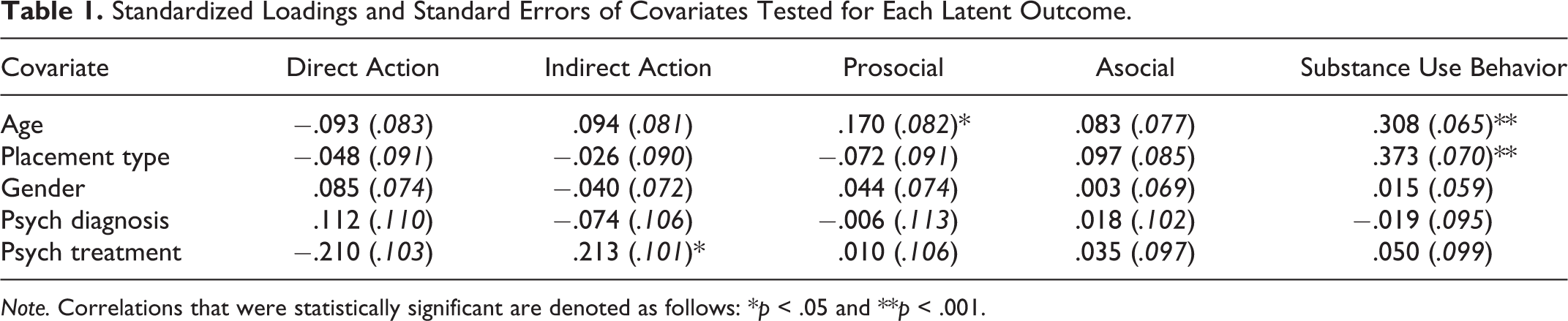
To assess for the role of potential covariates, each variable was entered into the model separately. Ethnicity, gender, presence/absence of psychological diagnosis, and participation in psychological treatment were not significant contributors to variance in SU behavior or coping outcomes. Youth age and placement type did systematically vary with SU behavior in this study, and, as such, these factors were included in all model tests as covariates with SU behavior as the outcome. In models testing coping behavior as the outcome, age and history of treatment were significant covariates included across models (see Table 1 for covariate data).
Standardized Loadings and Standard Errors of Covariates Tested for Each Latent Outcome.
Note. Correlations that were statistically significant are denoted as follows: *p < .05 and **p < .001.
Results
Full information on descriptives of this sample and further details on measurement models can be found in prior publications (Gabrielli, Jackson, & Brown, 2016; Gabrielli, Jackson, Tunno, & Hambrick, 2017). Across the four types of coping, youth with SU behavior only differed from youth with no SU behavior on direct action coping. Refer to Table 2 for mean scores across coping type based on the full sample, youth with SU behavior, and youth with no SU behavior.
Observed Mean Score Differences for Substance Users and Nonusers.

Note. Mean scores that were statistically significant in difference across substance users and nonsubstance users are denoted as follows: *p < .05.
Coping as Moderator of Maltreatment and SU
Direct coping
For the direct action coping model (Figure 1A), maltreatment and direct coping were significantly correlated (Φ = −.245, Z = −3.120, p = .002). Maltreatment was a significant predictor (γ = .190, Z = 2.119) at the p = .034 level; direct action coping contributed minimally to the model (γ = −.094, Z = −1.162, p = .245). Comparisons of AIC and BIC values across models revealed that the more parsimonious baseline model fit the data as well as the model with the interaction term, and the −2LL test supported this finding with a nonsignificant comparison of values across the two models, Δχ2 (1) = 0.728, p = .394.
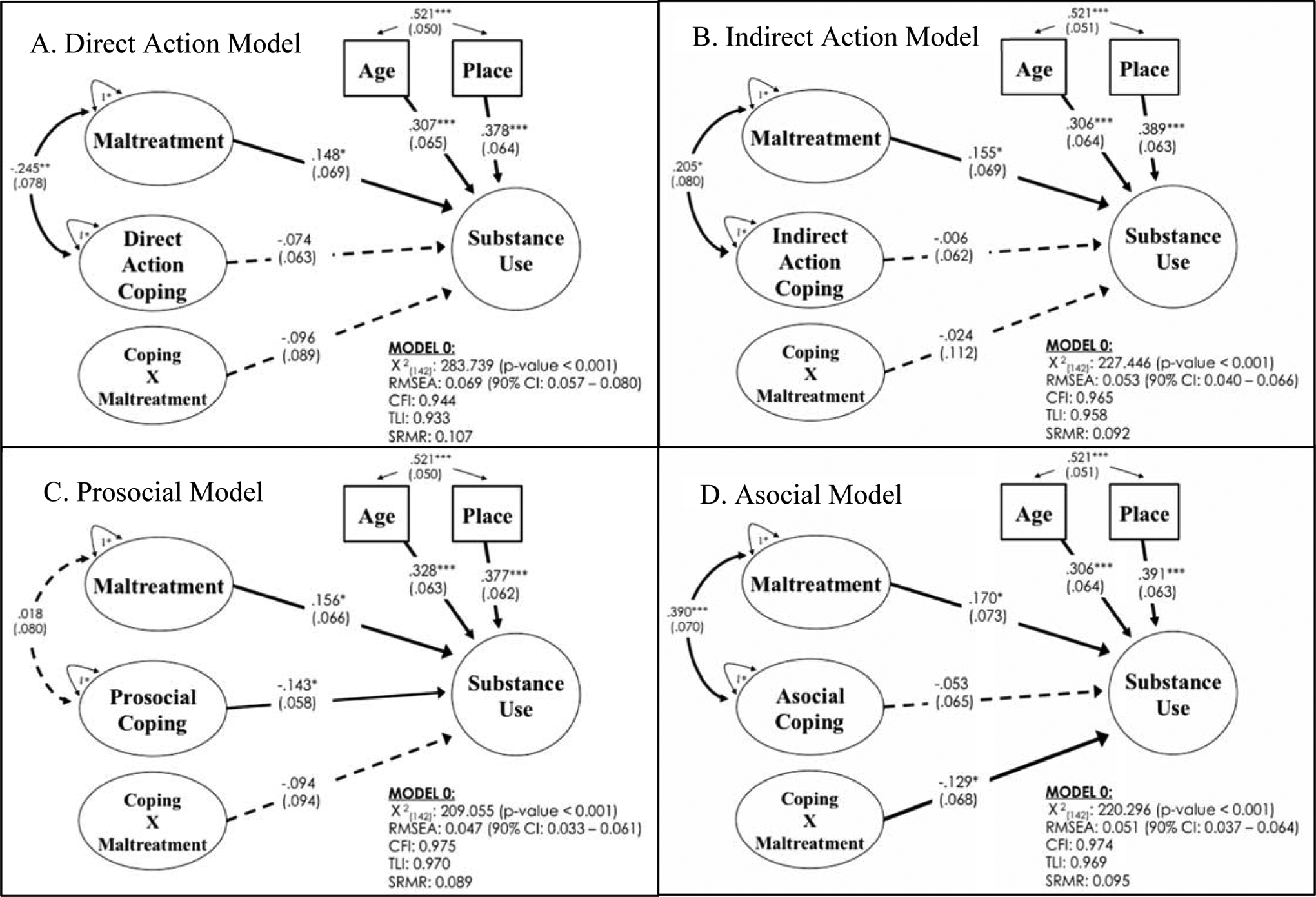
Structural models with coping type by maltreatment interaction terms. Model fit statistics are provided for baseline models with no interaction term. Solid lines represent paths that were statistically significant. Dotted lines represent paths that were nonsignificant. Significance level denoted as follows: *p < .05, **p < .01, and ***p < .001.
Indirect coping
In the baseline indirect action coping model (Figure 1B), maltreatment was a significant predictor (γ = .155, Z = 2.233) at the p < .05 level, whereas indirect action coping was not (γ = −.006, Z = −0.062, p = .927). Moreover, the association between maltreatment and indirect coping was significant (Φ = .205, Z = 2.576, p = .010). When the interaction term was added to the model, it was a nonsignificant contributor to the variance explained in SU behavior (ω = −.024, Z = −0.213, p = .831). The −2LL test, Δχ2 (1) = 0.058, p = .810, and comparison of AIC and BIC values suggested that the baseline model with no interaction term provided better fit to the data than the model with the interaction term included.
Prosocial coping
In the baseline prosocial coping model (Figure 1C), the association between prosocial coping and maltreatment was nonsignificant (Φ = .018, p = .826); however, both maltreatment (γ = .156, Z = 2.359, p = .018) and prosocial coping (γ = −.143, Z = −2.485, p = .013) served as significant predictors of SU behavior. When the interaction term was added to the model, it was a nonsignificant contributor to variance in SU behavior (β = .094, Z = −1.003, p = .316) and comparison of models using the −2LL ratio test revealed that their difference was nonsignificant as well, Δχ2 (1) = 1.784, p = .182. Comparison of AIC and BIC values across the two models also showed that the baseline model provided better fit to the data.
Asocial coping
In the asocial coping model (Figure 1D), the interaction factor was significant (p = .046), which suggests that main effects should be interpreted within the context of the interaction. A graph of the interaction revealed that, as levels of asocial coping decreased, the strength of the positive relation between maltreatment and SU behavior increased, suggestive of a buffering effect of asocial coping. The main effect for maltreatment was significant (γ = .273, Z = 2.399, p = .016), while the main effect for asocial coping was not (γ = −.068, Z = −0.883, p = .377). The maltreatment and asocial latent factors were significantly correlated (Φ = .388, Z = 4.654, p < .001). The −2LL ratio test revealed that the model with the interaction term provided significantly better model fit, Δχ2 (1) = 3.898, p = .048, and AIC and sample size–adjusted BIC values were lower for the model with the interaction term than the baseline model.
SU as Moderator of Maltreatment and Coping
For models with coping behavior as outcome, coping behaviors were assessed concurrently with the full measurement model of coping utilized as the outcome variable and maltreatment, SU behavior, and the interaction term as predictors. The best-fitting model indicated significant paths between maltreatment and indirect action, prosocial, and asocial coping (Figure 2). When the SU/maltreatment interaction term was added, results revealed that SU did not serve as a moderator for prosocial (ω = −.025, Z = −0.236, p = .813), asocial (ω = −.084, Z = −0.840, p = .401), direct action (ω = .016, Z = 0.154, p = .877), or indirect coping (ω = .026, Z = 0.252, p = .801). The −2LL ratio test was utilized to evaluate change in overall model fit with the interaction term included for each path, Δχ2 (4) = 2.15, p = .708, and findings demonstrated no significant improvement in model fit with the inclusion of the interaction term.
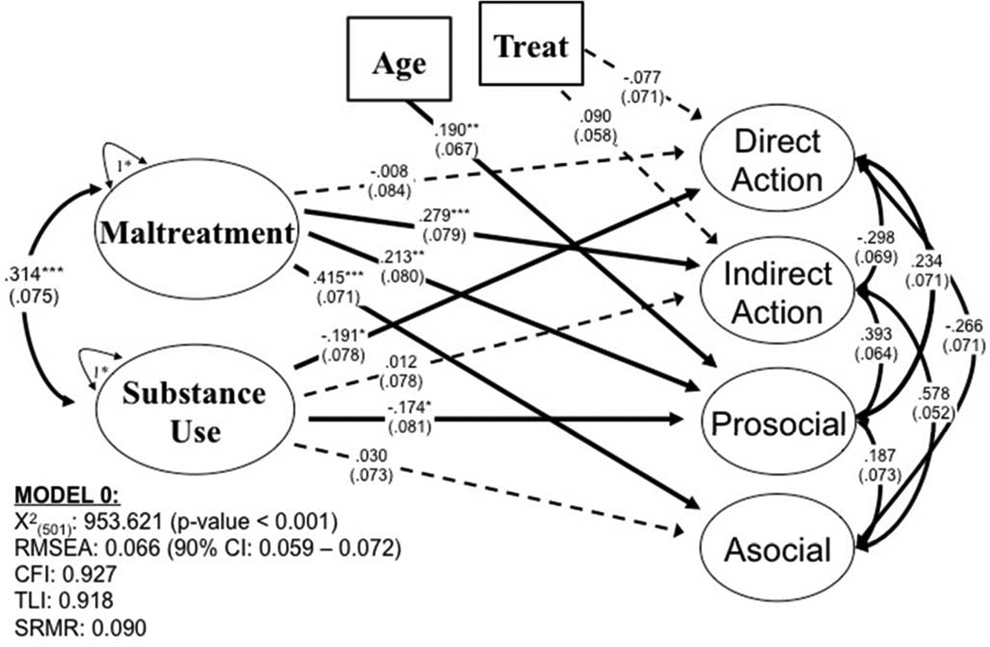
Substance use as predictor of coping outcomes. Solid lines represent significant paths and dotted lines represent nonsignificant paths. Significance level denoted as follows: *p < .05, **p < .01, and ***p < .001.
A similar follow-up analysis was conducted examining a multigroup model of the structural model of maltreatment predicting coping across youth who endorsed any SU behavior compared with youth who did not endorse SU behavior. These results provided additional support for the lack of a moderation effect. Measurement models for each group were constrained to be equal, and each regressive path from maltreatment to each type of coping was constrained to be equal across groups, with change in χ2 values assessed with each additional model constraint. Summary data from these multigroup analyses can be found in Table 3.
Comparison of Equated Maltreatment/Coping Models Across Substance Users and Nonusers.
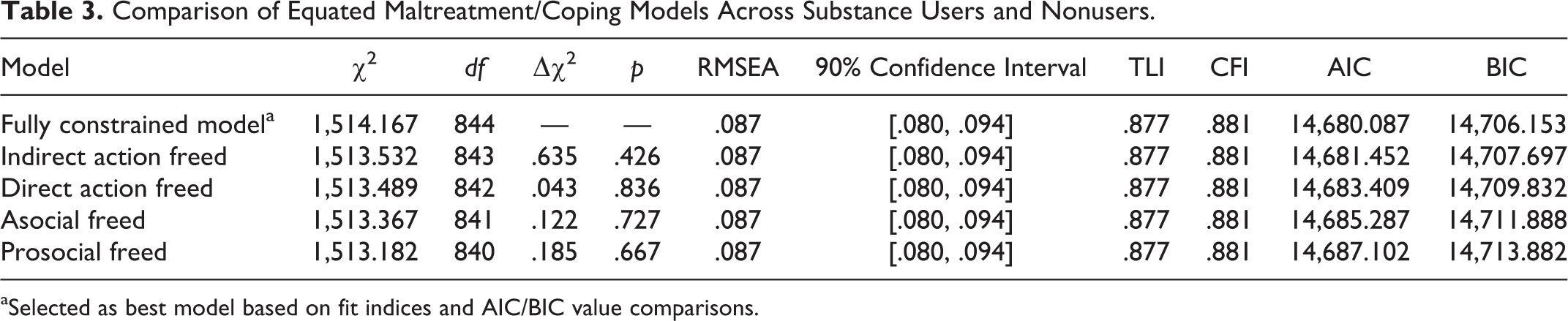
aSelected as best model based on fit indices and AIC/BIC value comparisons.
Together, these results suggest that SU behavior did not serve as a moderator of the relation between maltreatment and coping, and, subsequently, the baseline model that does not include the interaction term provides a more parsimonious fit to the data. The final model with maltreatment and SU behavior as predictors of coping behavior across the four coping behavior types accounting for the influence of youth age and a history of treatment demonstrated acceptable fit, χ2 (501, n = 210) = 953.621, p < .001, RMSEA(0.059–0.072) = .066, TLI = .918, CFI = .927. Maltreatment remained a significant contributor to variance in indirect action (γ = .279, Z = 3.519, p < .001), prosocial (γ = .213, Z = 2.670, p = .008), and asocial coping (γ = .415, Z = 5.810, p < .001), and it was not significantly associated with direct action coping (γ = −.008, Z = −0.100, p = .920), similar to the baseline model. SU behavior was significantly associated with prosocial coping (γ = −.174, Z = −2.140, p = .032) and direct action coping (γ = −.191, Z = −2.439, p = .015), but it was not associated with asocial (γ = .030, Z = 0.409, p = .683) or indirect action coping (γ = .012, Z = 0.157, p = .875). SU behavior and maltreatment were significantly associated (Φ = .314, Z = 4.209, p < .001).
Discussion
The purpose of the present study was to identify relations between maltreatment, SU behavior, and coping and elucidate the possible moderating role of both SU behavior and coping behavior in youth exposed to maltreatment. The results contribute to existing literature not only by providing new evidence for the interrelations among the study variables but also in the testing and development of latent measurement models for a rigorous capture of maltreatment, coping, and SU constructs. Furthermore, this research was conducted with youth in foster care, a population known for significant risk of SU behavior and other maladaptive outcomes (Pilowsky & Wu, 2006).
Overall, findings revealed that maltreatment served as a significant predictor of SU behavior and coping behavior for this sample. While SU behavior did not moderate the maltreatment/coping relation, SU behavior was significantly negatively associated with direct action and prosocial coping. Across the four types of coping behavior, only asocial coping served as a moderator of the maltreatment/SU behavior relation. Accounting for the effect of maltreatment, only prosocial coping contributed a significant negative main effect in variance explained in SU behavior.
Moderation Models: Coping
Hypotheses related to moderation were only partially supported in this study. Across the four types of coping, only asocial coping served as moderator of the predictive relation between maltreatment and SU behavior, and contrary to expectations, asocial coping buffered the effect of maltreatment. Analyses probing the interaction effect revealed that at higher levels of asocial coping, the positive predictive relation between maltreatment and SU behavior was weaker than at lower levels. Prior research suggests that prosocial approaches to coping may relate to more adaptive outcomes, whereas asocial approaches to coping may relate to more maladaptive outcomes (Sussman, Dent, & Leu, 2001; Tolan, Gorman-Smith, Henry, Chung, & Hunt, 2002).
Factors unique to the sample contextualize this finding, as many youth enrolled in foster care have biological parents who abuse substances, and SU behavior of caregivers often contributes to termination of parental rights (Vanderploeg et al., 2007). Additionally, some youth in foster care may struggle to identify people in their life who promote adaptive behavioral outcomes and, specifically in this research, strategies other than use of substances. Research shows that placements for youth in foster care, particularly older youth, may not be stable, which gives rise to a transient lifestyle and potential disruption of social networks (Barber & Delfabbro, 2003; Newton et al., 2000). For youth with repeated changes in their social networks, investment in coping strategies that hinge on relationships may seem, or actually be, futile. Alternatively, for youth in foster care who demonstrate a range of coping strategies and the ability to find mechanisms of coping that do not solely rely on support from others, the presence of asocial coping strategies may be a resource that is protective against SU behavior, as they may not be as sensitive to the influence of substance using peers or adults in their lives.
Recent research has suggested that coping approaches may vary based on the type of stressor, and the effectiveness of a given coping approach for outcomes may vary on the nature of stressors (Tolan et al., 2002). For example, Griffith, Dubow, and Ippolito (2000) suggested that youth may use avoidant coping approaches when confronted with family-based stressors as opposed to other stressors such as peer- or school-related events. Research on special populations such as homeless youth or inner-city youth revealed differences in expected outcomes based on coping approach as well (Dashora, Erdem, & Slesnick, 2011; Gonzales, Tein, Sandler, & Friedman, 2001). For youth in foster care, coping approach may be influenced by the uniqueness of their life experiences (e.g., severe maltreatment, removal from biological families), and subsequently, models of coping found in general community samples may not be applicable to youth in foster care.
This is not the first study to identify a somewhat counterintuitive finding on youth coping. In a study on approach versus avoidant coping in adolescent females residing in out-of-home placements, avoidant coping served as buffer in the relation between childhood trauma exposure (e.g., maltreatment experiences) and adolescent trauma symptoms (Elzy, Clark, Dollard, & Hummer, 2013). Results from the present study build upon these findings. Specifically, asocial coping may be more than simply “maladaptive coping” and may functionally represent an adaptive approach in certain circumstances, especially for youth who have experiences with caregivers who are not adequate resources for socially dependent forms of coping.
Main Effects of Maltreatment and Coping on SU
Contrary to expectations, direct action and indirect action coping did not serve as significant predictors of SU behavior in this sample. While prior research investigating the associations between coping and SU behavior in youth has not used this particular multidimensional model of coping or examined the coping/SU behavior relation in the context of maltreated youth specifically, prior studies have demonstrated significant relations between more behavioral or direct approaches to coping and SU behavior in youth. For example, Wills et al. (2001) found significant predictive associations between behavioral coping (which appears to overlap with the present study’s construct of direct action coping) and disengagement coping (which appears to overlap with the present study’s indirect action and asocial coping domains) and youth SU in a school-based sample.
Alternatively, prosocial coping offered a significant negative influence in variance explained in SU behavior in the present sample, above and beyond the influence of maltreatment. This adds complexity to the finding that asocial coping moderated the maltreatment/SU behavior relation, as it appears that greater prosocial coping is predictive of lower levels of SU behavior in these youths as well. Consistent with past research, in a prospective study with a high-risk sample of adolescents, Sussman, Dent, and Leu (2001) found that prosocial coping was a significant negative predictor of later substance dependency.
Overall, these findings suggest that the social domains of coping impact SU behavior outcomes for youth in this sample, whereas the direct and indirect action domains did not offer significant main effects or interaction effects in SU behavior models. Subsequently, intervention and prevention efforts targeting SU in youth residing in out-of-home placements should consider the social aspects of coping, with recognition that youth may employ prosocial and asocial coping strategies concurrently, with differential effects on SU behavior outcomes. These findings provide additional support for the notion that coping behavior may function differentially for youth exposed to maltreatment and residing in foster care, which gives rise to the need for careful consideration of how coping may be supported within this population.
Moderation Models: SU
Results from this study indicated that SU behavior did not serve as a moderator of the maltreatment/coping relation as hypothesized. A number of factors may have contributed to this finding. One, the sample was relatively young, as most youth studies on SU behavior are conducted with older adolescents. It may be that the present sample was not experienced enough with SU behavior for it to exert influence on the relation identified between maltreatment and coping across the study time frame of 4.5 months. Prior research on SU in youth has indicated a range of outcomes based on age of assessment and duration and severity of SU behavior (e.g., Lansford et al., 2008; Lynne-Landsman, Bradshaw, & Ialongo, 2010). SU behavior may exert effects later on in a person’s developmental trajectory. For example, in three studies with older samples over 15 years of age with mean ages of 15.7, 30.5, and 32.1 years, marijuana use served as moderator between loneliness and mental health outcomes. Effects found in the older samples were identified through cross-sectional design, but the effects identified in the sample with mean age of 15.7 years at Time 1 were obtained through longitudinal design with a 2-year follow-up (Deckman, DeWall, Way, Gilman, & Richman, 2014).
Two, the way SU behavior was operationalized in this study was novel in the use of a latent approach to identifying behavior across a range of substances. It may be that specific substances (e.g., marijuana vs. alcohol) function differentially across the maltreatment/coping relation. Indeed, in research examining alcohol specifically, alcohol use served as a moderator in research on revictimization outcomes (Gidycz et al., 2007). In Deckman, DeWall, Way, Gilman, and Richman’s (2014) studies on marijuana, however, marijuana use buffered the relation between loneliness and mental health outcomes across three samples. Thus, combining information across substance types may have obscured moderating effects across different substance types.
Alternatively, for some youth, SU behavior may be more transient and episodic in nature, thus reducing its impact on any stable or pervasive approaches to life stress, such as coping behavior. Indeed, in the present sample, youth endorsed a wide range of variability across the SU behavior measure, including the number of different types of substance used, age of onset of SU behavior, and frequency of SU behavior. It may be that a moderation effect would only surface for youths whose SU had consistently been a prevalent part of their experience. Research with samples of older youth with more severe and chronic SU behavior may be needed to identify if SU behavior can serve as moderator of the relation between negative life events, such as maltreatment, and coping behavior.
Main Effects of Maltreatment and SU on Coping
In the structural model with SU behavior added as a predictor of coping behavior in addition to maltreatment, the relations between maltreatment and coping remained consistent with maltreatment sustained as a significant contributor to variance explained in indirect action, prosocial coping, and asocial coping and with a nonsignificant relation with direct action coping. Moreover, significant main effects were demonstrated between SU behavior and coping, with SU behavior having negative predictive relations with direct action and prosocial coping. These paths were in the expected direction, and this model provides additional support for the theory that SU behavior may interfere with coping approaches traditionally viewed as adaptive (Compas et al., 2001). It is logical to assume that use of substances may interfere with one’s ability to identify appropriate social resources needed for effective prosocial coping as well as impair one’s ability to problem-solve or strategize as needed for effective direct action coping (Grant, Chamberlain, Schreiber, & Odlaug, 2012; Schweinsburg, Brown, & Tapert, 2008). If youth engaged in SU behavior as a means of avoiding problems, they may demonstrate lower levels of direct action coping; similarly, if SU behavior served as a means of avoiding problematic social situations, youth may demonstrate lower levels of prosocial coping. While the motivation for SU behavior in the present sample is unknown, empirical exploration of these dynamics may serve as a useful next step in this research.
Limitations
Findings should be interpreted with consideration of inherent limitations. First, only youth report of maltreatment, coping, and SU was used. Although a child might be the best informant regarding his or her coping and SU behaviors, other reporters, such as foster caregivers or teachers, might have provided a useful perspective. Second, inclusion of older youth and youth with more severe and chronic SU behavior may be needed to further elucidate the role of SU behavior as a moderator of maltreatment and coping behavior. Third, only several months elapsed between Time 1 and Time 2; coping behaviors may have a different impact on SU behavior given more time. Fourth, we were unable to include a control for placement changes or duration within this sample, which may be influential for SU and coping outcomes. While age and placement type are highly correlated with placement instability, these can only serve as proxy for the potential added influence of placement instability for youth in foster care. Fifth, the approach to operationalization of constructs may impact significant relations identified. For example, both the SU and maltreatment constructs were single latent factors, yet different types of maltreatment exposure or different types of substances used may provide alternative findings. Finally, our sample consists of 32% of the children residing in residential care facilities, a unique living situation in which youth primarily live with peers and staff members that are interchangeable. Coping behavior and SU behaviors of these youth may differ from youth in traditional foster care settings. While our study included placement status as a covariate, coping and SU relations may be impacted by our disparate sample as compared to other foster care populations.
Conclusion and Future Research
Despite these limitations, the present study contributes to the literature by examining two models of moderation, and results provide first-time assessment of the dynamic interplay of risk and protective factors in youth residing in foster care. This study provides a foundation for future research examining the complex relations between multidimensional constructs of maltreatment and coping, and further work identifying differences within specific maltreatment types may add information on how type of maltreatment relates differentially to type of coping approach utilized. Given high rates of SU behavior within the sample and significant links between maltreatment severity/chronicity and coping behaviors with SU outcomes, continued exploration of adaptive coping strategies that reduce risk of SU in youth in foster care is needed. Findings suggest important implications for conceptualization of coping processes specific to youth residing in foster care, and results indicate a need for further research on how specific types of coping may function differentially for youth in foster care as compared to the youth in the general population.
Footnotes
Authors’ Note
Joy Gabrielli is now a postdoctoral research fellow at Geisel School of Medicine at Dartmouth, Lebanon, NH.
Declaration of Conflicting Interests
The author(s) declared no potential conflicts of interest with respect to the research, authorship, and/or publication of this article.
Funding
The author(s) disclosed receipt of the following financial support for the research, authorship, and/or publication of this article: This research was supported in part by funding from the National Institutes of Mental Health, RO1 Grant MH079252; the National Institute on Drug Abuse, F31 grant DA034423; and the Elizabeth Munsterberg Koppitz Child Psychology Graduate Student Fellowship awarded to Joy Gabrielli. The writing of this article was also supported in part by Joy Gabrielli’s participation in the NIDA T32 fellowship training grant DA037202.