




Abstract
This study examined children’s responses to two alternate prompts used to transition to the substantive phase of an interview. Children (N = 401) experienced four scripted events and were later interviewed. After rapport building, half of the children were asked, “Tell me what you’re here to talk to me about today,” whereas the other half were asked, “Tell me why you’re here to talk to me today.” Children’s responses were coded as informative (e.g., nouns) or uninformative (e.g., “don’t know”). The what prompt elicited more informative responses than the why prompt, and 7- to 9-year-olds were more informative than 5- to 6-year-olds regardless of the type of prompt they received. Given that the what prompt elicited more informative responses, the present study provides initial support for this phrasing when forensic interviewers transition to the substantive phase.
Keywords
Interview methods to elicit complete and accurate information from children have advanced considerably in recent decades. Much of the extant literature has focused on children’s suggestibility in response to interviewers’ questions and has led researchers to advise that interviewers phrase prompts in a nonsuggestive manner wherever possible (Nicol, La Rooy, & Lamb, 2017; Saywitz, Lyon, & Goodman, 2017). Eliciting a disclosure of the substantive interview topic (e.g., a child’s abuse) in a non-suggestive manner, however, is challenging for interviewers (Powell & Snow, 2007).
Most forensic interview protocols have adopted non-suggestive phrasings for the transition prompt, which shifts the focus to the topic of concern, usually after greeting and rapport building. Some phrasings draw children’s attention to the reason for their interview, such as, “Now that I know you a little better, I want to talk about why you are here today” (National Institute of Child Health and Development [NICHD] protocol; Lamb, Orbach, Hershkowitz, Esplin, & Horrowitz, 2007) and, “Tell me the reason you are here today” (State of Michigan protocol, 2011). Other protocols advise asking children the topic of the interview (rather than the reason for it), such as, “Tell me what you’re here to talk to me about today” (Standard Interview Method protocol; Powell, 2014). These transition prompts are an important opportunity for children to disclose the substantive interview topic without direct questioning.
The particular phrasing adopted for the transition prompt will likely impact children’s responses, given that different phrasings request different information. Phrasings that request the topic of an interview rely on children’s understanding of concrete nouns (like events, objects, and people), while phrasings that request the reason for an interview require children to understand concepts such as causation and purpose. While young children can readily understand concrete nouns, understanding of more sophisticated concepts develops slowly throughout childhood, and children develop an understanding of more concrete wh- questions (i.e., what, who, and where) before understanding when, how, and why (Bloom, Merkin, & Wootten, 1982). Why questions require a complex process of metacognitive, cognitive, and linguistic operations that may not be mastered until 7 to10 years of age or even later if the question requires making inferences (Walker, 1999). Malloy, Orbach, Lamb, and Walker (2017) examined the use of “why” and “how” questions throughout forensic interviews with 3- to 5-year-olds, which likewise rely on understanding of causative actions and purpose. Their study showed that children frequently provided uninformative responses to these questions (although they were increasingly likely to provide the sought-after information with age). To date, no study has directly compared the differential effects of transition prompt phrasings on children’s responses as they begin the substantive phase of the interview. A better understanding of children’s responses to different transition prompts is necessary in order to provide forensic interviewers with evidence-based recommendations about the most appropriate phrasing.
Present Study
The present study compared children’s responses to two transition prompt phrasings. Children aged 5 to 9 years old experienced a scripted event on four occasions and were later interviewed about their experiences. Approximately half the children were asked, “Tell me what you’re here to talk to me about today” (what condition), while the remaining children were instead asked, “Tell me why you’re here to talk to me today” (why condition). It was expected that children in the what condition would be more likely to provide an informative response than those in the why condition, and that older children would be overall more likely to provide an informative response than younger children.
Method
Participants
Children 5 to 9 years old (N = 401, 54% female) were recruited from primary schools across Melbourne, Australia and surrounding areas to take part in several larger studies on children’s repeated event memory (Danby, Brubacher, Sharman & Powell, 2015; Danby, Brubacher, Sharman, Powell & Roberts, 2016; Danby, Brubacher, Sharman & Powell, 2017; Danby, Sharman, Brubacher, Powell & Roberts, 2017 ). Children were randomly assigned to the what (n = 198, Mage = 7.07, SD = 1.19) or why (n = 203, Mage = 7.08, SD = 1.23) conditions. In order to examine developmental differences, children were separated into younger (5- to 6-year-olds; n = 134, Mage = 6.16, SD = 0.45) and older (7- to 9-year-olds; n = 267, Mage = 8.22, SD = 0.77) age groups for analysis. The research was approved by the university’s human research ethics board. Parents gave informed consent and the children assented to participate.
Materials and Procedure
On four occasions in a 2-week period, children experienced a 25-min scripted activity session (the Deakin activities). Each occurrence comprised 16 target items that were always presented in the same order and centered around six main activities (e.g., listening to a story, doing a puzzle). Some of the items were the same each time (e.g., the same warm-up activity each day) and some varied (e.g., reading a different story each day). The activities were derived from those used in previous repeated event studies (e.g., Powell & Thomson, 1996, 2003).
Each child was interviewed individually 3–14 days after the final occurrence (Mdelay = 6.52 days, SD = 2.31). There was no difference in delay between the interview conditions, t(399) = −0.01, p = .99. All interviews were conducted by the same interviewer who was blind to the hypotheses of the current study. Prior to the rapport building and ground rules phases, the interviewer introduced herself and indicated that she was there to talk about the Deakin activities. After rapport building, the interviewer posed a transition prompt to elicit the substantive topic of the interview. Children were either asked “Tell me what you’re here to talk to me about today” (what condition) or “Tell me why you’re here to talk to me today” (why condition). In both conditions, if a child was unable to identify the topic of the interview (the Deakin activities), the interviewer assisted by asking, “I heard that you did the Deakin activities. Did you do the Deakin activities?” All children assented to this question. Once the substantive topic was established, the interviewer prompted children through a narrative account of the activities using open-ended prompts until they could recall no more. Interviews lasted approximately 20 min. Although the full interviews were part of several larger studies, interview manipulations related to that research were fully counterbalanced across the what and why conditions.
Coding
Children’s immediate responses to the transition prompts were coded as informative (child made reference to some aspect of the Deakin activities) or uninformative (no reference to the Activities). Within these categories, responses were further classified according to the type of details provided. Informative responses fell into five categories: noun (e.g., “the Deakin activities), verb—past tense (e.g., “I did the Deakin activities”), verb—present tense (e.g., “doing the Deakin activities”), person—noun (e.g., the activity leader’s name), and person—verb (e.g., “playing with [activity leader]”). Uninformative responses fell into six categories: precursor (e.g., “because my teacher told me to come here”), don’t know, don’t understand, rapport topic (e.g., “to talk about soccer” if the child had discussed soccer during rapport building), no response, and other (e.g., “because it’s an exciting day”). All informative responses were accurate; inaccurate responses were rare and were coded in the other category.
Reliability
The transcripts were randomly distributed between two coders who each coded half of the data. The coders were blind to the hypotheses and children’s ages. For reliability purposes, 15% of the transcripts were double-coded. κ was excellent at .96. Disagreements were resolved through discussion prior to analysis.
Results
Effects of Transition Prompt and Age Group on Informativeness
Overall, children’s answers were informative 63% of the time. Older children were informative 69% of the time, whereas younger children were informative in only 49% of cases. Children who received the what prompt responded informatively 72% of the time, compared to children who received the why prompt, who were informative 52% of the time.
A binary logistic regression was conducted to predict informativeness (yes, no) using prompt type (what, why), age group (younger, older), and the interaction as predictors. The model was significant, χ2(3) = 35.11, p < .001, Nagelkerke’s R2 = .11. The model correctly classified 68% of cases. Both prompt type and age group significantly predicted informativeness (ps < .001), but the interaction did not reach significance (p = .18). The older children were 1.41 times more informative than the younger children, and children who received the what prompt were 1.38 times more informative than those who received the why prompt. The number and percentage of the children who were informative in each age group and prompt condition are presented in Table 1.
Informativeness of Responses Broken Down by Age Group and Prompt Type.
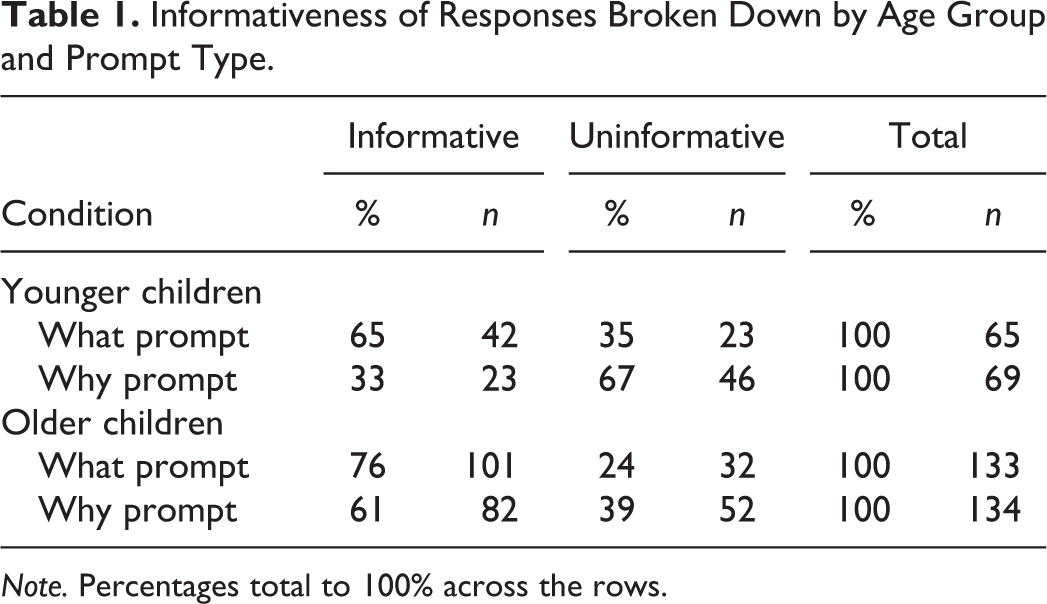
Note. Percentages total to 100% across the rows.
Response Type
Descriptive analyses revealed small cell counts for some variables; these were collapsed prior to performing χ2 analyses involving response type (see Table 2). A 2 (prompt: what, why) × 6 (response: noun, verb, person, precursor, don’t know, other) χ2 indicated significant differences in how children responded to the transition prompts, χ2(5, N = 401) = 40.73, p < .001, Cramer’s V = .32. An inspection of the responses contributing to the χ2 value revealed that the significant effect was driven by noun, precursor, and don’t know responses (see Table 3). Nouns were used more often than expected in response to the what prompt, whereas precursors and don’t know responses were more likely than expected in response to the why prompt. The analysis was repeated for each age group separately, and both were significant, ps ≤ .001. younger children were more likely than expected to provide a noun to the what prompt and a don’t know response to the why prompt, while older children reflected the pattern observed in analysis of the overall sample. The older children were nearly 6 times more likely to give a precursor response, and nearly twice as likely to say don’t know, to the why than what prompt, and answered the what prompt with a noun at a rate significantly higher than expected.
Frequency of Children’s Response Types.

Results of 2 (Prompt) × 6 (Response) χ2s.

Note. Boldface values represent variables where the contribution [(E − O)2/E] to the overall χ2 is larger than the critical value for χ2(df = 1) = 3.841. Totals in contribution columns are χ2 values and all are p < .001.
Discussion
The results of the present study highlight the potential usefulness of the what prompt compared to the why prompt in facilitating a successful transition into the substantive phase of an interview. The children in the what condition were more likely to provide informative responses, and particularly nouns, whereas children in the why condition provided equal numbers of informative and uninformative responses, such as “don’t know” or references to precursors (e.g., “because my teacher said it was my turn”). In addition, this study showed that older children’s (7- to 9-year-olds) responses to transition prompts were overall more informative than younger children’s (5- to 6-year-olds).
Uninformative responses, more frequently associated with why prompts, are a figurative dead-end in an interview and may leave the interviewer still struggling with how to introduce the topic of concern nonsuggestively (Powell & Snow, 2007). Having a child produce an informative, event-related noun or verb (e.g., “the touching”) is a more effective pathway into discussing the substantive issue. Importantly, the what prompt was related to more informative responses for both age groups; that is, children from 5 to 9 years old benefited equally from the use of the what prompt over the why prompt. This finding demonstrates that the what prompt gives elementary school-aged children a better chance of providing the interviewer with the desired information.
Because children in the present study were recalling positive experiences, their don’t know responses were more likely due to a genuine lack of understanding of the purpose or topic of the interview than reluctance to discuss the activities. The increased rate of don’t know responses elicited by the why prompt compared to the what prompt supports the suggestion that children have more difficulty mastering an understanding of the abstract concepts needed to respond appropriately to the why prompt (Bloom et al., 1982, Walker, 1999). References to precursors also demonstrate the potential for misunderstanding when the transition prompt is phrased as a why question. Although these responses were logical, and most likely accurate, they did not serve the purpose of introducing the topic of the interview.
Forensic interviewers often question children about experiences that they are reluctant to describe, and therefore, the rates of informativeness in response to the transition prompts in this study are likely an overestimate. Nevertheless, the pattern of results showing the increased usefulness of what prompts in eliciting a relevant disclosure is likely generalizable, given the cognitive developmental underpinnings that may influence the differential understanding of these transition prompts. In addition, when children are interviewed about sensitive topics such as abuse, they may perceive the why prompt to be more critical and accusatory, implying that they need to justify their actions (Walker, 1999). For this reason, it is expected that the effect of the transition prompt would also be demonstrated in field interviews and could potentially affect the detail of narrative responses elicited after the transition prompt due to inhibited reporting. Future research should aim to replicate these effects in more generalizable interview conditions as well as examine whether the phrasing of the transition prompt has an effect on the ensuing line of questioning or children’s responses after the initial disclosure. Because the what prompt elicited more useful and relevant responses than the why prompt, this study provides initial support for the phrasing, “Tell me what you have come here to talk to me about today” for use in forensic interviews with children.
Footnotes
Declaration of Conflicting Interests
The author(s) declared no potential conflicts of interest with respect to the research, authorship, and/or publication of this article.
Funding
The author(s) disclosed receipt of the following financial support for the research, authorship, and/or publication of this article: Preparation of this article was supported in part by an Australian Research Linkage Grant LP120200095.
