




Abstract
The current study compared behavioral and adrenocortical functioning of maltreated (N = 91) and comparably aged (1.5–3 years) institutionally-reared children soon after (1.5–2.5 months) placement in foster care or adoptive homes, respectively. Foster and adoptive parents reported on the children’s socioemotional competence and behavior problems, experimenters scored fear and positive affect to laboratory tasks, and diurnal cortisol measures were obtained. We sought to address whether these early contexts, characterized by different types of neglect and deprivation, have differential effects on young children’s development. We found little support for the argument that either context results in uniformly poorer functioning soon after removal from adversity. Maltreated children were less fearful and more positive when exposed to both positive and novel events than institutionally-reared children. However, maltreated children were reported to have more behavior problems than did institutionally-reared children, and institutionally-reared children showed more typical declines in cortisol throughout the day than the maltreated children. These findings increase our ability to construct more targeted and effective interventions for these populations.
The impact of early life stress on physical and mental health is an active area of research linking psychosocial experiences with changes in both physiology and behavior (Boersma et al., 2014). Numerous animal models have been devised to examine the impact of early adversity on development, most of which have created adversity by producing various degrees and durations of deprivation (Lyons, Parker, & Schatzberg, 2010; Meyer & Hamel, 2014). In human studies, neglect and abuse in the home (Schilling & Christian, 2014) and institutional (orphanage-like) rearing (Bakermans-Kranenburg et al., 2011) are the two contexts of early adversity that have received the greatest attention, and both have been associated with subsequent maladjustment and deficits in cognitive, emotional, and behavioral domains (e.g., McGoron et al., 2012; Pears, Kim, & Fisher, 2008). It has been argued that institutional rearing produces a constellation of deprivation-specific deficits (Kumsta et al., 2010). However, the immediate outcomes of maltreatment in the home and institutional rearing have never been directly compared. Thus, the goal of the current study was to compare toddlers from both of these at-risk populations on measures of social and emotional development, as well as hypothalamic–pituitary–adrenocortical (HPA) functioning.
Neglect is the most common form of child maltreatment either alone or co-occurring with other types of abuse (U.S. Department of Health and Human Services, 2011). This is particularly true among children removed from the home in infancy and early childhood (Pears et al., 2008). Children experiencing neglect and maltreatment in the home have no stable source of care and do not experience adequate amounts of positive social interaction with their caregivers (National Scientific Council on the Developing Child, 2012). Similarly, children in institutions have few one-on-one interactions and are often ignored for almost all of their awake hours, resulting in low levels of stimulation (National Scientific Council on the Developing Child, 2012). Given the importance of sensitive and responsive caregiving for the development of young children’s early social and emotional skills (Sroufe, 1996), it is not surprising that empirical work has demonstrated that institutionally-reared children and children experiencing severe neglect and maltreatment within the home show decreased social and emotional functioning relative to their nonmaltreated peers. For example, in a sample of institutionally-reared children adopted between 15 and 34 months and a nonadopted comparison group, Stellern, Esposito, Mliner, Pears, and Gunnar (2014) found that institutionally-reared children demonstrated more freezing behavior, thought to result from children having fewer skills and resources to deal with increased emotional arousal in response to a threatening stimulus (Zuddas, 2012). In toddlerhood, Horwitz and colleagues (2012) found that 34% of maltreated children scored high on caregiver reported emotional problems, while only 20% scored high on caregiver-reported emotional competence. With regard to behavior problems, 10% scored above the clinical cutoff (Horwitz et al., 2012). Institutionally-reared children have also been found to have lower levels of emotion understanding (as indexed by emotion labeling and affective perspective taking tasks) than their nonadopted peers in early childhood (Fries & Pollak, 2004; Tarullo et al., 2016). In a sample of 6- to 12-year-old children experiencing neglect within their home, Shipman, Edwards, Brown, Swisher, and Jennings (2005) showed that compared to their nonmaltreated peers, neglected children displayed fewer appropriate behavioral displays of emotion, as well as lower levels of empathy and emotional self-awareness; these children also reported using fewer adaptive strategies for coping with emotional arousal.
Considering stress physiology, alterations in activity of the HPA axis have been reported for young children following rearing in both maltreating homes and institutions. Threats to a person’s well-being lead to a cascade of events resulting in increased cortisol production, which serves to promote survival by adjusting central and peripheral physiological systems to withstand the threat (Gunnar & Adam, 2012). Chronic activation of the HPA system, however, can downregulate the system resulting in blunted cortisol levels in response to stressors and a flattening of the typical diurnal decrease in cortisol over the daytime hours (Fries, Hesse, Hellhammer, & Hellhammer, 2005; Gunnar & Vazquez, 2001). Indeed, a flattened diurnal cortisol slope has been observed in maltreated children in foster care (Dozier et al., 2006; Fisher, Van Ryzin & Gunnar, 2011) and young children internationally adopted from institutional care (Koss, Hostinar, Donzella, & Gunnar, 2014; Koss, Mliner, Donzella, & Gunnar, 2016).
Taken together, these studies highlight that when compared to children who have not experienced early adversity, children who have experienced early maltreatment within their family and children who have experienced early institutional care show deficits in social and emotional development and HPA functioning. However, a question that remains is whether children coming from different maltreating contexts exhibit similar or different emotional, behavioral, and physiological functioning at the point when maltreatment is terminated. It has been argued that because institutional care is outside the context of natural caregiving experiences, its effect may be either more severe than maltreatment within the family (National Scientific Council on the Developing Child, 2012) or may produce a unique set of maladaptive behaviors. Yet there is little evidence to support this claim. To our knowledge, this is the first study to assess the difference in social, emotional, and HPA functioning between institutionally-reared and maltreated children soon after removal from adversity. A better understanding of the consequences of these two contexts is important for determining whether the literatures on these two populations of children should be considered separately or together.
The Current Study
We compared toddlers from both of these at-risk populations (i.e., institutionally-reared and maltreated) using multiple methods of measurement across both biological and behavioral domains. This study is unique in that children from both populations were roughly the same age (1.5–3 years old), had been recently removed (i.e., within 1.5–2.5 months) from either maltreating biological families or institutional care, and were assessed using the same laboratory protocol. Recent removal from adversity was a particular strength of the current study because it allowed little time for the new and likely more well-resourced, environment to affect developmental outcomes. Measures of social and emotional problems, emotionality (i.e., fear and positive affect/engagement), and diurnal cortisol were obtained.
To the extent that institutional care is viewed as a more extreme form of maltreatment than parental maltreatment, we predicted that institutionally-reared children in our sample (IR) would appear more adversely affected across social, emotional, and biological domains than the children in our sample who experienced maltreatment (MAL).
Method
Participants
Participants were 167 toddlers (IR = 76, 45 female; MAL = 91; 40 female) who were placed with foster parents in the urban Pacific Northwest or who were internationally adopted directly from institutional care into families in a metropolitan area of the Midwest. A χ2 test revealed no significant difference in sex between group, t(167) = 3.856, p = ns. Children placed into foster care had experienced documented instances of maltreatment and were subsequently removed from their biological families. Unfortunately, we were not able to obtain the case files of the maltreated children removed from their homes, so we do not know the specific types of maltreatment children experienced. However, in a study utilizing a sample of 117 preschoolers from the same state as participants in the current study, researchers were able to obtain case files and classify children into four distinct profiles each containing at least moderate neglect and emotional maltreatment (Pears et al., 2008). The largest profile (63% of the sample) contained neglect and emotional maltreatment with very little to no physical or sexual abuse; 16% of the sample experienced high physical abuse, neglect, and emotional maltreatment, with little to no sexual abuse; 12% of the sample had experienced neglect, high emotional maltreatment, and sexual abuse, with little to no physical abuse; and 9% of the sample had experienced all maltreatment types at moderate to high levels. Thus, although we were not able to obtain the case files for participants in the current study, analyses of records in a sample very comparable to the current study suggest that all children likely experienced significant neglect and emotional maltreatment, while a much smaller percentage also experienced physical and/or sexual abuse. Maltreated children placed into foster care ranged from 17 to 36 months of age at the time of data collection (M = 27.1 months, SD = 5.3 months) and were assessed 2.5 months (M = 2.7, SD = 1.01) after placement in the foster home. Parents reported that 64% of foster children were Caucasian, 4% were African American, 3% were Native American, 26% were multiracial, and 3% reported not knowing the ethnicity of their foster child. Foster parent’s education varied: 3% did not complete high school, 14% earned a high school diploma or General Education Diploma (G.E.D.), 30% had some college or vocational training post high school, 5% received a bachelor’s degree or equivalent, and 5% completed schooling beyond a bachelor’s degree. Foster families typically were middle income: 31% made less than US$30,000 annually, with 31% making US$30,000–50,000, 32% making $50,000–100,000, and 6% making over US$100,000.
Toddlers in this study were adopted internationally directly from institutional care and had experienced at least 75% of their preadoptive life in an institution (25 months, range = 17–36 months). These children were adopted directly from Eastern Europe (33%), Southeast Asia (30%), Africa (29%), and Latin America (8%). In a consensus report on institutional care for infants and toddlers, this care was described as neglect (van Ijzendoorn et al., 2011). They were 19–36 months of age at the time of data collection (M = 26.6 months, SD = 5.3 months) and were assessed 1.5 months (M = 1.7, SD = .80) after removal from the institution. Adoptive parents were highly educated (49% had a college degree, 46% completed schooling beyond a bachelor’s degree), with 40% being middle income (US$38–100,000 annually) and the rest earning above this level (up to above US$200,000 annually).
Procedures
The researchers conducting this study were part of a federally funded center. The protocols for each site were designed together and researchers trained across locations to help insure the comparability of the work. All videotaped parent–child interactions and responses to fear and positive affect eliciting stimuli were coded at one of the study sites.
The maltreated children were recruited via the local branch of the child welfare system. Children entering a new foster care placement (for their first placement, reentry following failed reunification with biological parents, or a new foster placement following a prior foster placement) were referred to the study. The state is the legal guardian of children in foster care; thus, each child’s caseworker provided permission for them to participate. Foster caregivers provided informed consent for their own participation. An effort was made to contact the biological parents for their informed consent for the child’s participation, though this was not required by the institutional review board. The institutionally-reared children were recruited through one of the major adoption agencies that connected us to families prior to adoption or an adoption medical clinic where families typically made appointments shortly after their child’s arrival into the United States.
Foster/adoptive parents and their children completed a laboratory visit as soon after placement/adoption as possible. During this laboratory visit, the parent completed several questionnaires and the parent and child participated in several observational tasks. Additionally, a saliva home collection kit was completed to assess diurnal salivary cortisol production.
Measures
Parent report of socioemotional adjustment
The Brief Infant/Toddler Social-Emotional Assessment (BITSEA; Briggs-Gowan, Carter, Irwin, Wachtel, & Cicchetti., 2004) was created to screen for socioemotional and behavioral problems and competence in very young children. The BITSEA yields a problem subscale and a competence subscale. Because the scale reliability for the competence subscale was low in our sample, we used only the problems subscale in the current study. Items on the problem scale include “Cries or has a tantrum until he or she is exhausted”; “Seems very unhappy, sad, or depressed”; and “Hits, shoves, kicks, or bites other children.” Each item was rated on a 3-point scale as to whether each behavior has occurred in the past month. A score of 0 indicates that the behavior does not occur or rarely occurs, a score of 1 indicates that the behavior sometimes occurs or the statement is somewhat true, and a score of 2 indicates that it is very true or the behavior often occurs. The problems subscale (MAL: α = .82, IR: α = .76) showed good reliability in both groups.
Observed fear and positive affect
The Laboratory Temperament Assessment Battery (Lab-TAB; Gagne, Van Hulle, Aksan, Essex, & Goldsmith, 2011) is a standardized battery of observational tasks and was used to assess fear and positive affect. We adapted two tasks to assess positive affect, an experimenter blowing bubbles and an experimenter bouncing balloons with the child. The fear task consisted of mechanical cars that were dressed up as “creatures” with pipe cleaner antennae, fuzzy bodies, and strange googly eyeballs.
All tasks were coded for positive affect, fear affect, freezing behavior (for the fear task only), and proximity to parent in 20-s epochs. Codes ranged from 0 = no evidence to 4 = extremely high intensity. Mean scores for each of these behaviors were created by averaging across the epochs. Global passive versus initiating scores were also coded and ranged from 0 = consistently passive to 3 = showed high initiative. For the positive tasks, global positive engagement was scored from 0 = no engagement to 4 = high engagement. Behavioral codes across both positive tasks (balloons and bubbles) were correlated (r ranged from .36 to .46). Thus, these scores were averaged. Coders double coded 14.5% of the total episodes for interrater reliability and were blind to children’s group membership. As the scales were ordinal, weighted percentage agreements were computed (J. Cohen, 1968). For the epoch variables, the weighted percentage agreements ranged from 88% to 99%. For the global variables, the weighted percentage agreements ranged from 81% to 87%.
Two principal component analyses were conducted (one for the positive context and one for the fear context) to identify composite scores for children’s observed positive affect and fear. Two interpretable positive affect and fear factors emerged with eigen values greater than one for both contexts, resulting in four composites: a positive (explained 51% of the variance; characterized by high positive affect, high initiative, and greater positive engagement) and a fear composite (explained 17% of the variance; characterized by high fear affect and greater proximity to parent) during a positive context and a positive (explained 22% of the variance; characterized by high positive affect, low freezing, and high initiative) and a fear composite (explained 45% of the variance; characterized by high fear affect and greater proximity to parent) during a fear context. Thus, greater scores on the positive composites reflected greater positive affect, initiative and engagement, and greater scores on the negative composite reflected greater fear behavior. A Promax rotation provided the best-defined factor structure. All items in these analyses had primary loadings over .6 and no items had cross-loadings above .45.
Salivary cortisol
Saliva samples were collected by participant’s parents 30 min after wake-up in the morning and just before bed across 3 days to be assessed for cortisol levels. Parents also recorded the time children woke up and when sample was taken. Children mouthed a cotton dental roll until sufficiently wet with saliva, facilitated by a few grains of sugary drink powder to stimulate the salivary glands and promote interest of the children, consistent with procedures outlined in Talge, Donzella, Kryzer, Gierens, and Gunnar, (2005). Samples were stored in families’ freezers until they were returned to the lab and stored at −20°C until sent to Trier, Germany, for assay. Samples were assayed in duplicate using a time-resolved fluorescence immunoassay. Inter- and intra-assay coefficients of variation were below 10%. Biologically implausible values above 2.00 μg/dl were removed and values 3 SD above the mean were winsorized to the next highest value. Values were averaged across the 3 days of sampling and natural log transformed to resolve positive skew. Morning values and diurnal slope were used in the analyses described below as indicators of HPA axis functioning. Slope values were calculated by subtracting the morning value from the bedtime value, such that larger negative numbers represent healthier diurnal cortisol production.
Observed parenting quality
Each parent–child dyad completed a 5-min free play assessment followed by a 2-min clean-up task. Parents were instructed to play with their child as they normally would at home and were provided with a bin full of different toys to use. Coders rated parent and child behaviors during the interaction along multiple 5-point scales. These scales represented frequency of behavior (1 = never to 5 = the whole time), intensity (1 = not at all to 5 = very), or valence (1 = very negative, 3 = neutral, and 5 = very positive). A few subsets of questions were scored on a 4- or 3-point scale. All items were z-scored before creating parenting composites using the mean of all items included in that composite. Two composites were used in the present analyses—positive parenting (9 items, α = .76) and power assertive parenting (8 items, α = .73). The positive parenting composite included items like “Did the parent laugh/joke with the child in such a way that both participants seemed to enjoy it?” The power assertive parenting composite included items like “Did the parent interrupt the child’s play to initiate switches from one game/activity to another?” Coders double coded 17.6% of tapes for interrater reliability, and percentage weighted agreement was calculated similarly to that described above for Lab-TAB. Interrater reliability was 89% and 86% weighted agreement for positive and power assertive parenting, respectively, for the IR sample, and 86% and 87% weighted agreement for positive and power assertive parenting, respectively, for the maltreated sample.
Results
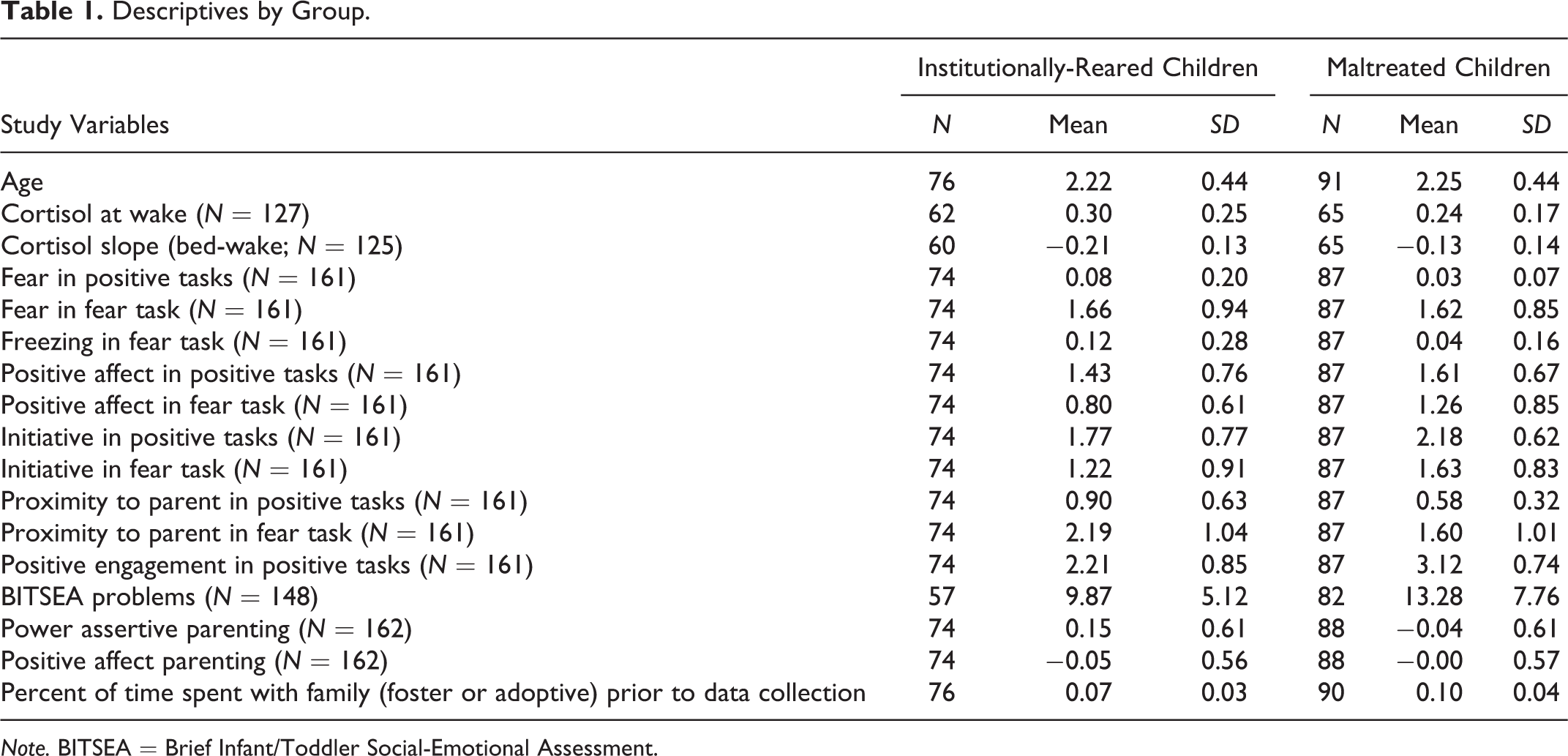
Descriptive statistics by group for all study variables are presented in Table 1. Regression tables with standardized and unstandardized coefficients are presented in Tables 2 –4. Analyses were conducted in Mplus v8 (Muthén & Muthén, 2017), and full information maximum likelihood was used to handle missing data. Data were missing for various reasons: 40 participating families failed to return the cortisol collection kit to the lab, 19 families failed to finish the questionnaire data, and 6 families refused or did not complete the laboratory assessment.
Descriptives by Group.
Note. BITSEA = Brief Infant/Toddler Social-Emotional Assessment.
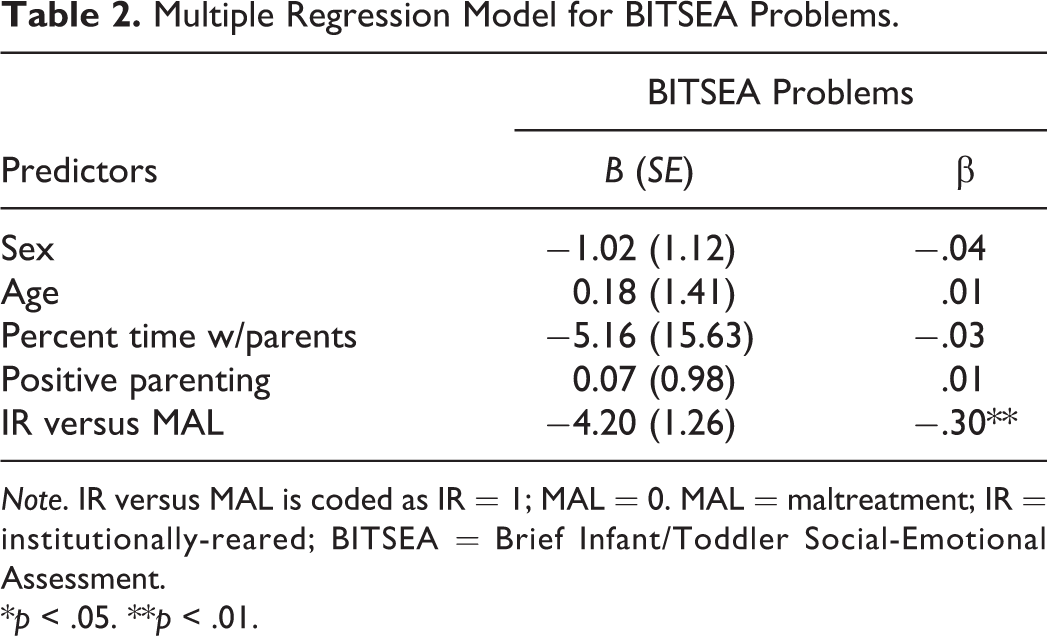
Multiple Regression Model for BITSEA Problems.
Note. IR versus MAL is coded as IR = 1; MAL = 0. MAL = maltreatment; IR = institutionally-reared; BITSEA = Brief Infant/Toddler Social-Emotional Assessment.
*p < .05. **p < .01.
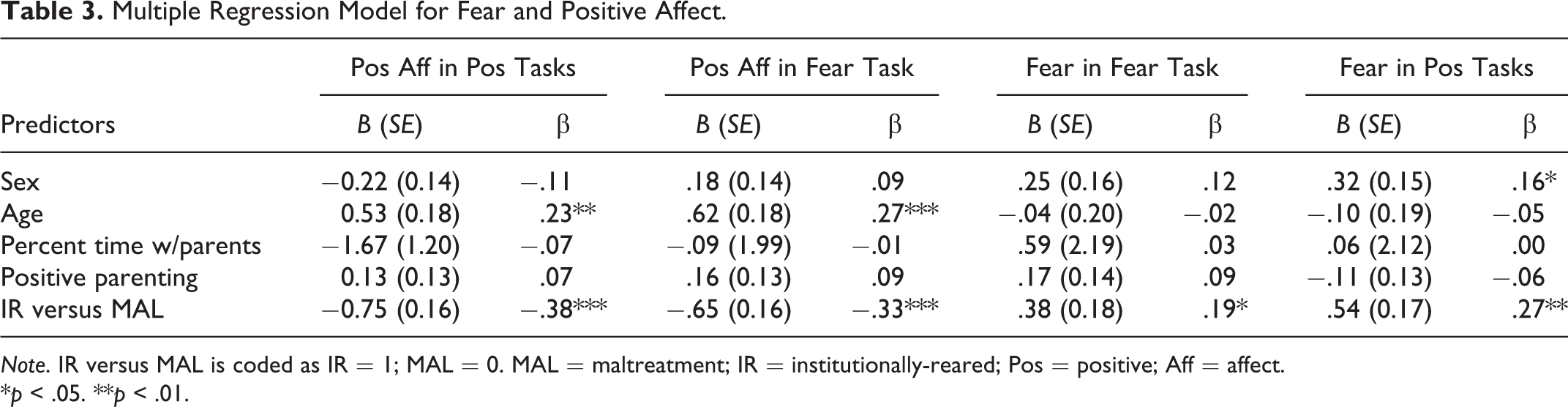
Multiple Regression Model for Fear and Positive Affect.
Note. IR versus MAL is coded as IR = 1; MAL = 0. MAL = maltreatment; IR = institutionally-reared; Pos = positive; Aff = affect.
*p < .05. **p < .01.
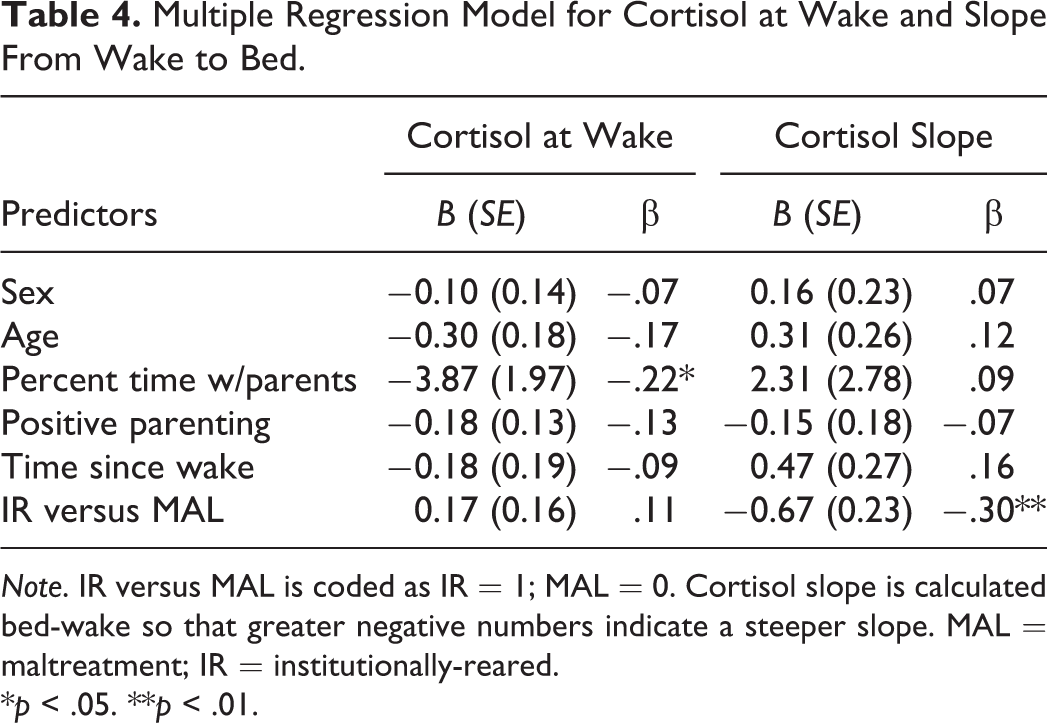
Multiple Regression Model for Cortisol at Wake and Slope From Wake to Bed.
Note. IR versus MAL is coded as IR = 1; MAL = 0. Cortisol slope is calculated bed-wake so that greater negative numbers indicate a steeper slope. MAL = maltreatment; IR = institutionally-reared.
*p < .05. **p < .01.
Our primary goal was to compare maltreated and institutionally-reared children on measures of HPA functioning and social and emotional development around the time of placement in an effort to reduce effects of postplacement experiences on behavioral and physiological measures and to better understand differences in outcomes depending on the type of early adversity. However, children in both groups had been with caregivers for short but varying periods of time prior to data collection (on average, maltreated children spent 10% of their lives with their foster families and institutionally-reared children had spent 6% of their lives with their adoptive parents prior to data collection). A “t-test” revealed the maltreated group had been with their foster families significantly longer than the institutionally-reared children had been with their adoptive families, t(164) = 6.09, p = .00. Therefore, duration of time that children had been with foster and adoptive parents was included as a control variable in all analyses.
Foster and adoptive parents did not differ in observed assertiveness in the laboratory, t(160) = −1.41, p = ns. However, parents of institutionally-reared children were observed to be more positive, t(160) = −2.53, p ≤ .05, than foster parents. To account for this difference, all analyses of child outcome measures were conducted controlling for positive parenting. By controlling for positive parenting, our goal was to rule out the possibility that even though children had been with parents for only a short time, differences in institutionally-reared and maltreated children’s adjustment could be attributed to differences in parenting. We also controlled for child age and sex in all analyses. Group × Sex interactions were tested but were not significant and were therefore removed from the final models. Finally, the amount of time since waking is believed to affect the magnitude of cortisol (Edwards, Evans, Hucklebridge, & Clow, 2001), and a t test revealed that, on average, foster care parents reported a longer time since wake before collecting the first sample than adoptive parents of IR children, t(116) = 2.36, p = .03. Thus, the amount of time since waking was used as a control variable in our model predicting cortisol wake and slope.
Three separate multivariate regressions were run: one assessing the associations between group- and parent-reported socioemotional problems as assessed via the BITSEA, one assessing the associations between group and cortisol wake and slope, and one assessing the associations between group and positive affect and fear in the Lab-TAB tasks. There were no significant correlations across types of measures (e.g., problems measured in BITSEA were not correlated with the Lab-TAB composites or the cortisol measures); therefore, accounting for potential shared variance across these different measures was not necessary.
Contrary to prediction, foster parents maltreated (IR = 1, MAL = 0) reported more socioemotional and behavior problems in their children than did parents of institutionally-reared children (β = −.30, B = −4.20, p < .01; see Table 2); the model accounted for 10% of the variance in child problems.
Because, as noted previously, institutional rearing is viewed as a more extreme form of neglect, we predicted greater fearfulness and less positive affect in institutionally-reared children than maltreated children. As hypothesized, group significantly predicted positive affect during the positive (β = −.38, B = −.75, p < .01) and the fear (β = −.33, B = −.65, p < .01) Lab-TAB tasks, with institutionally-reared children exhibiting less positive affect in both contexts: the model explained 23% of the variability in positive affect during the positive tasks and 21% of variability of positive affect during the fear task. As expected, group also predicted fear during the positive tasks (β = .27, B = .54, p < .01) and during the fear task (β = .19, B = .38, p < .05), such that institutionally-reared children displayed more in both contexts than maltreated children; the model explained 12% of the variability in fear during the positive tasks and 6% of variability of fear during the fear task.
We hypothesized that children reared in institutions would also have experienced more chronic stress and thus might have a more dysregulated HPA axis than maltreated children. Unexpectedly, group did not significantly predict cortisol at wake. Moreover, although group did predict cortisol slope from wake to bed (β = −.30, B = −.67, p < .01; see Figure 1), the direction of the difference between groups revealed that institutionally-reared children had more typical diurnal pattern than maltreated children. The model predicted 18% of the variance in cortisol slope.
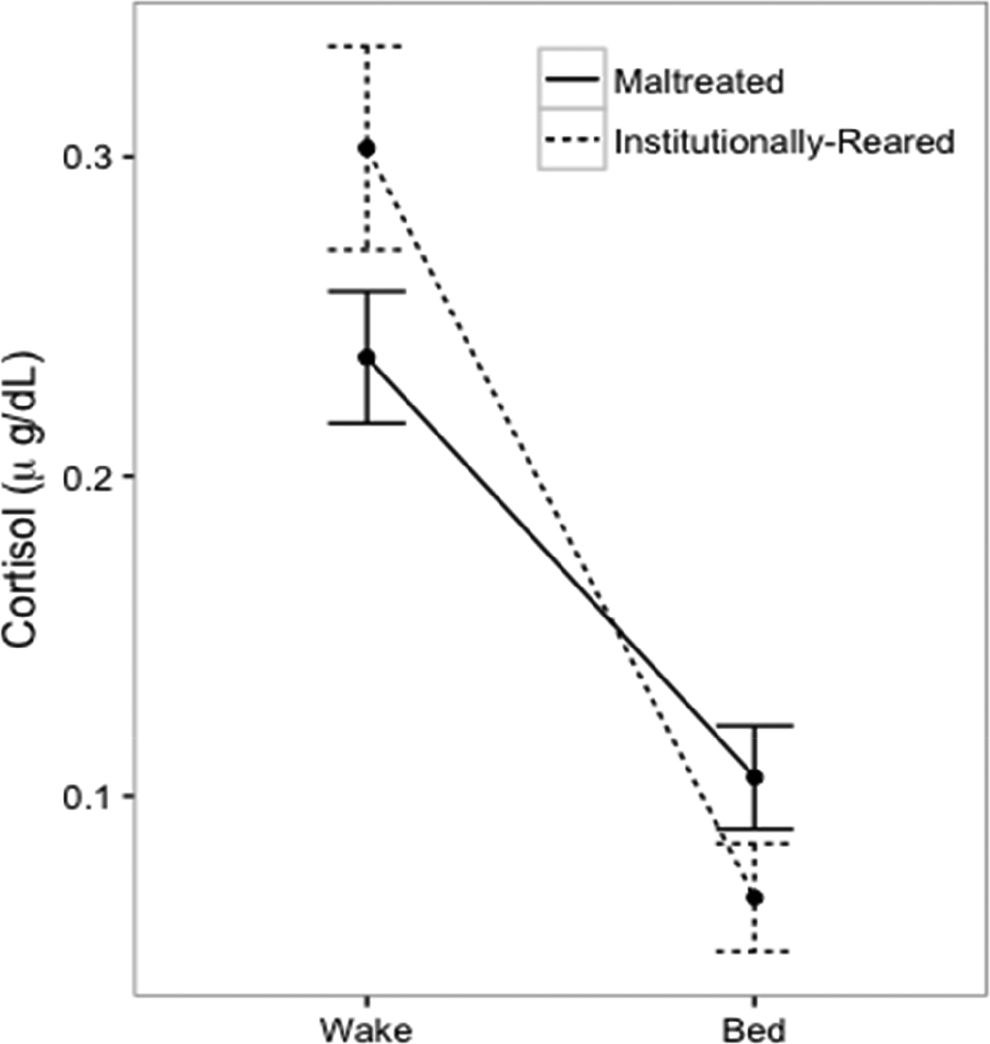
Cortisol differences by group. Cortisol values were back-transformed and are presented here as μg/dL for visualization purposes.
Discussion
A substantive body of empirical work has attempted to describe the effects of early life adversity both within the home and within institutions on young children’s development. Although findings across these populations consistently demonstrate a link between early neglect and children’s subsequent maladjustment, the extent to which these contexts may be differentially associated with the severity of maladaptive functioning has only been discussed theoretically. The current study is the first to compare both physiological (i.e., HPA functioning) and behavioral (i.e., social and emotional skills) development in young children who were recently removed from maltreating families or institutional care.
It has been theorized that institutional rearing may be associated with the most severe outcomes, given that it is not within the realm of normative caregiving. However, there was little in our findings to argue that either context of adverse early care results in uniformly poorer functioning soon after removal from adversity. Maltreated children appear to be less fearful and more capable of being positive, engaged, and joyous when exposed to both positive and strange or novel events than institutionally-reared children. However, foster parents reported that maltreated children had more behavior problems than did children from institutions. The diurnal slope of the institutionally-reared children also appeared to be steeper than that of the maltreated children. Together, these results suggest that any simple ordering of these contexts along a continuum of adversity or perhaps even two dimensions of adversity is too simplistic. This should not be surprising, yet it would still be highly useful if the underlying dimensions of each type of adverse early care could be identified and measured, so that results from different contexts could be meaningfully compared. Notably, it is likely that when we do have a good understanding of the dimensions that should be assessed, we will find as much variation within contexts or types of maltreatmentas between them. For example, Zhang and colleagues (2018) found that within similar institutions, the quality of care significantly varied and was associated with children’s self-perceived competence. We can assume the same would be true of different maltreating families, even those classified with the same type of maltreatment. Thus, this is a ripe area for future research.
Contrary to our expectation, children who experienced maltreatment within the home were reported to have greater socioemotional and behavioral problems than institutionally-reared children. It is possible that the children removed from their homes were more severely neglected, deprived, and otherwise maltreated than children from institutions. We do not have actual measures of the institutions or the maltreating families; thus, this possibility cannot be ruled out. It is also possible that the parents of institutionally-reared children were focusing on their children’s strengths and were downplaying weaknesses or were expecting improvement with time; foster parents may have had a more objective viewpoint. However, as will be noted below, the behavior problems data fit with the diurnal cortisol data, so it is not likely that reporting bias by adoptive parents fully explains this finding. Finally, it is possible that children maltreated within their home were more exposed to alcohol prenatally than were institutionally-reared children (due to the countries that the children were adopted from), given that we excluded children with frank facial evidence of fetal alcohol syndrome from the institutionally-reared sample (see Loman, Wiik, Frenn, Pollak, & Gunnar, 2009, for a more thorough description of this process).
As expected, institutionally-reared children displayed more fear and less positive affect in the positive context of the Lab-TAB than maltreated children. If institutionally-reared children had fewer opportunities for social interaction before adoption compared to maltreated children, they may have been less willing to engage and show enjoyment when the experimenter was showing them the balloons and bubbles. It is also possible that these items were more novel to the institutionally-reared children compared to the maltreated children whether they had no prior experience with them. If maltreated children were more familiar with bubbles and balloons, it would make sense that they would show less fear and more positive affect when they saw them in the laboratory. Institutionally-reared children also showed less positive affect and more fear during the novel, potentially frightening, creature task than maltreated children. Previous studies have shown that children experiencing adverse early care either in the home or in institutions show increased amygdala activity and arousal when processing threatening information (M. M. Cohen et al., 2013; Hein & Monk, 2017; Maheu et al., 2010); however, our findings would indicate that institutionally-reared children’s experiences may have instantiated a more reactive fear system compared to that of the maltreated children. While these results are inconsistent with the findings regarding parent-reported behavior problems, the problem behavior questions dealt more with tantrums and intense emotional displays. Our observational measures focused on facial expressions, approach, avoidance, and freezing, which would be more similar to measures of temperament or behavioral disposition rather than problematic behavior. Alternatively, the observational measures were by definition more objective and avoided reporter bias.
The finding that institutionally-reared children displayed a greater decline in cortisol from wake to bed than maltreated children was surprising, given that there is now significant evidence of dysregulated HPA axis rhythms and reactivity for children previously reared in institutions. Previous research has found that several decades after removal from Romanian institutions, individuals adopted into England still exhibit blunted diurnal cortisol rhythms (Kumsta et al., 2017). These same institutionally-reared children, when studied over 2 years postadoption, showed more blunted rhythms than nonadopted children and their decreased slopes predicted externalizing and attention problems (Koss et al., 2016), similar to reports in other samples (Salis, Bernard, Black, Dougherty, & Klein, 2016). Thus, these results indicate that maltreated children show even more blunted diurnal slopes than institutionally-reared children. The fact that diurnal cortisol patterns indicate potentially more disturbance for maltreated children than institutionally-reared children is consistent with the greater behavior problems reported for the maltreated children.
It is unclear why toddlers who have been maltreated by their parent(s) show flatter cortisol rhythms than institutionally-reared children. It may be that the day-to-day pattern of institutional life, while not sufficient to support optimal development, is at least predictable, while the life of an infant or toddler in a maltreating home may be relatively unpredictable. Predictability is a critical factor in stress, with unpredictability amplifying reactivity of stress-mediating physiological systems, including the HPA axis. For example, in a sample of children with bipolar disorder and a community comparison, lower levels of parent-reported structure (i.e., organization and consistency) in middle childhood were associated with a more typical HPA diurnal response even while controlling for risk group (Ellenbogen & Hodgins, 2009). Institutional care may have been more predictable with regard to the timing of activities during the day (eating, sleeping) that influence diurnal rhythms. Thus, if predictability is a determinant of stress for young children and influences diurnal rhythms, it would make sense that maltreating homes produced greater opportunity for dysregulation of the diurnal cortisol rhythm than many institutions. While potentially plausible, this idea needs further examination in future work. Alternatively, the experience of neglect and abuse by attachment figures may be more stressful than the benign neglect experienced in institutional care.
Moreover, it should be noted that when studied in institutional care, both marked flattening (Carlson & Earls, 1997) and relatively normal patterns emerged (van Ijzendoorn et al., 2011). The difference may have to do with the quality of social care the infants and toddlers received (Koss et al., 2014). If so, this might suggest that despite the deprivation experienced in institutional care, in this sample, the maltreated children may have experienced more neglect of their need for social contact and support.
Limitations
There are limitations of this study, most notably was a lack of objective measures of the actual adverse care experienced by the children, its nature, duration, and severity. Although results from a study using a comparable sample showed that all foster children were reported to have experienced neglect and emotional maltreatment, we were unable to obtain the case files for participants in the current study and therefore could not test whether specific types of maltreated or exposure to multiple forms of maltreatment were associated with outcomes differently. Likewise, we did not have access to all of the institutions in which the institutionally-reared children resided.
In addition, although children were only in their foster or adoptive homes for a couple of months prior to data collection and we statistically controlled for duration of time within the home and positive parenting behaviors, it should be noted that parenting behaviors, family resources such as income and parental education, and characteristics within the home not reflected in our measures might explain some differences. Given these limitations, we need to be cautious when comparing these groups of children.
Conclusions
The goal of the current study was to determine whether these contexts are so markedly different in degree of adversity that one group would stand out as obviously more impaired than the other. The fact that we did not find evidence to support this should lead us to renew attempts to understand the various factors that are embedded in adverse care contexts. By gaining more insight regarding the potential differential effects of both types of early adversity on development, researchers can focus on possible mechanisms to maladjustment that may be specific to each at-risk context and therefore develop more effective and targeted intervention and prevention efforts.
Footnotes
Authors’ Note
The content is solely the responsibility of the authors and does not represent the views of the National Institutes of Health.
Acknowledgments
The authors would like to thank the parents and children without whom this study would not have been possible. We would also like to thank the project staff at both site locations for their assistance with study coordination and data collection. This research was supported by NIMH P50MH078105 and R01HD075349 (to Megan Gunnar and Philip Fisher) and NIMH training grant T32 MH015755 (to Nicole Perry and Carrie DePasquale).
Declaration of Conflicting Interests
The author(s) declared no potential conflicts of interest with respect to the research, authorship, and/or publication of this article.
Funding
The author(s) disclosed receipt of the following financial support for the research, authorship, and/or publication of this article: This research was supported by NIMH P50MH078105 and R01HD075349 (to Megan Gunnar and Philip Fisher) and NIMH training grant T32 MH015755 (to Nicole Perry and Carrie DePasquale).