




Abstract
Media reports and government enquiries have shone a spotlight on institutional child sexual abuse (CSA) globally. With youth-serving organizations seeking to identify how to improve policies and procedures developed to protect children, a gap exists in research and organizational quality assurance procedures. A new tool is needed to measure the capability of workers to implement and support effective child-safeguarding policies and practices. To address this, our aim was to develop the Safeguarding Capabilities in Preventing Child Sexual Abuse Scale. Participants (n = 345) from a range of youth-serving sectors in Australia answered 128 questions. Using exploratory factor analysis to assess the underlying factor structure and refine the item pool, items loaded onto four factors. Reliability coefficients ranged from .68 to .95. Results showed that knowledge, attitudes, self-efficacy to take action, and awareness are all key capabilities related to creating conditions of safety for children and young people and preventing CSA in youth-serving organizations.
Child sexual abuse (CSA) within institutions and other youth-serving organizations has begun to receive specific focus both in terms of research and in policies and practices related to its prevention. In Australia, the recent Royal Commission Into Institutional Responses to Child Sexual Abuse (2017a; the Royal Commission) brought to light the failings of numerous different youth-serving organizations across a broad range of sectors. With the introduction of legislatively mandated child-safe standards in the state of Victoria (Australia), and with other jurisdictions set to follow, that include staff training of knowledge, skills and awareness, as well as the embedding of an organizational culture that embodies child safety (Mathews, 2017), it is vital that researchers and organizations have access to reliable valid measures, supporting changes in these areas.
Why Measure Safeguarding Capability?
Globally, CSA has been identified as a public health concern (Letourneau, Brown, Fang, Hassan, & Mercy, 2018; Mathews, 2017). Recent estimates for the prevalence of CSA are between 18% and 19.7% for girls and between 7.6% and 7.9% for boys (Pereda, Guilera, Forns, & Gomez-Benito, 2009; Stoltenborgh, Bakermans-Kranenburg, Alink, & van Ijzendoorn, 2015). However, estimates are fraught with difficulty, given the secrecy, silence, and shame associated with CSA. Coupled with specific findings of CSA in institutional contexts, this has led to a need to develop systematic approaches to prevention, focused on improvements in safeguarding practices in a wide range of youth-serving organizations.
In Australia, the Royal Commission Into Institutional Responses to Child Sexual Abuse (2017b) reported evidence suggesting nonpenetrative CSA prevalence rates of between 14% and 26.8% for girls and between 5.2% and 12% for boys. To reduce CSA in institutional settings, the Royal Commission recommended the necessary strategies should include training staff in relation to strategies to prevent and report CSA and enhancing the capacity for workers across different sectors to provide advocacy and support (Royal Commission Into Institutional Responses to Child Sexual Abuse, 2017c). The United States, UK, Ireland, and Canada have had similar enquiries, with important lessons learned about the conditions of safety for children and what needs to be done in institutions to create a culture of prevention (Higgins, Kaufman, & Erooga, 2016). However, there is a lack of appropriate measures to assess the “culture” of youth-serving organizations and the level of progress toward achieving a culture based around creating conditions of safety for children. Existing measures are either focused on knowledge, attitudes, and behaviors relating to reporting abuse (rather than prevention) or focused on specific youth sectors (such as teachers, doctors, sports administrators; see Dinehart & Kenny, 2015; Goodman-Delahunty, Martschuk, & Cossins, 2016; Kenny, 2004; Noble & Vermillion, 2014; Walsh, Rassafiani, Mathews, Farrell, & Butler, 2012).
CSA in Youth-Serving Organizations
As well as the general risk factors for CSA occurring (such as age, gender, history of maltreatment, and disability status of the child/young person), specific risk factors related to institutional CSA have begun to be identified in research (Kaufman et al., 2016). A factor that increases the risk of CSA is the level of involvement and amount of time a young person spends within an institution (Carr et al., 2010). Alongside this, compulsory attendance at activities at an institution such as school, after-hours care, or church increases the potential to be harmed (Wolfe, Jaffei, & Jetté, 2003). The power differentials that come hand-in-hand with the child-to-adult relationships that are formed within such institutions also add not only to the risk of being abused (Bohm, Zollner, Fegert, & Liebhardt, 2014; Wurtele, 2012) but also difficulty in disclosing such abuse (Wolfe et al., 2003). This is due in particular to the level of trust that the communities—and specifically parents—have in them. Such environmental factors have supported the notion of utilizing a situational crime prevention model to reduce CSA in institutional contexts and improve youth-serving organizations safeguarding policies and practices (Morely & Higgins, 2018).
Specific programs have been developed to support the prevention of CSA in youth-serving organizations, particularly CSA prevention education (“protective behaviors” programs). However, they often relate to the skills of workers, with a narrow focus on mandatory reporting knowledge and skills (Walsh et al., 2012). Some are focused on the behavior and capability of children and young people themselves, particularly CSA prevention education (“protective behaviors”) programs. However, such programs lack rigorous evaluation (Letourneau, Eaton, Bass, Berlin, & Moore, 2014). One of the challenges to such evaluations is that the long-term outcome (the occurrence, or the successful prevention of, CSA) is difficult to measure, given the relatively low incidence of CSA within statutory child protection data (compared to other child maltreatment types) and the sensitivity of the content presenting ethical and practical challenges for measurement of sexual abuse prevalence within organizational settings (Mathews et al., 2015). Currently, there are no suitable “proxy” measures of progress toward a culture of safeguarding in organizations that are operationalized at the individual worker level and that can apply across a broad range of youth-serving sectors.
What Should Safeguarding Capability Look Like?
Based on recent Australian research (Moore, McArthur, Heerde, Roche, & O’Leary, 2016; Moore, McArthur, Noble-Carr, & Harcourt, 2015) and policy proposals in Australia (the National Principles for Child-Safe Organisations developed by all Australian Governments, Australian Human Rights Commission, 2018), the Australian Catholic University (ACU, 2017) has outlined six broad capabilities that adults in youth-serving organizations need in order to develop and implement appropriate approaches to child safety. The ACU Safeguarding Capability Framework is prevention-oriented, tailored to the specific issues and challenges of CSA prevention and responses. It is focused on equipping adults with the skills needed to keep children safe through implementation of strategies and compliance with regulatory regimes and standards. Although focused specifically on creating child-safe organizational environments that address the risks of CSA, it is applicable to safeguarding children from all forms of maltreatment including harm from peers. Capabilities are framed in terms of the skills, knowledge, and behaviors needed of adults to support and empower children and young people and implement effective strategies to prevent harm and respond to risks. The Framework includes the following six capabilities: Nature of abuse and risk factors, Child-safe organizational cultures and governance, Risk-management strategies, Participation of children and young people, Education and prevention, and Responsive care and support (see Table 1).
Safeguarding Capabilities of Workers and Volunteers for Preventing and Responding to Child Sexual Abuse Within Organizational Contexts.
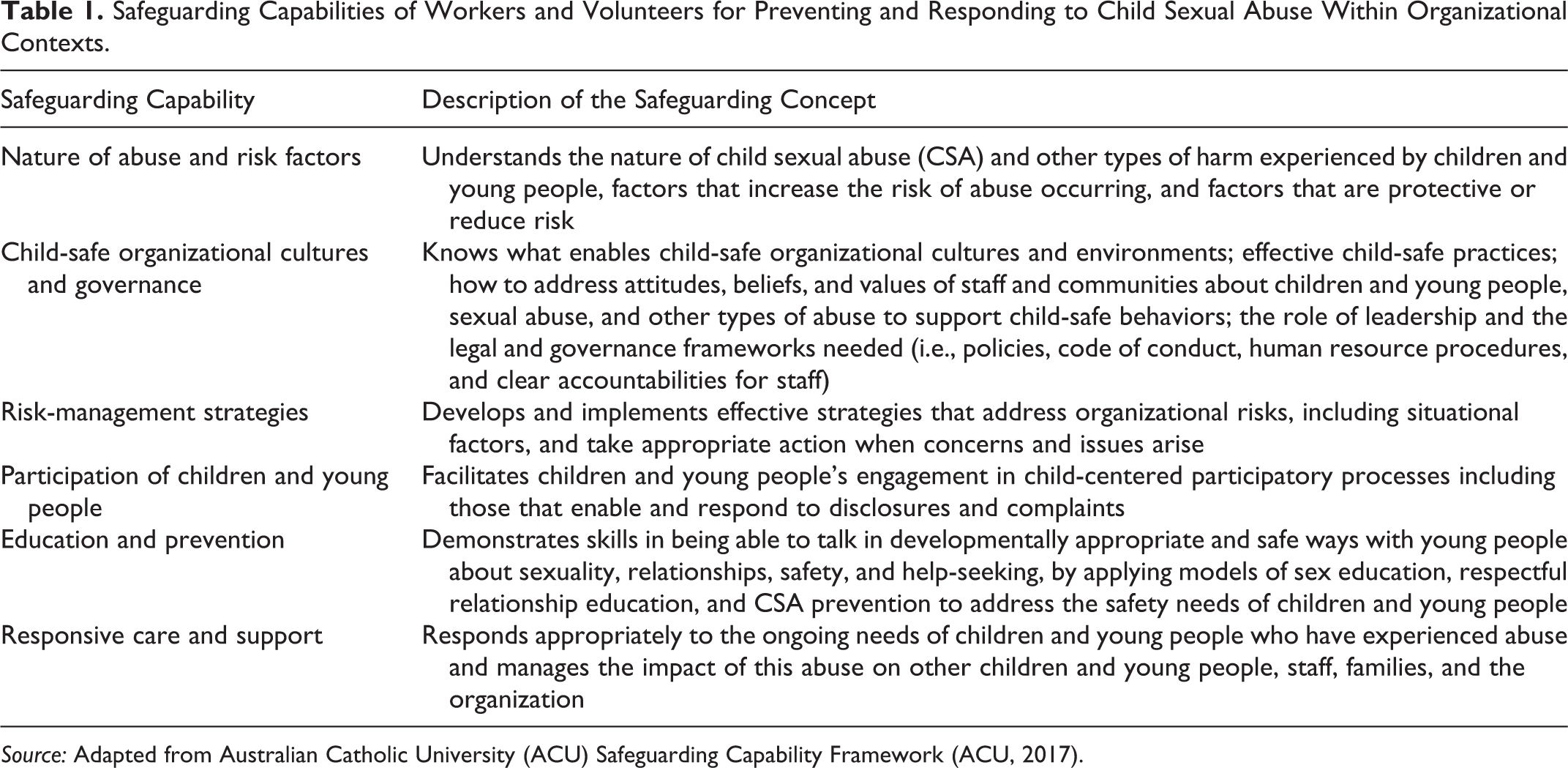
Source: Adapted from Australian Catholic University (ACU) Safeguarding Capability Framework (ACU, 2017).
Existing Measures
As outlined below, several existing measures have been used over the years to support research into the safeguarding capabilities of staff and volunteers in youth-serving sectors. In an effort to develop a suitable proxy measure, the key areas of previous measures have focused on attitudes toward both reporting CSA and organizational training and disclosures, knowledge of prevalence of CSA and its impact on victims, and awareness of policies and procedures related to safeguarding, safety communication, and empowerment of staff to take safeguarding action.
Knowledge of CSA
Knowledge of CSA and how to prevent it has long been seen as an important capability of those with a duty of care to protect children and young people. Historically, teachers were seen as a major player in the defense of children from abuse (they have been in many Anglophone jurisdictions, a key mechanism of mandatory reporting schemes). As a result, it is unsurprising that one of the earlier measures designed, the Educators Child Abuse Questionnaire (ECAQ; Kenny 2004), focused on teachers’ knowledge of CSA as well as beliefs regarding their role in disciplining children. Keeping in mind that workers who perceive themselves to have a high level of knowledge, which is not matched by actual skills, may fail to protect children and young people from abuse. Coupled with a global move to remove physical discipline from classrooms, the ECAQ focuses too much on reporting rather than preventing. Further limitations to this measure relate to the lack of potential use in a broad range of sectors outside of education, which engage with children and youth, ranging from arts and drama clubs to youth justice.
More recently, the Child Sexual Abuse Knowledge Questionnaire, regarding jurors’ knowledge of CSA and its impact (Goodman-Delahunty et al., 2016), and the Administrators and Child Abuse Questionnaire (Noble & Vermillion, 2014), based on Kenny’s ECAQ, have been used for investigating abuse in sports club settings. Although broadening the number of sectors able to be investigated, these measures focus largely on staff’s self-perceived knowledge, as opposed to factual knowledge, and are not able to be used across the broader organizational contexts recently identified such as child welfare, pediatric health and mental health, and youth development (i.e., Scouts, Girl Guides).
Attitudes
Researchers have argued that staff with “positive” attitudes toward their roles in identifying, reporting, and supporting victims of CSA will be more capable than staff with poorer attitudes (Fraser, Mathews, Walsh, Chen, & Dunne, 2010). Hawkins and McCallum (2001) developed the Attitudes Towards the Reporting of Child Abuse and Neglect Questionnaire. Focusing solely on teachers’ attitudes toward their role in reporting abuse, not specifically sexual, and neglect, the questionnaire focuses more on responding to harm rather than capabilities to create cultures of prevention and foster conditions of safety for children and young people. As an extension of her original ECAQ, Kenny (2011) developed the Early Childhood ECAQ. Also focused within professionals largely in the education sector, the questionnaire similarly asks about attitudes toward reporting child abuse, organizational policy awareness questions, and questions regarding both factual and perceived level of knowledge related to abuse. The questionnaire lacks applicability beyond the education sector and broader use as a result of some questions being specific to state laws in Florida, United States.
The Teacher Reporting Attitude Scale toward Child Sexual Abuse Scale (Walsh et al., 2012) similarly focuses largely on workers in the education sector and on attitudes toward their role in reporting CSA. Questionnaires concerning attitudes toward procedures surrounding disclosure and justice systems (Finnila-Tuohimaa et al., 2008) and the extent and quality of an employee’s safety training (Noble & Vermillion, 2014) have also been developed with specific focuses in psychologists and sports club administrators, respectively. The Child Sexual Abuse Attitude and Belief Scale (Finnila-Tuohimaa et al., 2008), focusing on court-based instances, does not support the prevention of CSA but rather an understanding of psychologists’ capability to support court proceedings.
Safety Climate
Developed to support implementation of prevention strategies and enhancing safety in organizational settings, including work with U.S. organizations such as Boys & Girls Clubs of America (Kaufman, personal communication, July, 2015), the Organizational Safety Climate Survey measures staff capabilities related to safety communication, safety responsibility, safety empowerment, and organizational safety climate. A lack of specific questioning around preventative actions and knowledge regarding CSA risk factors prevents the survey from supporting an understanding of workers’ capabilities related to these important CSA prevention competencies. Along similar lines, the Domestic Abuse and Safeguarding Children (DASC) Scale (Szilassy, Carpenter, Patsios, & Hackett, 2013) also measures safety communication and empowerment, likely driven by the movement at the time to increase discussions between workers and organizational leaders and ensuring staff and volunteers felt comfortable and trained to deal with risks threatening youth safety. Despite having a focus on domestic abuse with safeguarding of children being discussed as a result of exposure to abuse, the DASC Scale is one of the few scales that measures workers’ awareness of organizational policies. Another measure used to enhance safety in organizational settings is the CSA Prevention Evaluation Tool for Organizations, which was recently used in a study to outline standards, focusing largely on HR procedures and policy implementation, which can help organizations improve safeguarding practices (Wurtele, Mathews, & Kenny, 2019).
Although existing measures have supported research and action related to safeguarding children in organizations, some key areas and limitations have thus far prevented wide scope research that could be translated into improvements in policies and procedures related to creating a child-safe culture across all manner of youth-serving organizations. Lacking in current measures are concepts related to knowledge of risk and protective factors, awareness of micro-, organizational-level policies and procedures related to prevention of CSA, self-efficacy to act to both prevent abuse and respond to allegations of abuse, and the existence of an empirically tested measure that can be utilized to sample staff and volunteers across the multiple sectors in which youth-serving organizations operate.
Aim of Study
The aim of the current study is to investigate the factor structure and internal reliability of a new scale to measure workers’ capabilities to prevent CSA in organizations. Using exploratory factor analysis, this study will develop the Safeguarding Capabilities in Preventing Child Sexual Abuse Survey: a measure of youth-serving worker capability related to safeguarding children and preventing CSA across the diverse sectors in which youth are served.
Method
Participants
The analysis is based on an opportunistic sample of staff and volunteers (n = 345) working in youth-serving organizations across Australia. More than half of participants (53.9%) worked directly with children and young people, while 30.7% identified themselves as middle management, and 14.8% identified themselves as senior management (principals, CEOs, and directors). We purposefully recruited workers across a range of employment types within youth-serving organizations, due to the fact that safeguarding children is the role of all staff and volunteers (the Royal Commission Into Institutional Responses to Child Sexual Abuse, 2017c), not just that of those who work directly with children. Of the 594 potential participants who commenced data collection, 126 completed only the demographic questions and were excluded. Of the 468 respondents, a further 123 (26%) were excluded from analysis due to answering less than 95% of the 128 items from the scale under development. The majority of the final sample of 345 were female (n = 277; 80%), with 1 participant identifying outside the male–female gender binary. Participants ranged in age from 16 to 80 (M = 25.4, SD = 13.3). In an effort to develop a broadly applicable scale, we invited individuals and organizations working across multiple different service contexts. Table 2 shows the breakdown of the service-sector participants who were employed or volunteering in at the time of data collection.
Participants’ Service Sector.
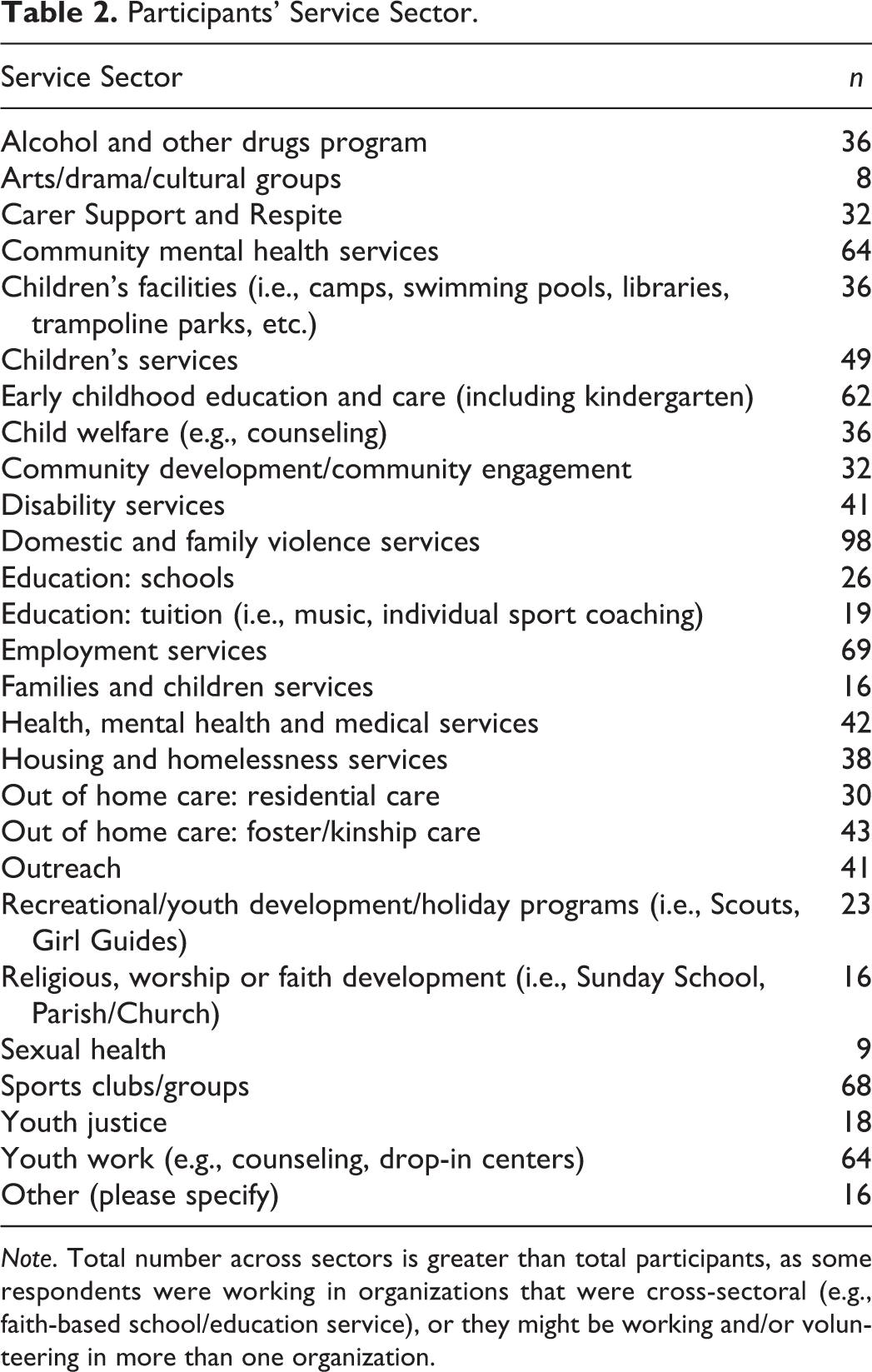
Note. Total number across sectors is greater than total participants, as some respondents were working in organizations that were cross-sectoral (e.g., faith-based school/education service), or they might be working and/or volunteering in more than one organization.
Procedure
Participants for the current study were recruited via e-mail invitations sent to organizational leaders in youth-serving organizations in Australia, subscribers to the newsletter of a university web portal that makes available research, practice tools, training, and other resources related to safeguarding children and young people in youth-serving organizations (https://safeguardingchildren.acu.edu.au/). An invitation was also sent to peak bodies across the child and family welfare, domestic violence, and early childhood education and care sectors, who advertised the research project in newsletters and on websites, and through posting a link to the survey on social media (LinkedIn). The study was described as an opportunity to those who work or volunteer in youth-serving organizations to help develop a new survey regarding safeguarding capabilities in preventing child sexual abuse. Data were collected across a period of 2 months from August to September 2018.
Measurement
The development of the online questionnaire followed the eight steps for scale development suggested by DeVellis (2016). After deciding on the latent construct of “safeguarding capabilities,” a pool of items was generated across the six capabilities. The item construction process occurred in such a way that they try to cover four different ways in which each capability needs to be applied or expressed by individuals: content knowledge (i.e., factual, research-based information about CSA and prevention/responses), organizational awareness (i.e., of the presence of policies and procedures and what they should cover), attitudes (both toward CSA as a general concept and to the various aspects of safeguarding practice), and confidence or self-efficacy to take action to implement safeguarding strategies (e.g., confidence to be able to speak to young people in developmentally appropriate and safe ways about sexual development). Sources for capabilities included the final report of the Royal Commission, the Taking Us Seriously (Moore et al., 2015) and Our Safety Counts (Moore et al., 2016) reports, as well as the ACU Safeguarding Capability Framework (ACU, 2017).
Once 128 initial questions had been developed, these were given to an expert panel to review for content and clarity of wording to adjust or suggest removal as they felt appropriate. The expert panel consisted of three academic experts: (a) an education specialist whose research focuses on school-based interventions and strategies to prevent CSA, with experience in scale development related to this topic; (b) a criminologist who has researched CSA both in and out of organizational contexts for over 20 years; and (c) a mental health and public health specialist whose expertise in CSA prevention is internationally recognized and has experience in scale development. Ethics clearance was provided by the ACU human research ethics committee (2018-116E). The authors then approached organizations and individuals working in youth-serving contexts via e-mail invitation.
Statistical Analysis
To determine the dimensionality of the Safeguarding Capabilities Survey, factor analysis including tests for suitability and exploratory factor analysis with principal axis factoring were used to determine the minimum number of factors to explain the variance with retention of factors with eigenvalues loading above 1.0 and interpretation of a scree plot. Reliability was addressed following the retention of the final items as informed by factor analysis and determination of the internal consistency using Cronbach’s α.
Results
All data were analyzed using IBM SPSS for Windows (Version 25). Prior to analysis, data were checked for missing values. Little’s Missing Completely at Random test indicated that data were not missing at random; thus, the use of expectation–minimization procedures to handle missing data was not seen as suitable. As a result, any participant missing more than 5% of questions related to safeguarding capabilities were removed, and pairwise deletion was used within the factor analysis. Mahalanobis’s distance was calculated to identify any potential multivariate outliers. Using a threshold value of χ2 = 183.19, α = .001, and degrees of freedom (df) = 128, no multivariate outliers were identified. Sampling adequacy and factorability of the data were tested using the Kaiser–Mayer–Olkin measure (.87) and Bartlett’s test of sphericity (χ2 = 19.558.13, df = 7,750, p = .000), demonstrating an adequate sample size for the analysis. Of the 128 questions tested, 54 were reverse coded prior to analysis.
A principal axis factoring analysis using an oblique promax rotation was used because any potential subscales were assumed to be correlated to the overarching construct of safeguarding capability. Items were retained in the analysis after identifying the number of factors if the rotated factor loading weight was greater than ±0.4. Initial analysis indicated four distinct factors. After forcing three-, four-, and five-factor rotations, 75 items were retained in a four-factor solution. One item, “My organization focuses on the danger that children and young people face from strangers,” was removed due to an unexpected negative factor loading. Another item, “My employer regularly facilitates training opportunities about responding effectively to child safety issues,” was removed due to significant and large correlations with 3 other items, leaving a total of 73 items (See Table 3). Online Supplemental Table S1 identifies the full 128 items developed and cross-loadings evident in the four-factor solution. Intercorrelations between the four factors ranged from .25 to .55.
Factor Loadings for the 73 Items, Percentage of Variance, Internal Consistency, and Descriptive Statistics of the Four Factors.
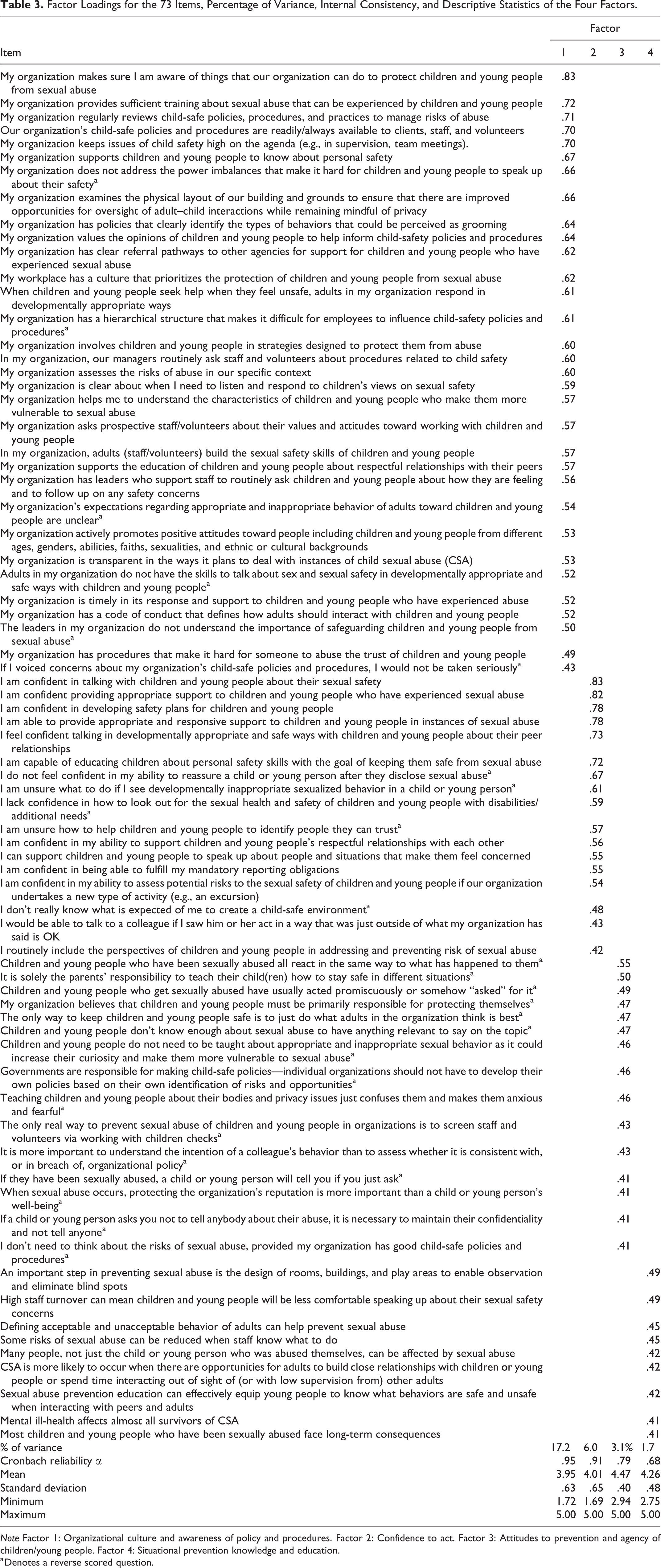
Note Factor 1: Organizational culture and awareness of policy and procedures. Factor 2: Confidence to act. Factor 3: Attitudes to prevention and agency of children/young people. Factor 4: Situational prevention knowledge and education.
a Denotes a reverse scored question.
The results of the analysis indicate four factors underpinning the construct of safeguarding capability in youth-serving workers, namely, organizational culture and awareness of policy and procedures, confidence to act, attitudes to prevention and agency of children and young people, and situational prevention knowledge and education. The four factors demonstrated good internal consistency. As shown in Table 3, Cronbach reliability coefficients (α) were excellent for the first two factors (.95 and .91) and moderate for the other two (.79 and .68).
Discussion
The purpose of the current study was to develop a broad-sectored measure of worker capability related to child safeguarding and CSA prevention. The items were constructed to cover the four ways that safeguarding expertise need to be expressed or applied (knowledge, attitude, skills, and confidence) within each of the six content areas of safeguarding identified in the Capability Framework (Table 1). However, we were not sure whether empirical testing would result in a factor structure that mirrors the six content areas, the four ways in which that content needs to be applied or a combination of the two. The exploratory factor analysis indicates that the new 73-item Safeguarding Capabilities Survey has four factors. These four factors are a combination of the content domains and the different applications of capability (knowledge, attitudes, skills, and confidence). These are briefly outlined.
Organizational Culture and Awareness of Policy and Procedures
These questions relate to staff and volunteers’ awareness of the safeguarding policies, procedures, and practices that they are expected to follow in an effort to safeguard children and young people. Ranging from policies that affect them directly to expectations of leadership to help create an organizational culture of safety, these questions not only help identify strengths and gaps in worker awareness but also encourage reflection about the design and delivery of policies within an organization.
Confidence to Act
These questions relate to confidence to act or self-efficacy of workers. The questions in this factor assess the degree to which staff and volunteers feel confident to implement safeguarding strategies such as providing support for children and young people to keep themselves safe, approaching colleagues and other adults when they feel someone hasn’t followed a child-safe policy or where a child or young person may be—or feel—unsafe, and responding to and supporting young people if something was to happen.
Attitudes to Prevention and Agency of Children and Young People
These questions relate to workers’ attitudes toward activities needed to support prevention of CSA and their sense of personal responsibility for prevention activities. It focuses on the workers’ role in prevention as well as that of children and young people themselves and the role of others including parents and the government. It measures workers’ attitudes toward supporting children’s agency and the empowerment of children and young people.
Situational Prevention Knowledge and Education
The final group of questions address staff and volunteers’ knowledge of situational prevention strategies (i.e., how to modify environmental factors to reduce opportunities for grooming and abuse to occur) and the education of children and young people and the staff who work with them to support the prevention of grooming and sexual abuse.
The four factors derived from the analysis combine expertise or capability in terms of adults knowing about CSA and effective prevention strategies, having positive attitudes about CSA prevention, being skilled in the implementation of preventative actions and therapeutic responses to concerns, and having confidence to implement safeguarding policies. These four sets of questions allow for researchers and organizations to gain a better understanding of staff and volunteers’ safeguarding capabilities.
As well as being a reliable research measure of safeguarding capabilities, implications regarding the development of the Safeguarding Capabilities Survey relate to its potential to be used by youth-serving organizations seeking to better understand their workforce’s capacity to fulfill legal and moral obligations to protect children from institutional CSA. With recent efforts to upskill current professionals as well as the need to prepare future workers in youth-serving organizations, a dual-purpose research measure that can guide quality assurance processes while also collecting data for empirical work has the potential to greatly improve the lives and well-being of children and young people who interact with such organizations around the globe.
We have framed the capabilities in relation to what adults need to know and do within their organizations and sectors to keep children safe and to create the conditions of safety that support effective prevention and responses to harm. Organizations can use the survey to help measure the following attributes of staff and volunteers: (a) awareness of organizational policies, practice, and safeguarding culture; (b) confidence to take action when a child or young person voices a concern about their safety and well-being; (c) attitudes in relation to children and young people’s knowledge and access to safety education; and (d) knowledge about the risks and prevention of CSA. The current study is not without limitations. The participants more strongly reflected some sectors (i.e., community mental health, domestic and family violence services) than others (i.e., youth justice, religious, recreational/youth development). There may be limits on the generalizability of the findings and therefore the applicability of the survey to volunteers and workers in organizations that were less-well represented. A methodological limitation of the study is the removal of 26% of the sample as a result of extensive missing data.
Future research is needed to confirm the factor structure of Safeguarding Capabilities Survey with samples of participants from a broader range of youth-serving organizations, particularly those not well represented in the current sample, and measure the test–retest reliability of the survey. The testing of concurrent validity with existing measures with specific subgroups (i.e., teachers) would also confirm the psychometric properties of the scale. Future research comparing the safeguarding capabilities of staff across different employment types (i.e., administration, management, and frontline workers) would allow for a deeper understanding of how organizations can foster a culture of child safety across all departments and workers. Generalizability to other countries and/or contexts may also need to be tested with suitable translations and/or adaptations. Researchers interested in child safeguarding practices within organizations could examine the relationship of worker capabilities to children’s perceptions of safety in organizations, the efficacy of interventions to improve worker capabilities related to safeguarding practices and examine differences in worker capabilities between different sectors, and level of employment or in action research aiming to improve organizational policies and procedures.
Supplemental Material
Supplemental Material, Table_4 - Safeguarding Capabilities in Preventing Child Sexual Abuse: Exploratory Factor Analysis of a Scale Measuring Safeguarding Capabilities in Youth-Serving Organizations Workers
Supplemental Material, Table_4 for Safeguarding Capabilities in Preventing Child Sexual Abuse: Exploratory Factor Analysis of a Scale Measuring Safeguarding Capabilities in Youth-Serving Organizations Workers by Douglas Russell and Daryl Higgins in Child Maltreatment
Footnotes
Declaration of Conflicting Interests
The author(s) declared no potential conflicts of interest with respect to the research, authorship, and/or publication of this article.
Funding
The author(s) received no financial support for the research, authorship, and/or publication of this article.

Supplemental Material
Supplemental material for this article is available online.
References
Supplementary Material
Please find the following supplemental material available below.
For Open Access articles published under a Creative Commons License, all supplemental material carries the same license as the article it is associated with.
For non-Open Access articles published, all supplemental material carries a non-exclusive license, and permission requests for re-use of supplemental material or any part of supplemental material shall be sent directly to the copyright owner as specified in the copyright notice associated with the article.
