




Abstract
Despite an increasing awareness about the existence and harms of commercial sexual exploitation of children (CSEC), the identification of victims remains a challenge for practitioners, hindering their ability to provide appropriate services. Tools that gauge risk of CSEC support the identification of victims but are underdeveloped because most tools assess risk of CSEC within a general youth population. An understanding of what predicts actual CSEC victimizations among youths at higher risk of CSEC due to experiences of childhood adversities has been left unassessed. Research in this area is limited in part because traditional methods do not allow for an assessment of the unique impact of childhood adversities that tend to co-occur. To address these difficulties, the current study applied predictive regularization methods to identify the most decisive risk items for CSEC. Proximal risk of CSEC was assessed among 317 youths who were referred to a specialized program in the Northeast of the United States due to suspicion of CSEC. With an innovative methodological approach, this study seeks to prompt other scholars to examine risk utilizing novel techniques and provides a foundation for the development of concise tools that assess risk of CSEC among populations of youths at higher levels of risk.
Keywords
The commercial sexual exploitation of children (CSEC) has become an important focus for providers who seek to protect children from harm. The significant concerns among providers stem from observed severe health impacts of CSEC that are often different from other forms of child abuse. Victims of CSEC are more likely to have experienced multiple and prolonged forms of adversity during childhood (Naramore, Bright, Epps, & Hardt, 2017). These experiences of cumulative and co-occurring victimizations can reduce resiliency and are related to health outcomes such as post-traumatic stress disorder, suicidal ideation, cognitive impairment, anxiety and depression, and a range of other emotional and behavioral problems (Cole, Sprang, Lee, & Cohen, 2016; Varma, Gillespie, McCracken, & Greenbaum, 2015). Despite an increasing awareness about the existence and harms of CSEC, the identification of victims remains a challenge for practitioners, hindering their ability to provide appropriate services.
CSEC includes a range of harmful acts. The victims of Trafficking and Violence Protection Act of 2000 (TVPA) recognizes minors who are engaging in commercial sex as victims of sex trafficking regardless of coercion, fraud, or force (TVPA, 2000, P.L. 106-386). The Justice for Victims of Trafficking Act (JVTA) expands the definition of sex trafficking by including additional harms such as sexual exploitation and other sexual abuse types, live or online sex shows, pornography, or sex tourism (JVTA, 2015, amending 18 U.S.C. 1591[a][1]). While CSEC is sometimes used interchangeably with sex trafficking, we use the term CSEC to encompass any sexual act performed by a minor in exchange for anything of value.
The responsibility of child welfare agencies to identify CSEC has increased dramatically in recent years (Reid, Baglivio, Piquero, Greenwald, & Epps, 2018). The Preventing Sex Trafficking and Strengthening Families Act (2014, Title IV-E, Section 101) mandates state child welfare agencies to “develop policies and procedures to identify, document, screen, and determine appropriate services for children who are victims of, or at risk of, sex trafficking or a severe form of trafficking in persons.” Despite this mandate, child welfare providers and other youth-serving professionals face difficulties identifying victims. CSEC victims are often reluctant to disclose information about victimizations out of fear of harm by the offender or facing criminal charges for activities related to their victimization (O’Brien, Li, Givens, & Leibowitz, 2017; Reid, Baglivio, Piquero, Greenwald, & Epps, 2017). Youths may also not disclose victimization experiences because of emotional attachments to the exploiter, self-blame, or fear of negative judgments (Andretta, Woodland, Watkins, & Barnes, 2016).
Although youths are unlikely to self-disclose victimization, particularly to stakeholders such as police who may be unfamiliar to a youth, they often share information with a range of adults in their life, including counselors, doctors, or social workers. Assessment tools are increasingly being used in these different professional settings to identify young people who are at risk of CSEC. However, gaps in the literature have left current CSEC assessments lacking a clear consensus of risk determination.
The literature is insufficient for two key reasons. First, prior work has focused on how CSEC victims differ from a general population of youth because of histories of childhood adversities, including sexual abuse, runaway histories, substance abuse, and involvement with child welfare, juvenile justice, and health-care systems (see De Vries & Goggin, 2018; Gibbs, Henninger, Tueller, & Kluckman, 2018; Greenbaum, Dodd, & McCracken, 2018; Kotrla, 2010; Salisbury, Dabney, & Russell, 2015). While these childhood adversities increase vulnerability to CSEC victimizations compared to youths without such experiences, little is known about what signals immediate vulnerability to CSEC among groups of young people who have already been identified as being at higher risk of victimization (see, for recent work in this area, Panlilio, Miyamoto, Font, & Schreier, 2019). Second, prior work has highlighted a multitude of childhood adversities that increase risk of CSEC but often co-occur (Reid et al., 2018). While this co-occurrence can have an aggravated impact on vulnerability to CSEC, it is challenging to measure the unique impact of correlated items using standard regression models.
Utilizing data about youths identified as high risk of CSEC and referred to a specialized CSEC program in the Northeast, this study examined childhood adversities, behaviors, and system involvement that signal immediate vulnerability to CSEC. In response to calls from both researchers and practitioners to apply innovative methods to detect CSEC risk (Cannon, Arcara, Graham, & Macy, 2018; Reid et al., 2018), we applied supervised machine learning to identify proximal risk items among a large number of potentially co-occurring problems. We use the term “proximal risk” to highlight the broader purpose of this study, which was to enhance the identification of risk of CSEC victimization as observed through items that may be causes, risk markers, or correlates with causes (see also Farrington, 2000). The identification of these risk items can inform intervention strategies seeking to prevent numerous negative short- and long-term health and behavioral outcomes associated with CSEC.
The next section reviews prior research, followed by the presentation of the methods and findings that illuminate those items that are most strongly associated with CSEC victimization among high-risk youths. The study concludes with a discussion of the key findings and their implication for research and practice regarding the identification and prevention of CSEC.
Assessing Risk of CSEC
As CSEC has widely been recognized as an important concern, it is imperative that providers have the appropriate tools to rapidly assess the risk of victimization among a high-risk population. Evaluating a young person’s risk of commercial sexual exploitation often requires youths to provide sensitive information that may provoke stress or anxiety. This stress can be minimized by establishing a protocol that includes a concise, yet effective, risk assessment instrument (Baldwin, Eisenman, Sayles, Ryan, & Chuang, 2011; Greenbaum & Crawford-Jakubiak, 2015; Mostajabian, Bocchini, Wiemann, & Santa Maria, 2017).
Existing assessment tools widely vary in terms of format (e.g. open interview questions vs. checklist), length, who should administer the screening, the mode of data collection (e.g. self-administered, interview), and what information should be captured (see Supplement A). Additionally, few tools determine weights for risk items (see, for an exception, the CSE-IT West-Coast Children’s Clinic tool) and thus ignore the possibility that risk items impact CSEC to different degrees. While there is no consensus about which risk items matter and to what degree, risk items are expected to be found at multiple ecological levels including individual characteristics, family, and peer influences. Examples that are empirically supported by research are sexual abuse, substance use, and runaway histories or homelessness (De Vries & Goggin, 2018; Edwards, Iritani, & Hallfors, 2006; Martin, Hearst, & Widome, 2010; Reid, 2011; Reid & Piquero, 2014; Roe-Sepowitz, 2012). These items have shown to increase risk of CSEC in a general population of minors, although the items that signal general risk are likely different from the items representing immediate risk of CSEC among a high-risk population.
In addition, most CSEC assessment tools have not been validated, and service providers are therefore left with unsystematic and unvalidated tools at their disposal (Reid et al., 2018; Rothman et al., 2017). Existing validations often examine how several childhood adversities co-occur leaving the impact of each individual risk item on CSEC unassessed. These prior validations help establish shorter assessment tools, but as more youths are referred to child welfare agencies for suspicion of CSEC, more work is needed to understand which risk items are most decisive, especially among populations at highest risk of CSEC.
Theory guiding analyses of risk items is also underdeveloped in the context of CSEC even though empirical work has typically focused on a limited selection of risk items (Greenbaum et al., 2018; Panlilio et al., 2019). Specifically, childhood experiences that are being put forward as issues increasing risk of CSEC are typically compared to a much broader population of minors not experiencing such adversities at all. Little is known about the items that increase vulnerability among youths known to be at highest risk due to experiences of childhood adversities. Since the majority of youths referred to child welfare agencies are not commercially sexually exploited, it is critical to enhance the identification of CSEC among the most vulnerable youths and seize opportunities for CSEC prevention.
In addition, while general risk items as suggested by previous research may contribute to victimization risk, they are highly correlated with one another, and a youth’s risk of victimization is likely an accumulation of the impacts of several experiences (Seng, 1989; Tyler, Hoyt, & Whitbeck, 2000). For example, exploiters may target youths with multiple vulnerabilities such as abuse histories and exploit their need for connection, love, and protection. The experience of child abuse may have an indirect impact on a youth’s risk of commercial sexual exploitation as it relates to other more proximal risk items for CSEC, such as running away or being homeless (Cobbina & Oselin, 2011; Nadon, Koverola, & Schludermann, 1998; Reid, 2011; Reid & Piquero, 2014; Roe-Sepowitz, 2012; Seng, 1989; Tyler et al., 2000). Furthermore, certain risk behaviors co-occur because youths have oftentimes experienced more than one adversity in a given period of time. For example, Reid, Baglivio, Piquero, Greenwald, and Epps (2018) point to victimization experiences that cluster together in groups of different types of childhood adversities. This co-occurrence of childhood problems has impeded many researchers to identify the role of single risk items using regular analytical strategies due to issues such as multicollinearity. These challenges call for improvements in research to improve the identification of CSEC among high-risk youths.
Current Study
The purpose of this study was to enhance the identification of key predictors for CSEC among a population of youths identified as having high risk of victimization. Unlike previous studies that identified risk among general populations of youths or youths within systems (e.g. runaway youths, child welfare, juvenile justice), we examined which items help identify victimization among youths who have been referred to a child advocacy center due to suspicion of CSEC. We evaluated an extensive list of risk items and their validity to predict a child’s vulnerability to CSEC. In doing so, we sought to examine whether the items signifying general risk of CSEC as proposed in prior research, such as experiences of running away, childhood maltreatment, and family abuse, are different from the items signifying risk among populations of youths who have been identified as being at high risk of victimization.
Method
Study Participants and Data Collection Procedures
This study utilized data for 317 youth who were referred to a specialized CSEC program housed within a Children’s Advocacy Center in the Northeast of the United States between 2015 and 2017. The data came from a database that researchers from Northeastern University helped develop and implement in collaboration with leadership from the Children’s Advocacy Center (CAC) in Suffolk County, MA. Referrals to a specialized CSEC program within the CAC were made by different agencies based on concerns that individual youths were at risk of or suspected to be commercially sexually exploited. A primary referral mechanism to this program is through the state’s child welfare system, where reporting suspicion of CSEC to the CAC is mandated by policy. This data set is unique compared to previous studies because it includes only those youths who have been identified as different from a general population of peers or other system-involved peers due to suspicion of CSEC risk. Data from referrals were entered into the database by research assistants from Northeastern University and case coordinators at the CAC. This included demographic information, prior and current concerns about childhood adversities and system involvement, in addition to a variety of other behaviors and presenting indicators that could signal CSEC involvement at time of referral. To ensure consistency across data entry and coding, ambiguities and inconsistencies were discussed and resolved in meetings.
This study included information from a youth’s first referral to the specialized CSEC program. While nearly a third of the youths had multiple referrals (29.65%, n = 94), we were interested in assessing risk of CSEC at the time of their first referral with the aim to identify vulnerability to CSEC in early phases of contact with case workers.
Measures
Confirmed commercial sexual exploitation
The outcome variable represents a confirmed CSEC victimization (1 = yes), which was determined at referral or within a window of 15 days after time of referral. CSEC was confirmed if any of the following items were true: (1) “CSEC discovered or corroborated by a relevant agency (e.g. law enforcement)”; (2) “Youth disclosed commercial sexual exploitation by third party”; (3) “‘survival sex’ or sexual activity in exchange for shelter, money, or goods”; and (4) “Youth identified in an advertisement regarding sexual exchange.” Case coordinators serving CSEC youth had identified these items as signifying CSEC victimization. About 23% of youths (n = 73) were confirmed CSEC cases. Just over half of these youths self-disclosed CSEC in the process of being referred by an agency to a case coordinator (n = 42).
Youth history items
Information known about youths prior to their first referral was assessed through a total of 21 items. Eight items represent whether or not (1 = yes) youths had out-of-home placement or prior contact with the criminal justice system, medical agencies, child welfare services, school, and other agencies. Another three items indicate whether youths had a history of (1) a cognitive disability, (2) civil issues, and (3) criminal issues (1 = yes). Finally, 10 items measured prior childhood adversities (e.g. abuse) on a three-point scale indicating no known concern, possible concern, and clear concern.
Referral items
Current information about youths was registered at time of referral or within 15 days after referral. Eight dichotomous items about agency involvement around the time of referral were included, which concern the criminal justice system, medical agencies, child welfare agencies, CSEC-specific programs, a youth’s out-of-home placement, school, and other agencies in addition to involvement of family members in the referral of a youth. Two variables represent whether or not (1 = yes) youths were identified while (1) on the run or (2) missing from care. Finally, 28 items represent information on current concerns about youths, such as experiences of physical or sexual assault, characteristics of youths’ romantic relationships, concerns of grooming by an exploiter, and concerns more specific to commercial sexual exploitation (e.g. approached for CSEC). These items were measured using a 3-point scale that represented no known concern, possible concern, and clear concern. 1
Demographics
Three demographic items were included: gender (1 = female; 92.42%, n = 293), whether youths were English-speaking (1 = yes; 94.63%, n = 300), and age at time of referral (M = 14.91, SD = 1.86). 2 For 38% (n = 122) of the youths, race and ethnicity were not documented in the case file and could therefore not be included in the present analyses. When race or ethnicity was reported, the distribution was as follows: 32% Black, 13% White, 11% Hispanic, 4% Multi-racial, 1% Asian, and less than 1% Indian/Native American or Middle-Eastern. Table 1 presents the full list of history, referral, and demographic items.
Descriptive Statistics and Bivariate Logistic Regressions.
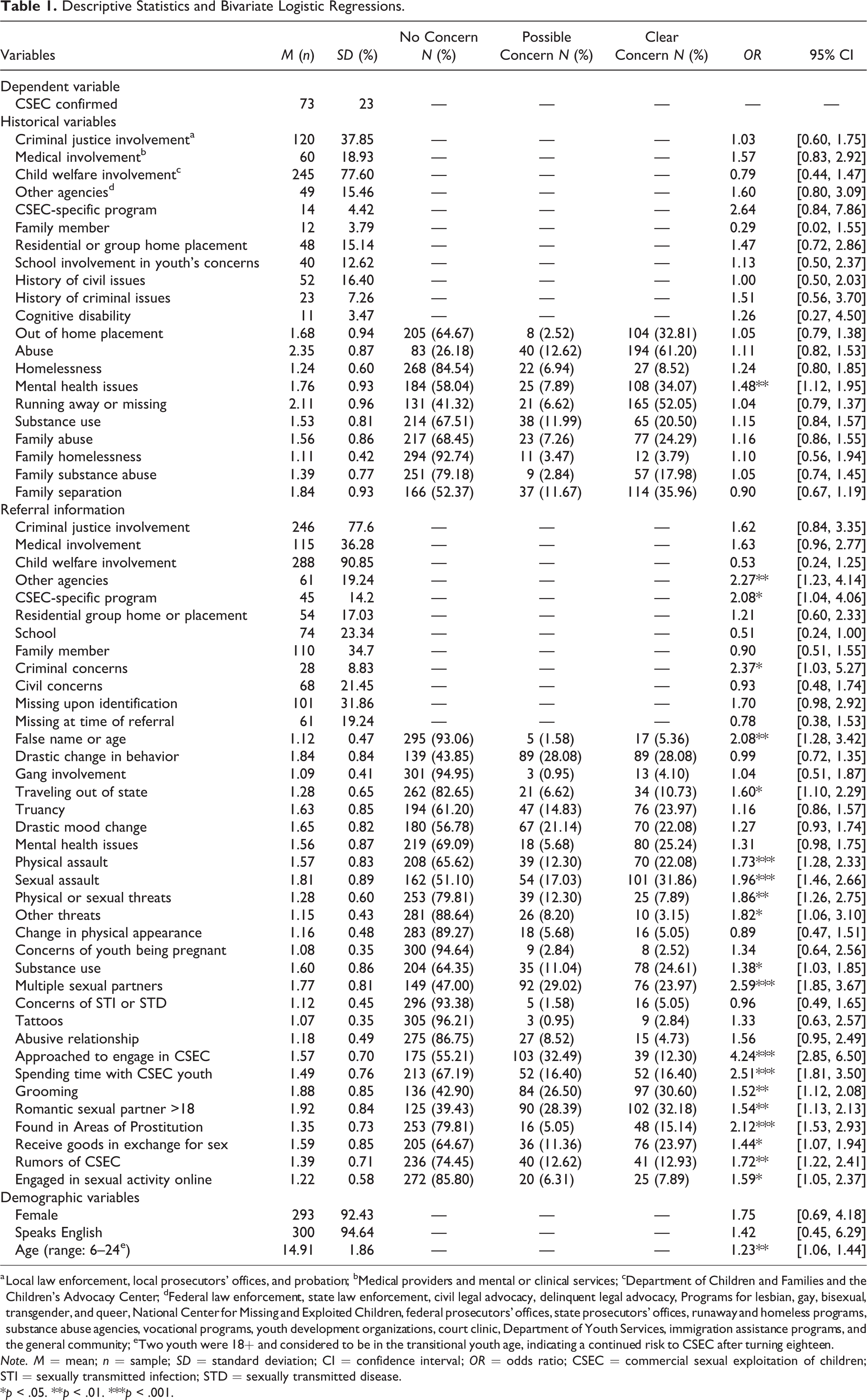
a Local law enforcement, local prosecutors’ offices, and probation; bMedical providers and mental or clinical services; cDepartment of Children and Families and the Children’s Advocacy Center; dFederal law enforcement, state law enforcement, civil legal advocacy, delinquent legal advocacy, Programs for lesbian, gay, bisexual, transgender, and queer, National Center for Missing and Exploited Children, federal prosecutors’ offices, state prosecutors’ offices, runaway and homeless programs, substance abuse agencies, vocational programs, youth development organizations, court clinic, Department of Youth Services, immigration assistance programs, and the general community; eTwo youth were 18+ and considered to be in the transitional youth age, indicating a continued risk to CSEC after turning eighteen.
Note. M = mean; n = sample; SD = standard deviation; CI = confidence interval; OR = odds ratio; CSEC = commercial sexual exploitation of children; STI = sexually transmitted infection; STD = sexually transmitted disease.
*p < .05. **p < .01. ***p < .001.
Analytical Strategy
Regularization methods for predictive modeling were employed to optimize the identification of item-level risk of CSEC. These are supervised machine-learning techniques that address the theoretical and methodological limitations associated with various other methods. In particular, the lack of theoretical guidance on risk of CSEC limited our ability to preselect risk items and is the reason for why standard regression analyses, such as logistic regression, were not suitable for the current study. In lieu of theory-based model specification, forward selection and backward selection regression methods can be applied, but these methods are known for a risk of overfitting and likely present misleading R2 values, regression coefficients, and p values. 3 Exploratory factor analysis (EFA) was considered as another dimension reduction method, but this method is also not without significant limitations in the context of the present study. As is shown in Supplement C, an EFA generated five meaningful factors, two of which were related to increased odds of experiencing CSEC victimization. However, a factor analysis suppressed the impact of the most decisive items within factors, failed to capture most variation in the data, and impeded an assessment of how any of the items that did not load onto a factor may increase CSEC risk. Supplementary Materials B and C discuss the issue of correlated risk items and present the methods, findings, and limitations of the EFA.
Regularization models have shown to be particularly useful in estimations with high-dimensional data and have gained increasing popularity in the literature on crime and victimization (e.g. Brennan & Oliver, 2013; Kadar, Zanni, Vogels, & Cvijikj, 2015). These type of methods produce sparse models, improve predictive accuracy, and help address issues of multicollinearity and overfitting that other selection methods suffer from (Friedman, Hastie, & Tibshirani, 2010; Tibshirani, 2011). A regularization model does not seek to assign weights to every plausible risk item as is being done in item response theory (for that, see Panlilio et al., 2019). Instead, the method seeks to optimize the identification of CSEC by producing parsimonious models with parameter estimates for only the most important risk items.
We present findings from the least absolute shrinkage and selection operator (lasso) variant of the logistic regression classifier and deduct two-class classifications (

Here, β refers to the weights given to all predictors,
The regularization model was implemented using a cross-validation task whereby the data were randomly divided into equally sized train and test data sets. The most important items were obtained from the train data, and these were verified for predictive accuracy on the test data. Parameter estimates were computed for a sequence of 100 different
Findings
Bivariate Regressions
Table 1 shows a total of 21 of the 62 items that were significantly associated with CSEC victimizations at the bivariate level, nearly all of which concern information about youths at time of referral. The following 5 items had the largest association with CSEC victimizations: (1) Youths approached to engage in CSEC were about 4.24 times (95% CI [2.85, 6.50]) more likely to have experienced CSEC victimizations, (2) youths having multiple sex partners were about 2.59 times (95% CI [1.85, 3.67]) at higher risk of CSEC, (3) youths spending time with others engaged in CSEC were about 2.51 times (95% CI [1.81, 3.50]) more likely to be a victim of CSEC, (4) youths in contact with an agency from the other category (see Table 1 for the complete list) at the time of referral were 2.27 times (95% CI [1.23, 4.14]) more likely to be a CSEC victim, and (5) youths in contact with a CSEC-specific program at time of referral were 2.08 times (95% CI [1.04, 4.06]) more likely to have experienced CSEC. These findings gave reason to further explore the relative importance of each of the childhood problems in the next section.
Results From the Regularization Models
Table 2 presents the estimates of variables from the lasso regularization model. Standard errors, confidence intervals, and p values are not presented because there is no consensus in the literature on how to interpret those measures when using regularization models (Tibshirani, 2011). The coefficients can be interpreted as in traditional logistic regression: A one unit increase in a
Model A in Table 2 reports the results from a lasso regression (
Most Decisive Proximal Risk Items from the Regularization Model With the Optimal Shrinkage Parameter (
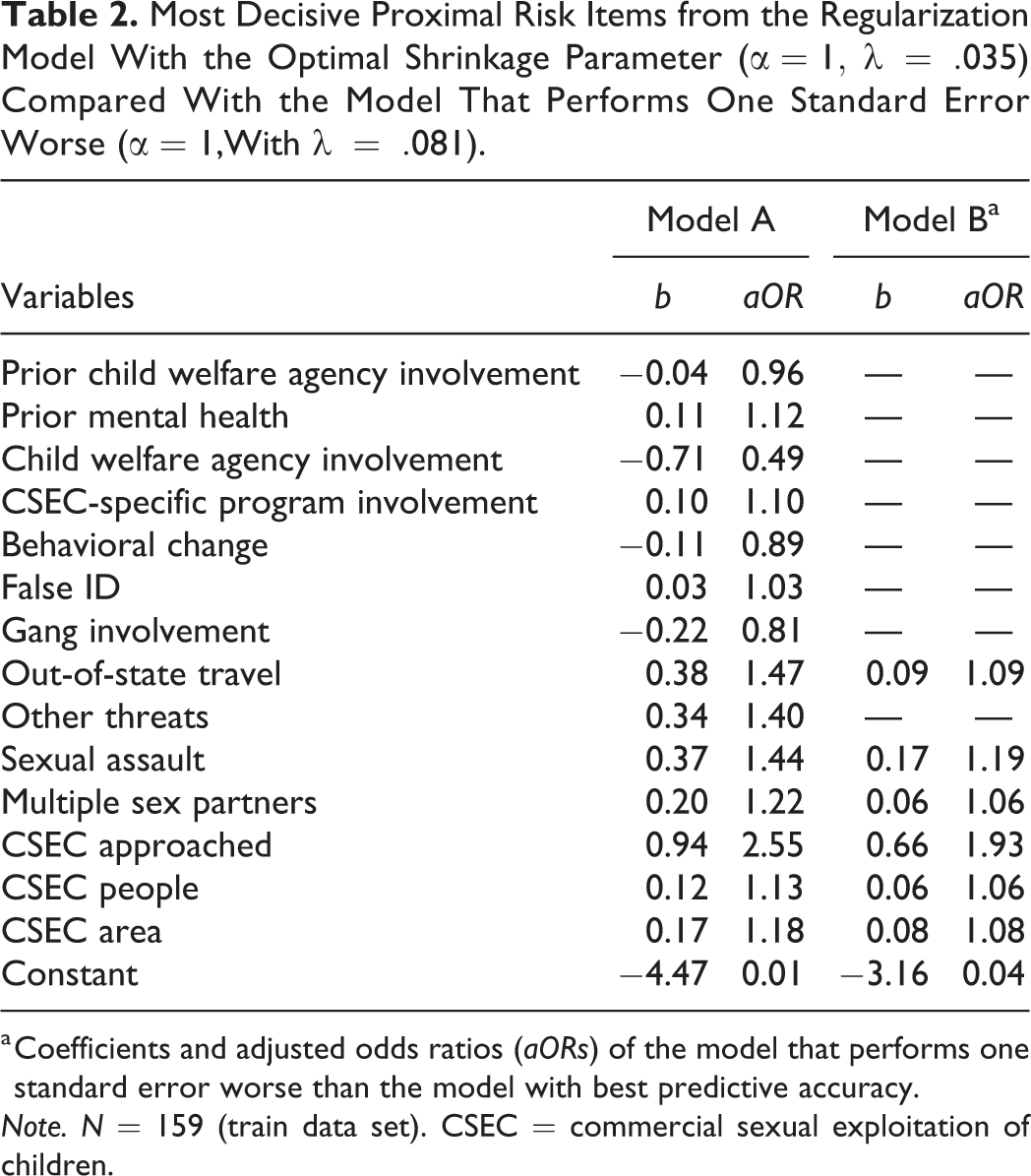
a Coefficients and adjusted odds ratios (aORs) of the model that performs one standard error worse than the model with best predictive accuracy.
Note. N = 159 (train data set). CSEC = commercial sexual exploitation of children.
To cross-validate our findings, predictive accuracy was examined by comparing predicted with observed confirmed and nonconfirmed CSEC cases on the test sample (see Table 3). The overall prediction accuracy—youths for whom the predictions matched with their actual status as a CSEC victim or not—was 81.13% (i.e., mean classification error was 18.87%). 6 Prior work on crime and victimization has reported similar percentages (e.g. Kadar et al., 2015). Our model correctly identified around 30.77% of the CSEC victims. While this is a significant part, the failure to identify the remaining CSEC youths suggests that other items are at play that could not be accounted for in the present study. The false positive rate—youths predicted as CSEC victims who in reality were not CSEC victims—was only 2.50%.
Confusion Matrices to Show Out-of-Sample Predictive Accuracy of Lasso Regularization Models With the Best Predictive Model (Left) Compared With the Model That Performs One Standard Error Worse (Right).

Note. N = 159 (test data). CSEC = commercial sexual exploitation of children.
As is a common strategy with regularization methods, we also examined a model that performed only one standard error worse in predicting CSEC but included substantively fewer variables. As shown in Model B in Table 2, a lasso regression (
Discussion
This study proposes an innovative way to determine variables that signal proximal risk of commercial sexual exploitation among high-risk populations. Given the lack of theoretical guidance on risk of CSEC, we presented predictive regularization methods as an effective way to enhance the identification of CSEC when the aim is to generate a parsimonious model that contains the most important risk markers for CSEC out of a long list of plausible risk markers. Regularization models are theory-agnostic and overcome issues of overfitting and multicollinearity of standard regression techniques (Friedman et al., 2010; Tibshirani, 2011).
Using regularization models, we found that a select set of seven items were most decisive in increasing risk of CSEC among a high-risk population. These include stronger concerns related to (1) youths being approached to engage in CSEC, (2) sexual assault, (3) youths engaging with people known to be involved in CSEC, (4) youths seen in areas known for CSEC, (5) youths having multiple sex partners, (6) youths traveling out of state, and (7) youths threatened in a way other than with physical or sexual assault (e.g. verbal assault). A few other items were associated with higher or proximal risk of CSEC, though to a lesser extent. These include prior mental health concerns, involvement of a CSEC-specific program at time of referral, and youths reporting a false name or age. Additionally, youths involved with child welfare agencies before or at time of referral, gang-involved youths, or youths with behavioral changes were less likely to be confirmed CSEC cases. Altogether, these items enhanced the identification of youths referred to a specialized CSEC program and helped to differentiate between the fifth of the sample that was commercially sexually exploited and the remaining high-risk youths, even though they shared a history of many of the same childhood adversities.
It follows that the select set of risk markers identified in this study are different from the risk items that are commonly found in studies seeking to identify CSEC among other system-involved youths or general populations of youths. Many of these studies found that youths experiencing child maltreatment (e.g. prior child sexual abuse) or presenting with risk behaviors (e.g. running away or alcohol and drug use) were more likely to be involved in CSEC (Bagley & Young, 2009; Boxill & Richardson, 2007; Clawson, Salomon, & Goldblatt Grace, 2006; Edwards et al., 2006; Greenbaum et al., 2018; Kaestle, 2012; McClanahan, McClelland, Abram, & Teplin, 1999; Nadon et al., 1998; Reid et al., 2017; Reid et al., 2018; Roe-Sepowitz, 2012; Silbert & Pines, 1981). A recent study also examined CSEC vulnerability among youths at higher risk of victimization, although not necessarily due to suspicion of CSEC but because of being involved in the child welfare system generally. As such, other items were important CSEC indicators in that study, including running away from home, using drugs or alcohol, experiencing or exposure to serious injury, being sexually active before the age of 14, suicidal ideation, and having hitchhiked (Panlilio et al., 2019).
Against the background of prior work, the findings in our study suggest that there are differences between behaviors and experiences that put any youth at risk of CSEC compared to those that can be used to flag high-risk youths as CSEC victims. In contrast to prior work, a history of childhood adversities was less predictive of CSEC for this particular sample. Instead, we identified behaviors that signal most immediate vulnerability to CSEC, experienced in real time with or immediately prior to CSEC victimization. Nearly 45% of the confirmed CSEC cases did not self-disclose CSEC but disclosed information about any of the most predictive features for CSEC. This information is important for child welfare providers and others working with high-risk youths who need to identify, prioritize, and tailor responses and services to those youths who are at the highest risk of experiencing CSEC victimization.
Our study is not without limitations. While the regularization methods put forward a select set of items based on which risk of CSEC can be assessed, the modest predictive accuracy proves the difficulty in identifying a complex problem like CSEC. Despite our long list of potential risk items, which were chosen based on both extant research and the experiences of professionals with deep experience in the field, there may be risk items that we are not measuring and which may increase the proportion of predicted CSEC youths. Specifically, it is possible that information about offenders, friends, and family as well as contextual problems put high-risk youths at increased risk of CSEC. This latter point is particularly important because key risk items highlighted in this study point to increased risk due to contact with others involved in CSEC or being in areas known for CSEC. This also speaks to recent qualitative research that has emphasized the influence of friends who provide risky role modeling and pressure youths to engage in commercial sex (Reed, Kennedy, Decker, & Cimino, 2019). Different predictors may predict risk of CSEC in populations less commonly studied. For example, Reid and colleagues (2018) suggested that the factors that predict risk of CSEC among runaway youths do not successfully predict CSEC across different youth populations.
In addition, more complex mechanisms may be driving vulnerability to CSEC. For example, it is widely cited that experiencing child abuse at the hands of parents or caregivers is a key contributor for youths to run away from home (Cobbina & Oselin, 2011; Nadon et al., 1998; Reid, 2011; Roe-Sepowitz, 2012). In order to subsequently meet their basic needs, adolescents may engage in survival sex and are left susceptible to CSEC (Reid, 2011; Reid & Piquero, 2014; Varma et al., 2015). Future work should further examine these indirect effects and assess which experiences, including a history of childhood adversities, predict the most decisive CSEC risk items. Understanding indirect pathways toward CSEC would further inform and offer context about the proximal risk items identified in this study.
More research is needed to further examine differences in problems that make a youth generally at risk of CSEC versus the proximal risk items that make youths more likely to be a CSEC victim (Panlilio et al., 2019). Such research is needed to test whether risk items to screen (identify high-risk youths) and assess (to confirm CSEC victimization among high-risk youths) should be separated. This separation would have important implications for the development and use of assessment tools. This type of research requires a comparison group of youths without reported childhood adversities but matching characteristics (e.g. gender, age, or family income, see, e.g. Reid et al., 2018). Additionally, larger samples of youths as well as qualitative data may clarify some surprising findings such as gang affiliation reducing the likelihood of being confirmed as a CSEC victim. A small number of the youths in our sample had gang affiliation (n = 13, 4.10%), and the data are insufficient to determine the nature of those affiliations which in some cases may be protective. Lastly, future studies may replicate our findings using data from youths in other locations or served by different providers. As noted in prior research, characteristics of CSEC youths may differ depending on the location and contextual circumstances (Reid, 2012; Reid et al., 2018).
Limitations notwithstanding, the findings of our study have important implications for both research and practice. First, our study responds to calls for more innovative analytic methods to detect risk profiles (Cannon et al., 2018; Reid, 2010; Reid et al., 2018). Cross-validation and regularization methods used here assess the importance of certain risk items and are one example of robust and efficient methods scholars may employ to assess item-level risk to CSEC. Second, as child welfare and other service providing agencies struggle to offer appropriate responses when young people do not immediately self-disclose their victimization, our findings suggest that information gathered by the CAC from collateral contacts with people involved in the life of high-risk youths can be used to assess risk to CSEC victimizations and appropriately tailor the response to youths depending on their risk. Practitioners need short but effective tools that are not stress- or anxiety-provoking (Baldwin et al., 2011; Greenbaum & Crawford-Jakubiak, 2015; Mostajabian et al., 2017). Our study suggests a select set of items that would help the early identification of a substantial proportion of youths facing higher proximal risk of CSEC. By knowing which youths require additional attention and long-term, trauma-informed care due to their increased risk of CSEC, providers will be in a better position to allocate scarce resources and deploy appropriate interventions that can meet the needs of young people with the highest risk.
Supplemental Material
CM-19-037_Supplementary_Materials_2nd_revision_final - Enhancing the Identification of Commercial Sexual Exploitation Among a Population of High-Risk Youths Using Predictive Regularization Models
CM-19-037_Supplementary_Materials_2nd_revision_final for Enhancing the Identification of Commercial Sexual Exploitation Among a Population of High-Risk Youths Using Predictive Regularization Models by Ieke de Vries, Matthew Kafafian, Kelly Goggin, Elizabeth Bouchard, Susan Goldfarb and Amy Farrell in Child Maltreatment
Footnotes
Authors’ Note
The data were extracted from a database funded by a CJA & MCW Grant (CT 09922015JRIGRANT0000).
Declaration of Conflicting Interests
The author(s) declared no potential conflicts of interest with respect to the research, authorship, and/or publication of this article.
Funding
The author(s) disclosed receipt of the following financial support for the research and/or authorship of this article: The current study was, in part, funded by a Research Scholar Fellowship of the Violence and Justice Research Laboratory at Northeastern University (2017) awarded to the first author of this article.

Supplemental Material
Supplemental material for this article is available online.
Notes
References
Supplementary Material
Please find the following supplemental material available below.
For Open Access articles published under a Creative Commons License, all supplemental material carries the same license as the article it is associated with.
For non-Open Access articles published, all supplemental material carries a non-exclusive license, and permission requests for re-use of supplemental material or any part of supplemental material shall be sent directly to the copyright owner as specified in the copyright notice associated with the article.
