




Abstract
This study examines the effects of child welfare, mental health, and drug/alcohol system experiences on jail involvement, as mediated by juvenile justice placement, for Black and White youth/young adults. The sample was comprised of individuals born between 1985 and 1994 with child welfare involvement in an urban Pennsylvania county (N = 37,079) and an out-of-home placement (OOHP) subsample (n = 8,317). Four path models were estimated (two full samples, two subsamples; separate models for Black and White youth). For all models, juvenile justice placement was positively related to jail involvement. For the full samples, out-of-home child welfare placement was associated with an increase in juvenile justice placement. Within the Black placement sample, child welfare placement experiences had complex relationships with juvenile justice placement. Providing drug/alcohol services may be a protective factor for Black youth prior to juvenile justice contact. Articulating these relationships helps identify youth most at risk of justice system involvement and better targets services, especially mental health and drug/alcohol services.
Recent research finds that a large proportion of those arrested in early adulthood have previous child welfare system involvement (Eastman et al., 2019). This is not surprising given that considerable evidence shows that individuals with a history of child abuse and/or neglect are more likely to become involved in in the justice systems than those who did not experience maltreatment (Cuadra et al., 2014; Currie & Tekin, 2006; Grogan-Kaylor, 2005; Lee et al., 2015; Mersky et al., 2012; Millett et al., 2013; Ryan, 2006; Ryan & Testa, 2005; Widom, 1989). To prevent justice system involvement and the challenges it poses to attaining successful markers of adulthood (Hook & Courtney, 2011; Warburton et al., 2014), it is necessary to develop a better understanding of the connection between child maltreatment and subsequent justice system involvement, which can inform the development of supports and interventions for children and young adults who have experienced child maltreatment.
Typically, such studies use samples of young people involved in the child welfare system and examine how child characteristics and child welfare experiences are related to justice system involvement (Crawford et al., 2018; Doyle, 2008; Grogan-Kaylor, 2005; Jonson-Reid, 2002; Jonson-Reid & Barth, 2000; Lee et al., 2015; Ryan, 2006; Ryan & Testa, 2005; Thornberry et al., 2010; Widom, 1989). Most research in this area, however, has focused on involvement in the juvenile justice system, which means that the period of transition to adulthood, typically considered ages 18–24, is not included (but see Ryan et al., 2016). In addition, many studies measure justice system involvement with arrest data despite the fact that many people who are arrested are not detained or charged and do not have further justice system involvement. Further, the extant research on the relationship between child welfare and criminal justice involvement has included a limited set of measures of child welfare services and experiences. For example, young people involved in the child welfare system are also likely to be receiving other services (e.g., mental health, substance abuse treatment). Yet, studies on the relationship between child welfare and criminal justice involvement have not examined how receipt of these services is related to criminal justice involvement, which could help to inform the delivery and improvement of such services. To help fill these gaps, this article uses data from a birth cohort of individuals whose families were involved in the child welfare system to examine relationships among child welfare placement experiences, mental health and drug/alcohol services, and juvenile justice placement and adult jail involvement.
Literature Review
Child Maltreatment, Child Welfare, and Criminal Justice Involvement
Numerous studies have found that maltreated youth are more likely than nonmaltreated youth to engage in delinquent behavior (Courtney et al., 2001; Currie & Tekin, 2006; Ireland et al., 2002; Jonson-Reid & Barth, 2000; Kelley et al., 1997; McCord et al., 1960; Mersky et al., 2012; Thornberry et al., 2010; Watts & McNulty, 2013; Yun et al., 2011). Based on the link between maltreatment and delinquent behavior, scholars have sought to understand the relationships among child characteristics, child welfare experiences, and justice system involvement. Widom’s research on these relationships has been foundational. These studies, based on a sample of individuals involved with the child welfare system between 1967 and 1971, explored the relationship between specific child welfare experiences and arrests (DeGue & Widom, 2009; Widom, 1989; Widom, 1991; Widom & Maxfield, 1996). They found that type of placement, placement stability, and age at first placement were related to arrests as an adult (DeGue & Widom, 2009; Widom, 1991). More recent work also documents relationships between child maltreatment and criminal justice involvement in young adulthood (Crawford et al., 2018; Mersky & Topitzes, 2010; Smith, Ireland, & Thornberry, 2005 Eastman and colleagues (2019), using California data, strikingly found that 60% of those born in 1998 or later who were arrested as a young adult have a history of child welfare involvement.
Race and Justice System Involvement
Studies of child welfare system–involved youth have found that Black youth are more likely than White youth to experience contact with the juvenile justice system (Grogan-Kaylor et al., 2008; Jonson-Reid, 2002; Jonson-Reid & Barth, 2000; Ryan et al., 2008; Ryan et al., 2016; Summersett et al., 2019), despite few or no differences in delinquent behavior. In a recent study of dually involved youth (i.e., those involved with both the child welfare and juvenile justice systems) in Los Angeles County, Dierkhising et al. (2018) found that Black youth were involved in both systems at a rate almost 6 times their proportion of the general population. These studies, together with a large body of research that documents the discriminatory treatment of Black youth (and adults) by the police and justice systems (e.g., Bishop et al., 2010; Office of Juvenile Justice and Delinquency Prevention, 2009), suggest that there may be different relationships between child maltreatment, child welfare involvement, and subsequent justice system involvement for White and Black youth.
Effects of Child Welfare and Other System Experiences
Timing of maltreatment and child welfare system contact
Research indicates that the age when maltreatment and child welfare system involvement occur is an important factor related to delinquency and justice system outcomes. Studies suggest that abuse or neglect that occurs at relatively younger ages has less of an impact on delinquency and juvenile justice involvement than maltreatment in older children and youth (Stewart et al., 2008; Widom, 1991). Research by Thornberry, Ireland, and Smith (2001) shows that maltreatment during adolescence has more severe and steady adverse outcomes than childhood-only abuse or neglect.
OOHP
Several scholars have examined whether OOHP itself might be a risk factor for subsequent delinquent or criminal behavior. Widom (1991), similar to an earlier study (Runyan & Gould, 1985), did not find differences in justice system involvement between youth receiving in-home child welfare services and those in OOHP. In a comparison of foster care youth and non–foster care youth matched on preplacement characteristics, Berzin (2008) found that risk factors other than foster care placement were associated with arrests and jail sentences. Other work, however, has found OOHP to be associated with increased likelihood of justice system involvement (Doyle, 2007; Dregan & Gulliford, 2012; Jonson-Reid, 2002; Ryan & Testa, 2005; Taussig & Clyman, 2011). Doyle (2007) found that foster care placement itself, for a subset of youth on the border between placement in foster care or in-home services, was associated with subsequent juvenile and criminal justice involvement. In contrast, Ryan and colleagues (2016) found that youth with long-term foster care placements were less likely to be arrested than those with a long-term in-home case. Specific OOHP factors that previous research has identified as relevant to delinquency and juvenile justice contact include placement instability (Crawford et al., 2018; DeGue & Widom, 2009; Ryan et al., 2007), length of time in placement (DeGue & Widom, 2009), and type of placement (Ryan, 2006, 2012; Ryan et al., 2008). With regard to the latter, research has found that youth in congregate care, compared with youth in traditional foster care, have higher rates of justice system involvement (Ryan, 2012; Ryan et al., 2008).
Running away from placement
Whether a youth has ever run away from an OOHP in the child welfare system is another factor in understanding maltreatment to justice system pathways. Running away is typically a status offense and may be related to juvenile justice contact (Bender, 2010; Kempf-Leonard & Johansson, 2007). Several studies have shown that youth, specifically girls, run away at high rates. For example, Goodkind and colleagues (2013) found that approximately 18% of a sample of youth with OOHPs had ever run away and that about twice the number of girls as boys had run away. Other research has similarly found that girls, as well as Black youth and youth with mental health and substance abuse issues, are more likely to run away (Courtney & Zinn, 2009).
Involvement in the mental health and substance abuse systems
Few studies include the relationship between involvement in other systems, such as the mental health or drug and alcohol systems, and juvenile and/or criminal justice system contact (Hazen, Hough, Landsverk, & Wood, 2004). Many youth involved in child welfare are also involved in these other systems, which are intended to address the trauma of child maltreatment and support young people in successfully transitioning to adulthood. Previous studies document that maltreatment is related to substance use (e.g., Mersky & Topitzes, 2010; Mersky at al., 2012; Widom et al., 2006) as well as mental health issues (Mersky & Topitzes, 2010; Mersky at al., 2013; Widom et al., 2007). In one study on the relationship between child welfare and juvenile justice involvement, Jonson-Reid (2002) found the highest rates of juvenile justice entry among youth who had conduct disorder (17.5%) and substance abuse problems (13%). More recently, Dierkhising and colleagues (2018) found substantial mental health and substance abuse service needs among dually involved youth: About 75% of youth had a diagnosed mental health issue, and approximately half were receiving mental health services when they were arrested. Garcia and colleagues (2015) found that mental health service use decreased the likelihood of engaging in delinquent behavior for Black youth involved in child welfare. These studies point to the importance of understanding how treatment for such issues may be related to the involvement of youth in the child welfare and justice systems.
Current Study
As is apparent from this review of the literature, a variety of child characteristics, child welfare experiences, and other system involvement have been found to be related to involvement in the justice systems. No study, however, has yet examined whether and how juvenile justice placement mediates the relationship between child welfare experiences, other system involvement, and criminal justice involvement. This gap in the research is significant because the juvenile justice system is another point of intervention and services, as well as control, for young people. Examining the pathways through which child welfare and other system experiences are related to criminal justice system involvement can lead to the development of interventions and services to reduce the movement of youth from child welfare to the criminal justice system. As noted previously, arrests are a commonly used measure of criminal justice involvement, in part because these data are often easily accessed. However, many people who are arrested are not detained or charged, making arrests an imprecise measure of consequential criminal justice involvement. We use jail involvement as a more conservative measure of criminal justice involvement, though we recognize that this may also capture some who are not ever charged.
The aim of the analyses presented here is to gain a better understanding of the relationships among child welfare system experiences, other system experiences, and subsequent juvenile justice placement and jail involvement. Specifically, these analyses are designed to address the following questions: (1) How are child welfare system experiences related to jail involvement? (2) How are mental health and substance abuse treatment related to jail involvement among child welfare–involved youth? (3) Does juvenile justice placement mediate these relationships? Given our review of the literature, we hypothesize that OOHP in the child welfare system, placement instability, running away, and placement in congregate care are positively associated with jail involvement and that these relationships are mediated by juvenile justice placement. We also hypothesize that receipt of mental health and drug/alcohol services is positively associated with jail involvement and that these relationships are also mediated by juvenile justice placement. Because of racialized social systems and structures, we hypothesize that these relationships vary by race and specifically hypothesize stronger relationships between child welfare and jail involvement for Black youth.
Data and Methods
Data
The population for these analyses includes all individuals born between 1985 and 1994 whose families received in-home services from the child welfare system and/or who were placed in out-of-home care for any length of time in one Pennsylvania county. One advantage of a birth cohort is that it includes those who entered and exited the child welfare system multiple times as well as who shifted between the child welfare and juvenile justice systems. Because we are interested in how juvenile justice placement mediates child welfare experiences and other system involvement, we identify and include experiences and involvement prior to a juvenile justice placement. Data were obtained from the Data Warehouse of the Department of Human Services of Allegheny County, Pennsylvania. The data warehouse is a unique data source because it integrates data across several county systems including child welfare, mental health, drug and alcohol, hunger and housing, employment and training, public welfare, juvenile justice, and the county jail. The study received approval from the university institutional review board.
The overall birth cohort includes 42,735 different children from 23,754 families. Of this group, 9,273 children from this group were in an OOHP for some period. As expected in any large administrative data set, there were some errors contained in the files and missing data that required us to remove some individuals. Cases were removed when child’s age was less than 0 at the date of last family involvement and when the sex of the child was not included in the file. We also removed individuals whose only entry in the file was an adoption. This was done because there was no further information provided for them (these cases did not differ from the remaining adoption cases on juvenile justice or other systems involvement). Given the overrepresentation of children of color in systems, we were particularly interested in racial differences. Because 94% of this birth cohort are either White or Black, we were limited to comparisons of White and Black youth and thus include only these two groups in analyses. Finally, we limit our analyses of the full sample to children and youth whose families were involved in the child welfare system prior to youths’ juvenile justice placement (if any) and our analyses of the placement sample to children and youth who were in a child welfare placement prior to a juvenile justice placement (if any). Thus, the full sample contains 37,079 children from 19,782 families and the placement sample 8,317 children from 4,827 families.
Measures
As indicated previously, our dependent variable is a dichotomous measure for whether a youth spent time in the county jail (jail involvement). This is a somewhat limited measure of criminality/criminal justice involvement because it does not incorporate self-reports of behavior, official arrests, or court complaints filed that did not result in time in jail. Thus, the models here are conservative since our measure includes only those who spent time in jail and does not include those who were otherwise involved in the criminal justice system. Yet, entering jail is an important measure because it is associated with deeper involvement in the system and the numerous consequences that come with deeper end criminal justice involvement.
Demographic, child welfare, and other system involvement variables are included in the models. A continuous measure of age and a dichotomous measure of sex are used. Age when family case was closed is a categorical variable that indicates whether the case was closed before age 10, closed between 10 and 13 years old, or open after a child turned 14. This variable accounts for whether the issues that brought the child into the child welfare system ended during childhood, preadolescence, or were ongoing through adolescence. Although it is limited because it is based upon whether the family was involved during these periods of a child’s life, not necessarily whether the problems fully ended, it does provide a proxy of family functioning. We also include a variable to account for whether a child was in an out-of-home child welfare placement prior to a juvenile justice placement.
Juvenile justice placement measures whether a youth was ever in detention or juvenile justice placement. Similar to our dependent variable, this is a limited measure because many youth involved in the juvenile justice system are not detained or placed. Being detained or placed in the juvenile justice system, however, is related to deeper end involvement in the system and has significant consequences for youth beyond other measures of system involvement.
Mental health services is an indicator of whether a youth received mental health services prior to a juvenile justice placement, or, if not receiving a juvenile justice placement, whether the youth ever received mental health services. Similarly, drug and alcohol services is an indicator of whether a youth received drug and alcohol services prior to a juvenile justice placement, or ever, if they had not received a juvenile justice placement. We code mental health and drug and alcohol services this way because many youth who were detained or placed received these services after their juvenile justice placement. Because we are interested in how juvenile justice placement mediates the relationships between these services and jail involvement, it made sense to limit our sample in this way. These measures represent involvement in services including outpatient therapy, inpatient treatment, medication, crisis services, and so on.
Additional measures are used in the placement subsample models to capture child welfare placement experiences prior to a juvenile justice placement. Congregate care is a dichotomous indicator of a placement in either a group home or residential treatment facility for any length of time. Length of time in OOHP measures the total amount of time that a child spent in child welfare OOHP. Number of OOHPs represents the total number of child welfare placements, and runaway is an indicator of whether the youth ever ran away from child welfare placement.
Analysis Plan
A series of path analysis models were used to examine the experiences and attributes associated with jail involvement, for Black and White youth, including both direct effects on involvement and indirect effects mediated by juvenile justice placement. Four path models are presented, the entire sample for White and Black youth and the placement subsample for White and Black youth separately. The multi-sample path models were tested for moderation by race for the full sample and placement subsample. The constrained models fit significantly worse than the freed models,
In the full sample models, the direct and indirect effects were examined for the dichotomous variables: sex, ever being in out-of-home child welfare placement, having ever runaway, case open after age 14, and ever receiving drug and alcohol or mental health services. The lone continuous variable was the youth’s age. The direct effect of juvenile justice placement on jail involvement was estimated as well as the indirect effect of all the other variables mediated by juvenile justice placement. In the placement-only models, the direct and indirect effects were examined for the following dichotomous variables: sex, having ever runaway, case open after 14, ever being in congregate care, receiving drug and alcohol services, and receiving mental health services. The continuous variables included in this model were the youth’s age, length of time spent out of home, and the number of placements they had. The direct effect of juvenile justice placement was examined along with its mediation of all other variables.
Results
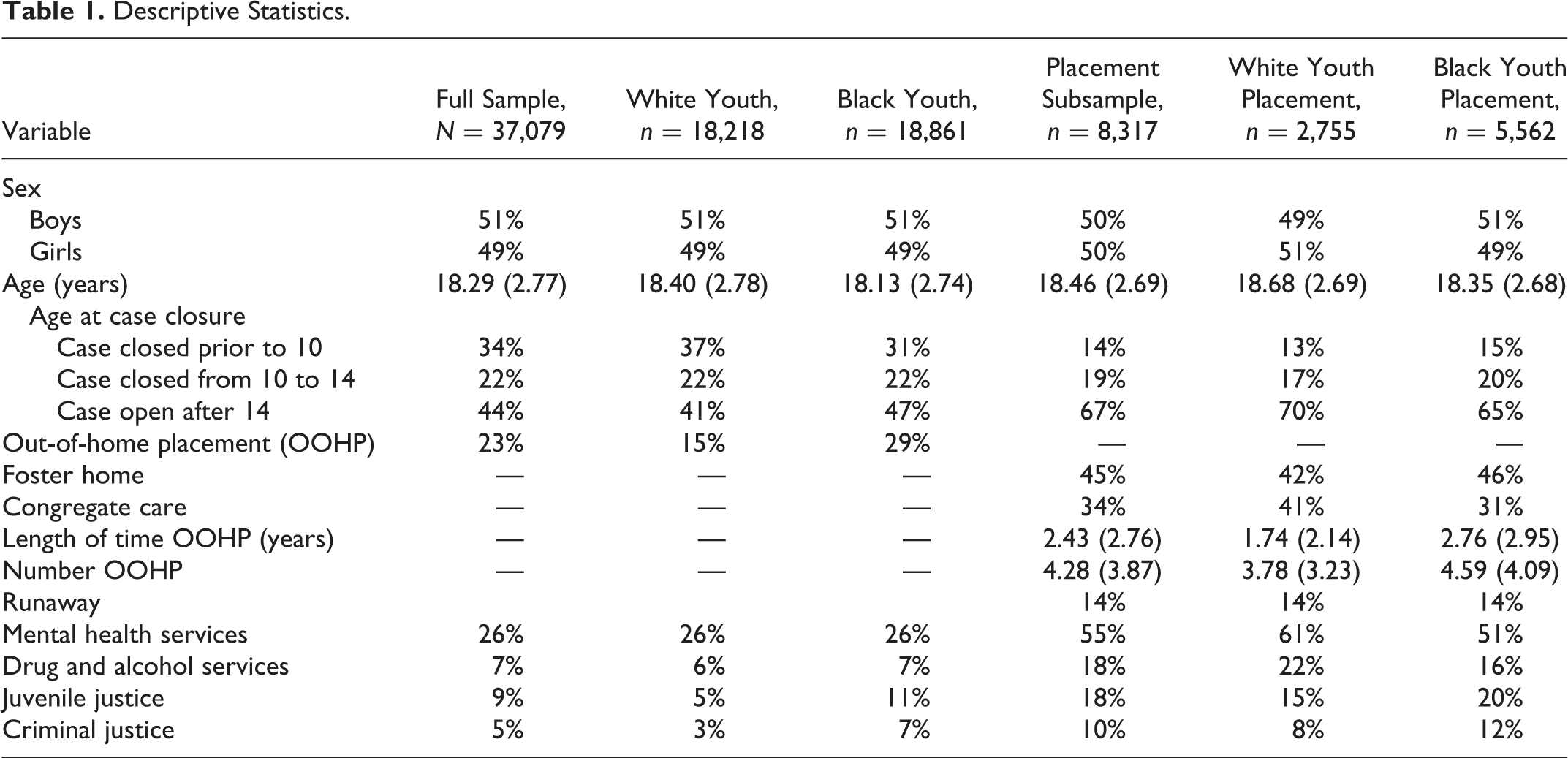
Table 1 reports the descriptive statistics for the full sample. Of the 37,079 children and youth in this sample, about 9% had juvenile justice placement and 5% had jail involvement. Approximately 11% of Black youth had juvenile justice placement compared to 5% of White youth, and 7% of Black youth had jail involvement compared to 3% of White youth. The average age of the sample was just over 18 years (M = 18.29, SD = 2.77). About 23% of the children had an out-of-home child welfare placement, although the rates for White (15%) and Black (29%) children differed substantially. For one third of the sample, the family’s case was closed prior to the child turning 10 years old, and for another 22% the family’s case was closed between ages 10 and 14. Forty-four percent of the children and youth were in families that had cases open after the child turned age 14. About 26% of the sample received mental health services, and about 7% received drug and alcohol services. For the placement subsample (n = 8,317), 18% had juvenile justice placement and 10% had jail involvement. About 20% of Black youth had juvenile justice placement compared to 15% of White youth, and 12% of Black youth had jail involvement compared to 8% of White youth. The average age of the subsample was nearly 18½ (M = 18.46, SD = 2.69). Forty-five percent of the subsample had experienced a foster home placement, and 34% had been in a congregate care placement. Children and youth in the subsample spent on average 2.43 years in placements (SD = 2.76) with a mean of 4.28 placements (SD = 3.87). Bivariate correlations reveal that all of our independent variables are significantly related to jail involvement although the coefficients for most are small. Age, sex (boys), and juvenile justice placement had the strongest relationships to jail involvement.
Descriptive Statistics.
Full Sample—White Youth
For the model including the full sample of White youth, there was a significant difference between the observed and covariance matrix,
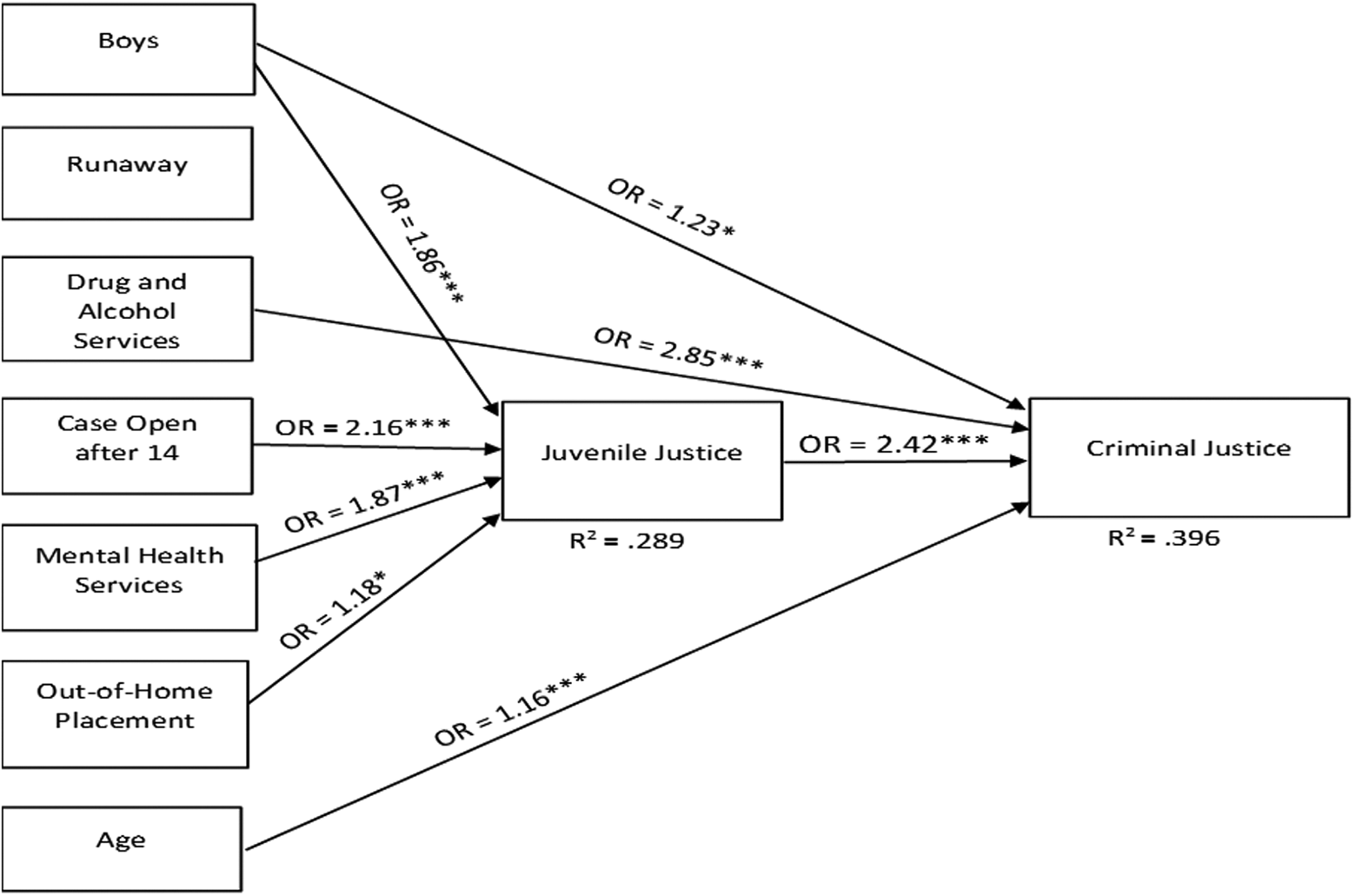
Full sample path model for White youth.
Full Sample—Black Youth
Similarly, for the full sample of Black youth, there was a significant difference between the observed and covariance matrix,
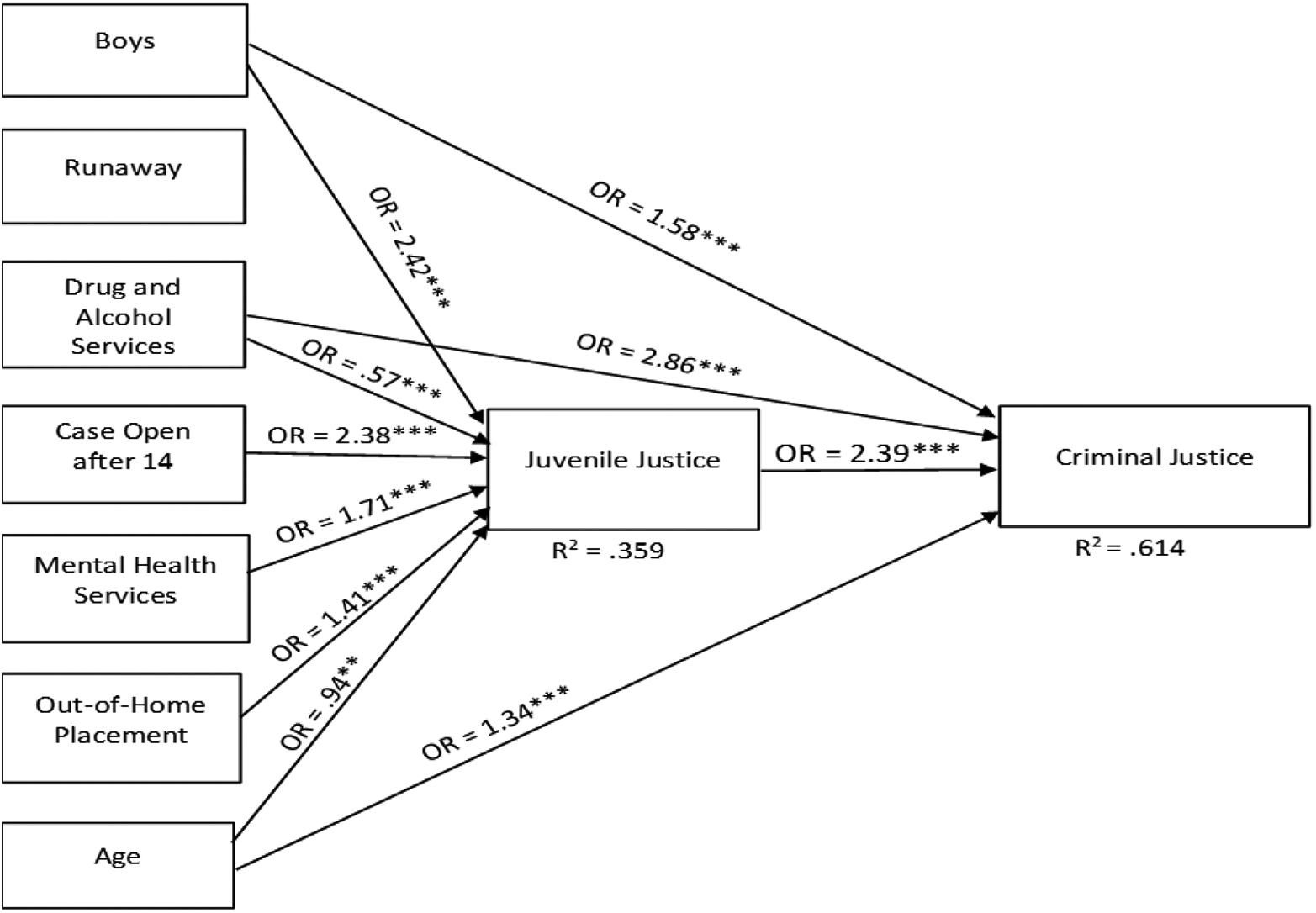
Full sample path model for Black youth.
Placement Subsample—White Youth
For the placement subsample of White youth, there was a significant difference between the observed and covariance matrix,
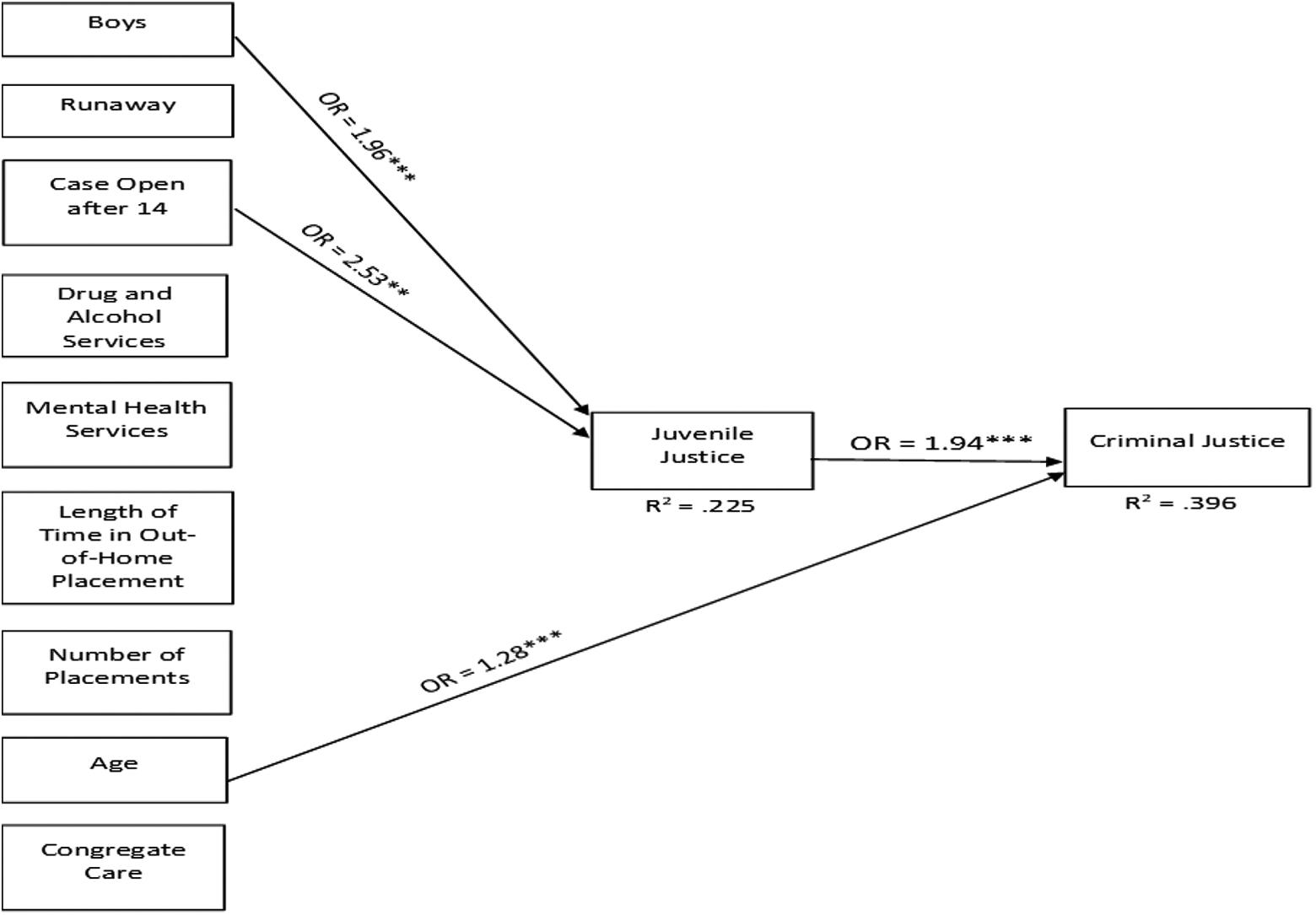
Placement subsample path model for White youth.
Placement Subsample—Black Youth
For the placement subsample of Black youth, there was a significant difference between the observed and covariance matrix,

Placement subsample path model for Black youth.
Discussion
The goal of this article is to extend previous research on young people involved in the child welfare system by examining whether and how juvenile justice involvement (indicated by being detained or placed in a residential facility) mediates the relationship between child welfare and other system experiences and jail involvement using a birth cohort of youth in a large urban county. We examine these relationships for all youth whose families were involved in the child welfare system and then for a subsample of youth who were involved in out-of-home child welfare placement. Because prior research suggests that White and Black youth have different pathways through these systems, we examine these relationships separately for White and Black youth for both the full and placement groups. Two main findings emerge. First, juvenile justice placement mediates many aspects of the relationships of child welfare and other system involvement with jail involvement. Second, the relationships among child welfare experiences, other system involvement, and juvenile justice placement and jail involvement differ, in part, for White and Black youth.
This is the first study to find a mediating effect of juvenile justice placement on the jail involvement of child welfare–involved youth. Specifically, we found that child welfare–involved youth who were in a juvenile justice placement were more likely to spend time in jail. While this finding is consistent with previous studies indicating that juvenile justice involvement increases the risk for subsequent criminal justice involvement (McMahon & Clay-Warner, 2002), it extends previous findings that have only examined a direct relationship between child welfare experiences and criminal justice involvement (DeGue & Widom, 2009; Widom, 1991). For the full sample, juvenile justice placement mediated the effects of age of child welfare involvement, mental health involvement, and out-of-home child welfare placement on jail involvement for both White and Black youth. Specifically, youth who were older when their family was system involved, who received mental health services, and who spent time in OOHP had greater odds of having a juvenile justice placement. Although drug and alcohol system involvement was directly related to a higher odds of jail involvement for both White and Black youth, it was related to a lower odds of juvenile justice placement for Black youth.
In the placement subsample, age was the only factor directly related to jail involvement, as juvenile justice placement mediated the relationships between both sex and age at child welfare involvement and jail involvement for Black and White youth. Further, juvenile justice placement only mediated the effects of OOHP length, placement instability, and drug and alcohol services for Black youth. Black youth who were in the system longer and who had fewer placements had lower odds of juvenile justice placement. Like the full sample, Black youth involved in drug and alcohol services had lower odds of juvenile justice placement.
This study has some limitations, particularly related to the generalizability of findings. The youth in this sample were from one county; thus, geographical and local policies and practices may influence some of the results, and we are unable to track who moved out of the county. Our measures of juvenile justice placement and jail involvement are official measures from one county, so do not include such involvement in other county systems for those who may have moved and may not be reflective of actual delinquent or criminal acts committed, nor of experiences with less formal justice system contact. We utilized measures of mental health and drug and alcohol services receipt, yet additional variables related to involvement in these systems are necessary to elucidate the relationships among them. Nevertheless, this study enhances the research base, and we discuss the implications of our findings in the remainder of this piece.
Overall, our analyses reveal that the movement of youth from the child welfare to the criminal justice system is complex, and experiences are different for different groups. Our analyses add to the literature in a number of ways. Because we focus on juvenile justice placement and jail involvement, rather than arrest or other indicators of less serious justice system involvement, we find relatively small proportions of child welfare–involved youth with these justice system outcomes. This is an important counternarrative to the deterministic rhetoric that suggests that child welfare–involved youth will inevitably be involved in the justice systems. As we note subsequently, their high rates of arrest are often artifacts of their oversurveillance, marginalization, and survival strategies rather than necessarily an indicator of criminality. Our analyses are specific to youth whose families had some involvement in the child welfare system (in-home services or OOHP) prior to juvenile justice placement. The child welfare system offers a point of contact with an array of family and child-based services and an opportunity to address issues that may influence the movement of youth into the justice systems. Targeting services effectively has the potential to reduce the risk of movement across systems, and our findings reveal aspects of these relationships that can help to target these services.
Youth in our birth cohort who experienced juvenile justice placement have over twice the odds of jail involvement than nondually involved youth, and youth involved in the child welfare system during adolescence similarly have over twice the odds of being dually involved in the child welfare and juvenile justice systems. These findings are consistent with other research (e.g., Ryan, 2006; Ryan & Testa, 2005; Widom, 1989) and underscore the importance of developing and targeting interventions for these young people to reduce their movement into the criminal justice system. They suggest that the issues that lead to being dually involved are not vestiges of prior maltreatment or system involvement but are likely present during adolescence when young people are involved in the child welfare system, thus providing an opportunity for intervention. Further, these findings also raise questions concerning whether involvement in child welfare itself increases the risk of juvenile justice involvement regardless of behavior. Some research does suggest that this is the case (e.g., Doyle, 2007), whereas other research does not (e.g., Berzin, 2008). Our findings indicate that out-of-home child welfare placement does increase the odds of juvenile justice placement, although we are not able to control for or match across all characteristics and factors that might differentiate placed from nonplaced youth. Understanding whether and how child welfare system involvement, and placement in particular, facilitates movement into the juvenile justice system remains important if practices and services are to be tailored to disrupt this.
Understanding the relationship between child welfare experiences, other system involvement, and justice system involvement can help develop and target practices and services. We did not find a difference based on whether a youth was ever placed in a congregate care setting, but, like other studies, we find that placement instability is related to a higher odds of juvenile justice placement, at least for Black youth. At the same time, more time in OOHP is related to a slightly decreased odds of juvenile justice placement for Black youth. This relationship suggests that long-term stable child welfare placements for Black youth can reduce the risk of juvenile justice placement and, subsequently, criminal justice involvement. The odds ratios were not large for these findings, indicating 5% higher odds of juvenile justice placement for each additional placement and a 5% decrease in odds for each year in out-of-home child welfare placement, but they were significant and indicate that stability does matter.
More research is needed to specifically understand the pathways for Black youth from the child welfare to the juvenile justice system, especially regarding placement. One interpretation of our findings is that long-term stable child welfare placements are a protective factor for Black youth compared to shorter or unstable placements, as they provide more consistency and enable youth to bond with caregivers and providers. However, this should be interpreted cautiously as a recent study of Black child welfare–involved youth found that young people who spent less time in care were less likely to be delinquent (Williams-Butler, 2018). Another explanation involves the broader social structure and context. Black youth who enter the child welfare system in this county are more likely to come from segregated communities with higher levels of concentrated poverty than are White youth (U.S. Census Bureau, 2016). Despite evidence that Black youth do not commit minor offenses at higher rates than White youth and that most Black youth do not commit serious crimes at higher rates than White youth (Agnew, 2016), these communities tend to be surveilled at higher levels and Black youth are overrepresented at every decision point in the justice systems. Long-term stable placements in the child welfare system may “protect” youth from greater surveillance in the community as well as from system decisions that they require more restrictive placements because of their failure to adapt to their current placement. Additional research is needed on Black youth, particularly on their strengths and protective factors as they shift from the child welfare to the juvenile justice system (Williams-Butler, 2018). Also, it should not be overlooked that the root issues of structural and institutional racism inherent within systems and the broader issues associated with it need to be addressed.
Findings also point to the complexity of other system and justice system involvement. Providing mental health and drug and alcohol services is intended to help youth deal with various issues that are likely related to justice system contact, as evidence indicates that mental health and drug and alcohol issues are prevalent among youth in the juvenile justice system (e.g., Dierkhising et al., 2018). In the full sample, mental health system involvement is associated with a higher likelihood of juvenile justice placement and drug and alcohol involvement is associated with a higher likelihood of jail involvement for both White and Black youth. At the same time, in both the full and placement samples, involvement in the drug and alcohol system decreased the likelihood of juvenile justice placement for Black youth. These findings raise several points: (1) It is likely that even though youth are receiving mental health services, the services provided are not meeting their needs, and (2) drug and alcohol services are effective in reducing the odds of juvenile justice placement for Black youth in both the full and placement groups, but these services are not effective over time for youth in the full sample. This suggests that providing services early can help reduce the risk of juvenile justice placement, but these services might need to be provided over a longer period to prevent jail involvement for some youth.
Essentially, results indicate that when youth move from child welfare to juvenile justice, they face a greater likelihood of jail involvement. Thus, attention needs to focus on practices and services designed to keep them out of the juvenile justice system. If they do move from the child welfare to the juvenile justice system, cross-system collaboration and communication is necessary to provide early interventions to prevent further penetration. The child welfare and juvenile justice systems each have their own mission, protocols, and priorities. Cross-systems trainings and other opportunities for professionals to interact, build relationships, and work together may be beneficial, from informal sessions to more formalized trainings that change jurisdictional practice and policy, such as the Crossover Youth Practice Model (Center for Juvenile Justice Reform, 2019), which is currently being implemented in this county (but had not been at the time these data were extracted). Thus, future studies will be helpful in determining the effects of these efforts on youth outcomes.
Footnotes
Declaration of Conflicting Interests
The author(s) declared no potential conflicts of interest with respect to the research, authorship, and/or publication of this article.
Funding
The author(s) disclosed receipt of the following financial support for the research, authorship, and/or publication of this article: This research was supported by the Eden Hall and Pittsburgh Foundations.
