




Abstract
There is a growing body of research that underscores that young child welfare-involved children are a unique vulnerable subgroup of children. The decision to provide postinvestigation child welfare services is consequential to children’s safety and well-being and has fiscal implications for organizations. Despite the potential ramifications of the decision, there is little known about the factors associated with the ongoing services provision for young children. This study uses secondary data analysis of the Canadian Incidence Study of Reported Child Abuse and Neglect 2008 to explore what case and worker factors predict the provision of ongoing child welfare services. Multilevel modeling was used to assess the relationship between independent variables and the decision to provide ongoing services; analyses included 2,296 children and 555 workers. Case and worker characteristics, including worker training and worker position, predicted ongoing child welfare services suggesting that further research examining the role of what worker characteristics impact child welfare decisions is warranted and essential.
Child maltreatment is recognized as a public health problem (Gilbert et al., 2009). The high burden and the long-term consequences associated with childhood maltreatment on physical and mental health across the life course have underscored the importance of investment in early prevention and intervention efforts (Gilbert et al., 2009; Taylor et al., 2016). There is growing evidence to suggest that young children are a unique subgroup of children in contact with the child welfare system and that this subgroup warrants focused attention in practice, policy, and research contexts (Filippelli et al., 2017a). Findings from the secondary analysis of data from the Canadian Incidence Study of Reported Child Abuse and Neglect (CIS; 1998, 2003, 2008; Trocmé et al., 2000; Trocmé et al., 2005; Trocmé et al., 2010) as well as various provincial incidence studies indicate that young children are among the most likely to be investigated and to receive services that extend beyond the initial investigation (e.g., Fallon et al., 2013; Fast et al., 2014; Filippelli et al., 2017a; Filippelli et al., 2017b)
Early childhood is a critical period of development (Center on the Developing Child at Harvard University, 2010). Young children are most vulnerable to maltreatment and its devastating consequences as a result of rapid brain development (Perry, 2009). Early identification, referrals, and intervention can help to mitigate the adverse and chronic consequences of early childhood maltreatment (Center on the Developing Child at Harvard University, 2016; Perry, 2009). The child welfare system is afforded a unique opportunity to enhance the well-being of young children served (Center on the Developing Child at Harvard University, 2016). The decision to provide child welfare services to children and their families following an initial investigation also has significant fiscal implications for organizations that must allocate limited resources to families with the greatest needs.
The decision to provide ongoing child welfare services to young children and their families is not well-understood (Filippelli et al., 2017a; Filippelli et al., 2017b; Lwin, Fluke, Trocmé, Fallon, & Mishna, 2018a). This study extends previous research by examining possible worker (decision maker) factors that may influence this critical decision to provide services. Using data from the most recent iteration of the CIS-2008, we examined whether case (e.g., child functioning, caregiver drug use) and worker factors (e.g., education, training, position) predicted the ongoing child welfare services decision. Further, this is the first study to utilize multilevel modeling to examine how case and worker characteristics are related to and contribute to the decision to provide ongoing child welfare services to young children and their families. The CIS is notably the only source of nationally aggregated data involving maltreatment-related investigations of children in Canada.
Theoretical Framework
The context within which child welfare decisions are made are complex and ambiguous (Baumann et al., 1997), and there is a myriad of factors that can influence decision making throughout the service continuum (Fluke et al., 2014). The Decision-Making Ecology (DME; Baumann et al., 1997) provides an ecological framework for empirically testing which factors predict child welfare decisions and suggests that decisions may be impacted by case (e.g., child age, type of alleged abuse), decision maker (e.g., education, experience; worker), organizational factors (e.g., agency culture, policy, resource constraints), and external factors (e.g., laws, funding, public opinion; Baumann et al., 2011; Fluke et al., 2014). Decision-making studies have predominantly focused on examining which case-level variables impact child welfare worker decisions. There is, however, a growing body of literature that has explored the impact of worker and organizational factors on decision making (e.g., Fallon, 2005; Fallon et al., 2013; Jud, Fallon, & Trocmé, 2012; Lwin et al., 2018a; Fluke et al., 2010; Graham et al., 2015). The DME provides a strong theoretical foundation for the current study, which tests whether case and worker factors play a role in the ongoing services provision for young children.
Literature Review
Case Characteristics
Caregiver risk factors have been found to drive the decision to provide ongoing child welfare services (Chabot et al., 2010; Fast et al., 2014; Filippelli et al., 2017a; Lwin et al., 2018a). The emerging literature suggests that caregiver risk factors are key drivers of the decision to provide ongoing child welfare services (Fallon et al., 2013; Filippelli et al., 2017b) and out-of-home placements for infants (Tonmyr et al., 2011). McConnell and colleagues’ (2011) study examined factors that influenced the provision of ongoing child welfare services of caregivers with cognitive impairments and found that workers with more years of child welfare experience were less likely to open a case following an investigation of child maltreatment. Child age has been found to be a factor that influences ongoing service provision (Fast et al., 2014; Filippelli et al., 2017a; Jonson-Reid, 2002; King, Fallon, Filippelli, Black, & O’Connor, 2018; Lwin et al., 2018a). Type of maltreatment and severity of harm have also been found to predict ongoing services for youth (Esposito et al., 2013).
Child functioning concerns are drivers of postinvestigative decisions involving older children and adolescents (Esposito et al., 2013; King et al., 2018; Tonmyr et al., 2011). Studies assessing the contribution of child gender to worker decision making in Canada has rendered mixed results. Male children have been found to be less likely to receive postinvestigation services in some studies (e.g., Filippelli et al., 2017; Jud et al., 2012); whereas, other studies did not find an association between child gender and ongoing services (Fast et al., 2014; Lwin et al., 2018a). Recent Canadian studies have explored ethnicity and Aboriginal status on the decision to transfer a case to ongoing services. Jud et al. (2012) found that ethnicity did not influence the decision to refer to specialized services; whereas, Fast and colleagues (2014) found adolescents’ Aboriginal status was associated with the ongoing services decision. A recent study exploring differences in decision making for Black children compared to White children found racial disparities in child welfare involvement and the decision to provide ongoing services (King et al., 2018). Race was a significant factor in decision making in the presence of child functioning concerns, caregiver risk factors, and conditions of socioeconomic disadvantage. The importance of better understanding the influence of socioeconomic disadvantage and race on child welfare service decision making has been underscored in the literature (e.g., King et al., 2018; Rivaux et al., 2008).
Worker Characteristics
The majority of the decision-making research that has focused on the decision to provide ongoing services has focused on exploring the impact of case-level variables. There is a dearth of research that has sought to better understand the influence of worker characteristics on the decision to provide ongoing child welfare services (e.g., Fallon, 2005; Lwin et al., 2018a). While Fallon (2005) found that worker caseload and position predicted the transfer to ongoing child welfare services, these findings were not consistent between organizations of different sizes or community geographic context (e.g., metropolitan, urban). Workers with larger caseloads and workers in the combination position (e.g., workers are responsible for investigations and other duties in the service continuum, including ongoing services and other duties) versus intake position (workers are primarily responsible for conducting investigations and assessing referrals) were more likely to transfer a case to ongoing services. In a recent 3-level multilevel analysis of the CIS-2008 that included children under 15 years, Lwin et al. (2018a) did not find any child welfare worker characteristics that predicted the ongoing services provision. The association between worker experience and decision making remains inconsistent and is not well-understood, emphasizing the need for additional research to better understand worker contributions to service (Bartelink et al., 2018; Font & Maguire-Jack, 2015). Overall, there is little consistency in the factors that predict the ongoing child welfare services decision in the literature.
Method
This study aimed to understand how case and worker characteristics are related to the decision to provide ongoing child welfare services. Secondary data analysis of the CIS-2008 (Trocmé et al., 2010) was used to address the goal of this study. The CIS is the only national study and aims to produce estimates of child maltreatment investigations including characteristics of the children and families who come to the attention of child welfare systems. This study addressed the following research questions: How are the case characteristics of a child maltreatment investigation related to the ongoing services provision for investigations involving children between 0 and 3 years? How are the characteristics of a child welfare worker related to the ongoing services provision for investigations involving children between 0 and 3 years? Does the decision to transfer a family to ongoing services differ among workers for investigations involving children between 0 and 3 years?
Sample
Stratified random sampling was used for the CIS-2008. Stratified random sampling occurred in three stages: (1) selection of a representative sample of child welfare organizations across Canada (n = 112), (2) selection of cases sampled over a 3-month period (October 1st to December 31st; n = 9,933), and (3) workers identified children who were the subject of a maltreatment-related investigations (15 years of age and younger; n = 15,980; Trocmé et al., 2010). Only the first report was included for cases that were reported more than once during the 3-month sampling period. Please see the CIS-2008 Major Findings for more detail on methodology (Trocmé et al., 2010).
Investigated children between 0 and 3 years of age (n = 2,296) were included in the current study. A total of 555 investigating workers were also included in the analysis in order to assess the association between worker characteristics and ongoing services provision. This study has an overall participation rate of 96%.
Data collection instruments
The CIS data collection instrument is completed by the investigating worker. This instrument includes information about the child (e.g., age, gender, functioning), caregiver(s) (e.g., risk factors, history with child welfare), and case (e.g., alleged maltreatment type, referral source). Workers assigned to selected cases for inclusion in the CIS are invited to participate in a worker questionnaire. The worker questionnaire includes demographic information about the assigned worker (e.g., years of experience in child welfare, education type and level) and was completed during the data collection period. These two levels of data (case, child, caregiver—Level 1; worker—Level 2) were combined into one data set suitable for multilevel modeling.
Missing data
There are minimal missing data for each case variable; worker variables, however, had higher rates of missing data, yet no variable had more than 15% missing data. Multilevel modeling addresses missing data well, as the computation accounts for missing values via maximum likelihood estimation (Snijders & Bosker, 2012).
Measures
Dependent variable
The decision whether to transfer a family to ongoing services or close the case after the maltreatment investigation (0 = not transferred to ongoing services, 1 = transferred to ongoing services). At the conclusion of the investigation, a decision to place the child out-of-home or may not have also been endorsed by the worker.
Independent variables
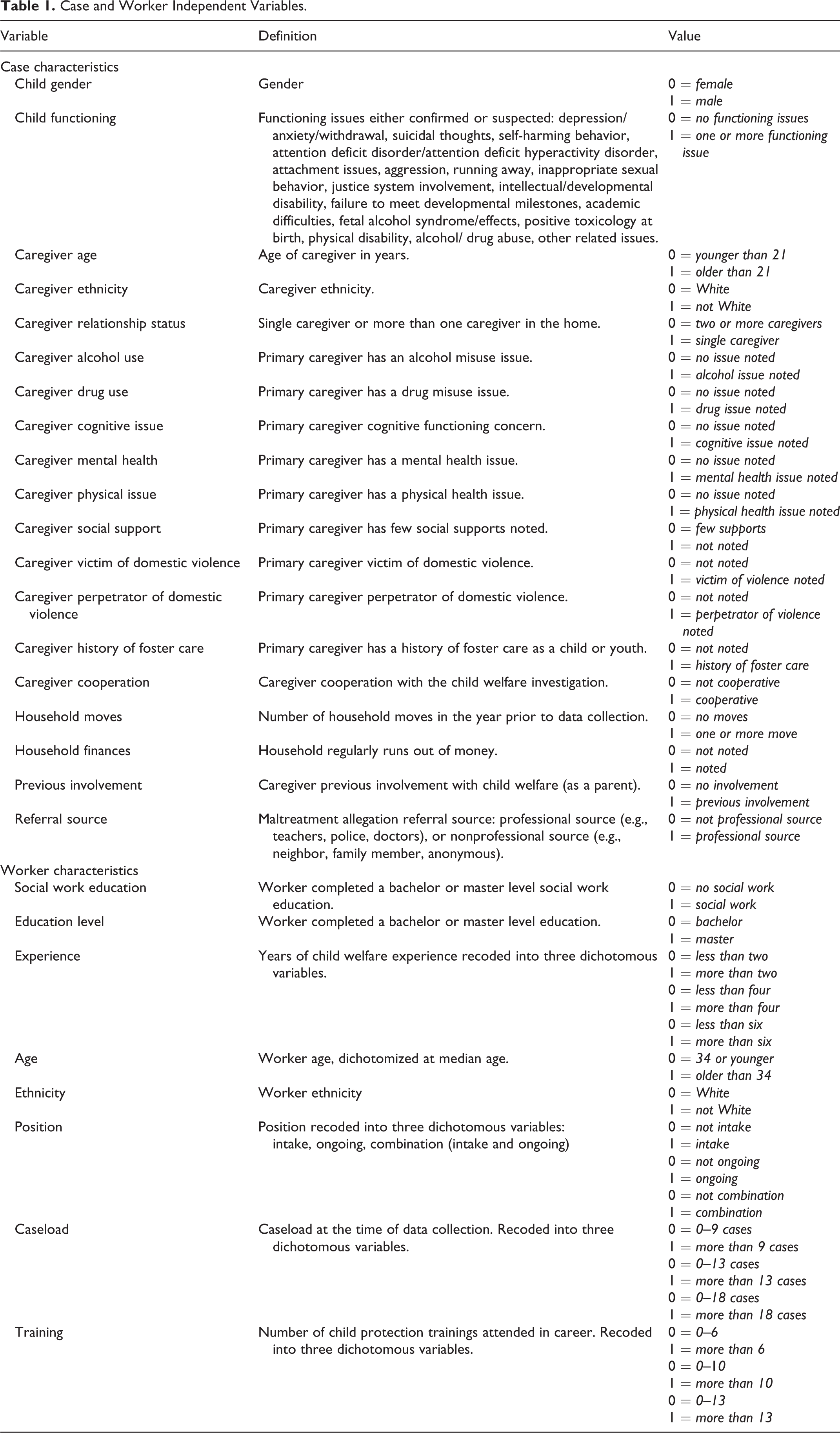
Child, caregiver(s), case, and worker characteristics were used to predict the ongoing services provision. See Table 1 for a full description of case (Level 1) and worker (Level 2) independent variables included in preliminary and final multilevel analyses. To account for multicollinearity level, one independent variables was centered. Centering variables produces a meaningful zero, transfers correlation between independent variables to the intercept, and increases the ability to interpret coefficients (Enders & Tofighi, 2007; Ene et al., 2015; Snijders & Bosker, 2012). Level 1 (case) independent variables were group mean centered on the Level 2 (worker) variable mean (Enders & Tofighi, 2007). Grand and group mean centering were conducted using SPSS Version 24 Python Extension software.
Case and Worker Independent Variables.
Analysis Plan
Primary analyses were conducted using IBM SPSS Version 24, and IBM SPSS Python Extension. Multilevel modeling was conducted using SAS Version 9.5. Univariate and bivariate analyses were initially conducted to assess the relationship between dependent and independent variables. The 2-level data set used for multilevel analysis was created by merging Level 1 (i.e., child, caregiver[s], case) and Level 2 (i.e., worker) variables. Single-level logistic regression models were run until a final parsimonious model was developed. An empty 2-level logistic model was then created, and Level 2 variables were inserted until a final multilevel parsimonious model. In order to simplify the model, fixed effects with a p value higher than .05 were removed from analyses.
To assess differences between workers’ decision to transfer a family to ongoing services, the intraclass correlation coefficient (ICC) was calculated in the final 2-level parsimonious model. Unlike linear regression, the Level 1 residual is not estimated in logistic regression; the unknown Level 1 error, therefore, is assumed to have a variance of π2/3 or 3.29 (Snijders & Bosker, 2012). The ICC at the worker level is therefore calculated as:

Model fit between single-level and 2-level logistic regression was tested by assessing the difference between covariance parameter estimates by running empty models. Significant (i.e., less than .05) results indicate dependence in the data and that 2-level analysis is more appropriate than single-level regression.
Model fit, with the inclusion of independent variables, was assessed by subtracting −2 log likelihood statistics from subsequent models. Lower likelihood ratio score implies better model fit.
Results
The majority of the children (77%, n = 2,075) did not have any functioning concerns noted. Just over half of the children investigated were male (51%, n = 1,385). The majority of caregivers were over 21 years (75%, n = 2,018), were in an intimate relationship (61%, n = 1,659), and identified as White (58%, n = 1,567). Univariate results suggest that the majority of caregivers had few social supports (60%, n = 1,628), one or more housing moves in the prior year (53%, n = 1,055), and had a history with child welfare services (50%, n = 1,350). The most common maltreatment referral reason was neglect (43%, n = 842), followed by exposure to intimate partner violence (35%, n = 680) and physical (11%, n = 218), emotional (8%, n = 157), and sexual maltreatment (2%, n = 39). Thirty-eight percentage (n = 1,030) of children between birth and 3 years of age were open to ongoing services at the conclusion of a maltreatment-related investigation.
The majority of workers identified as White (82%, n = 736) and female (85%, n = 785). The mean age of workers was 35 (n = 867; SD = 9.15). The majority of child welfare workers obtained a social work education (bachelor or master; 67%, n = 532) and a bachelor degree (vs. master; 86%, n = 643). Just over a third of the workers (33%, n = 299) had 2 or less years of experience, another third between 2 and 6 years (33%, n = 300), and the final third more than 6 years (33%, n = 300). Worker’s mean caseload size was 15.75 (n = 883, SD = 9.06).
Bivariate Relationships
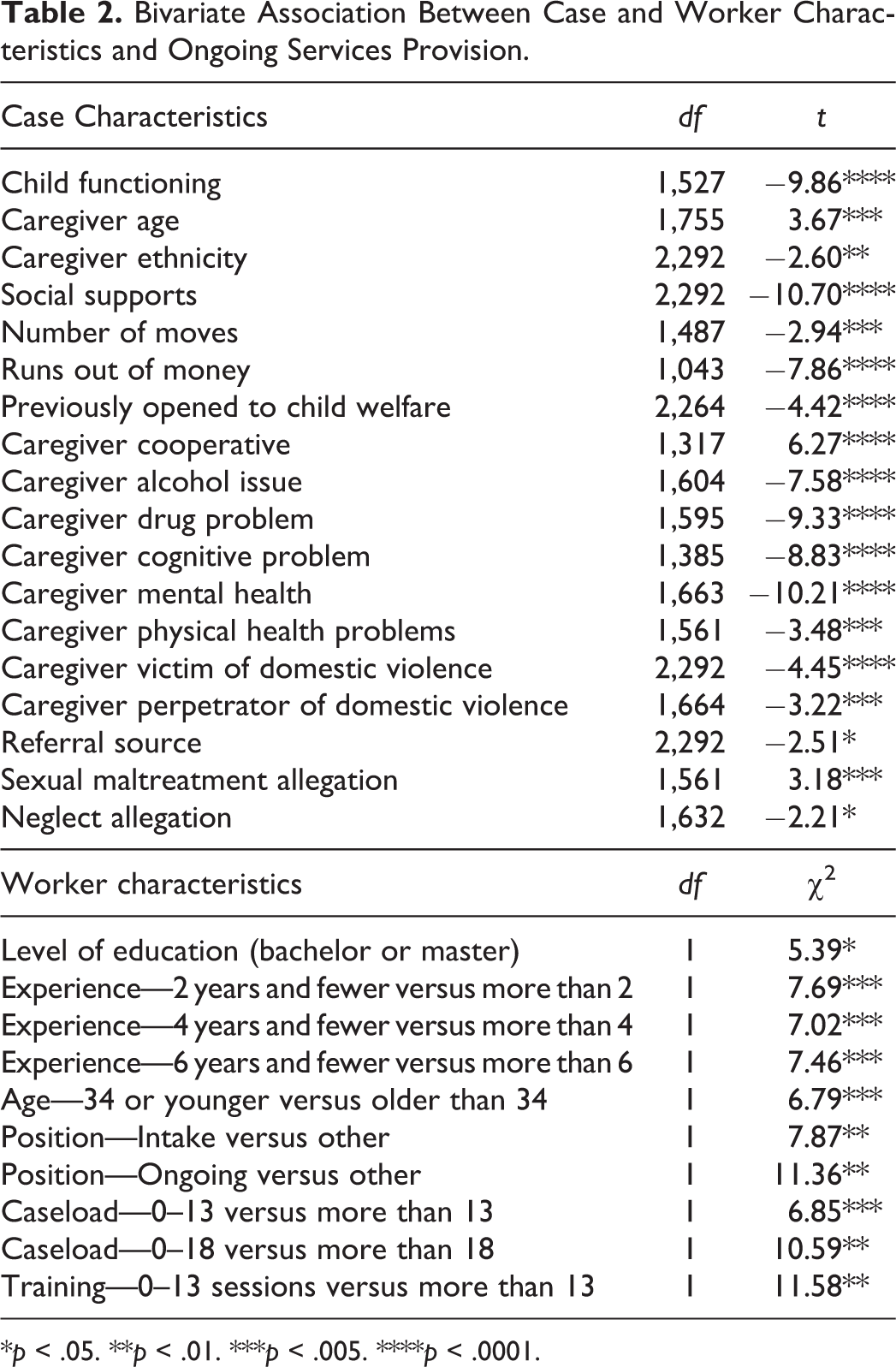
Almost all case factors were significantly associated (bivariately) with the ongoing services provision. However, child gender, t(2,292) = 0.18, p = .85; caregiver relationship status, t(2,292) = 1.56, p = .11; physical maltreatment allegation, t(1,357) = 0.77, p = .44; emotional maltreatment allegation, t(1,632) = −1.45, p = .14; and exposure to intimate partner violence allegation, t(1,323) = 1.91, p = .05, were not significantly related to the ongoing services provision. See Table 2 for significant bivariate relationships.
Bivariate Association Between Case and Worker Characteristics and Ongoing Services Provision.
*p < .05. **p < .01. ***p < .005. ****p < .0001.
While fewer worker characteristics were significantly related to ongoing services provision than case characteristics, the majority of these Level 2 factors were significantly associated with the dependent variable, as noted in Table 2. Worker education type (i.e., social work, other than social work), χ2(1) = 0.13, p = .70; ethnicity (i.e., White, not White), χ2(1) = 0.13, p = .71; position (i.e., combination, other than combination), χ2(1) = 2.99, p = .08; caseload (i.e., 0–9, more than 9), χ2(1) = 0.05, p = .81; and training, that is, 0–6, more than 6: χ2(1) = .86, p = .35; 0–10, more than 10: χ2(1) = 0.40, p = .52, were not significantly (bivariately) related to the ongoing services provision. See Table 2 for significant bivariate relationships.
Multilevel Modeling
The test between Level 1 and Level 2 covariance parameter estimates indicated that the 2-level model fit significantly better than the 1-level model, χ2(N = 2,296) = 99.27, p < .0001, −2 log likelihood 1,810.19. These results suggest that there is dependence within the data and that 2-level modeling is more appropriate than single-level logistic regression for these data. See Table 3 for model fit results.
Parsimonious Models Predicting Ongoing Services Provision.

a Likelihood ratio test Model 1 compared to Model 2 significant. b Likelihood ratio test Model 3 compared to Model 2 significant.
*p < .05. **p < .01. ***p < .005. ****p < .0001.
Children with one or more functioning concerns had more than 3 times the odds of being transferred to ongoing services than children with no functioning concerns (odds ratio [OR] = 3.26, 95% CI [2.12, 5.02], p < .0001). Younger caregivers (OR = 0.53, 95% CI [0.36, 0.78], p < .01), caregivers with drug misuse issues (OR = 2.59, 95% CI [1.70, 3.96], p < .0001), and mental health concerns (OR = 3.13, 95% CI [2.09, 4.68], p < .0001) were more likely to receive ongoing services than older caregivers or those without drug or mental health concerns. Caregivers who regularly ran out of money had 3 times the odds of receiving ongoing services than caregivers who did not run out of money regularly (OR = 2.46, 95% CI [1.49, 4.05], p < .005). Finally, caregivers with few social supports had more than 2.5 times the odds of receiving ongoing services than caregivers who had social supports (OR = 2.66, 95% CI [1.79, 3.96], p < .0001).
Few worker characteristics significantly predicted the ongoing services provision in the final 2-level parsimonious model. Worker education, experience, age, and caseload variable did not significantly predict the ongoing services provision. Workers in the “ongoing” (OR = 2.95, 95% CI [1.43, 6.06], p < .005) and “combination” (intake and ongoing; OR = 1.71, 95% CI [1.14, 2.55], p < .005) positions had almost 3 and almost 2 times the odds, respectively, of transferring a case to ongoing services versus workers in other positions. Finally, workers who noted more than 13 trainings had slightly over 1.5 times the odds of transferring a case to ongoing services than workers with fewer than 13 trainings.
The ICC of the final 2-level parsimonious model suggests that there is 29% variance among workers in the decision to transfer a case to ongoing services.
Discussion
There is a dearth of literature exploring the factors associated with child welfare service provision decisions and young child welfare-involved children. The DME framework posits that there are factors at multiple levels that can influence decision making in child welfare. Although an area of increasing focus, the majority of decision-making research has not explored the contribution of worker characteristics to decisions guiding service provision (Allan et al., 2017; Lwin et al., 2018a; Lwin et al., 2018b). In order to begin to address these gaps in knowledge, this is the first study to examine the influence of both case and worker characteristics on the decision to provide ongoing child welfare services to young children and their families using a multilevel model. This study extends the current knowledge base by examining whether the ongoing services decision differed among child welfare workers. Understanding whether variability is occurring among workers is important, especially for this vulnerable subgroup of child welfare-involved children, as variability may illustrate whether infants and their families are served differently by workers with certain characteristics. Indeed, young children are particularly vulnerable to the adverse consequences of maltreatment that can extend into the life course and strive to build the knowledge base with the ultimate aim of strengthening recruitment and training strategies.
As anticipated, several case variables predicted the ongoing service provision decision and the majority of these variables were caregiver risk factors (e.g., drug misuse, mental health concerns). These findings corroborate other studies that have noted significant associations between caregiver risk factors and the decision to provide ongoing services to families of infants (Fallon et al., 2013; Filippelli et al., 2017a; Filippelli et al., 2017b) and adolescents (Fast et al., 2014; King et al., 2018).
The finding that young caregivers of young children are more likely to receive ongoing services is consistent with other studies that have found that younger caregivers are more likely to receive ongoing services (Filippelli et al., 2017b; King, Fallon, Goulden, O’Connor & Filippelli, 2019). Similarly, the finding that caregivers who regularly ran out of money had significantly increased odds of receiving ongoing services than caregivers who did not corroborate the findings of other studies that have found an association between child welfare service provision and socioeconomic disadvantage (Fallon et al., 2011; Jud et al., 2012; King et al., 2018; 2019).
As posited by the DME framework and demonstrated by this study’s findings, factors at multiple levels, including case (e.g., child, family) and decision maker factors, influence decision making. Although there were no worker factors associated with ongoing services in the multilevel study conducted by Lwin and colleagues (2018b), this study found that two worker characteristics did make contributions: worker position and the level of worker training. These studies were, however, methodologically different. Lwin et al. (2018b) utilized three levels in their statistical analyses and included organizational characteristics. Nonetheless, findings here and elsewhere suggest that the decision to provide ongoing services is not solely driven by clinical need. The finding that worker position significantly predicted the decision to transfer a family to ongoing services in this study corroborated the findings of previous research (Fallon, 2005). In the current study, workers in the ongoing and the combination (intake and ongoing positions) were found to transfer significantly more cases to ongoing services than their counterparts (other than ongoing and other than combination, respectively).
In contrast to previous research (Lwin et al., 2018b), this study found that the level of worker training explains some of the variances in the decision to provide ongoing services. Workers with more training versus workers with less training were more likely to transfer families with young children to ongoing services. Literature assessing the level of training has not been previously tested in a similar context with young children. Future research in this area is required to better understand the relationship between training and decision making for this subgroup of children. Indeed, there may be another factor that mediates or moderates the relationship between the amount of training and the decision to provide services. Are there particular characteristics (e.g., skills, values) associated with workers who have more extensive training? Does the amount or type of training (e.g., child development, trauma) influence the decision to transfer to ongoing services for younger children? There is minimal research that has linked training type, quantity, and quality to effective practice (Collins et al., 2007; Lwin et al., 2018b). Antle and colleagues (2008), however, have identified that organizations that support their workers to attend training predict transfer of learning. Further, Antle and colleagues (2009) have found that different training methods produce different results. While the data collected cannot explain the type of training workers attended, they may have attended different training and therefore practice differently. Understanding whether worker training may influence child outcomes is also an important area for future research, particularly given the financial resources child welfare systems allocate to this endeavor. Ongoing training, low caseloads, and type of degree are among the many factors assumed to help develop effective workers but have not necessarily been shown to be the case in the literature (Lwin et al., 2018b).
With respect to worker characteristics, previous studies have indicated that the decision to transfer a family to ongoing services was related to having fewer years of child welfare experience (McConnell et al., 2011) and a high caseload (Fallon, 2005). Neither of these factors were significant in this study. These findings highlight inconsistencies and gaps in the field’s understanding of contextual factors that impact decision making for one of society’s most vulnerable groups of children. It is also important to better understand the influence of case and worker factors and whether service provision decisions are rooted in equity and fairness.
Consistent with the broader literature (King et al., 2018; Lwin et al., 2018b), the identification of child functioning issues was associated with the likelihood of providing ongoing child welfare services in this study. It is, however, unclear what the provision of “usual care” for the recipients of child welfare services consists of (Jonson-Reid et al., 2017). There have been concerns with respect to the child welfare system’s response to the unique developmental needs of young children (Jones Harden, 2007). Future research is critical in this area, given the dual mandate of safety and well-being across provincial and territorial jurisdictions in Canada (Trocmé et al., 2014). Future research requires a better understanding of how workers are meeting the needs of children and families at ongoing services and how well-being is being operationalized and addressed in working with families of young children (Fallon et al., 2018). It is also unclear how worker characteristics are linked to service trajectories and child outcomes. To ensure and promote effective services, future research in this area is required.
Examination of the difference among workers’ decisions is independent of the examination of which independent variables predict ongoing services; therefore, the significant (worker level) predictors are not necessarily included in the model variance. Further research, using multilevel modeling, is required to build further evidence about what factors contribute to differences in decision making among workers. The primary message, however, is that workers’ decisions are not necessarily consistent among one another.
Limitations
Limitations of this study are important to consider in the application of practice, policy, or future research. Importantly, it cannot be assumed that the decision to provide ongoing child welfare services is the correct one. These data simply suggest that there are differences in this decision among workers. The analyses are cross-sectional and providing only a point in time measure of when investigations are transferred to ongoing services. The data collection tools are completed by the assigned child welfare workers and their family assessments are not independently verified. The data are not evaluative, meaning we cannot determine whether the decision to transfer a family to ongoing services is the appropriate decision. Rather, the current analyses aimed to assess the case and worker characteristics that predict the ongoing services provision. The training variable is a gross measure, as workers are asked to indicate the number of training sessions they have received over their child welfare career. It is not clear what type (e.g., webinar, in-class) or how much (e.g., 1 day, 3 days) training these workers attended. Finally, the ICC should be interpreted with caution when calculated in logistic regression, as the error residual cannot be calculated and unlike linear regression calculates the probability of the dependent variable not the frequency.
Conclusion
This study is the first to examine which case and worker characteristics predict the ongoing services provision decision for young children involved with the child welfare system. The findings of this study highlight that both case and worker characteristics influence this important service decision. Given the vulnerable nature of this young subgroup of child welfare-involved children and the pivotal role that the child welfare workers could play in enhancing their safety and well-being, identifying and understanding the child welfare worker factors associated with this decision and their subsequent impact is an important avenue of future research.
Footnotes
Declaration of Conflicting Interests
The author(s) declared no potential conflicts of interest with respect to the research, authorship, and/or publication of this article.
Funding
The author(s) received no financial support for the research, authorship, and/or publication of this article.
