



Abstract
Children in foster care face disproportionate rates of biopsychosocial challenges but social and extracurricular activities (SEAs) may support their healthy development. The Reasonable and Prudent Parenting Standard (RPPS), a 2014 federal policy, aims to increase access to these opportunities for children in foster care. Analyses of statutes from 50 US states and the District of Columbia (n = 51) revealed similarities and differences in state-level RPPS policy implementation. Building on these findings, researchers conducted semi-structured retrospective telephone interviews with foster parents across one southeastern state (n = 20) to identify local retrospective perspectives on RPPS implementation. Using thematic inductive coding two unique themes emerged about SEAs prior to RPPS: 1) negative social impacts and 2) complicated activity approval processes. Three unique themes emerged after RPPS: 1) empowerment, 2) implementation disparities and 3) resource recommendations. Policy implications include the need to support foster parents by increasing resources (funding, transportation, access), clarifying liability and clarifying motivation expectations.
Keywords
Introduction
The Foster Care Context
Roughly 430,000 children live in the United States foster care system on any given day (U.S. DHHS, 2019). Before entering foster care, approximately 90% of foster children experience trauma (Dorsey et al., 2012) in the form of neglect, physical abuse, emotional abuse, sexual abuse, and abandonment (Bruskas, 2008). Children who experience trauma prior to foster care often experience psychological distress in the form of feelings of confusion, fear, sadness, anxiety, and stress (Bruskas, 2008), as well as negative, long-lasting effects on physical, social, and emotional well-being and development (Felitti et al., 2019; Infurna et al., 2015). Childhood and adolescent trauma increases the risk for neurodevelopmental impairment (Schauss et al., 2019), aggressive behavior (Khodabandeh et al., 2018), mental health concerns (Hughes et al., 2019; Poletti et al., 2017), substance use disorders (Garland et al., 2019; Hughes et al., 2019), attachment difficulties (Fowler et al., 2013), obesity (Isohookana et al., 2016), and premature mortality in adulthood (Meadows et al., 2019).
Foster parents have a vital role in supporting the development and well-being of foster children who have experienced trauma. Foster child participation in social and extracurricular activities (SEAs) is one method which has been shown to negate the consequences associated with trauma (Humphrey, 2019; Zinn et al., 2017). A study by Kwak et al. (2018) found that adolescents in foster care who participated in mentored groups, including athletic and academic clubs, reported higher levels of school engagement and adolescents who participated in art and music clubs reported fewer depression symptoms. SEAs include sports, the arts, field trips, afterschool clubs, employment activities, summer camps, informal short-term childcare (i.e., babysitting), social activities with friends, haircuts and vacations. Federal legislation, known as the Reasonable and Prudent Parenting Standard (RPPS), was created to promote foster child access to SEAs.
Child Participation in Social and Extracurricular Activities
For children in the general population, previous research has demonstrated that SEAs have a positive impact on childhood socialization and integration (Pomohaci & Sopa, 2017), as well as the association between SEA participation and decreased introversion (Allen et al., 2015; Quarmby et al., 2019). SEA participation is also associated with academic achievement, higher health and well-being, prosocial behavior, decreased delinquency and positive adjustment (Carolan, 2018; Oberle et al., 2019; White et al., 2018). Ilari et al. (2019) found that parents of children who participate in SEAs reported their children had increased emotional stability, decreased aggression, and decreased hyperactivity, compared to children who did not participate in SEAs.
Age and developmentally appropriate SEAs have the potential to mitigate some of the adversities experienced by children in foster care (Jackson & Martin, 1998; Klitsch, 2010). Conn and colleagues (2014) found an association between foster youth involvement in extracurricular physical activity and higher social skills; with those not involved in structured activities scoring higher on measures of depression, loneliness, and substance use. Humphrey (2019) found that foster child participation in music-related activities provided a sense of structure, which facilitated the relationship building process between foster parent and foster child.
Although participating in SEAs may be particularly beneficial for children in foster care, relatively low percentages of youth in foster care participate in organized social or extracurricular activities such as organized sports, mentored groups, art and music activities (Kwak et al., 2017). The context of foster parenting may make navigating SEA participation uniquely challenging. As Murray et al. states, “The challenges of providing sensitive and structured care for children in foster care go well beyond normative experiences of parenting” (2010, p. 149).
Appointments
Compared with children from the general population, children in foster care use services more frequently, including healthcare services (American Academy of Pediatrics, 2009), case manager visits and family visitation (422§(b)(17); McWey & Cui, 2017; 42 USCA § 671(b)(31)). Many children attend multiple visitations weekly or monthly with their biological mother, father, siblings and others. For example, a foster parent caring for three children in foster care might typically be responsible for navigating over three appointments every month (i.e., case manager visits, healthcare and behavioral health appointments, family visitations).
Childcare
Finding a temporary childcare provider (i.e., babysitter) is also uniquely challenging for foster parents. Because children in foster care often have a higher level of medical, behavioral and/or emotional needs than children in the general population (Felitti et al., 2019; Hughes et al., 2019; Infurna et al., 2015; Poletti et al., 2017), foster parents generally need to identify a more specialized temporary childcare provider than parents from the general population. At the same time, babysitting is particularly important for foster parents, as temporary childcare support has been shown to decrease foster parent burnout and foster child placement disruption (Geiger et al., 2013; Jedwab et al., 2020).
Oversight
Compared to the general population, foster parents face multiple layers of oversight and scrutiny from case managers, supervisors, licensing agencies and families of origin, which may cause additional stress around decisions related to foster child participation in SEAs. These foster parenting challenges are further complicated by socioeconomic status. U.S. foster parents typically receive lower annual incomes than parents from the general population (US Census, 2019).
In summary, empowering children in foster care to participate in SEAs may increase their social support and well-being across several biopsychosocial domains. While social support is important for the healthy growth and development of all children, it is particularly important for children who experience constant change and who are uniquely vulnerable, such as children in foster care (Blakey et al., 2012). Conversely, excessively restricting the activities of children in foster care can remove a sense of normalcy and negatively impact children’s physical, social, and emotional development. While SEAs may be particularly beneficial for children in foster care, the complexities of foster parenting (e.g., multiple children with multiple appointments and complex needs) serve as barriers to SEA participation access. Collectively, these studies suggest that increasing foster children’s access to SEAs may also increase well-being outcomes in this population, which is the inspiration for this study.
The Reasonable and Prudent Parenting Standard
The Reasonable and Prudent Parenting Standard (RPPS) was codified into law in 2014 as part of the Preventing Sex Trafficking and Strengthening Families Act (H.R. 2014). This policy was adopted by state child welfare departments over the next few years and adopted in 2016 in the southeastern state where our qualitative interviewees provide foster care. RPPS legislation grants foster parents the autonomy to allow foster children to engage in age and developmentally appropriate SEAs. The intention of this policy is to assist foster parents in facilitating normalcy for the children in their care (H.R. 2014; P.L. 113-183, n.d.). The concept of “reasonable and prudent parenting” is defined as follows: Reasonable and prudent parenting means the standard of care characterized by careful and sensible parenting decisions that maintain the health, safety and best interest of a child while at the same time encouraging the growth and development of the child, that a caregiver shall use when determining whether to allow a child in foster care to participate in age or developmentally-appropriate activities. (H.R. 2014)
Current Study
“This study on RPPS is part of a larger study focused on developing an integrated health and educational data platform for children in foster care in one southeastern state. During informal conversations with child welfare case managers before focus groups, two case managers mentioned that new implementation of the Reasonable and Prudent Parenting Standard was impacting foster care in the state. These casual conversations with case managers led researchers to examine RPPS legislation across the United States through policy data from all 50 US states and Washington DC (n = 51) in order to better understand how RPPS was impacting foster parents and the children in their care. Case manager and supervisor data are not provided here because these informal conversations were not recorded and transcribed. We reviewed national-level policy data and state-level interview data in order to gain a more holistic understanding of the impacts of the federal RPPS policy on children in foster care. We sought 1) to examine variation in RPPS statutes at the state level through a policy review and 2) examine foster parents’ perceptions of the impact of RPPS on children in foster care within a specific state context through qualitative interviews. To our knowledge, this study is the first to examine how RPPS is impacting foster parents and the children in their care.”
Methods
Policy Review
Procedures
Reasonable and Prudent Parenting Standard legislation for all 50 US states and Washington DC (n = 51) were retrieved using an internet search of publicly available documents. The National Conference of State Legislatures (NCSL, 2019) provided nationwide RPPS statute summaries for 39 US states and Washington DC. RPPS statutes for the 11 states not included in NCSL resources were obtained through an internet search of RPPS state policies. These included Alaska, Arkansas, Maine, Maryland, Massachusetts, Mississippi, Montana, New Jersey, New Mexico, South Dakota and Vermont. Several states, including California, Florida, Hawaii, Kentucky, Tennessee and Utah, had state provisions similar to RPPS prior to federal RPPS implementation in 2014 (NCSL, 2019).
Data analysis
We reviewed national-level policy data and state-level interview data in order to gain a more holistic understanding of the impacts of the federal RPPS policy on children in foster care. We sought 1) to understand how RPPS was implemented at the state level through a policy review and 2) to understand how RPPS impacted foster parents within a specific state context through qualitative interview analyses. The state policy analysis provided a broad understanding of RPPS nationally and the foster parent interview analysis provided an in-depth understanding of how foster parents in a single southeastern state were affected by RPPS.
Statutes from each state were analyzed using inductive thematic analysis following a process of first-cycle and second-cycle axial coding (Krueger, 1997b). Emerging themes were discussed among the qualitative team. Coding was conducted in NVIVO-12 and theme prevalence was determined using a conceptual cluster matrix.RPPS statutes from each state was analyzed using inductive thematic analysis following a process of first-cycle and second-cycle axial coding (Krueger, 1997b). Emerging themes were discussed among the qualitative team. Coding was conducted in NVIVO-12 and theme prevalence was determined using a conceptual cluster matrix.
Qualitative Interviews
Our interview sample size was determined by thematic saturation. Using a process described by Marshall (1996), our qualitative team preliminarily reviewed interviews as they were collected to begin identifying emerging themes in the data. When new interviews produced no new themes, we determined we had reached saturation.
Recruitment
Using a network of foster parent support groups in one southeastern state, foster parents were contacted for recruitment. Initially, a letter was emailed to county-level foster parent leaders to inform them of the project’s purpose and eligibility criteria. In response, some foster parent leaders expressed interest in participating and others introduced our study team to other foster parents in their counties who might be interested in participating. Potential foster parent participants were then contacted by phone and email to schedule a telephone screening. First eligibility was determined. Foster parents were eligible if they had fostered at least one child for any length of time in the state during the past 2 years. Then, demographic information was obtained during the screening phone call. Next, foster parents had the option to complete the interview at that time or to schedule the interview for the future. In addition to these recruitment methods, snowball sampling was used in which those screened by phone could suggest other individuals who might meet criteria who were then contacted by phone for potential involvement in the study.
Participants
Twenty foster parent participants were interviewed. Characteristics of participating foster parents are shown in Table 1, below.
Foster Parent Characteristics.
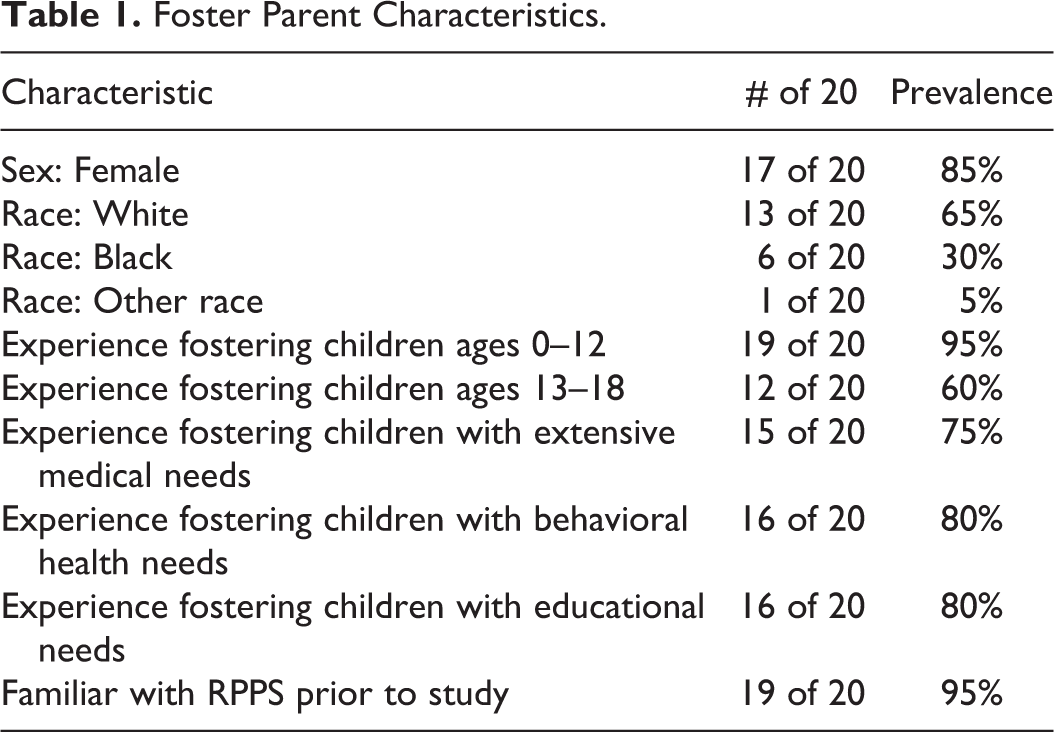
Foster parents were mean 54.00 years old (SD = 12.29 years), predominately white (65% white, 30% Black, 5% other race) and primarily identified as female (85%). At the time of the interview, participants reported an average of 3.15 children in their homes (SD = 2.56) and a mean 11.0 years of experience serving as foster parents (SD = 10.76 years). Most (19 of 20) had experiencing fostering young children, from newborn to age 12, and the majority (12 of 20) had experience fostering older children, ages 13–18. Of the twenty participating foster parents, 19 were familiar with the Reasonable and Prudent Parenting Standard, had served as foster parents during the time their county began adopting RPPS and were aware of changes related to RPPS. One foster parent was unfamiliar with RPPS and stated that it had not yet been implemented in their community. Many participating foster parents had experience fostering children with extensive medical needs (15 of 20), behavioral health needs (16 or 20) and educational needs (16 of 20), such as children with an Individualized Education Plan (IEP).
Interview procedures
Semi-structured qualitative interviews were conducted with foster parents as part of the larger study. To inform the parent study on health and educational data platform development, qualitative data were collected about foster parents’ experiences fostering and their use of health and educational data. Participants were also asked a series of questions about RPPS. All semi-structured interviews were conducted by telephone and lasted approximately 75 minutes. Foster parents received a $10 gift card from Target as remuneration for interview participation. Interviews were audio recorded and transcribed verbatim. This research was approved by the institutional review board at the university of the last author who was the Principal Investigator and all participants provided informed consent prior to participating in the interview.
Interviews were conducted by the first author from November 2017 to October 2018 under the supervision of the study principal investigator who is the last author. Following methods described by Kruger (1997a, 1997b), the interview guide was developed over a series of qualitative team meetings. The interview guide included prompts about RPPS that asked about: 1) if and how RPPS was implemented in the participants’ counties, 2) experiences of children prior to RPPS, 3) impact of RPPS on children, and 4) resources children need to participate in SEAs. The RPPS portion of the interview lasted approximately 15 minutes. Prior to the interview, all participants were emailed a copy of the RPPS state policy statement by the interviewer to reference during the call. All foster parents were interviewed about RPPS and asked to retrospectively report on the implementation of the policy.
Data analysis
We used inductive thematic analysis to analyze the interviews (Krueger, 1997a). First, a four-member qualitative team independently read a series of transcripts, meeting together after each one to review key themes. A preliminary codebook was developed which was revised through an iterative process of reading transcripts, discussing and defining themes, and applying codes. This process continued until no new themes emerged. Descriptive statistics were calculated using SAS 9.4. Qualitative coding was conducted in NVIVO 10 and NVIVO 12.
Results
Policy Review
Inductive, thematic analyses of state RPPS policies revealed 10 nationwide themes: 1) nationwide disparities, 2) age/developmental considerations, 3) child empowerment through preferences/decision-making autonomy, 4) cultural activities, 5) timeframes, 6) transition to adulthood, 7) family of origin involvement, 8) foster parent benefits, 9) liability and 10) support resources. Some state provisions restated or summarized the federal statute while others expanded on, or further clarified, the RPPS component of the Preventing Sex Trafficking and Strengthening Families Act. Many (39) statutes specifically identified that the goal of RPPS was to expand opportunities for children in foster care to participate in social and extracurricular activities. Most (45) mandated that activities should consider the child’s age and/or development in determining appropriateness of participation. Some (11) stated that RPPS activities should consider children’s preferences and decision-making autonomy. For example, in Maryland, “if the [foster] child disagrees with the resource parent’s decision the child should request a meeting and communicate his/her feelings to his/her caseworker.” Although many (31) RPPS statutes specifically used terms like “cultural activities” only a few specifically gave examples like “participation in native dance groups” (Alaska), “speaking in one’s native language with siblings or others who speak the language,” (Vermont), maintaining “tribal values” (Wisconsin) and learning about “skin and hair care” (Missouri).
While most statutes did not outline specific timeframes for RPPS activities, five referenced time durations for activities occurring out of the home or away from the foster parent(s) like babysitting, camps and vacations (excluding international travel); these time periods ranged from 24 hours (Arkansas, California) to 72 hours (Alaska, Vermont), attending camp for 7 days (New Hampshire), to “overnight activities away from caregiver lasting 1 week” or “vacations with caregiver lasting up to 2 weeks” (South Carolina). Four states indicated RPPS to support the transition to adulthood, including opportunities for youth employment (Colorado), to “open and maintain a bank account,” participate in a “driver’s education course” and obtain a “learner’s permit (15 years old),” “junior driver’s license (16 years old)” and “senior driver’s license (18 years old)” (Vermont).
Six states specifically outlined involvement from the child’s family of origin; for example, “Unless there are safety restrictions, birth parents should be invited to watch their child participate in a sport or other event. Parents support their children this way and it can be a great way to help develop a healthy activity they share” (New Hampshire).
In addition to children benefitting from participation in SEAs, California specifically outlined reasons why foster parents might benefit from informal, short-term childcare (i.e., babysitting) made possible by RPPS: “including, but not limited to, when the foster parent has a medical or other health care appointment, grocery or other shopping, personal grooming appointments, special occasions for the foster parents, foster parent training classes, school-related meetings (such as parent-teacher conferences), business meetings, adult social gatherings, or an occasional evening out by the foster parent.” In contrast, foster parents in South Dakota are encouraged to focus on children’s activity requests, not caregivers’ respite desires: “Was the sleep away camp selected because it fits the child’s interests and is what they want to do, or is it to give the caregivers a break?”
Although all state RPPS statutes expanded opportunities for youth in foster care to participate in activities, few (12) mentioned issues of liability and even fewer (2) specifically indicated resources available to expand these opportunities, such as financial and transportation support. Liability references in state RPPS statutes varied. For example, while the Tennessee code states that “Any caregiver or child-placing agency acting in good faith in compliance with the reasonable and prudent parent standard shall be immune from civil liability arising from such action;” Utah and Florida codes both state that RPPS “does not remove or limit any existing liability protection afforded by statute.” Financial and transportation support was made available in Nevada and South Dakota. Nevada created “The Normalcy for Foster Youth Account” to financially support foster parents and child welfare agencies to “provide opportunities to a child…to participate in extracurricular, cultural or personal enrichment activities.” South Dakota indicated that the state social service agency may be able to provide transportation to and from RPPS activities when a foster parent is unable to do so. Other states directly or indirectly indicated that SEAs will be supported by existing foster care stipends or fee waivers; for example, in Alaska, although foster parents may request financial support for special circumstances, RPPS activities “should be supported by your foster care stipend though in many cases, schools may waive participation fees for children in care.”
Interviews
Foster parent statements were categorized into two groups: retrospective report about foster care experiences prior to RPPS and statements about foster care after RPPS. Two unique themes emerged in retrospective statements about ‘before RPPS was implemented:’ 1) negative social impacts and 2) complicated activity approval processes. Three unique themes emerged related to “after the implementation of RPPS:” 1) empowerment, 2) implementation disparities and 3) additional resource recommendations.
We examined the frequency of these themes across foster parent interviews using a conceptual cluster matrix (Miles & Huberman, 1994). Our conceptual cluster matrix contained interview transcript quotations and text phrases organized by interview (row) and theme (column); ensuring agreement in the coding process and ensuring thematic consistency across interviews (Stahlschmidt et al., 2013).
Before RPPS Was Implemented
Foster parents were asked about their experiences related to SEA engagement of children in foster care before the Reasonable and Prudent Parenting Standard was implemented in their community. Complicated activity approval processes themes appeared in 85% of interviews (17 out of 20) and negative social impacts were discussed in 65% of interviews (13 of 20).
Complicated activity approval processes
Before foster parents were granted the decision-making discretion to decide what SEAs children in their care could participate in, they reported challenges related to the bureaucratic process of activity permissions and approvals. Seventeen of the 20 foster parents interviewed described these complicated activity processes as the “red tape” of obtaining signatures from case managers, supervisors and the children’s family of origin and submitting detailed paperwork long before the SEA could take place. In some cases, these requirements limited children’s ability to participate in opportunities.
For example, one foster parent who lived close to the border of another state described the impossibility of taking children in foster care to participate in an impromptu family activity in a town less than 1 hour away: If we wanted to go apple picking and we decided like last minute, hey, we have some time tomorrow, let’s go apple picking [the children in foster care] would have to be babysat and not go because we would be crossing the [state] border and we didn’t ask for travel letters that had to have three signatures on it which usually took a week or two to get accomplished and so if you didn’t—if anything you had wasn’t planned out well in advance, they just couldn’t go. One foster parent explained how she wanted to “communicate with the child, ‘we need to do this’ and ‘how do you feel about that?’” But prior RPPS implementation, she had to “wait and run it past the [biological] parents.” She would prefer to ask the child their preferences first, and then communicate with other stakeholders: “I’ve had some older children, a ten-year-old and a six-year-old lately [and]…I’m able to talk to them…it just makes communication between the foster parent and the child a little more important and a little more personal. And then I can communicate that to the workers, [and] to the guardians.”
Negative social impacts
In 13 of the 20 interviews foster parents described ways that children in foster care faced barriers to building strong social relationships within their foster family and with their peers related to SEAs. Before the Reasonable and Prudent Parenting Standard, foster parents reported concerns for liability if children were injured as the result of an activity, such as participation in a sports team: I think that it made the foster parent be more cautious…when they’re scared that something would happen to the kid and they’re liable and then they are liable instead of just letting them feel that it was, you know, part of like—like they were part of their—the family when you could just make that decision With two children in the home, “one could go over and spend the night at their friend’s house, but the other one couldn’t…and so it caused some conflict…you know, caused conflict with me, caused conflict with the other child because they felt like you know, they were being singled out.” Many years ago, I took in two children, a boy and a girl and they had a head full of head lice…The girl had long hair and the parents refused to do any cutting of any kind and that child suffered because of all of the hair and all of the treatments we had to go through, the combing……he little girl wanted her hair cut so bad and she begged her mother to cut her hair and [the mother said] “no can’t do it.” But, for the well-being of the child, she needed a haircut and…And the child was suffering the consequences of that; [not] being able to go to school [and] participate.
After RPPS Was Implemented
RPPS was passed federally in 2014 and nationwide state-level implementation occurred over the next few years. In many communities across the US, including our respondents’ communities, county-level RPPS implementation occurred recently (in 2017 and 2018). Resource Recommendations was the most prevalent theme, with 19 out of 20 or 95% of foster parents recommending additional RPPS resources. Themes of empowerment appeared in 90% (18 out of 20) of foster parent interviews and 75% (15 of 20) discussed disparities in the way RPPS was implemented.
Empowerment
Following implementation of RPPS, 18 of the 20 foster parents we spoke with described ways in which children in foster care were empowered by increased access to SEAs. These ideas of empowerment were described as follows: They should be able to participate in everything…playing in sports or being in plays in school…being able to go on the computers and have their pictures made at school…I think that it’s good for the children…. They can feel proud of what they’re doing. We got a child in our home about two days before we went to [another state for a family vacation] a summer or so ago, and we were able to take that child with us where in the past we would have had to get special permission from the director…. We were able to take this child because we didn’t want to take this child [into our home] and then have to put the child in respite for a week and have another adjustment so that was very helpful. And that was as a result of that Reasonable and Prudent Parenting. In terms of them being able to go on overnight stays and playing with friends and that kind of stuff, I’ve seen a very positive aspect come out of it, especially with the “it falls under this, but it’s not labeled” you know; being able to get the child’s haircut, without having to go through the [biological] parent to do that. Nothing drastic, but a typical haircut…now it allows you to kind of get the child’s hair cut so it stays healthy and maintained.
In addition to empowering children in foster care, RPPS also seems to have empowered foster parents to make independent decisions, such as allowing a child to participate in a sport or activity, without fear of excessive liability. I think um, the fact that we can you know, parent these children like they’re our own, instead of always asking permission, was the biggest thing…. We’re a county of really close foster parents, and so we watch each other’s children, we do respite for each other, we’ll arrange things like that between us…. when this came out, it really helped us out because we were able to call on each other and just say “Can you watch my child for a weekend?” And it’s no big deal. We don’t have to call everybody and let them know.
Implementation disparities
A second subtheme that emerged related to experiences following the implementation of RPPS was unequal, or disparate, implementation. Foster parents revealed inconsistent statewide implementation of RPPS and disparity between and within counties, including foster parent uncertainty about documentation requirements. Some foster parents reported having full freedom with regard to SEAs while others reported more flexibility, but with continued oversight from case managers. Some foster parents reported that RPPS had been implemented over a year ago (in 2017) while others reported it was currently being implemented in their county (in 2018). So, while the literature indicates that RPPS was codified into federal law in 2014 and adopted by state child welfare policies in 2015 and 2016, actual county-level implementation in our sample occurred in 2017 and 2018.
One foster parent works with child welfare systems in two counties and reported different experiences: In [county]…they follow the guidelines of being able to enroll your kid in [activities]…they have done a fine job with the [RPPS] transition. In other counties, not so much. [The child welfare system is] still saying things like, “you need our permission before you can put your child in swimming lessons.”
Resource recommendations
In addition to the extended activity permissions provided by the Reasonable and Prudent Parenting Standard, nearly all (19 of 20) foster parents explained that children in foster care need additional resources beyond permission in order to participate in SEAs.
Although RPPS made it possible for foster parents to grant permission for children in their care to participate in SEAs, the statute did not expand resources to fund activities for children in foster care. One foster parent described this, stating: “people need to keep in mind everything, everything costs…money is involved in everything you need. You cannot do anything without money. That’s just the bottom-line.” Other foster parents described financial barriers to SEAs as follows: Let’s say for instance, my daughter wanted…to take dancing. To pay for a child to take dancing when you’re making [dollar amount] a day and that doesn’t even cover what it costs for costumes and to take dancing, it’s really hard. So, I know that a lot of foster parents are limited in what they allow their children to do…extracurricular because of the finances…it’s just the fact that it gets expensive. They need to be sponsored…because…it’s a joke for anybody to suggest that a foster parent is making money off of what they’re doing…. because you know the base rates for a child is like [dollar amount] a month, and if you figure out what you’re gonna pay for just in food, clothing, and shelter, that [dollar amount] is easily gone and you’re already in the hole, so there’s no money for extracurricular activities, unless you’re paying for it out-of-pocket which is what my husband and I [do]…. We just decided that this was gonna be part of our ministry and that part of our income was gonna go towards the foster children. So, our kids have had piano lessons and gymnastics and things like that, but we paid for that and not every family can do that. Some foster families don’t have, you know, an extra $200 a month for a foster child, so then they have to miss out, they don’t get to participate in any of those things. Even though you can choose your babysitter and you don’t necessarily need to get them approved by [child welfare system], sometimes that can just be so hard to find, and we try to help each other, but…I know that’s one of the challenges.
Activity Types
Although not a primary theme, one interesting study finding was the types of social and extracurricular activities impacted, or potentially impacted, by RPPS. During the interviews, foster parents listed a total of 57 different SEAs the children in their care participated in. The most mentioned activities were vacations with the foster family (mentioned in 11 of 20 interviews), haircuts (mentioned in 10 of 20), athletics (8 of 20) and school field trips (7 of 20).
Discussion
Context and Implications
Enacted under the Preventing Sex Trafficking and Strengthening Families Act of 2014, the Reasonable and Prudent Parenting Standard and its nationwide implementation over the next 6 years lifted formal, administrative barriers to children participating in SEAs. Inductive, thematic analyses of state RPPS policies revealed 10 nationwide themes: 1) nationwide disparities, 2) age/developmental considerations, 3) child empowerment through preferences/decision-making autonomy, 4) cultural activities, 5) timeframes, 6) transition to adulthood, 7) family of origin involvement, 8) foster parent benefits, 9) liability and 10) support resources. Inductive, thematic analyses of qualitative foster parent interview data revealed five themes: 1) negative social impacts pre-RPPS, 2) complicated activity approval processes pre-RPPS, 3) empowerment post-RPPS, 4) implementation disparities and 5) resource recommendations. Together, analyses of state policies nationwide and analyses of foster parent interviews in a single southeastern state revealed three primary overlapping themes: 1) implementation disparities, 2) empowerment and 3) support resources.
Although RPPS was a federal US policy, implementation differed at the state policy level and at the county/community level within one southeastern US state. Some implementation differences, such as unique provisions for tribal, ethnic and cultural activities have the potential to benefit underrepresented foster care populations within the state. Other implementation disparities may prove challenging for foster parents who may provide foster care for children from two or more counties within a state, and who may be held to different RPPS guidelines in each. An example if this is the foster parent who described working with one county which allowed her to enroll children in her care in activities without child welfare agency permission and working within another county that did not allow her to enroll children in her care in activities without child welfare agency permission. The finding that RPPS was passed federally in 2014, implemented in many states in 2015 and 2016, but locally implemented within one southeastern state in 2017 and 2018 indicates a 4-year policy implantation lag. These between-state and within-state implementation differences suggest that future analyses of the Reasonable and Prudent Parenting Standard, the parent Preventing Sex Trafficking and Strengthening Families Act or similar child welfare policy consider a sampling plan that includes state-level and local-level data analyses.
Empowerment was a central theme of both state RPPS polices and qualitative foster parent interviews. Some state policies empowered youth in foster care by prioritizing 1) their SEA preferences and decision-making authority, 2) SEAs relevant to the child’s ethnic, cultural or racial identity and 3) SEAs that intentionally support their transition to adulthood, such as obtaining a driver’s license and working at a part-time job. Qualitative interviews indicated that foster parents reported that children felt proud of themselves for participating in SEAs; and that engaging in activities like family vacations, social events at friend’s houses and getting haircuts fostered feelings of normalcy with their foster family, school environment and community.
Similarly, state policy data and local interview data revealed ways that RPPS empowers foster parents and the children in their care. The California RPPS policy outlines how the ability to make babysitting decisions might empower foster parents to better manage and balance personal responsibilities. Foster parents described feeling empowered by the ability to make decisions about the children in their care. This finding indicates that, for some youth in foster care and their families, policies like RPPS which seek to promote normalcy and expand opportunities for SEAs are fostering feelings of empowerment in children in foster care and in foster parents by expanding foster parents’ decision-making autonomy.
Nationwide policy analyses revealed examples of states with resources to support foster parents and access to SEAs for children in foster care. Qualitative interviews revealed suggestions of resources to support foster parents, and resources that will better support access to SEAs for children in foster care. Nearly all (19 of 20) foster parents specifically indicated a need for additional resources, including financial and transportation, to support SEA participation by the children in their care. The state policy review provided examples of support resources, including a designated fund account for “extracurricular, cultural or personal enrichment activities” in Nevada, transportation through the state foster care agency in South Dakota and the encouragement that “schools may waive participation fees for children in care” in Alaska. This finding indicates that although the federal RPPS policy increased foster parent discretion and decision-making power related to the children in their care participating in SEAs, additional support beyond the ability to make decisions is needed to fully implement this policy. In other words, simply allowing children in foster care to participate in SEAs, without providing financial or in-kind support, may not be enough to expand SEA participation.
Related to support, the issue of liability was also a consistent theme in state and local data. Foster parent interviews revealed that RPPS helped foster parents feel more confident making independent decisions they felt were in the best interest of their children, without fear of excessive liability. Although all state RPPS policies expanded SEA opportunities, only 12 explicitly mentioned issues of liability.
Foster parent liability concerns may pose a challenge to nationwide implementation of RPPS. Foster parents may be cautious in allowing their foster children to participate in SEAs due to concerns of being legally and financially responsible for civil liabilities (e.g., the foster child incurring an accidental injury while playing a sport). Foster parents can by sued by the biological parents of their foster children for negligence, which includes accidental injury to the foster child (Anderson & Marlett, 2014). However, to prevent this from occurring, most states offer some form of protection for foster parents in the form of liability insurance, immunity, trust funds, or state employee status (Anderson & Marlett, 2014; Palma, 2015).
Collectively, these findings support and extend our understandings of the complexities of foster parenting. As our literature review revealed, compared to parents from the general population, foster parents generally care for children who have higher levels of needs and numerous appointments, visitations, and commitments while having lower annual earnings. These challenges are further complicated because foster parents generally have more children than parents for from the general population (O’Hare, 2008; US Census, 2019). Within this context, increasing access to SEAs is potentially empowering for foster parents and the youth in their care. Now that RPPS allows foster parents increased decision-making authority about SEAs, additional financial and transportation resources might better support SEA participation by children in foster care, given foster families’ complex schedules and complex needs.
Limitations and Future Direction
Several study constraints limit the scope of our findings. Although analyzing national-level policy data and state-level interview data provided breadth and depth to our understanding of the federal RPPS policy, the disconnect between the two levels of analysis is a limitation. Our sample was comprised of individuals who were leaders in their foster parent community, recommended by leaders in their foster parent community and/or who self-selected to participate. As such, the perspectives of these foster parents may not necessarily mirror the perspectives of foster parents statewide. Next, participants were primarily female (85%). Increased input from male foster parents may yield a more comprehensive understanding of this complex issue. Similarly, foster parent experiences only represent one dimension of RPPS. To better understand the impact of RPPS on children in foster care, future research should examine the perspectives and experiences of youth in foster care, foster care case managers and families of origin of children in foster care. Participants shared the broad ages of children they have experience fostering. However, more specific details about the ages of children participants were currently fostering might allow for a focus on specific types of SEAs and RPPS
Despite these limitations, findings from this exploratory study provide a useful and unique perspective about the local and particular experiences of foster parents within one Southeastern state. These themes may be used to inform additional studies, such as representative statewide or nationwide quantitative surveys, which have the potential to yield more generalizable results about the impacts of RPPS.
To allow a view on comparable RPPS policies in international child welfare, future research might explore ways in which policy initiatives are used to facilitate participation in social, extracurricular, enrichment and normalcy initiatives for children in the care of child welfare systems in nations outside of the US.
Conclusions
This study finds that foster parents and children in foster care have been positively impacted by increased access to SEAs, in large part attributable to the implementation of the Reasonable and Prudent Parenting Standard. The increased empowerment and flexibility for foster parents has the potential to increase retention rates and reduce feelings of burnout. Additional supports such as increasing activity funding opportunities, increasing transportation resources, clarifying liabilities and clarifying expectations of motivations have the potential to further facilitate these positive outcomes for youth in foster care.
Footnotes
Declaration of Conflicting Interests
The author(s) declared no potential conflicts of interest with respect to the research, authorship, and/or publication of this article.
Funding
The author(s) disclosed receipt of the following financial support for the research and/or authorship of this article: The Duke Endowment.
