




Abstract
Forensic interviewers are routinely advised to instruct children that they should indicate when they do not understand a question. This study examined whether administering the instruction with a practice question may help interviewers identify the means by which individual children signal incomprehension. We examined 446 interviews with children questioned about abuse, including 252 interviews in which interviewers administered the instruction with a practice question (4- to 13-year-old children; Mage = 7.7). Older children more often explicitly referred to incomprehension when answering the practice question and throughout the interviews, whereas younger children simply requested repetition or gave “don’t know” responses, and individual children’s responses to the practice questions predicted their responses later in the interviews. Similarly, older children were more likely to seek confirmation of their understanding of interviewers’ questions and to request specification. The results highlight the need for interviewers to test and closely monitor younger children’s responses for ambiguous signs of incomprehension.
Keywords
Classic research in developmental psychology has shown that young children often attempt to answer unanswerable questions (Hughes & Grieve, 1980; Piaget, 1928/2014) rather than ask for clarification (Cosgrove & Patterson, 1977). These findings have been replicated in applied contexts in which children are asked complex questions similar to those encountered by child witnesses in court (Perry et al., 1995). Researchers have sought means of encouraging children to express incomprehension (Peters & Nunez, 1999; Saywitz et al., 1999) and interview practice guides routinely recommend that interviewers give children an instruction that if they don’t understand a question, they should say so (ASPAC, 2012; Lamb et al., 2018; Lyon, 2014; Saywitz & Camparo, 2014). However, given younger children’s likely difficulty in comprehending and utilizing the “I don’t understand” (IDU) instruction, one might advise interviewers to omit the instruction with younger children. Examining children’s responses to IDU instructions and their subsequent responding, this study explores an alternative possibility: administering the instruction with a practice question may help interviewers identify the means by which individual children signal incomprehension.
Arguments for and Against Giving Younger Children the IDU Instruction
Some practice guides have suggested abandoning the IDU instruction with younger children (National Children’s Advocacy Center, 2019), and field research has found that forensic interviewers are less likely to give the instruction to younger children (Fessinger et al., 2020; Teoh & Lamb, 2010). If young children lack a concept of incomprehension, then they are unlikely to recognize when they don’t understand a question, and are unlikely to understand what an interviewer wants them to do when they hear the instruction (Dickinson et al., 2015). Furthermore, even if they grasp incomprehension, younger children are less likely to be influenced by an instruction because using an instruction in guiding one’s behavior requires executive functioning skills that also show substantial development with age (Roebers et al., 2012).
However, there are several potential problems with omitting the IDU instruction for younger children. First, there is no clear age cutoff for determining when the IDU instruction cannot be understood. Age trends in research on children’s awareness of incomprehension are highly task-specific (Whitehurst & Sonnenschein, 1985). One can make the task more difficult and show difficulty at an older age, and one can simplify the task and demonstrate understanding at a younger age. It is unclear how one should compare the difficulty of monitoring comprehension in forensic interviews to experimental tasks. Furthermore, age trends aren’t always intended to specify when most children (and certainly not when all children) understand a concept; rather, researchers often equate above chance understanding among an age group with the emergence of understanding (Revelle et al., 1985). As a result, age trends are unreliable predictors of understanding among individual children.
Second, even if one could establish an age below which most children are unlikely to understand the IDU instruction in a forensic interview, it is not obvious that one would want to abandon the instruction among younger children. Many young children will be on the cusp of understanding and might benefit from the scaffolding that an instruction could provide. Moreover, precisely because they are younger, and more inclined to guess in response to questions they don’t understand, these children are most in need of an IDU instruction.
An alternative to abandoning the instruction with younger children is to give the instruction with feedback, which can clarify the instruction for children, and provide practice with (and reinforcement for) providing IDU responses (APSAC, 2012; Dickinson et al., 2015 [State of Michigan Protocol]; Lyon, 2014 [10-step interview]; Newlin et al., 2015 [OJJDP guidelines]). Researchers reviewing the literature on interview instructions have noted in general how practice appears to increase the efficacy of instructions (Brubacher et al., 2015), and two studies giving children extensive practice practicing IDU responses reported benefits (Peters & Nunez, 1999; Saywitz et al., 1999). On the other hand, two recent studies have cast doubt on the utility of IDU instructions with practice, at least among children 9 years of age and younger: 4- to 9-year-olds performed poorly in response to practice questions (Danby et al., 2015; Dickinson et al., 2015) and a brief instruction did not appear to improve children’s performance (Danby et al., 2015).
Developmental Differences in How Children Express Incomprehension
An alternative and heretofore overlooked potential benefit of administering the IDU instruction with practice and feedback is that it could provide helpful diagnostic information about how children express incomprehension. Review of developmental research reveals that children may express incomprehension in increasingly sophisticated ways as they mature, progressing from statements requesting repetition (e.g., “what?”) or signifying ignorance (e.g., “I don’t know”) to statements explicitly referencing a failure to understand (e.g., “I don’t know what you mean”). At first glance, research examining naturalistic interactions among children suggests that even very young children have a sophisticated capacity to identify problems in communication and request clarification. Language developmentalists have found that children’s use of simple “what?” (i.e., requests for repetition) in conversation emerges at 25 months of age (Wootten et al., 1979). Garvey (1977) studied young children (from 2 years 10 months to 5 years 7 months) interacting with each other during play, and distinguished among different kinds of “clarification requests” or “contingent queries,” including requests for repetition, confirmation, and specification. Requests for confirmation entailed asking for confirmation of what one believes had been said (e.g., “if you’re not a scaredy-cat”/“scaredy-cat?”). Requests for specification asked the speaker to clarify the focus of their utterance (e.g., “look at that little mirror”/“where?”). Garvey (1977) concluded that these types of requests were “well learned by the time that speech is fluent, that is, by 3 to 3 ½ years of age” (p. 91).
Although requests for specification suggest some insight into one’s inability to understand an utterance, requests for repetition and requests for confirmation could reflect a failure to hear the utterance rather than a failure to understand, and Garvey (1977) did not attempt to distinguish between hearing and understanding. Indeed, even adults frequently use “what?” and “huh?” to indicate incomprehension rather than a failure to hear (Drew, 1997). Hence, many comprehension failures in young children could easily be misconstrued as failures to hear. Similarly, Garvey (1977) did not distinguish between requests for confirmation that simply repeated the speaker’s utterance and requests for confirmation that expanded on the utterance as a means of clarifying what the speaker meant in addition to what the speaker said.
Children may also use “don’t know” responses when they fail to understand a question. The expression “I don’t know” emerges at about 26–28 months of age (Shatz et al., 1983), and Harris and colleagues showed that it appears predominantly in response to questions (Harris et al., 2017). Researchers studying children’s ability to reflect on their own knowledge have found that children initially base their judgments solely on whether they can generate a response, even if it is purely speculative (Rohwer et al., 2012). For younger children, “I don’t know” is therefore synonymous with an inability to provide a response, which includes failure to understand the question. As with the distinction between failure to hear and failure to understand, it may be difficult to distinguish between “don’t know” responses that reflect a lack of knowledge and responses that reflect incomprehension. Indeed, this is implicitly recognized in the literature on children’s responses to incomprehensible questions, in which children are given credit for recognizing incomprehension when they provide don’t know responses (Waterman et al., 2000). Furthermore, in the first (and heretofore only) study to examine children’s requests for clarifications in forensic interviews, Malloy and colleagues (2015) recognized that don’t know responses could reflect incomprehension, though they did not code for “don’t know” responses.
We are unaware of research directly exploring children’s incipient understanding of the words used to explicitly signal incomprehension (including “I don’t understand” or “I don’t know what you mean”), though indirect evidence suggests substantial development during the grade school years. Peterson and colleagues (1972) examined whether 4- and 7-year-olds’ could reformulate their requests to an adult if the adult exhibited incomprehension. Whereas the younger children reformulated their requests when explicitly asked to do so, only the older children reformulated requests in response to simple assertions of incomprehension (“I don’t understand” and “I don’t think I can guess that”). Distinguishing between a request for repetition (“what did you say?”) and explicit reference to incomprehension (“what did you mean?”) requires an understanding of the difference between saying and meaning. Olson (1982) summarized pilot work in which kindergartners (but not second graders) would conflate what was “said” with what was “meant” when recalling stories in which the speaker had strongly implied a proposition.
Also relevant is research finding that children only gradually acquire the ability to distinguish between lack of memory and incomprehension. Lovett and Flavell (1990) asked first and third grade children what would help them perform well on a comprehension task, hearing words repeated or hearing words defined. Only the older children (8-year-olds) recognized that hearing words defined was essential for demonstrating understanding (see also Lovett & Pillow, 1995). Fabricius and colleagues (1989) asked children and adults to judge the similarity of acts depicting different mental activities, including memory and comprehension, and found that although 8- and 10-year-olds grouped together acts requiring memory, only the adults grouped together acts involving comprehension. Remembering can occur if information is merely repeated, whereas understanding requires something more.
The distinctions between hearing and knowing on the one hand and understanding on the other are analogous to a classic distinction that originated in work on visual perspective-taking (Flavell, Everett et al., 1981) and has been broadened to explain a diverse group of findings concerning children’s theory of mind abilities (Doherty & Perner, 2020). At level 1, the child understands the distinction between seeing and not seeing an object, whereas at level 2 the child understands that different people interpret the same object in different ways (e.g., a picture viewed from different perspectives will appear right side up to one person but upside down to another). Children may appreciate the distinction between hearing and not-hearing and knowing and not-knowing on the basis of whether the individual perceived the relevant target, yet fail to understand incomprehension, because in cases of incomprehension one clearly hears the communication but cannot interpret it.
We hypothesized that older children would be more inclined to seek clarification through “I don’t understand” responses and through requests for confirmation of what the speaker meant (as opposed to what the speaker said). In the only study to assess children’s requests for clarification in forensic interviews, Malloy et al. (2015) examined 91 forensic interviews with 4- to 13-year-old children. Because clarification requests were quite uncommon, the study had limited statistical power to detect age differences. The authors found an increase in clarification requests with age overall, but “I don’t understand” responses were not more common among older children. The authors did find an increase in age in requests for confirmation in which the child attempted to clarify what the interviewer intended, and no age differences among requests for confirmation in which the child simply repeated the interviewer’s words. This is consistent with our hypothesized distinction between a failure to understand and a failure to hear or know.
The Current Study
We examined a large sample of forensic interviews with children, first identifying the extent to which interviewers administered the IDU instruction with practice and feedback. Second, we examined how children responded to the practice questions. Because of the conceptual difficulties differentiating understanding from hearing and knowing, we anticipated that the older children would be more inclined to respond with explicit references to incomprehension. Third, we examined the substantive questioning. We expected the pattern of responses to the practice questions to be repeated during the substantive questioning, that is, that explicit references to incomprehension would be more common among older children. Conversely, we expected that younger children would more often give responses that could reflect a failure to hear the question or know the answer to the question. We also hypothesized that when seeking confirmation, confirmation of what the interviewer meant (as opposed to what the interviewer had said) would be more common among older children. Fourth, we conducted exploratory analyses of children’s requests for specification. Although Garvey (1977) found that they occurred with some frequency even among the younger children, we suspected that they might be more common among older children because they evince recognition that one fails to fully grasp what the speaker means. Fifth, we examined whether children’s answers to the practice questions predicted how they would express comprehension during substantive questioning. We hypothesized that children who explicitly referred to incomprehension when asked the practice question, regardless of age, would be more likely to explicitly refer to incomprehension throughout the interview.
Method
Sample
The study included 446 children 2 to 18 years of age (Mage = 7.6, SD = 3.0; n = 15 children over the age of 12) who were forensically interviewed about suspected abuse, predominantly sexual. The interviews were transcribed from video recordings and anonymized for training purposes, with the consent of the parent or legal guardian, and archived data was used for the current study. The interviews were conducted between 2004 and 2013 at one of five different Child Advocacy Center sites in Southern California. Most of the interviewers would have received the California Forensic Interview Training (CFIT), a state-wide program that provides interviewers the 10-Step Protocol, a revision of the NICHD Protocol (Lyon, 2014). The 10-Step recommends that interviewers present children with ground rules, including an IDU instruction. Interviewers practice the instruction by asking an incomprehensible wh- question (e.g., “What is my ocular pigmentation?”). If children fail to answer the question, interviewers acknowledge the question’s difficulty and rephrase it as a comprehensible question (e.g., “What color are my eyes?”). If children answer the incomprehensible question or incorrectly guess, interviewers follow-up with a second practice question so that they can give appropriate feedback.
Coding
Coders were blind to children’s ages throughout the coding process. We first reviewed transcripts for the presence of the IDU instruction, and (1) whether interviewers explained the instruction using the word “understand” or an alternative term (e.g., the language in the 10-step: “what I mean or what I am saying”); (2) whether the interviewer gave a practice question, using a difficult word or phrase (e.g., “ocular pigmentation”); and (3) how the child responded to the practice question. Children’s responses were categorized into four mutually exclusive response types: (1) request for repetition, (2) don’t know, (3) don’t understand (for further description of these codes see Table 1), and (4) non-response, off-topic response, or correct/incorrect answer. If the child failed to respond appropriately (i.e., their response was categorized as a (4)), we coded for whether the interviewer accepted the answer and moved on or asked an additional practice question. If the interviewer asked an additional question, the child’s answer was considered their final answer.
Types of Potential Expressions of Incomprehension.
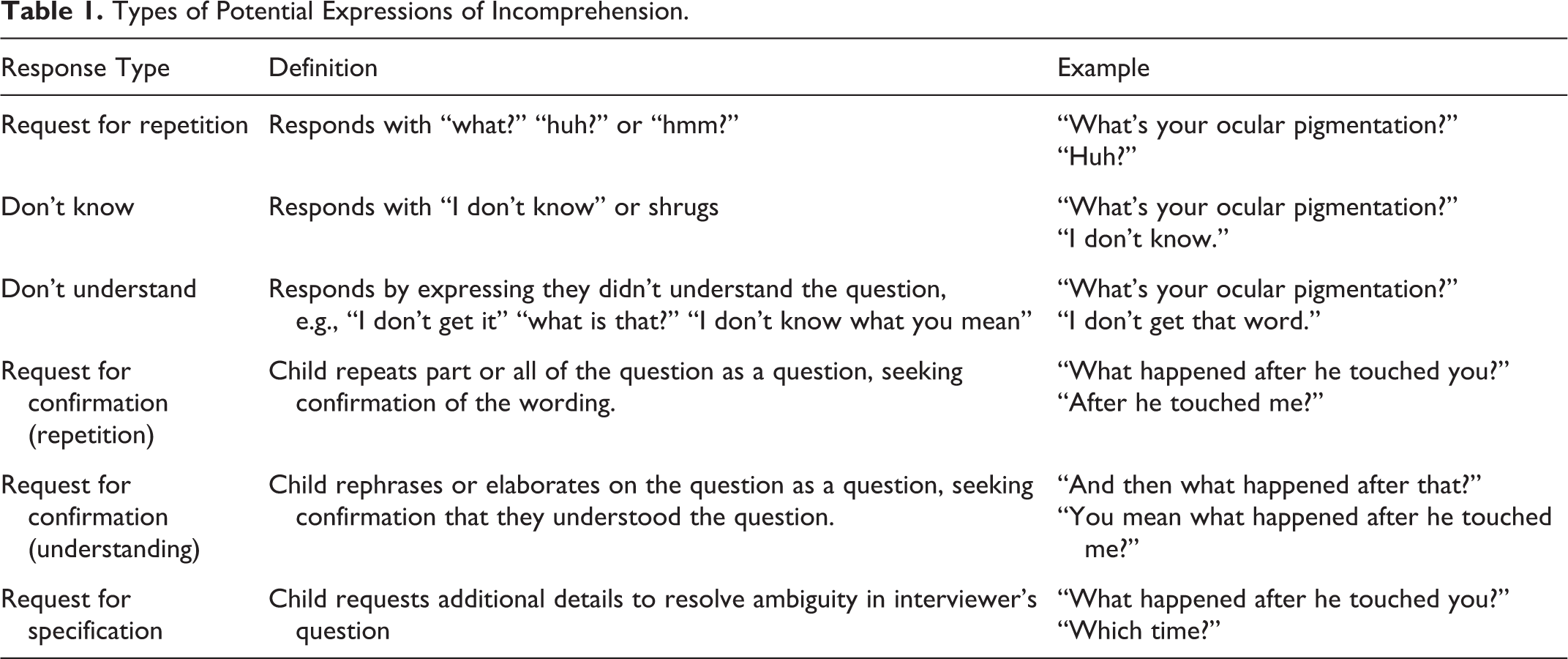
Independently of the IDU instruction, the full interviews were coded for children’s potential expressions of incomprehension, which included requests for repetition, don’t know responses, and don’t understand responses (1–3), and additional responses indicative of an attempt to clarify the interviewer’s question, including (4) requests for confirmation (repetition) (5) requests for confirmation (understanding), (6) requests for specification, and (7) other (for further description see Table 1). Responses coded as “other” included correcting the interviewer and ambiguous requests. Requests were ambiguous when they could either be requests for repetition or specification (e.g., Q: “Did he tell your mom?” A: “Who?”: Child could be asking for repetition of “mom” or for specification of “he”). Because “other” responses accounted for less than 1% (n = 32) of children’s responses, they were excluded. We modeled our classification after Garvey (1977), using her terms “requests for repetition,” “requests for specification,” and “requests for confirmation.” We added codes for don’t know and don’t understand responses, and added the distinction between requests for confirmation (repetition) and requests for confirmation (understanding).
In a small number of cases (n = 38) children gave responses that were codable in two categories; 24 were codable as both (3) “don’t understand” responses and either (4) confirmation (repetition; n = 3), (5) confirmation (understanding; n = 16), or (6) specification (n = 6) responses (these were coded as “don’t understand” responses given our primary interest in these responses); and 14 were codable as both (6) request for specification and either (4) confirmation (repetition; n = 3) or (5) confirmation (understanding; n = 11) responses (these were coded as “request for specification” responses). It was noted during coding that some specification-seeking responses were references to visually present objects (e.g., “which one?” [referring to markers for drawing]), and these were noted, and discussed below. An independent reliability coder recoded 20% of the instruction prompts and clarification-seeking responses. Inter-rater reliability coefficients for all variables were high, Kappa (K) > 0.8.
Analysis Plan
Descriptive analyses began by examining how forensic interviewers employed the IDU instruction, and afterward, analyses investigated whether age was associated with interviewers’ use of the IDU instruction and with children’s responses to the practice question. Because children typically only received the IDU instruction one time, analyses examined associations at the case level using binary logistic regressions. Next, descriptive analyses examined the prevalence of children’s expressions of potential incomprehension throughout their forensic interviews. Because children express incomprehension as often as they wish, analyses examined associations at the response level. Generalized linear mixed models (GLMMs) examined whether age was associated with how children expressed potential incomprehension. Last, GLMMs examined associations between children’s responses to the IDU instruction and how children subsequently expressed incomprehension during the interview.
Analyses were performed using the glmer function in the R package lme4 with the bobyqa optimizer (Bates et al., 2015). GLMMs combine the properties of linear mixed models (which incorporate random effects) and generalized linear models (which handle non-normal data) and are preferable to traditional analysis of variance (ANOVA) models because they have fewer assumptions, handle response variables from different distributions (e.g., binary), and maximize power while simultaneously estimating between-subject variance (Bates et al., 2015; Bolker et al., 2009). The most complex converged models are reported below accompanied by the unstandardized fixed effect estimates (β), standard errors of the estimates (SE), and estimates of significance (Z and p values).
Results
How (and How Often) Did Interviewers Administer the IDU Instruction?
Out of the 446 interviews, 71% of interviews included an IDU instruction (n = 317). In 86% of the cases including the instruction, the interviewer used words other than (or in addition to) “understand” in order to describe incomprehension (n = 272). The child’s age was not associated with whether interviewers described the instruction using terms recommended in the 10-step interview, such as “what I mean or what I am saying,” (Mage = 8.2) or solely used the word “understand” (Mage = 8.4).
Of the interviews that contained the instruction, 89% of them included a practice question (n = 269). In 9% (n = 24) of the cases, the child was non-responsive, or attempted to answer the practice question, thus failing to evince incomprehension (Mage = 6.1, SD = 1.9). In 22 (8%) of the cases, the child knew the answer to the practice question (Mage = 10.3, SD = 0.9). In both of these situations, interviewers usually remembered to ask an additional question to elicit an incomprehending answer (63%: 29/46). Ultimately, 57% of interviews included the instruction and a practice question evincing an incomprehending response (n = 252).
Binary logistic regressions demonstrated that interviewers were significantly less likely to give the instruction to younger children, B = 0.24, S.E. 0.042, Wald = 33.12, df = 1, p < .001, Exp(b) 1.28. However, interviewers were significantly more likely to give a practice question to younger children, B = −0.45, S.E., 0.75, Wald = 36.23, df = 1, p < .001, Exp(b) = 0.64. The mean age of children receiving the instruction was 8.2 years (SD = 2.8) whereas the mean age of children not receiving an instruction was 6.3 years (SD = 2.9). On the other hand, the mean age of children receiving a practice question was 7.7 years (SD = 2.4), whereas the mean age of children not receiving a practice question was 10.9 years (SD = 3.4). In sum, interviewers administered the IDU instruction with successful practice over half the time (57%), but were less likely to use the instruction with younger children.
How Did Children Respond to the IDU Instruction Practice Question?
For purposes of examining how children expressed incomprehension in response to a practice question, the sample included the 252 interviews that included a practice question and a response by the child expressing potential incomprehension. The sample included children aged 4–13 years old (Mage = 7.7, SD = 2.4). The proportion of different types of responses and the mean age of children giving that response are provided in Table 2. As can be seen from the Table, just over half (54%) of children requested repetition or gave a don’t know response. Furthermore, the children who either requested repetition or gave a don’t know answer were younger than average, whereas the children who explicitly signaled incomprehension were older than average.
Proportion and Mean Age of Children Giving Different Responses to the IDU Practice Question.
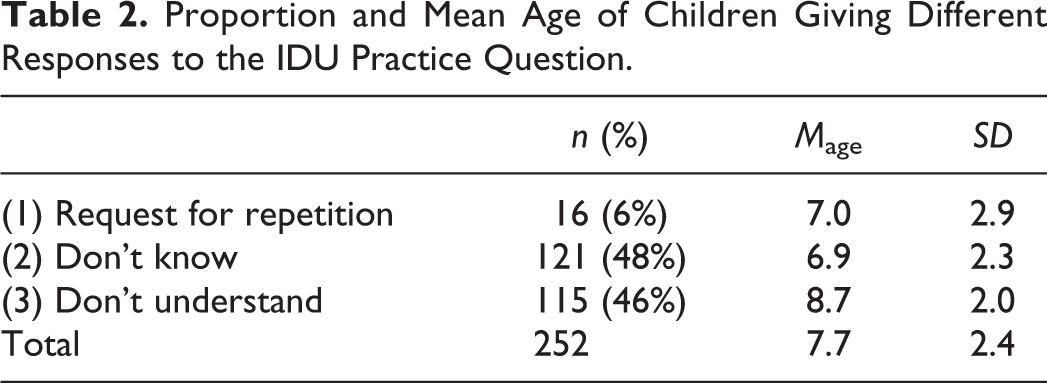
In order to more formally assess the relation between age and children’s expressions of potential incomprehension, a binary logistic regression examined associations with children’s age and children’s don’t understand responses, which are clear expressions of incomprehension (n = 115), compared to their don’t know/didn’t hear responses, which are more ambiguous expressions of incomprehension (n = 137; the two responses were combined because of the rarity of didn’t hear responses). Consistent with our hypothesis, younger children were significantly more likely to respond with I don’t know/didn’t hear responses (Mage = 6.9, SD = 2.4) and older children were significantly more likely to respond with don’t understand responses (Mage = 8.7, SD = 2.0, B = 3.50, S.E., 0.062, Wald = 31.70, df = 1, p < .001, Exp(b) = 1.42). Descriptively, the children who specifically used the word “understand” in their response (n = 29) were the oldest (Mage = 9.1, SD = 2.4). In sum, when children were given the IDU instruction with a practice question, younger children were more likely to express incomprehension with ambiguous expressions (i.e., don’t know/didn’t hear) whereas older children used clearer expressions of incomprehension (i.e., don’t understand).
How Did Children Express Potential Incomprehension During the Interview?
We examined the entire sample of interviews (n = 446) involving children 2–18 years old (Mage = 7.7, SD = 3.0). Excluding responses to the IDU instruction, 6% (n = 5,112) of children’s responses expressed potential incomprehension. The proportion of each type of response and the mean age of children providing that response are shown in Table 3.
Proportion and Mean Ages of Responses Expressing Potential Incomprehension.

A GLMM examined associations between age and children’s expressions of incomprehension during the interview (i.e., through didn’t hear/ don’t know, or don’t understand responses). As expected, older children were significantly more likely to give don’t understand responses compared to didn’t hear/don’t know responses (B = 0.42, S.E., 0.05, Z = 8.52, p < .001).
Next, we examined confirmation and specification requests. We hypothesized that older children would be more likely to seek confirmation of understanding (Mage = 8.7, SD = 2.8) rather than confirmation of hearing (Mage = 7.2; SD = 2.8), and this hypothesis was confirmed (B = 0.21, SE = 0.04, Z = 5.87, p < .001). With respect to requests for specification, older children were more likely to request specification (Mage = 8.7; SD = 2.7) compared to didn’t hear/don’t know responses (Mage = 7.2; SD = 2.7; B = −0.25, S.E. = 0.04, Z = −6.03, p < .001). Although the numbers were too small for inferential testing, requests for specification that referred to something seen were uncommon and were predominantly uttered by younger children (10%; n = 27/266 specification requests, Mage = 6.2, SD = 2.8), whereas other requests for specification were most common and predominantly uttered by older children (90%; n = 239/266 specification requests, Mage = 9.1, SD = 2.6). In sum, older children were more likely to express incomprehension with don’t understand responses, confirmations of understanding, and specification requests, whereas younger children were more likely to use didn’t hear responses, don’t know responses, and confirmations of hearing.
Were Children’s IDU Responses Associated With Expressions of Incomprehension?
A GLMM examined whether the child’s response to the IDU practice question (n = 252) and age were associated with how they expressed incomprehension during the interview. As predicted, children who gave don’t understand responses to the IDU practice question were more likely to give don’t understand responses during the interview (B = 0.92, SE = 0.22, Z = 4.11, p < .001). Controlling for children’s response to the practice question, age was not significantly associated with children’s don’t understand responses during the interview (B = 0.08, SE = 0.05, Z = 1.77, p = .08). Hence children’s response to the practice question was a better predictor of their performance than age alone.
Discussion
We examined how children exhibited potential incomprehension during forensic interviews, both in response to a IDU instruction practice question and throughout the interviews. Although interviewers sometimes omitted the instruction with younger children, or failed to administer the instruction with practice and feedback, we identified a large sample of interviews in which we were able to assess children’s responses. Consistent with our hypotheses, older children were more likely to respond to the practice IDU instruction questions and to questions throughout the interviews with explicit references to incomprehension (e.g., “I don’t know what you mean”). Younger children were more likely to request repetition or give a don’t know response. Children who responded to the IDU instruction practice question with an explicit reference to incomprehension were more likely to make explicit references to incomprehension during the interview, and this effect was independent of age. A similar pattern emerged when we analyzed children’s requests for confirmation; older children were more likely to request confirmation of what the interviewer meant, and younger children were more likely to request confirmation of what the interviewer said.
Requests for Specification
Exploratory analyses revealed that requests for specification were also more common among older children. We did not make any prediction with respect to these requests, given Garvey’s (1977) finding that they appeared to be part of children’s repertoire even at 3 years of age. However, the fact that they predominated among older children is understandable in light of the fact that in order to request specification, a child must understand that a question is ambiguous, and recognition of referential ambiguity improves with age (Nilsen & Graham, 2012).
Children’s performance in Garvey (1977) was likely enhanced by two differences between naturalistic interactions with age-mates and forensic interviews. First, children’s play probably refers more often to visible objects and less often to remembered events. Garvey (1977) noted that “children’s first requests for clarification arise for the most part, in situations where they do not need to rely solely on the verbal channel” (p. 47). In the forensic interviews, we noted when requests for specification referred to visible objects, and found that these were both uncommon (10%) and predominated among younger children, whereas requests that did not refer to something seen were most common and predominated among older children. Second, children are more likely to detect referential ambiguity problems when speaking with other children than when speaking with adults (Sonnenschein & Whitehurst, 1980), presumably because they assume adults are more competent speakers.
Implications for Practice
The results support use of the IDU instruction with practice and feedback. Although protocols uniformly recommend the IDU instruction, some suggest giving only the instruction without practice. For example, the NICHD protocol advises interviewers to simply say “If I ask a question you don’t understand, just say ‘I don’t understand’” (Revised Investigative Interview Protocol, 2013; see also Ministry of Justice, 2011; Powell & Earhart, 2018). Saywitz and Camparo’s (2014) narrative elaboration interview outlines a procedure for giving interviewees feedback on signaling incomprehension, but suggests that the interviewer can omit the instruction if the child seems well-engaged, or if the interviewer is pressed for time or worried that the child will be less productive if too much time is spent on interview instructions. Research examining IDU (and other) instructions in court have similarly found that judges and attorneys rarely if ever provide practice questions (Ahern et al., 2015; Earhart et al., 2017). However, without practice questions, the interviewer is unable to assess how the child expresses incomprehension.
The results also support using wh- questions (rather than yes/no questions) as practice questions. An important aspect of the procedure, as prescribed by the 10-step interview (Lyon, 2014), was that the practice questions were wh- questions, which are less likely to induce guessing than yes/no questions (Waterman et al., 2000). In addition, interviewers accepted don’t know responses as appropriate, which again is consistent with the research on children’s acquiescence to incomprehensible questions (Waterman et al., 2000). Hence, no more than 10% of children attempted to guess in response to the practice question, and no child who was asked two practice questions persisted in guessing.
At first glance, this finding appears inconsistent with Dickinson and colleagues (2015), who examined 4- to 9-year-old children’s responses to practice questions in a lab setting. They found that more than 25% of the 9-year-olds and more than 80% of the 4-year-olds failed to respond appropriately to the IDU instruction practice questions, even when given a second attempt. However, their practice questions were yes/no questions (“Is my shirt gridelin?”; “Is my shirt burnet?”), which are known to elicit very high rates of guessing (Waterman et al., 2000). Moreover, even when children did manage to answer “don’t know,” their answers were treated as inappropriate. Similarly, Danby and colleagues (2015), using yes/no questions to test children’s retention and use of the IDU instruction, found no effects of practice, no age effects, and high rates (55%–59%) of failure among 5- to 9-year-olds (and failure included both don’t know responses and attempts to answer the unanswerable questions). Notably, they did find an increase in don’t know responses among children who were given practice with instructions, but they attributed this result to the don’t know instruction rather than the IDU instruction. If children are expected to explicitly signal incomprehension in response to yes/no practice questions, then even quite old children can be expected to struggle with the IDU instruction.
Powell and Brubacher (2020) emphasize that “practice examples need to be developmentally and culturally appropriate so that all children can complete them successfully” (p. 6). Children’s apparent difficulty with the IDU instruction in Danby and colleagues’ study led Powell and Brubacher (2020) to warn interviewers against the metacognitive challenges of signaling incomprehension, and to recommend that interviewers only introduce one instruction per interview, preferably the don’t know instruction. Our results suggest that an alternative approach would be to utilize the IDU instruction and to accept less than explicit references to incomprehension as appropriate responses.
An additional benefit to using wh- questions as IDU instruction practice questions is that interviewers trained in protocol interviewing will rely heavily on wh- questions (and other recall questions, including invitations) during the substantive portion of the interview. Conversely, they are trained to avoid yes/no questions, and taught that when they do use them, preferably as screening questions late in the interview, they should follow up any yes answers with requests for elaboration (a technique called “pairing”; Lamb et al., 2018). Furthermore, children by 4 years of age are likely to answer incomprehensible or unanswerable yes/no questions with a “no” (Fritzley & Lee, 2003). This reduces the risk of misinterpreting children’s responses to incomprehensible yes/no questions, at least with respect to false positive errors. It thus seems most valuable to train and practice children to signal incomprehension in response to wh- questions.
Another implication of the results is that they counsel greater care among interview professionals (interviewers and those who review interviews) with respect to children’s comprehension. It is unrealistic to expect young children to explicitly inform the interviewer when they don’t understand a question, with or without instructions, practice, and feedback. Rather, professionals should keep alert to requests for repetition and don’t know responses that might signal incomprehension. Of course, disambiguating a child’s possible expression of incomprehension will be difficult. Professionals should monitor the wording of questions, and consider whether simpler wording is an appropriate response when children request repetition or give don’t know responses. Furthermore, professionals may be able to watch for nonverbal cues to incomprehension, such as long response latencies (Bearison & Levey, 1977; Patterson et al., 1980) and puzzled expressions (Flavell, Speer et al., 1981). Future research may provide additional guidance, including how one can distinguish between the “huh?” that requests repetition and the “huh?” that evinces confusion.
Limitations and Future Directions
Studying instructions in the field has both advantages and disadvantages. The disadvantages concern internal validity. Interviewers do not always stick to the script; they may forget what they have been trained to do (e.g., we suspect this is why some failed to ask a second practice question if the child failed the first), or they may resist guidance (e.g., this is probably why the IDU instruction was often omitted with younger children). This complicates attempts to make causal claims about the effect of instructions (as opposed to the diagnostic value we have claimed here). Moreover, questions in actual forensic interviews surely vary widely across interviews and across children of different ages in how difficult they are to understand. Experimental work can ensure consistency in how (and to whom) instructions are administered and how questions are asked.
On the other hand, there are also obvious advantages to field research. Examining children’s interview performance when questioned about abuse clearly increases external validity. Children questioned about abuse may respond quite differently than children questioned about staged events. Maltreated children may respond differently than non-maltreated children. Danby and colleagues’ (2015) argued that their experimental findings regarding instructions might not apply to maltreated children because of research finding maltreated children suffer from cognitive delays.
Ideally, field research and lab research are conducted in tandem, and the findings suggest a number of fruitful directions for further work. In this study, we focused on developmental differences, but future work could examine other aspects of maltreated children’s experience and assess whether it affects how well and how often they exhibit incomprehension. Motivational factors may also influence children’s tendency to express incomprehension, and experimental work could explore whether children motivated to conceal information strategically claim incomprehension as a means of concealment.
Basic developmental research can explore children’s acquisition of terminology explicitly referring to comprehension, and in turn applied research can determine whether this affects children’s performance when given the IDU instruction. Children may respond better to IDU instructions that use terms such as what the interviewer “means” rather than what the child “understands,” given the potentially late acquisition of “understand.” As noted above with respect to different results in the literature, future work can consider the advantages and disadvantages of different types of practice questions (wh- vs. yes/no). Furthermore, practice questions refer to difficult vocabulary, but questions may be incomprehensible for different reasons (e.g., requests for specification are about ambiguity rather than vocabulary). It may be that different types of practice questions can help children signal different types of incomprehension.
Conclusion
In sum, this study shows how IDU instructions with practice may have an overlooked advantage: they provide information about how a child expresses incomprehension. Younger children are likely to react to incomprehensible questions by responding as if they didn’t hear or don’t know the answer, rather than by explicitly stating that they don’t understand. How children respond to practice questions can help interviewers (and professionals who review interviews) to better understand children’s performance throughout the interview. Simply repeating a question if a child says “what?” or assuming ignorance when a child says “don’t know” can create confusion among both interviewer and child.
Footnotes
Acknowledgment
The authors would like to thank Kevin Salas, Anya Hee, Agnieszka Nogalska, and Hailey Konovalov for their assistance.
Declaration of Conflicting Interests
The author(s) declared no potential conflicts of interest with respect to the research, authorship, and/or publication of this article.
Funding
The author(s) disclosed receipt of the following financial support for the research, authorship, and/or publication of this article: This study was supported in part by the National Institute of Child Health and Development (Grant HD087685).
