



Abstract
While there is a growing body of research examining resilient development in adolescents with a history of maltreatment, it remains unclear whether youth resilient functioning changes over time and what factors predict such change. The current study aimed to identify the socio-ecological predictors of the change in resilient functioning over time among adolescents with a history of maltreatment. Multinomial logistic regression analyses were conducted with a sample of 771 adolescents drawn from the National Survey of Child and Adolescent Well-Being (NSCAW-II). Over 18 months, 23.2% of the adolescents remained in the less resilience group, 45.4% stayed in the greater resilience group, 17.4% moved from the greater resilience group to the less resilience group, and 14.0% moved from the less resilience group to the greater resilience group. Younger age, better parent-child relationship quality, and neighborhood safety were associated with stable and continued resilient functioning over time. Conversely, child physical abuse, affiliation with deviant peers, and receipt of behavioral services were negatively associated with continued resilience. Our findings suggest that interventions that support adolescents in building positive relationships with their parents and peers may prevent a loss of resilience over time and ensure continued resilient functioning in child welfare-involved adolescents.
With an estimated 37.4% of all U.S. children experiencing a child protective services investigation by the time they turn age 18 (Kim, Mennen, & Trickett, 2017), child maltreatment is a serious social concern. As such, researchers have examined various risk factors and outcomes for youth who have experienced maltreatment. In particular, an extensive evidence base has been created for adverse outcomes of abuse and neglect. However, interest has shifted from examining negative outcomes to understanding positive constructs, such as resilience. Yet, little empirical evidence exists to understand resilience over time. This study aimed to fill this gap using a large longitudinal dataset to examine adolescent resilience within a socio-ecological framework.
Resilience Following Child Maltreatment
Substantial research has linked child maltreatment to various adverse developmental outcomes during childhood and adolescence. Child maltreatment is associated with externalizing behavioral problems, internalizing symptoms, and impairment in cognitive functioning (Gould et al., 2012; Harpur et al., 2015). However, despite past maltreatment experiences, many children and adolescents are able to continue along a positive developmental pathway. Many children’s ability to “beat the odds” has prompted researchers to examine why some children are able to adapt while others do not, what constructs and contexts help children adapt, and how such promotive factors can be increased in others to foster the same positive outcomes. This research sparked the addition of resilience to the literature on child maltreatment.
Generally, resilience is defined as a process of adaptation despite exposure to adversity (Cicchetti, 2013; Masten & Barnes, 2018). However, childhood resilience literature expresses great ambiguity in regard to the conceptualization and operationalization of resilience processes among individuals with a history of child maltreatment (Yoon et al., 2019). Early work in this area often focused on individual-level characteristics and personality traits, such as the ability to adapt to stress and the use of positive coping strategies, to operationalize resilience (Henry, 1999). Other studies have conceptualized resilience as the absence of negative outcomes and operationalized resilience as scores in the normal (e.g., non-clinical: Holmes et al., 2015) or lower (e.g., at or below the median: Jaffee et al., 2007) range on measures of psychopathology, such as aggression (Holmes et al., 2015), externalizing symptoms (Yoon, 2018). More recent work argues for the inclusion of contextual factors as one’s environment can shape an individual’s ability to access external resources. For instance, Ungar (2015) suggests that the cumulative effects of individual-level traits account for less variance in children’s ability to adapt than environmental factors. Additionally, recent research has tried to expand the literature by conceptualizing resilience as a construct with various subdomains. For example, studies have used functioning across multiple domains (e.g., emotional, behavioral, cognitive, social, life satisfaction, school) to operationalize resilience (Dubowitz et al., 2016; Martinez-Torteya et al., 2017). For the purpose of this study, resilience is defined as adaptive child functioning across multiple developmental domains (externalizing, internalizing, social, and cognitive) in the context of exposure to child maltreatment.
Changes in Resilience Over Time
Both theoretical and empirical evidence suggests that resilience is a mutable process, providing another avenue for researchers to explore. Okuyama and colleagues (2018) examined 760 high school students’ resilience over 3 years following a traumatic earthquake. The percentage of resilient students rose from 28.6% in the first year to 42.9% in the third, suggesting that resilience is a highly changeable mechanism. Theoretically, Titterton and Taylor (2018) have noted the importance of highlighting different time periods within resilience research in order to enhance service delivery among a range of professionals. Similarly, developmental psychologists and theorists argue that resilience is a dynamic developmental process that is neither fixed nor irreversible (Cicchetti, 2013; Masten & Barnes, 2018).
To date, limited longitudinal studies exist to capture the complex process of resilience over time among youth with a history of maltreatment. Findings from a study among children investigated for maltreatment suggested that access to social resources increased children’s resilience over 3 years (Oshri et al., 2017). However, children who are resilient in one developmental period may not be in others (Werner & Smith, 2001). Therefore, understanding how resilience processes are shaped within a time-sensitive context can help to promote positive supports in youth with a history of maltreatment at different developmental periods.
Socio-Ecological Framework
There are multiple levels of influence concerning resilience in children who have been maltreated, however the intricacies of such influences still remain ambiguous. Thus, understanding the interrelations between youth and their environments is imperative in further determining pathways to resilience. Bronfenbrenner’s (1977) ecological systems theory serves as a holistic theoretical approach regarding the influence of various social environments on human development in which individuals are understood as embedded within a larger social system that is interconnected with other social institutions and domains. Application of Bronfenbrenner’s ecological model places youth with a history of maltreatment at the center of an interactive social system composed of interrelated subsystems. The microsystem is the innermost level, which includes relations between an individual and their most immediate surroundings, those in which they have direct contact (Bronfenbrenner, 1977). The connections or networks between various microsystems make up the next ecological context, the mesosystem (Bronfenbrenner, 1977). The exosystem includes more remote social settings that present indirect effects on an individual (Bronfenbrenner, 1977). Finally, the macrosystem can be understood as the overarching social norms and values, cultural beliefs, political systems, and laws relevant to the micro-, meso-, and exosystems (Bronfenbrenner, 1977). Each of these systems influence and are influenced by one another, within the context of their interrelations with personal characteristics or individual factors, time, and proximal processes.
Though limited research has examined socio-ecological predictors of resilience over time, many studies have identified predictors of resilience in youth with a history of maltreatment at the individual-, family-, and school/community-level (Afifi & MacMillan, 2011; DuMont et al., 2007). These predictors act as protective factors to ensure that children who have been maltreated can still sustain a positive developmental trajectory. Utilizing a socio-ecological framework can help to combat discrepancies in availability and accessibility of resources provided to youth, depending on their meso- and macro-systems.
At the individual-level, self-esteem (Dang, 2014), prosocial skills (Holmes et al., 2015), and cognitive ability (Gould et al., 2012) have been identified as predictors of resilience following maltreatment. Gender has also been predictive of resilience, with adolescent girls reporting higher resilience than adolescent boys (DuMont et al., 2007). However, empirical evidence also supports the opposite depending on the domain of resilience. For example, Samplin et al. (2013) found females to be more resilient to the neurological effects of emotional abuse compared to males, but not more resilient to the psychiatric symptoms associated with maltreatment. Similarly, mixed findings exist for age differences, with some research suggesting older children reporting higher resilience than younger (Davidson-Arad & Navaro-Bitton, 2015) and others suggesting the opposite direction (Benavides, 2015). Literature also suggests racial differences impact resilience, as being a White, non-Hispanic adolescent has been shown to decrease resilience (DuMont et al., 2007).
Children with access to nurturing homes and other positive family-level predictors are positioned to develop positively despite past maltreatment (Afifi & MacMillan, 2011). In a study of children with a history of maltreatment, a high level of home protection was predictive of consistent resilient functioning, suggesting the critical importance of positive home environments (Martinez-Torteya et al., 2017). Similarly, perceived father acceptance (Davidson-Arad & Navaro-Bitton, 2015) and family connectedness (Dang, 2014) have been associated with resilience among children with a history of maltreatment. A systematic review by Meng et al. (2018) suggested multiple familial factors associated with resilience and adaptive functioning, including positive parenting, parental care, sibling relationship, and family functioning. However, it is also important to acknowledge that caregivers may or may not be the best protective factor for an individual child, as remaining in a home with an abusive caregiver can decrease psychological well-being (Cicchetti, 2013).
Furthering the socio-ecological framework, researchers have begun to examine predictors of resilience at the community-level. Specifically, neighborhood quality has been found to be predictive of resilience, with better quality associated with higher resilience levels (Sattler & Font, 2018). Shifting contexts, Meng et al. (2018) found multiple school protective factors associated with resilience and adaptive functioning, including school safety as well as peer and teacher support. These are particularly important among adolescents versus children due to differing needs in developmental periods. The influences of school and community/ neighborhood contexts become increasingly important during adolescence as adolescents spend more time in the school and neighborhood, compared to younger children. Limited research exists in relation to the community and school-level predictors of resilience, warranting the need for further research that can provide a more comprehensive knowledgebase on resilience among adolescents who have experienced child maltreatment.
The Current Study
Although there is a growing body of research examining resilience development in youth with a history of maltreatment, it remains unclear how their resilient functioning changes over time after exposure to maltreatment and what factors predict the change in resilience. Since resilience represents a mutable developmental process, it is vital to examine adolescent resilience functioning longitudinally, following child maltreatment. The current study sought to fill existing gaps in the literature and contributes to the field by examining changes in resilient functioning over an 18 month of period in a sample of child welfare-involved adolescents (ages between 11 and 17.5) drawn from the National Survey of Child and Adolescent Well-Being (NSCAW-II). Specifically, the following research questions were addressed: 1) What are the prevalence rates of resilience at baseline (Time 1) and 18-month follow-up (Time 2) among adolescents involved with the child welfare system)?; 2) To what extent does adolescents’ resilience change over time?; 3) Do socio-ecological (individual-, family- and school/community/service level) predictors relate to changes in adolescents’ resilience over time?
Methods
Sample and Data Source
This study used data from the second National Survey of Child and Adolescent Well-Being (NSCAW-II). The NSCAW-II study included 5,872 children between 0 and 17.5 years of age at the time of sampling. NSCAW-II aimed to examine a variety of outcomes for children and families who have come into contact with the child welfare system due to alleged child abuse and neglect. NSCAW-II collected a wide range of data, including information about child welfare investigations, family demographics, service use, children’s exposure to violence, and developmental functioning. The data were collected in three data time points, with the baseline (Time 1; T1) data collected between March 2008 and September 2009. Time 2 (T2) data collection occurred approximately 18 months after the completion of the baseline assessment. Time 3 (T3) data collection was conducted about 36 months after the baseline assessment. Data were collected via face to face interviews with children, parents, non-parent caregivers (e.g., kinship caregivers, foster parents), and child welfare caseworkers. Based on the scope and focus of the paper, the analytic sample for the current study was limited to adolescents who were 11 years old or older. Further, adolescents removed from their home (and placed in out-of-home care) were excluded because they represent a unique population with distinct needs and also because some study measures were not administered to them in the NSCAW survey. The final analytic sample for this study included 711 participants.
Measures
Dependent variables
Resilience
Resilience was measured at T1 and T2 using multiple measures across four developmental domains: externalizing, internalizing, social, and cognitive. The operationalization of the construct “resilience” was primarily derived from prior resilience research (e.g., Cicchetti & Rogosch, 2012; Dubowitz et al., 2016). Using similar approaches (e.g., scores higher than 1 SD below the mean or scores within the non-clinical/normal range are considered signs of competency), youth’s competencies in four developmental domains were assessed, and resilience was operationalized as showing competencies in all developmental domains: externalizing (behavioral), internalizing (emotional), social, and cognitive (Dubowitz et al., 2016).
For the
For the
For the
For the
The resilience variable was coded dichotomously, with adolescents showing competences across all four developmental domains coded as greater resilience (= 1) and the remaining coded as less resilience (= 0).
Independent variables
All independent variables were measured at T1, except for the out-of-home placement variable which was assessed at T2 in order to reflect the youth’s out-of-home placement experience between T1 and T2.
Demographics and individual-level
Adolescent
Family level
At the family level,
School, community, and service-level
Data Analysis
Preliminary data analysis, including univariate descriptive statistics (mean, standard deviation, skewness, kurtosis, variance, range) and bivariate correlations, was conducted prior to primary data analysis. In order to examine and identify significant predictors of the movement between resilience groups over time (i.e., T1 to T2 resilience categories), a series of multinomial logistic regression analyses were conducted. The outcome variable was four different change patterns in resilience status over time (i.e., remained in the greater resilience group; moved from the less resilience group to the greater resilience group; moved from the greater resilience group to the less resilience group; remained in the less resilience group). Individual/demographic factors, family-level factors, and school/community/service factors were entered as predictors. All data analyses were performed using SPSS v. 25. Missing data were handled via multiple imputations with 25 imputed data sets created using the fully conditional specification method (an iterative Markov Change Monte Carlo [MCMC] method with 100 iterations).
Results
Sample Characteristics
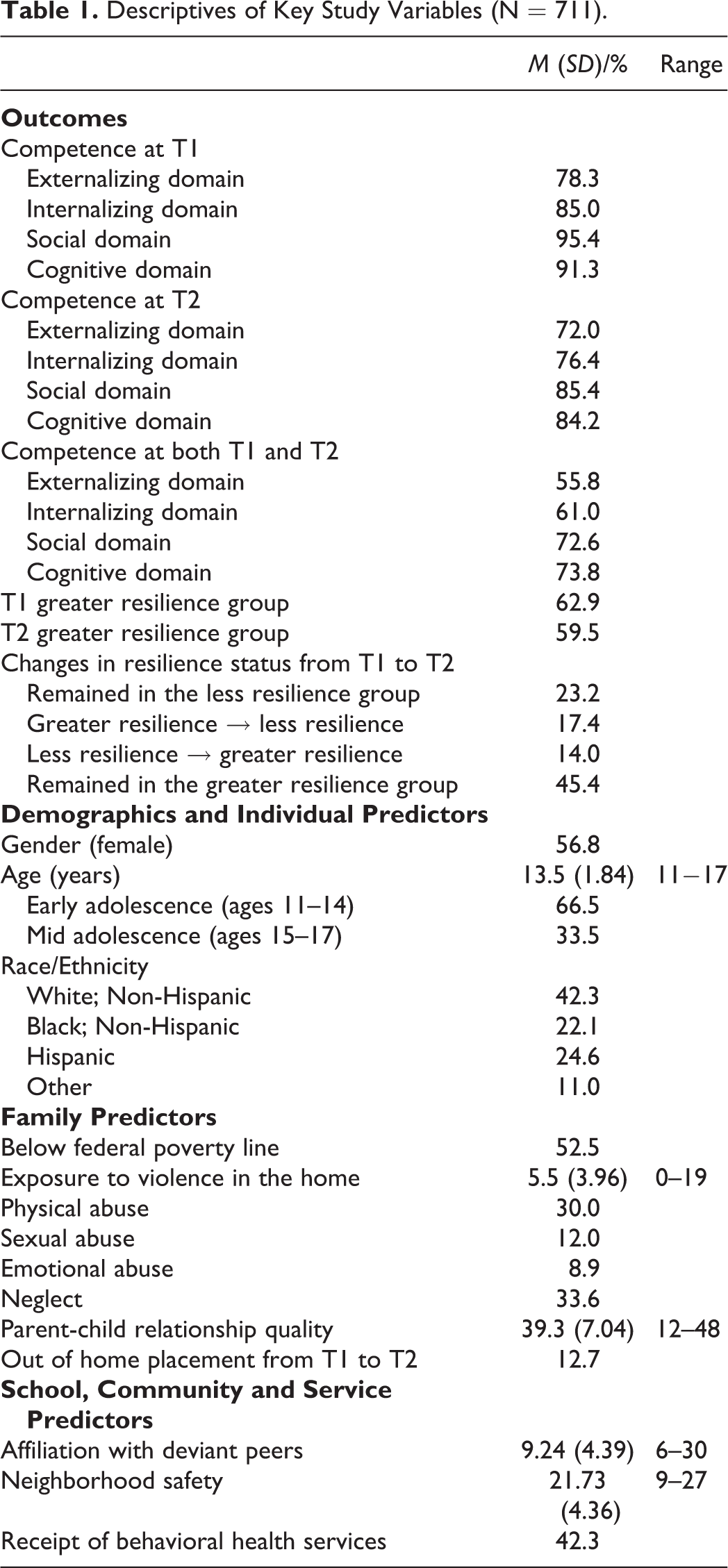
A little over half of the sample was female (56.8%). The adolescents’ age ranged from 11 to 17, with a mean age of 13.5 years. In terms of race/ethnicity, 42.3% of the adolescents were White, 22.1% were Black, and 24.6% were Hispanic. The remaining 11.0% were participants who identified as American Indian/Alaskan Native, Asian/ Hawaiian/Pacific Islander, or other.
Changes in Resilience Status
Table 1 presents the information about adolescents showing competence in each domain and resilience at each time point (T1, T2). About 55.8% of the sample continuously showed competence in externalizing domain, 61.0% in internalizing domain, 72.6% in social domain, and 73.8% in cognitive domain at both time points (across T1 and T2). Approximately 63% of the sample was classified into the greater resilience group (i.e., showing competencies in all four domains of developmental functioning: externalizing, internalizing, social, cognitive) at T1 and about 60% of the adolescents were classified into the greater resilience group at T2. Over 18 months (from T1 to T2), about 23.2% of the adolescents remained in the less resilience group and a little less than half (45.4%) stayed in the greater resilience group. About 17.4% of the adolescents moved from the greater resilience group to the less resilience group while 14% of the adolescents moved from the less resilience group to the greater resilience group.
Descriptives of Key Study Variables (N = 711).
Predictors of Changes in Resilience Over Time
A series of multinomial logistic regression models were conducted to identify significant predictors of the movement in resilience status over a period of 18 months from T1 to T2 (see Table 2). Three different contrasts are presented in this section to make meaningful comparisons between groups: 1) adolescents who moved from the less resilience group to the greater resilience group vs. those who remained in the less resilience group; 2) adolescents who remained in the greater resilience group vs. those who remained in the less resilience group; and 3) adolescents who moved from the less resilience group to the greater resilience group vs. those who moved from the greater resilience group to the less resilience status.
Predictors of Movement in Resilience Status (N = 711).
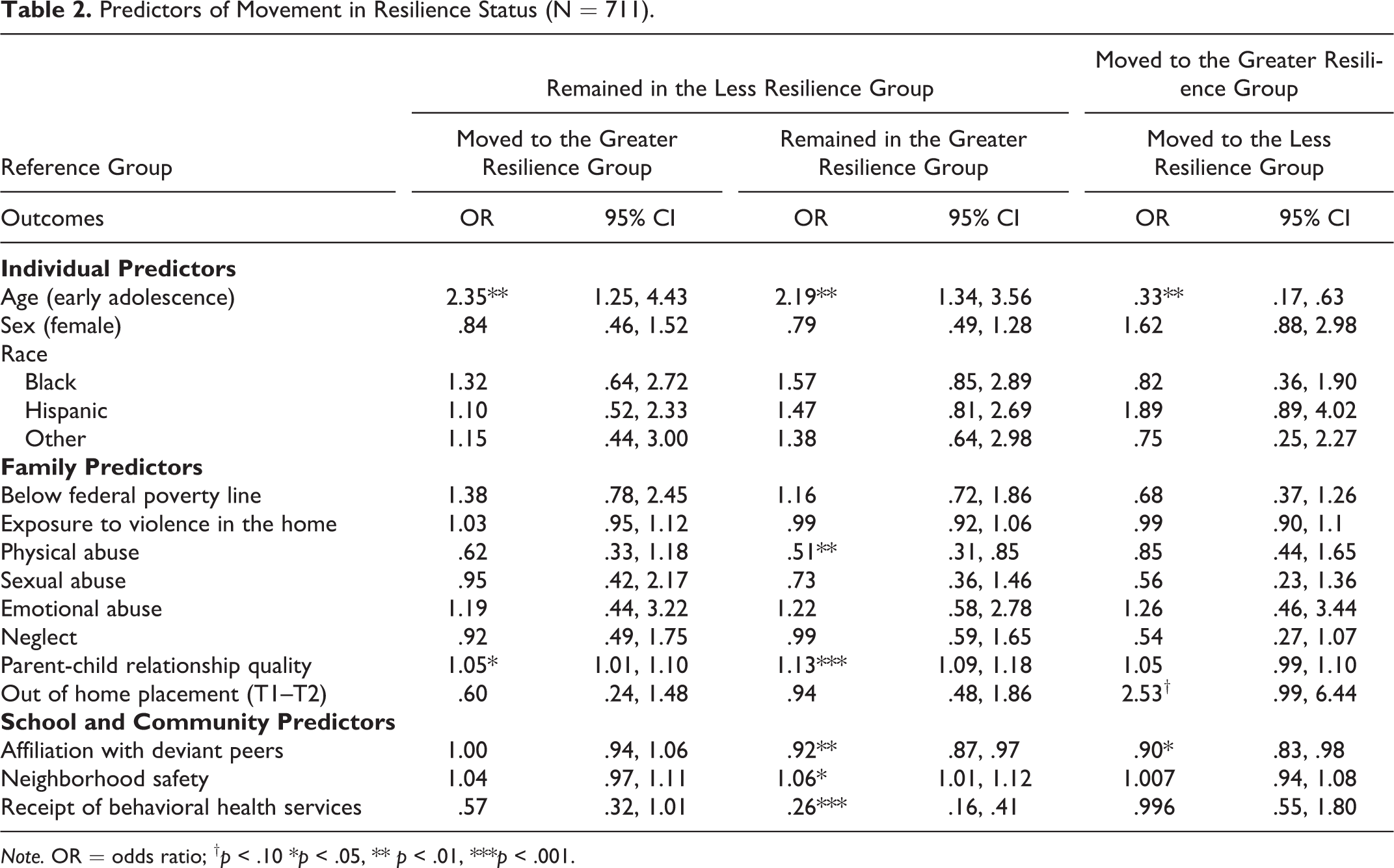
Note. OR = odds ratio; †p < .10 *p < .05, ** p < .01, ***p < .001.
Moved from less resilience to greater resilience (reference group: remained less resilient)
Early adolescents (ages 11–13), compared to older adolescents (ages 14–17), had about 2.35 higher odds of displaying greater resilience over time (i.e., classified into the less resilience group at T1 but classified into the greater resilience group at T2). Higher quality of parent-child relationship also predicted the change from less resilience to greater resilience (OR = 1.05, 95% CI: 1.01, 1.10).
Remained in the greater resilience group (reference group: remained less resilient)
Early adolescents (ages 11–13) had 2.19 times higher odds of showing greater resilience over time (i.e., classified into the greater resilience group at both time points) than did older adolescents (ages 14–17). At the family level, adolescents with a history of physical abuse had .41 times lower odds of showing greater resilience at both time points whereas adolescents with a better parent-child relationship quality had 1.13 higher odds of remaining in the greater resilience group over time. In terms of school, community, and service-level predictors, adolescents affiliated with deviant peers and receiving behavioral health services had .92 and .26 times lower odds, respectively, of remaining in the greater resilience group over time. Conversely, higher neighborhood safety was positively associated with the likelihood of remaining in the greater resilience group over time (OR = 1.06, 95% CI: 1.01, 1.12).
Moved from greater resilience to less resilience (reference group: moved from less resilience to greater resilience)
Early adolescents (ages 11–13), compared to older adolescents (ages 14–17), had about .33 times lower odds of moving from the greater resilience group at T1 to the less resilience group at T2. Adolescents affiliated with deviant peers had .90 times lower odds of moving from greater resilience to less resilience over time.
Discussion
The current study sought to examine how resilient functioning in youth exposed to maltreatment changes over time. The study findings suggest that resilience among youth with a history of maltreatment is changeable over time, and there are important predictors at the individual-, family, and community-level factors that affect these changes.
The study provided empirical support for the notion that resilience changes over time, consistent with other recent developmental research (Cicchetti, 2013; Masten & Barnes, 2018). About one-third of the adolescents in the sample showed changes in resilience over the 18-month study period. This finding is critical as it suggests children who are maltreated are not pre-determined for negative outcomes, despite early indications of negative sequalae. Outcomes can improve over time, thus there are opportunities for facilitating resilience. Furthermore, it is noteworthy that almost half of the sample (45.4%) began and remained in the greater resilience group, suggesting that many youths in the child welfare system are already resilient. These findings underscore the importance of identifying and maintaining the youth’s pre-existing resources and supports to ensure continued resilient functioning in youth who show adaptive functioning, in addition to providing targeted services for higher risk youth.
Consistent with the ecological systems perspective (Bronfenbrenner, 1977), factors across the social ecology were relevant in the development of resilience over time among youth with a history of maltreatment. At the individual level, we found that, compared to older adolescents, youths who were in early adolescence were more likely to be in the consistent greater resilience or move from the lower to the greater resilience group over time. While findings related to age and resilience have been mixed, some studies have found that younger age is related to greater resilience (Carbonell et al., 2002; Chandy et al., 1996). Although our study is unable to speak to the reasons for this finding, there are a few plausible explanations. First, some of the problems included in the resilience measure, such as internalizing symptoms, may increase over time (Shanahan et al., 2014). Second, younger adolescents may be more amenable to change and therefore more likely to build resilience over time. Although the human brain continues to change well into adulthood, there are significant changes in early adolescence (Lebel & Beaulieu, 2011) that may play a role.
Other individual level factors, such as sex and race/ethnicity, did not significantly predict changes in adolescents’ resilience over time. These findings may suggest that the development of resilience is largely driven by environmental and contextual factors versus inherent characteristics (Luthar, 2013). Yet, it is important to consider the ways in which race/ethnicity may indirectly influence resilience given that racial/ethnic minority youth often lack access to many of the resources available to other youth that can serve as protective factors. Further research is needed to clarify the roles of sex and race/ethnicity in resilience development among youths with a history of child maltreatment given that previous research has yielded inconsistent findings, with some studies reporting greater resilience in females (McGloin & Widom, 2001) and White children (Dubowitz et al., 2016), and others reporting no significant sex (Dubowitz et al., 2016) or race (Youssef et al., 2017) differences in resilience.
At the family level, physical abuse was found to be particularly salient in inhibiting resilience development over time. Researchers often coalesce subtypes of child maltreatment, which may hinder the ability to understand variation in sequalae as a result of the subtypes. As physical abuse, psychological abuse, and neglect involve very different behaviors, the effects on children may differ greatly as a result (Manly et al., 2001). The findings that physical abuse is particularly harmful for resilience development over time suggests a need for greater intervention in order to foster well-being among children who have been physically abused. However, careful interpretation of this finding should include the caveat that the subtypes of child maltreatment commonly co-occur (Kim, Wildeman, Jonson-Reid, & Drake, 2017).
Better parent-child relationship quality played a key role in developing and maintaining resilience over time. This finding is consistent with numerous prior studies that found a significant association between good parent-child relationships and positive development in children and adolescents (Afifi & MacMillan, 2011; Dang, 2014; Davidson-Arad & Navaro-Bitton, 2015; Martinez-Torteya et al., 2017; Meng et al., 2018). As families are the relevant unit of intervention for child welfare services, this finding is important to understand the potential power of positive family relationships and the opportunity child welfare workers have to make a difference for children. The Teen Triple P Positive Parenting Program is an evidence-based program that shows critical improvements for parent-teen relationships (Ralph & Sanders, 2006). Interventions such as this may hold significant promise for promoting resilience in youth with a history of maltreatment.
Similarly, and consistent with previous literature that found neighborhood safety and better community environment to be a predictor of positive youth development (Meng et al., 2018; Sattler & Font, 2018), we found that neighborhood safety was associated with consistent resilience development in adolescence. The context in which youth live is critical for their development, and although child welfare workers may have limited ability to make significant changes to neighborhood safety, it is important for workers to be aware of this hindering factor. Identifying neighborhood safety concerns of youth with a history of maltreatment should signal a need for additional supports in order to promote resilience despite such challenges at the community-level.
As expected, affiliation with deviant peers was associated with lower odds of youth showing resilience at both time points, but counterintuitively, we found that it was also associated with lower odds of youth losing resilience over time. While the reasoning behind this finding remains unclear, it may be due to better emotional (e.g. lower anxiety and depression) and social (e.g. less loneliness and more satisfaction) outcomes that result from spending time with peers, even if the peers are perceived to be more deviant (Brendgen et al., 2000). This suggests that those who are socially isolated may be at an even greater risk for negative outcomes compared to those who affiliate with even deviant peers. Another explanation is that some of the items that measured peers’ engagement in risky and deviant behaviors, such as cheating on school tests or stealing something worth <$5, may represent a normative behavior in adolescence. Thus, it is possible that deviant peer affiliation assessed in the study was akin to normative peer relationships during adolescence that provided support to the youth and did not lead to negative outcomes. Developmentally, our sample utilized participants during their adolescence, a period in which the epicenter of children’s universe transitions from parents and family to peers (De Goede et al., 2009). Thus, participants receiving social support of any kind may have helped to maintain resilience. However, it is also important to note that deviant peers are likely to peer pressure participants into engaging in risky behaviors that hinder resilience (Cambron et al., 2018), which may explain why participants were at lower odds for consistently showing resilience over time. Regardless, when interpreting these findings, it is important to note such complexities.
Another surprising finding was that youths who received behavioral health services were less likely to exhibit consistent, high resilience over time. This was a surprising finding as we had expected receipt of services to be a protective mechanism. It is possible that this finding is driven by a selection bias, in that those who receive behavioral health services may have the greatest level of need, therefore even with receipt of services, they still struggle to develop resilience over time. Our post-hoc analysis supported this speculation such that youths who received behavioral health services showed significantly higher levels of internalizing and externalizing problems compared to those who did not receive any behavioral health services. Together with the physical abuse finding, these results suggests that adolescents in the less resilience group may represent a group of youth who have fundamentally different life experiences and challenges (e.g., greater exposure to severe violence, higher level of psychopathology) that result in less resilience and a greater need for behavioral health services. Alternatively, it is possible that behavioral health services may have had no or even adverse effects on adolescents if adolescents dropped out of services prematurely or the services were insufficient for their needs.
Strengths and Limitations
The current study had several strengths. First, NSCAW is a large, longitudinal dataset that allowed us to examine changes in resilience over time. Second, the current study considered resilience as a complex phenomenon across multiple domains of functioning, including behavioral, emotional, social, and cognitive domains. Third, the study holistically examined predictors at multiple levels of the social ecology, rather than focusing on individual-level factors alone. This helped to provide a more comprehensive understanding of resilient functioning over time.
There are also important limitations to consider prior to discussing the implications of this study. First, there are potentially important predictors that were not able to be included in the study due to lack of data, including the timing of maltreatment, the type of behavioral health intervention received, the number of intervention sessions attended, and the completion/dropout of the intervention. Second, because multiple measures with different response scales and ranges were utilized to construct our resilience variable, we chose to code resilience as a dichotomous variable, i.e. greater versus less resilience. This decision likely does not fully represent the resilience continuum. Third, by design, the NSCAW sample consists of child welfare-involved children, and as such, the findings may not generalize beyond this particular population. Since we were specifically interested in children with a history of maltreatment, this sample was appropriate, but it is important to consider limitations within administrative data, namely, that child welfare-involved youths represent only a subset of the population of all youths with a history of maltreatment. Furthermore, the study’s exclusion of adolescents placed in out-of-home care significantly limits the ability to generalize the study findings to adolescents with the most severe trauma and maltreatment history.
Implications for Policy, Practice, and Research
Despite these limitations, the current study has important implications for policy, practice, and future research. At the policy level, although child welfare systems tend to have the greatest focus on child safety, there are three key pillars to the system, including safety, permanency and well-being. Given that resilience has been found to be a mutable process, with factors at multiple levels that can facilitate resilience development, it is critical that increased attention and funding be dedicated to the well-being mandate on child welfare systems. Specifically, there is a need for increased funding for activities/strategies targeted at improving parent-child relationships and fostering positive peer relationships among younger adolescents in the child welfare system. While most money is spent on safety, well-being must be a priority. Additionally, since neighborhood safety was found to be related to increased resilience over time, policies that improve safety and build trust among neighborhood communities may be beneficial for improving outcomes among youth with a history of maltreatment.
This study offers several important practice implications. First, findings help identify youth who are most at risk and in greatest need of services to build resilience. For example, children who were physically abused in childhood may benefit from targeted services and added supports, given that this group was at risk for exhibiting less resilience initially and over time. Additionally, the findings of the study suggest that strategies to promote positive peer relationships may prevent a loss of resilience over time. Finally, interventions that support youth in building strong and positive relationships with their parents may promote resilience development among youth with a history of maltreatment.
In terms of research implications, more longitudinal research is needed to understand how resilience changes over time. A more complex consideration of resilience as a continuum rather than a dichotomous variable, is needed to fully understand and capture the experience of youth with a history of maltreatment. Relatedly, children who are not competent in one domain (e.g., cognitive) can still be competent in other domains (e.g., emotional, social) of functioning and display a distinctive pattern of resilience. Future research should explore various resilience profiles among youth with a history of maltreatment. Furthermore, a longer time period of investigation would help further disentangle the ways in which resilience changes over several years of development. A more nuanced measure of service receipt, that allows controlling for higher levels of challenges, is needed to understand the potentially promotive effect of service receipt. Finally, a larger examination of youth with histories of maltreatment (including youth in out-of-home placements and those outside of the child welfare system) would help further illustrate these relationships, beyond just the experience of children within the child welfare system.
Footnotes
Acknowledgments
This document includes data from the National Survey on Child and Adolescent Well-Being, which was developed under contract with the Administration on Children, Youth, and Families, U.S. Department of Health and Human Services (ACYF/DHHS). The data were provided by the National Data Archive on Child Abuse and Neglect (NDACAN).
Declaration of Conflicting Interests
The author(s) declared no potential conflicts of interest with respect to the research, authorship, and/or publication of this article.
Funding
The author(s) received no financial support for the research, authorship, and/or publication of this article.
