




Abstract
Children exposed to maltreatment are at risk of experiencing intimate partner violence (IPV) and behavioral problems. This study examined different forms of family violence that co-occur and their relationship to children’s externalizing behaviors across developmental stages (early childhood, middle childhood, adolescence). Longitudinal data (N = 1,987) at baseline and 18 months and 36 months post-baseline from the NSCAW II were used. Mixture modeling was employed in which latent class models estimated subgroups of children who experienced co-occurring forms of family violence; regression models estimated which subgroups of children were at risk of externalizing behaviors. Three latent classes were identified across developmental stages: high family violence, low family violence, and child physical abuse and psychological aggression. For children in early childhood, a fourth class was identified: partner and child physical abuse and child psychological aggression. Results from regression models revealed differences in externalizing scores by class membership across developmental age groups and over time. That distinct classes of child maltreatment and IPV co-occur and differentially impact children’s behavior suggests a need for strong prevention and intervention responses to address children’s dual maltreatment and IPV exposure.
Keywords
Children involved with the child welfare system are a vulnerable population and are often exposed to multiple co-occurring adversities (Brown et al., 2019). Indeed, children living in homes characterized by abuse and neglect may also be at risk of exposure to other forms of family violence, such as intimate partner violence (IPV). A growing body of research shows that child maltreatment and IPV co-occur at rates between 30%–60% (Appel & Holden, 1998; Hamby et al., 2010; Smith Slep & O’Leary, 2005). In fact, children in homes where IPV is present are 2.5 times more likely to be physically abused and 9.5 times more likely to be psychologically abused (Zolotor et al., 2007). In addition, children exposed to IPV are approximately 1.5–2.0 times more likely to experience neglect (Taylor et al., 2009; Zolotor et al., 2007). Both forms of family violence—that is, partner-to-partner and parent-to-child violence—places children at increased risk for poor developmental, socio-emotional, and behavioral outcomes (English et al., 2009; Sousa et al., 2011). Although these children are at high risk of developing internalizing behavior problems (e.g., anxiety and depression; Gonzalez et al., 2014), they are also at high risk of developing externalizing behavior problems, such as aggression and delinquency, which may in turn affect future adverse outcomes and perpetuate cycles of violence (Graham-Bermann & Perkins, 2010; Kitzmann et al., 2003; Wolfe et al., 2001). Despite evidence suggesting a high rate of co-occurrence between child maltreatment and IPV, we lack an advanced understanding of the specific forms of child maltreatment and IPV that co-occur and whether the co-occurrence of these family adversities differentially impact children’s externalizing behavior problems.
Understanding distinct forms of family violence has unique implications for the etiology and consequences of both IPV (e.g., Johnson, 2005) and child maltreatment (e.g., Manly et al., 2001). As documented in the IPV literature, types of IPV can be differentiated based on partner dynamics, context, and consequences (Kelly & Johnson, 2008). For example, IPV has been characterized by physical violence (slapping, shoving, kicking, choking, etc.), psychological dimensions (cursing, isolating, threatening, coercion, etc.), sexual violence (forced unwanted sexual behaviors, rape, etc.), and financial control (controlling purchases, withholding funds, etc.; Straus et al., 1996), with higher levels of violence coupled with coercive and controlling behaviors more likely to lead to worse outcomes (Kelly & Johnson, 2008). Men are also more often identified as perpetrators of severe IPV, such as using a weapon or physical force, than women (Norlander & Eckhardt, 2005). Likewise, in the child maltreatment literature, four types of maltreatment are often recognized, including physical abuse, sexual abuse, psychological abuse, and neglect (U.S. Department of Health & Human Services, Administration for Children and Families, Administration on Children, Youth, and Families, Children’s Bureau, 2020). Child neglect is identified as the most common type of maltreatment and the youngest children are most vulnerable to maltreatment and its effects (U.S. Department of Health & Human Services, Administration for Children and Families, Administration on Children, Youth, and Families, Children’s Bureau, 2020). Although distinct forms of IPV and child maltreatment are well established in the literature, their association with one another is not fully understood.
Growing evidence suggests that the presence of IPV may place children at greater risk of maltreatment. Indeed, it is estimated that in over 50% of cases of partner violence, one or both caregivers are aggressive toward the child (Jouriles et al., 2018). In the context of child welfare, specifically, approximately 42% of families investigated for maltreatment report some form of IPV (Jones et al., 2002). Mothers and fathers who perpetrate IPV toward their partners are twice as likely to abuse their children (Ross, 1996). However, research shows that victims of IPV are also around 2.5 times more likely to expose their children to maltreatment (Salzinger et al., 2002). Specifically, mothers who are victims of IPV report that they were more likely to be physically abusive and/or neglectful to their child (Hartley, 2004; Salzinger et al., 2002). Moreover, mothers who endorse attitudes justifying IPV also report that their children not only experience physical abuse and forms of harsh discipline, but are similarly exposed to psychological aggression, such as insults or an absence of affection (Lansford et al., 2014). Among child welfare-involved families, children in homes with IPV are more likely to experience physical abuse and neglect (i.e., failure to protect) (Jones et al., 2002).
Exposure to co-occurring types of violence and victimization, or poly-victimization, may have critical implications during formative periods of child development (Finkelhor et al., 2007a; 2007b; Grasso et al., 2016). Numerous studies have shown that children who have experienced maltreatment and IPV, separately, are at risk of exhibiting behavioral problems (Lichter & McCloskey, 2004; McCabe et al., 2005). Research has also primarily focused on single forms or the cumulative impact of family violence exposure—that is, a dose-response relationship between violence and child outcomes (Horan & Widom, 2015; Nilsson et al., 2012). However, limited research shows that exposure to distinct and multiple forms of violence may have unique effects beyond those of cumulative risk or experiencing one type of violence (Ford & Delker, 2018). In fact, in a study using latent class analysis to examine co-occurring adversities, more broadly (e.g., maltreatment, IPV, injury, illness, etc.), among subgroups of children, Grasso et al. (2016) found that specific patterns of adversity exposure in different age groups were linked to disparate child outcomes. Specifically, children characterized by multiple adversities (i.e., high and variable exposure) in early childhood, middle childhood, and adolescence had higher behavioral and post-traumatic stress disorder scores than other subgroups of children.
Despite early evidence indicating that there are unique effects across development when exposed to co-occurring forms of family violence (Grasso et al., 2016; Herrenkohl et al., 2008; Sternberg et al., 2006; Wolfe et al., 2001), studies specifically examining the impact of co-occurring maltreatment and IPV on externalizing behaviors have produced mixed results, suggesting a need for further investigation. For example, compared to non-exposed children, dual-exposed children had an elevated risk of externalizing outcomes, but there were no differences between dual-exposed children and single-exposed children (i.e., children exposed to maltreatment only or IPV only; Moylan et al., 2010). Moreover, evidence suggests possible demographic-related vulnerabilities, such that males, compared to females, may be differentially impacted by family violence exposure, with males exhibiting more externalizing behaviors (Evans et al., 2008; Graham-Bermann & Hughes, 2003). Although racial and ethnic minoritized children are often disproportionately overrepresented in child welfare systems and may therefore show disparate outcomes both with regard to violence exposure and behavioral outcomes, these findings are also mixed (Lansford et al., 2004; Sedlak et al., 2010). For example, studies show that the prevalence of family violence may differ for Black and White children, and the relationship to externalizing behaviors may be confounded by the type and chronicity of family violence as well as other social determinants of health (Comeau & Boyle, 2018; Lee et al., 2012).
Heightened risk for externalizing behavior problems, in particular, may also play a role in the intergenerational transmission of violence (Moylan et al., 2010). Indeed, children ages 4 to 9 years old who were exposed to co-occurring abuse and IPV were found to have higher rates of externalizing behaviors, including aggression, conduct problems, and violence (Sternberg et al., 2006). According to social learning perspectives, it is postulated that violent behavioral patterns are communicated and passed from caregivers to their children and become steadily reinforced (Bandura, 1973). While children who are victims of abuse and who witness IPV have been shown to perpetrate violence toward their own children and partners in the future, thereby demonstrating the stability of externalizing behaviors over time (Ehrensaft et al., 2003; Wolfe et al., 2001), life-course perspectives also suggest that the timing of adversity may differentially affect the outcomes of children at specific developmental stages (Ireland et al., 2002).
Although extant research provides compelling evidence regarding the adverse effects of exposure to family violence on children’s outcomes, there is an advanced need for the use of diverse methods to better understand the context of co-occurring forms of violence and its impact among vulnerable children and families. Therefore, this study aimed to build upon the growing body of research and apply a mixture modeling approach to quantify and synthesize different forms of child maltreatment and IPV. Specifically, we employed latent class analyses to examine how types of family violence cluster together to identify subgroups of children exposed to maltreatment and IPV as well as regression analyses to investigate which subgroups of children are at increased risk of behavior problems, specifically externalizing behaviors. By using person-centered analytic methods (Roesch et al., 2010), such as latent class analysis, we were able to classify children into mutually exclusive groups based on their exposure to co-occurring forms of family violence and use these groups to predict the development of children’s externalizing behavior problems over time. Such an approach has specific advantages over traditional variable-centered analytic methods (i.e., examining relationships among variables), and offers preliminary insights into how family violence exposure may perpetuate cycles of violence across generations. This may in turn better inform advancements in evidence-based screening and prevention and intervention programming to identify and address children’s exposure to maltreatment and IPV.
Method
Study Design and Procedure
Data from the National Survey of Child and Adolescent Well-being II (NSCAW II) were used for the present study. The NSCAW II is a national longitudinal study of children, ages birth to 17.5 years, and their families investigated for child maltreatment in the U.S. The NSCAW II used a two-stage stratified cluster sample of children in which eight sampling strata were identified based on U.S. states having the largest child welfare caseloads and the ninth stratum was identified for the remaining U.S. states. Strata were then divided into randomly selected primary sampling units that included the geographical area served by child welfare. Stratification also occurred by child age, receipt of child welfare services, type of maltreatment, and type of placement (see Dowd et al., 2014). In the larger NSCAW II study, data were collected from 5,872 children and families over three waves: baseline (wave 1), 18 months post-baseline (wave 2), and 36 months post-baseline (wave 3). Data collected from mothers across all three waves were used in this study in order to examine both the proximal and distal impacts of exposure to co-occurring forms of family violence on children’s externalizing behaviors.
Sample
For the current study, data were restricted to children ages 1.5 to 17.5 years who remained at home with their biological mother at baseline (maternal age: 63.6% < 35 years, 30.1% 35–44 years, 6.3% > 45 years); this subsample (N = 1,987) was selected because externalizing behaviors were assessed only for children ages 1.5 to 17.5 years and only biological caregivers completed measures assessing IPV, specifically physical assault and one psychological abuse question. Although some fathers completed assessments in the larger NSCAW II study, data collected only from fathers were excluded from this study because such a small subsample of fathers (n = 235) were identified, which may differentially impact study outcomes due to potential differences in violence perpetration and victimization by caregiver gender. Data were subsequently analyzed according to developmental stage of the child: early childhood (1.5 to 5 years; n = 807), middle childhood (6 to 11 years; n = 724), and adolescence (12 to 17.5 years; n = 456). For the overall sample, the majority of families were low-income and fell below the federal poverty line (FPL). There were nearly equivalent males and females. Children mostly identified racially and ethnically as White non-Latinx, followed by Latinx, Black non-Latinx, and “other” race and ethnicity (e.g., Native Indian/Alaskan, Asian). For all age groups, children’s externalizing T-scores were on average below clinical levels across all waves of data collection. Demographic characteristics are shown in Table 1.
Demographic Characteristics for the Overall Sample of Children and by Developmental Stage.
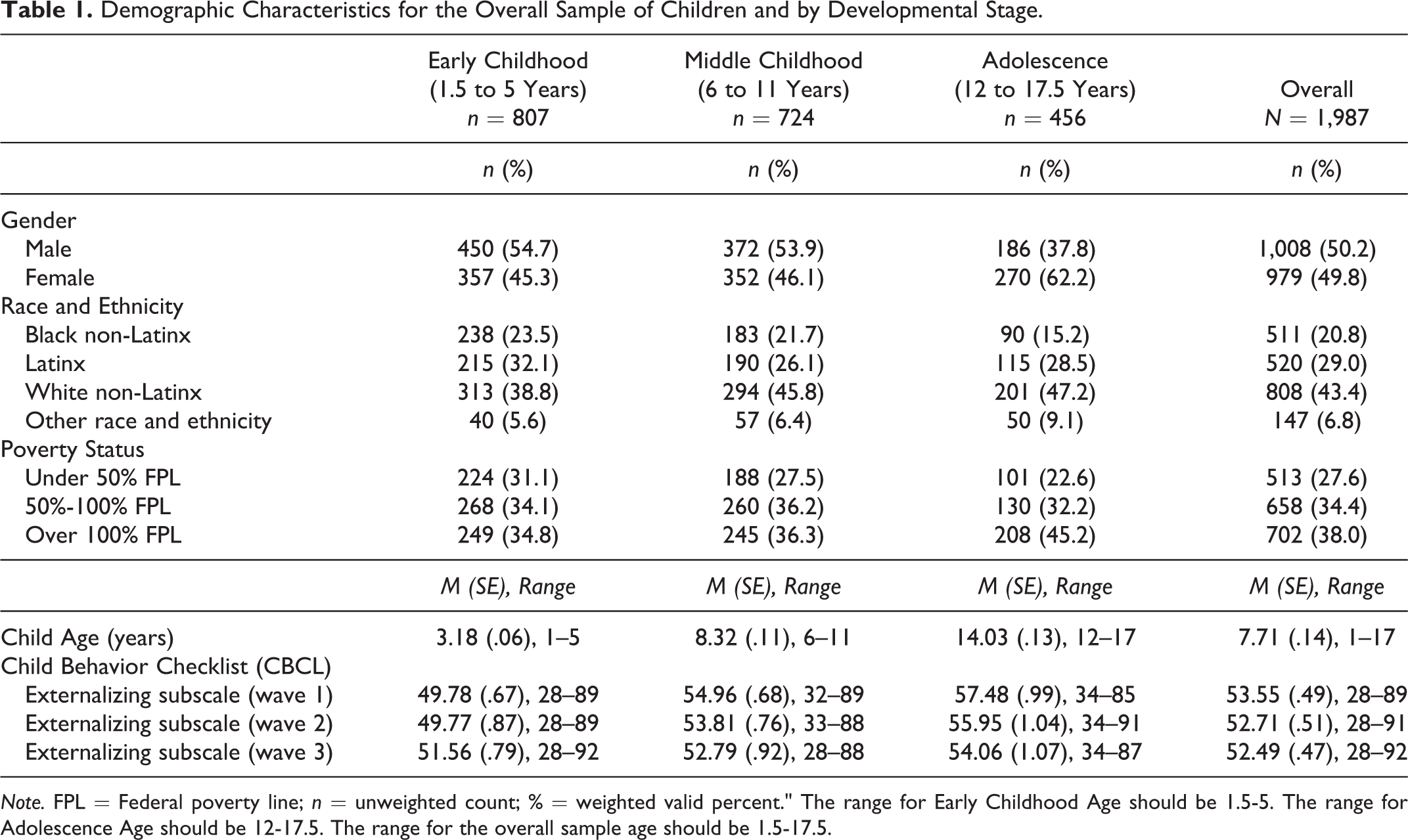
Note. FPL = Federal poverty line; n = unweighted count; % = weighted valid percent." The range for Early Childhood Age should be 1.5-5. The range for Adolescence Age should be 12-17.5. The range for the overall sample age should be 1.5-17.5.
Measures
Family violence indicators
Intimate partner violence (IPV) in the home was measured at baseline from maternal reports on the physical assault items of the Conflict Tactics Scale (CTS-2; Straus et al., 1996) and a similarly phrased study derived psychological aggression item (threatened partner with knife or gun). The CTS-2 and study derived item assesses the type and frequency (1 = 1 time, 2 = 2 times, 3 = 3–5 times, 4 = 6–10 times, 5 = 11–20 times, 6 = more than 20 times, 7 = not in the past 12 months, but it happened before, 8 = this never happened) of violence mothers’ experienced by her partner in the last 12 months. To capture incidence of IPV in the past year, response options for each item (12 items for physical assault and 1 item for psychological aggression) were recoded into dichotomous indicators where exposure to violence “1 time” to “more than 20 times” were coded as 1 and all other values were coded as 0.
Child maltreatment was measured at baseline from maternal reports on the neglect, physical abuse, and psychological aggression items of the Conflict Tactics Scale Parent-Child version (CTSPC; Straus et al., 1998). The CTSPC assesses the methods and frequency (1 = 1 time, 2 = 2 times, 3 = 3–5 times, 4 = 6–10 times, 5 = 11–20 times, 6 = more than 20 times, 7 = not in the past 12 months, but it happened before, 8 = this never happened) of disciplinary actions used by the caregiver with the child during the last 12 months. To capture incidence of maltreatment in the past year, response options for each item (5 items for neglect, 13 items for physical abuse, and 5 items for psychological aggression) were recoded into dichotomous indicators where exposure to violence “1 time” to “more than 20 times” were coded as 1 and all other values were coded as 0.
Children’s externalizing behaviors
Children’s externalizing behavior problems were assessed across all three waves of data collection from maternal reports on the externalizing subscale of the Child Behavior Checklist (CBCL) preschool- and school-aged versions (Achenbach & Rescorla, 2000, 2001). The externalizing subscale for the preschool version included 24 items wherein caregivers rated the degree to which the statement best describes their children’s emotions and behaviors now or within the past 2 months (0 = not true; 1 = sometimes true; 2 = very true). For the school-aged version, caregivers used the same rating scale to answer 35 items that describe their children’s problems now or within the past 6 months. Raw scores were computed by adding the sum of scores for each item and then converted to age-standardized scores. T-scores above 63 indicate borderline- to clinical-level for externalizing behavior problems. For this study, the externalizing subscale demonstrated excellent reliability for each developmental age group: (1) early childhood α = .97 at wave 1, α = .99 at wave 2, and α = 1.00 at wave 3; (2) middle childhood α = .98 at wave 1, α = .99 at wave 2, and α = .99 at wave 3; and (3) adolescence α = .94 at wave 1, α = .99 at wave 2, and α = 1.00 at wave 3.
Data Analysis
Design characteristics, including stratification, clustering, and weights, were applied to analyses to adjust for the complex sampling and ensure estimates were representative of children investigated for maltreatment in the U.S. (Dowd et al., 2014); in addition, for the analysis of subpopulations, cases in the subpopulation are used for parameter estimates, but the full sample is used for standard error estimates. Descriptive statistics (means, standard errors, and percentages) were conducted on demographic characteristics as well as the proportion of children with maltreatment and IPV exposure for the overall sample and each developmental age group. Zero order correlations of demographic characteristics (gender, race and ethnicity, and poverty status) with outcome variables (wave 2 and wave 3 externalizing behaviors) were also conducted; demographic characteristics with statistically significant correlations to the outcome variables were included as covariates in mixture models described below.
Latent class analyses were conducted for each developmental stage (early childhood, middle childhood, and adolescence) using Mplus (version 8.1) (MutheÌn & MutheÌn, 1998–2017). All models were fit using maximum likelihood estimation with robust standard errors, which makes use of all available cases including cases with missing data. All 36 family violence indicators derived from the CTS-2 and CTSPC were included in the model to allow classification of subgroups of children who experienced co-occurring forms of family violence. An iterative process was employed that evaluated models specifying two to four classes. To determine the best fitted model, several fit indices were examined: (1) entropy values approaching 1 and larger than .80 (Celeux & Soromenho, 1996); (2) average class probabilities larger than .80 (Geiser, 2012); (3) smaller Akaike information criterion (AIC) values for the k class model relative to the k-1 class model (Akaike, 1987); (4) smaller sample-size adjusted Bayesian information criterion (BIC) values for the k class model relative to the k-1 class model (Sclove, 1987); (5) significance values for the k class model compared to those of the k − 1 class model for the Lo-Mendell-Rubin adjusted likelihood ratio test (LMR) (Lo et al., 2001); (6) classes contain at least 5% of the total sample; and (7) classes were theoretically meaningful and interpretable.
After fitting latent class analysis models, we used the Bolck-Croon-Hagenaars (BCH) method (Bolck et al., 2004; Vermunt, 2010) to compare outcomes across latent classes. The BCH method belongs to a group of mixture modeling analytic techniques, broadly referred to as the three-step approach, in which latent classes are used as analysis variables. The three-step approach fits a latent class model in the first step (i.e., the models described above). In the second step, respondents are assigned to a latent class. In the third step, latent class membership is used in an analytic model, in which class membership is adjusted for classification error. These models allow latent class membership to be used in models while incorporating class membership uncertainty as opposed to treating class membership as an observed characteristic. The BCH method is a known-group analysis in which groups are measurement error-weighted latent classes. In our application, regression models were fit separately in each latent class. In each class, wave 2 and wave 3 externalizing behaviors were regressed on wave 1 externalizing behaviors and the participant’s gender and race and ethnicity. Wave 1 externalizing behavior was mean centered prior to fitting the model. We used model constraints to evaluate whether wave 2 or wave 3 externalizing behaviors differed across classes by comparing the model-estimated intercepts, which represent mean wave 2 or wave 3 externalizing behaviors adjusted for wave 1 externalizing behavior and participant’s gender and race and ethnicity.
Additionally, sensitivity analyses were performed using the three-step mixture modeling approach but without adjusting for wave 1 externalizing behavior. Because externalizing behaviors demonstrate high stability over time (e.g., Heller et al., 1996; Stemmler & Lösel, 2012), and may therefore explain a high percentage of variance in wave 2 and wave 3 externalizing behaviors, we tested alternative models to confirm that the conclusions of the results (i.e., differences in proximal and distal externalizing behaviors by class membership) may be sensitive to the inclusion of baseline behaviors.
Results
Proportion of Children Experiencing Maltreatment and IPV
As indicated in Table S1 in the supplement, the proportion of children with reported experiences of child physical abuse and psychological aggression tended to be moderate to high for the overall sample and across developmental age groups. Low to moderate levels of neglect were reported for all children. Overall, IPV exposure was less common; however, a small proportion of children were reported to experience IPV that involved a partner pushing, grabbing, shoving, or throwing something at their mother.
Latent Class Analysis Models
The four-class solution was identified as the best fitting model in early childhood and the three-class solutions were identified as the best fitting models in middle childhood and adolescence based on several fit indices and selection criteria (see Table S2 in the supplement). Despite non-significance of the LMR test for class solutions for all developmental age groups, greater differences in the BIC values for the k class model relative to the k − 1 class has been identified as the most reliable approach for selecting classes and was therefore compared, along with class size, to help determine the best fitting models (Nyland et al., 2007).
The three classes identified across all developmental stages included: (1) high family violence class; (2) low family violence class; and (3) child physical abuse and psychological aggression class. The fourth class identified in early childhood included: (4) partner and child physical abuse and child psychological aggression class. Eight percent (n = 67) of children in early childhood, 11% (n = 79) in middle childhood, and 11% (n = 51) in adolescence were classified into the high family violence class. These children were characterized by high proportions of multiple types of maltreatment and IPV as well as more and less severe forms of IPV. For example, mothers reported IPV that escalated to a partner hitting, slapping, or choking them. Forty-three percent (n = 346) of children in early childhood, 51% (n = 370) in middle childhood, and 46% (n = 209) in adolescence were classified into the low family violence class. The majority of children were classified into this class and reportedly experienced less family violence, with the exception of verbal discipline. Thirty-six percent (n = 288) of children in early childhood, 38% (n = 275) in middle childhood, and 43% (n = 196) in adolescence were classified into the child physical abuse and psychological aggression class. These children had more experiences of multiple forms of maltreatment. Finally, 13% (n = 106) of children in early childhood were classified into the partner and child physical abuse and child psychological aggression class. This class was characterized by a higher proportion of children with reported experiences of physical types of IPV and maltreatment as well as psychological aggression, such as threats to be hit by a caregiver. In the supplement, Figure S1 shows the proportion of children classified into each class.
Regression Models
Table 2 displays estimates for the regression models of the associations among demographic characteristics, latent class membership, and externalizing behavior problems 18 months post-baseline (wave 2) across developmental age groups. In all developmental age groups, children’s baseline (wave 1) externalizing behaviors significantly predicted their wave 2 externalizing behaviors in each class. For children in early and middle childhood, gender was not a significant correlate, but race and ethnicity were associated with wave 2 externalizing behaviors in some subgroups of children. Specifically, children in early childhood classified in the high family violence class and who identified as “other” race and ethnicity had higher externalizing behavior scores at wave 2 than White non-Latinx children. However, compared to Black non-Latinx and Latinx children in middle childhood, White non-Latinx children classified into this class had higher externalizing behaviors. In addition, compared to Latinx children in early childhood and children who identified as “other” race and ethnicity in early and middle childhood, White non-Latinx children classified in the low family violence class had higher externalizing behaviors. There were no differences in wave 2 externalizing behaviors by class membership for children in early or middle childhood. For adolescents, gender was a significant correlate of wave 2 externalizing behavior problems such that males classified in the child physical abuse and psychological aggression class had higher externalizing behaviors at wave 2 than females. Moreover, White non-Latinx adolescents classified into this class also had higher externalizing behaviors than their counterparts who identified as “other” race and ethnicity. However, compared to White non-Latinx adolescents, Black non-Latinx adolescents classified in the high family violence class had higher externalizing behaviors. Finally, adolescents classified in the child physical abuse and psychological aggression class had higher externalizing behavior scores at wave 2, controlling for demographic characteristics and baseline externalizing behaviors, than adolescents in the high family violence and low family violence classes.
Regression Models of the Association Between Latent Classes and Externalizing Behaviors at Wave 2.

Table 3 displays estimates for the regression models of the associations among demographic characteristics, latent class membership, and externalizing behavior problems 36 months post-baseline (wave 3) across developmental age groups. In all developmental age groups, children’s baseline (wave 1) externalizing behaviors significantly predicted their wave 3 externalizing behaviors in each class. For children in early childhood, gender was not a significant correlate, but race and ethnicity were associated with wave 3 externalizing behaviors in some subgroups of children. Specifically, children in early childhood classified in the high family violence class and who identified as Black non-Latinx or “other” race and ethnicity had higher externalizing behavior scores at wave 3 than White non-Latinx children. However, White non-Latinx children in early childhood classified in the low family violence class, compared to children of other races and ethnicities, had higher externalizing behaviors. Children in early childhood classified in the low family violence class had higher externalizing behavior scores at wave 3, controlling for demographic characteristics and baseline externalizing behaviors, compared to their counterparts classified in the partner and child physical abuse and child psychological aggression class. For children in middle childhood, race and ethnicity were not significant correlates, but gender was associated with wave 3 externalizing behaviors such that females classified in the child physical abuse and psychological aggression class had higher externalizing behaviors at wave 3 than males. Conversely, for adolescents, gender was not a significant correlate, but race and ethnicity were associated with wave 3 externalizing behaviors. Compared to adolescents classified in the high family violence class who identified as “other” race and ethnicity or Latinx adolescents classified in the low family violence class, White non-Latinx adolescents had higher externalizing behaviors. There were no differences in wave 3 externalizing behaviors by class membership for children in middle childhood or adolescence.
Regression Models of the Association between Latent Classes and Externalizing Behaviors at Wave 3.
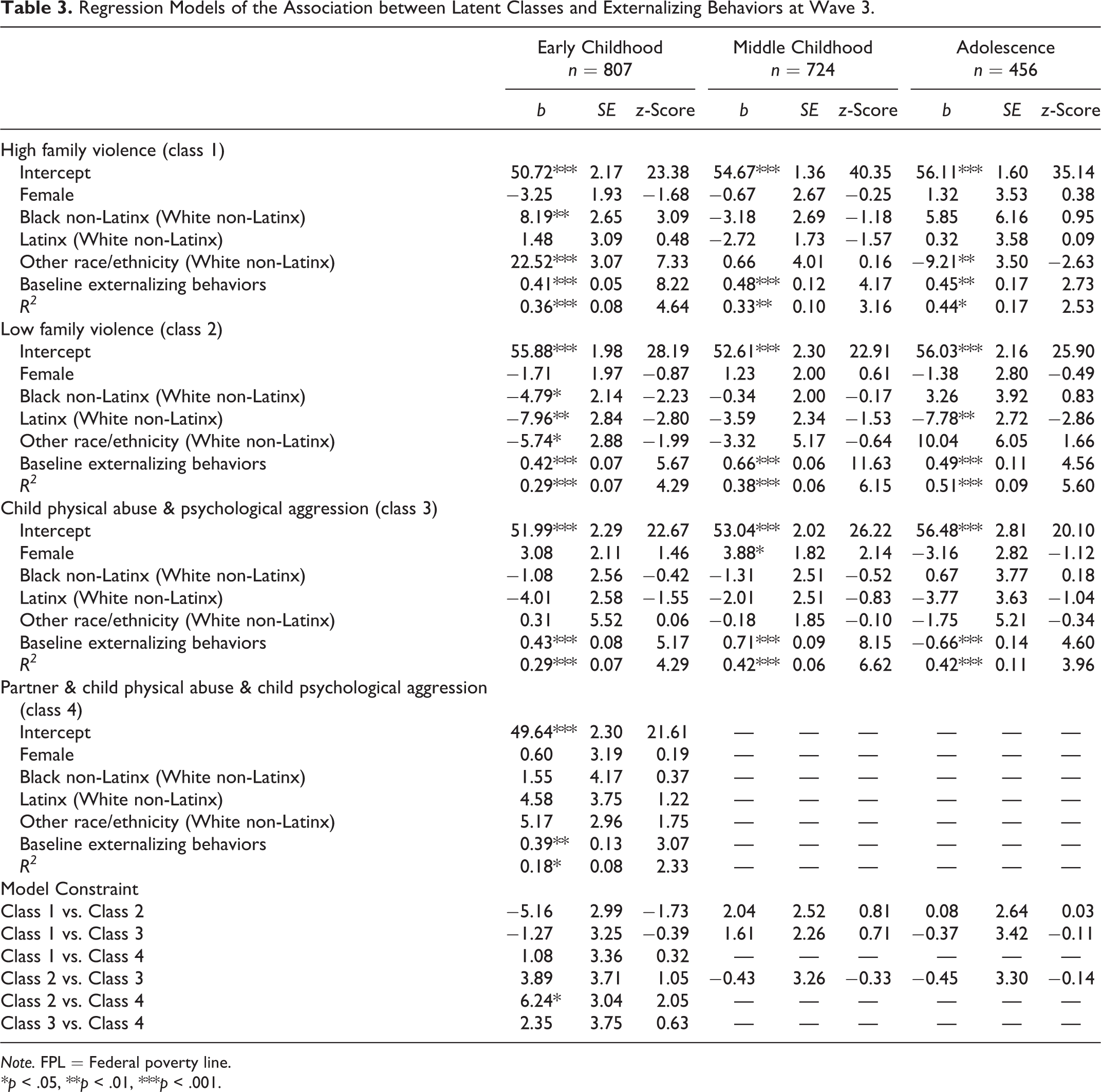
Note. FPL = Federal poverty line.
*p < .05, **p < .01, ***p < .001.
Sensitivity Models
Regression models of the associations between latent class membership and wave 2 externalizing behavior problems, without controlling for baseline externalizing behaviors, indicate no differences in externalizing behaviors by class membership for children in early childhood. However, children in middle childhood classified in the child physical abuse and psychological aggression class had higher externalizing behaviors at wave 2 than children in the low family violence class (b = 5.46, SE = 2.71, p < .05). In addition, adolescents classified in the child physical abuse and psychological aggression class had higher externalizing behaviors at wave 2 than adolescents in the high family violence class (b = 8.53, SE = 4.23, p < .05) and low family violence class (b = 12.19, SE = 3.22, p < .001).
Regression models of the associations between latent class membership and wave 3 externalizing behavior problems, without controlling for baseline externalizing behaviors, indicate no differences in externalizing behaviors by class membership for children in early or middle childhood. However, adolescents classified in the child physical abuse and psychological aggression class had higher externalizing behaviors at wave 3 than adolescents in the low family violence class (b = 8.28, SE = 4.08, p < .05).
Discussion
The present study examined the different forms of family violence that co-occur during different developmental stages and their relationship to children’s externalizing behaviors over time among children involved with child welfare. Findings build on existing research (e.g., Dixon et al., 2007; Hartley, 2004) demonstrating that different forms of family violence do co-occur among this vulnerable population. Understandably, these children experience high proportions of maltreatment given their involvement with child welfare. Although the majority of children investigated for child maltreatment generally experience neglect and are under 1 year of age (U.S. Department of Health & Human Services, Administration for Children and Families, Administration on Children, Youth, and Families, Children’s Bureau, 2020), our sample of children differed from prior research as they predominantly experienced psychological aggression and physical abuse. This may be due in part to the restricted age range of our sample, which did not include infants under 1.5 years old, as well as the use of self-report questionnaires to identify maltreatment types. Nevertheless, a high proportion of children reportedly experienced maltreatment within latent classes, suggesting some stability of maltreatment exposure by developmental stage.
Although there was continuity in three classes of family violence across developmental age groups, class structure differed according to reported experiences of IPV in early childhood. Specifically, an additional class was derived only for children in early childhood that was characterized by partner physical abuse in combination with child physical abuse and psychological aggression. Given that violent relationships and other risk factors (e.g., parenting stress or depression) may increase during the perinatal period and last for several years, the likelihood of exposure to IPV is thus high during early childhood (Taylor et al., 2009). Indeed, with the exception of infancy, preschool-aged children have one of the highest rates of exposure to IPV (Finkelhor et al., 2005). Also unique to this age group is the extent to which they may rely on parents to meet their basic needs and thus be placed in high-risk situations that could additionally lead to child maltreatment (Howell et al., 2016).
A high family violence or poly-victimized subgroup of children was evident in all three developmental age groups. Indeed, prior research shows that in homes where child maltreatment is prevalent, other forms of family violence are likely to occur (Zolotor et al., 2007). Specifically, children classified into the high family violence class experienced elevated maltreatment and multiple forms of IPV, which ranged from less to more severe violence. Although more severe IPV is less common, in general, approximately 8% to 11% of children in this study experienced more severe IPV in combination with maltreatment. That even more children were not exposed to multiple forms of family violence is likely due to the fact that children in this study remained at home with their biological mother. It is possible that children exposed to more severe and multiple forms of family violence are removed from the care of their caregivers and placed out of the home to ensure the child’s safety and well-being.
Findings from this study build on extant research indicating that children’s exposure to multiple forms of violence is often implicated in the identification of later behavioral problems (Finkelhor et al., 2009; Grasso et al., 2016). However, the extent to which class membership consistently predicted proximal and distal externalizing problems during different stages of child development was less pronounced. In early childhood, it was somewhat unexpected that class membership did not differentiate children according to externalizing behaviors at wave 2, but the subgroup of children with low family violence exhibited greater externalizing behavior problems at wave 3 when compared to their counterparts exposed to partner and child physical abuse and psychological aggression. Although behavioral problems are shown to have continuity over time (Korhonen et al., 2018), younger children in this sample had slightly lower mean levels of externalizing behaviors than children in other age groups. That these children already had lower reported externalizing behaviors may indicate that the effects of family violence are not yet fully evident among a sample involved with child welfare due to extant concerns of abuse and/or neglect. It is also possible that efforts to protect children who were grouped into classes with higher family violence may help to explain why these trajectories differ for younger children. Research on toxic stress denotes that the effects of exposure to early adversity may be mitigated when children are in the presence of supportive adults (Shonkoff et al., 2012). It is therefore reasonable to suggest that younger children involved in the child welfare system with higher familial risk may have been buffered from family violence exposure after the 18-month follow-up when they transitioned to school and/or if intervention was warranted and they needed to be removed from a violent home.
For children in middle childhood, however, class membership predicted externalizing behaviors over time but was influenced by adjusting for baseline behavioral problems. Children in the child physical abuse and psychological aggression class, compared to children in the low family violence class, did not show higher externalizing behaviors at wave 2 or wave 3 when controlling for baseline behavior, but did at wave 2 when baseline behaviors were removed in sensitivity analysis. These findings are consistent with work conducted by Stemmler and colleagues (2012), such that externalizing behaviors among subgroups of males remain stable over time, with high stability more evident during proximal assessment periods. Thus, baseline behaviors could account for more variance in 18-month post-baseline outcomes. In addition, given that IPV and maltreatment were assessed during the past 12 months in the current study, the precise length of violence exposure is unknown. That is, some children may have been experiencing maltreatment for a longer period of time than other children; thus, the developmental timing of violence exposure cannot be determined in relation to the onset of children’s problem behaviors. These findings suggest the need for further investigation of the developmental timing of maltreatment and IPV exposure and relationship to children’s externalizing behaviors.
Class membership had more noticeable impacts on adolescent’s externalizing behaviors, particularly at wave 2. Specifically, adolescents in the child physical abuse and psychological aggression class had higher externalizing behaviors over time than adolescents in the high and low family violence classes. Some longitudinal studies show an adolescent onset-group of externalizing behaviors (Reef et al., 2011) and decades of research demonstrates that children exposed to maltreatment are more likely to exhibit higher levels of externalizing behavior problems (McCabe et al., 2005). However, these findings are mixed with regard to the additive role that IPV plays among maltreatment-exposed children (Moylan et al., 2010; Sternberg et al., 2006). In our adolescent sample, exposure to maltreatment-only appeared to shape behavioral outcomes more than co-occurring maltreatment and IPV. In a mega-analysis, Sternberg et al. (2006) found that children who experienced co-occurring maltreatment and IPV were at elevated risk of externalizing problems, but only when compared to their non-exposed peers, and this relationship varied for older children. While inconsistencies in findings call for more research, it is possible that as children progress into adolescence, the impact of IPV on behavioral outcomes may change, especially as they are exposed to influences beyond the family, such as peer and other social groups (Parker et al., 2006). Adolescence is also a period marked by increased autonomy and exposure to other forms of violence, such as peer victimization or teen dating violence. This underscores the need to take situational factors into account when examining the effects of family violence on children’s behavior over time.
The associations among demographic characteristics, class membership, and externalizing behaviors varied across developmental age groups. In general, the relationship between gender and externalizing behaviors emerged across developmental age groups within the same class whereas differences in externalizing behaviors by race and ethnicity was impacted by class membership. For example, females in middle childhood with reported experiences of child physical abuse and psychological aggression had higher externalizing behaviors than males, but this relationship changed by adolescence with males experiencing higher behavioral problems than females. These findings mostly corroborate prior research demonstrating mixed main and interaction effects involving child gender in relation to family violence and children’s behavior (e.g., Moylan et al., 2010; Sternberg et al., 2006). With the exception of children in middle childhood, racial and ethnic minoritized children generally classified in the high family violence class had higher externalizing behaviors than White non-Latinx children. However, White non-Latinx children in middle childhood classified in the high family violence class as well as those classified in the low family violence class across developmental age groups had higher externalizing behaviors compared to their racial and ethnic minoritized counterparts. This is consistent with the extant literature on poly-victimization and child development, which indicates variations in violence exposure and behavioral outcomes among children of diverse racial and ethnic backgrounds (Ford et al., 2013; Lansford et al., 2004). Given that systemic stressors, discrimination, and cultural barriers are often implicated in child welfare involvement among minoritized populations, it is essential to examine the contextual factors that could exacerbate family conflict as well as impact disparate behavioral outcomes. Moreover, given recommendations for examining intersectionality in research on children’s exposure to family violence (Etherington & Baker, 2018), future research should further examine how subgroups of children experiencing co-occurring forms of family violence may differ according to salient demographic characteristics.
This study has several important limitations as well as strengths. As previously mentioned, our data were limited to parental assessment of family violence and children’s behavior. Parental reports of family violence and child behavior problems may be more susceptible to social desirability and underreporting due to existing involvement with the child welfare system. Because parent reports of children’s externalizing behaviors may be unreliable across some developmental stages, such as adolescence, and due in part to adolescents having less parental supervision, it is possible that externalizing behavior T-scores could have been higher if self-reported by adolescents. Indeed, the average externalizing scores were below clinical thresholds. Although there were a broad range of externalizing scores across developmental age groups, with some exceeding clinical cut-off, perhaps other robust measures of children’s behavior problems could be utilized to understand the impact of family violence on children’s outcomes. Moreover, these data were collected only from mothers, which in turn merely reflects maternal experiences of IPV and reports of maltreatment and fails to include the perspectives of fathers/other partners or other sources of information, such as administrative data. We were also limited in our assessment of IPV. Our IPV measure included less to more severe forms of IPV, but it did not capture the way IPV has been conceptualized in prior literature. For instance, we did not have a measure of a partner’s motivation to maintain power and control over the other partner and were thus unable to assess other severe forms of IPV. Future research would benefit from inclusion of multiple informants as well as investigation of more diverse types of IPV.
Although a strength of this study included the proximal and distal effects of family violence on externalizing behaviors in a nationally representative sample, we specifically examined children’s externalizing behavior problems to better understand the possible intergenerational implications of co-occurring maltreatment and IPV exposure that are associated with aggressive and high-conflict behaviors—that is, behaviors that could be indicative of future perpetration of violence. Future research would benefit from linking exposure to multiple forms of family violence with additional child behavior and health outcomes. Another strength of this study was the inclusion of items assessing psychological aggression as a form of maltreatment given that prior research predominantly focuses on physical abuse and neglect, and that it greatly co-occurred with IPV in our sample. Despite this strength, more research is needed to understand the relationship between IPV and child neglect. Specifically, mothers in our sample reported lower proportions of neglect exposure among children; however, neglect is the most common type of maltreatment identified by child welfare agencies and thus warrants further attention.
Several implications can be drawn from this study. Given that subgroups of children experiencing maltreatment are also likely to experience IPV, there is a critical need to address multiple forms of family violence in the context of child welfare and other child- and family-service settings. This information could be used to enhance screening practices to not only obtain information regarding the initial maltreatment report but also to assess other forms of family violence that may co-occur within households. Given that prior research suggests that both mothers and fathers can perpetrate maltreatment and IPV (Dixon et al., 2007), a more holistic approach is also warranted, which should consider the perspectives from, and impacts on, multiple members of the family.
Interagency collaboration could also aid in the prevention and intervention of family violence by more appropriately meeting families’ complex needs. This might involve employing liaisons that work to bridge child welfare, health care, and the judicial system to recognize multiple risk factors and communicate to provide integrative services rather than to work with families in isolation. Home visitors may also be well positioned to recognize early warning signs of maltreatment and IPV (Prosman et al., 2015). Given that home visiting programs and other community-based programs, such as the Nurse Family Partnership (Olds et al., 1988), often work with marginalized, first-time mothers, it may present a unique opportunity to intervene early during sensitive periods of child development and when family stress may be particularly high.
Finally, the developmental stage of children should also be considered in screening and prevention and intervention programming. Because different combinations of family violence were associated with higher externalizing behavior problems among subgroups of children, it suggests that the effects of family violence may vary with development and that some children may be more vulnerable to poor outcomes. Effective strategies would greatly benefit from a deeper look into distinct forms of IPV among maltreatment-exposed children as well as the promotion of protective factors within families and communities experiencing multiple forms of violence. Building on the strengths of families may help to prevent future maltreatment and IPV exposure and reduce the impact on children’s health and developmental outcomes.
In summary, this study underscores the importance of using diverse approaches to quantify and synthesize different forms of child maltreatment and IPV that may co-occur to predict children’s outcomes. Findings indicate that distinct classes of family violence may remain somewhat stable across developmental stages, but their impact on externalizing behaviors may uniquely impact children. Future work is needed to understand the complex nature of family violence exposure and to examine the individual and combined effects of maltreatment and IPV in the context of salient protective factors. Such an understanding will better inform a strong prevention and intervention response to address the needs of this vulnerable population.
Supplemental Material
Supplemental Material, sj-docx-1-cmx-10.1177_1077559520985934 - The Co-Occurrence of Child Maltreatment and Intimate Partner Violence in Families: Effects on Children’s Externalizing Behavior Problems
Supplemental Material, sj-docx-1-cmx-10.1177_1077559520985934 for The Co-Occurrence of Child Maltreatment and Intimate Partner Violence in Families: Effects on Children’s Externalizing Behavior Problems by Samantha M. Brown, Galena K. Rhoades, C. Nathan Marti and Terri Lewis in Child Maltreatment
Supplemental Material
Supplemental Material, sj-pdf-1-cmx-10.1177_1077559520985934 - The Co-Occurrence of Child Maltreatment and Intimate Partner Violence in Families: Effects on Children’s Externalizing Behavior Problems
Supplemental Material, sj-pdf-1-cmx-10.1177_1077559520985934 for The Co-Occurrence of Child Maltreatment and Intimate Partner Violence in Families: Effects on Children’s Externalizing Behavior Problems by Samantha M. Brown, Galena K. Rhoades, C. Nathan Marti and Terri Lewis in Child Maltreatment
Footnotes
Authors’ Note
Data from the National Survey on Child and Adolescent Well-Being II were used, which was developed under contract with the Administration on Children, Youth, and Families, U.S. Department of Health and Human Services, ACYF/DHE-(S). Access to the data was provided by the National Data Archive on Child Abuse and Neglect (NDACAN). The content of this manuscript is the responsibility of the authors and does not necessarily represent the official views of NDACAN.
Declaration of Conflicting Interests
The author(s) declared no potential conflicts of interest with respect to the research, authorship, and/or publication of this article.
Funding
The author(s) disclosed receipt of the following financial support for the research, authorship, and/or publication of this article: This study was supported by funding from the Eunice Kennedy Shriver National Institute of Health and Human Development (K01HD098331) awarded to S.M. Brown.

Supplemental Material
Supplemental material for this article is available online.
References
Supplementary Material
Please find the following supplemental material available below.
For Open Access articles published under a Creative Commons License, all supplemental material carries the same license as the article it is associated with.
For non-Open Access articles published, all supplemental material carries a non-exclusive license, and permission requests for re-use of supplemental material or any part of supplemental material shall be sent directly to the copyright owner as specified in the copyright notice associated with the article.
