




Abstract
The high co-occurrence of intimate partner violence (IPV) and physical child abuse suggests that studying these forms of aggression simultaneously, bidirectionally, and longitudinally is critical. Guided by family systems theory, this study examined parent-child aggression (PCA) risk, IPV victimization, and child behavior problems as reported by mothers and fathers when their child was 18 months and at 4 years old, to evaluate whether negative processes can transmit across family subsystems (i.e., spillover hypothesis) and/or across individuals (i.e., crossover hypothesis). Results indicated that mothers’ PCA risk predicted their subsequent IPV victimization and their reported child behavior problems (i.e., spillover effects) as well as fathers’ reported IPV victimization (i.e., crossover effect). Maternal reports of child behavior problems also predicted mothers’ reported IPV victimization and fathers’ reported child behavior problems, indicating child-driven effects. Overall, mothers rather than fathers appear more vulnerable to harmful spillover effects. Findings underscore the need for early prevention and intervention given the complex, transactional nature of family violence.
Keywords
Although intimate partner violence (IPV) and child abuse and neglect have historically been examined and treated independently (Dixon & Slep, 2017; Slep & O’Leary, 2001), they are estimated to co-occur at 9.0% in the general population and 38.6% in samples from clinical service settings or police records (Chan et al., 2019). Research overwhelmingly suggests that families subject to one type of violence within the family are more likely to experience another type of family violence (Dixon & Slep, 2017). In light of the concurrence between IPV and child abuse, studying any one type in isolation may be inadequate. Instead, examining IPV and physical child abuse jointly is vital to address this public health need (Capaldi et al., 2020).
Importantly, physical child abuse becomes more likely when parents implement physical discipline (Gershoff & Grogan-Kaylor, 2016). Parent-child aggression (PCA) has been construed along a continuum in which milder physical punishment constitutes a lower endpoint, with physical abuse at the opposite, higher end (Gershoff, 2010; Rodriguez, 2010; Straus, 2001). As the frequency or severity of physical discipline increases, parents’ aggression use is more likely to become abusive (Zolotor et al., 2008). The likelihood a parent will engage in abusive PCA is termed child abuse potential (Milner, 1994), and is typically estimated by endorsement of attitudes and behaviors associated with abuse perpetration and harsh physical discipline, including more punitive or coercive responses to child noncompliance (Beauchaine et al., 2002; Rodriguez, 2016). Examining PCA risk, including child abuse potential and harsh parenting that can become abusive, can inform abuse prevention efforts (Rodriguez et al., 2018).
The overlap between IPV and child abuse suggests that a family systems approach may provide a useful theoretical framework for future inquiry. According to family systems theory, the family is a dynamic social system with nested subsystems that can simultaneously impact one another (Emery, 2014). Each member may influence and be influenced by others’ behaviors, as posited by the principle of reciprocal causality (Emery, 2014). Due to this interdependence, negative processes in one subsystem, such as the couple dyad, may affect other subsystems or relationships, such as the parent-child dyad. Known as the spillover effect, dysfunction can be transmitted from one subsystem to another, cultivating additional problems (e.g., McCoy et al., 2013). Spillover is hypothesized as a mechanism whereby IPV and physical child abuse directly contribute to one another (Grasso et al., 2016). Thus, IPV in the family may heighten the risk for physical child abuse or PCA, while PCA may in turn foment IPV.
In addition to spillover, another mechanism for the interdependence posited by family systems theorists is the crossover hypothesis, which refers to emotions or behaviors transferring across individuals within a subsystem rather than across subsystems or domains (Nelson et al., 2009). In other words, one parent’s personal attitudes or experiences might then influence their partner’s functioning (e.g., Miragoli et al., 2018; Tucker et al., 2017). Although crossover effects have rarely been studied in models of PCA risk, one study observed a crossover effect from mothers’ higher stress to fathers’ perceptions of poorer couple functioning, which then related to fathers’ PCA risk (Tucker et al., 2017). Reflecting family systems theory, spillover and crossover effects are not mutually exclusive but can co-occur (Nelson et al., 2009). More research is needed to understand potential crossover effects when studying IPV and PCA.
Bidirectional Relations Between IPV and PCA Risk
Cross-Sectional Studies
In line with the spillover model, IPV victimization and perpetration have each been associated with harsh parenting practices, including use of physical and psychological PCA (Chiesa et al., 2018; Kopystynska et al., 2017). Perpetrators of IPV commonly also perpetrate child abuse, perhaps due to life stressors or as a means to further dominate their partners (McCloskey, 2001). Victims of IPV are also at higher risk of physically abusing their children, perhaps due to the traumatic stress of being victimized or diminished coping or emotional functioning (Ahmadabadi et al., 2018; Rodriguez, 2006b). In a cross-sectional study, mothers of children ages 4 to 6 who endorsed psychologically aggressive IPV in their couple relationship, whether victim or perpetrator, were more likely to engage in physical and psychological PCA, relative to mothers who did not endorse IPV (Grasso et al., 2016). Mothers reporting greater physical IPV also reported greater use of physical punishment of their child, including mild/moderate and more severe PCA (Grasso et al., 2016). Interestingly, in a sample of parents of 3-year-olds, mothers but not fathers with high aggressive partner conflict were more likely to use similar behaviors with their child (Kopystynska et al., 2017), suggesting that mothers’ parenting may be more eroded by couple conflict than fathers’ parenting. Still, few directional inferences about spillover can be decisively drawn from cross-sectional studies.
Longitudinal Studies
Longitudinal work has primarily concentrated on the impact of IPV on parenting over time, particularly among mothers. For example, mothers of 1-year-olds who experienced psychological abuse from their partners were more likely to use spanking 4 years later; however, mothers’ experience of physical IPV was not associated with their later parenting (Postmus et al., 2012). Nonetheless, the family systems principle of reciprocal causality suggests that parenting or PCA might also affect IPV. Bidirectional spillover effects have been observed between parent-child conflict broadly and couple conflict in a daily diary study of mothers and fathers of school-aged children (Sears et al., 2016). Regarding IPV specifically, disagreements over parenting practices, including the use of physical punishment, could theoretically contribute to subsequent IPV (Slep & O’Leary, 2001). In a two-wave study of families assessed when children were 36 and 60 months old, bidirectional relations between father-perpetrated IPV and maternal PCA were identified at comparable magnitudes (Gustafsson et al., 2014), indicating that each contributed to the other equally across this early stage of child development. Such early evidence for bidirectionality highlights the need for further longitudinal investigations of both forms of family violence (Gustafsson et al., 2014).
Findings on gender differences in spillover are mixed in longitudinal work (Stevenson et al., 2019). Couple IPV before childbirth predicted physically punitive parenting two years after childbirth for fathers but not mothers (Moore & Florsheim, 2008), implying that fathers’ parenting may be more vulnerable to couple spillover. Similarly, interparental conflict predicted increased psychologically controlling parenting and insensitivity to child distress for fathers but not mothers of kindergarten-aged children (Davies et al., 2009). Such evidence supports the father vulnerability hypothesis, which proposes that fathers’ parenting is more degraded by couple conflict (McCoy et al., 2013). In contrast, expectant mothers’ PCA risk predicted later couple dysfunction (including IPV) for mothers but not fathers across the transition to parenthood (Pu & Rodriguez, 2020). Increases in IPV victimization over time also predicted changes in PCA risk for mothers but not for fathers (Rodriguez et al., 2018). Although studies vary widely in their sample sizes and characteristics as well as the rigor of their methodological and analytic approaches, there is no clear consensus on why findings are mixed. Thus, further inquiry is needed, particularly with well-controlled, longitudinal models.
Bidirectional Relations Between IPV and Child Behavior Problems
Cross-Sectional Studies
Couple conflict broadly has been associated with young children’s poor emotional adjustment (Gallegos et al., 2016; Kopystynska et al., 2017). With respect to IPV, evidence links childhood exposure to physical and/or psychological IPV with child socioemotional and behavior problems, with moderate effect sizes for both internalizing and externalizing problems (Evans et al., 2008). Mothers who experienced physical IPV victimization reported that their toddlers had greater socioemotional and behavioral problems, relative to mothers who did not report such IPV (Harper et al., 2018). Couples’ report of average or higher psychologically aggressive conflict in the presence of their child was associated with higher child internalizing and externalizing problems, with the latter problem perhaps due to young children modeling their parents’ aggression (Pendry et al., 2013). Mothers’ harsh parenting partially mediated the association between psychological IPV and their preschooler’s disruptive behavior, yet psychological IPV was still directly associated with child disruptive behavior, even after accounting for harsh parenting (Grasso et al., 2016). This finding suggests a need to continue examining these interrelationships, ideally using prospective designs.
Longitudinal Studies
Although relatively fewer longitudinal studies have been conducted in this area (Evans et al., 2008), early evidence supports the association between IPV and child behavior problems over time, with IPV exposure more strongly linked to externalizing problems for younger children and internalizing problems for older children (Vu et al., 2016). First-time mothers’ reports of physical and psychological IPV, either as victim or as perpetrator, were each associated with their reports of their toddlers’ higher behavior problems a year later (Easterbrooks et al., 2018). Toddlers who experienced corporal punishment or PCA were rated as having higher child behavior problems in the presence of mothers’ psychological IPV (either victimization or perpetration), relative to children who had not (Easterbrooks et al., 2018). These findings again indicate interrelated processes that merit further examination.
As suggested by reciprocal causality and transactional models of behavior (Leve & Cicchetti, 2016
Bidirectional Relations Between PCA Risk and Child Behavior Problems
Cross-Sectional Studies
Greater PCA, including child abuse potential and harsh discipline that is likely to escalate into abusive parenting, has been linked with children’s internalizing and externalizing problems (Miragoli et al., 2018; Rodriguez, 2006a, 2018). Meta-analytic studies indicate that non-injurious spanking and more serious corporal punishment are associated with higher child internalizing and externalizing behaviors (Gershoff & Grogan-Kaylor, 2016). Mothers who evidenced higher child abuse potential also rated their young children as having higher activity levels or more negative mood quality (Lowell & Renk, 2017). For children who are exposed to both IPV and PCA, parents’ psychological and physical PCA were significantly associated with child internalizing and externalizing behaviors, whereas limited evidence was found linking IPV exposure and child behaviors (Capaldi et al., 2020), suggesting that child maladjustment is more strongly connected to PCA than to IPV.
Longitudinal Studies
PCA also contributes to the development of children’s behavior problems over time (Combs-Ronto et al., 2009; Gustafsson et al., 2014). Parents’ use of physical punishment such as spanking predicted more subsequent child internalizing and externalizing problems across diverse familial, socioeconomic, and cultural contexts, such as two-parent households (Choe et al., 2013) and low-income, single-mother families (Coley et al., 2014). For children aged 3 to 9 exposed to both IPV and PCA, PCA appears to be stronger than IPV in predicting child internalizing and externalizing problems over time (Maneta et al., 2017). Therefore, PCA clearly poses a risk for poor adjustment in children.
Consistent with transactional models, children’s difficult qualities may challenge or undermine parenting quality, signifying child-driven or child evocative effects (Leve & Cicchetti, 2016; Sameroff & Mackenzie, 2003). Findings on child evocative effects on physical punishment have been mixed. Children with more externalizing problems at age 3 were subject to more maternal physical discipline at age 5½, suggesting that children’s behavioral difficulties may elicit more punitive behaviors from mothers (Choe et al., 2013). Likewise, mothers’ negative parenting at age 3 was associated with child externalizing at age 6, and maternal reports of child externalizing at age 3 were associated with mothers’ negative parenting at age 6, indicative of bidirectional and child evocative effects (Combs-Ronto et al., 2009). However, for children ages 2 to 4, their internalizing and externalizing behaviors did not predict increased spanking by mothers over time (Coley et al., 2014). Thus, the conditions in which children’s difficult behaviors might elicit harsh parenting responses are unclear and warrant further study.
Current Study
To discover the degree of reciprocal adverse influences between family subsystems, the present study examined bidirectional associations between parent-child aggression risk (i.e., child abuse potential, harsh parenting), IPV victimization, and perceived child behavior problems from toddlerhood to early childhood, in a diverse sample of mothers and fathers (see Figure 1). Given the need for gender-inclusive methodology in research that can address male victims and female perpetrators in couple relationships (Dixon & Slep, 2017), pathways for mothers and fathers were analyzed separately as well as dyadically (i.e., with parents nested as a couple to explore gender-differences and crossover effects). Several hypotheses guided these analyses. First, higher parental PCA risk when children were 18 months old was hypothesized to predict greater IPV victimization and perceived child behavior problems when children were 4 years old. Second, greater IPV victimization and perceived child behavior problems at 18 months were hypothesized to predict higher PCA risk at 4 years. Third, crossover effects were examined in an exploratory fashion to consider how parents’ reports of their PCA risk, IPV victimization, and perceived child behavior problems would predict their partner’s reports of these domains.
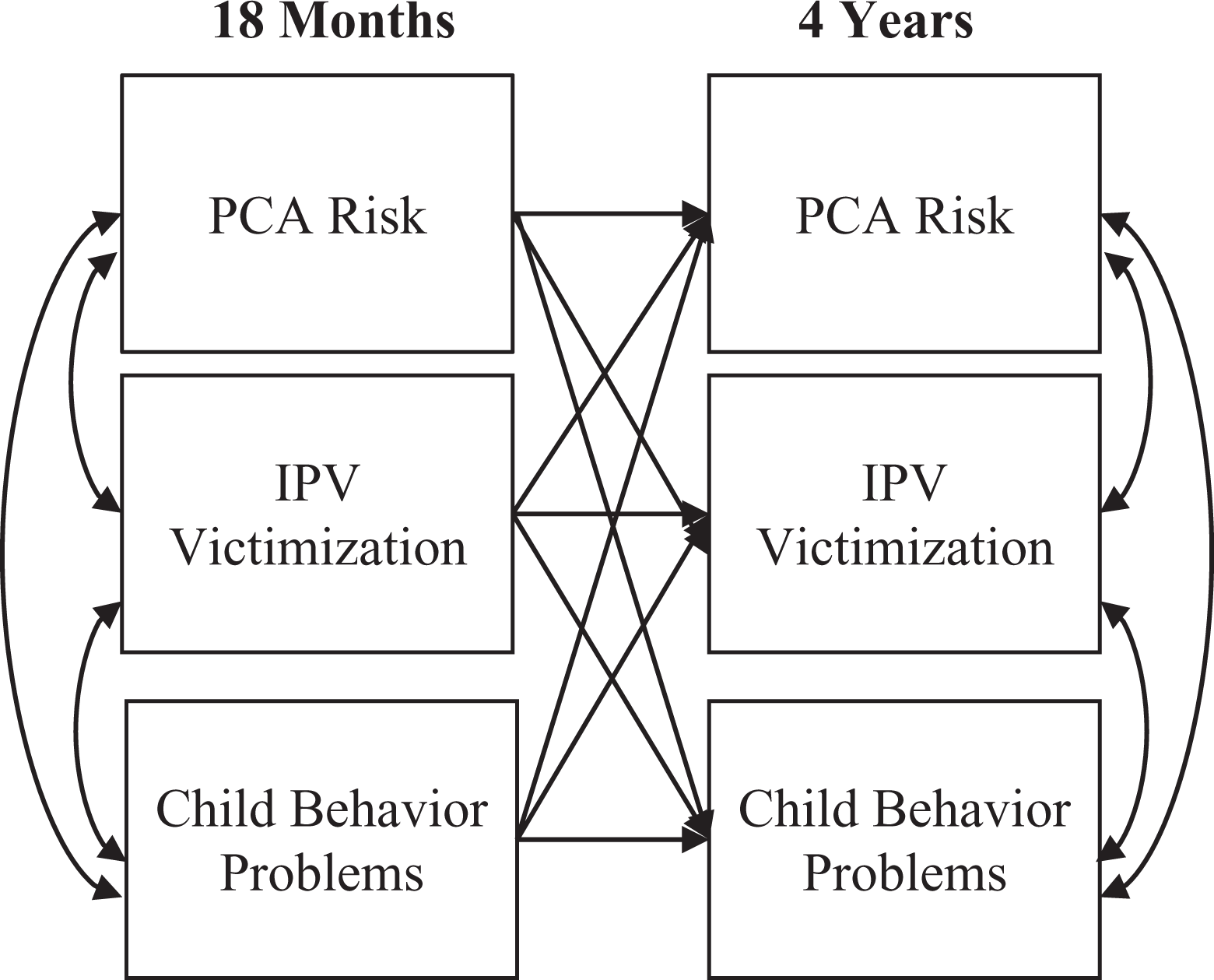
Theoretical model of bidirectional relations. Note. Bidirectional relations between parent-child aggression (PCA) risk, intimate partner violence (IPV) victimization, and child behavior problems from child age 18 months to 4 years.
Method
Participants and Procedures
The sample involved participants in the prospective longitudinal “Following First Families” (Triple-F) Study, which tracked parent-child aggression risk among first-time mothers and their male partners in a large urban city in the Southeast U.S. Mothers were recruited through flyers at four area hospital OB/GYN clinics, including oversampling at-risk families in the city’s primary public community health center. Mothers interested in participating contacted the lab to schedule a session for themselves and fathers where available, either in the research lab or in families’ homes. Fathers were required to be involved in direct caregiving at least one day per week to be eligible. All measures were delivered electronically on laptops. Mothers and fathers provided informed consent independently and completed the protocol in separate private rooms. The university’s Institutional Review Board approved all study procedures.
At Time 1, 203 primiparous women were enrolled in their last trimester of pregnancy, along with 151 of their male partners (87% of mothers in a relationship), for a three-wave study. Parents were reassessed when their children were 6 mo. (±2 weeks; Time 2) and 18 mo. (±3 weeks; Time 3). Two families were ineligible to continue by Time 2 due to death of the child, and one family lost custody of the child by Time 3. Families were later invited for an added fourth wave (Time 4) when their children were between 4 and 4½ years old (by which time an additional family had lost custody of their child). The current study focuses on families who participated at Time 3 (T3) and Time 4 (T4), waves that involved identical measures except to assess child behaviors, for which comparable, developmentally appropriate measures were used.
By T3, 180 mothers (90% of eligible T1 mothers) and 144 male partners were retained. At T4, 119 mothers and 85 male partners participated. Attempts to locate participants for T4 were made primarily by phone and email. Some families did not participate in T4 because they had moved out of state or because contact information had changed since T3. At T3, mean age for women was 27.6 years (SD = 5.76) and for men, 30.4 years (SD = 6.24). Women reported their racial/ethnic identity as: 48.9% White, 48.3% African American, 1.1% Asian, and 1.7% Native American; 3.3% of women also identified as Hispanic/Latina and 7.8% as biracial. Men reported their racial/ethnic identity as: 56.3% White and 43.8% African American; 4.2% of men also identified as Hispanic/Latino and 7.6% as biracial. Women reported their educational attainment as: 25.6% high school or less; 25.0% some college or vocational training; 21.1% college degree; and 28.3% > college degree. Men reported their educational attainment as: 29.1% high school or less; 25.7% some college or vocational training; 26.4% college degree; and 18.8% > college degree. At T3, 48% of mothers reported an annual household income ≤ $40,000, with 39% of women reporting receipt of public assistance. At Time 3, 87.8% of mothers reported they were currently in an intimate relationship and at T4, 91.6% reported they were in a relationship.
Measures
Parent-child aggression (PCA) risk
The Child Abuse Potential Inventory (CAPI; Milner, 1986) is a standard screening tool commonly used for child abuse risk assessment. The CAPI comprises 160 Agree/Disagree items that assess attitudes and behaviors associated with child abuse perpetration, but do not directly ask about parenting (e.g., “Children should never disobey”). An Abuse Scale is formed from 77 items that are variably weighted and scored, with higher scores indicating greater abuse risk. The Abuse Scale has strong evidence of reliability and predictive validity (Milner, 1994).
The Adult Adolescent Parenting Inventory-2 (AAPI-2; Bavolek & Keene, 2001) is a supplemental measure of child abuse potential, evaluating beliefs and behaviors that characterize abusive parenting (e.g., ““If you love your children, you will spank them when they misbehave”). Forty items are rated on a 5-point scale, and items are summed wherein higher total scores reflect greater child abuse risk. The test authors selected items that distinguish between maltreating and non-maltreating samples (Bavolek & Keene, 2001). The AAPI-2 had acceptable reliability in the current sample (α = .90 to .91 for mothers, .89 for fathers over time).
The Response Analog Child Compliance Task (ReACCT; Rodriguez, 2016) is a computerized analog task which evaluates parents’ strategies for handling child compliance and noncompliance. The task presents a realistic scenario in which the parent and child are depicted as running late for preschool. Twelve sequential scenes portray the parent giving an instruction to the child, after which the child is described as either compliant (eight instances) or noncompliant (12 instances). Parents can select from 16 possible adaptive (weighted positively), maladaptive (weighted negatively), or neutral responses. Throughout the task, a ticking clock induces time urgency, and each instance of securing child compliance results in receiving a game bonus of $0.50. Parents’ responses to noncompliance were used in this study, with higher Noncompliance scores indicating harsher responding. Across samples of varying risk levels, ReACCT Noncompliance scores demonstrated good internal consistency and concurrent validity with child abuse potential and abusive physical discipline (Rodriguez, 2016). In this sample, ReACCT showed acceptable reliability (α = .81 to .82 for mothers, .78 to .79 for fathers over time).
Intimate partner violence (IPV)
The Revised Conflict Tactics Scale-Short Form (CTS-2 S; Straus & Douglas, 2004) was used to estimate the frequency of current partner IPV victimization and perpetration in the last year. Of the 20 total items, the eight items assessing physical or psychological victimization were used in this study. Frequency counts are weighted and summed; higher total scores suggest greater experience of IPV. The CTS-2 S exhibits concurrent validity and associations with the well-established CTS-2 (Straus & Douglas, 2004).
Child behavior problems
The Brief Infant Toddler Social Emotional Assessment (BITSEA; Briggs-Gowan et al., 2004) was used to evaluate children’s socioemotional functioning at Time 3. Parents rated the frequency of their children’s feelings and behaviors on 42 items on a 3-point scale, and two items about their worries about children on a 4-point scale. These 44 items assess internalizing and externalizing problems as well as emotion dysregulation, which contribute to a BITSEA Total score. The BITSEA demonstrates good test-retest reliability, interrater reliability, and 1-year stability (Briggs-Gowan et al., 2004), and the current study obtained good reliability (α = .81 for mothers, .87 for fathers).
The preschool version of the Child Behavior Checklist (CBCL/1.5-5; Rescorla, 2005), a 99-item checklist measuring children’s internalizing and externalizing problems, was used at Time 4. This adaptation for children ages 1½ to 5 is an extension of the original CBCL for school-aged children (CBCL/6-18; Achenbach & Rescorla, 2001). On the CBCL/1.5-5, parents rate child behaviors from the past 2 months on a 3-point scale. Items are summed, with higher total scores indicating more total child internalizing and externalizing problems. Both versions of the CBCL have high individual item intraclass coefficients (>.90), and total scores have high convergent validity with other measures of children’s behavior problems (Achenbach & Rescorla, 2001; Rescorla, 2005). In the current sample, the CBCL totals demonstrated high internal consistency (α = .94 for mothers, .96 for fathers).
Demographic covariates
At each time point, parents reported their annual household income and highest educational attainment. Because income and educational level were highly correlated (r = .61 to .75 across time), they were standardized and averaged to create a composite socioeconomic status (SES) variable at each time point for mothers and fathers separately.
Data Analytic Plan
Missing data
Because of participant loss to follow-up, differential attrition analyses were first performed to evaluate whether participants who did not return for T4 differed from those retained at both waves. Independent samples t-tests and chi-square tests were performed for mothers and fathers separately. Analyses indicated that participants not retained did not differ significantly on any of the study variables at T3 (i.e., CTS-2 S, AAPI-2, CAPI Abuse Scale, ReACCT, or BITSEA scores), or on T3 sociodemographic variables including household income, education, age, or minority status.
Data reduction
Given multiple measures for PCA risk, data reduction was examined for AAPI-2 Total, CAPI Abuse Scale, and ReACCT Noncompliance scores. Exploratory factor analyses identified a single factor based on eigenvalues greater than 1 with all measures loading from .69 to .82 at T3 and .64 to .87 at T4 for mothers, accounting for 60.4% and 57.6% of the variance at T3 and T4, respectively; for fathers, loadings ranged from .68 to.87 at T3 and .74 to .80 at T4, accounting for 59.4% and 59.1% of the variance. Data reduction was achieved for PCA risk by creating a composite score that summed standardized scores for these three variables.
Primary analyses
Hypotheses were tested with autoregressive cross-lagged path models using Mplus 8.1 with Full Information Maximum Likelihood (FIML) estimation, using all available data to handle missing data. Path models were estimated for mothers and fathers separately (see Figure 1 for theoretical model). In addition, to consider crossover effects, parents were nested as a couple in an Actor-Partner Interdependence Model (APIM). The dyadic APIM simultaneously examines the effect of one member of the couple on their own dependent variable of interest (an actor effect) as well as crossing over to predict their partner’s dependent variable (a partner effect) (Cook & Kenny, 2006; Kenny et al., 2006). The dyadic model also used FIML to preserve the full sample size. To identify significant gender differences in the dyadic model, Wald statistics were utilized that constrained selected paths to be equal for mothers and fathers; only paths with significant actor effects for either mothers and/or fathers were tested for gender differences. Wald statistics for paths of interest were constrained one at a time.
Model fit was evaluated using root mean square error of approximation (RMSEA), standardized root-mean-square residual (SRMR), and comparative fit index (CFI). For RMSEA and SRMR, values < .08 are ideal; CFI values > .95 also denote adequate model fit (Kline, 2011). All reported path coefficients are standardized.
Results
Preliminary Analyses
Sample means, standard deviations, and correlations for all variables by time point and by parent gender are presented in Table 1. SES and child sex were examined as possible covariates. Given that higher SES was significantly associated with lower PCA risk for both mothers (r = .52 to .55, p < .001) and fathers (r = .40 to .57, p < .001) across time, SES was included as a time-varying demographic covariate in all path models. Neither mothers nor fathers reported significant differences in behavior problems between girls and boys on the BITSEA at T3 or the CBCL at T4; thus, child sex was not included as a covariate in the path models.
Means, Standard Deviations, and Correlations between Measures.
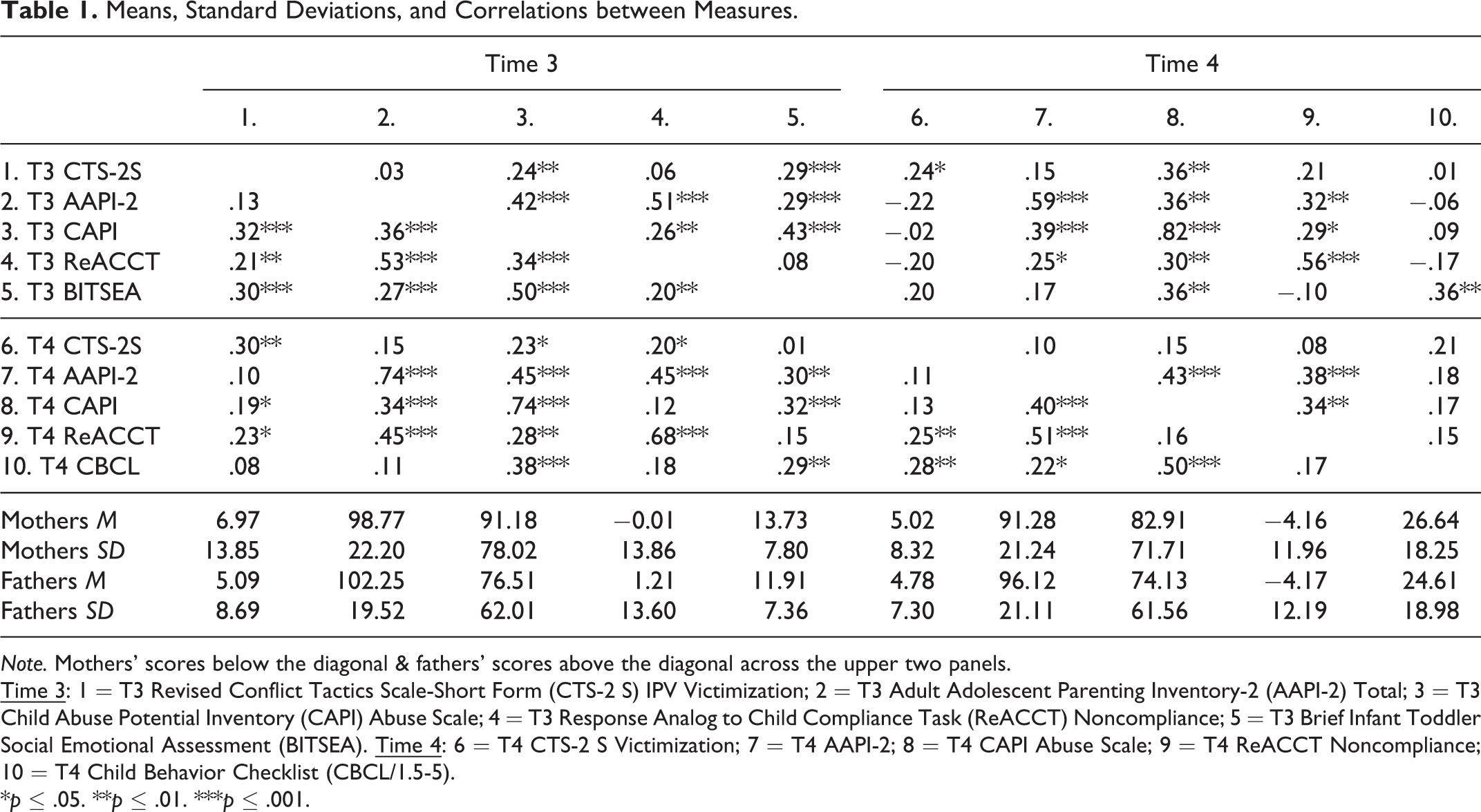
Note. Mothers’ scores below the diagonal & fathers’ scores above the diagonal across the upper two panels.
*p ≤ .05. **p ≤ .01. ***p ≤ .001.
Path Analyses
Mothers
Path analysis findings appear in Table 2. Model fit for mothers was adequate: χ2(6) = 14.744, p = .02; RMSEA = .090; SRMR = .015; CFI = .982. Mothers’ higher PCA risk at T3 significantly predicted both their greater IPV victimization at T4 as well as their reports of more child behavior problems at T4. With regard to child-driven effects, mothers’ reports of greater perceived child behavior problems at T3 significantly predicted mothers’ reported greater IPV victimization, but not PCA risk, at T4. No significant paths were identified between IPV and subsequent PCA risk or perceived child behavior problems.
Standardized Coefficients for Individual and Dyadic Path Models.

Note. T3=Time 3 (18 months); T4=Time 4 (4 years). PCA=Parent-Child Aggression Risk; IPV=Intimate Partner Violence Victimization; Child=Child Behavior Problems. N = 180 for mothers’ individual model, 144 for fathers’ individual model, and 186 for dyadic model.
Fathers
Fathers’ path analysis results also appear in Table 2. Model fit was adequate: χ2(6) = 18.826, p =.005; RMSEA = .122; SRMR = .015; CFI = .963. Fathers’ greater IPV victimization at T3 significantly predicted higher PCA risk at T4. However, no other significant paths were identified. To verify that results would not differ in using IPV victimization versus perpetration, analyses were conducted for fathers using their CTS-2 S reports of IPV perpetration in place of IPV victimization; model fit was adequate and significant effects did not change.
Dyadic APIM
Path analysis coefficients for the dyadic model are also in Table 2. Model fit was good: χ2(44) = 70.002, p =.008; RMSEA = .056; SRMR = .056; CFI = .973. Actor effects in the dyadic analyses indicated similar effects to the individual models for mothers, with the additional finding that mothers’ greater IPV victimization at T3 predicted their higher PCA risk at T4. For fathers in the dyadic model, no significant spillover effects were observed; IPV victimization at T3 no longer significantly predicted their PCA risk at T4 (reduced to marginal).
Partner effects were observed. For mothers, their partners’ (fathers) greater PCA risk at T3 predicted mothers’ own reports of more child behavior problems at T4. For fathers, their partners’ (mothers) greater PCA risk at T3 predicted higher levels of fathers’ report of IPV victimization at T4. Also, for fathers, their partners’ (mothers) reports of more child behavior problems at T3 predicted fathers’ reports of more child behavior problems at T4.
For the four paths that were significant for one parent but not the other, paths were further tested for possible differences by parent gender. Three significant Wald tests were identified. Although mothers’ PCA risk at T3 predicted their IPV victimization at T4, this significant path was not observed for fathers: Wald(1) = 4.018, p = .045. Likewise, mothers’ PCA risk at T3 also predicted their reports of child behavior problems at T4, but this was not evident for fathers: Wald(1) = 8.412, p = .004. Lastly, mothers’ reports of child behavior problems at T3 predicted their IPV victimization at T4, although again this path was not significant for fathers: Wald(1) = 6.832, p = .009.
Discussion
The present study tested family systems principles by evaluating spillover and partner crossover effects between IPV victimization, PCA risk, and perceived child behavior problems over time, as reported by mother-father dyads. Findings partially supported the hypotheses, with evidence of spillover occurring bidirectionally between reported IPV victimization and PCA risk for mothers and unidirectionally from reported IPV victimization to subsequent PCA risk for fathers. Results indicated several other significant associations for mothers only, including unidirectional spillover from mothers’ PCA risk to their subsequent reports of child behavior problems as well as child-driven effects linking perceived children’s behavior problems to mothers’ subsequent IPV victimization. Results from the dyadic model also indicated several partner effects unique to either mothers or fathers, again highlighting the interconnectedness of members within and between family subsystems.
Mothers’ PCA risk predicted their reported IPV victimization in both the individual and dyadic models; reciprocally, mothers’ IPV victimization predicted their PCA risk in the dyadic model only. Findings for mothers are consistent with the family systems tenet of reciprocal causality (Emery, 2014) and with prior studies documenting bidirectional spillover between couple conflict and parent-child conflict (e.g., Sears et al., 2016), particularly for mothers (Pu & Rodriguez, 2020). In contrast, fathers’ PCA risk did not predict their own reported IPV victimization in either model or their partners’ reports of IPV victimization in the dyadic model. However, fathers’ reports of IPV victimization predicted their PCA risk in the individual model (only marginal in the dyadic model, perhaps due to controlling for additional variables). This diverges from prior evidence of bidirectional spillover among fathers (Sears et al., 2016); the current findings suggest that fathers’ IPV victimization may interfere with their parenting, but their harsh parenting may not translate into greater risk for IPV. The spillover observed between PCA risk and IPV victimization indicate that different forms of family violence may not only co-occur but also form a dysfunctional feedback loop, which may affect women more strongly.
Mothers’ PCA risk also predicted their later reports of children’s behavior problems in both the individual and dyadic models, although this was not evident for fathers. Findings for mothers support the extensive literature connecting use of PCA with children’s internalizing and externalizing problems over time (e.g., Choe et al., 2013; Coley et al., 2014; Gershoff & Grogan-Kaylor, 2016), yet findings for fathers do not. Relative to previous research, the present study benefits from a rigorously controlled model which examined all variables simultaneously, thus controlling for continuity across time and multiple family subsystems. Yet the smaller sample size for fathers versus mothers in the current study may have limited the ability to identify significant effects and indicates a need for replication with a larger sample of fathers.
Likewise, child-driven effects were observed for mothers only. Mothers’ reports of toddler’s behavior problems predicted their later IPV victimization in both the individual and dyadic models, but did not predict their later PCA. Meanwhile, fathers’ reports of child behavior problems did not predict either their PCA risk or IPV victimization. The observed effects for mothers’ IPV is consistent with previous findings of child-driven effects (Heinrichs et al., 2010; Schermerhorn et al., 2007) and suggests that mothers who perceive their children as difficult are more likely to experience later couple discord that corresponds with victimization. The absence of this effect for fathers is notable and may stem from current sample size limitations for fathers, or a true lack of association, perhaps due to traditional gender roles (Riina & Fineberg, 2012). Again, more work is needed with fathers to clarify the absence of these effects. Findings on child evocative effects on parents’ physical PCA are mixed in the literature, but the results of this study are consistent with past work indicating that child behavior problems do not predict more punitive physical discipline (Coley et al., 2014). As some have proposed, this might mean that connections between PCA and child adverse outcomes are related due to the unidirectional effects of harsh parenting on children rather than the reverse (Coley et al., 2014), which would have clinical implications for parent-focused interventions aimed at child behavior modification.
Several crossover effects between parents were identified in the dyadic model, consistent with the emerging evidence of crossover effects within couples in previous models of PCA risk (Miragoli et al., 2018; Tucker et al., 2017). Fathers’ PCA risk predicted mothers’ subsequent reports of child behavior problems, whereas mothers’ perceptions of child behavior problems predicted fathers’ subsequent reports of child behavior problems. These findings suggest that both mothers and fathers appear to be influenced by their partners’ perceptions of their child. Additionally, mothers’ PCA risk predicted fathers’ later IPV victimization, suggesting that mothers’ use of physical PCA might then generalize to more aggression toward their partners. Again, this highlights the overlap between PCA and IPV (Dixon & Slep, 2017), as mothers may display aggressive behavior patterns toward both their children and their partners.
Prior research has been mixed with regard to gender differences in family spillover pathways, with some studies observing stronger spillover for mothers (e.g., Pu & Rodriguez, 2020) and others observing effects for fathers (e.g., Moore & Florsheim, 2008). Current findings point to a stronger spillover effect for mothers, in contrast to the propositions of the father vulnerability hypothesis (McCoy et al., 2013). Present results instead support previous findings that mothers are more vulnerable to spillover from one family domain to another (Kopystynska et al., 2017; Pu & Rodriguez, 2020; Rodriguez et al., 2018). The mechanism for this vulnerability remains unclear. Perhaps mothers were more affected by spillover due to the salient role that mothers have historically occupied in child-rearing, relative to fathers (Riina & Feinberg, 2012). Traditional gender role attitudes would suggest that fathers may be less involved in caretaking or have less contact with children than mothers (Riina & Feinberg, 2012), particularly fathers who are non-residential, and this could contribute to the relative lack of spillover for fathers. Indeed, more traditional gender role attitudes are associated with greater PCA risk for both mothers and fathers (Gowda & Rodriguez, 2019). Future work could further investigate the impact of parents’ gender role attitudes in spillover between PCA and IPV, particularly as children transition from toddlerhood into their early school years.
Although this study benefits from its use of nested mother-father data to explore family violence across two timepoints, some methodological limitations warrant consideration. The study relied on parent-reported data and did not observe IPV or PCA directly. Self-report biases related to attention, selective recall, and social desirability may compromise the accuracy of such reports (Möricke et al., 2016). Source biases may be exacerbated when disclosing information about sensitive topics such as IPV or PCA, which are often unrecognized and underreported by men and women alike (Chan, 2011). Although IPV and PCA cannot and should not be observed or induced in the laboratory, both pragmatically and ethically, future studies could include new multimethod innovations to improve IPV assessment (Follingstad & Rogers, 2013) or supplement with observer ratings of child functioning or harsh parenting. Of note, both physical and psychological IPV were combined in this study, which may impact findings and implications, as future work may attempt to disentangle to effects of both forms of IPV.
Other limitations serve as directions for future research. Although this study focused on dysfunction at the dyadic or subsystem levels for adults, other family dynamics and parents’ intrapersonal challenges (e.g., mental health concerns) could be included in future models, given that parents’ personal distress may crossover to affect their partners’ parent-child or couple relationships (Miragoli et al., 2018; Tucker et al., 2017). Further, child assessment for behavior problems at 18 months and at 4 years involved different measures, although these measures are considered developmentally appropriate and generally parallel. Children were not assessed between 18 months and 4 years of age, a considerable gap in time that may have attenuated some effects and contributed to attrition, and families were only evaluated through age 4. More frequent and continued assessment across time, in larger samples, would provide greater stability in model estimates of child behaviors and illuminate potential changes in spillover over time as children age and family structures evolve. Child sex was not examined in current analyses but could be relevant in future work conducted after age 4, when gender differences in disruptive behaviors typically emerge (Combs-Ronto et al., 2009). Lastly, despite considerable racial diversity in this sample, parents identifying as Latinx were somewhat underrepresented and merit further study. Despite oversampling for risk, this sample involved parents recruited from the community; replication in other samples would help ascertain further generalizability, including cross-cultural samples, clinical or treatment-seeking samples, families at risk or substantiated for IPV or child abuse, or community samples with same-sex couples or parents of older children.
Current findings demonstrate the mutual influence of individuals and subsystems within the family. Although it is important to remember that statistical longitudinal predictions do not demonstrate causality, the need for family prevention and intervention services is clear. Particularly for mothers, higher PCA risk may herald an increased risk for subsequent IPV victimization and vice versa. The clinical implications are substantial: mothers seeking treatment for IPV or couple conflict may benefit from additional attention to their parenting and child discipline behaviors. Likewise, parents under investigation for potential child abuse or seeking treatment for improved parenting strategies may also benefit from screening and/or prevention of IPV or couple conflict. The relative absence of significant effects for fathers in the current study does not indicate that fathers do not require further inquiry, but rather points to the need for continued inclusion of fathers in family research to better understand their roles as partners and parents. Innovative research assessments replicated in various social and cultural contexts will also help shed light on the generalizability of current findings. Ultimately, examining processes between individuals and across subsystems within the family will be necessary to achieve a more comprehensive understanding of family violence.
Footnotes
Authors’ Note
We thank our participating families and participating Obstetrics/Gynecology clinics that facilitated recruitment.
Declaration of Conflicting Interests
The author(s) declared no potential conflicts of interest with respect to the research, authorship, and/or publication of this article.
Funding
The author(s) disclosed receipt of the following financial support for the research and/or authorship of this article: This research was supported by award number R15HD071431 from the National Institute of Child Health and Human Development to the second author, and by award number TL1TR003106 from the National Center for Advancing Translational Sciences to the first author. The content is solely the responsibility of the authors and does not necessarily represent the official views of the National Institutes of Heath. This project was also supported by the Jesse B. Milby Endowed Support Fund; Mamie Phipps Clark Diversity Research Grant, Psi Chi International Honor Society in Psychology; American Psychological Foundation Annette Urso Rickel Foundation Dissertation Award; and American Psychological Association, Society for Child and Family Policy and Practice Section on Child Maltreatment Dissertation Grant Award
