



Abstract
This study examined injuries that may precede a child maltreatment (CM) diagnosis, by age, race/ethnicity, gender, and Medicaid status using a retrospective case–control design among child members of a large integrated healthcare system (N = 9152 participants, n = 4576 case). Injury categories based on diagnosis codes from medical visits were bruising, fractures, lacerations, head injury, burns, falls, and unspecified injury. Results showed that all injury categories were significant predictors of a subsequent CM diagnosis, but only for children < 3 years old. Specifically, fracture and head injury were the highest risk for a subsequent CM diagnosis. All injury types were significant predictors of maltreatment diagnosis for Hispanic children < 3 years, which was not the case for the other race/ethnicities. Overall, these findings suggest that all types of injury within these specific categories should have a more thorough assessment for possible abuse for children under 3 years. This work can inform the development of clinical decision support tools to aid healthcare providers in detecting abusive injuries.
Child abuse is pervasive in the United States (Wildeman et al., 2014) and is associated with numerous deleterious outcomes (Afifi et al., 2012; Danese & Tan, 2014; Dunn et al., 2013; Hughes et al., 2017; Mills et al., 2013; Weder et al., 2014; Wildeman et al., 2014). Child welfare records indicate that 678,000 children experienced substantiated maltreatment in 2018, including 1770 fatalities (U. S. Department of Health and Human Services, 2019). Suspected maltreatment is reported to child protective services through mandated reporters in schools, healthcare systems, law enforcement, as well as other community contexts such as neighbors, churches, and childcare (Sedlak et al., 2010). Healthcare providers account for approximately 10% of the maltreatment reported by professionals (e.g., teachers and police officers) (Child Welfare Information Gateway, 2019). However, the rates of maltreatment recorded by healthcare systems are likely an underrepresentation of the actual prevalence (Schnitzer et al., 2004), necessitating solutions to improve identification of potential abuse.
Previous studies have described substantial underreporting of pediatric injuries from clinicians to protective services, even among high risk injuries (Flaherty et al., 2008; Ravichandiran et al., 2010). For example, nearly one in three suspicious head injuries to young children are not reported (Jenny et al., 1999). Prior work describes a number of barriers to accurately detect and document child maltreatment (CM), such as concerns related to lack of resources to deal with maltreatment, a “grey zone” of probable maltreatment, and a fear that coding abuse in the medical record will be more harmful than helpful (Rovi & Johnson, 2003). Demographic characteristics such as age, gender, race/ethnicity, and low income (receiving Medicaid insurance) may be important considerations when assessing potential abusive injuries or biases in diagnosis. For example, abusive head trauma is most common in children under 5, with particularly high risk for those under age 1 (Jenny et al., 1999; Parks et al., 2012; Shanahan et al., 2013). While there are specific “sentinel” injuries that are highly unlikely to occur accidentally in an infant, such as frenulum tears or bruising to the face or trunk (Lindberg et al., 2015; Sheets et al., 2013), other types of injury may be more difficult to diagnose as abuse because of the inability to obtain an account of the cause of injury from the child (Gilbert et al., 2009). Black children are significantly overrepresented in referral to child welfare (Drake et al., 2011), and this disparity may stem from a bias in the assessment of suspicious injuries by healthcare providers (Jenny et al., 1999) and higher likelihood of being reported for abuse (Flaherty et al., 2008). For example, abusive head trauma was missed more often in white than minority children, indicating that head injuries are less likely to be suspected as abuse for white children (Jenny et al., 1999). Conversely, several studies have found that Black children are less likely to be evaluated for physical abuse when presenting with a visible injury (Eismann et al., 2020; Wood et al., 2015). Regarding gender, boys with extremity fractures were found to be at twice the risk for a delayed diagnosis of abuse than females (Ravichandiran et al., 2010), indicating that physicians may be less likely to assume arm or leg bone fractures are a result of physical abuse among boys. Finally, receipt of public insurance has been found to increase the odds of a CM diagnosis (Kuang et al., 2018), indicating socioeconomic status may be an important consideration for understanding CM reporting disparities. Data-driven methods may enhance the ability of clinicians to decide whether injuries are associated with abuse, eliminate some of the “grey zone” in clinical decision making, and prevent future abuse for these children.
Current Study
To improve identification and reporting of child maltreatment, this study examined specific types of injuries that may precede a CM diagnosis separately by age, race/ethnicity, gender, and Medicaid status. We used specific injury categories that have empirical and clinical support for indicating CM (i.e., bruising, burns, lacerations, fractures, head injuries, falls, and unspecified injuries) (Berger et al., 2018; King et al., 2015) as predictors of a subsequent diagnosis of maltreatment (suspected or confirmed) using a retrospective case–control design. Injury and CM diagnoses were obtained from the electronic health records (EHR) of members of a large integrated healthcare system. As repeat injuries occur for approximately 30% of abuse cases, there is a critical need to identify abuse-related injuries at the earliest encounter (Jenny et al., 1999; Ravichandiran et al., 2010).
Methods
Setting
Data were obtained from a large integrated healthcare delivery system in the southwest United States serving over 4.6 million racially and socioeconomically diverse members, including 1.5 million children. There are 15 medical centers (including inpatient and outpatient services) and 233 medical offices (outpatient). Health care is coordinated through an integrated EHR system that captures comprehensive information on the healthcare members receive at owned and contracting facilities. The healthcare system also obtains claims data on any out-of-network care that members receive. In terms of the representativeness of the members to the population of the region, comparisons with census data show that the proportion of Hispanic/Latinos was between our health system and the census reference population (Koebnick et al., 2012). In addition, neighborhood education levels and household income were similar between members and the census reference population. The exception being that there was a marginal underrepresentation of individuals with very low income and very high education.
Study Population
Demographic Characteristics of the Sample.
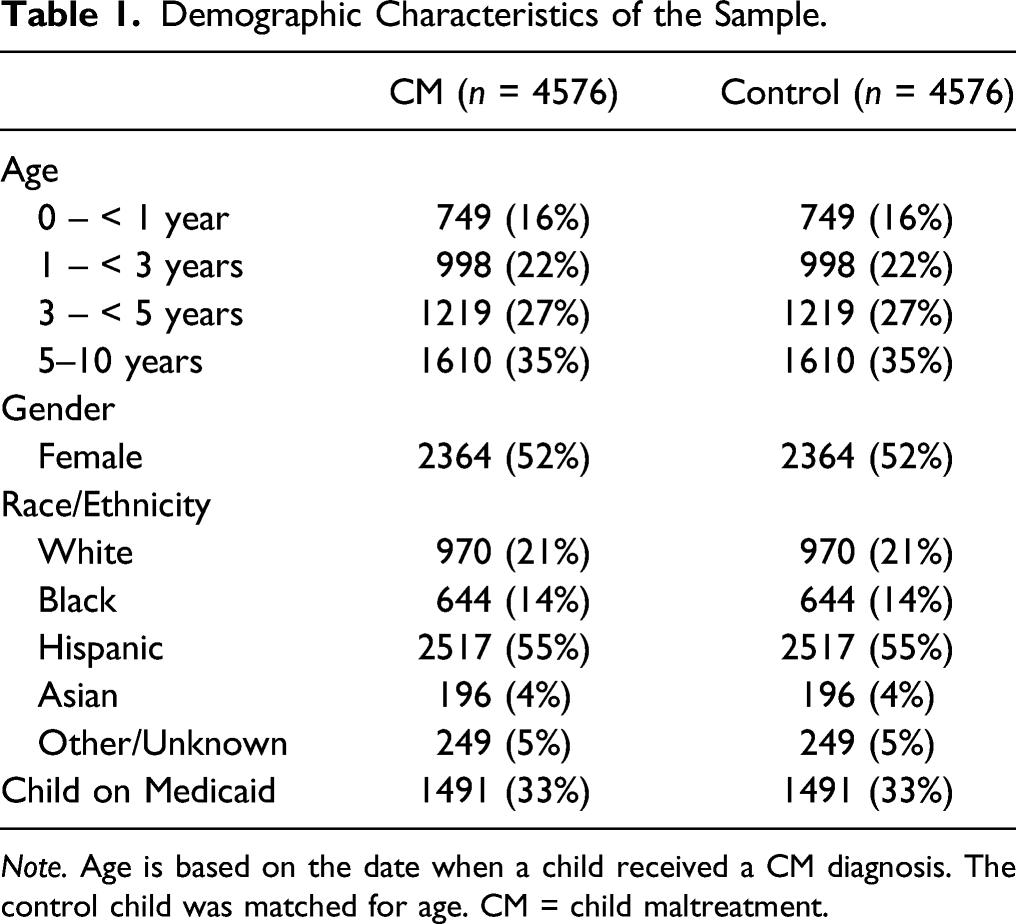
Note. Age is based on the date when a child received a CM diagnosis. The control child was matched for age. CM = child maltreatment.
Measures
Maltreatment Codes
Child maltreatment was defined by using the specific CM codes from the International Classification of Disease 9th and 10th revision (ICD-9 and ICD-10) and internal (healthcare system–specific) CM codes. These codes are entered into the child’s EHR by the medical provider during a healthcare visit. ICD-9 codes included 995.5 to 995.59, and ICD-10 codes included “child abuse neglect and other maltreatment confirmed” T74.02 to T74.92 (XA, XD, and XS) as well as “child abuse neglect and other maltreatment suspected” (T76.02 to T76.92) (XA, XD, and XS). We also included perpetrator codes after verifying by chart review that this indicated CM. These ICD-9 codes were E967.0 to E967.9, and ICD-10 perpetrator codes were Y07.01 to Y07.9. In addition, internal codes (not used for billing) indicating CM were manually mapped to the corresponding ICD code. Previous chart review has confirmed validation of the maltreatment ICD codes in progress notes (Negriff et al., 2020). Prior studies have also supported the validity of using these codes to capture maltreatment (Schnitzer et al., 2004).
Injury Codes
Using ICD codes and categories of injury validated by King et al. (2015) and Berger et al. 2018 to indicate possible CM and physical abuse in particular, we performed a keyword search on the ICD database to capture all possible ICD codes indicating bruising, fractures, lacerations, head injury, burns, and falls. We also captured a category of unspecified injury. We performed a backward and forward search between ICD-9 and ICD-10 to ensure we captured all possible injury codes. We specifically excluded codes for contusions on appendages that were likely accidental self-injury (e.g., contusion on knee).
Statistical Analysis
Univariate logistic regression was used to test each individual injury type (burn, bruise, laceration, fracture, head injury, fall, and unspecified injury) as a predictor of CM diagnosis. One injury type was tested at a time to estimate the individual contribution of each type of injury to the outcome. Models were run separately by age group (birth to < 1 year [11.99 months], 1 to < 3 years, 3 to < 5 years, and 5–10 years). Because the general pattern of significance was the same in the two youngest age groups and some of the cell sizes were very small in the birth to < 1 year age group, we combined these two groups for subsequent analyses (birth to < 3 years) and examined the effects of gender (male/female), race/ethnicity (Black, white, Hispanic, Asian, Multiple/Other/Unknown), and Medicaid status (yes/no) by these newly combined age groups. If there were zero instances for an injury type within either the case or control groups, the Haldane correction was used to estimate the odds ratio (OR) and modified confidence intervals (CI). Next, a multivariable logistic regression model was run including all seven injury categories simultaneously to determine the risk for a CM diagnosis for each injury type after controlling for the presence of the other injury types. This was conducted separately for each age group. Collinearity tests were performed and no issues were detected. Finally, robust Poisson regression was used to compare the count of total injury types (sum of seven injury categories) as a predictor of CM diagnosis by age group to determine if a higher number of different injury types increased the risk for a subsequent CM diagnosis. Robust standard errors were calculated for the parameter estimates to control possible mild violation of the distribution assumption that the variance equals the mean. For all analyses, sensitivity analyses were performed by excluding the subjects in race/ethnicity group “Multiple/Other/Unknown.”. The results from the sensitivity analyses did not differ substantively from the full sample so we only report the full results. Analyses were conducted using Statistical Analysis System (SAS) software v9.4 (Cary, NC). Significant main effects are reported after adjustment for multiple comparisons using Holm’s step-down method (Holm, 1979).
Results
Descriptives
The study sample included 9142 children (n = 4576 in each group), 38% were less than 3 years old, 52% were female, 55% were Hispanic, and 33% had Medicaid insurance (Table 1). The most common injury category for the CM group was unspecified injury (28% of participants received this type of ICD code), followed by laceration (27% of participants received this type of ICD code). For the control group, laceration was the most common injury category (25% of participants received this type of ICD code), followed by unspecified injury (23% of participants received this type of ICD code).
Individual Models for Injury Types
Age
Logistic Regression for Each Injury Type as a Predictor of Child Maltreatment Diagnosis by Age Group.

Note. Bolded OR are significant after correction using Holm’s step-down method; CM = child maltreatment; CI = confidence interval.
Gender
Logistic Regression for Each Injury Type as a Predictor of Child Maltreatment Diagnosis by Gender and Age Group.
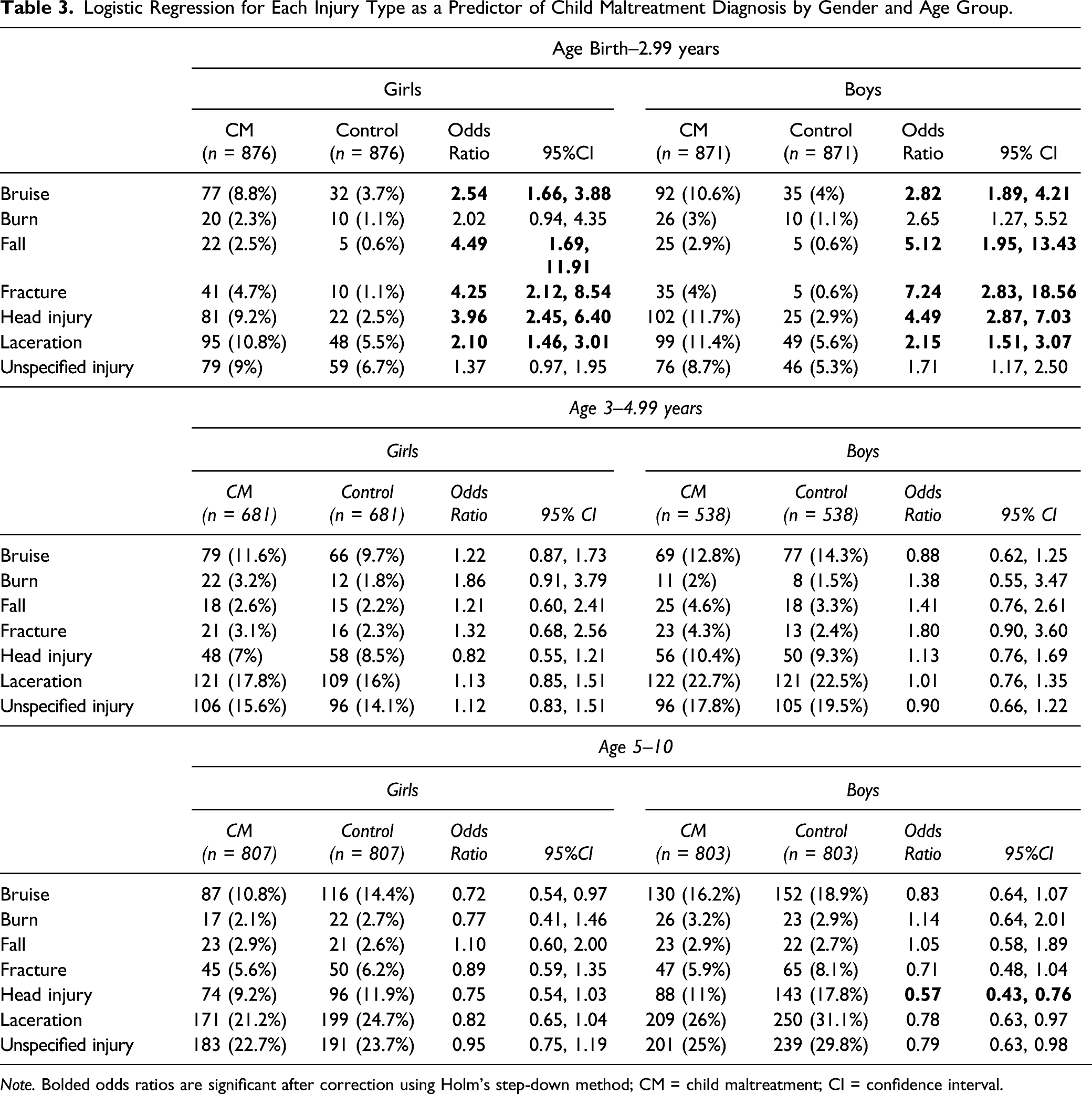
Note. Bolded odds ratios are significant after correction using Holm’s step-down method; CM = child maltreatment; CI = confidence interval.
Race/Ethnicity
Logistic Regression for Each Injury Type as a Predictor of Child Maltreatment Diagnosis by Race/Ethnicity (For Birth to < 3 year Age Group Only).
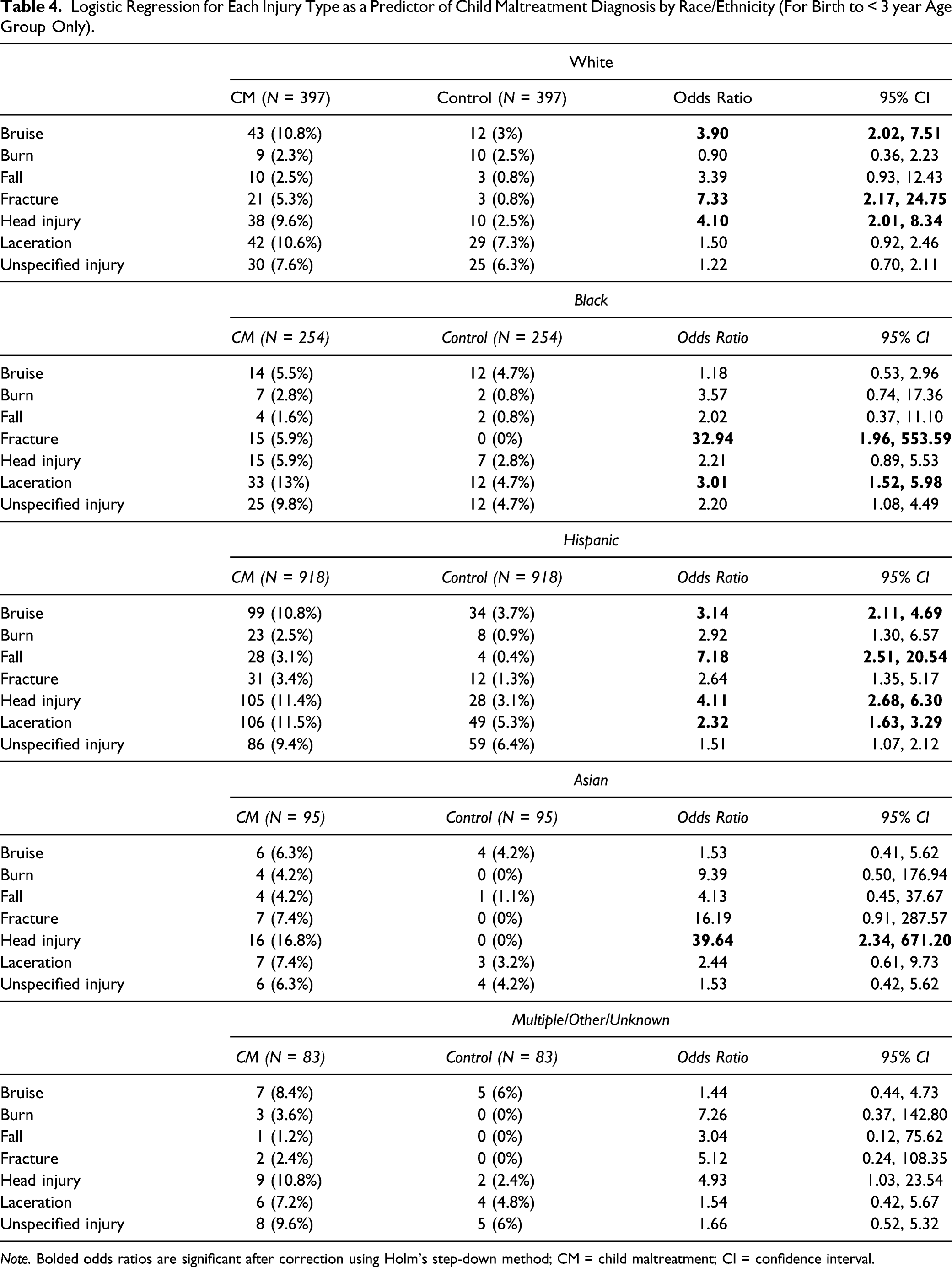
Note. Bolded odds ratios are significant after correction using Holm’s step-down method; CM = child maltreatment; CI = confidence interval.
Medicaid
In the youngest age group (birth to < 3 years), all injuries types were significantly associated with CM diagnosis for the Medicaid group, except fall and unspecified injury. Fracture (OR = 5.15, 95% CI = 1.75–15.17) and burn (OR = 4.14, 95% CI = 1.68–10.20) had the highest odds for CM diagnosis. For the non-Medicaid children, fall (OR = 5.42, 95% CI = 2.41–12.21), fracture (OR = 5.29, 95% CI = 2.76–10.15), head injury (OR = 4.51, 95% CI = 3.04–6.70), and laceration (OR = 1.95, 95% CI = 1.41–2.68), were the only significant predictors of CM diagnosis. In the 3 to < 5 year age group, there were no significant effects for either the Medicaid or non-Medicaid group. Lastly, in the 5- to 10-year-old age group, head injury reduced the odds in the non-Medicaid group (OR = .60, 95% CI = .46–.79).
One Model for All Injury Types
Logistic Regression Predicting Child Maltreatment Diagnosis by Age Group, All Injuries Entered in Same Model.
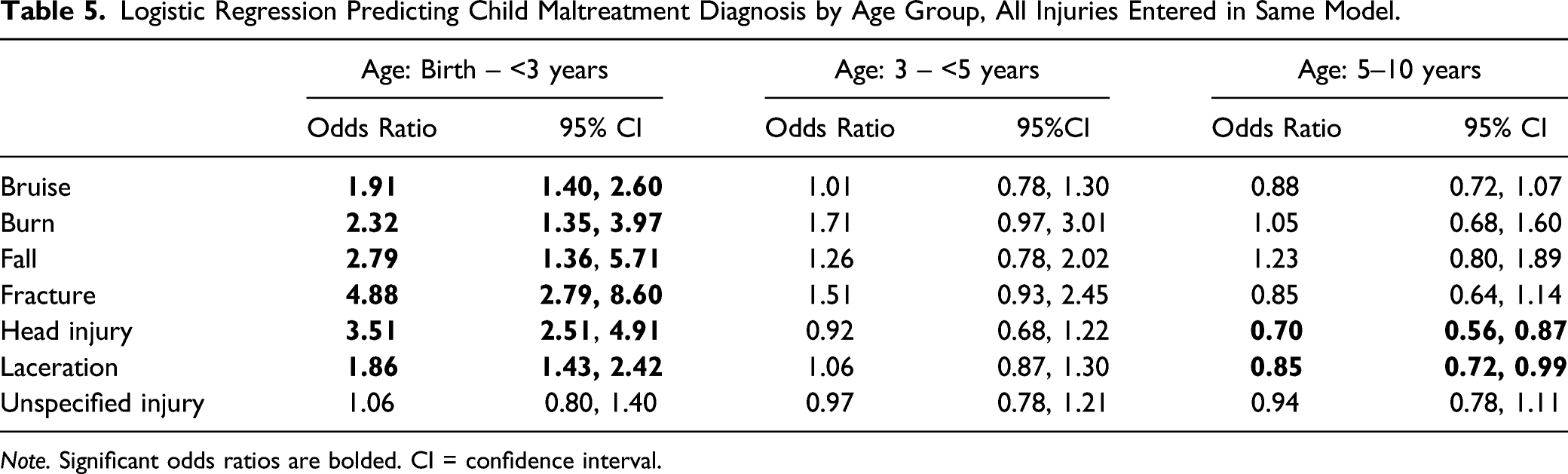
Note. Significant odds ratios are bolded. CI = confidence interval.
Total Injury Types
The results of the robust Poisson regression showed that a higher number of different injury types increased the risk of a subsequent CM diagnosis by 28% for each additional injury type (RR = 1.28, 95% CI = 1.24–1.32), but only in the birth to < 3 year age group. Conversely, a higher number of injury types was associated with lower risk in the 5- to 10-year-old age group (RR = .93, 95% CI = .90–.96). There was no effect in the 3- to < 5-year-old age group.
Discussion
Injuries preceding a CM diagnosis by a healthcare provider may be useful in helping to prevent future injury. Using a case–control matched design the current study found that for children < 3 years of age, most injury categories were significant predictors of a subsequent CM diagnosis with fractures and head injuries resulting in the highest risk for CM. However, none of the injury types were associated with CM for older age groups (3–10 years) and were not consistently associated with CM diagnosis when comparing gender or race/ethnicity. The number of different types of injury also appears to be a substantial risk factor, with each additional injury category increasing the risk by 28% for children under 3 years old. This means that children with three different types of injury categories had an 84% increased risk for a subsequent CM diagnosis. Overall, these findings demonstrate that for children under 3 all types of injuries within the categories of burn, bruise, laceration, fracture, and head injury should have a more thorough assessment for possible abuse and this recommendation does not depend on gender, race, or ethnicity.
The finding that bruise, fracture, head injury, and laceration were significant predictors of CM diagnosis for children under 3 years old but not for those 3–10 years old is consistent with other studies (Lindberg et al., 2015). However, we did not find differences between infants (< 1 year) and toddlers (1 to < 3years) in the types of injuries that predicted a CM diagnosis, as other studies have (Hutchings et al., 2010; James-Ellison et al., 2009; Keenan et al., 2004; Pierce et al., 2010; Vinchon et al., 2005). Importantly, our results provide support for the utility of assessing injuries in young children as potential abuse up to 3 years, rather than just in infancy (< 1 year). Fractures (5 fold risk increase) and head injuries (3.5 fold increase) had the highest risk for a CM diagnosis, but only among those < 3 years of age. Gender did not appear to demonstrate substantial differences as boys and girls had similar risks for CM diagnosis, and again only while under 3 years old.
Regarding differences by race/ethnicity, we found the majority of significant effects in the Hispanic youth aged birth to < 3 years followed by the white youth, then Black youth, and Asian youth. Interestingly, fracture predicted a subsequent CM diagnosis for both white and Black youth, but not Hispanic youth, whereas head injury predicted CM diagnosis for white, Hispanic, and Asian youth, but not Black youth. Generally, national data indicate that Black children are referred to Child Protection at the highest rates, followed by Hispanic youth (U. S. Department of Health and Human Services, 2020). Indeed, in the EHR data, we found that across all ages, Black youth had the highest incidence of CM diagnosis of all race/ethnicities. Yet, our results indicate that perhaps this is not being driven by higher rates of injury, leaving uncertainty regarding what the CM diagnosis was based on. Stereotypes may be a source of bias that impacts the medical assessment of suspicious injuries. (Najdowski & Bernstein, 2018). Most importantly, these results should not be taken to imply that Hispanic children should be assessed more thoroughly than other race/ethnicities, but that convergence on injury types that predict maltreatment across groups may prove to be more useful in reducing under- or overreporting for children of racial minorities. In our view, these results support recommendations to use objective and routine evaluation protocols that will mitigate the potential bias that may occur.
Many healthcare systems use screening methods for suspicious injuries based on markers such as age and type of injury, sentinel injuries, repeated injuries, or a history that is inconsistent with the injury (Gilbert et al., 2009; Lindberg et al., 2015). However, despite additional training or decision support tools, pediatric healthcare providers will also need to use their clinical judgment to evaluate suspicious injury cases, and more work needs to be done to help improve their confidence in these decisions. In addition, the integration of CM prevention programs into pediatric primary care could help medical providers assess risks and address them in the context of the visit. For example, the Safe Environment for Every Kid (SEEK) model was developed to help healthcare providers identify and address risk factors for CM (Dubowitz et al., 2009). Two large randomized controlled trials showed that children who received the SEEK intervention were less likely to be maltreated, and mothers reported less aggression and physical assault than the controls (Dubowitz et al., 2009; Dubowitz et al., 2012). Other programs such as Connected Kids: Safe, Strong, and Secure (Sege et al., 2005), developed by the American Academy of Pediatrics (AAP), provide training and education to the pediatrician and parent but has not been formally evaluated for CM prevention. Similarly, “Practicing Safety” conducted by the AAP also provides anticipatory guidance and educational material for use in pediatric primary care to address topics such as coping with crying, discipline, sleep, feeding, and toilet training. Unfortunately, a review of primary care interventions for CM by the US Preventive Services Task Force determined that the evidence on primary care interventions for CM was insufficient to assess the balance of benefits and harms, but also found no evidence indicating prevention of CM in primary care would be harmful (Curry et al., 2018). Screening for adverse childhood experiences (ACEs) is also gaining widespread implementation in pediatric primary care, albeit with the goal of assessing health risks rather than CM prevention (Bhushan et al., 2020). Yet, the ACEs screener assesses some of the same psychosocial risk factors for maltreatment as the SEEK screener (e.g., parental mental illness, parental substance use, and exposure to domestic violence) and could be used in conjunction with the SEEK model to focus on CM prevention.
Limitations
There are limitations to the present study that should be noted when interpreting the findings. First, we obtained the injury types based on keyword search for the main categories of injury that have been validated previously. It is possible that we missed some ICD injury codes using this approach. Based on the uncertainty with the accuracy of ICD codes for specific injuries, we chose to aggregate the codes into larger categories. In our clinical experience, medical providers will often use a drop-down menu and select the first code that fits. Therefore, we do not suspect that using more granular codes will be useful in predicting maltreatment. Second, our “case” sample was restricted to those children who received a diagnosis code for CM, which may not accurately capture all actual instances of maltreatment. Some maltreatment may be indicated in progress notes and not receive an ICD code. We were also restricted in our age groupings and could not conduct analyses for each year of age because of small cell sizes for some injury types. It is important to note the potential limitation of the use of retrospective EHR data versus prospective longitudinal data as we are limited by the data available to us and cannot assess variables that are not documented in the EHR. Certain variables that may predict CM diagnosis were not available as part of our study. For example, we did not include chart review to determine how providers made decisions about injuries in prelingual children (Gilbert et al., 2009) or injuries inconsistent with a reported history. These remain key aspects of the healthcare provider’s assessment of injuries and their critical role in assessing the history and consistency of the explanation by the parent with the actual injury (Flaherty et al., 2008).
Conclusion
The prevention of CM is a critical issue and healthcare providers have an important part in recognizing and reporting abuse. Our results indicate that most types of injuries are useful in determining risk for future maltreatment, but only for young children (< 3 years). This work suggests that many types of injury for a child under 3 years are a risk, and therefore all types of injury within these categories should have a more thorough assessment for possible abuse. Additionally, fracture and head injury were the highest risk for CM diagnosis in our final model as well as the most consistent risk across our analyses split by age, race/ethnicity, gender, and Medicaid status, demonstrating utility as the most universal high-risk injury types for young children. Finally, our findings also support the risks of multiple types of injuries as each additional injury type increased the risk of a subsequent CM diagnosis by 28%. Early identification of abuse is particularly critical for mitigating the short- and long-term effects on children and families and these findings advance our knowledge of the types of injuries that may help identify young children with elevated risk for abuse.
Footnotes
Declaration of Conflicting Interests
The author(s) declared no potential conflicts of interest with respect to the research, authorship, and/or publication of this article.
Funding
The author(s) received no financial support for the research, authorship, and/or publication of this article.
