



Abstract
Research is needed to better understand how childhood maltreatment history affects parental reflective capacities, and whether early childhood interventions help mitigate these effects. We examined associations between childhood maltreatment and current parenting (parental reflective functioning, parenting behaviors) among mothers who participated in a follow-up study (N = 97) of the Minding the Baby® (MTB) randomized control trial. MTB is a home visiting program that aims to help mothers understand their child’s mental states (feelings, intentions, needs) by promoting parental reflective functioning. Mothers retrospectively reported childhood maltreatment using the Childhood Trauma Questionnaire. Endorsing a higher number of childhood maltreatment subtypes was associated with less supportive/engaged parenting and higher pre-mentalizing modes, or difficulty with appropriately reflecting on the child’s mental states. These relationships were not moderated by participation in the MTB intervention. However, exploratory analyses of individual maltreatment subtypes revealed that participation in MTB may mitigate the harmful effects of childhood emotional abuse on pre-mentalizing modes, specifically. Further research is needed to understand the mechanisms through which early childhood interventions may prevent intergenerational cycles of maltreatment.
Parents who experienced childhood maltreatment are at increased risk for negative parenting behaviors (e.g. aggression, overcontrol), less positive parenting (e.g. responsivity, sensitivity), impaired parent-child relationships and interactions, and perpetrating maltreatment against their own children (Madigan et al., 2019; Savage et al., 2019). Despite these risks, research consistently demonstrates that intergenerational transmission of maltreatment and adversity can be prevented by promoting a safe, stable, and nurturing environment for the child (Britto et al., 2017), and today there are a myriad of interventions available to help promote positive parenting among families (Chen & Chan, 2016). However, few programs have evaluated whether these effects are sustained over time (Eckenrode et al., 2017), and the mechanisms through which these programs mitigate the harmful effects of parental maltreatment history remain poorly understood. Given the global prevalence of childhood maltreatment (Stoltenborgh et al., 2015), identifying these mechanisms is critical for appropriately targeting and tailoring interventions to support families with trauma histories.
Parental Reflective Functioning
Parental reflective functioning (PRF) describes a caregiver’s capacity to envision and reason about their own and their child’s mental states, namely their thoughts, feelings, and intentions (Slade, 2005). PRF is an overt manifestation of underlying mentalizing processes (Fonagy & Target, 1997) that help human beings understand one another, and specifically help caregivers make sense of their child’s inner world and behavior. Highly reflective parents are interested in and curious about their child’s mental states, and see their child’s behavior in light of mental states (“he turned away from me because he’s angry at me”). Reflective parents appreciate that, as well as they may know the child, there are parts of the child’s experience that will remain opaque to them. Highly reflective parents also appreciate the interconnectedness of minds and specifically that their thoughts and feelings have a powerful impact on the child (Slade, 2005). Parents who have difficulty with reflecting on their child’s mental states may be overly certain about their child’s thoughts or intentions, or may misinterpret a child’s behavior as malicious or ill-intended, even when the child is very young. This stance, in which the parent misreads the child’s thoughts and feelings (“she’s clinging to me just to annoy me”), is described as pre-mentalizing (Luyten, Nijssens, et al., 2017; Slade, 2005).
PRF is associated with a number of positive outcomes for caregivers and their children, including secure maternal-infant attachment, tolerance of infant distress, parenting sensitivity (e.g. responsiveness to child’s behavioral signals), lower maternal physiologic stress, and fewer child externalizing behavior problems (e.g., aggression, hostility) (Ensink, Bégin, et al., 2016; Fonagy & Target, 1997; Grienenberger et al., 2005; Rutherford et al., 2013, 2015; Slade et al., 2005). Poor reflective functioning has also been observed in mothers with histories of depression, substance use, and other psychosocial risk factors (Smaling et al., 2015; Stacks et al., 2014; Suchman et al., 2010).
Childhood Maltreatment and PRF
Mentalizing capacities—which ultimately lay the foundation for PRF—develop over time as a function of the child’s social relationships (Fonagy & Target, 1997; Slade, 2005). Childhood maltreatment often occurs within the context of a stressful, unpredictable environment, and maltreatment is associated with neurocognitive changes (e.g. emotion regulation, threat detection, inhibitory control) that may impair the development of mentalizing capacities in childhood and lead to poor reflective functioning in adulthood (Cowell et al., 2015; Fonagy & Target, 1997; Slade, 2005; Teicher et al., 2016). In turn, an adult’s difficulty with reflective functioning may have a negative influence on his or her children, as PRF not only helps parents understand their child’s mental states, but also to consider the ways in which their own mental states influence their interaction with the child (Slade, 2005). Alternatively, an enriching and supportive environment during childhood may enhance the development of mentalizing capacities and lead to higher PRF in adulthood, with positive implications for the next generation.
Despite the strong theoretical connection between a parent’s own experiences of maltreatment and PRF, very few studies have examined this relationship, all have used retrospective measures of maltreatment history, and heterogeneity of samples limits comparability across studies. Among demographically diverse mothers and infants, Ensink and colleagues (2016) found no differences in reflective functioning between mothers with and without histories of childhood abuse, and Stacks and colleagues (2014) found no association between PRF and maternal childhood experiences of maltreatment or PTSD. In a study of pregnant women, reflective functioning partially mediated a relationship between childhood maltreatment history and psychological symptoms (Berthelot et al., 2019), and in a study of mothers with a substance use disorder, history of emotional abuse, but not physical abuse, sexual abuse, or neglect, was associated with lower PRF (Håkansson et al., 2018). When these researchers compared mothers with low vs. high PRF, however, they found that mothers with low PRF had significantly more experiences of adversity in early childhood. Further, they found that adaptive experiences, or family strengths, during childhood were associated with high PRF in adulthood (Håkansson et al., 2018).
Minding the Baby®: A Reflective Parenting Intervention
Minding the Baby® (MTB) is a home visiting intervention for first time mothers residing in under-resourced communities [ClinicalTrials.gov Identifier: NCT01458145]. Expectant mothers are recruited during the second trimester of pregnancy and receive regular home visits from a registered nurse and social worker until the child is 2 years of age (Sadler et al., 2013; Slade et al., 2019). Visits are conducted weekly until the child’s first birthday, and then every other week until the child’s second birthday. MTB home visitors employ many strategies that are common in home visiting, including health education, injury prevention, family planning, developmental and mental health screenings, teaching positive parenting skills, and connecting families with community resources. However, MTB is also unique in its focus on the provision of in-home mental health care and on enhancing parental reflective functioning.
All MTB home visitors receive extensive training in reflective functioning, and work to promote PRF in families by modeling and encouraging a reflective stance (Sadler et al., 2013; Slade, 2007). This includes wondering out loud about a child’s behavior (“I wonder why he is acting fussy right now”) in an effort to help the parent consider the child’s underlying mental states (Ordway et al., 2015; Simpson et al., 2016). This stance of curiosity encourages parents to move away from a stance focused only the child’s behavior (“he acts like this every time we go to the grocery store”) and to consider the meaning behind their child’s behavior (“I think he’s getting tired because we skipped his nap today”) (Ordway et al., 2015; Slade, 2005). By modeling PRF over the course of the intervention, MTB home visitors aim to help parents respond appropriately to their child’s behavior and promote a healthy parent-child relationship.
Results from the MTB randomized controlled trial (RCT) demonstrate that participation in the MTB program improves reflective capacities among high-risk mothers, and also improves child health, parent-child relationships, and maternal life course outcomes in participants overall (Ordway et al., 2018; Sadler et al., 2013; Slade et al., 2019). For example, compared with controls, children in the MTB intervention were less likely to be disorganized in relation to attachment, less likely to be obese at age 2 years, and their mothers were less likely to report behavioral problems at preschool-age (Ordway et al., 2014; Ordway et al., 2018; Sadler et al., 2013; Slade et al., 2019). In the current study, we use data from a longitudinal follow-up of the RCT: the MTB-Early School Age follow-up study. Previous findings from this follow up study demonstrate that benefits of MTB are sustained over time: MTB mothers report less hostile/coercive parenting, less impaired PRF, and fewer child externalizing behavior problems at early school age compared to control mothers (Londono Tobon et al., 2020).
The Current Study
Using data from the MTB-Early School Age follow-up study, we conducted a secondary analysis to examine associations between mothers’ childhood maltreatment history and current parenting (PRF, parenting behavior) among families who previously participated in the Minding the Baby® RCT (Londono Tobon et al., 2020). We hypothesized that mothers who experienced more childhood maltreatment would report lower PRF, higher hostile/coercive parenting, and less supportive/engaged parenting behaviors. MTB is a mental health focused intervention, and home visitors work to promote PRF in the context of individuals’ past and current trauma. Therefore we also hypothesized that participation in MTB would mitigate the harmful effects of experiencing childhood maltreatment on current parenting.
Methods
Design, Sample, and Setting
Ninety-seven mother-child dyads participated in the MTB-Early School Age follow-up study (Table 1). Average maternal age was 27 years (SD = 3.1), and mothers identified as Black/African American (33%), Hispanic (primarily Puerto Rican or Dominican, 62%), and other/mixed race backgrounds (5.2%). Children were age 6.6 years (SD = 1.7) on average and 51% were female. Mean time since RCT completion was 4.6 years. Out of 152 families eligible for participation in the follow up study, 62% of intervention families (n = 43) and 65% of control families (n = 54) were ultimately enrolled (Supplemental Appendix A). Families who enrolled did not differ from those who did not by time since intervention or baseline characteristics (maternal age, education level, father involvement, child gender, or use of social services), with the exception of maternal race/ethnicity. There were no differences in enrollment between Black and Hispanic/Latina women in the intervention group; however, in the control group, Hispanic/Latina women were less likely to enroll than Black women (p < .001).
Demographic Characteristics of Minding the Baby® Participants at Early School Age Follow-Up.
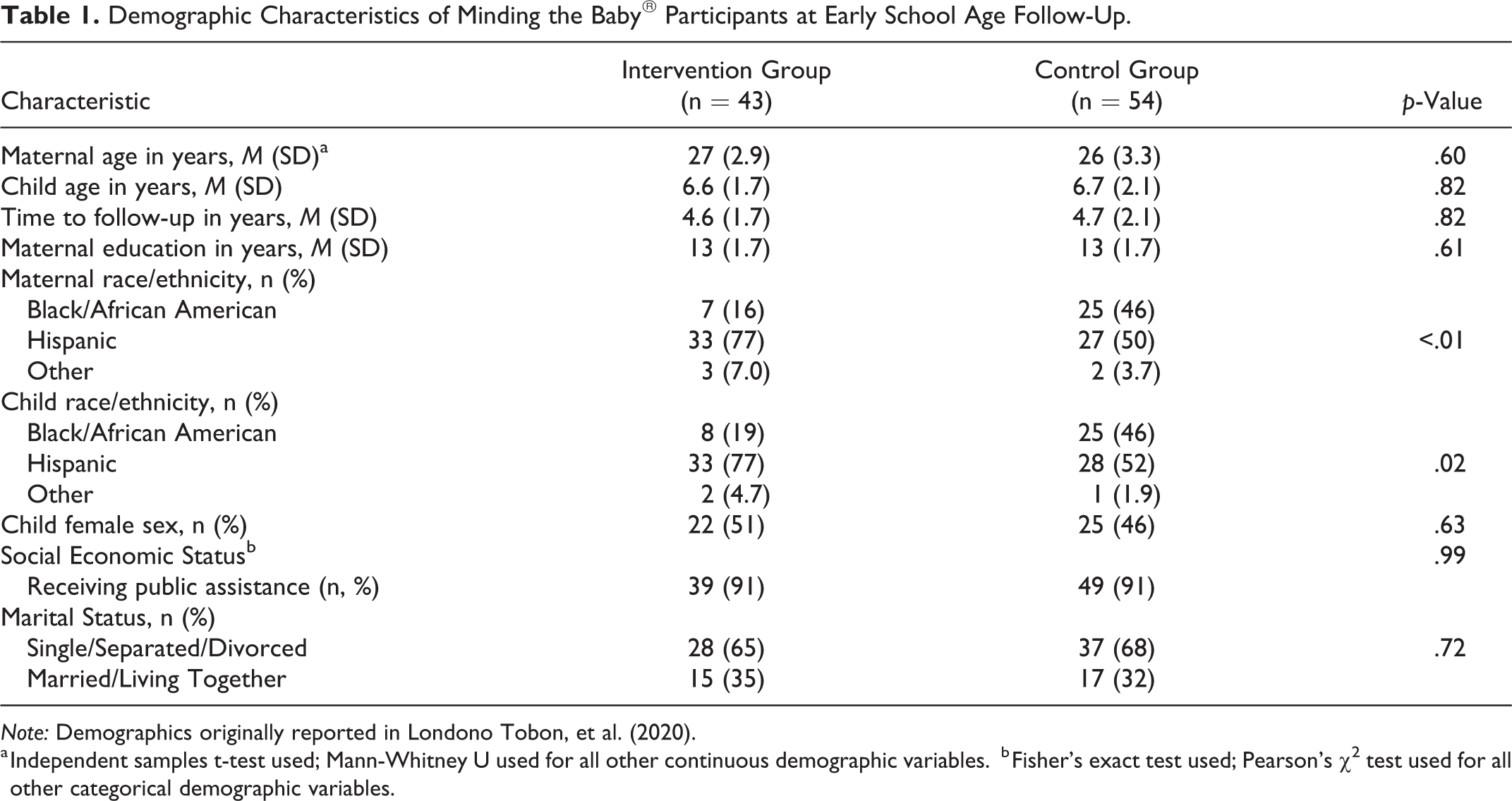
Note: Demographics originally reported in Londono Tobon, et al. (2020).
a Independent samples t-test used; Mann-Whitney U used for all other continuous demographic variables.
b Fisher’s exact test used; Pearson’s χ2 test used for all other categorical demographic variables.
Participants were eligible for the MTB-Early School Age follow-up study if (i) the child was early school age (4–10 years) at the time of data collection, (ii) the child’s mother had custody or regular contact with the child, and (iii) the dyad was residing within state. In the original MTB RCT, pregnant women were recruited through group prenatal care classes at community health centers. In the current study, invitation letters and flyers were sent in colorful envelopes to all eligible families, and these letters were followed up with text messages from a member of the research team. For additional information on the MTB-Early School Age follow-up study design and methods, see Londono Tobon et al. (2020). For information on the original MTB RCT, see Sadler et al. (2013) and Slade et al. (2019).
Procedures
Data for the Early School Age follow up study were collected from October 2016 to March 2018. We obtained Yale University Institutional Review Board approval prior to data collection and mothers provided informed consent. We collected data during a single visit at a private location chosen by the participant, such as the participant’s home, the Yale University Center for Biobehavioral Research, or a private room in a community library. Participants were compensated $50 for their time, consistent with the original MTB RCT.
Variables and Measures
Demographic characteristics
We collected demographic information from mothers including age, ethnicity, marital status, education level, and employment.
Childhood maltreatment history
Mothers reported childhood maltreatment using the retrospective 28-item Childhood Trauma Questionnaire (CTQ) Short Form. The CTQ includes a total score, five maltreatment subscales (physical abuse, emotional abuse, physical neglect, emotional neglect, and sexual abuse) with five items each, and a three-item minimization-denial scale (Bernstein et al., 2003). Responses to the CTQ are recorded on a Likert scale ranging from 1 (“never true”) to 5 (“very often true”), and mean scores are calculated to create continuous variables for the total score and subscales. Mean scores can also be used to create categorical variables for each subscale using established cutoffs ranging from “none/minimal” to “severe to extreme” maltreatment (Bernstein et al., 2003). Internal consistency of the CTQ scales was high (α = .83 to .96) for the current study.
The CTQ can also be used to create a continuous family strengths subscale. Following the methods described by Hillis et al. (2010), we reverse-scored seven Likert-scale items related to family strengths (e.g. “I felt loved,” “I had someone to take me to the doctor”) to create a mean score. Internal consistency for the family strengths subscale was high (α = .92). There are no established cutoffs to create a categorical variable for this subscale. As described below, we used the family strengths subscale as a continuous variable in our exploratory analyses.
The CTQ minimization-denial scale is used to detect possible under-reporting of childhood maltreatment (MacDonald et al., 2016). The three minimization-denial items are intended to capture exaggerated responses that idealize childhood (e.g. “my childhood was perfect”): if respondents endorse “very often true” for any of these items, the response is coded as 1; all other responses are coded as 0 (Bernstein et al., 2003; MacDonald et al., 2015, 2016). These dichotomized scores are summed for a possible range of 0 to 3, and scores greater than zero indicate potential response bias (Bernstein & Fink, 1998).
Parental reflective functioning
We measured PRF with the Parental Reflective Functioning Questionnaire (PRFQ), an 18-item self-report measure used to assess a mother’s interest in and ability to recognize her child’s mental states (Luyten, Mayes, et al., 2017). The PRFQ includes three subscales. Interest and Curiosity in Mental States (PRFQ-IC), a measure of high PRF, includes items such as “I wonder a lot about what my child is thinking and feeling.” Certainty about Mental States (PRFQ-CM) describes a parent’s capacity to recognize the opacity of his/her child’s mental states, and includes items such as “I can always predict what my child will do.” Prementalizing Modes (PRFQ-PM) describes difficulties with or an inability to be reflective about the child’s mental states, and includes items such as “When my child is fussy he or she does that just to annoy me.” Likert responses on this scale range from 0 (strongly disagree) to 7 (strongly agree). Internal consistency was adequate for the PRFQ-IC (α = .65) and PRFQ-PM (α = .70) scales, but we did not use the PRFQ-CM scale due to low reliability (α = .44).
Parenting behaviors
We assessed parenting behaviors using the Parent Behavior Inventory (PBI), a 20-item self-report measure for parents of early school-aged children (Lovejoy et al., 1999). The PBI includes two subscales which showed adequate internal consistency: supportive/engaged parenting (α = .69) and hostile/coercive parenting (α = .69). Supportive/engaged parenting includes items such as “I try to teach my child new things” and “My child and I hug and/or kiss each other.” The hostile/coercive scale includes items such as “I spank or use physical punishment with my child” and “I say mean things to my child that can make him/her feel bad” (Lovejoy et al., 1999).
Data Analysis
Descriptive statistics and correlations
Data were analyzed using SAS 9.4®. Univariate statistics were used to describe sample characteristics and all study variables. Bivariate analyses were used to compare the intervention and control groups for differences in demographic characteristics, childhood maltreatment subtypes, and parenting scores. We examined Pearson correlations among the continuous CTQ childhood maltreatment subscales. These scales were highly inter-correlated (with the exception of childhood sexual abuse), indicating overlap between types of maltreatment experienced by mothers. To address this, we created a summed score of the number of childhood maltreatment subtypes endorsed (0–5). We considered a subtype endorsed if the individual scored higher than “none/minimal” on the categorical version of the subscale, and used this summed score as our main predictor of interest.
Regression analyses
We used linear regression to examine associations between mothers’ childhood maltreatment history (number of CTQ subtypes endorsed) and current parenting (PRF, parenting behaviors). Due to non-normal distributions, we log-transformed the pre-mentalizing modes variable and square-transformed the interest and curiosity in mental states and supportive/engaged parenting variables. We also used robust standard errors to address evidence of heteroskedasticity. We selected theoretical covariates a priori: treatment group (intervention/control), maternal race/ethnicity (due to baseline differences between the control and intervention groups), and time since intervention completion (as parenting and intervention effects may change over time). We did not adjust for child gender, as inclusion of this covariate did not improve fit for any of the models tested. In each model, we also included an interaction term between childhood maltreatment history and treatment group, in order to examine whether relationships were moderated by participation in the MTB intervention.
Minimization/denial
CTQ minimization-denial scores indicating potential response bias were detected in 40% of intervention group mothers and 32% of control group mothers and did not significantly differ between the two groups (p = .41; Table 2). We conducted sensitivity analyses by removing these mothers from our analyses and our findings were unchanged. For these reasons and to maintain sample size, we did not exclude participants with positive minimization-denial scores from our analyses.
Mothers’ Self-Reported Childhood Maltreatment History and Total Number of Subtypes Endorsed.
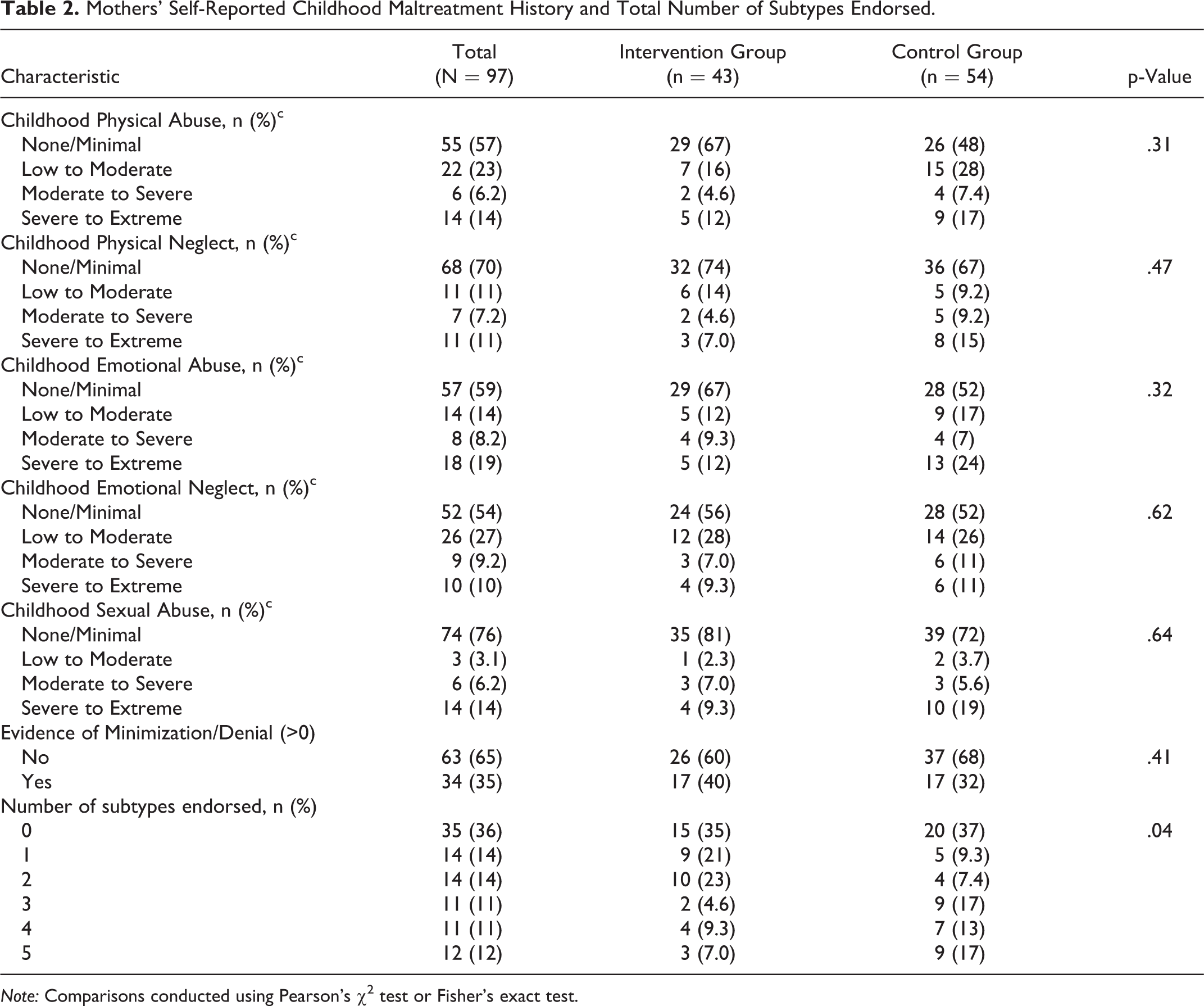
Note: Comparisons conducted using Pearson’s χ2 test or Fisher’s exact test.
Exploratory analyses
We also conducted exploratory analyses to examine the independent effects of childhood maltreatment subtypes. Our rationale for this approach was 1) childhood sexual abuse was not highly correlated with the other maltreatment subtypes, suggesting potential differential effects, and 2) our primary predictor (number of subtypes endorsed) failed to account for maltreatment subtype severity or family strengths. We first examined correlations between the continuous childhood maltreatment subscales and the parenting variables. For all statistically significant correlations detected, we then conducted separate linear regression models to examine associations between the childhood maltreatment subscales and parenting. We transformed variables, adjusted for covariates, and included an interaction term in each model as described above. Because our exploratory analyses included multiple comparisons, we used the Benjamini-Hochberg correction method at a false discovery rate of .05 to control the rate of Type 1 error (Benjamini & Hochberg, 1995). Results of our exploratory analyses are presented as supplemental material.
Results
Mothers in both the intervention and control groups reported high levels of childhood maltreatment, with physical abuse and emotional neglect as the most commonly endorsed maltreatment subtypes (Table 2). Thirty-five mothers (36.1%) reported no history of childhood maltreatment, while 12 mothers (12%) reported experiencing all five maltreatment subtypes. Severity of childhood maltreatment did not differ between intervention and control group mothers when examined by categorical subtype. However, distribution of the total number of subtypes endorsed did differ between the two groups (p = .04; Table 2).
Mothers in the intervention group reported significantly lower hostile/coercive parenting behaviors than control group mothers at follow-up (p < .001), but no other group differences in parenting were detected (Table 3). See Londono Tobon et al., (2020) for detailed follow-up study results related to group differences in parenting.
Mothers’ Self-Reported Parental Reflective Functioning and Parenting Behaviors.
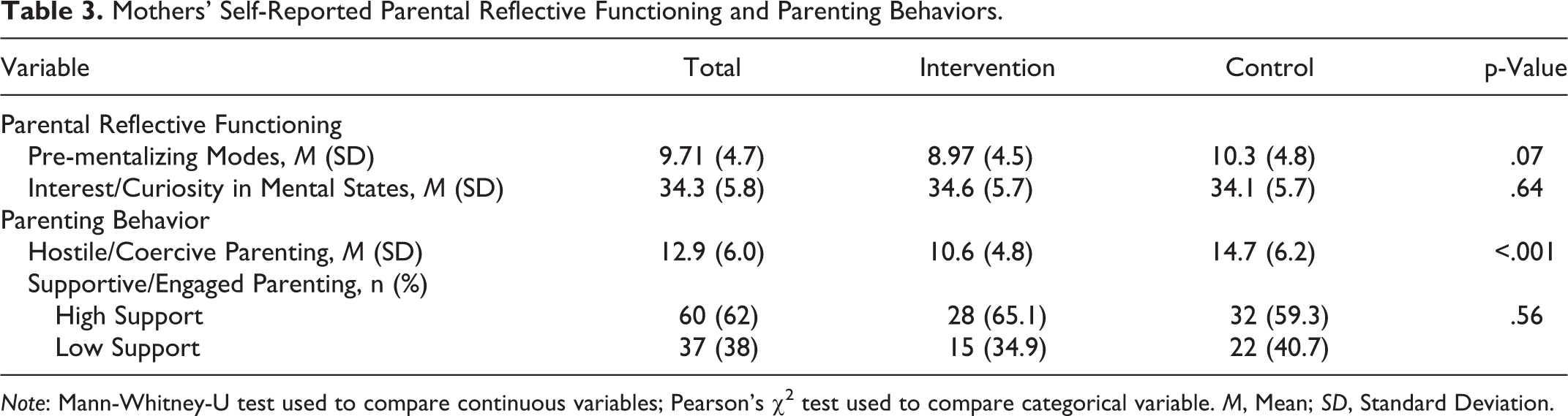
Note: Mann-Whitney-U test used to compare continuous variables; Pearson’s χ2 test used to compare categorical variable. M, Mean; SD, Standard Deviation.
Associations Between Mothers’ Childhood History and Current Parenting
In our adjusted models, endorsing more childhood maltreatment subtypes was associated with higher pre-mentalizing modes (p < .001) and lower supportive/engaged parenting behaviors (p = .02; Table 4), but associations with interest and curiosity in mental states or hostile parenting behaviors were not detected. Relationships between the number of childhood maltreatment subtypes endorsed and current parenting were not moderated by participation in MTB (Table 4).
Adjusted Associations Between Number of Childhood Maltreatment Subtypes Endorsed and Current Parenting.
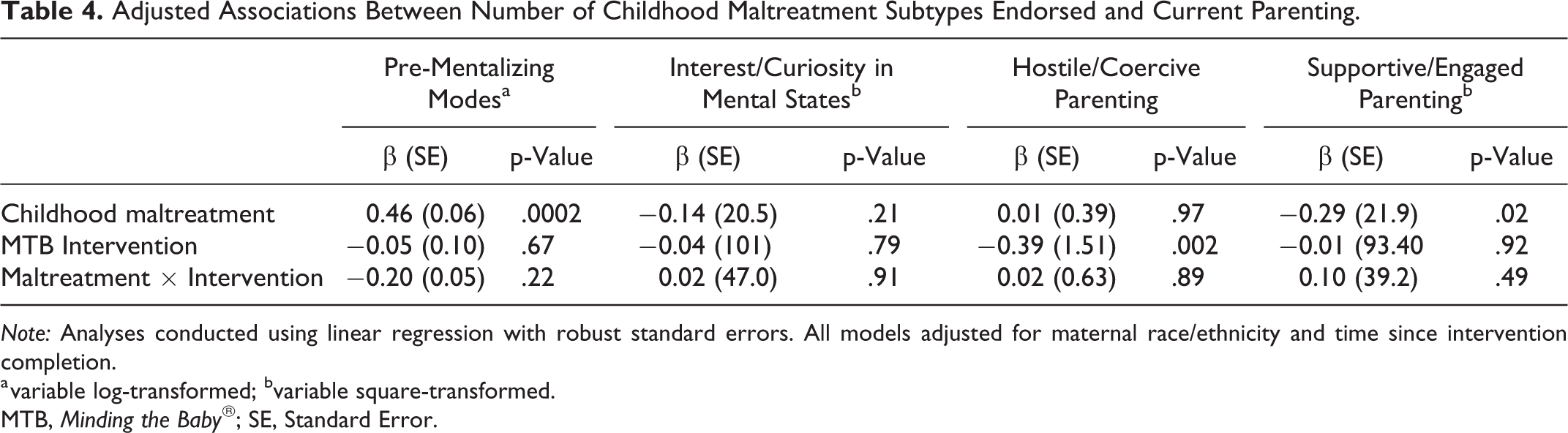
Note: Analyses conducted using linear regression with robust standard errors. All models adjusted for maternal race/ethnicity and time since intervention completion.
a variable log-transformed; bvariable square-transformed.
MTB, Minding the Baby®; SE, Standard Error.
Exploratory Analyses
Descriptive statistics for the continuous versions of childhood maltreatment subscales are presented in Supplemental Appendix B. The physical abuse, physical neglect, emotional abuse, and emotional neglect subscales were highly correlated with one another (ρ = .65 to .98), but correlations between these subscales and sexual abuse history were small (ρ = .29 to .46; see Supplemental Appendix C).
The physical abuse, physical neglect, emotional abuse, and emotional neglect subscales were positively correlated with pre-mentalizing modes and negatively correlated with supportive/engaged parenting behaviors (Supplemental Appendix D). Childhood family strengths were negatively correlated with pre-mentalizing modes and positively correlated with supportive/engaged parenting behaviors. Childhood sexual abuse was correlated with higher hostile/coercive parenting behaviors. In adjusted regression models, childhood family strengths were associated with significantly lower pre-mentalizing modes and higher supportive/engaged parenting behaviors, and childhood emotional neglect was associated with significantly higher pre-mentalizing modes (Supplemental Appendix E). Childhood emotional abuse was associated with significantly higher pre-mentalizing modes, and this relationship was moderated by participation in the MTB intervention, such that emotional abuse was associated with higher pre-mentalizing among control group mothers only.
Discussion
Findings of this study demonstrate a significant relationship between mothers’ childhood experiences of maltreatment and reflective capacities in adulthood; experiencing more childhood maltreatment subtypes was associated with higher pre-mentalizing modes, or a difficulty with appropriately reflecting on a child’s mental states (e.g. thoughts, feelings, intentions) and interpreting his or her behavior. We also found that experiencing more childhood maltreatment subtypes was associated with less supportive/engaged parenting behavior. Our exploratory analyses indicate that the effects of childhood sexual abuse may differ from other maltreatment types, and that childhood family strengths may have lasting effects on both PRF and parenting behavior. In our main analyses, we did not find evidence to support our hypothesis that participation in Minding the Baby® mitigates the effects of childhood maltreatment history on parenting. However, our exploratory analyses suggest that the harmful intergenerational effects of childhood emotional abuse, specifically, may be mitigated by promoting reflective functioning through the Minding the Baby® intervention. Additional research is needed to understand the optimal approaches for preventing intergenerational cycles of maltreatment through early childhood intervention.
Childhood Maltreatment History and Parenting
Our findings align with previous literature suggesting that experiences of childhood maltreatment may impair mothers’ capacities to engage in positive parenting behaviors with their children (Savage et al., 2019), and also provides new evidence to suggest that childhood maltreatment may impair mentalizing capacities in ways that affect future relationships, including a parent’s ability to understand the mental states of his or her child. Research suggests that the ability to be reflective, or mentalize, develops in the context of secure attachment relationships in early childhood (Fonagy & Target, 1997), and PRF in turn helps the child to develop socioemotional and self-regulation capacities (Ensink & Mayes, 2010; Slade, 2005). It is therefore unsurprising that childhood maltreatment history was associated with pre-mentalizing modes, or difficulty with appropriately reflecting on mental states, among mothers in this study.
Relationships between childhood experiences of maltreatment and PRF were largely not observed in past studies (Ensink, Normandin, et al., 2016; Håkansson et al., 2018; Stacks et al., 2014). Ensink et al. (2016) used the Adult Attachment Interview and Håkansson et al. (2018) and Stacks et al. (2014) used the Parent Development Interview to evaluate reflective functioning, but these measures do not specifically differentiate the pathological thinking that characterizes pre-mentalizing (Slade et al., 2003). Findings of the current study advance this prior research by examining specific PRF constructs, and suggest that pre-mentalizing, specifically, may play a critical role in the intergenerational transmission of childhood maltreatment.
Differential Effects of Childhood Maltreatment Subtypes
Our exploratory analyses indicate the physical and emotional abuse/neglect subtypes largely drove the effects of childhood maltreatment history on pre-mentalizing modes and supportive/engaged parenting behaviors. Findings of our exploratory analyses suggests that childhood sexual abuse may have differential effects on parenting, as childhood sexual abuse was correlated with higher hostile/coercive parenting behaviors, but not the other parenting measures. This aligns with findings of past studies that indicate mothers who experienced childhood sexual abuse often engage in controlling or hyper-vigilant parenting behaviors as a means of protecting their children from also experiencing abuse (Lange et al., 2019). Childhood experiences of sexual abuse have also been associated with “hostile-helpless” states of mind on the Adult Attachment Interview (Milot et al., 2014). Individuals with a hostile stance have globally negative views toward a childhood attachment figure, but also identify with this figure, which may help explain tendencies toward punitive parenting behaviors (Lyons–Ruth et al., 2005). While the relationship between childhood sexual abuse and hostile/coercive parenting was not statistically significant in our regression model, sexual abuse was reported at lower frequencies than other subtypes, so we may not have had statistical power to detect significant effects. Regardless, our results support past research suggesting that childhood sexual abuse represents a distinct risk factor that should be differentiated in studies of childhood maltreatment.
The Protective Role of Family Strengths
Results of this study also contribute to an emerging body of literature on “angels in the nursery,” or the positive intergenerational effects of benevolent childhood experiences (Lieberman et al., 2005; Narayan et al., 2018). Family strengths were associated with lower pre-mentalizing modes and higher supportive/engaged parenting behaviors in our adjusted models, supporting the theory that protective factors are transmitted through generations, and that enhancing reflective capacities in at-risk families may be an important approach for mitigating the long-term effects of childhood trauma (Suchman et al., 2012). However, as items for the family strengths subscale were derived from the Childhood Trauma Questionnaire, future research with independent measures of family strengths, such as the Benevolent Childhood Experiences questionnaire, is needed to confirm these relationships (Narayan et al., 2018).
Preventing Intergenerational Transmission of Maltreatment through Intervention
Many interventions are available to support families at risk for intergenerational transmission of maltreatment, including early home visiting programs with varying strategies for service delivery, home visitor qualifications, and target populations (Sama-Miller et al., 2018). Given the lasting and complex effects of childhood experiences of maltreatment on parenting, however, it is unclear whether and how these interventions might help mitigate family cycles of childhood maltreatment. While the Minding the Baby® model is similar to other home visiting programs that serve socioeconomically marginalized first-time mothers, such as the Nurse Family Partnership (NFP), it is unique in its specific focus on enhancing PRF and in providing in-home maternal mental health care as needed. Findings from the MTB-Early School Age follow-up study demonstrate that participation in Minding the Baby® is associated with reduced externalizing behavior problems, an effect not seen in NFP follow up studies of early school age children, and which may be attributable to MTB’s effects on reflective functioning and parenting behaviors (Londono Tobon et al., 2020; Olds et al., 2004, 2014).
Results of the current study suggest that participation in Minding the Baby® does not globally mitigate the effects of experiencing childhood maltreatment on parental reflective functioning or parenting behaviors. However, our exploratory analyses of individual maltreatment subtypes suggest that participation in Minding the Baby® may mitigate the harmful effects of childhood emotional abuse, specifically. Among mothers in our sample, childhood emotional abuse was associated with increased pre-mentalizing modes among mothers in the control group, but not among mothers in the intervention group. The lack of any significant interaction effect for the other maltreatment subtypes may be due to either lack of effects or insufficient statistical power. Alternatively, these results may underscore an important relationship between emotional support and the development of mentalizing capacities. Experiences of emotional abuse, which may be more chronic in nature than other maltreatment types, may have particularly harmful effects on a child’s social-emotional development and impair skills necessary for “keeping another in mind,” the underpinnings of PRF. In a recent study of mothers with substance use disorder, childhood emotional abuse was associated with lower PRF, but effects were not seen for other childhood maltreatment subtypes (Håkansson et al., 2018). Thus, a home visiting program like Minding the Baby®, that specifically focuses on developing PRF, might be expected to mitigate the effects of mothers’ childhood maltreatment related specifically to experiences of emotional abuse.
Other recent studies also provide evidence to suggest that promoting PRF may be an important approach to preventing the harmful intergenerational effects of childhood maltreatment. Ensink and colleagues found that mothers’ mentalizing mitigated the effects of experiencing sexual abuse on internalizing behaviors among young children (Ensink et al., 2017). Further, among mothers with a history of childhood sexual abuse, higher reflective functioning about their own trauma was associated with a lower likelihood of their child experiencing maltreatment (Borelli et al., 2019). Additional research on the mechanisms through which interventions may prevent intergenerational cycles of maltreatment, including with interventions that target maternal representations such as Mothering from the Inside Out (Suchman et al., 2017), Child Parent Psychotherapy (Lieberman et al., 2018), and Attachment and Biobehavioral Catch-Up (Dozier et al., 2017), will help inform approaches to two-generation intervention.
Strengths & Limitations
This study represents a unique opportunity to examine the relationship between mothers’ childhood history and later parenting, as well as the long-term effects of a home visiting intervention. Our sample size was limited to MTB families who were both eligible and available for the current study, and thus we may have had insufficient power to detect statistically significant effects in regression analyses. We also did not have sufficient statistical power to examine other relationships of interest, such as testing PRF as a mediator of the relationship between mothers’ childhood experiences of maltreatment and hostile/coercive parenting. However, results of this study can be used to inform future research on the mechanisms through which home visiting interventions prevent intergenerational transmission of maltreatment.
While we successfully recruited approximately two-thirds of eligible participants for the MTB Early School Age follow-up study, we found differential enrollment by maternal race/ethnicity, with Hispanic mothers from the control group underrepresented in our sample. This may be related to cultural values, as sustained relationships are highly valued in the Hispanic community, and thus intervention group mothers may have felt more connected to the program and thus more willing to participate in a study years later. We adjusted for maternal race/ethnicity in regression analyses, but we are unable to determine whether this differential enrollment biased our sample in unmeasured ways.
This study is also limited by the use of maternally reported parenting measures. Use of self-reported parenting measures was most feasible, and an observational measure of PRF is not currently available. However, this approach may have also introduced response bias and common method variance may have influenced our results. Future research with observational measures of parenting is needed. The PRFQ and PBI did not demonstrate strong internal consistency, suggesting that the items from the instrument subscales may not be measuring the same latent constructs. This may reflect the ethnocentricity inherent in many parenting measures, which are often developed with white, heteronormative, middle- to high-income samples. Additional validation studies with caregivers from diverse racial, ethnic, and socioeconomic backgrounds and development of new parenting instruments that capture ethnic and cultural differences in parenting are needed. We were also unable to examine changes in parenting over time, as different measures were used during MTB RCT and follow up study time points.
Data on mothers’ childhood history was not collected as part of the MTB RCT, and so we are unable to evaluate whether participation in MTB affected mothers’ perceptions of their childhood history. The CTQ has been shown to be highly reliable over time (Cammack et al., 2016; Paivio & Cramer, 2004), although retrospective reports of childhood maltreatment are poorly correlated with prospective reports (Baldwin et al., 2019). We found that the CTQ maltreatment subscales were highly inter-correlated in our sample, reflecting co-occurring maltreatment subtypes. While this is commonly documented in the literature, there is no consensus on how childhood maltreatment subtypes cluster among individuals, and exploratory latent class analysis (LCA) is commonly used to address this issue (Debowska et al., 2017; Rivera et al., 2018). Our sample was too small to conduct LCA, so we instead summed the number of subtypes experienced. While this allowed us to account for overlap between the CTQ subscales, it did not capture the severity of each maltreatment type. We therefore also examined the independent effects of maltreatment subtypes in exploratory analyses. However, it should be noted that even for subtypes for which we detected independent effects, the maltreatment did not occur independently. For example, of the 40 mothers who reported childhood emotional abuse, 36 (90%) also reported emotional neglect and 33 (82.5%) reported physical abuse. Of the 22 mothers reporting childhood sexual abuse, 21 also reported other types of maltreatment.
Finally, over one-third of participants had CTQ minimization/denial scale scores indicating potential response bias and under-reporting of maltreatment. Recent studies suggest that minimization of maltreatment is common (MacDonald et al., 2016), and the CTQ scoring manual suggests interpreting these responses with caution (Bernstein & Fink, 1998). However, there is no consensus regarding how to handle participants with positive MD scores, and the value of the MD subscale in assessing response bias is not well established (MacDonald et al., 2015, 2016), We chose not to exclude these mothers because we found no differences between the intervention and control groups, and our results were unchanged in sensitivity analyses. Thus, childhood maltreatment history may be underestimated in our sample.
Conclusions
This study provides novel empirical evidence to support the theoretical link between childhood maltreatment and parents’ mentalizing capacities, and suggests that enhancing PRF may be a critical strategy for interventions aiming to prevent intergenerational cycles of problematic parenting and maltreatment (Sadler et al., 2013; Slade et al., 2019). Future research focused on intergenerational transmission of family protective factors, differential effects of childhood maltreatment type, and additional mechanisms through which early childhood interventions help to mitigate intergenerational transmission of maltreatment will help inform precision health strategies to tailor interventions based on family vulnerabilities and strengths.
Supplemental Material
Supplemental Material, sj-pdf-1-cmx-10.1177_1077559521999097 - Examining Mothers’ Childhood Maltreatment History, Parental Reflective Functioning, and the Long-Term Effects of the Minding the Baby® Home Visiting Intervention
Supplemental Material, sj-pdf-1-cmx-10.1177_1077559521999097 for Examining Mothers’ Childhood Maltreatment History, Parental Reflective Functioning, and the Long-Term Effects of the Minding the Baby® Home Visiting Intervention by Eileen M. Condon, Amalia Londono Tobon, Margaret L. Holland, Arietta Slade, Linda Mayes and Lois S. Sadler in Child Maltreatment
Footnotes
Acknowledgments
We thank Andrea Miller and Priscilla Qinglan Ding for their assistance with recruitment and data collection and the Yale School of Nursing Center for Biobehavioral Research for providing the resources necessary to conduct this research. We also gratefully acknowledge the families who participated in this study for contributing their time and expertise.
Declaration of Conflicting Interests
The author(s) declared no potential conflicts of interest with respect to the research, authorship, and/or publication of this article.
Funding
The author(s) disclosed receipt of the following financial support for the research, authorship, and/or publication of this article: This work was supported by the National Institute of Nursing Research (F31NR016385, T32NR008346, K99NR018876) and the National Institute of Mental Health (NIMH T32MH018268) of the National Institutes of Health, the NAPNAP Foundation, the Connecticut Nurses Foundation, the Jonas Nurse Leaders Scholars Program, the Alpha Nu chapter of Sigma Theta Tau International, and the American Academy of Child and Adolescent Pilot Research Award.

Supplemental Material
Supplemental material for this article is available online.
References
Supplementary Material
Please find the following supplemental material available below.
For Open Access articles published under a Creative Commons License, all supplemental material carries the same license as the article it is associated with.
For non-Open Access articles published, all supplemental material carries a non-exclusive license, and permission requests for re-use of supplemental material or any part of supplemental material shall be sent directly to the copyright owner as specified in the copyright notice associated with the article.
