



Abstract
Purpose
The economic downturn due to the Coronavirus Disease 2019 (COVID-19) pandemic initially led to a large increase in the US unemployment rate. Being laid-off or losing a job could cause financial stress and have an impact on the relationship between parents or other adults in the home and children. We aimed to assess the effect of household unemployment on child physical and emotional abuse during the early part of the COVID-19 pandemic, with an older population of children.
Methods
Data were from a sample of 7,555 students from 51 schools that participated in a survey administered from October to December 2020. We conducted weighted multivariable logistic regression models and report adjusted odds ratio to estimate associations between recent household unemployment and emotional and physical abuse.
Results
Having a parent or other adult in the home with a job loss was associated with higher odds of emotional or physical abuse.
Conclusions
The findings are consistent with child maltreatment prevention strategies focused on alleviating economic hardship.
Introduction
The Coronavirus Disease 2019 (COVID-19) pandemic has led to significant increases in unemployment in the United States (Smith & Duong, 2021). For example, the unemployment rate peaked at 13% in the 2nd quarter of 2020; the highest quarterly average in over 70 years (Bureau of Labor Statistics, 2020). Certain sectors of the economy including leisure, education, construction, and government were most affected by job losses related to lock-down restrictions (Satyaki et al., 2021). Survey research has identified that younger and lower income workers have been more likely to experience job loss (Pew Research Center, 2020). Finally, there is mixed evidence by race with one study finding Hispanics at greater risk for job loss (Pew Research Center, 2020), and another ecological study finding that the greater the non-Hispanic white population in the state, the great the job loss (Satyaki et al., 2021).
Socio-economic status and economic insecurity have been associated with child maltreatment in cross-sectional and longitudinal studies (Drake & Jonson-Reid, 2014; Stith et al., 2009). Much of this literature has focused on families experiencing chronic economic strain and low income. However, a limited literature, much of it using ecological designs, has looked at the effects of economic changes on child maltreatment (Lindo et al., 2018; Schenck-Fontaine & Gassman-Pines, 2020). For example, in studies conducted prior to the pandemic, declines in family disposable income, and increases in regressive taxation (i.e., tax rate decreases as taxable income increases) were found to be associated with increased referrals to child protective service (CPS) systems (McLaughlin, 2017, 2018). Meanwhile, increasing family incomes may have a preventive effect on maltreatment. A study found that an increase to the minimum wage was associated with a decrease in maltreatment reports, especially for neglect, among younger children, with a decreasing effect for adolescents (Raissian & Bullinger, 2017). Together this literature supports going beyond the established relationship between chronic economic strain and maltreatment to consider how changes in economic status can increase the risk of child maltreatment.
Few studies have considered the specific and acute effects of job loss on child maltreatment, in contrast to ongoing under- or unemployment. Among the only published studies is a study was conducted in England in the 1970s and 1980s which did not find an association between job loss in an otherwise stable home and an increase in child abuse. However, this study was limited to one town and a total of 209 cases (Taitz et al., 1987). Ecological studies of the impacts of an economic recession, in the form of community or state-level rates of job loss, have found associations with physical abuse reports (Schenck-Fontaine et al., 2020), and in another study, the proportion of reports that were severe (Schenck-Fontaine et al., 2017). A recent study examined the relationship between parental job-loss during the COVID-19 pandemic and child maltreatment among a community sample of 342 parents of children aged 4 to 10. The study found that parents who lost their jobs during the COVID-19 pandemic were more likely to abuse their children psychologically and physically during the pandemic (Lawson et al., 2020). Given the large body of literature linking economic stress and hardship with child maltreatment, and recent evidence emerging during the pandemic, it is reasonable to hypothesize that the stress of unemployment and unprecedented economic hardship associated with the COVID-19 pandemic would be associated with increased child maltreatment. Note also that the proposed hypothesis is plausible even though early data showed that reports to child protective service agencies dropped initially after lockdowns, driven in part by decreased reports from school professionals (Brown et al., 2021); such changes in reports may or may not have indicated actual declines in maltreatment. Furthermore, much of the extant literature has a focus on younger children, under 10 years of age, and parental reports (Conrad-Hiebner & Byram, 2020). We aimed to expand evidence of the effect of household job loss on child physical and emotional abuse during the COVID-19 pandemic to an older population of children, middle and high school aged adolescents who are able to report on their own experiences of abuse.
Methods
Participants
The Healthy Kids Colorado Survey (HKCS) is a biennial statewide cross-sectional survey on the health and wellbeing of Colorado public high school and middle school students. The data collection methods are consistent with the Youth Risk Behavior Survey (Underwood et al., 2020). We leveraged this periodic surveillance system and existing relationships with schools, to recruit a sample of schools to participate in a one-time survey during the COVID-19 pandemic. To be eligible to participate in the study, schools had to have participated in the most recent regularly scheduled survey administration, in the fall of 2019. From this sample of schools, which was sampled to be representative of Colorado, 73 schools volunteered to survey their students about the effects of the COVID-19 pandemic. Of these, 26 high schools and 25 middle schools (n=7,955 students) were able to survey at least 60% of their student population (mean response rate = 73.6%). We set this threshold for a minimum student participation rate to decrease the risk of non-response bias.
Schools administered the online survey from October to December in 2020. Surveys were administered online, either in school if the school was holding in-person classes, or virtually, if the school or student was engaging in remote learning. The survey was anonymous, and students were instructed that they could skip any questions they wished. Parents could opt their student out of the survey and students could decline to participate without any consequence.
Data on schools are publicly available from the Colorado Department of Education. According to that classification, a majority of the participating schools were located within rural areas (88%), compared to the state overall (38.8%). The participating sample of schools was more likely to be rural than the state representative sample in 2019, where 45% of schools were classified as rural. The mean Free/Reduced Lunch rate (FRL) for participating schools was 45.2% (SD = 18.7%), similar to the FRL rate for all Colorado middle and high schools (mean = 44.5%). The observations with students who responded they were 18 years old or older (n = 308) or did not respond to the age questions (n = 92) were removed, which resulted in, a total of 7,555 students who were included in the further analysis. Among them, about 38% were between 10 to 13 years old, 35% were 14 or 15 years old, about 27% were 16 or older; 51.1% of participants are female, 54.5% were non-Hispanic White, 33.2% were Hispanic, and 1.7% were non-Hispanic Black, compared to all Colorado middle and high schools (52.3% non-Hispanic White, 34.7% Hispanic, and 4.5% non-Hispanic Black).
Measures
The binary exposure variable was constructed from the question “During the COVID-19 pandemic, did a parent or other adult in your home lose their job even for a short amount of time?” (Centers for Disease Control and Prevention, 2020). The two binary maltreatment outcome variables were constructed based on the questions, “During the COVID-19 pandemic, how often did a parent or other adult in your home swear at you, insult you, or put you down?” and “During the COVID-19 pandemic, how often did a parent or other adult in your home hit, beat, kick, or physically hurt you in any way?” The responses of “Sometimes”, “Most of time”, and “Always” were collapsed as the positive response, and “Never” and “Rarely” were collapsed as negative response, for both maltreatment indicators. These measures were developed by the Centers for Disease Control and Prevention and proposed as optional additions for state administrations of the Youth Risk Behavior Surveillance System, in which Colorado participates.
Other measures collected at student level included sex, grade, race/ethnicity, sexual orientation, gender identity, mother’s education, learning environment (how often did students go to their school building during past week), food/house insecurity during the pandemic, and receiving donated food during pandemic. Two school-level variables were included: the proportion of students who qualified for free/reduced lunch, based on which a binary variable with two categories of greater than or equal to 70% and less than 70% was created, and urbanicity were added to the dataset as the school-level auxiliary information.
Analysis
Participating student responses were weighted to represent school enrollment. Most schools surveyed all the students (i.e., census). For the six schools that drew samples of classes, the design weights were constructed to account for the sampling probability. The post stratification weights were then applied to make the weighted distribution of sample of students within each of the participating school adhere to the school’s demographic distributions, by using an iterative proportional fitting method (Kolenikov, 2014). The adjusting factors included gender, race/ethnicity, and grade. We used a Rao-Scott chi-square to test for differences by student characteristics and household employment status. We calculated weighted adjusted odds ratios from multivariate logistic regression models that controlled for sex, grade, race/ethnicity, mother’s education, sexual orientation, food/housing insecurity, receiving donated food, and urbanity. These variables were identified as significantly associated with maltreatment in bivariate analysis. All analyses were performed using SAS 9.4. This study was a secondary analysis of the existing data, and thus is exempted from IRB approval.
Results
Comparison of characteristics among participants with and without parent/adult who lost jobs during COVID-19 pandemic.
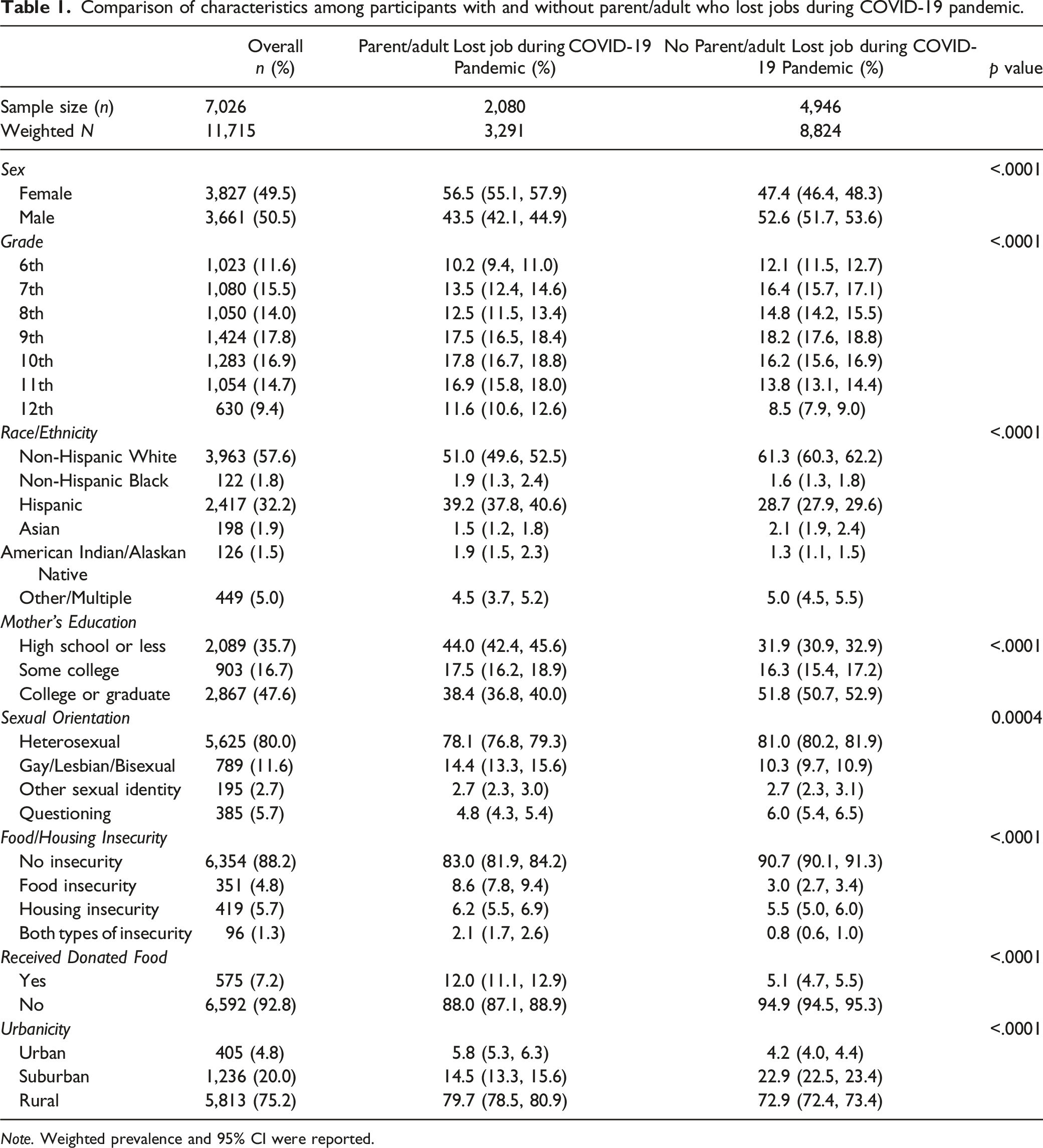
Note. Weighted prevalence and 95% CI were reported.
After adjusting for demographic characteristics, sexual orientation, mother’s education, food/housing insecurity, receiving donated food, and urbanicity, the odds of emotional and physical abuse for participants with an unemployed parent or other adult were, respectively, 1.30 (95% CI: 1.18, 1.44) and 1.57 (95% CI: 1.26, 1.97) times the odds for those without (Figure 1). Association between parent/adult’s unemployment and child abuse during COVID-19 pandemic. The adjusted ORs were adjusted for sex, grade, race/ethnicity, sex orientation, mother’s education, food/house insecurity during pandemic, receiving food donation during pandemic, and urbanicity.
Discussion
We evaluated the association of parental or household unemployment with child abuse among middle and high school students during the COVID-19 pandemic. We found significantly higher prevalence and odds of emotional or physical abuse for those with a parent or other adult in the household recently unemployed due to the pandemic. We hypothesized that financial stress from job loss may have resulted in psychological impact to the parents and other adults (Griffith, 2020) as an acute risk factor, and when parents and caregivers are not able to manage their frustration, anger, or mental distress, then the risk and frequency of domestic violence increases (Stith et al., 2004). This psychological impact, combined with increased time that households were confined at home together during lockdowns may also have increased the likelihood of maltreatment (Connell & Strambler, 2021).
Over the last 60 years, since the development of a modern conception of the phenomenon of child maltreatment (Johnson-Reid, 2018), there is no precedent for understanding the impact of a global pandemic on child maltreatment in the United States (B. Drake, personal communication, May 30, 2021). Although economic stress is well-established in the literature as a risk factor for maltreatment (Conrad-Hiebner & Byram, 2020), it would be unwise to simply assume that a known risk factor functions uniformly as it did prior to a social shock such as the global pandemic. Further, it is critical to triangulate self-report data regarding maltreatment with administrative data, which showed initial declines in reported maltreatment (Brown et al., 2021) over the time period that many experienced job losses. The current study provides important insight about the relationship between the maltreatment risk of economic stress and actual, self-reported maltreatment during the pandemic. Findings underscore a continued need for prevention efforts in regard to child maltreatment, including among households with adolescent children. Child maltreatment is a persistent problem, existing before, during, and after the pandemic. Our findings suggest the hypothesis that verbal and physical abuse may have onset during the pandemic for some families, or increased in frequency, associated with the immediate household economic stressor of job loss, even after controlling for stressors of food and housing insecurity, which likely have pre-pandemic roots. There are evidence-based interventions for family violence, many focusing on caregivers (The California Evidence-Based Clearinghouse for Child Welfare, 2021). However, in recent years, more attention has been given to social determinants of health, specifically relevant to this study is the role of policy strategies, including poverty reduction strategies for preventing child maltreatment (Klevens et al., 2015). For example, an experimental study with over 13,000 mothers found that the provision of additional income support to low-income families led to a reduction in the number of maltreatment reports (Cancian et al., 2013). As previously cited, increases to minimum wage have been associated with reduction in child maltreatment reports, particularly child neglect (Raissian & Bullinger, 2017). A recent observational study found that increased earned-income tax credits was associated with reduced neglect for children 0 to 5 and 6–17, although the associations did not rise to statistical significance for physical or emotional abuse (Kovski et al., 2021). In the short term following a job loss, there is evidence that extending unemployment benefits can prevent child maltreatment, particularly neglect (Brown & De Cao, 2018). Economic strategies and supports for maltreatment prevention, both acutely following a job loss, and long term, should continue to be studied across forms of economic stress and for a range of child ages including families with middle and high school aged children to understand evidence for their effectiveness.
The pandemic has also precipitated novel public policy changes in this area. For example, changes to the federal Child Tax Credit will allow advance payments to families, prior to the 2021 tax filing (Internal Revenue Service, 2021). Furthermore, policy proposals for cash allowances for families with children have received notable attention and discussion over recent months (York & Watson, 2021). The United States is positioned at a unique moment to evaluate the impacts of poverty reduction on child maltreatment.
A study limitation is that there are possible confounders that may relate to both unemployment and child maltreatment such as substance use, poor anger management and other interpersonal skills. However, these measures were not available in this study. Relatedly, due to the scope of the survey, only two items measuring maltreatment were available and one item about family job loss. It would be informative to know who in the family lost the job, the nature of the job, and the effect of the family such as difficulty paying bills. This would provide further information about the potential economic stress on the household. Additionally, it should be noted that this study was cross-sectional and pre-pandemic employment and maltreatment in the household is not known. Although large, the sample is representative of the participating schools but is not necessarily representative of the entire state of Colorado (e.g., disproportionately rural), and thus the ability to generalize to other states and contexts is not known.
We observed higher prevalence of emotional or physical abuse for those with a parent or other adult in the household recently unemployed due to the pandemic. Verbal and physical abuse may have onset for some families, or increased in frequency, during the pandemic, associated with household economic stressors. These findings are consistent with economic supports and poverty reduction as prevention strategies for child maltreatment.
Footnotes
Declaration of Conflicting Interests
The author(s) declared no potential conflicts of interest with respect to the research, authorship, and/or publication of this article.
Funding
The author(s) disclosed receipt of the following financial support for the research, authorship, and/or publication of this article: This work was supported by Colorado Department of Public Health and Environment; 19 FHLA 108,254.
