



Abstract
This study examined the role of character evidence and other issues in criminal appeals of child sexual abuse (CSA) convictions. Character evidence includes uncharged acts and character witnesses who testify to another’s reputation or opinion and is offered to prove an individual’s propensities. Examining 168 appellate court opinions reviewing CSA convictions between 2005 and 2015 in Maricopa County, Arizona, we found that when specific types of evidence were at issue, they were most often character evidence issues (49%). However, appellate courts virtually never reversed convictions (n = 5), and when defendants did obtain relief, the reduction in charges or in sentences was minor. Of the small number of opinions that were published (n = 4), all focused on character evidence, including the single case reviewed by the Arizona Supreme Court. However, close examination of the published cases suggested they effected only modest change.
Introduction
Although a number of studies have examined the types of evidence that affect the likelihood that child sexual abuse (CSA) cases will be prosecuted or that prosecution will be successful (Block et al., 2023; Brewer et al., 1997; Walsh et al., 2010), little attention has been paid to the possibility that convictions for CSA are reversed on appeal. Also overlooked is the significance of character evidence, which includes the admission of uncharged acts and character witnesses testifying to reputation or opinion (Myers, 2021). In both state and federal courts, other acts are often admitted in CSA trials, sometimes to show that the defendant has the propensity to abuse children (Stolzenberg and Lyon, 2014; Tchividjian, 2012). However, the practice has been vigorously criticized because of the highly stigmatizing nature of being labeled a child molester, which may lead the jury to convict solely on the other acts, and the purportedly low recidivism rates of defendants convicted of CSA, which may lead to an exaggeration of the evidentiary value of prior abuse (Lave & Orenstein, 2012). Whether appellate courts second guess the admissibility of character evidence or otherwise reverse CSA convictions has not been studied. The role of character evidence in influencing the success of appeals of criminal convictions of sexual abuse is of obvious interest to attorneys; it is also important for professionals who investigate child sexual abuse because of the implications for the sorts of information that will be legally relevant in prosecution.
This study examined ten years of CSA trials that ended in conviction in Maricopa County, Arizona, and analyzed 168 appellate opinions reviewing legal arguments for reversal. We assessed the likelihood that different types of evidence would be subject to legal objections, the likelihood that the appellate courts would find that error occurred, and the likelihood that the defendant was entitled to some relief. In what follows, we first describe the legal framework for character evidence, both in United States trials generally and in Arizona specifically, and then discuss issues regarding the success of criminal court appeals.
Character Evidence in the Law
Character evidence describes evidence in which either “character witnesses” or “other acts” are offered to prove that a person is or is not the kind of person who has the propensity to commit an act. Character witnesses testify to their opinion of a person’s propensity, or to a person’s reputation for having a propensity. For example, in a child sexual abuse case, a witness could testify that in their opinion the defendant does not have sexual interest in children. Other acts describe a person’s behavior other than the charged act. The prosecutor could offer other acts of sexual abuse by the defendant in order to prove aberrant sexual interest.
Character evidence is generally inadmissible in both state and Federal courts in the United States (Mueller and Kirkpatrick, 2021). This is because character evidence offered against a defendant can unfairly prejudice the jury in two ways. First, the jury may give the character evidence more weight than it deserves. Second, the jury may convict the defendant for their propensity, or for their other acts, rather than for the charged crime. This violates the basic principle in criminal law that defendants are on trial for what they did and not for the kind of person they are (Mueller and Kirkpatrick, 2021).
The rules of character evidence are complicated because there are a number of exceptions to the rule against admissibility, and because other acts may be admissible on the grounds that they prove something other than propensity. Furthermore, even if evidence has a non-propensity use, the court may exclude it because of the dangers that the jury will misuse it as propensity evidence. The U.S. Supreme Court called the common law rules regarding character evidence a “grotesque structure” that was “archaic, paradoxical, and full of compromises and compensations by which an irrational advantage to one side is offset by a poorly reasoned counter-privilege to the other” (Michelson v. U.S., 1948, p. 486). Nevertheless, the common law rules were for the most part codified in the Federal Rules of Evidence when they were enacted in 1975, and most states (including Arizona) have evidence codes that are similar to the Federal rules (Graham, 1990).
There are a number of standard exceptions to the rules against character evidence, and those most relevant to CSA prosecutions are noted here. One standard exception is that defendants in criminal cases can present character witnesses on their behalf. For example, in a CSA case, a witness could testify for the defense that in their opinion the defendant was not sexually interested in children, or that the defendant did not have a reputation as a molester. Furthermore, defendants are often allowed to offer character evidence against victims. If the defendant offers character evidence, however, the prosecutor can then rebut with their own character evidence. Examining final arguments in criminal trials of CSA in California, Stolzenberg and Lyon (2014) found that character evidence offered by the defense on the defendant’s behalf was presented in at least 20% of the cases, and the defendant offered character evidence against the victim in at least 14% of the cases.
Another standard exception is that both the defense and the prosecution can offer character evidence regarding the opponent’s witnesses, in which a witness will testify about another witness’ character for truthfulness (referring either to their opinion or to the reputation of the other witness). A “witness” includes anyone who is called to testify or whose hearsay statements are offered into evidence. Stolzenberg and Lyon (2014) found that the defendant offered character evidence against prosecution witnesses in at least 27% of the cases, and the prosecutor offered character evidence against defense witnesses in at least 10% of the cases.
In CSA cases, the most significant exception to character evidence is the prosecutor’s ability to introduce other acts of abuse to prove that the defendant has the propensity to sexually abuse children. This exception exists in the Federal Rules (Federal Rules of Evidence 414), 23 states (including Arizona and California), and the District of Columbia (Tchividjian, 2012). Stolzenberg and Lyon (2014) found that prosecutors offered character evidence against defendants in at least 29% of the cases.
As noted above, the sexual propensity exception is the source of much controversy. Speaking of the exception, Mueller and Kirkpatrick (2021) argued that it represents “a breach in a bedrock principle of evidence law that is closely connected to a version of our idea of due process.” Indeed, a few state supreme courts have struck down legislation enacting the exception (Lave & Orenstein, 2012).
Arizona has long had the sexual propensity exception, first under its common law (State v. McFarlin, 1973 [Hereafter Arizona cases are cited by last name of the defendant, hence McFarlin]) and, as of 1997, under the Arizona Rules of Evidence (Rule 404(c)). This type of proof is subject to heightened requirements. The trial court must make findings in the record that the defendant committed the prior act by clear and convincing evidence, that the prior act demonstrated a propensity to commit the charged act, and that the evidentiary value of the act was not substantially outweighed by the unfairly prejudicial effect it would likely have on the jury. In assessing these factors, the trial court considers the similarity of the other acts to the charged acts, their remoteness in time, and frequency.
Whereas many states and the Federal courts liberally allow other acts to be admissible against criminal defendants in order to demonstrate a propensity to commit sexual crimes, Rape Shield Laws protect alleged victims in sex crime cases from the use of their prior sexual history because of the likelihood it will prejudice the jury against the alleged victim, and in order to protect the privacy of victims and encourage them to come forward (Federal Rule of Evidence 412; Arizona Rule of Evidence 412). There are narrow exceptions to these rules, and defendants can argue that they have a due process right to introduce sexual history when it is not offered to prove propensity and is highly relevant in proving a defense argument.
An additional reason that the rules regarding character evidence are complicated is that other acts may be admissible to prove something other than propensity. First, if other acts directly prove an element of abuse, or if they occur at the same time as the abuse and facilitate the abuse, then they are considered “intrinsic” to the crime and not “other” acts (State v. Ferrero, 2012). For example, the prosecution could prove that the defendant physically restrained the child in order to sexually abuse them. Second, other acts can be offered to prove something other than propensity, such as “motive, opportunity, intent, preparation, plan, knowledge, identity, or absence of mistake or accident” (Federal Rule of Evidence 404(b); Arizona Rule of Evidence 404(b)). For example, the prosecution could offer evidence that the defendant had given the alleged victim marijuana in order to prove that the defendant groomed the victim; under the legal rules this would constitute evidence of a plan (State v. Garcia, 2001).
The ways in which other acts and opinion or reputation evidence might be admissible in CSA prosecutions is of obvious importance to attorneys, but it is also important for professionals who question children and other potential witnesses about child sexual abuse. Sexual abuse by the defendant in other jurisdictions, or at remote times, either against the primary victim or against other victims, is often admissible to prove propensity to abuse or for another purpose. Knowing that actions by the defendant that fall short of prosecutable sexual abuse might nevertheless be admissible in a sexual abuse prosecution encourages investigators to question witnesses about the defendant’s actions more broadly.
Character Evidence in Appeals of Criminal Convictions
Of course, if character evidence often leads to reversal on appeal, this is also of importance to attorneys and others who assess CSA. Anecdotal evidence suggests that character evidence is an important issue in criminal appeals across crimes in general. Imwinkelried (1990) noted that “[i]n many jurisdictions, alleged errors in the admission of uncharged misconduct evidence are the most common ground for appeal in criminal cases,” and citing an Arizona source, added that “[i]n some jurisdictions, errors in the introduction of uncharged misconduct are the most frequent basis for reversal in criminal cases” (p. 577; see also McClennen, 1990). The reference to “uncharged” refers to the fact that the other acts are not part of the current criminal charge. Similarly, Gottsfield (1997), an Arizona trial court judge, argued that “based on personal experience and an unscientific poll of some trial and appellate judges,” improper admission of other acts was the most common evidence issue leading to reversal (p. 24).
Only a few studies have systematically examined criminal appeals, and most do not discuss the types of evidence underlying the legal challenges (Buller, 2015; Foley, 1999; Heise et al., 2017). We have identified two studies that mention character evidence, but their results are difficult to interpret. Chapper and Hanson (1989) examined whether appellate courts found reversible error (other than sentencing errors), such that one or more of the criminal charges would have to be retried. Reversible error was found in 13% of the cases and the authors noted that “[e]rrors occur most frequently during the government’s direct examination and involve (in decreasing order of frequency) character testimony, opinion evidence (problems both with expert testimony and opinions proffered by nonexperts), evidence of uncharged acts and prior convictions, and hearsay in general” (p. 15). However, it was unclear whether the frequency of reversal for character testimony and uncharged acts was due to the number of times the issue was raised or the success rate of such challenges, or both. Waters et al. (2015) reported that “character testimony” was only the seventh most common issue on appeal and led to reversal in only 4% of the cases. However, they included claims (such as sentencing issues) that are unrelated to specific types of evidence. Furthermore, some of the issues that they classified as distinct from character evidence (e.g., pretrial evidence issues, prosecutorial misconduct) may have involved arguments about character evidence (e.g., the admissibility of other acts might have been addressed pretrial), such that character evidence issues may have been more common and challenged more successfully than the numbers suggest.
The Current Study
The current study examined appellate court opinions of CSA trials ending in conviction in Maricopa County, Arizona from 2005–2015. We identified, read, and coded 168 appellate opinions identifying legal issues raised by the defendants, the courts, and the state. We classified issues as involving specific types of evidence (our primary interest), not involving specific types of evidence, and sentencing issues (which did not contest the verdict). We assessed whether the appellate court identified an error and whether there was reversible error, such that one or more of the charges had to be retried or that the sentence should be changed. Because of the lack of prior research examining CSA appeals, we treated our analyses as exploratory and did not make predictions.
Method
Sample
The current study examined appellate issues in 168 appeals filed by defendants following a conviction in a CSA trial. We obtained case information on all CSA cases that went to trial from January 2005 to August 2015 (n = 252) in Maricopa County, Arizona from the Maricopa County District Attorney’s Office. Maricopa County includes the city of Phoenix, is the largest county in Arizona, and is the fourth largest county in the United States. CSA cases included one or more charges of Sexual Conduct with a Minor (A.R.S.13–1405), Child Molestation (A.R.S. 13–1410), or Sex Abuse (A.R.S. 13–1404). Of the 252 cases, 184 resulted in the conviction of the defendant on at least one charge (73%). In two cases, the defendant was convicted only of non-CSA offenses (burglary in one case and kidnapping in another). In Arizona, as in most states, criminal defendants have a right to appeal convictions (Waters et al., 2015). We searched for appellate opinions reviewing these convictions on the Arizona Court of Appeals’ website, Westlaw, and Google search, identifying 168 appellate decisions (91% of convictions). We were unable to find appeals for 16 cases. In eight of these, court dockets suggested that defendants declined to appeal the conviction or accepted a plea and forfeited their right to an appeal. No information was available on the remaining eight cases.
Coding
Before coding began, and based on informal review of the appellate opinions, the research team identified and defined 36 unique issue types, including 15 types of evidence (e.g., character evidence; victim’s testimony; defendant admission or confession), 20 issues unrelated to specific evidence types (e.g., general assertions of the insufficiency of evidence, jury issues, ineffective assistance of counsel), and sentencing issues. We separately considered issues raised by the defendant, the courts, and the state, because we expected the frequency of issues raised by each entity, and their success, to vary. Defendants would raise as many issues in their favor as possible. The appellate courts, by contrast, would likely only raise issues on their own initiative when they aroused concern, which may lead to a higher rate of error. The state would raise few issues because they would be procedurally limited in appeal (e.g., the state cannot argue on post-conviction appeal that evidence in its favor was unfairly excluded).
Definition of Character Evidence and Subtypes.
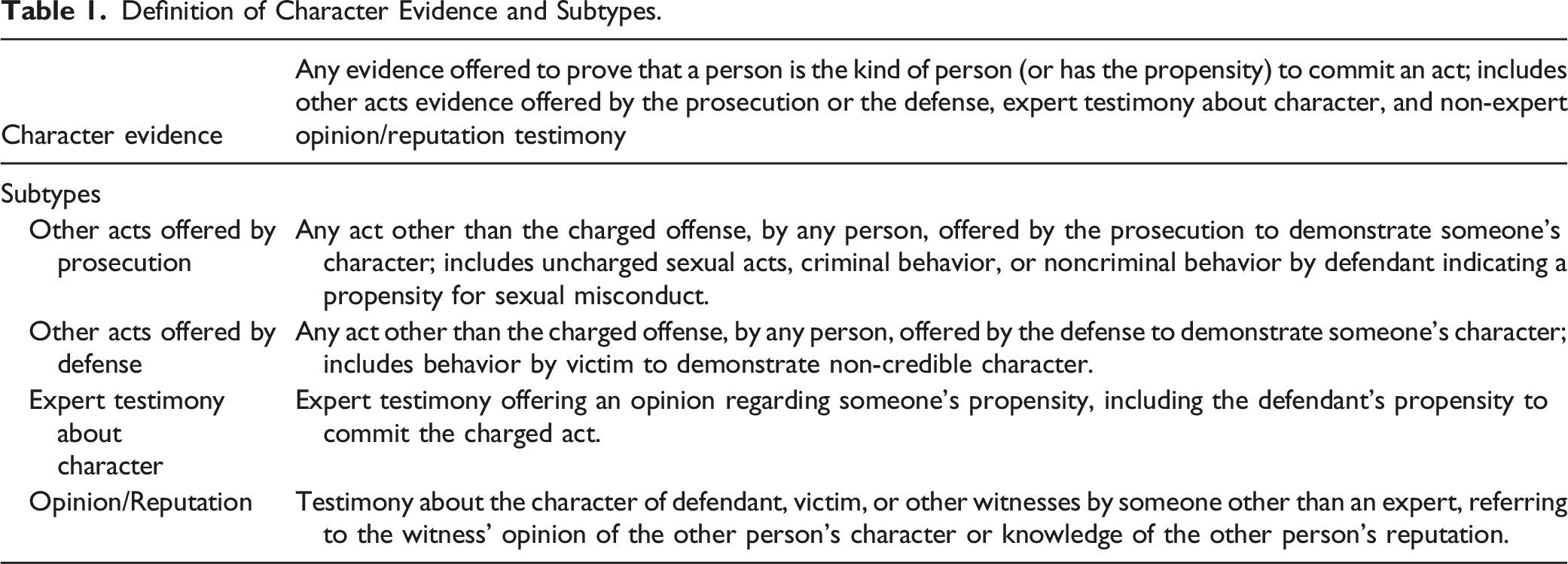
With respect to the appellate court’s response, we assessed whether the court concluded that an error had occurred, and whether the error was reversible. Errors would not be reversible (1) if they were harmless, meaning the appellate court concluded beyond a reasonable doubt that the error would not have influenced the jury’s verdict (State v. McVay, 1980); or (2) when the defendant waived the error by failing to object at trial, and the appellate court failed to find fundamental error, which requires that the error went to the heart of defendant’s case and rendered the trial unfair (State v. Valdez, 1989).
Searching Westlaw, we identified which of the appellate opinions were published, which essentially requires a majority of the appellate court panel to view the opinion as legally significant. Unpublished opinions are more common, and although they are publicly available, they usually cannot be cited by attorneys or other courts as precedent (though this was modified somewhat for cases after 2015). Indeed, technically speaking, they are not even “opinions” but “memorandum decisions” (Az. Rule of Supreme Court 111).
Results
Defendant Raised Issues: Frequency of Cases, Issues, and Court Response by Issue Type in 10% or More of Cases.

Note. Cells with (100%) identify the number used as the denominator in calculating the percentages of issues (across rows) and in calculating the percentages of errors (across columns). Definitions of character evidence can be found in Table 1, and all other issues in Supplemental Table 1. Information regarding the issues raised in less than 10% of cases can be found in Supplemental Table 2. In one case, the court found error regarding the admission of guilty mind evidence, but found the error was not reversible. In another case, the court found reversible error regarding a miscellaneous procedural issue.
Court Raised Issues: Frequency of Cases, Issues, and Court Response by Issue Type.
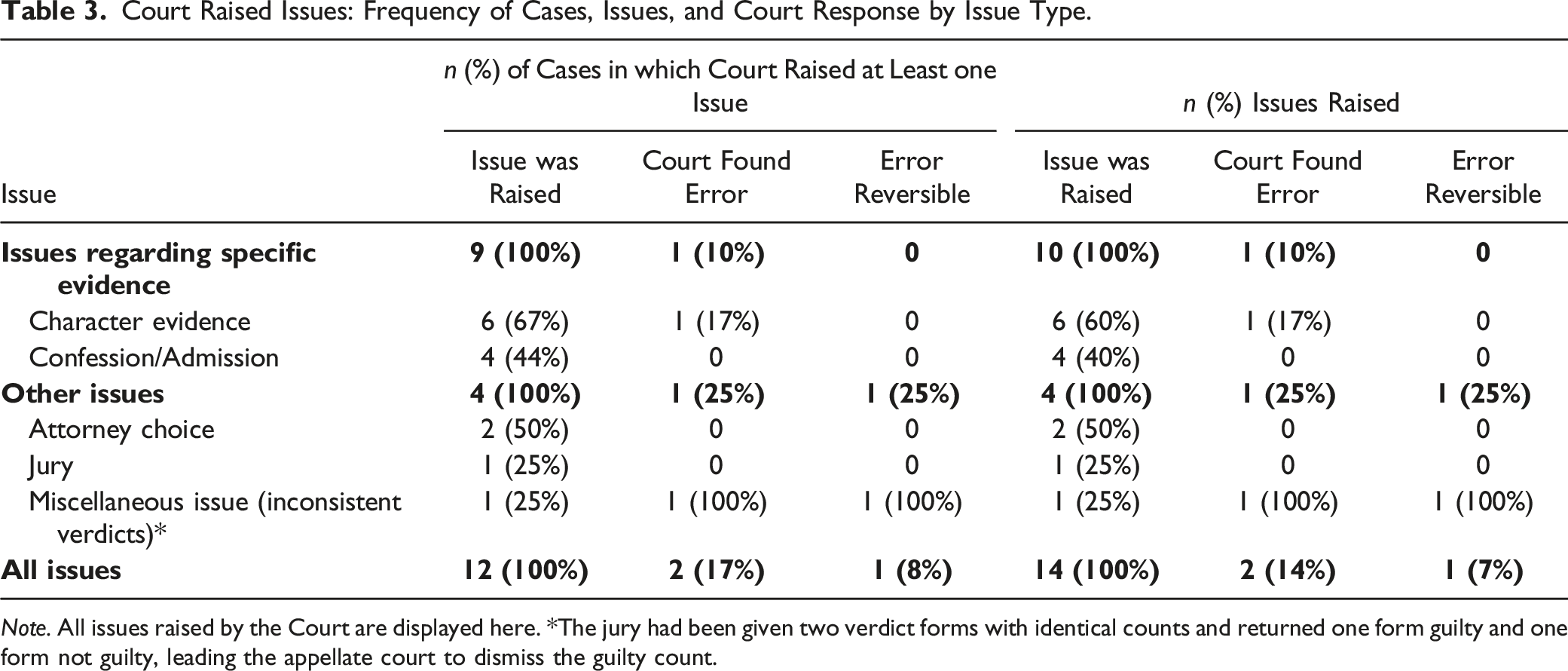
Note. All issues raised by the Court are displayed here. *The jury had been given two verdict forms with identical counts and returned one form guilty and one form not guilty, leading the appellate court to dismiss the guilty count.
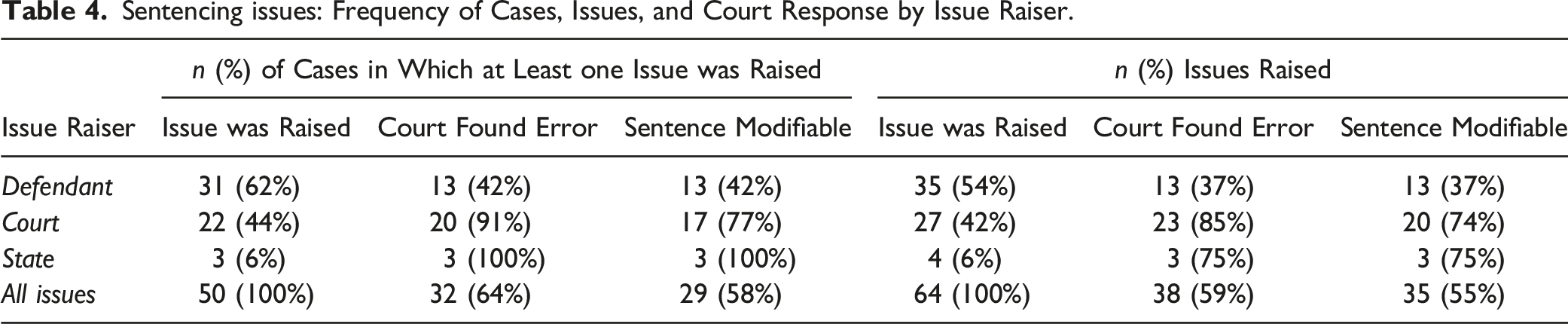
Sentencing issues: Frequency of Cases, Issues, and Court Response by Issue Raiser.
In 24% (n = 40) of the cases, the defense appellate attorney stated that they were unable to find any arguable grounds for reversal and requested that the court review the record for fundamental error in accordance with the U.S. Supreme Court opinion, Anders v. California (1967). In 24 of these 40 cases, the appellate court also failed to identify any potentially important issues, and the state did not raise any issues of its own; in the other 16 cases, either the appellate court or the state raised an issue. Hence, the final sample was reduced from 168 to 144 cases in which the defendant, the court, and/or the state raised an issue. As detailed in Tables 2-4, each entity could raise more than one issue per case. Below, we focus on results at the case level.
Overview of Issues Raised
Defendant-Raised Issues
The types of issues raised by defendants and their success rates are depicted in Table 2. Defendants raised issues regarding the conviction in 122 of the 144 cases, and the appellate court found an error in 16 of those cases (13%). The appellate court found the error required reversal of one or more charges in four cases (3%). A reversible error means that one or more of the charges would have to be retried, whereas if the error is not reversible, the conviction stands. As noted above, even if an error was not reversed, the appellate court’s description of the error could have some precedential effect on future cases, at least if the decision was published. However, we identified only two cases in which defendant-raised issues led to published opinions. (In one other published case, none of the issues regarding the CSA challenges were discussed, but the court addressed additional child pornography charges, finding no error; (State v. Jensen, 2008).
Court-Raised Issues
The types of issues raised by the appellate courts and their outcomes are depicted in Table 3. The appellate courts raised issues regarding the conviction in 12 cases (8%), found an error in two cases, and a reversible error in one case. None of the cases involving court-raised issues were published.
State-Raised Issues
The state raised issues in only three cases. State-raised issues are rare because the state cannot appeal acquittals; attempting to retry the defendant would constitute double jeopardy. However, the state can appeal some pre-trial and post-trial court orders. Two of the three cases in which the state raised issues were published.
Issues with Specific Types of Evidence
Defendant-Raised Issues: Overview
Defendants raised objections regarding specific types of evidence in 89 of the 144 cases (62%; Table 2). The most common issue was character evidence, which was raised in 44 of the 89 cases (49%). The appellate courts found error in 12 (13%) of the 89 cases, and in five (11%) of the 44 cases in which character evidence was challenged.
Defendant-Raised Issues: Reversible Error
The errors only required a reversal of the trial court judgment in two cases out of the entire sample (2%). One of the two cases involved character evidence and was ultimately decided by the Arizona Supreme Court (State v. Ferrero, 2012). Like most state supreme courts, the Arizona Supreme Court chooses whether to review appellate court cases, and only a small percentage of cases are reviewed (Waters et al., 2015). The case involved uncharged acts committed by the defendant. The court narrowed the admissibility of other acts in two respects. First, before Ferrero, courts had freely admitted prior CSA by defendants to prove propensity to abuse if the victim of the other acts was the victim in the case. The Arizona Supreme Court held that before admitting evidence of those acts, the trial courts should screen them under the additional rules for admissibility in Arizona Evidence Code 404(c), which applies generally to other acts that are offered to prove the defendant’s propensity to abuse children. As the reader will recall, 404(c) applies heightened requirements for admissibility: The trial court must make findings in the record that the defendant committed the other act by clear and convincing evidence, that the other act demonstrated a propensity to commit the charged act, and that the evidentiary value of the act was not substantially outweighed by the unfairly prejudicial effect it would likely have on the jury.
Second, the court narrowed the type of acts that could be considered “intrinsic” to the crime (rather than “other” acts) and thus not subject to any restrictions on character evidence. Before Ferrero, courts had admitted other acts if they were “inextricably intertwined” with, part of the “same criminal episode” as, or “necessary preliminaries” to, the charged act. These terms were confusing, leading to inconsistent application, and the Arizona Supreme Court held that henceforth the acts must directly prove the charged crime or must have occurred contemporaneously with and directly facilitated the charged crime. For example, in Ferrero, the charged act occurred at the defendant’s house. The uncharged act (the defendant told the child to expose himself) occurred in the defendant’s car on the way to the defendant’s house. Whereas the trial court had considered the uncharged act intrinsic to the crime, the Supreme Court held that it constituted an other act.
In addition to restricting the types of character evidence admissible, the case was a significant win for the defendant. The Court found that the defendant was entitled to a new trial on two counts (for which he had been sentenced to 40 years), but the error was harmless as to the third count (because he had admitted the act), which led to lifetime probation.
In the other case reversing the trial court’s judgment, State v. Jones (2016), the appellate court in an unpublished case reversed one of 14 counts, reducing the 114-year sentence by no more than 3 years. The child had testified to touching of her chest and stomach, and the trial court erroneously amended the charged count pertaining to the touching to a count that required vaginal contact.
Defendant-Raised Issues: Harmless or Non-Reversible Error
In two cases the appellate courts found non-reversible error but published the opinions, thus giving them precedential effect. One case involved the admissibility of the defendant’s confession (State v. Lucero, 2009), and concerned whether the jury or the judge should assess certain prerequisites to admissibility.
The other published case, State v. Vega (2011), concerned character evidence. Indeed, it involved the same issue that the Arizona Supreme Court resolved in State v. Ferrero (2012). The trial court had admitted uncharged other acts committed by the defendant against one of the two victims in the case without considering the aforementioned prerequisites under 404(c). The appellate court held that the trial court should have followed the prerequisites, but reviewed the prerequisites itself, held that they were satisfied, and therefore found the error harmless. The error was harmless because the victim herself testified (satisfying clear and convincing evidence), the other act was clearly sexual (satisfying proof of propensity), and the other act was less serious than the charged act (so that the other act was not prejudicial, meaning the jury would not find the defendant guilty of the charged crime just because they thought he was guilty of the prior act).
Vega and Ferrero were two of the five cases in which appellate courts found error with respect to character evidence. As noted, both cases concerned application of Rule 404(c). Two of the others also involved 404(c): Bustillos and Galvez. In State v. Bustillos (2017), the trial court failed to use the clear and convincing standard, though the appellate court concluded that the standard had been fulfilled and found the error harmless. In State v. Galvez (2018), the trial court overlooked some of the prerequisites for a few of the 15 other acts admitted, and again the appellate court found the errors harmless. The cases illustrate the trial courts’ difficulty and occasional confusion in applying the prerequisites of Arizona Rule of Evidence 404(c).
The final case involving error with respect to character evidence concerned the defendants’ right to introduce character evidence on his own behalf. In State v. Dahnad (2009), the trial court erroneously excluded the defendant’s wife’s testimony that the defendant had normal sexual interests, but because of the other evidence against the defendant, the appellate court held the error was harmless.
Court-Raised Issues: Overview
The courts raised concerns about specific types of evidence in nine cases (6%; Table 3). Six of the nine cases involved character evidence and four cases involved the defendant’s admissions or confessions (in one case both issues were raised). None of the cases involved reversible error.
Court-Raised Issues: Harmless or Non-Reversible Error
The court found error in one case, and the case involved character evidence (State v. Holland, 2010). The detective in the case made an unsolicited reference during cross-examination to uncharged CSA by the defendant against the victim. The acts were not part of the indictment because they occurred in a different state. The trial court told the jury to disregard the statement and denied the defendant’s motion for a mistrial. The appellate court agreed that the defendant’s statement was inadmissible character evidence, but, given the other evidence in the case (including a partial confession by the defendant), also agreed that a mistrial was not warranted.
State-Raised Issues
There were two cases in which the state raised an issue regarding a specific type of evidence. Both cases involved character evidence, and both were published. State v. Rhodes (2008) involved the same issue the appellate court confronted in State v. Dahnad (2009): the trial judge had erroneously failed to allow the defendant to introduce character witnesses to testify that he was not sexually interested in children. The issue was raised by the state on appeal because the trial court changed her mind about the admissibility of evidence after the trial ended, granting the defendant a new trial. The state appealed the trial court’s order granting a new trial. The appellate court upheld the trial court’s order, holding that she did not abuse her discretion. However, the appellate court corrected the trial court’s confusion regarding the character evidence rules. The trial court erroneously believed that the defendant’s evidence was admissible under an exception to the bar against character evidence that allows evidence of other acts proving character when character is an “essential element” of a charge or defense. Instead, as the appellate court explained, it was admissible because of the longstanding rule that defendants are allowed to offer pertinent character evidence in their defense. The case highlights the potential for confusion in applying the character evidence rules.
In Montgomery v. Duncan (2011), the state appealed a pre-trial order by the trial court in the State v. Fries (2013) prosecution. The defendant was charged with abusing a 15-year-old but argued that he mistakenly believed that the victim was 18. In order to justify his belief, he wanted to prove the victim said he was experienced in performing oral sex, and the trial court had ruled that the testimony would be admissible. The state successfully argued on appeal that admitting the testimony presumptively violated the state’s rape shield statute, which protects victims from the admission of their prior sexual history on the grounds that the history is improperly used by juries to make unwarranted character assumptions against the victim. The appellate court held that the rape shield statute meant that the defendant could offer the evidence only if he had a due process right to do so. The defendant would have argued that the evidence was offered not to impugn the minor’s character, but to prove the defendant’s lack of knowledge. On remand, the trial court held that the defendant did not have a constitutional right to admit the evidence, and the evidence was excluded.
Issues not Tied to Specific Types of Evidence
Defendant-Raised Issues
Defendants raised issues that were not tied to specific types of evidence in 84 of the 144 cases (58%), about half of which made general challenges to the sufficiency of the evidence to support the verdict (Table 2). The appellate courts found error in four cases (5%), and reversible error in two cases (2%). Both cases led to the dismissal of a small number of counts against the defendant after the state conceded errors. In State v. Valentine (2016), the state conceded that there was insufficient evidence to support three of the 36 counts for which the defendant was convicted, and without any substantive discussion, the court agreed. In State v. Bucholtz (2016), the state conceded that in one of the 11 counts for which the defendant had been convicted, the verdict form (alleging oral contact) was inconsistent with the indictment (alleging contact of the breast).
Court-Raised Issues
The court raised issues that were not tied to specific types of evidence in four out of the 144 cases (3%), and they found reversible error in one case (Table 3). In State v. Gonzales (2015), the defendant had been found guilty of ten counts and been sentenced to 92 years. The court vacated the conviction for one count because for one of the guilty counts, the jury had returned an additional identically-worded verdict form with a not guilty verdict.
State-Raised Issues
In one case, the state identified an error in responding to the defendant’s appeal brief (State v. Farr, 2017). The defendant was convicted of 23 counts, and the state argued that there was insufficient evidence to support two of the counts. Without further details or explanation, the appellate court agreed. However, because the defendant had received concurrent sentences for the counts, the change had no effect on the sentence served.
Sentencing Issues
The defendant, court, and state raised issues about the imposed sentence in 35% (n = 50) of cases, raising 64 sentencing issues (Table 4). At first glance, sentencing issues appear highly successful, suggesting that the defendants obtained substantial relief. However, defendants in cases with successfully argued sentencing issues received an original average sentence of 146 years (SD = 209 yrs, Median = 72 years). In nine out of the 32 cases in which the courts found error, the court modified the sentencing minute entries (a record of the judgment available to the parties), which had no effect on the sentence length or fines. In another nine cases, the courts acknowledged errors in calculating presentence incarceration credit (also known as time served), which resulted in a mean sentence reduction of 190 days (SD = 548 days, Median = 3 days). In seven cases, defendants’ fines were reduced; six of these vacated the requirement to pay for DNA testing. In one case, the defendant’s sentence was increased. The appellate court agreed with the state that the sentencing judge incorrectly sentenced the defendant to four concurrent terms of 16 years when they were legally required to impose consecutive terms. As a result, the defendant’s sentence was increased by 48 years.
In six cases, the court vacated one or more of the defendant’s sentences, potentially reducing the sentence an average of 57 years (SD = 74 years, Median = 35 years). However, because these cases were remanded to the trial court for recalculation, the final actual reduction in sentence was unclear.
Discussion
This study examined the issues raised in appeals of CSA convictions in Maricopa County, Arizona, over a 10-year period (2005–2015). The results highlight the importance of character evidence issues. When specific types of evidence were at issue, they were most often character evidence issues, and this was true whether the issues were raised by the defendants, the courts, or the state. All four of the published cases concerned character evidence, including the only case that was reviewed by the Arizona Supreme Court (State v. Ferrero, 2012). In what follows, we first highlight the predominance of character evidence issues in the four published cases, but then turn to defendants’ generally poor success and reassess their apparent character witness victories in this light.
Character Evidence in the Published Cases
Ferrero involved application of the special rules for other acts by criminal defendants proving a propensity to abuse children (Az. Rule of Evidence 404(c)), which was also at issue in another of the four published cases (State v. Vega, 2011), as well as in several of the unpublished cases in which the appellate courts identified trial court errors (State v. Bucholtz, 2016; State v. Galvez, 2018). The reversal meant that the defendant would be freed from prison (but lifetime probation for a third count he had admitted) unless and until the state refiled charges. As noted above, Ferrero narrowed the admissibility of other acts by finding, contrary to prior cases, that the requirements of 404(c) applied to acts committed by the defendant against the alleged victim in the case (as also held in Vega), and applied to acts that had previously been considered “intrinsic” to the crime.
Another published opinion, State v. Rhodes (2008) involved the standard exception to the character evidence rules that defendants can introduce character witnesses to testify that the defendant does not have a propensity to molest children. The case involved repeated misreading of the character evidence rules by the trial judge, first in excluding the evidence at trial, and second in thinking that propensity was an “essential element” of the crime. Because the appellate court upheld the trial court’s decision to grant a new trial, the case constituted the only other case we examined in which the defendant was freed unless and until he was retried. The fourth published case was Montgomery v. Duncan (2011), yet another character evidence case. Here, the state successfully argued that the alleged victim’s prior sexual history should not be admitted.
Illusory Success for Defendants on Appeal
Of course, the published cases present an unbalanced view of appellate decision-making, because the great majority of cases are unpublished, and the published cases predominantly reflect the rare wins for defendants. The overall rates at which appellate courts identified errors were low to begin with, consistent with prior research examining appellate review (e.g., Heise et al., 2017; Waters et al., 2015), and closer examination revealed that reversible errors usually constituted small wins for the defendants. Summing across the cases in which non-evidence-based issues led to findings of reversible error, defendants obtained relief from only seven of 73 guilty counts. Similarly, although sentencing claims led to higher percentages of rulings favoring the defense, also consistent with prior research (e.g., Heise et al., 2017; Waters et al., 2015), substantial reductions in sentences (i.e., other than time served) occurred in less than 20% (6/32) of the cases finding error.
Even the character evidence victories appear less favorable to criminal defendants upon closer examination. It is unlikely that Ferrero and Rule 404(c) substantially reduced the number of cases in which prosecutors are able to admit other acts against defendants. In the cases at issue, the state sought to introduce other acts of abuse involving the same victim. State v. Vega (2011), which found harmless error by conducting its own 404(c) assessment, and holding that the evidence would have been admissible under 404(c), illustrates how the other acts can usually (1) be proven by the victim’s statements, satisfying the clear and convincing standard; (2) prove propensity precisely because they involve the same child victim; and (3) are not prejudicial as long as they are not more serious than the charged acts. With respect to Ferrero’s narrowing of what constitutes “intrinsic” acts, the Arizona Supreme Court itself noted that most, if not all, of the acts that had been admitted as intrinsic would henceforth be admissible to prove something other than character, such as the defendant’s plan.
Rhodes involved a straight-forward application of the rule that criminal defendants can offer character witnesses in their defense, and thus helped future defendants only to the extent that other trial courts were similarly ill-informed about settled law. Moreover, the appellate court upheld the trial court’s grant of a new trial, and thus offered no new relief. Had the trial court rejected the motion for a new trial, and let the defendant seek an appeal of the conviction, it is not obvious that he would have won. In State v. Dahnad (2009) the trial court similarly erred in refusing to allow the defendant to present a character witness on his behalf, and the appellate court held it was harmless error.
Limitations and Future Directions
We only examined one county (albeit one of the nation’s largest), and each of the 50 states (as well as the Federal government) has its own rules and its own politics. Because this is the first study to examine appeals of CSA cases, and one of the few to examine character evidence, definitive statements are premature. It is possible that character evidence fares less well on appeal in other jurisdictions, given Arizona’s liberal admissibility of propensity evidence against defendants accused of CSA. When state law does not allow other uncharged acts to prove propensity in sex crime cases, then prosecutors are likely to seek admission of the other acts under the provisions allowing non-propensity use of other acts (e.g., to prove motive, intent, or plan; Bryden and Park, 1994). This specific issue—admission of uncharged acts to prove something other than propensity—has generated the most commentary in the legal literature on character evidence (Reed, 2005). In the future, researchers can determine if CSA defendants in the 27 states that do not allow sexual propensity evidence are more likely to prevail.
We also limited our focus to character evidence, though defendants often raised other issues, such as the victim’s testimony or the victim’s out of court statements (i.e., hearsay). These issues will be of interest to future researchers, particularly given concerns regarding the accuracy of child witnesses. Furthermore, we limited our results to issues that were raised by the defendants in more than 10% of the cases, reflecting the heterogeneity and uniqueness of CSA appeals. In the future, researchers may want to compare the type, frequency, and success of issues raised in CSA appeals to appeals of other crimes.
Implications for Practice
Although character evidence led to challenges on appeal, it only very rarely led to any substantive changes in convictions. The appellate courts were not skeptical of character evidence, but corrected trial courts’ errors in interpreting highly complex rules. In general, had attorneys more clearly established the legal foundation for admissibility, most of the errors would have been avoided. Pre-trial motions could clearly identify both witnesses qualifying as character witnesses and other acts that prove propensity, or another relevant issue (such as plan), and point to the specific legal provision allowing admissibility.
Forensic interviewers may also benefit from understanding character evidence and when it may be admissible. For example, interviewers are often challenged to identify specific information about individual acts of abuse. It is particularly difficult for children to provide temporal information and enumerate events (Wandrey et al., 2012). Understanding that individual acts may either form the basis for a specific charge, which requires more information, or for admission as other acts supporting specific charges, which requires less detail, enables interviewers to know when it is most necessary to attempt to probe for specifics.
As a general rule, identifying the most serious act with specificity is most important, because it should form the basis for a charge. Other acts are most likely admissible when they are less serious than the charged act, because the jury is less likely to be prejudiced by less serious acts. If the other acts are as serious or more serious than the charged act, then the jury is more likely to improperly conclude that because the defendant committed the other acts, it does not matter if he committed the charged act.
Conclusion
Character evidence, which includes other acts offered to prove propensity to commit the charged act and character witnesses testifying to reputation or opinion, plays an important role in CSA prosecutions (Myers, 2021; Stolzenberg and Lyon, 2014), yet has received little attention in research. Character evidence has been posited to be an important issue in appellate decision-making, yet research has neglected to examine what happens to CSA cases on appeal. This study showed that in one large county, character evidence was an important issue in CSA appeals, and prominently featured in the highest profile appellate cases. However, it ultimately led to few decisions giving defendants substantial relief, consistent with a general tendency for the appellate courts to uphold virtually all CSA convictions, counts, and sentences.
Supplemental Material
Supplemental Material - Appellate Review of Child Sexual Abuse Convictions: The Importance of Character Evidence
Supplemental Material for Appellate Review of Child Sexual Abuse Convictions: The Importance of Character Evidence by Suzanne St. George, Hayden Henderson, Michaela Flippin, Stacia N. Stolzenberg, and Thomas D. Lyon in Child Maltreatment.
Footnotes
Declaration of Conflicting Interests
The author(s) declared no potential conflicts of interest with respect to the research, authorship, and/or publication of this article.
Funding
The author(s) disclosed receipt of the following financial support for the research, authorship, and/or publication of this article: This work was partially supported by the Eunice Kennedy Shriver National Institute of Child Health and Human Development grants HD087685 and HD101617. We thank Vedant Vamshidhar and Matthew Barber for their help with this project.

Supplemental Material
Supplemental material for this article is available online.
References
Supplementary Material
Please find the following supplemental material available below.
For Open Access articles published under a Creative Commons License, all supplemental material carries the same license as the article it is associated with.
For non-Open Access articles published, all supplemental material carries a non-exclusive license, and permission requests for re-use of supplemental material or any part of supplemental material shall be sent directly to the copyright owner as specified in the copyright notice associated with the article.
