




Abstract
The newsroom is a powerful influence in a journalist’s identity formation. Research has yet to verify the socializing impact of academia. This research utilized the quantitative survey method applying it to undergraduate journalism students (n = 798) to assess how academic status relates to students’ degree motivations, life values, and technology use. The results show advancement is related to variations in perceptions of some degree motivations, which include perceiving journalism as a path to write and fame, but life values were not significantly different. The implication of this study suggests that academia may not have much impact on certain perceptions and behaviors.
An important element of the socialization of journalists to consider is the training that takes place within the higher education system. 1 The fact that most journalists are college educated (at levels that well exceed the general population) “may influence the way in which they see the world, a potentially far-reaching effect on what is selected to report and how it is reported.” 2 Thus, it is important to determine whether university education is a factor because as students progress, certain individual motivations, values, and skills may be emphasized. 3 However research is mixed as to whether university training has an effect on perceptions and behavior of journalists as shown in the literature review.
The goal of this research is to examine how academic status relates journalism students’ perceptions and behaviors. This study is a quantitative web survey comparing U.S. journalism undergraduate students (n = 798) based on their academic status (beginning [first- and second-year students] and advanced students [third- and fourth-year students]) to determine whether journalism degree motivations (JDM), life values, and technology use vary based on their academic status.
Literature Review
Some have suggested that journalism can be conceptualized as a culture that is constituted and reaffirmed by negotiated values and becomes visible in the practices and artifacts associated with the field. 4 Socialization is the primary mechanism for instilling social norms and work expectations of the journalism profession because journalism has no formal mechanism to enforce professional standards or prescribed schooling requirements. 5 Due to the uncertainty of the appropriate work behavior, in part because of public scrutiny pressures, journalists seek assurance about their work from representatives of the organization and their community of fellow professionals. 6
Prior to entering a professional work setting, most U.S. journalists learn the scripts of what it means to be a journalist as a student in academia. Education takes place within a structured social context in which learners—who possess their own individual psychological and emotional conditions—are provided with patterns of behavior to follow. 7 While the goals of students may reflect their own personal needs and personality, the context of academia may also influence their needs and behaviors. 8 Undergraduate socialization can be described as a series of processes in which a student enters college with certain values, aspirations, and goals and then is exposed to various normative pressures and socializing influences during the college experience. The main sources of normative pressures come from the academic and peer culture of the institution, social relationships maintained with faculty and peers, pressures from parents, and involvement with reference groups outside the college environment such as employers and community organizations. 9 In a case study of four different newspaper newsrooms, Gutsche and Salkin found that student journalists’ reliance on a university affected their decision-making ability, their ability to identify conflicts of interest, and their level of independence. 10 Thus, researchers should consider academia’s relationship to student values and motivations to determine whether a college education has an impact on their perceptions and behaviors.
Role of Journalism Programs
Socialization should hypothetically begin at the department level within a university, and some research supports this theory showing that education is related to role perceptions and variations in content. 11 And thus, journalism educators’ philosophical and professional perspectives are expected to affect students’ perceptions and occupational norms. Among U.S. news workers, education has been shown to play a significant part in role perceptions, with journalists who possess more years of education as more likely to rate analyzing and interpreting problems as important than those with lower levels of education—though that relationship appears to be different outside of the American context. 12 In Johnstone, Slawski, and Bowman’s study of professional journalistic roles and news values, the authors used scales that consisted of three opposing pairs related to professional responsibility—objectivity versus subjectivity, detachment versus advocacy, and observer versus watchdog. The authors found the amount and type of education was the single strongest predictor on both scales. Perceptions that journalists should have a strong participant role in society were associated with higher levels of schooling, while perceptions that journalists should be neutral were associated with lower levels of schooling. 13 These differing perceptions may have an impact on content. For example, Shoemaker and Reese found media workers who earned degrees in communication produce content with different characteristics than what was produced by those from other majors—a difference that has produced vigorous debate from advocates on both sides, each of which is “based on assumptions about the kind of educational experience that makes the best journalist.” 14 And within academic settings, a comparative study of first-year and third- and fourth-year Australian journalism students showed upper class students slightly preferred the adversarial role of the media, while lower-level students supported the marketing role of the news media. 15 Other research on Chinese students has found different and similar results. First-year students have been shown to endorse the role of disseminator; however, unlike what the previously mentioned scholar found, first-year students were more likely to prefer the watchdog role of the press than were senior students. 16
Research has shown exposure to specific journalism courses resulted in shifts in knowledge and attitudes. 17 Bower found a positive link between courses taken and the perceived usefulness of journalism among students. In a study of ninety-four communication and journalism undergraduate students, the author found college students thought along the same lines with regard to the role of the media. 18 Dillion speculated that classroom socialization might be partially responsible for their beliefs about the purpose of media. 19
Longitudinal research is mixed as to whether university or college training has an impact on students’ views. In the United Kingdom, a longitudinal study of journalism students found their ideals changed little throughout their academic career. 20 Bjørnsen, Hovden, and Ottosen’s study fell in alignment with these results showing professional ideals from students’ first to final year remained stable. 21 However, in a longitudinal study of Australian undergraduate students, Alysen discovered students’ perceptions of the publics’ view of journalism grew more pessimistic as time passed. 22
JDM
Previous research suggests the motivations of those seeking a career in journalism fall generally into three categories: intrinsic motivations related to personal creativity, motivations related to the importance of journalism in society, and motivations related to the practice of journalism as an exciting profession. Motivations can be defined as specific factors or individual characteristics that determine the direction and intensity of a person’s activity. 23
Journalism is a field that attracts people for many reasons. For example, journalism is one of several majors most favored by students with artistic inclinations. 24 Some students pursue a journalism degree because it involves personal creativity, such as writing, photography, video editing, and other aspects related to media production. 25 The attraction of working in an exciting field also lures students to the profession because they can work in niches such as sports or entertainment. 26 On the other hand, other people value more idealistic goals based on the democratic function of journalism—notions such as informing the public, 27 giving voice to the voiceless, fighting injustice, or holding elected officials accountable. 28 There is evidence that some students select journalism as a major for pragmatic reasons, such as job opportunities 29 or the desire to avoid science and math coursework—which is considered to be a common characteristic of journalism students. 30 One study on Chinese journalism students’ motives found the more senior the students, the more likely they perceived journalism as a path to rewards such as pay, travel, and social status, whereas less advanced status envisioned journalism as way to develop their potential and express themselves. 31
Life Values
In addition to the examination of JDM, this study was concerned with examining whether the values of journalism students differ dependent upon academic status. Schwartz defined values as “desirable trans-situational goals, that vary in importance, and serve as guiding principles in the life of a person or other social entity.” 32 Values help determine attitudes and are thus central to understanding human cognition. 33
It has been argued that people adapt their values to life circumstances such as studying in an academic environment. 34 Kahle asserted that values “have a pervasive relationship to how people adapt to their life circumstances—sociologically, social psychologically, and psychologically.” 35 Once students leave their family home, students’ definition of self evolves, and thus so may their values and motivations. While the goals of students may reflect their own personal needs, there are also constructs that are derived through the rules and conventions of the culture and context of academia. 36 The learner assesses the salience of those normative pressures and ultimately either changes or maintains their values. 37
This is why it is important for researchers to consider academia’s relationship to student values.
The assumption, based on previous research, is that journalism schools may influence a change in attitude and perceptions of their degree choice; however, values are thought to be a stable trait over time. 38 Values provide a lens through which people interpret solutions to problems. 39 The identification of values is important to examine because values can influence attitudes, which then influence the behavior of—and ultimately the content created by—journalists. 40
This research utilized the List of Values (LOV) scale, which was inspired in part by the Rokeach Values Scale and rooted in Kahle’s Social Adaption Theory, which states an “individual actively filters societal and cultural demands, refining and redefining values in the process, in order to enhance their adaptive worth.” 41 The values relate to Maslow’s hierarchy of needs and track closely with major life roles such as work and parenting. 42 The scale assesses nine values: self-respect, sense of belonging, excitement, security, fun and enjoyment in life, warm relationships, self-fulfillment, being well respected, and sense of accomplishment. 43
The LOV scale is most often applied in consumer research, 44 and few researchers have applied it to student populations. In one study of American and international university students, Kahle et al. found self-fulfillment was the value most highly rated, which they noted could be expected from a sample that was young and well educated. 45 Plaisance used Rokeach’s values scale in addition to some items added by the author to examine how media ethics courses affected students’ values and found some slight changes in the ranking of some of their values. 46 Students ranked being fair, independent, aboveboard, and avoiding harm higher after taking a media ethics course, while being ambitious, helpful, and loving as not as important following exposure.
Research Questions
Due to digital media landscape, technology training has been identified as an increasingly more important component within journalism education. 47 News organization leaders want journalists to receive more training in skills. 48 And journalism instructors have been shown to be influential of the adoption of media technologies. 49 Authors of The Annual Survey of Journalism and Mass Communication Graduates report the majority of U.S. graduates can create content for the web and use social media. 50 However, educators and students believe higher education training in technology is still inadequate 51 despite the majority of U.S. programs having at least one digital journalism skills class. 52 Hypothetically, a variety of technological tools should be used more often as students advance within a program. But it has also been suggested that journalism programs are not adapting adeptly to the technological literacy needs of students.
Method
The survey was administered using Qualtrics Inc. Web surveys were chosen because this sample was most likely accessible via the Internet, which made this methodological approach most suitable. 53 The survey was administered to U.S. journalism undergraduate students (n = 798) in spring 2013 at three large U.S. universities in the Midwest, northeast, and southeast. The sample reflects a convenience sample because the sample required the permission and cooperation of administration officials. Most research on journalism students utilizes is not generalizable to all journalism students because access to students requires permission and support of journalism programs. 54 Adult students were asked to voluntarily participate through e-mail blasts, flyers, and course instructors. Incentives included a chance to win a fifty-dollar gift card and extra credit for participation.
The validity of the questionnaire was assessed through multiple procedures: (1) A committee of experts (i.e., international and national researchers, n = 6, and doctoral students, n = 3) reviewed the survey, (2) four undergraduate journalism focus groups at two different large U.S. universities (southwest and southeast) were carried out to assess students’ motivations for a journalism degree, and (3) a pilot study was conducted with students (n = 104) from a different southeastern university in the fall semester of 2012 prior to the launching of the survey. The final survey was administered over a six-week period in spring 2013, which included a week of spring break vacation for the students. The questionnaire took approximately twelve minutes to complete. The majority of the items were based upon a seven-point Likert-type scale with the exception of a small number of demographic questions toward the end of the questionnaire. The survey had a 33.2 percent (N = 2,401) response rate.
Operational Definitions
Academic Status
Students who reported themselves as freshmen and sophomores were classified as beginning students, and students who classified themselves as a junior or senior student were grouped in the advanced category.
JDM Scale
Due to the lack of existence of a JDM scale, a scale was created based on literature, theory, expert panel advice, focus group data, and a pilot test. The total number of items presented to students was sixty-four. And after an exploratory factor analysis (EFA) with Principal Axis Extraction and a Promax rotation was done on one-half of the sample, the item pool was reduced down to an eight-factor structure with twenty-seven items for the JDM scale. The model was submitted to a confirmatory factor analysis (CFA) using AMOS 21.0 on the other half of the journalism student sample. Overall, the fit indices suggested a suitable fit: χ2(84, N = 310) = 563.612, p < .001; χ2/df = 1.917; comparative fit index (CFI) = .90; Tucker–Lewis index (TLI) = .88; root mean square error of approximation (RMSEA) = .05 (with range of .05 to .06). Reliability for the journalism students for the eight factors was social responsibility (e.g., “I want to work against injustice or corruption”; α = .84), sports media (e.g., “I want to meet local, national, and international sports athletes”; α = .83), photography (e.g., “I enjoy photography”; α = .86), social prestige (e.g., “I want to have high status in my community”; α = .79), writing (e.g., “I want to refine my writing skills”; α = .79), reporting skills (e.g., “I enjoy telling stories”; α = .73), numbers and science anxiety (e.g., “I want to avoid a major that emphasizes math”; α = .59), and varied career (e.g., “I want to have a varied (non-routine) daily lifestyle”; α = .54). The ideal level in scale development is .80, but levels as low as .50 levels have been considered acceptable. 55 However, future work should include additional related items to these factors to refine and determine the validity of the last two dimensions on the JDM scale.
LOV
In administering the LOV scale, respondents were asked to rate nine value items on a seven-point rating scale. The values were sense of belonging, excitement, warm relationships with others, self-fulfillment, being well respected, fun and enjoyment of life, security, self-respect, and sense of accomplishment. Students were presented a list of things that some look for or want out of life. They were asked to rate how important each value was in their daily life. Most of the early studies using the LOV used a most-to-least important ranking task 56 or, in recent years, studies have increasingly used rating methods. 57 The rationale for the switch includes ease of use for respondents, the ability to use longer lists of items, and better statistical properties. 58
Active Technology Use
An index was created asking students a range of possible technology-related activities that they have used within the past month based upon feedback from digital media instructors. The scores per case could range from 0 to 10. The items included “participated in an online forum on a specific niche topic”; “wrote in an online diary or blog”; “participated on a social networking site such as Facebook”; “posted information on a microblog such as Twitter, Pinterest, or Tumblr”; “uploaded a video to a video-sharing site such as YouTube”; “uploaded a photo to a photo-sharing site such as Facebook or Flickr”; “created a website using HTML/CSS”; “edited images in an image program such as Photoshop”; “edited a video in a video editing program such as iMovie or Final Cut”; and “created an audio podcast or produced an audio recording using a program such as Audacity, Protools, or Garageband.” The resulting index was approximately normally distributed, with a mean of 5.27, SD = 1.90, skewness = .116, and kurtosis of −.078.
Results
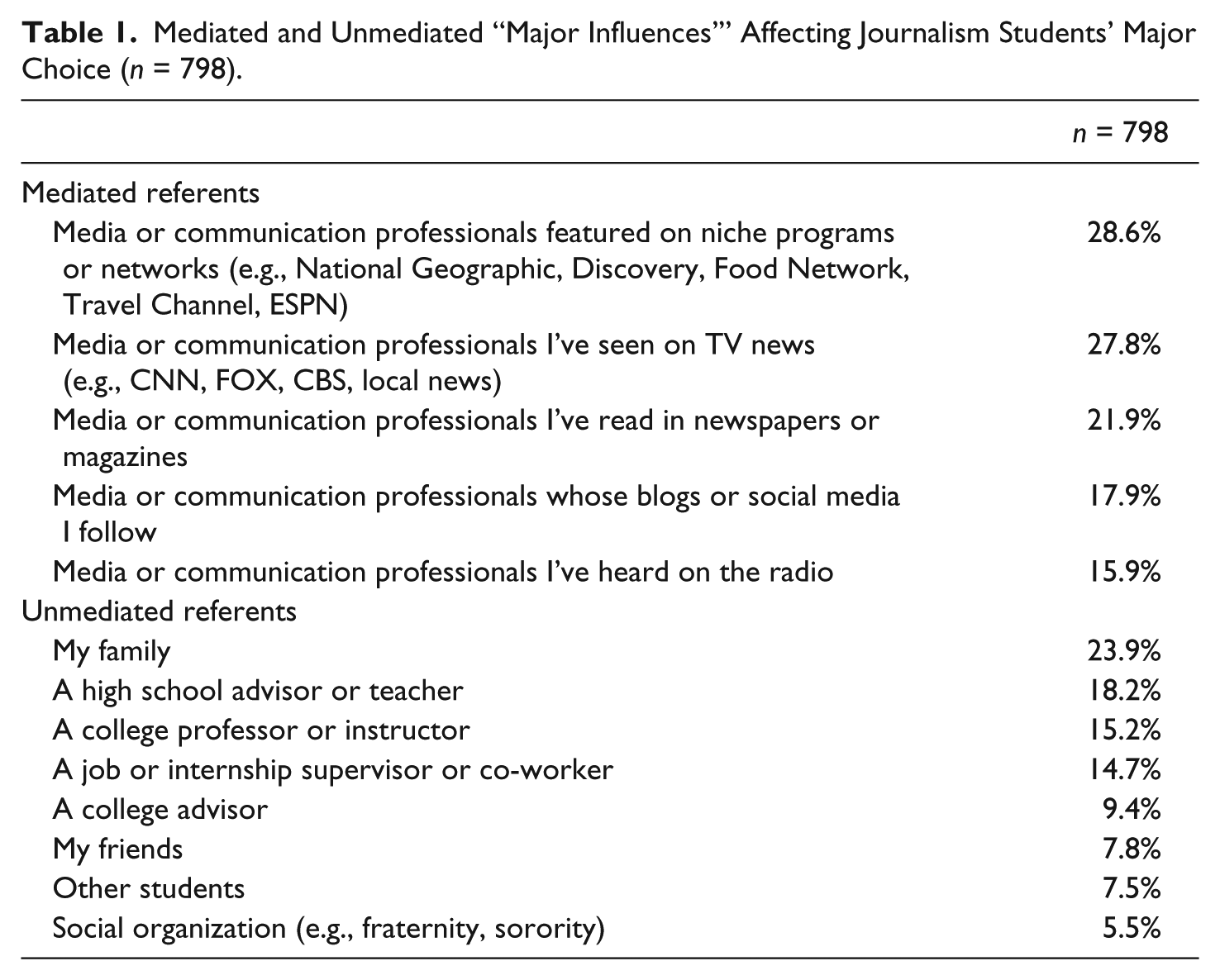
Participants consisted of 798 U.S. undergraduate university students (63.0 percent female; 26.3 percent male) majoring in journalism with an average age of 21.0. The participants were 66.9 percent White, 10.9 percent Black or African American, 5.1 percent Hispanic or Latino, 3.1 percent Asian, 0.4 percent Pacific Islander, 0.3 percent Native American or Alaskan Native, and 2.5 percent other. In addition, an unmediated and mediated salient referents scale was created using an EFA with a principal axis extraction and Promax rotation asking students what or who was most influential related to their decision to major in journalism. The hypothesized scale was submitted to a CFA. The fit indices suggested a good fit: χ2(30, N = 684) = 73.601, p < .001; χ2/df = 2.453; CFI = .99; TLI = .96; RMSEA = .05 (with range of .03 to .06) for the referents scale. Scale items were based on prior research of unmediated referents 59 and focus group results on mediated referents. Media or communication professionals on niche programs or networks (28.6 percent), TV news professionals (27.8 percent), and family (23.9 percent) were the top “major influences” affecting their decision to major in journalism based on a one to five scale measuring mediated (α = .82) and unmediated (α = .83) salient referents (see Table 1).
Mediated and Unmediated “Major Influences’” Affecting Journalism Students’ Major Choice (n = 798).
SPSS (version 21.0) was used to analyze the data to answer
Means of Dimensions and Items of Journalism Degree Motivations.

Note. Answer categories ranged from “very unimportant” (1) to “very important” (7) on “My motivations for choosing my major.”
p < .05. **p < .01. ***p < .001.
An independent-samples t-test was used to answer
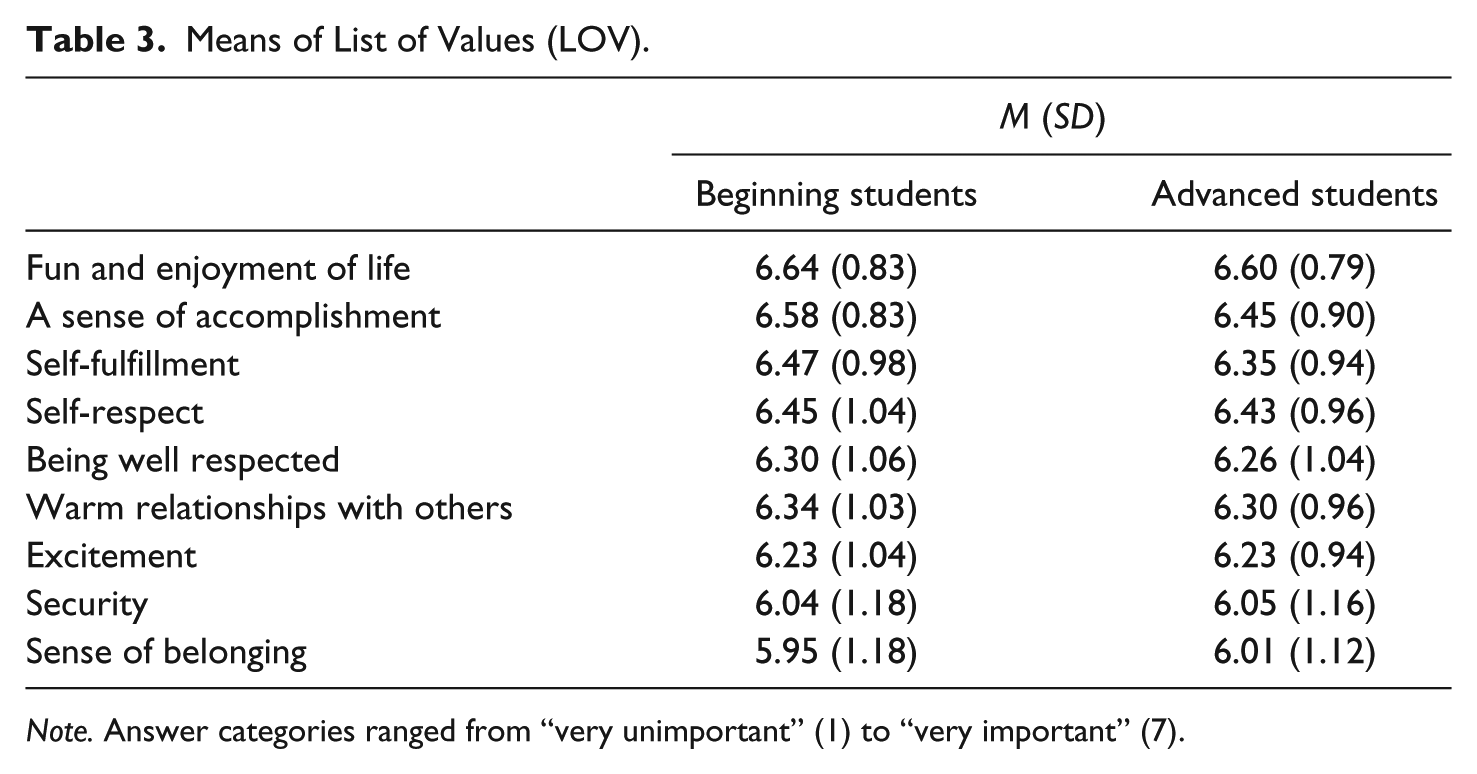
Means of List of Values (LOV).
Note. Answer categories ranged from “very unimportant” (1) to “very important” (7).
Discussion and Conclusion
The survey results indicate that academic experience did not extensively relate to variations in students’ motivations, values, and technology use. Most of the significant differences had a very small effect size. Specifically, the results did show beginning (i.e., first and second year) and advanced (i.e., third and fourth year) journalism students differed significantly in perceiving that writing, social responsibility, social prestige, and sports media were motivations for a journalism degree. And the groups differed significantly in how active they were in their use of technology.
The survey outcomes showed advanced students were significantly less likely to view writing, sports, social responsibility, and social prestige as perceived motivations for a journalism degree. Based on the results, it appears that these motivations become more depressed as they advanced within journalism programs. Exposure to journalism curriculum may negatively influence students’ perceptions of journalism as a path to being a writer and gaining notoriety in media venues. In fact, most perceived motivations on the JDM scale also reflected lower means in the more mature student category. This may mean that their perceptions become more realistic rather than idealistic. 60 In addition, journalism education has been said to concentrate on preparing students for newsroom environments, which may also affect their attitudes toward niches less emphasized within programs such as entertainment and sports journalism. It appears that journalism leaders have some influence on students’ interpretations of the definition of what constitutes journalism as a profession. However it is interesting that their social responsibility motivations decreased as time passed because previous research of Australian journalism students has shown that advanced students identified more with the watchdog role of journalism in comparison with beginning students. 61
Values did not significantly vary between beginning and advanced levels of students. This may mean that academia does not have an impact on human values. Values are commonly thought of as an attribute that remains stable over time. 62 As a result of the potential stability of the values variable, values could make a good independent variable. Values are also generally considered a positive construct, and thus, users may cluster their answers all on the positive end of the scale. 63 In addition, Beatty et al. cautioned against a small influence of social desirability bias in LOV surveys, which could lead respondents to over- or underrate some values. 64 However, it is interesting to see values vary in rank. Overall, it appears that they appreciate fun and enjoyment in life, a sense of accomplishment, and self-fulfillment the most. An awareness of their value system could help inform journalism educators on how to reach students based on their priorities.
Ideally, college experiences and coursework would positively influence technology habits. However, their reported behaviors do not appear to change dramatically. There was a slight significant difference in higher levels of activity with technology for advanced students. The scores could range from 0 to 10. It would be expected that upper-level students would be substantially more active in technology use, especially because many of the items in the index could be skills acquired through journalism coursework. However, the mean scores on the technology index were only slightly different, less than half a point, suggesting that differences among students are less due to the coursework attempted than to the interests of the individual students.
For future research, replication and refinement of constructs is needed to determine how precisely education is affecting students. The available sampling frame limits our ability to generalize to all undergraduate journalism majors. The data sets represent five different public universities. Perhaps smaller or private schools may have a larger impact on students, which ultimately means additional research needs to be conducted to test these measures on other national and international samples.
Second, previous survey research on journalism students has looked at variations in roles, perceptions about the public’s view of journalism, Rokeach’s values, rewards versus professional attributes, and perceived usefulness of journalism. The replication of these studies helps to more precisely determine to what extent and whether education has an impact on future professional communicators’ views. This is why it is important to employ standard measures to build upon our existing knowledge and make predictions.
Researchers have extensively studied how news organization and media routines constrain journalists’ editorial freedom, available frames, and source selection. Yet it appears that most work on journalism students is survey-based, which means our understanding of them is at an individual level analysis on Shoemaker and Reese’s model of influences. Many higher levels such as media routines or the organization exist that constrain their individual freedoms. 65 Additional methodological approaches such as a content analysis of student publications, participant observation of student newsrooms, or experiments are needed to determine whether, in what ways, and to what degree universities and teachers have an impact on behavior.
Last, it should be noted that this study did not address those who change majors, either into journalism or from journalism. The socialization processes discussed are likely to operate quite differently on those who are undergoing a change of major, and future research should address these dynamics as a means of improving retention, advising, and enrollment.
In conclusion, the notion that journalism schools alter students’ identity or technology habits appear to be an assumption that needs further testing to determine its validity. College is a time in which undergraduate students are susceptible to influences that alter their identity. The intellectual leadership of many U.S. journalism programs has adopted the professional mission to provide job-related training to journalists. 66 If the goal of U.S. programs is to train students to learn newsroom-related skills, to take atheoretical courses, and to take the majority of the courses outside of the major, educational leaders may have little impact on students’ understanding of journalism and its place in society. From the results of this study, one could argue that program leaders need to increase the teaching of technology in courses. One could also argue that educators need to focus greater attention on theory. To compromise, numerous approaches exist to create a richer awareness of journalism’s impact. For example, the teaching of how to increase or decrease engagement with online information, how people cognitively process information when the information structure varies within mediated environments, or how to verify information in digital environments. It has been argued that the long-term effect of a journalism education may be overridden by the socialization that occurs within journalism organizations. 67 However, this is a sample of students who are immersed in academic culture, and they should hypothetically be affected by their journalism education. And that is why it is important to test other samples with these and other variables to more precisely determine the impact of a journalism education.
Footnotes
Acknowledgements
We thank the National Academic Advising Association (NACADA): The Global Community for Academic Advising for funding this project and Dr. Tim Brown from the University of Central Florida for his assistance with the project.
Declaration of Conflicting Interests
The author(s) declared no potential conflicts of interest with respect to the research, authorship, and/or publication of this article.
