




Abstract
The purpose of this study was to add to the limited body of knowledge on the effect of the media ethics course, specifically to investigate the effect of the course on the growth in moral judgment reasoning of students through a quasi-experimental pre-test, post-test analysis using the Defining Issues Test 2 (DIT-2). Results demonstrated significant advances in such reasoning among students in one section of the media ethics course but not in the other. It is difficult to determine the exact cause that led to significant increases in moral judgment reasoning in one section of a course and not the other, but the effect of different educational interventions seems clear. Although we cannot know which techniques or combination of techniques were successful, it would seem that interactive and experiential activities that require demonstrated application of principles in the classroom are more successful than traditional Socratic lecture and reflection essay methods.
Introduction
Many studies have demonstrated that students in today’s classroom—the so-called Millennial generation—require different classroom methods and techniques than earlier generations. This generation of students prefers to work in teams and small groups, learns best in an experiential environment, and is less apt than their predecessors to read textbook material carefully (Twenge, 2002; Wilson, 2004). The media ethics course provides good substance in which to incorporate a rich learning environment for students as it involves incorporation of traditional philosophical theories such as Kant, Mill, Rawls, and Aristotle, with application to ethical problems in media production and consumption.
In the late 1970s, just 27% of 237 schools investigated had media ethics courses, yet by the beginning of this century about two thirds included media ethics courses (Christians, 1978; Lambeth, Christians, & Cole, 1994; Lambeth, Christians, Fleming, & Lee, 2004). As Austin and Toth (2011) noted, “A dedicated ethics course is recommended in an ideal undergraduate curriculum” (p. 503). Moreover, in recent years, conversations in academic publications have shifted to include not just consideration of the role of media ethics courses in educating communications students (Harrison, 1990; Lambeth et al., 1994) or the instructional methods used (Braun, 1999; Christians & Lambeth, 1996) but have begun to delve into the measurable outcomes produced by such courses (Canary, 2007; Gale & Bunton, 2005; Surlin, 1987). Unfortunately, there have been few studies that propose to measure the outcomes of the media ethics class, and the results of these studies have been mixed. Moreover, there are differences of opinion among educators as to what such outcomes should be. For example, some argue that ethics courses should aid in the development of moral judgment reasoning (Goree, 2000; Jagger, 2011; Lambeth et al., 2004; Yoder & Bleske, 1997) while others do not see that as one of the key outcomes of such a course (Callahan & Bok, 1981).
Among the outcomes of the media ethics course were those investigated by Gale and Bunton (2005) who found that those who had taken the media ethics course were more likely to consider ethical issues important in their profession than those who had not. Similarly, Surlin (1987) found that students’ values, based on Rokeach’s 18 terminal and 18 instrumental values, shifted toward more “moral” and “social” values as the result of educational intervention. Yet, Canary (2007) found in a comparative study of students enrolled in a media ethics class and those enrolled in a conflict resolution class that “students in communication ethics courses demonstrated small but insignificant gains in moral reasoning” (p. 194), with greater gains from students enrolled in the conflict resolution class. Thus, while there is no one desired outcome of the media ethics class, research suggests “that education in moral reasoning can be effective in the development of student journalists and their sense of responsibility to society” (Yoger & Bleske, 1997, p. 227). The purpose of this study, therefore, is to add to the limited body of knowledge on the effect of the media ethics course, specifically to investigate the effect of experiential and cooperative learning techniques as well as traditional Socratic lecture and reflection essay techniques, on the growth in moral judgment reasoning of students through a quasi-experimental pre-test, post-test analysis using the Defining Issues Test 2 (DIT-2).
Literature Review
The DIT as a Measure of Moral Development
There have been more than 400 published reports investigating the concept of moral judgment and the DIT (Bebeau & Thoma, 2003). The DIT-2 is an updated paper and pencil measure of the DIT, and is based on the work of Lawrence Kohlberg who used interview format to determine a measure of moral judgment. Using schemas rather than stages, Rest, Narvaez, Thoma, and Bebeau (2000) referred to the DIT as providing a neo-Kohlbergian approach to morality. Based on more than 25 years of research, this study suggests that moral development occurs as shifting distributions rather than as hard, sequential movement. Rather than the six stages of moral development proposed by Kohlberg, the DIT evaluates three schemas. According to Rest et al. (2000), “Schemas are general knowledge structures residing in long-term memory” (p. 389). In the neo-Kohlbergian approach, the first schema, referred to as the Personal Interest schema, is derived from Kohlberg’s second and third stages. The second, the Maintaining Norms schema, is derived from Kohlberg’s Stage 4, and the third schema, referred to as Post-Conventional schema, from Stages 5 and 6 of Kohlberg.
Those who use the Personal Interest schema in moral decision making analyze moral dilemmas by considering the positive and negative consequences of action as they relate to the individuals involved, rather than to any societal implications. As Rest et al. (2000) noted, this schema “justifies a decision as morally right by appealing to the personal stake the actor has in the consequences of an action” (p. 387). In the next schema, the Maintaining Norms schema, individuals see importance in maintaining social order, which defines morality. In this schema, law is seen as the foundation for order, without which there would be anarchy, a situation that the authors suggest responsible people will want to prevent. The final schema, Post-Conventional, is comprised of four elements: (a) the primacy of moral criteria, (b) appeal to an ideal, (c) shareable ideals, and (d) full reciprocity. In this schema, the attempt to achieve moral consensus is achieved by appealing to ideals and logical coherence as opposed to the Maintaining Norms schema in which the attempt to achieve moral consensus is based on appealing to established practice and existing authority.
Within the fields of communication, the DIT has been used to measure the moral judgment acuity of public relations practitioners (Coleman & Wilkins, 2009), public relations and journalism undergraduates (Cabot, 2005), advertising and marketing research practitioners (Castleberry, French, & Carlin, 1993), and journalists (Coleman & Wilkins, 2002). As Rest et al. (2000) noted, “The DIT is a device for activating moral schemas. Reading moral dilemmas and the DIT issue statements activates moral schemas (to the extent that a person has developed them)” (p. 389). The Cabot study is unique among these studies in that the population of study was undergraduate students while the others studied professional adults. Results of Cabot’s (2005) study indicated that the public relations and journalism undergraduate student participants in the study scored lower than professionals in both fields, as discussed below, and lower than undergraduate students in general.
Studies have found that both journalists and public relations practitioners scored significantly higher on industry-specific dilemmas used as part of the DIT-2 than on the non-domain-specific dilemmas (Coleman & Wilkins, 2002). In these studies, journalists placed fourth among professions examined using the DIT, while public relations practitioners ranked seventh. Ironically, the study also found that journalists scored somewhat lower than desirable when considering ethical dilemmas outside of their professional experience, and nearly 25% “scored below the average adult in moral reasoning” (p. 220). In contrast, Lieber (2008) reported mixed results on industry-specific dilemmas in public relations with one dilemma scoring quite high and one low. Moreover, the study found significant differences between agency/corporate practitioners and their academic counterparts.
The DIT-2 and College Students
These differences between agency/corporate practitioners and their academic counterparts are unsurprising and in line with long-term validity tests of the DIT, which have shown that “30% to 50% of the variance of DIT scores is attributable to level of education” (Bebeau & Thoma, 2003, p. 30). While level of education can mean anything from comparative studies of elementary school students versus their high school counterparts, to college educated versus non-college educated, a great many studies have focused specifically on the moral development of college students (King & Mayhew, 2002; Rest, 1988). In a review of 172 studies of college students using the DIT, King and Mayhew (2002) found just two studies that did not report, or did not find, differences in moral reasoning as the result of formal education. Results of a later study by Cabot (2005) also failed to discover differences in moral reasoning as the result of higher education. These few studies notwithstanding, overall results indicate that the development of moral judgment is not attributable to general maturation and that “Intentionally or unintentionally, moral development is an outcome of higher education, at least as measured by the DIT” (King & Mayhew, 2002, p. 249).
Moreover, studies of moral judgment among college students have taken place in a variety of institutional contexts from large public universities to 2-year colleges, smaller private universities, and Bible colleges (King & Mayhew, 2002). Of these studies, large effect size was found consistently only among students attending liberal arts colleges. Lesser effect size was found for universities and the least effect size for the Bible colleges.
Additional studies have considered the effect of educational intervention on the development of college students’ moral judgment abilities. Such interventions have included a variety of approaches from ethics-specific courses, community service projects, outdoor education, social diversity, psychology, and general education courses, most of which were effective. Of the three studies that focused on ethics courses, results were mixed with two studies reporting gains in moral reasoning and one that did not (King & Mayhew, 2002).
Measuring the Effect of the Media Ethics Course
No studies of media ethics courses using the DIT or DIT-2 for measure of development in moral judgment were found. Of the four studies evaluating the outcomes of the media ethics course, one used a pre-test, post-test measure of Rokeach’s value systems (Surlin, 1987); one used a study-specific survey measure of participants’ perceptions of ethics and the ethics instruction they received at university (Gale & Bunton, 2005); the third used the Moral Judgment Test (MJT; Canary, 2007); and the forth evaluated student values through the Ethics Position Questionnaire (EPQ; Plaisance, 2007). Although direct comparison of these studies with the DIT cannot be made, both Rokeach and the MJT also measure moral development.
According to Surlin (1987), Rokeach identifies two major types of value systems, the instrumental and the terminal values. Instrumental values refer to those values indicating specific modes of conduct and can be further separated into moral values or competence values. Moral values reflect an interpersonal focus that can result in feelings of guilt, while competence values are personal and less concerned with morality or guilt than feelings of shame about personal inadequacy. Terminal values can also be subdivided into two value groups, that of personal values or social values. As indicated in their nomenclature, personal values are self-centered while social values consider the welfare of others. Within the instrumental value system, results have demonstrated that students’ value patterns shifted from the competency-based value to more moral-based value during the course of the semester. Moreover, within the terminal values, students generally reflected more social value than personal value identification by the end of the course in media ethics.
A comparative study by Gale and Bunton (2005) examined perspectives of alumni who had taken a media ethics class and those who had not, and discovered that 86% of advertising and public relations professionals who had attended an ethics class, regardless of university institution, agreed that the course made them more aware of ethical issues in the profession. This is in contrast to those who had not taken an ethics course, of whom only 38.6% agreed. Moreover, more than 50% of those who had taken ethics felt better informed about professional codes of conduct, compared with the non-ethics students of whom just more than 13% agreed.
Like the DIT and DIT-2, the MJT is based on Kohlberg and is used to measure development in moral reasoning ability. In an examination of both instructional method and the effect of the media ethics class on students using the MJT, no significant relationship between the extent to which ethical issues were addressed in the classroom and the changes in moral reasoning was found (Canary, 2007). The use of case studies as instruction material was, however, associated with a higher degree of moral reasoning.
Development of Research Questions
The DIT has been used in hundreds of studies, many of which on college students, but has hitherto been unused to study the development of moral judgment as the result of a media ethics course. Moreover, the college experience accounts for the majority of variance in all DIT scores, and students within colleges of liberal arts have consistently scored higher in moral reasoning than their university or Bible college counterparts. Evaluation of communication professionals (journalists and public relations practitioners) has demonstrated above average mean scores among professions studied (Coleman & Wilkins, 2002, 2009). In contrast, a study of communication undergraduates found these students ranked lower than their professional counterparts and lower than undergraduates in general (Cabot, 2005). The subject for this study is two sections of a required media ethics course for journalism, public relations, advertising, and multimedia undergraduates in a liberal arts college. As a result, the following research questions are posed:
Method
Participants
All the students enrolled in a media ethics course during the fall semester of 2012 in the liberal arts college of a medium-sized private, religiously affiliated, university were used in the study. The media ethics course is required for all junior- or senior-level students within the department, regardless of major course of study (public relations, advertising, journalism, and multimedia technology), and it is a stand-alone course within the department that also includes a separate Media Law and Regulation course.
Total enrollment for the course (N = 56) was divided into two sections: a once-per-week night section (Section 1; n = 22) and a twice-per-week afternoon section (Section 2; n = 34). It should be noted that though the sample may appear small, there have been more than 400 published studies relating to the DIT, among which a sample size of 50 to 100 is common (Coleman & Wilkins, 2002). Because discussion of the DIT-2 was to be included as part of the course, students were required to take the DIT-2 as part of their classwork; however, during the informed consent procedure, they were allowed to prevent access to their results for research purposes. According to Bebeau and Thoma (2003), “There are sufficient reasons to include the measure as a regular part of the curriculum” (p. 282). They further suggest that “When the test is appropriately presented and constructive feedback is given, the test can serve a useful curricular purpose” (p. 282).
Procedures
The study used a two-group quasi pre-test, post-test experimental design with participation in the class serving as the intervention. Each section was taught by a different professor, and different instructional interventions were used in teaching, including a diversity of textbooks. To maintain consistency in test administration and to adhere to requirements from the subject university Internal Review Board, the graduate assistant for one of the researchers administered all sections of the DIT-2. The first set of tests was administered during the first session of the once-per-week section and during the second class period of the twice-per-week section of media ethics. The second administration of the test occurred within the final 2 weeks of the semester when the concept of moral maturity and the work of Lawrence Kohlberg were discussed. Prior to administering the DIT-2, forms were coded for identification of course section and also to enable analysis of pre-test and post-test results from individual subjects. Following administration of the second DIT-2, tests were removed for which the student had been present for only the first or second administration of the DIT-2 and thus did not qualify for the repeated measures analysis.
Measures
The DIT-2 was used to measure the extent of increased moral judgment. The DIT-2 is an updated version of the DIT, which was used for more than 30 years before the new measure was developed. According to its developers, the DIT-2 has more up-to-date dilemmas and is shorter than the DIT, appears to produce slightly stronger trends on validity and reliability, and purges fewer subjects for unreliability (Bebeau & Thoma, 2003). Cabot (2005) reported the option of hand-scoring the DIT; however, that option is no longer available to researchers, except for graduate students with small sample sizes. For all other researchers, it is necessary to return the completed tests for the DIT and DIT-2 tests to the Center for the Study of Ethical Development, which now resides at the University of Alabama.
The original DIT is composed of six ethical dilemmas while the DIT-2 contains five, just two of which are similar to those in the DIT. The first of the similar scenarios involves a doctor who must decide whether to give an overdose of pain killers to a suffering patient, while in the second, college students must decide whether or not to demonstrate against U.S. foreign policy. In the DIT, this scenario refers to the Vietnam War, making it somewhat outdated. The remaining three scenarios in the DIT-2 involve (a) a father who must decide whether to steal food from the warehouse of a wealthy man to feed his starving family, (b) a school board chair who must choose whether or not to hold a contentious meeting, and (c) a newspaper reporter who must decide whether to submit a damaging story regarding a political candidate.
After reading each scenario, participants are asked to complete 12 questions relating to that scenario; for example, in the school board scenario, follow-up questions include “Is Mr. Grant required by law to have Open Meetings on major school board decisions?” and “Would the community regard Mr. Grant as a coward if he stopped the Open Meetings?” For each such question, respondents are asked to select the extent of importance of the item from great importance to no importance on a 5-point scale. After completion of the 12 questions, respondents are asked to rank the four most important items from most important to fourth most important of the 12 preceding questions. From such process, the DIT-2 reliability check is made, ensuring that items selected as of no importance are not then ranked among the four most important items.
The DIT analyzes participant responses among the three schemas: Personal Interest schema, Maintaining Norms schema, and Post-Conventional schema. A score is assigned to participants based on the relative importance participants give to higher level moral reasoning versus the lower forms of moral reasoning. The original score used for such analysis and that which is found in most studies of the DIT is the P score. Within the last decade, however, a new score called the N2—which provides more powerful data trends—has been implemented to replace the usual P score index (Center for the Study of Ethical Development, 2013). In addition to P scores and N2 scores, respondents receive a type indicator, which identifies their level within the schema. According to Bebeau and Thoma (2003), the types are described as follows:
Type 1: Predominant in Personal Interest schema and consolidated.
Type 2: Predominant in Personal Interest schema but transitional.
Type 3: Predominant in Maintaining Norms schema but transitional with personal interests as secondary schema.
Type 4: Predominant in Maintaining Norms schema and consolidated.
Type 5: Predominant in Maintaining Norms schema and transitional with Post-Conventional as secondary schema.
Type 6: Predominant in Post-Conventional schema but transitional.
Type 7: Predominant in Post-Conventional schema and consolidated.
The terms consolidated and transitional refer to the extent to which individuals discriminate strongly between two or more schema. Those that appear to clearly distinguish among the three schemas are considered consolidated while those who show less discrimination are considered transitional.
Results
Descriptive Statistics
Fifty-six students were registered for the media ethics course at the start of the semester. Of these, 47 completed both the pre-test and post-test, and 4 were purged for scoring higher than 10 on the “meaningless items” check, leading to a usable sample of 43, of which Section 1 students accounted for n = 18, and Section 2 accounted for n = 25. Just one graduate student and a rogue sophomore were included in the same; however, no differences in level of moral judgment reasoning were indicated by level of education at the pre-test or post-test level for either P score or N2 score. Testing for differences based on age again found nothing of significance; however, there were significant differences in the levels of moral development depending on the gender of the student.
In the pre-test P score, the means for men (M = 29.76, SD = 12.63) and women (M = 39.69, SD = 14.68) were significantly different with F(1, 41) = 5.23, p < .05. In the post-test for P scores, men (M = 32.94, SD = 17.16) and women (M = 43.31, SD = 13.61) again demonstrated significant differences in the extent of moral reasoning with F(1, 41) = 4.85, p < .05. With regard to the N2 scores, men and women had differing levels of moral judgment in both pretest and posttest evaluation. In the pre-test, men (M = 30.58, SD = 11.27) and women (M = 39.74, SD = 12.54) indicated significantly differing levels of moral judgment with F(1, 41) = 5.92, p < .05. They also had significantly differing levels in the post-test N2 score results: men (M = 35.20, SD = 14.93), women (M = 45.25, SD = 12.14), F(1, 41) = 5.87, p < .05.
Results Relating to Research Questions
Research Question 1 asked whether there were demonstrated increases in the level of moral judgment reasoning of students following the intervention of a media ethics course. Using nonparametric analysis, a Wilcoxon’s test was conducted to evaluate whether students showed higher level of moral development before or after attending the media ethics class. When students from both sections were pooled, the results indicated no significant difference in P score, z = −1.181, p > .05; however, results indicated a significant difference in moral judgment as indicated by the N2 score, z = −3.115, p < .05. The mean of pre-test P scores was 35.77 (SD = 14.60), and the mean of post-test P scores was 39.21 (SD = 15.77). The mean of pre-test N2 scores was 36.12 (SD = 12.74), while the mean of post-test N2 scores was 41.28 (SD = 14.05).
Individual results of the procedure varied with some students moving from levels within lower schema to levels within higher schema and vice versa. Table 1 describes individual participants in the once-per-week section (Section 1) by their pre-test and post-test type indicators within the three schemas and also indicates whether the individual’s N2 scores increased or decreased between the two applications. Table 2 describes individual participants in the twice-per-week section (Section 2) by their pre-test and post-test type indicators within the three schemas and also indicates whether the individual’s N2 scores increased or decreased between the two applications. Overall, of the students in Section 1, 14 had increased N2 scores and 4 had decreased scores, while of those in Section 2, 12 showed increases in N2 scores and 13 showed decreases. At the pre-test stage, 39% of Section 1 students and 52% of Section 2 were identified at levels within the Post-Conventional schema. However, at the post-test stage, 67% of Section 1 students and 40% of Section 2 students were identified at levels within the Post-Conventional schema, an increase of 28% for Section 1 and a decrease of 12% for Section 2.
Individual Type Indicators Within Schema in Pre-Test and Post-Test Application and Directional Changes in N2 Scores (Section 1).

Please note that the type indicator level is not the same as Kohlberg’s (Rest, Narvaez, Thoma, & Bebeau, 2000) stages of development; the type indicators are described within the three schema and are described in greater detail in the “Results” section.
Individual Type Indicators Within Schema in Pre-Test and Post-Test Application and Directional Changes in N2 Scores (Section 2).
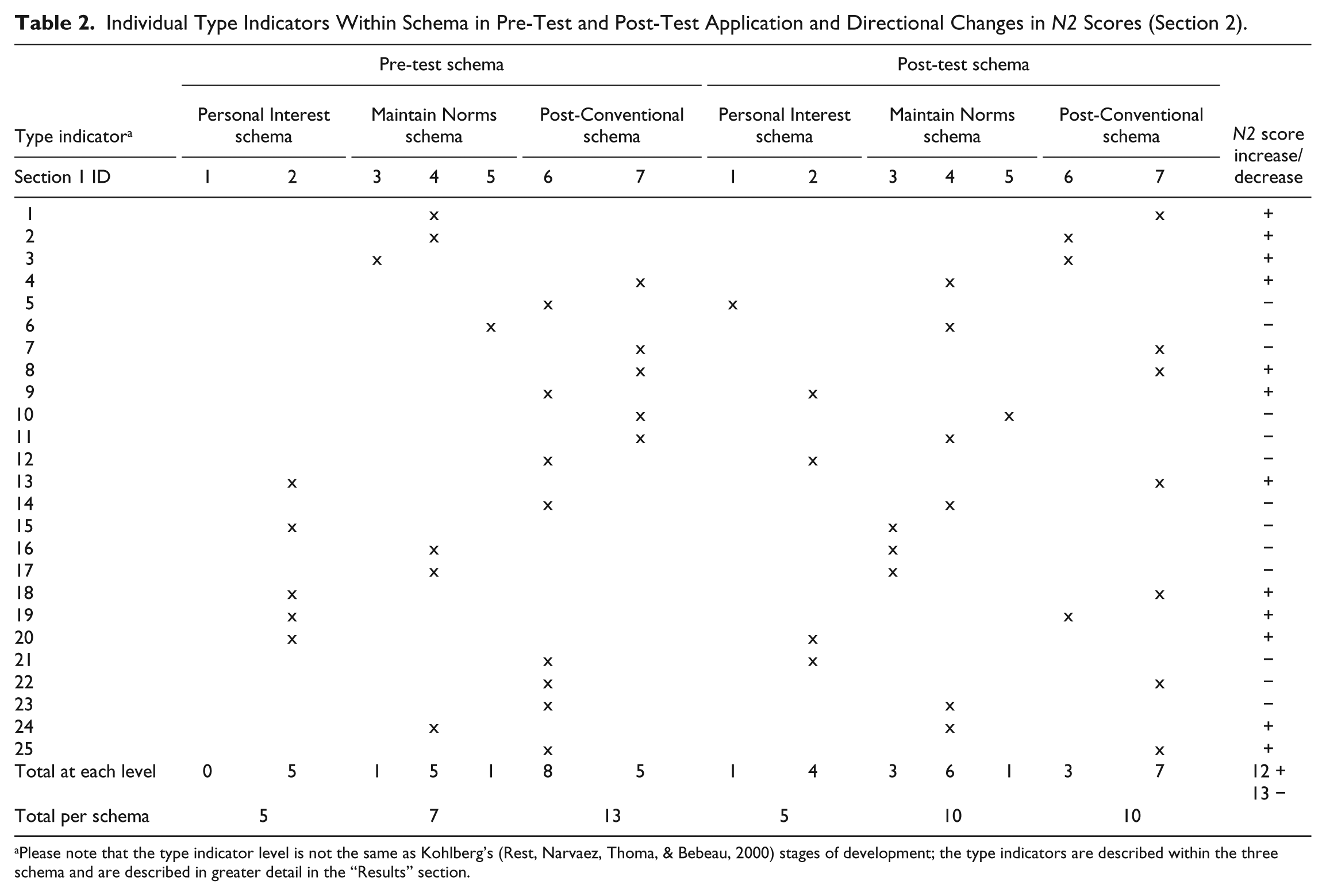
Please note that the type indicator level is not the same as Kohlberg’s (Rest, Narvaez, Thoma, & Bebeau, 2000) stages of development; the type indicators are described within the three schema and are described in greater detail in the “Results” section.
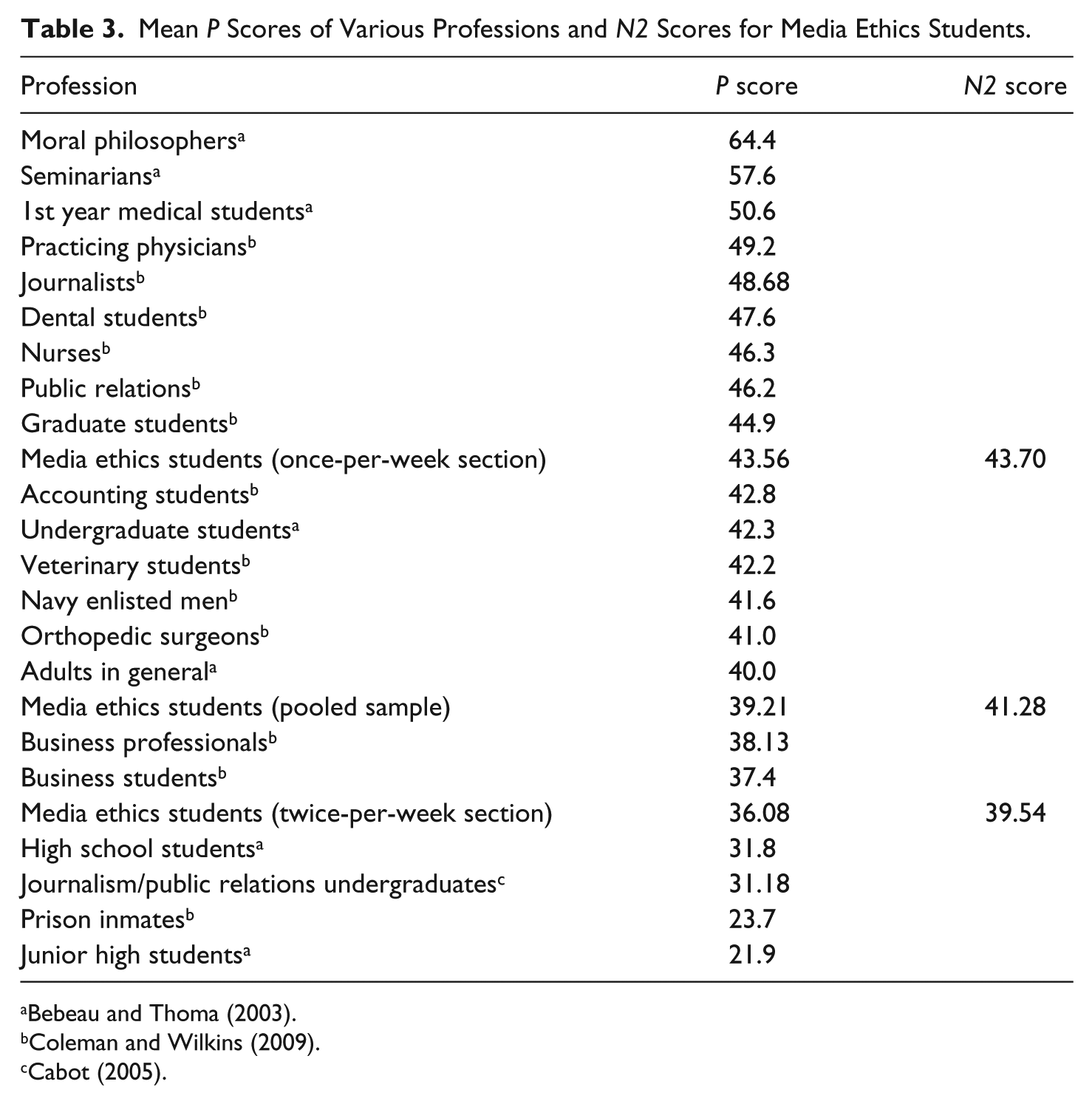
Research Question 2 questioned whether the type of instructional intervention would have any effect on the development of moral judgment reasoning of students. Nonparametric analysis of students by section demonstrated differences in student outcomes depending on the section of media ethics in which they were enrolled. A Wilcoxon’s analysis of Section 2 (n = 25) did not find significant differences in the level of moral judgment reasoning in either the P scores, z = −0.244, p > .05, or the N2 scores, z = −1.628, p > .05. Pre-test P scores for this section were 35.20 (SD = 11.62) with means of 36.08 (SD = 14.38) in post-test, while scores for the N2 score pre-test were 36.30 (SD = 10.31) and post-test N2 score means were 39.54 (SD = 13.03).
Analysis of students in Section 1 (n = 18) through a Wilcoxon’s test showed progression in moral development between pre-test and post-test for both the P score, z = −2.115, p < .05, and the N2 score, z = −2.809, p < .01. Mean scores for the pre-test P scores were 36.56 (SD = 18.30) and post-test means were 43.56 (SD = 16.98). Mean scores for the pre-test N2 scores was 35.87 (SD = 15.85), and post-test means were 43.70 (SD = 15.40).
Results indicated that students in the pooled sample of both sections scored higher on the P score measure than students in the Cabot (2005) study. Moreover, as indicated in Table 3, students in the twice-per-week section scored at a similar level to the pooled sample, and students in the once-per-week section scored higher than business, veterinary, and accounting students and undergraduates in general.
Mean P Scores of Various Professions and N2 Scores for Media Ethics Students.
Discussion
The purpose of this study was to investigate the effect of the media ethics course on the development of moral reasoning of students. Results demonstrated significant advances in such reasoning among students in one section of the media ethics course but not in the other through use of P scores, N2 scores, and individual level indicators within schema. The course description for both sections is the same; therefore, consideration must be given to differences in section-specific information and instructional interventions used in the classroom.
Once-Per-Week Versus Twice-Per-Week Sections
First, differences in student outcomes may be attributable to the once- or twice-per-week class format. It may be that students who select the once-per-week section share different characteristics than those in the twice-per-week sections. For example, students in the once-per-week class may have daytime jobs, internships, or other obligations that prevent attendance in morning or afternoon course sections. It is also possible that students in the once-per-week class have longer attention spans than those in the twice-per-week class. Conversely, students in the once-per-week class may suffer from procrastination, putting off registration until the last minute when they no longer had the option of the twice-per-week class because daytime classes fill more quickly than evening classes.
Types of Instructional Intervention
Second, it may be that the differences are attributable to different teaching techniques used in the classroom. Professors provide information via textbooks and readings, they deliver information through lectures, they guide students’ understanding of the concepts, and they engage students through a variety of educational techniques from essays to presentations and group discussions. Studies have shown the importance that professors and students place on various teaching techniques (Braun, 1999). For example, a study by Braun (1999) found that 98% of professors value ethical decision-making case studies while 65% of students do so. Conversely, just less than 80% of students value small group discussion while approximately 65% of professors value that technique. Lectures by professors are valued highly by professors (93.3%), but less than 50% of students value such lectures. Students are even less apt to favor research papers (21.1%) though 71.3% of professors value research papers. Moreover, students (31.7 %) are 50% less likely to value student presentation of topics than professors (62.8%), and about 50% of both professors and students see the importance of panels of opposing viewpoints.
Professors in the two sections used a variety of teaching techniques, textbooks, and readings. Both sections of the media ethics course used Patterson and Wilkins’s (2011) Media Ethics: Issues and Cases seventh edition. This was the only required textbook for Section 2 and was supplemented with a variety of other readings. Section 1 had two additional required texts—Plaisance’s (2009) Media Ethics: Key Principles for Responsible Practice and Sinclair’s (1928/2003) The Brass Check.
In Section 2, lectures were delivered in Socratic method with integrated video and case study content and relevant current examples from the news. Students were encouraged to give their opinions. They also were required to submit weekly reflection essays on a guided topic. For the mid-term, students were asked to apply a case study based on an errant fax from court to a TV news department manager concerning sensitive information in a warrant in a homicide case after which the police demanded the station withhold information. Students were asked to apply Aristotle, Mill, Kant, Ross, Bok’s Model, and Potter’s Box to their answers. The final consisted of a 12 page research paper on a communications industry ethical topic in the student’s area of interest. Students were to apply in-depth three philosophical premises of their choosing. Both sections used small group discussion sporadically during the semester.
In Section 1, lectures were delivered by the professor, with relevant current examples from the news, occasional video, or photographic examples, and some Socratic interaction. The course also included student-led case study discussion, with a pair of students engaging the class on a case study relevant to that week’s reading for at least 0.5 hr. Each student was required to lead, in partnership, one case during the course of the semester. The class also engaged in opposing viewpoint presentations in the form of weekly debates, again on a set case study relevant to that week’s readings. Panels of three or four students would be assigned to either the positive or negative side of an ethical dilemma and would be given an ethical framework to integrate into their arguments. Students were required to participate twice in debates during the semester, preferably once on the pro-side and once of the con-side. Reflection essays were also used twice during the semester where students were required to integrate ethical reasoning to deliberation of a specific case. The mid-term was an open book, written exam and took students the entire class time (2 hr 40 min) to complete wherein they were expected to integrate critical application of theory from a variety of sources including Mill, Kant, Ross, Feinberg, Potter, and Bok. The final research paper was very similar to that of Section 2 with students required to integrate at least four ethical theorists into a communication industry ethical dilemma of their choice.
Although the teaching techniques in the class sections differed, the professors share similarities—both are affable and enthusiastic, engage well with students, are of a similar age, and come from significant industry backgrounds, one from broadcast and one from public relations. Moreover, many of the video and photographic examples used in teaching were shared and used in both sections, and case studies were drawn from the Patterson and Wilkins (2011) book, noted above. In addition, student evaluation survey (SES) scores for both sections were above the college average.
Differences Between Women and Men
In addition to differences in moral development due to course section, there were also differences in the extent of development between men and women in the course. Earlier research has suggested that it is usual for men and women to have similar scores on the DIT (Cabot, 2005), yet Bebeau and Thoma (2003) indicated that while there are very modest differences between genders in lower levels of education, “the differences become more pronounced as educational level increases” (p. 37). It is possible that the women attending this private liberal arts college share characteristics that their male counterparts do not, but those characteristics are not made known by this study.
Limitations of the Study
Campbell and Stanley (1963) identified several questions of internal validity of the pre-test, post-test experimental design including history, maturation, and the effect of testing. During the 10- to 12-week span between initial testing and the second testing, students may have encountered social, personal, or historical events that contributed to growth in moral reasoning. People mature at different rates, and it is also possible that some students would have matured in their moral reasoning without benefit of classroom intervention during that period. That said, studies have demonstrated that maturation alone does not account for significant advances in moral reasoning (King & Mayhew, 2002).
The study is also limited by the size of the sample. Although studies using the DIT tend to have small samples and one of the few studies of student outcomes from the media ethics class had a sample size of just 20, it would be helpful to have studies with larger sample sizes for greater understanding of student outcomes as the result of the media ethics class (Coleman & Wilkins, 2002; Surlin, 1987).
In addition, the study used students from a liberal arts college, and students from liberal arts colleges tend to score higher on the DIT than other college students. It would be helpful to have a comparative study of the effect of the media ethics class in different university settings and not just comparative study of the DIT in general on these populations. Finally, while the varied teaching methods used by the two professors were identified as much as possible, it was not possible to control for differences in teaching method that are not readily apparent.
Conclusion
It is difficult to determine the exact cause that led to significant increases in moral judgment reasoning in one section of a course and not the other. However, the effect of different educational interventions seems clear. Although we cannot know which techniques or combination of techniques were successful, it would seem that something more than reflection papers and Socratic lectures are necessary to move students into higher levels of moral judgment reasoning. Additional study is needed to determine which interventions are best and most suited to engagement and growth of students in the media ethics course.
Footnotes
Author Note
Giselle A. Auger was affiliated with Duquesne University during the research and writing of this article. She is currently an assistant professor at Rhode Island College.
Declaration of Conflicting Interests
The author(s) declared no potential conflicts of interest with respect to the research, authorship, and/or publication of this article.
Funding
The author(s) received no financial support for the research, authorship, and/or publication of this article.