



Abstract
Teachers of business and economic journalism are developing creative approaches to attracting students and educating them in a field many find daunting. To recruit, some avoid using the terms business or economic in course titles, preferring financial basics and financial literacy. Many use novel classroom techniques: to educate students about stock markets, for instance, some set up competitions where students vie to develop the most profitable portfolio. Provocative videos, cleverly developed assignments and trips to business-news sites are highlights in some courses. This article reviews approaches by a broad array of teachers.
Keywords
Introduction
Business and economic journalism demands specialized skills that can be especially challenging to teach. Students must learn about corporate financial statements, understand company hierarchies, and grasp the essentials of business strategy. They must also learn about the securities markets, global trade, and key economic principles and barometers. Typically, moreover, journalism students bring little or no familiarity with these specialized areas into the classroom, posing considerable hurdles for educators.
Fortunately, journalism educators—many of whom now bring substantial professional media experience to the classroom—are developing an array of best practices to teach both undergraduates and graduate students. Their efforts, along with expansion in training programs for educators and students by the Society of American Business Editors and Writers (SABEW) 1 and the Donald W. Reynolds National Center for Business Journalism 2 at Arizona State University (ASU), may be making inroads. Suggesting much work remains to be done, some 57 percent of business editors surveyed by Mary Jane Pardue in 2012 rated graduating journalism students as “moderately unprepared” (50.8 percent) or “extremely unprepared” (6.2 percent). 3 But this marks a gain from 2002, when Pardue, now department head and professor of journalism at the Department of Media, Journalism and Film at Missouri State University, found that 80.5 percent of business editors rated the graduates as “moderately unprepared” (64.4 percent) or “extremely unprepared” (16.1 percent). 4
The gains may also reflect a drive toward encouraging journalism students to specialize in certain content areas, such as business and economics, or to double-major in such subjects along with journalism. Such “knowledge-based journalism” has been encouraged by programs such as the Carnegie-Knight Initiative on the Future of Journalism Education 5 and academics including Thomas E. Patterson at the Harvard Kennedy School. 6 Some schools, such as the Columbia University Graduate School of Journalism, have long offered the opportunity for graduate students (and mid-career fellows) to focus on business and economics, and Columbia now counts the area among four topics in which students concentrate to earn a master of arts degree. Undergraduate journalism students at the University of Nebraska–Lincoln (UNL), along with others across the university, are encouraged to study business in a six-course “applied” minor aimed at non-business students established by the UNL College of Business Administration. Similarly, students at the University of North Carolina learn about business in programs developed in cooperation with the university’s Kenan–Flagler Business School.
Furthermore, efforts to better train teachers may be helping. The Reynolds Center established endowed chairs of business journalism at four universities and funded visiting professors—who usually are business-journalism professionals—to teach at eleven other schools between 2012 (when the program began) and 2016. Since 2007, the center has also trained twelve to fifteen business-journalism educators each year, better equipping them for the classroom, through a fellowship program at ASU. Through mid-2014, the center had hosted approximately 111 educators through the annual fellowship, which includes training aimed at improving classroom skills, center administrative associate Cassandra Nicholson wrote in an email. 7 This article reviews syllabi gathered by the Reynolds Center and others collected independently, along with interviews with teachers, providing examples of promising techniques educators are now using.
A Rose by Any Other Name . . .
For some teachers, the novel practices begin with the names they use for their courses. Many are designed to expand enrollment beyond students particularly interested in business journalism, which is generally a small subset. Journalism students whose interests are more general, along with students majoring in public relations, business, economics, or other non-journalism fields, often find a label such as “Business and Economic Journalism” off-putting, some teachers find. So some label their courses “Making Sense of the Economy” or “Understanding the Economy.” More narrowly, others call their offerings “Financial Basics,” “Financial Fundamentals for Communicators,” or “Financial Basics for Communicators.”
Even though the course material is often similar, the differing names are more than cosmetic. They reflect the focus the teachers put on the topic, driving them to serve the interests of both journalism majors and non-journalism students, teachers say. James K. Gentry, a professor and former dean at the School of Journalism and Mass Communications at the University of Kansas, teaches “financial fundamentals” and “financial basics” classes, for instance. 8 By building his courses on such financial themes, he draws about 65 percent of his students from the school’s Strategic Communications sequence and most of the rest from the News and Information sequence. Gentry, a former executive director of SABEW, also teaches master’s degree students in the Integrated Marketing Communications program in Overland Park, for whom the “Financial Fundamentals for Communicators” course is required.
Gentry teaches about how markets and companies operate, explains financial analysis, and has students write about their findings, he wrote in an email. 9 They learn about Securities and Exchange Commission (SEC) documents and use financial techniques business reporters use to compare companies. Gentry also devotes a segment in his undergraduate course to personal finance. His students learn much of the same material as others teaching courses straightforwardly called “Business Journalism,” but they do not write business news or feature stories per se. Instead, they do academically oriented reports—an approach sometimes taken, as well, in business-journalism courses.
Similarly, Rob Wells, 10 now teaching at the University of Maryland while pursuing a doctoral degree there, tailors his courses to suit a varied mix of majors. While at the University of South Carolina in 2012, under the aegis of the Reynolds Center visiting business-journalism professor program, he called his classes “Making Sense of the Economy” and “Business Journalism, Corporations and You: Real-Time Financial Literacy.”
In a typical assignment, Wells required students to compare media coverage of an economic indicator. He asked them to provide overviews of companies, using SEC documents, and had them examine coverage of earnings reports. This approach—a kind of meta-journalism—is not the same as requiring news accounts on the topics, but the assignments immersed students in materials business journalists use. And he graded their work accordingly, holding journalism majors to a higher standard for such things as Associated Press (AP) style. “If a business student wrote a paper but did not have a crisp lead or did not follow inverted-pyramid style, but still had substance, he would not be penalized for it,” Wells said in an interview. 11
Wells, a former deputy bureau chief in Washington, D.C., for Dow Jones Newswires/Wall Street Journal, teaches “Special Topics in Data Gathering and Analysis: Dollars and Deadlines—Reporting on the World of Business.” The course fills a requirement for data gathering in the University of Maryland’s journalism program. In his syllabus, Wells said the class is designed for both journalism and non-journalism undergraduates and examines “how the U.S. economy works and how to find news in business, market and government data sources.” 12 In the spring of 2015, he offered the course to graduate students, as well.
Assignments Vary
Mixed classes, involving journalism majors and others, are a plus, teachers say. Mark W. Tatge, 13 now pursuing a doctorate as the Baldwin Fellow at the University of South Carolina, said in an interview that the mix in his courses at Ohio University and DePauw University enriched class discussions and produced better results on team assignments. At Ohio, where he started teaching in 2007 after serving as a senior editor at Forbes magazine, Tatge taught a course that was cross-listed in the journalism and business schools. At times, as many as a third of his students were marketing majors. Tatge said, “You’re not going to teach them to write news stories, that’s not what they’re there for.” 14
Still, journalism remained the core mission. For group projects, Tatge staffed each team with at least one journalism student. Business and marketing majors could help journalism students better see how corporations worked, while the journalism students could explain newsworthiness. Tatge’s students would probe corporate financial documents and follow news about companies. They would explain what went awry when companies had problems, and they would describe things readers would want to know in a news story. “It’s not journalism in the traditional sense, but in other ways it is,” Tatge said. “They don’t write a fifteen-inch story and put a headline on it, but they might keep a blog on it.”
When asking students to write like business journalists, some teachers use novel assignments. For a 2011 advanced business reporting course in the journalism school at the University of North Carolina at Chapel Hill, Bloomberg News staffers who taught on loan from the news service asked students, in lieu of a midterm exam, to write a paper about a county in North Carolina:
Your task will be to select and research a county . . . From this research you will discover a theme of vital importance to the county and write a story about it. What is driving the county? What is its biggest challenge? What is everyone talking about? Is it financing? Taxes? Schools? Water? Garbage removal? Remember to follow the money.
15
Chris Roush, who teaches at the University of North Carolina at Chapel Hill and wrote a widely used business-journalism text, 16 suggested many novel tasks in a model business-journalism syllabus he created in 2011 for the Harvard Kennedy School Shorenstein Center on Media, Politics and Public Policy. 17 Some suggested tasks are shown in Figure 1.
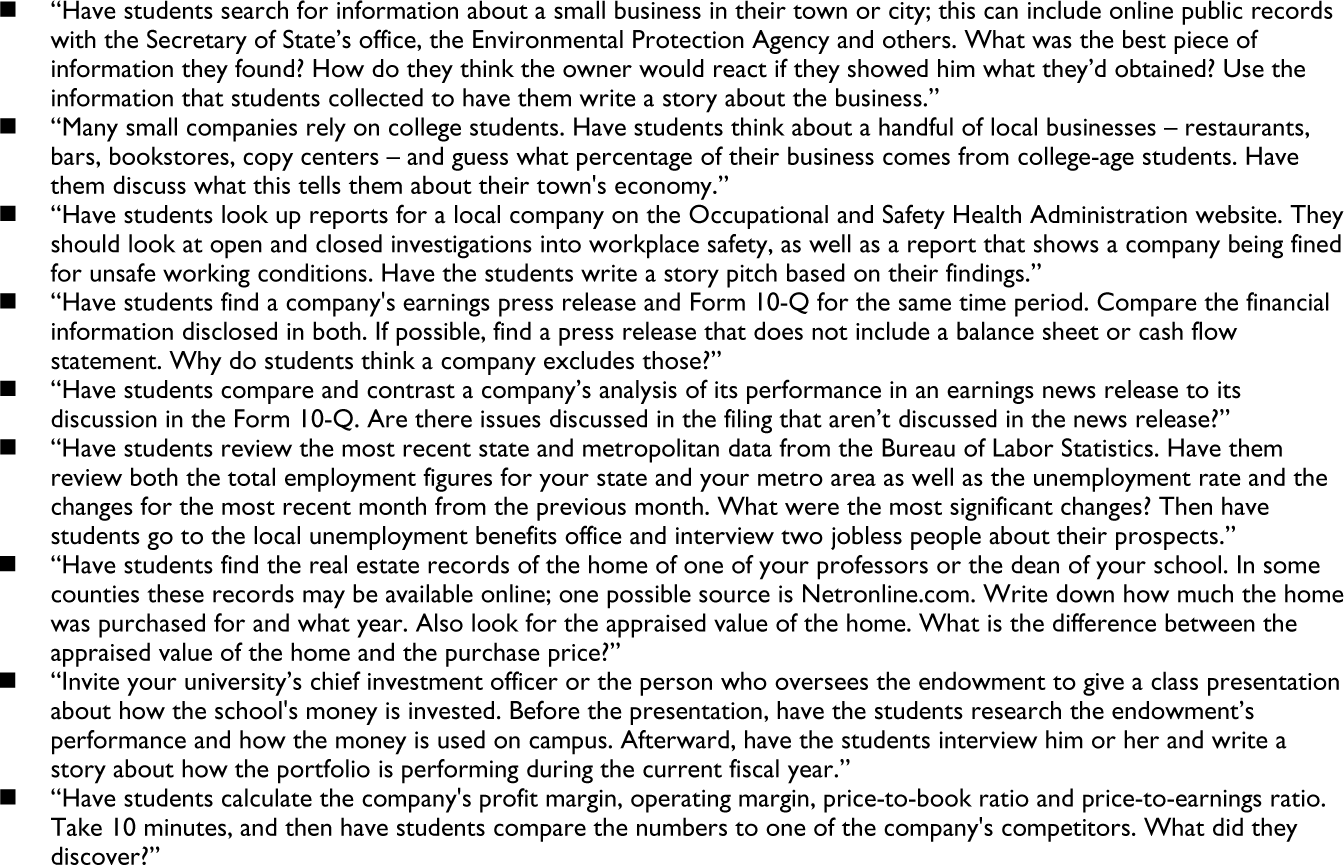
Sample assignments for business-journalism students.
For every business-journalism teacher, it can be daunting to make business statistics and measures come alive. Tom Contiliano, a top Bloomberg News executive and certified public accountant who has taught accounting and lectured on business and journalism at schools including the University of North Carolina, Northwestern University, and the University of Nebraska–Lincoln, engages students by having teams of students match important ratios with companies. In rapid-fire exchanges, students then see which companies maintain high inventories and which do not, which companies spend the most on research and development as a share of revenues, which companies are the most profitable, and so on. “The main goal is to get journalists thinking in terms of numbers and, in the process, overcome any allergies they may have towards financial information,” Contiliano said in an email, 18 adding that he tries “to drive home the intuitive nature of ratio analysis.” 19
Sometimes, students produce timely work. After Facebook Inc. filed a prospectus with the SEC for its initial public offering in 2012, Alan Deutschman’s
20
students at the University of Nevada, Reno, plowed through the three-hundred-plus-page document and wrote opinion pieces about it. “Almost all the students were bearish on Facebook’s stock because as teenagers they had been active in MySpace and watched their generational cohort embrace MySpace and then abandon it for Facebook,” Deutschman, a former correspondent for Fortune and former senior writer at Fast Company, said in an email
21
:
I disagreed, since I argued that Facebook had extended the reach of social media far beyond teenagers to include grown-ups, businesses, etc. Still, it was good to get them writing about a company and industry that they had experienced as consumers.
Moving Beyond the Numbers
To humanize corporate strategy and culture, some business-journalism teachers ask students to profile a chief executive officer. While challenging (especially because students rarely get access to the CEO), the exercise puts a face on business and requires students to bring to bear financial analysis, an understanding of markets and an appreciation of economic issues.
A team of trainers and journalists from Bloomberg News used a six-step “CEO Reporting Guide” in an advanced business reporting course at the University of North Carolina in the fall of 2012. The guide, designed to help students gather information for a CEO profile due late in the term, laid out specific tasks and deadlines, as shown in Figure 2.
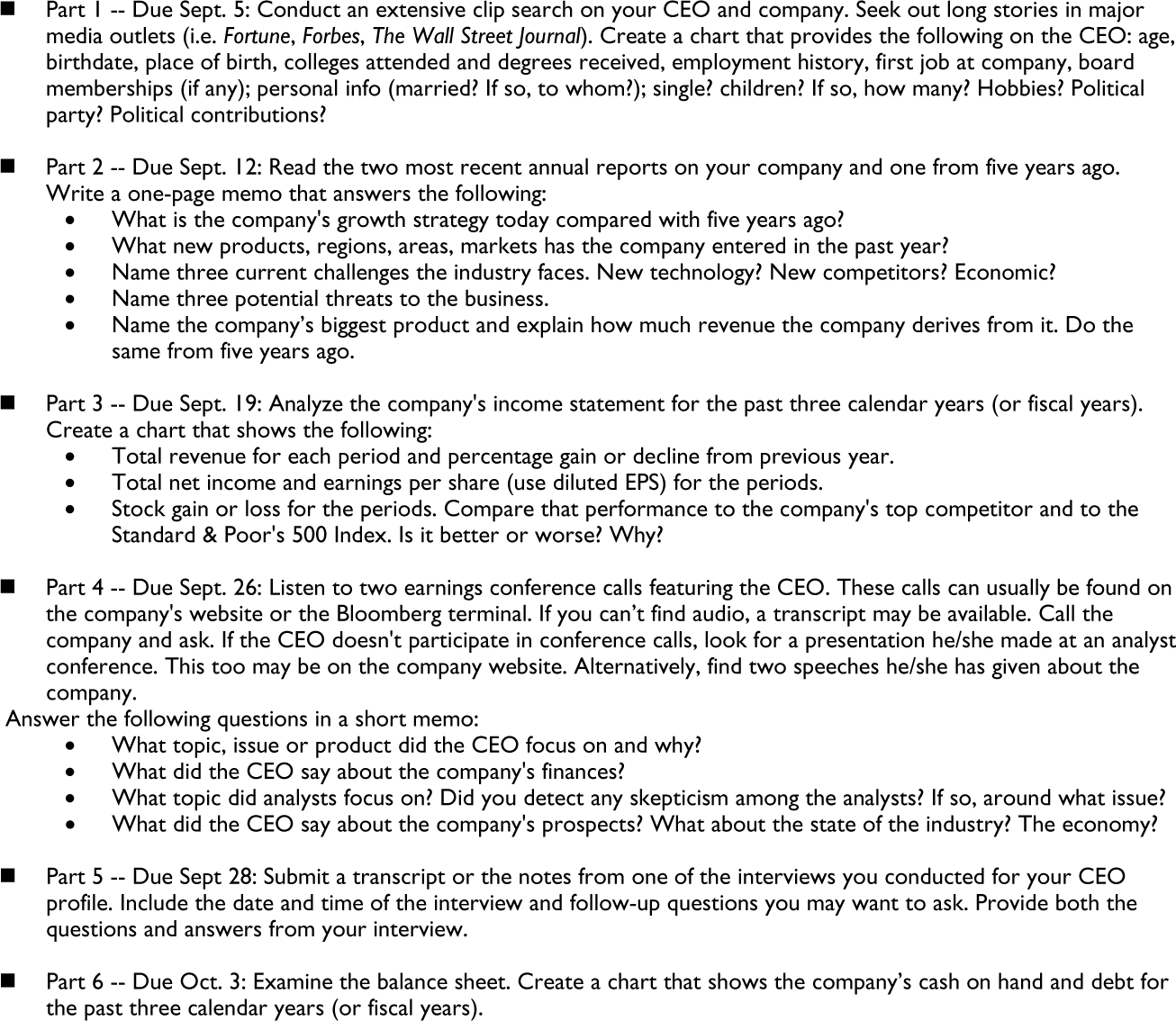
Bloomberg News’ CEO reporting guide.
The stepwise approach gave students a framework for digging into the companies whose CEOs they profiled, the course’s lead instructor, Alan Mirabella, said in an interview. 22 A senior editor and trainer at Bloomberg News and former adjunct instructor at the City University of New York’s graduate school of journalism, Mirabella said students could marshal enough material even without interviews with the CEO or analysts. Some students found the volume of material requested too heavy, Mirabella admitted, adding that in the future he might scale back, perhaps demanding a single major metric or piece of data per week.
Zeroing in on a single company throughout a semester is a popular tack. Gentry, at the University of Kansas, requires students to track a public company and prepare weekly reports. His first assignment is for students to spell out “what the company says about itself” in such sources as annual reports, Form 10-K reports, and press releases. In his syllabus, he said:
Other likely reports could be: What the business press says about the company (at least four sources). What analysts and “experts” say about the company (at least three sources). At least four key findings in the company’s 10-K. A recent SEC filing and what it means for the company. How does your company use social media? Specifically, for media relations, does it use Facebook, Twitter, blogs, etc.? For investor relations, does it use Facebook, Twitter, blogs, etc.?
At Southern Methodist University, former Fast Company and
SmartMoney.com
editor-in-chief Mark Vamos
23
told students in a 2012 syllabus that they would
learn how to cover business by writing about a publicly traded Dallas-area company. You will be assigned a local company to follow over the course of the semester; you will be expected to familiarize yourself with that company, and to plan for, watch for, and write about news related to it just as if you were a business reporter whose beat included that company.
Joe Mathewson 24 requires his graduate students at Northwestern University’s Medill School of Journalism, Media, Integrated Marketing Communications to cover a beat, such as retailing or technology, futures or manufacturing, banking or marketing, or jobs/workplace. According to the 2014 syllabus for his “Business Reporting: Money and Markets” class, they must each write a report about their beats that lists relevant Chicago-area companies, “identifying their strengths and weakness,” before they set out to write stories on the beat. They do this in the first week of the course, former Wall Street Journal correspondent Mathewson said in an email. 25
Mathewson tells students that such beat work will occupy most of their time. When economic statistics are released or other national news breaks, for instance, the students look for the impact on their beats. “Your beat will focus your daily reading and your work, but it doesn’t restrict you from covering other stories,” Mathewson’s syllabus said. He provides a long list of beats and Chicago-area companies they might write about. 26 The students also write breaking news reports regularly for the school’s Medill Reports website. 27
R. Thomas Herman, a former Wall Street Journal reporter now teaching at Yale College, the Columbia University Graduate School of Journalism, and the University of San Diego, requires his business-journalism students to write a “curtain raiser” (a story about an event that hasn’t yet occurred) on the U.S. Labor Department’s monthly report on jobs and unemployment. They learn the intricacies and nuances of the report, which is packed with large amounts of important information that many journalists often overlook, Herman said in an email. 28
Special Projects
Students in some programs team up with others. At Washington and Lee University, public relations (PR) students stage a mock press conference involving a company confronting a crisis, and Pam Luecke’s 29 business-journalism students cover the event. Often, the crises are real, such as problems involving Herbalife International Inc. and Carnival Corp. & plc, but PR students portray CEOs and spokespeople whom journalism students pepper with questions. “Sometimes, things get heated,” said Luecke in an interview. 30 Students write news stories based on the press conference and their research into the crisis. For a twist, Luecke has asked three outsiders—sometimes including a journalist or PR person—to review the event, offering critiques. Before moving into the classroom, Luecke served as editor at the Lexington (Kentucky) Herald-Leader.
At times, business-journalism projects dovetail with efforts in other journalism classes. Students in one of Deutschman’s 2012 courses at the University of Nevada, Reno, for instance, took part in a project with students in several courses writing about job creation in their area. Separately, Deutschman’s students also undertook a weeklong project, called Reinventing Reno, where they created a website about efforts at economic revival. 31 Micheline Maynard, a former New York Times reporter who now serves as Managing Editor for Web Content at the Reynolds Center at ASU, aided in the project, which was open to student volunteers and not connected to a for-credit course. “The site was well read at City Hall: The assistant city manager and the city’s economic development officer invited my students to City Hall for a meeting to talk about the students’ ideas at greater length,” Deutschman said in an email. 32
At the University of Maryland, Wells in the spring of 2014 paired his class with an investigative reporting class to look in depth at how new casinos affected the state economy. His class did economic research and analyzed the finances of the casinos, while the investigative class examined such issues as the social impact. “It was a killer assignment,” said Wells. “We had a lot of fun with it.”
Journalism teachers also have a wealth of books and supplementary materials to assist in the learning techniques they employ. See Appendices A and B for samples.
Making Business Journalism Fun
Some teachers use competitions and student presentations to promote student involvement. In stock-market investing contests staged by several teachers, students build fictional portfolios. They use Internet platforms such as Yahoo! Finance or Google Finance to create the portfolios and monitor their stocks. Periodically, students report on their portfolio’s performance, explaining rises or falls in various stock prices. They may win prizes.
At Washington and Lee University, Luecke creates a single Yahoo! Finance account and shares the password with her students, who each then build a separate portfolio. 33 The system allows them to see how everyone is doing. The winners and losers of the stock competition receive “some business-related swag,” Luecke said. “My goals for them are to have some sort of visceral understanding of what happens to stock prices as a result of internal and external events,” she said. “It sort of fans the competitive embers.” 34
Aside from the stock competition, Luecke’s students compete monthly to predict the unemployment rate and number of non-farm payroll jobs added. “Winners get chocolate,” Luecke said.
Timely and Topical
To teach about both the shortcomings of business journalism and the ways in which it can shine, some teachers turn to recent crises. Some teachers draw attention to the failure of most of the business press to anticipate the Great Recession of 2007–2009, showing how an appreciation of the foibles and risks of housing finance would have made for smarter reporting. The ability of Enron Corp. to pull the wool over the eyes of many financial journalists, until a few began to probe its finances in detail in 2001, is grist in several courses. Similarly, some teachers have used the Bernard Madoff Wall Street scandal as an object lesson.
Herman in his classes pointed to a few prescient stories that appeared long before Madoff confessed to his financial crimes late in 2008. In May 2001, for example, Barron’s published a story about Madoff by Erin Arvedlund titled “Don’t Ask, Don’t Tell.” Herman typically asks students to explore the warning flags that journalists and investors missed in the Madoff Ponzi scheme. Arvedlund met with Herman’s students to talk about her work. 35
Getting Students Involved
To promote active learning, some business-journalism teachers use techniques that allow students to educate themselves and one another. Luecke provides a list of blogs maintained by economists, 36 requiring them to keep track of entries and contribute to a group blog about them. They also must make occasional in-class observations about the blogs and turn in written critiques.
Herman usually requires two or three students to lead a discussion each week about an important story, or several stories on the same subject. Students give short presentations, summarizing the stories and discussing their strengths and weaknesses, areas for improvement, follow-up possibilities, and ideas for “art” (such as photos, drawings, timelines, and bullet boxes). Herman also assigns at least one student each week to take notes of classroom discussions and to send the notes to him within twenty-four hours. The purpose is to help improve note-taking skills.
Deutschman, at the University of Nevada, Reno, assigned different major media outlets to students and required them to make presentations analyzing the ways each covered business. Pardue, at Missouri State, required students to profile companies and make ten-minute presentations about them. Wells staged debates about newsworthy topics, such as whether the Bitcoin electronic currency was a scam, assigning pro and con roles to students beforehand. Tatge screened excerpts from an anti-capitalist documentary, “The Corporation,” 37 and led a discussion about the strengths and weaknesses of the film’s critiques.
Exams have also given students a chance for active learning. In his financial statements examinations, Gentry required students to analyze two companies’ statements, using common-size analysis 38 and other techniques, and to answer a series of questions. Roush, at the University of North Carolina, has had students write about famous dead journalists, and he publishes their work on a SABEW website about the history of journalism, AHBJ.org. For an economics reporting class, Roush required students to write a two-thousand-word paper analyzing stock picks they make in an investing exercise and explaining rises and falls based on economic factors.
Conclusion
Although challenging, teaching business and economic journalism is leading to considerable pedagogical innovation. Teachers have found ingenious ways to make the topic engaging for students. Active-learning techniques, such as the use of contests, the staging of classroom debates and mock press conferences, as well as requirements for presentations by students, go far to promote student involvement. So, too, do assignments involving local businesses or searches through real estate records for university faculty and administrators (salary records might especially interest students). The financial performance of a school’s investment portfolio likewise might intrigue students. And the ability of teachers to point to real-life crises and the ability (or shortcomings) of business journalists in covering them can also make for topical and timely discussions.
In some respects, the active-learning techniques used by the teachers noted here could be helpful in many types of journalism instruction. Such engaging classroom techniques could be useful, for instance, in courses ranging from introductory journalism to advanced reporting. In general, approaches that get students involved in learning, as opposed to passively listening to lectures, are likely to lead to better outcomes.
However, these techniques are especially useful in teaching business and economic journalism because the instructors face the dual challenge of teaching both content and reporting and writing skills. Finding ways to make corporate financial reports or economic analyses compelling, frankly, can be daunting, especially when one deals with undergraduates who bring little or no background in such areas. Journalists who have been immersed in such areas for years know how intriguing and useful such reports and analyses can be, in fact, but conveying that knowledge in an engaging way demands particular techniques that motivate and involve students. Making the coverage of economics and business come alive in a classroom is especially challenging, and savvy pedagogical techniques such as those used by the classroom and newsroom veterans here go far toward meeting that challenge.
As reflected by Pardue’s findings, business-journalism instruction still has far to go to meet the needs of media editors. Still, recent classroom efforts are heartening.
Footnotes
Appendix
Other Resources Used by Business and Economic Journalism Teachers.
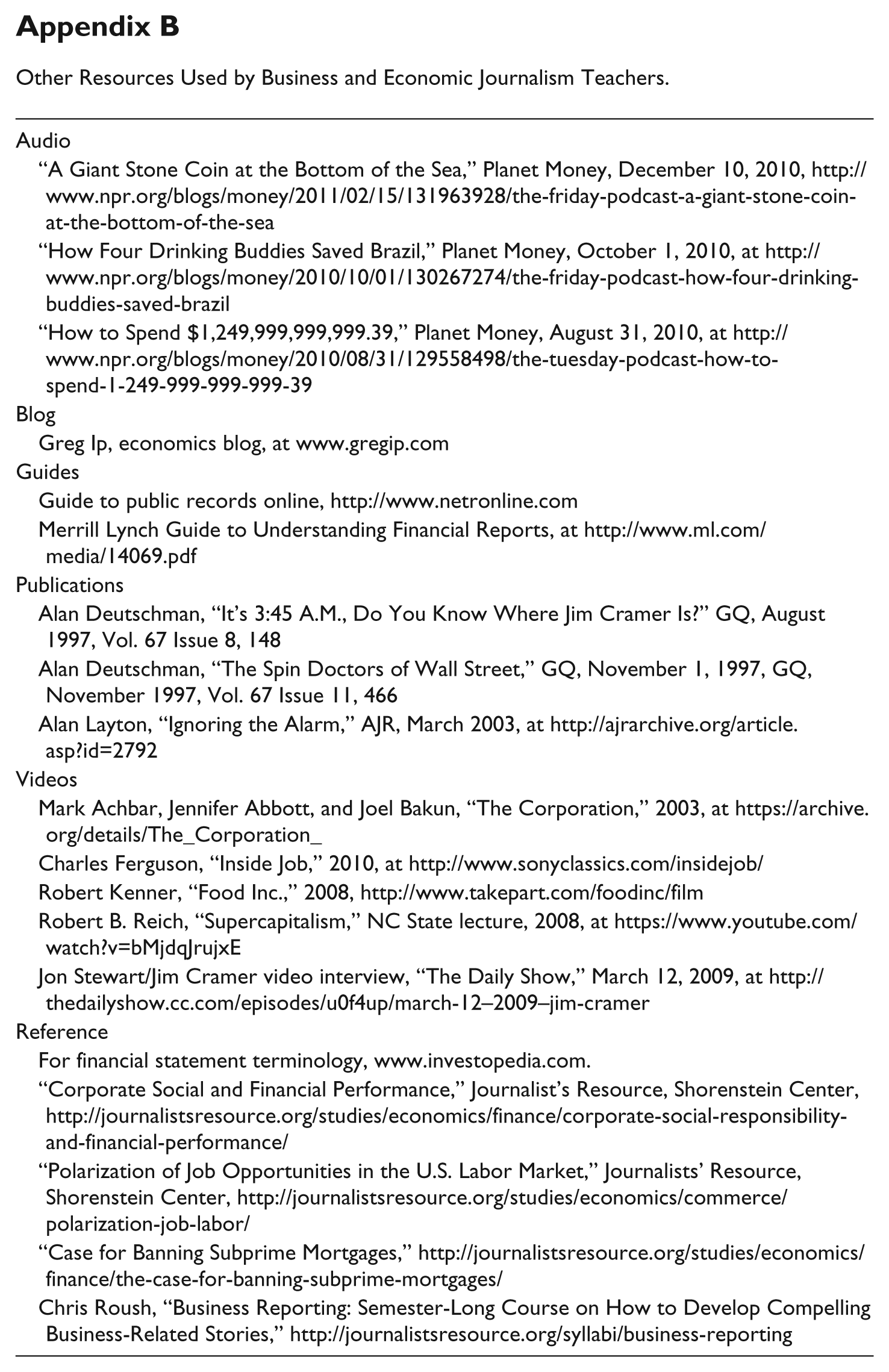
| Audio |
| “A Giant Stone Coin at the Bottom of the Sea,” Planet Money, December 10, 2010, http://www.npr.org/blogs/money/2011/02/15/131963928/the-friday-podcast-a-giant-stone-coin-at-the-bottom-of-the-sea |
| “How Four Drinking Buddies Saved Brazil,” Planet Money, October 1, 2010, at http://www.npr.org/blogs/money/2010/10/01/130267274/the-friday-podcast-how-four-drinking-buddies-saved-brazil |
| “How to Spend $1,249,999,999,999.39,” Planet Money, August 31, 2010, at http://www.npr.org/blogs/money/2010/08/31/129558498/the-tuesday-podcast-how-to-spend-1-249-999-999-999-39 |
| Blog |
| Greg Ip, economics blog, at www.gregip.com |
| Guides |
| Guide to public records online, http://www.netronline.com |
| Merrill Lynch Guide to Understanding Financial Reports, at http://www.ml.com/media/14069.pdf |
| Publications |
| Alan Deutschman, “It’s 3:45 A.M., Do You Know Where Jim Cramer Is?” GQ, August 1997, Vol. 67 Issue 8, 148 |
| Alan Deutschman, “The Spin Doctors of Wall Street,” GQ, November 1, 1997, GQ, November 1997, Vol. 67 Issue 11, 466 |
| Alan Layton, “Ignoring the Alarm,” AJR, March 2003, at http://ajrarchive.org/article.asp?id=2792 |
| Videos |
| Mark Achbar, Jennifer Abbott, and Joel Bakun, “The Corporation,” 2003, at https://archive.org/details/The_Corporation_ |
| Charles Ferguson, “Inside Job,” 2010, at http://www.sonyclassics.com/insidejob/ |
| Robert Kenner, “Food Inc.,” 2008, http://www.takepart.com/foodinc/film |
| Robert B. Reich, “Supercapitalism,” NC State lecture, 2008, at https://www.youtube.com/watch?v=bMjdqJrujxE |
| Jon Stewart/Jim Cramer video interview, “The Daily Show,” March 12, 2009, at http://thedailyshow.cc.com/episodes/u0f4up/march-12–2009–jim-cramer |
| Reference |
| For financial statement terminology, www.investopedia.com. |
| “Corporate Social and Financial Performance,” Journalist’s Resource, Shorenstein Center, http://journalistsresource.org/studies/economics/finance/corporate-social-responsibility-and-financial-performance/ |
| “Polarization of Job Opportunities in the U.S. Labor Market,” Journalists’ Resource, Shorenstein Center, http://journalistsresource.org/studies/economics/commerce/polarization-job-labor/ |
| “Case for Banning Subprime Mortgages,” http://journalistsresource.org/studies/economics/finance/the-case-for-banning-subprime-mortgages/ |
| Chris Roush, “Business Reporting: Semester-Long Course on How to Develop Compelling Business-Related Stories,” http://journalistsresource.org/syllabi/business-reporting |
Declaration of Conflicting Interests
The author(s) declared no potential conflicts of interest with respect to the research, authorship, and/or publication of this article.
Funding
The author(s) received no financial support for the research, authorship, and/or publication of this article.