



Abstract
Journalism students can no longer focus on being just writers or photographers or videographers. They must leave college with a multitude of media skills to have the greatest potential for career success. The development of the iPad and supporting apps has created a “one-stop shop” of journalistic tools that enable students to learn those skills, including note-taking devices, recording devices, research platforms, and word processing. We conducted a yearlong study of beginning journalism students utilizing one-to-one iPads to examine the impact of iPads and journalistically focused apps in a “flipped” journalism classroom environment (where video lectures are homework, and skill development and execution are done in class). Our goal was to identify how the iPad could be used to augment journalistic training and determine whether use of such technology would accelerate and enhance student learning. We found that confidence in the iPad as a journalistic tool and perceptions of journalistic ability increased, as did students’ execution of publishable-quality writing assignments. Qualitative results identified some of the challenges and benefits related to iPad use in a journalism class. Overall, we found that students did utilize the iPad and apps to more quickly create publishable-quality journalism assignments, which included effective reporting and use of multimedia and social media.
Introduction
Recent changes in the field of journalism have meant that students graduating from journalism programs may no longer specialize in one area of reporting and find success. Graduates must be adept at a variety of news gathering and dissemination skills, including reporting; research; writing for print, the web, and social media; shooting and editing photos; and recording and editing audio and video to create multimedia pieces. Often, in pursuit of a story, these skills must be executed at the same time.
Introduced in 2010, the iPad is known for its user-friendly design, large screen, portability, and utilization of apps, many of which are well suited to execute journalism-related skills. It acts as a camera, voice and image recorder, e-reader, word processor, and web browser that operates on Apple’s iOS [mobile operating] system. Essentially, it is an all-inclusive, multimedia reporting and dissemination platform.
Guided by the principles of the technology acceptance model (Davis, Bagozzi, & Warshaw, 1989), this article reports on findings from two semesters of course work utilizing iPads for an introductory journalism class, encouraging the use of the iPad in a sampling of journalism assignments and skill development. The instructor also recognized that there are limited class hours in an academic week, and teaching students many concurrent skills under a traditional class lecture setting would prove challenging. That led us to turn to a pedagogical approach to “flip” our classes, utilizing the iPad-based platform of iTunes U. Research into the flipped-classroom model has shown that allowing students to review lecture videos and support files prior to in-class sessions increases their access to learning materials to consume when and how they desire, while also freeing class time to devote to pursuing skills (Herreid & Schiller, 2013).
Our mixed-method approach focuses on survey data, as well as anecdotal student blog and interview data from 36 students enrolled in Autumn 2013 and Spring 2014 semester-long courses. The ultimate goal is to explore student understanding and uses of iPads as well as the device’s contribution to overall journalism educational development.
Literature Review
The technology acceptance model is designed to predict uses of and attitudes about new technologies (Davis et al., 1989). These attitudes are shaped by a number of factors, including design characteristics, user involvement, and perceived usefulness and ease of use (Huber, 1983; Malone, 1980). The list of factors that influence one’s attitudes about technology has broadened to include data speed, workforce efficiency, adaptive experiences, compatibility, playfulness of the device, and emotional attachment to the product or brand (Pagani, 2004). From desktop computers to Google Glass, Technology Acceptance Model literature has been expanded over the years to accommodate the changing technological landscape.
There has been both concern and optimism among educators about the effects of technology and mobile devices in the classroom. Mobile learning has been praised for facilitating “anytime, anywhere” education, which extends beyond the walls of a classroom (Houser, Thornton, & Kluge, 2002, p. 1149). Mobile devices have also been credited with increasing engagement and information recall, promoting collaboration among classmates, and increasing students’ technological literacy and job preparedness (Skiba, 2011).
Proponents of technology as a teaching and learning tool argue that technology, when used appropriately, enriches the learning experience, engages students, and fosters student-centered learning (Mason & Rennie, 2007). In addition, student responses to online teaching platforms as a supplement to traditional teaching methods have generally been positive (Saunders & Gale, 2012).
Studies indicate that technology is most attractive to students when it is integrated seamlessly into a curriculum (Lengel & Lengel, 2006). With all emerging technology, however, success is dependent on many factors, including the technological proficiency of the instructor, the availability of funding, the school’s culture and administrative practices, and the technological infrastructure of the school (Zhao, Pugh, Sheldon, & Byers, 2002). Other scholars have warned of the potential pitfalls of such devices in a learning environment, such as distraction, high cost, and unequal access to technologies (Wallace, Clark, & White, 2012).
The development of smartphones, tablets, and e-readers in the past decade has spurred even more research on these specific mobile devices and how they might transform the “classroom information ecology” (Culén & Gasparini, 2011). Widespread adoption of the smartphone, for example, sparked several studies on their effectiveness in a classroom environment. Multitasking with smartphones, by texting or accessing the Internet during class, has been found to disrupt student learning and comprehension of class content (Grinols & Rajesh, 2014). However, when implemented appropriately, smartphones can supplement student reading and aid in comprehension of complex texts (Bromley, 2012).
The iPad has been the subject of several small-scale studies to determine its effectiveness as a pedagogical tool in higher education and K-12 education, but research on the device’s role in undergraduate journalism education, specifically, is lacking.
During the peak of the iPad sales boom in 2011, a pair of pilot studies conducted with political science classes reported on some of the perceived benefits and drawbacks of the iPad as a learning tool. While participants enjoyed the quick touch screen response, portability, large screen with clear images, long battery life, and seamless transitioning, many students took issue with the digital keyboard and found syncing and sharing PDFs difficult (Marmarelli & Ringle, 2011).
A 2011 study found some interesting differences in the iPad user experiences of science graduate students and elementary students (Culén & Gasparini, 2011). The younger students called the devices “intuitive and playful” and reported more positive perceptions of iPads than graduate students, possibly because they were not under as much academic pressure as graduate students (Culén & Gasparini, 2011) The graduate students tended to gravitate back to the traditional pen and paper for note-taking.
Regarding journalism education specifically, journalists and professors Robert Gutsche Jr. and David Schwartz abandoned desktop computers, laptops, and smartphones for a 24-hr period in 2011, and relied solely on the iPad for blogging, reading, news consumption, student grading, Internet research, and other daily activities (Wilson, Gutsche, & Schwartz, 2010). The authors found that using iPads made students want to read more news, and the devices were described as “smart, addictive and engaging” (Wilson, Gutsche, & Schwartz, 2010, p. 5). The professors added that the iPad had potential as a teaching tool in journalism classes.
Additional research has indicated that iPads and smartphones are valuable as educational tools because of their portability, responsive touch screens, ability to display textbooks digitally, and the ability to house thousands of educational apps (Ireland & Woollerton, 2010). Tablets in the classroom have also been found to increase proficiency and engagement (Shepherd & Reeves, 2011).
Despite the lack of research on iPads in journalism education, scholars have remarked upon mobile devices as useful and even necessary for the aspiring journalist. While desktop computer use “takes place in a bubble,” mobile devices allow for greater autonomy, flexibility, and enhanced learning experiences out in the real world (Traxler, 2010, p. 5). The use of mobile devices also prepares journalism students for professional realities of the job (Hirst, 2010). A recent content analysis of journalist job announcements found that employers are looking for new hires who understand how to gather and report news using mobile devices and how to interact with audiences on social media networks (Wenger, Owens, & Thompson, 2014).
The increasing number of schools and universities investing in iPads speaks to the relevance of this type of research. Universities, such as Akron, Maryland, Arkansas State, and Ohio State, are also taking advantage of donor funding and technology grants to invest in iPads for students.
Guided by the Technology Acceptance Model, this study will build on existing literature on iPads in education to explore opportunities and potential advantages of using the iPad in journalism education. Our research examines how journalism students utilize the technology of the iPad as a self-contained and complete educational and reporting tool.
We pose the following research questions:
Materials and Method
Participants and Procedure
A US$25,000 impact grant was used to purchase 30 iPads and iPad cases, wireless keyboards, microphones, and six tripods for two newswriting courses at a large Midwestern university during Autumn and Spring semesters of 2013 and 2014.
Student participation in the study was voluntary, and those who opted out of the study were also given iPads to use during class. The iPads were configured with several apps, including Pages, Twitter, GarageBand, iMovie, iTalk, iTunes U, Evernote, Dropbox, Storify, USA Today, Instagram, and Associated Press Stylebook. Participants were free to download additional apps of their choosing. Technical support was offered in the form of in-class tutorials on iTunes U, iMovie, and Pages. Special equipment, such as microphones, memory card readers, and tripods, could be checked out anytime during the semester.
Thirty-six undergraduates participated in the study, in which students completed a series of five online surveys—a pre-assessment, three post-assignment surveys, and one post-assessment—throughout the semester-long course. Informed consent was collected at the beginning of each semester. In addition to the surveys, several interviews were conducted, and additional data on student experience with the iPad were gathered from student blogs.
Survey Measures
This study utilized a multi-method approach that included online surveys with both open- and close-ended items, as well as data from participant blogs.
Online surveys measured several variables used in SPSS analyses, including demographics such as gender (75% female), age (M = 20.32, SD = 2.16), and class rank (freshman = 2.8%, sophomore = 27.8%, junior = 33.3%, senior = 13.9%). The pre- and post-assessments given at the beginning and end of the semester measured several variables, which were later compared using paired-samples t tests on SPSS.
Social media experience was measured by asking participants their experience level with social media outlets, including Facebook, Twitter, LinkedIn, Instagram, Pinterest, Storify, and blogs, on a 4-point scale (1 = no experience, 4 = expert level). The items were averaged into an overall measure of social media experience, with a pre-test Cronbach’s alpha coefficient of .786 and a post-test coefficient of .760.
Confidence that the iPad is a suitable tool for journalism-related activities was measured by asking participants a series of questions regarding iPad utilization in interview note-taking, shooting video, shooting photographs, and writing news stories on a 4-point scale (1 = not at all confident, 4 = very confident). The items were averaged into a measure of overall confidence in the iPad as a journalism tool, with pre-test and post-test Cronbach’s alpha coefficient of .828. Journalism ability was measured by averaging responses to two items regarding ability to identify news and ability to report news, measured on a 4-point scale (1 = no experience, 4 = expert level).
Other variables of interest included laptop use, comfort using iPad technology in the classroom, experience using apps, research skills using the iPad, knowledge of how social media is used in journalism, knowledge of journalism innovations, and perceptions of how current technology skill set prepares them for future jobs. The preceding variables were measured using single items.
For analyses using repeated-measures ANOVA, measures of general iPad use for each assignment were taken from three post-assignment online surveys, with measures of iPad use for different assignment tasks and dimensions, such as research, looking up the source ID, interviewing, taking notes, writing the story, using social media, and shooting photos, video, and audio. This variable was measured by asking participants how much they used the iPad in the assignment, with response choices on a 6-point scale (1 = not at all, 6 = 100%).
Students completed the pre-assessment online survey on the second day of class, before receiving their iPads. Post-assignment surveys were completed following the submission of each of three major story assignments throughout the semester, before receiving grades from the professor. Post-assessment surveys were conducted on the final day of class. All survey responses were anonymous, and students gave consent for their class blog posts regarding iPad experiences to be included in the study.
Results
Results were analyzed first by examining the data in SPSS and then examining the qualitative data. We conducted paired-samples t tests, repeated-measures ANOVAs, and multiple regression analyses for close-ended items, while open-ended responses were thematically coded.
Regarding
Paired-Samples t Tests With Cohen’s d.

p < .05. **p < .005.
To explore
Multiple regression analysis was used to assess how well students’ confidence in the iPad predicted their feelings of self-efficacy as journalists at the end of the semester, after controlling for students’ existing use of laptop computers. Confidence in the iPad as a journalistic tool was significantly related to self-efficacy, R2 change = .24, F(1, 24) = 7.76, p < .05. Even after controlling for laptop use, iPad confidence uniquely explains 24.4% of the variance in journalism self-efficacy.
Several post hoc tests were conducted to further explore how students used social media and how they felt about social media as a function of on-the-go journalism. Throughout the semester, students were encouraged to utilize their iPads to create Twitter profiles and tweet on a regular basis, in addition to blogging on Wordpress. Participants reported significantly more experience with social media at the end of the course (M = 2.68, SD = 0.529) than at the beginning (M = 2.41, SD = 0.584); t(27) = −3.230, p < .005.
Knowledge of how social media is used in the journalism industry also significantly increased throughout the duration of the semester-long study, t(27) = 3.873, p < .005, with participants reporting a higher level of knowledge at the end of the course (M = 3.07, SD = 0.663) compared with the beginning of the course (M = 2.36, SD = 0.678).
Students also reported a significantly higher level of knowledge about emerging and innovative technologies in the field of journalism after the course (M = 2.71, SD = 0.713) compared with the beginning of the course (M = 2.11, SD = 0.629); t(27) = −3.863, p < .005.
Results of another paired-samples t test compared pre- and post-test measures of students’ confidence that their technological skill set adequately prepared them for future employment. Interestingly, students reported feeling significantly more prepared at the beginning of the course (M = 2.14, SD = 0.705) compared with the conclusion of the course (M = 1.79, SD = 0.686); t(27) = 2.17, p < .05.
Repeated-measures ANOVAs were used to measure differences in a dependent variable across three points throughout the semester, when participants completed online surveys after writing news stories. One such dependent variable was general iPad use. Results of the ANOVA found a significant effect for time, F(2, 19) = 5.315, p < .05. A Bonferroni correction indicated that iPad use only slightly increased from the first to second assignment. Interestingly, iPad use dropped significantly for the third assignment compared with the second assignment (M = 4.63, SD = 0.243, p < .05).
Participants were asked 3 times throughout the semester if their experience with the iPad made them want to use the device in other classes. The percentage of participants who said “Yes” or “Maybe” hovered around 80% consistently. During the first assignment, 80% of students said they wanted to use the iPad in other classes, and during the second and third assignments, 77% of students reported wanting to use the iPad in other classes.
Classroom Results: Grades
We looked at grade data from students taught the same class content in the 2012-2013 academic year without iPads and iTunes U. Those students utilized MacBook Pros for their written assignments, and they were encouraged to use university-provided digital single-lens reflex cameras and high-definition video cameras for multimedia components. Those grades were compared with the 2013-2014 iPad classes on consistent assignments at touch points in the semester: the first news story, a news profile, the midterm, and the final. The assignment instructions, goals, and evaluations were similar across each session and were evaluated by the same professor using identical rubrics. Table 2 shows the grade progression of the 2012-2013 non-iPad class and the 2013/2014 iPad-based class.
Comparison of Assignment Grades for Traditional Versus iPad-Based Journalism Classes.
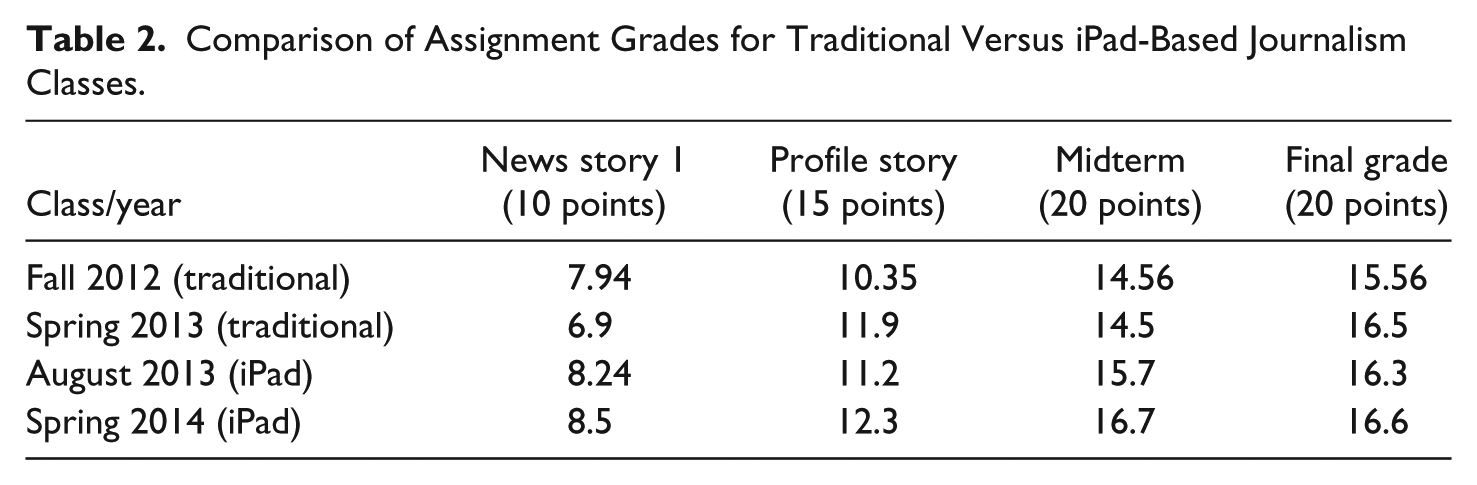
Successes were tangible, most notably the speed with which students demonstrated understanding of assignments and were able to produce publishable-quality content in those assignments. By the third week of the first semester using iPads, students were developing story ideas, writing articles, shooting photo, recording and editing video and getting published by the university’s student newspaper, The Lantern. In the second iPad semester, students’ work was published in The Lantern in the second week of classes. This is compared with publication in the seventh and ninth weeks, respectively, of the non-iPad classes from the 2012-2013 academic year.
Students in the first iPad semester had access to the same MacBook laptops as the 2012-2013 class, and just over 17% of students in the Autumn 2013 iPad semester (5 of 28) gravitated, periodically or consistently, toward use of the laptop instead of the iPad. For the Spring 2014 iPad semester, we moved the class into a room without laptop computers. The result was 11% of students periodically or consistently used a laptop computer (2 of 18).
Qualitative Results: Student Perspectives
Open-ended responses were analyzed to determine the advantages and limitations of iPads in the classroom. Participant responses were thematically analyzed and organized into the following categories, which outline benefits, challenges, and uses of the iPad and accompanying apps throughout the semester.
Portability
Nearly half of participants commented on the device’s portability for the first post-assignment online survey, and the fact that it enabled students to contain numerous tools in one device.
● I enjoyed having a smaller and more portable device than my MacBook, but also, a device that had more capabilities than my iPhone. ● Compact enough to carry with me at all times in order to be ready to interview for my story at any time . . . ● It’s all you need to bring—you don’t have to worry about bringing a notebook, computer, video camera, etc., because the iPad has all of those in one . . . ● Everything was right there, at my finger tips—if I needed the Internet to research, to record, to write the story I had all that I needed right there . . .
Several students reported that the iPad took some getting used to—It pushed them beyond their comfort zone. With practice, the majority of students found that tasks and assignments could be completed more efficiently with the device:
● It seemed to make us excel better than previous classes in our learning process and specifically with AP style. While this did create some stress initially, this became one of my favorite classes because of how I was challenged, motivated, and pushed. ● Before taking this course, I thought an iPad was nothing more than a giant iTouch. Several articles written, videos shot, and notes taken later, I’ve come to appreciate the iPad as an incredibly resourceful tool for journalism, and other activities. ● The transition to the iPad for me was not seamless. I began the semester using it only to watch lectures, and using my laptop to complete almost everything else, even declaring on twitter that it was going to be difficult for me to leave #teammacbook. Through the weeks, though, I started integrating the iPad into my daily academic life more and more. But it wasn’t until I utilized it during an interview to simultaneously record and take that I realized how easy/fast/simple it was to perform such a task.
A few students wrote more extensively on the specific ways the iPad served as a journalistic tool:
● As a journalist in our society, one must be able to market themselves using the Internet and social media. These online tools are the new keys to journalistic successes, and the iPad helps to easily integrate these practices for a journalist. I used the iPad for notes during interviews with Evernote and for recording during interviews with applications like iTalk. I became a mobile and fast-paced journalist while using my iPad this semester. ● For each interview, I took a picture of each individual and also video taped the interview. It was really easy afterwards to find quotes later on because during the interview I marked in my notes at what time important quotes were said. Not only did the iPad really help me throughout the interviewing process, the notes from class (regarding the inverted pyramid and ledes) tremendously helped me write my article.
Battery life and responsiveness were commonly reported as assets, and many chose to use the iPad for viewing class lectures and tutorials required by the “flipped” class structure.
● The iPad is used [sic] friendly, easily portable, and keeps its battery charge for a very long time, which was more convenient than my MacBook Pro. ● It is a perfect tool for the flipped-classroom because it allows you to watch the lectures, access all necessary resources such as the AP stylebook, various apps including iMovie, Twitter, iTalk, Evernote, etc., for optimal convenience. ● It has become my new best friend. Utilizing apps for everything from taking notes to social media has helped me be a better journalist and a better student. ● I was continually amazed by the easy access to iPad features and apps. I don’t think I fully powered down my iPad all semester. This didn’t seem to drain the battery much and allowed me to quickly open any app with just a few strokes. This is an essential feature for those with little time to spare.
Challenges
The most commonly mentioned issue concerned typing on the digital keyboard, which is smaller than a traditional keyboard and lacks tactile feedback. Others felt more comfortable using the wireless keyboard that all students received for the duration of the semester.
As part of the grant, iPads were outfitted with hard rubber protective “Otterbox” cases with screen protectors. A common view among participants during the beginning of the semester was that the iPad felt bulky, specifically when taking pictures.
A small number of students reported difficulties multi-tasking and keeping multiple apps open at once. Two participants remarked that multi-tasking was an issue specifically when trying to record and transcribe interviews. For example,
● I could not listen to my interview from iTalk and transcribe all on the iPad—I had to transcribe onto my laptop. ● Multi-tasking during the phone interview was hard, I wrote questions on paper so I could use iTalk to record.
Gaining familiarity
An area of difficulty that seemed to improve for many students by the end of the semester was a general sense of unfamiliarity with iPad technology and a propensity to rely to a desktop or laptop computer for certain tasks.
● I am still adjusting to typing on the iPad, although it is getting better. Also, I think I am a quick web searcher for research on a laptop, even though I am really trying to use the iPad, there are still things I prefer about the laptop. ● I like how now that I am comfortable with the apps and various tasks that can be performed by the iPad, I can immediately get to where I need to go and accomplish said task, even when in a crunch at an interview . . .
Two students reported not seeing the necessity or value of carrying an extra device:
● Will I buy an iPad? Nope. Not gonna spend money on a little laptop that I’m not very good at working. I have my cell phone and my camera to take pictures with and my computer for everything else. ● Talking about high tech, we have our laptops and MacBook. Talking about convenience, we have iPhone or just smart phones. Especially when iPhone becomes longer and longer along with iPad becomes smaller and smaller, I do not see the reason why both of them exist.
Discussion
This study adds to the existing literature on mobile technology in the classroom by exploring students’ user experience with iPads through open-ended responses and blogging data, as well as quantifiable variables.
Our first research question asked how the use of iPad technology influenced student confidence in the iPad as an effective journalistic tool. A paired-samples t test indicated that student confidence in the iPad as a tool significantly increased by the end of the semester. This result is supported by qualitative data, which revealed that most students utilized all the tools included in the device, from the video and audio recorder and camera, to note-taking apps, word processors, and the AP stylebook. Some students did express feelings of confusion or doubt initially, but these feelings seemed to dissipate as students became more familiar with the device through tutorials, in-class activities, and homework assignments.
In asking the second research question, we wanted to know how iPad technology influenced students’ feelings of self-efficacy regarding their journalistic abilities. Another paired-samples t test revealed that students did in fact report higher perceptions of their writing and reporting abilities at the end of the semester.
Additional analyses revealed that student knowledge of how social media is used in journalism, personal experience with social media, and knowledge of journalism technologies also increased by the end of the semester, citing use of the platforms via the iPad.
Regarding the third research question, we asked how much students were utilizing the iPad for newswriting assignments. We measured this by asking about general iPad use in three post-assignment online surveys throughout the semester. Results of repeated-measures ANOVAs indicated that while students did increase their iPad use for the second assignment, iPad use dropped for the third assignment. We believe this was a result of increased difficulty of assignments, prompting students to go with the technology with which they were most comfortable. iPad usage on the third assignment, however, did appear to increase when the class moved out of a computer lab in Spring 2014.
The fourth research question sought to uncover the perceived advantages and drawbacks of using iPad technology. Students reported positive experiences with the device’s portability and the convenience of having multiple tools in one. Camera/video quality and note-taking resources were also commonly reported as advantages. Some students reported that the device felt bulky and awkward when shooting photos, and a few had difficulties getting used to the digital keyboard. A few comments were made about difficulties multi-tasking and a general sense of unfamiliarity, though the majority of students reported adapting well to the technology as time passed.
This study had limitations that should be taken into consideration. The class structure and nature of the grant did not allow for a control group, except for grade comparisons. This opens up the possibility that a variable unrelated to iPad technology may have influenced the results.
A second limitation was the different classroom environments of the 2013 newswriting class and the 2014 newswriting class, both of which were included in the survey results. The 2013 classroom came equipped with laptop computers at each seat, much like a typical computer lab class. This offered students the opportunity to easily utilize computers during class, if they chose. The 2014 classroom had no available student technologies.
Conclusion
Journalism education must continue to evolve if we want to produce students who are marketable in the world—as content creators in all fields. That evolution must incorporate the changing and expanding technology that are viewed by many as an opportunity, and still others as a burden. Through this research project, we have sought to show how journalism education can be enhanced through the incorporation of iPad technology into a traditional journalism class setting, providing students the tools, training, support, and inspiration to strive for faster, deeper, and more expanded skill development. Our goal is not to replace conventional education with technology, but rather to see how we can augment the learning experience to provide the “real-life” training student journalists and communicators will need to have the best potential for career success.
In line with the assumptions of TAM, student perceptions of the iPad’s ease of use and its perceived contribution to multimedia assignments contributed to the success of the tool in a flipped-classroom environment. While some students experienced steeper learning curves then others, and several reported being taken out of their comfort zone regarding technology use, many saw the advantages of the all-inclusive platform for their future careers as multimedia journalists and their skills reflected an improvement traceable to the iPad technology.
The technological landscape is evolving rapidly, creating the need to understand which platforms are most relevant in educational. Future research should continue to focus on the iPad and the effectiveness of other mobile devices as journalistic tools, as they are continually redesigned and re-released with more applications and higher quality video, sound, and camera features. Bring-your-own-device (BYOD) programs in schools and smartphone adoption in college classrooms are also on the rise—53% of college students own a smartphone and 82% use them for educational-related tasks (Pearson Student Mobile Device Survey, 2004). More research is needed to understand how smartphones and other personal mobile devices can be integrated into the learning environment, especially in journalism education. The use of mobile technology will be especially vital to student journalists as they work to learn the skills that will make them marketable upon graduation.
Highlights
We examine two introductory journalism courses that were 1-to-1 iPad.
We examine how the use of the iPad changes student learning of core journalism concepts.
Students appeared to grasp key concepts faster with iPad instruction and utilization.
Students learned to develop publishable-quality work more quickly when learning with iPads.
Challenges exist with technology comfort.
Footnotes
Declaration of Conflicting Interests
The author(s) declared no potential conflicts of interest with respect to the research, authorship, and/or publication of this article.
Funding
The author(s) disclosed receipt of the following financial support for the research, authorship, and/or publication of this article: This work was supported by the 2013 Digital First Impact Grant.
Author Biographies
A doctoral student at UNC-Chapel Hill’s School of Journalism and Mass Communication,