



Abstract
This article presents findings from a pilot study of postgraduate journalism students in Dublin and Amman. The study compared professional outlooks and social characteristics of students in both contexts and examined institutional settings. The study finds that journalism students in Dublin and Amman have very similar views on the profession, although the students in Amman have a somewhat more activist outlook and less of a commitment to neutral or objective reporting; they also appear modestly more interested in effecting political and social change. We believe this has significant implications for journalism education across the region and for cross-cultural exchanges.
Introduction
Comparative studies of the influence of culture on journalistic practices have highlighted the particularities of ostensibly universal norms and values, such as impartiality and neutrality, and have shown a range of variations in such factors as ethical orientation, influences on newsmaking, and trust in public institutions (Hanitzsch, 2008). In most comparative studies of this sort, working journalists are the focus of attention. But in this study, we focus on journalists in training, who are also “key stakeholders in journalism’s future” (O’Donnell, 2006, p. 23).
This article presents findings from a pilot study of postgraduate journalism students in two leading institutes in different capital cities: Dublin City University (DCU) in Ireland and the Jordan Media Institute (JMI) in Amman. It included three components: (a) an anonymous survey sent to the entire postgraduate class in each institute; (b) a series of follow-on, in-depth interviews with students in each institute; and (c) an examination of the history of each institute, its cultural context, the programs available, and so on. Researchers in Dublin, with help from their counterparts in Amman, designed the survey and subsequent interviews to capture and compare the professional outlooks and social characteristics of journalism students. We designed the institutional component to explore if and to what extent cultural differences find expression in curricula and school organization between a predominantly Christian democracy in the English-speaking West and a predominantly Muslim kingdom in the Arabic-speaking Middle East.
Students in the two programs expressed very similar reasons for entering the profession and offered similar views of the role and purpose of journalism. Still, we found subtle yet important differences in their answers. It is worth nothing that Jordan is probably the most Western-oriented of all the Arab states. Arabic is the official language, although English is widely spoken on the street in the capital city of Amman—a holdover, no doubt, from the period before independence in 1946 when Jordan, then known as Transjordan, was a British protectorate. Yet Jordan is also very much part of the Arab world; it is a mixed-government monarchy and is 97% Muslim.
Worlds of Journalism
What follows is not a comprehensive literature review but a connection of our findings to three intersecting literatures: sociological studies of journalistic systems and practices, Arab journalism studies, and studies of journalism education.
Broad-view cultural analysis of journalism systems and the political and cultural systems that house them was stuck for a generation with the valuable but increasingly dated Four Theories of the Press (Siebert, Peterson, & Schramm, 1956). That book, ground-breaking as it was on its publication, contains several fatal flaws, foremost of which—particularly in view of our concerns here—is that it contains virtually nothing about the Arab world. In 2004, this landscape was profoundly enhanced with the publication of Comparing Media Systems (Hallin & Mancini, 2004). This work surveys news media in 18 Western European and North American countries and categorizes the press in these countries in terms of professionalization, legal freedom and state control, writing styles, and a number of other dimensions. The authors broadened their scope with a follow-on volume, Comparing Media Systems beyond the Western World (Hallin & Mancini, 2011), which deals with the same themes, but with non-Western countries. Of particular interest here is Marwan Kraidy’s chapter, “The Rise of Transnational Media Systems: Implications of Pan-Arab Media for Comparative Research,” which underscores Hallin and Mancini’s caution that the general typology does not hold true everywhere. For example, Kraidy (2011) describes the Middle East as a region “in which the primacy of the nation-state as an analytical category may indeed be misleading” (p. 177). Instead, Kraidy approaches pan-Arab media as a transnational system in which émigré media play an important role. In doing so, he points to the inadequacies of broad-stroke typologies, such as Rugh (1979, 2004), as failing to “account for the symbiotic relationship that takes place between the three actors involved in news production: government, journalists/editors, and the audience” (p. 179; cf. Mellor, 2005).
Intersecting such broad-view analyses of media systems are sociological studies of journalism practices. Zelizer (2004) provides an excellent review of the dominant strands of this research and observes that sociological perspectives typically focus “on people, patterned interactions, organizations, institutions, and structures” (p. 45). Sociological studies have also investigated how those working in the field self-identify as professional journalists. There is an increasing consensus that studies of journalism and journalists require consideration of multiple factors and multiple domains of influence. Preston’s (2009) model sets individual influences alongside political-economic factors, organizational influences, media routines and norms, and cultural/ideological power. This work builds on Schudson’s (2000) “sociology of news production,” which highlighted the importance of culture (or “symbolic systems”) in the identification and shaping of newsworthy events, along with organizational factors. Other research has delved more specifically into the belief systems under which journalists make sense of their craft and profession. Sparks (1998) suggests the “Anglo Saxon” model of journalism is
[characterized] by fearlessly independent media employing brave investigative journalists who are dedicated to the separation of fact and opinion in their reporting, who are even-handed and impartial between contending viewpoints and whose main task is to inform their readers and viewers without fear or favor about all that is most important in the world today. (p. 175)
However, Hanitzsch (2008) questions whether conventional Western values of journalism fit with non-Western cultures. Equally, some research suggests that putatively similar values are not understood and applied in the same way in every context. Ward (2004), for example, suggests that the objectivity ideal inheres mainly in the American tradition, with its emphasis on unbiased information, but that this ideal has historically been understood somewhat differently in European journalism, where a model of “pragmatic” objectivity developed (see also Bell, 1997). The ongoing “Worlds of Journalism” project has also identified national-level variations in such factors as trust in public institutions (Hanitzsch & Berganza, 2012), ethical orientations (Plaisance, Skewes, & Hanitzsch, 2012), and influences on newsmaking (Hanitzsch & Mellado, 2011). Despite this, some research suggests that Western approaches to journalism and journalism training dominate globally (Foley, 2006).
One of the subtle but important differences between DCU and JMI students concerns their assumptions about the overall purpose of journalism. In the West, there is widespread acceptance of the notion of journalism being an essential enabler of democracy. A very popular text, The Elements of Journalism, is but one of dozens of sources that make essentially the same argument: “The primary purpose of journalism is to provide citizens with the information they need to be free and self-governing” (Kovach & Rosensteil, 2007, p. 17). In the democratic world, this view is commonplace. This view is reflected in the Irish students’ view of the profession they intend to enter. However, far less is known in the West about journalists in the Arab world. The Arab Press (Rugh, 1979) and its update, Arab Mass Media (Rugh, 2004), have been the starting point for English-language students of Arab media and remain indispensable introductions to the law and culture of newspapers and broadcast stations across the region. But a great deal has changed in the region since their publication. More recent is The New Arab Journalist (Pintak, 2011). The author is an American former television journalist who spent decades in the Middle East before becoming an academic. Pintak conducted a broad survey of working professionals across the Arab world, and it is noteworthy that there are some similarities between his findings and the findings presented here. In the “Mission of Arab Journalism” (2008), co-authored with Ginges, Pintak concludes the following: (a) Arab journalists view their mission as driving political and social change in the Middle East and North Africa; (b) they identify most closely with the pan-Arab region and the wider Muslim world, rather than with individual nation-states; (c) they consider political reform, human rights, poverty, and education the most important issues facing the region; and (d) though they are protective of Arab people, culture, and religion, they are not overtly anti-American or anti-Western (indeed, half of those surveyed described themselves as “democrats”; Pintak & Ginges, 2008). Pintak therefore questions simple assumptions that Arab journalists are by nature different to those in the West. He suggests that their true predecessors may well be the journalistic change agents of American and European history, ranging from America’s 18th-century pamphleteer Thomas Paine, the 19th-century British journalist and social reformer Charles Dickens, and the 20th-century American muckraker Upton Sinclair (Pintak, 2011).
Comparative Study
Journalistic Contexts
There is a stark difference in the amount of press autonomy accorded to journalists in Ireland and Jordan. Jordan has avoided some of the worst disturbances in the Middle East but is still a very poor place for press freedom. Reporters Without Borders (2014) ranks it 141st in the 2014 World Press Freedom index of 180 countries, down seven places from the year before, better than the situation in Syria and Iran, but not as free as the United Arab Emirates, Qatar, or Lebanon. Despite the fact that press offenses were decriminalized in March 2007, as a result of a parliamentary vote amending the press and publications law, many Jordanian journalists still fear running afoul of the law and winding up in jail. Despite King Abdullah II’s attempts to reassure journalists in 2008 by reaffirming his position that no journalists should go to prison for their professional work, the courts have been far less consistent in their application of the law. This uncertainty doubtless contributes substantially to a lack of investigative reporting that could compromise political figures (www.rsf.org). By comparison, Ireland is ranked 16th in the latest rankings, in the organization’s top category, along with Scandinavian countries and some of the other states of Western Europe, 17 places above the press freedom in Britain and a full 30 places ahead of the United States.
Freedom House, the other major organization that provides an annual global ranking of press freedom, paints a similar picture, using a somewhat different methodology and scoring countries in absolute terms, not relative ones, with 1 being (theoretical) perfect press freedom, and 100 being absolute zero freedom. 1 The Freedom House (2014) analysis scores Jordan with 68 points, 5 points less free than in the 2013 report. By contrast, Ireland was awarded 16 points in the 2014 study, unchanged from the year before, and—as with the Reporters Without Borders study—it emerges as marginally freer than the United Kingdom and substantially freer than the United States (www.freedomhouse.org/report/freedom-press-2014).
Institutional Contexts
DCU’s School of Communications has offered a 1-year postgraduate program in journalism for more than 30 years. It was the first journalism MA offered in Ireland and is still widely regarded as the country’s leading university program. Some students coming to the program are entering postgraduate education from the profession, but most are recent graduates, either from DCU or other Irish universities. Most students have some journalism experience, generally amateur (such as student publications), and few could be considered professional. DCU is a public university.
JMI was founded in the last decade by Her Royal Highness Princess Rym Ali, a prominent broadcast journalist with postgraduate training at major Western universities, including Columbia University’s Graduate School of Journalism and the Sorbonne in Paris. She married into Jordan’s royal family—her husband is Ali bin Al Hussain, half-brother to the king, Abdullah II. JMI is consciously structured to be independent of political as well as economic pressures and influences.
The two schools’ curricula are extremely similar. Both feature a strong emphasis on the standard core courses in professional journalism programs: reporting, writing, and editing for print, broadcast, and online news outlets. In both schools, these traditional skills courses are augmented with very practical theoretical courses in press law, ethics, and politics.
The Study
In spring 2013, researchers at the two schools created a 10-question survey and administered it to postgraduate journalism students in both institutions. The survey contained identical questions but was administered in somewhat different ways. In Dublin, DCU students were invited by email (and reminded in person by Professor Knowlton) to complete an online survey, a link for which was distributed via email. Nineteen completed surveys were returned. At JMI, 20 surveys were completed face-to-face. In each case, the response rate was more than 80%. Following analysis of the survey findings, researchers conducted in-depth interviews in both locations.
We designed the survey with a larger future study in mind; we wrote questions that would themselves yield interesting data but that would also form the basis of future research. We sought to tease out themes in the literature cited above (e.g., putatively different attitudes toward “taking sides” in news reporting) as well as perceived gaps (e.g., subjective factors in choosing journalism as a career). As the findings reported here come from this initial pilot phase of the study, we do not detail answers given to every question asked in the survey and in interviews. We recognize that the self-selection sampling approach is somewhat more prone to human bias than other research techniques and therefore the representativeness of our findings is open to question. Still, particularly given the high response rate, we are confident that the results of this study argue for further work in the field. (See the appendix for the entire list of survey questions.) This research would have been impossible without the active cooperation of administrators at both schools, plus bi-lingual interviewers and translators. The university’s Research Ethics Committee, the Irish equivalent of an Institutional Research Board, was not involved because it was determined at the local level in both institutions that there was no potential harm to human subjects involved, especially because taking the survey was voluntary and anonymous.
Findings
This section summarizes survey responses of DCU (n = 19), and JMI (n = 20) students. Survey results were supplemented with in-depth interviews with students from both schools.
Perhaps the most significant difference in the outlook between students in Jordan and Ireland centered on one of the most vexing questions in journalism: When, if ever, may or should a journalist abandon neutrality and move to advocacy? An overwhelming majority of students at DCU supported journalistic neutrality: All but four DCU students said a reporter should “never” take sides and those four offered highly nuanced hypotheticals in which the overwhelming evidence supported one side of an argument, even though there was, technically, an opposing side. By contrast, the JMI students were almost evenly split between those who said a reporter should “never” take sides (n = 9) and those who said a reporter should “sometimes” do so (n = 11). Reasons and circumstances varied, but this quote was fairly typical: “Sometimes, because the journalist’s main task is to help in developing society and help the society to reach the truth, not taking sides will not be achieved.”
Similarly, students in the two schools differed in subtle but significant ways in their sense of the “primary” purpose of journalism (see Figure 1). Both groups considered “providing reliable information” to be the primary job of a journalist, followed by “educating people.” But where DCU students responded “entertaining the public” as their third most important job, the students in Jordan ranked “drive political/social reform” as the next most important job of the journalist. Both groups ranked “supporting government policy” to be least important as a “primary job” of a journalist. Furthermore, one JMI student said, Although educating people is important, I believe we should not stop there. I consider the primary job of a journalist is to motivate change. The role of any journalist in my opinion is to raise the awareness of people on matters that concern them and to give them solutions.
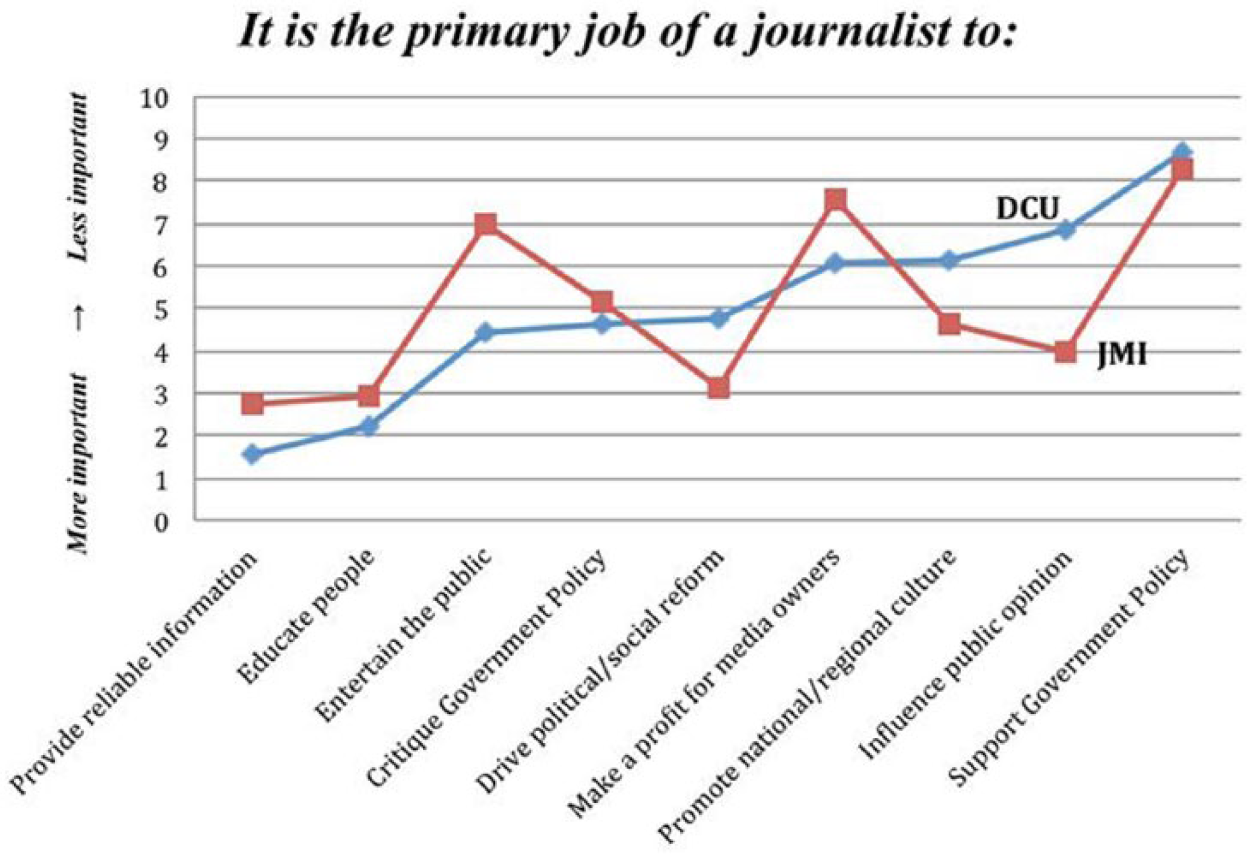
The primary job of a journalist.
Figure 1 suggests a stronger sense of advocacy in the responses of JMI students. This is further suggested by answers to the first question in the survey, which asked why students chose journalism as a profession. Most students in the Dublin group chose “promise of adventure or travel” (n = 10). Four DCU students also chose the open-ended “Other” choice, typically providing direct statements of the social responsibility theme (e.g. “I wanted to be able to write about things that are important to me and that affect others”)—though one also claimed to be attracted by the “glamour” of journalism. In Jordan, nearly half of the students also chose “promise of adventure or travel” (n = 9), but the “Other” category (n = 10) contained a wide variety of explanations, with many stressing direct personal experience as a motivating factor. One interviewee said, “I personally have witnessed a lot of real scenes in front of me in Palestine that only reinforced the journalist in me.”
There were clearer differences between DCU and JMI students’ assessment of the biggest obstacles they would face in their careers. In Dublin, various financial limitations—low salaries, newsroom cutbacks, and unpaid internships for beginners—were seen as the largest obstacles facing future professionals. JMI students saw political and social pressures as by far the largest obstacles. These included government censorship and other interference, self-censorship, and, in the case of female students, perceived gender bias against women engaged in journalism.
Both groups of students saw more pitfalls than promise in social media. In response to a question about the greatest threat to quality journalism in the future, students in both programs mentioned untrained bloggers, “citizen journalists,” and other non-professionals as diluting quality reporting and trivializing the news. At the same time, students at both schools saw enormous potential for quality journalism through the use of digital tools.
Discussion
It is clear that despite the very different cultural, economic, and political contexts, there is a great deal of similarity in the views of the two cohorts of students. The institutions themselves are very similar—in terms of curricula, module topics, mission statements, and approaches to technology. Students from both schools are largely middle class. Still, there are some real, if subtle, differences in the two groups’ attitudes toward journalism. JMI students appear somewhat less interested in the imagined glamour and excitement of the profession and more interested in journalism as a vehicle for promoting social justice. The Jordanian students were relatively more pro-advocacy than were their Irish counterparts, who were stauncher supporters of the traditional role of the journalist as the neutral reporter of factual information.
These findings demonstrate the need for increased research on the broader intellectual and cultural formation of journalists-in-training and not just their professional development once they are working in the field. Moreover, we suggest that greater scholarly attention to the social origins and biographies of journalism students should be complemented by institutional analysis. Here, journalism scholars might make use of the “Communities of Practice” approach, which originated in organization studies and which describes the gradual cultivation of shared identity by individuals collectively engaged in a particular craft or profession.
Cognitive anthropologists Jean Lave and Etienne Wenger (1991) originally investigated how newcomers to an informal group become fully fledged members. Their approach highlights the interrelationship of subjective and institutional dimensions of learning. The institutional dimension of a community of practice (COP) includes such things as an institution’s structure and finance base and its managerial philosophy. On the subjective side, Lave and Wenger emphasize that becoming a full member of a COP implies not only learning but also becoming a kind of person: “Learning and a sense of identity are inseparable” (p. 115). They argue that the process of becoming a professional involves a usually lengthy process of induction—of learning to act, talk, and perform as a professional. Studies that have used the COP approach have highlighted, however, that professional identity development and learning are not always free of conflict. For example, Charles Husband’s (2005) analysis of minority ethnic media workers centers on their negotiation of multiple identities and the different forms of accountability these identities imply. On one hand, such workers hold themselves accountable as media professionals—meaning shared codes of practice and professional ethics—while on the other hand, these individuals are also subject to the demands of “a personal identity politics that commands an allegiance to an ethnic community” (Husband, 2005, p. 462). Such insights resonate with suggestions that ostensibly “universal” journalistic norms and values (like impartiality and neutrality) can sometimes conflict with the cultural moorings of working journalists in various parts of the world. Beyond this, the COP approach may prove useful to scholars wishing to chart the interrelationship of subjective and institutional dimensions of learning and professional identity development. For example, Pintak and Ginges (2008) began their study with the questions, “How do Arab journalists perceive their mission, and how do they define themselves?” (p. 194). We suggest that similar questions might be asked of journalism education institutions: How do professional journalism schools define their mission? To what extent do such mission statements align with the perceptions of practicing journalists and journalism students? Moreover, researchers might analyze the codified mission statements of Arab journalism schools in light of the much more explicit mission statements of professional Arab media organizations such as AlJazeera and AlArabia.
Conclusion
This article presented findings from a pilot study of postgraduate journalism students in two leading institutes in Dublin, Ireland, and in Amman, Jordan. To our knowledge, this is the first comparative study of its kind. Our findings suggest several correspondences with the ground-breaking research of Pintak (2011), who draws on nearly a generation in the field as a journalist in the Middle East. Pintak makes a major point about what he sees as the differences between Western journalists and those in the Middle East. He quotes a conversation with Hussein Shobokshi, a Saudi columnist and television presenter, who flatly denies that U.S. and Arab journalists share a sense of mission: “I think that is part of the confusion. In the West, media seeks to maintain what it has achieved, while in the developing country, it seeks to achieve what it inspired” (Pintak, 2011, p. 2). Again, an AlJazeera journalist, Ahmed Mansour, is quoted talking about what Pintak describes as “the vast divide” between the journalism of the two cultures. “Two places and two cultures, and everything is different,” Mansour said (Pintak, 2011, p. 2).
Our survey reveals some of this difference, but it is very slight. JMI student responses indicated they are somewhat more activist in their outlook than their Irish counterparts and a bit less interested in being “neutral” or “objective.” 2 They are modestly more interested in effecting political change (and somewhat less interested in the glamour of the profession). Doubtless, the veteran journalists Pintak quotes represent both an accurate and a fair understanding, and his region-wide survey of hundreds of reporters and editors bears this out (see Pintak, 2011, especially pp. 155-206). But it may also be true that something else is going on. At the very least, the cohort of students at JMI is remarkably similar in its outlook to that at DCU. The reality of working in the region, particularly given the cross-currents, complexities, and imprecisions of typology, as Kraidy has argued, may mean that soon enough “everything is (or will be) different” in how Arab journalists see themselves, their mission, and their profession. But our study suggests that, in this instance at least, beginning journalists in the two worlds are far more alike than different. This has significant implications for journalism education across the region and for cross-cultural exchanges between Arab and Western institutes. Of course, these preliminary findings need to be either validated or discounted through a much broader analysis of how beginner journalists see themselves, their world, and their profession.
Footnotes
Appendix
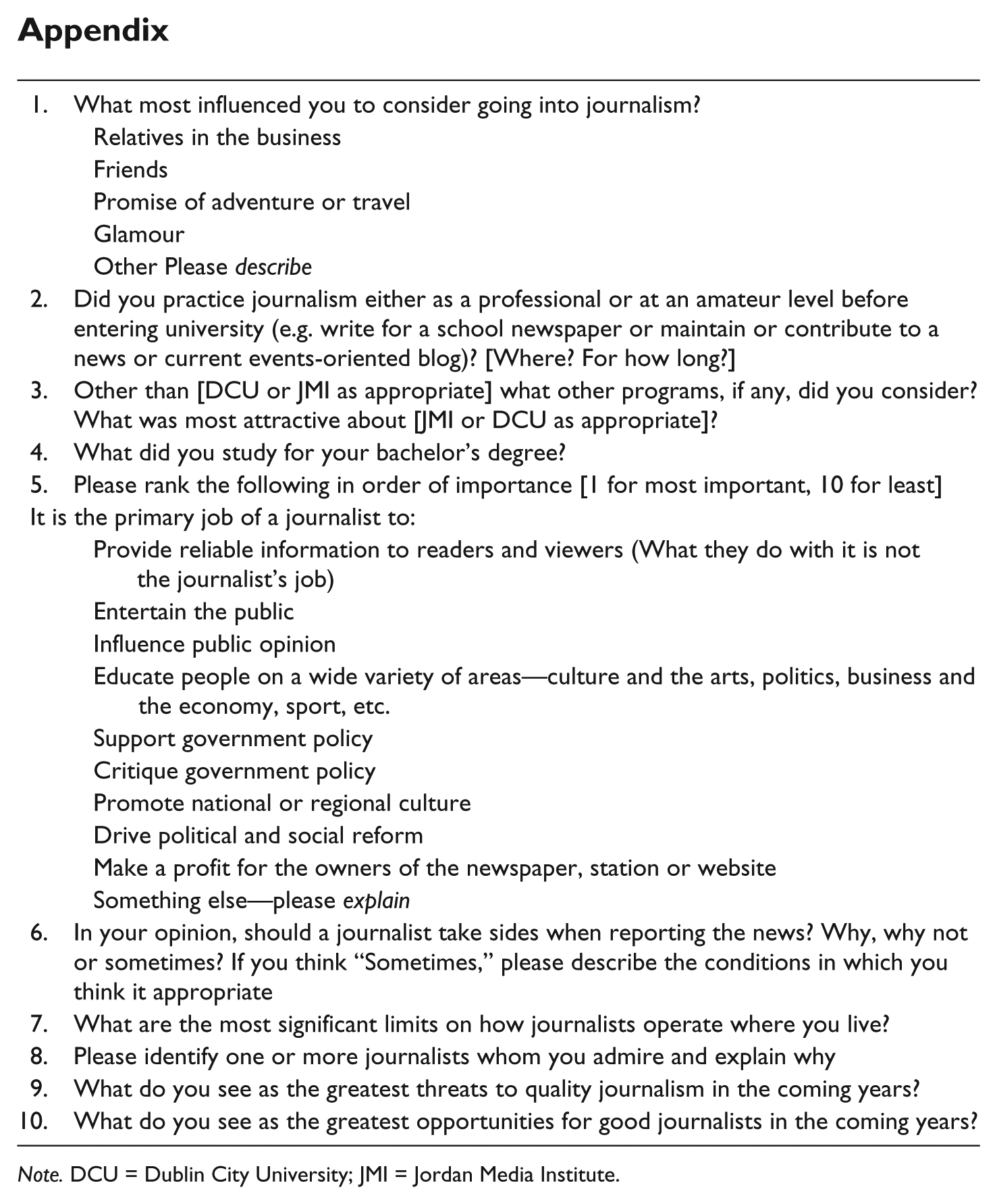
| 1. What most influenced you to consider going into journalism? |
| Relatives in the business |
| Friends |
| Promise of adventure or travel |
| Glamour |
| Other Please describe |
| 2. Did you practice journalism either as a professional or at an amateur level before entering university (e.g. write for a school newspaper or maintain or contribute to a news or current events-oriented blog)? [Where? For how long?] |
| 3. Other than [DCU or JMI as appropriate] what other programs, if any, did you consider? What was most attractive about [JMI or DCU as appropriate]? |
| 4. What did you study for your bachelor’s degree? |
| 5. Please rank the following in order of importance [1 for most important, 10 for least] |
| It is the primary job of a journalist to: |
| Provide reliable information to readers and viewers (What they do with it is not the journalist’s job) |
| Entertain the public |
| Influence public opinion |
| Educate people on a wide variety of areas—culture and the arts, politics, business and the economy, sport, etc. |
| Support government policy |
| Critique government policy |
| Promote national or regional culture |
| Drive political and social reform |
| Make a profit for the owners of the newspaper, station or website |
| Something else—please explain |
| 6. In your opinion, should a journalist take sides when reporting the news? Why, why not or sometimes? If you think “Sometimes,” please describe the conditions in which you think it appropriate |
| 7. What are the most significant limits on how journalists operate where you live? |
| 8. Please identify one or more journalists whom you admire and explain why |
| 9. What do you see as the greatest threats to quality journalism in the coming years? |
| 10. What do you see as the greatest opportunities for good journalists in the coming years? |
Note. DCU = Dublin City University; JMI = Jordan Media Institute.
Declaration of Conflicting Interests
The author(s) declared no potential conflicts of interest with respect to the research, authorship, and/or publication of this article.
Funding
The author(s) disclosed receipt of the following financial support for the research, authorship, and/or publication of this article: This work was supported by Dublin City University under the Enhanced Performance Scheme.
Notes
Author Biographies
Dr.
Professor