




Abstract
Despite the proliferation of mobile devices, there is limited awareness of how journalism students are prepared for the evolving nature of the workplace in regard to mobile devices and how journalism professionals utilize this technology in daily routines. This study examines how journalism educators, students, and practitioners embrace the proliferation of rapidly growing mobile technologies in the United States. The study finds that challenges lie ahead for both journalism professionals and scholars as media ecology expands current capabilities and redefines work routines, from funding technologies and gauging ways audiences use new technologies to selecting hardware and software that make reporting relevant.
Introduction
Despite the proliferation of mobile devices, there is still limited awareness of how journalism students are prepared for the changing nature of the workplace in regard to mobile devices and how journalism professionals utilize this technology in their daily routines. This study examines how journalism educators, journalism students, and media practitioners either perceive or embrace the proliferation of rapidly growing mobile technologies in the United States. A growing body of education technology research indicates how mobile devices and applications have penetrated higher institutions of learning (Lindbeck & Fodrey, 2011; Park, 2011; Traxler, 2010). Those studies specifically focus on when mobile devices are used for content delivery or to foster instructional assistance, assessments and evaluations, and interactivity such as social networking and communication, computation, capturing audio or visuals, and other types of data processing and uploading. Little research has focused on journalism and mass communication pedagogy in relation to professional use, particularly in terms of the ever-changing mobile technologies and the rapidly evolving journalism landscape.
Media ecology explains the evolutionary nature of media through advances in technology, and niche theory focuses on how media adapt to change to compete for scarce resources such as audience and advertisers. Both theories address the mutable environment facing journalism as technology develops. The academic fields of journalism and communication, as well as media professionals, are markedly dependent on communication technology and mobile devices for their daily practices and, as such, serve as examples of how media ecology and niche theory can apply to the adoption of mobile technology. How has mobile technology affected learning in journalism and communication schools? How do students and practitioners perceive the landscape of mobile learning and mobile journalism? How do academics and newsrooms, from educators and students to media practitioners, demonstrate this media ecology?
A total of 40 in-depth interviews were conducted from the following sources: 14 journalism schools, 5 professional journalism organizations, and 11 newsrooms. One professor from each of the journalism schools was interviewed. A conversational discourse analysis of in-depth interviews provides a better understanding of how mobile technology has transformed journalism practice and education.
Literature Review
The news industry is rapidly changing due to advancements in technology and the proliferation of mobile devices. The Pew Research Center found that nearly two thirds of all Americans, or about 64%, now own smartphones (Pew Research Center, 2015). Among the smartphone owners surveyed, 68% reported using their mobile device to follow breaking news events. This proliferation of mobile technology influences both how journalists gather and produce news and how audiences consume information.
This evolution of news, how it is delivered to a mobile audience, and the subsequent modification of journalism schools’ curriculum, could be informed by two theories: the idea of media ecology and the niche. Media ecology and the niche theories were previously used to examine how technology has changed media consumption behaviors and culture reaching back over five decades (Dimmick, 2003; Dimmick, Feaster, & Hoplamazian, 2011; Dimmick, Patterson, & Albarran, 1992; McLuhan, 1964). Both theoretical propositions are concerned with the way technology advances media and their environment.
Media ecology was first proposed in the 1960s but gained traction with the emergence of the Internet (Scolari, 2012). Echoing Ha and Fang (2012), niche is an important proposition, like media ecology, to understand new media dynamics as technology changes how people access news and information, and how media organizations compete for scarce resources. Advances in technology, including the Internet, created an environment where “multiple media systems coexist and media content increasingly flows across their boundaries” (Scifo, 2009, p. 193). The proposition for this study to advance these theories is that as the media environment changes, so should the instructional niche of journalism education and pedagogy.
A “Niche” for Adaptability
Evolution is at the heart of niche theory. Niche is predominately concerned with how a medium adapts when competing for scarce resources or audience (Dimmick, Chen, & Li, 2004; Dimmick, Kline, & Stafford, 2000; Ramirez, Dimmick, Feaster, & Lin, 2008). Scarce resources for the media also include time and space. A newspaper only has so many pages, and a television program only so many minutes. These scarce resources mean that media compete for everything from audience attention to advertising dollars. Niche theory can also apply to journalism education, as schools face competition for scarce resources including student enrollment and internships.
Although the niche theory has been used more recently to examine the influence of the rapid growth of the Internet (Ha & Fang, 2012), research considering the audience’s time as a scarce resource began with the rise of television in the 1940s (Cai, 2005). As Cai (2005) pointed out, there seems to be little debate that television dramatically affected the use of radio. How the Internet affects traditional media—whether it complements or displaces it—is up for debate (Ha & Fang, 2012). Cai found that when people gave up using a computer, they did not increase the attention they gave to other media. In contrast, Ha and Fang (2012) found the more experience a person had with the Internet, the more they perceived it “as superior to traditional media” (p. 177). They argued that the Internet was clearly a form of competitive displacement and that television had the highest niche breadth and overlap with the Internet, which means it could keep its stronghold as a relative medium (Ha & Fang, 2012). As newspapers and television stations change the way they disseminate news, journalism education also shifts and changes with the industry, demonstrating how the evolution of media ecology means a greater reliance on teaching online media in journalism schools.
An Ever-Evolving View of Reality
Media ecology explains the evolutionary nature of media through advances in technology. McLuhan (1964) examined communication as evolving through a series of stages, beginning with the tribal era of face-to-face contact, through the early 1960s, which he called the electronic era. It was the epoch’s change because what people considered being communication and how they communicated continued to evolve. The public is drawn to new media, and the media change the way news is received.
Environment and interaction are two common concepts associated with media ecology. Scolari (2012) argued that the concepts evolution, interface, and hybridization are equally relevant to theorizing media ecology. He argued that evolution and hybridization apply because “the history of media is full of technological fossils, from papyrus to the telegraph” (p. 212). Vestiges of these extinct media, however, still exist in modern technology. For example, the typewriter has fallen out of use but the QWERTY keyboard remains. D’Arcy, Eastburn, and Bruce (2009) used media ecology to determine what types of media should be used to facilitate the best learning environment for college classrooms. Their study found “a rich ecology of media appears to work best” and enabled instructors to reach more students. Media ecology demands revisiting how college students learn about media platforms, including mobile devices, because each generation adopts new ways of communication.
M-Learning: A Slow Progression?
Mobile devices are one way to promote academic engagement in the classroom (Kukulska-Hulme, 2005; Kukulska-Hulme & Traxler, 2005). Mobile learning (m-learning) is often defined in terms of both hardware and technology that features learning exclusively through the extension of handheld devices independent of the physical geography of both student and teacher (Traxler, 2007). Traxler (2007), considered among the earliest m-learning scholars, identified specific hardware involved with such pedagogy as devices from wireless laptops and tablets to smartphones.
M-learning is also understood as distance learning, because participants are not limited by pedagogical activities or confined to the traditional classroom (Kukulska-Hulme, 2005). Furthermore, m-learning typically takes on a variety of approaches tailored specifically for students, subjects, and educators. Traxler (2010) noted that m-learning was gaining support from institutions on a project-by-project basis, much in the same manner that e-learning or distance learning evolved from concept to classroom implementation. Royle, Stager, and Traxler (2014) more recently argued that unlike distance learning, m-learning by its very nature is different. In a short amount of time it has become popular, to the point of becoming universal in scope because it is “pervasive and ubiquitous” as well as “robust, reliable, and cheap” (p. 31).
The challenges of integrating new technologies into the classroom are not exclusive to university education departments. Journalism and mass communication instructors face similar challenges when integrating new technologies and pedagogical approaches into traditional classrooms. These impediments to the evolution of pedagogical coursework, including the adaptation of mobile devices into curriculum, are driven by proven demands for particular skills in the workplace and institutional resources, such as equipment and trained faculty.
A survey of 463 journalism programs, conducted by Lowery, Daniels, and Becker (2005), found that many program administrators are motivated to change curricula only after they see the news industry seeking new hires with particular skills. They concluded that perceptions of the news industry have a direct impact on the decisions administrators make regarding curriculum. Furthermore, Lindbeck and Fodrey (2011) argued that one of the biggest obstacles to embracing new technologies in journalism pedagogy include instructors struggling to find ways to incorporate ingenuity into traditional educational approaches.
Despite empirical evidence that demonstrated how mobile devices inside the classroom help engage learners and promote collaboration between student and instructor, Lindbeck and Fodrey (2011) found many journalism professors eschew this approach to learning. This resistance to embracing new technologies is not a new phenomenon. Their review of studies examining journalism instructional practices found that mass communication programs have seen few pedagogical reforms since Joseph Pulitzer painted a picture of journalism education when he funded the Columbia University School of Journalism in 1904.
Slow adaptation to change is argued to be a result of institutional culture (Mensing, 2010). Mensing (2010) concluded that failure to consider how technology was making information sharing more interactive left many institutions waxing nostalgic for traditional forms of instruction, where journalists discovered new information, crafted stories, and communicated to the masses. Instead, she urged an instructional model that merged theory with practice as the best way to prepare future journalists. Such an approach has been reinforced over the last decade by academics who continue to advocate a process that prepares future journalists to adapt to a multitude of information platforms and think critically (Cushion, 2007; Macdonald, 2006; Stepp, 2000).
Part of this struggle to adapt new technologies into the classroom is rooted in philosophical disagreements over professorial desires for students to be grounded in mass communication theory versus future employers seeking new hires equipped to think critically and demonstrate command of journalism basics (Castañeda, Murphy, & Hether, 2005). Castañeda and colleagues (2005) found wide disagreement among educators in terms of how much technology should be adopted into coursework. At the same time, their study determined that students and faculty were in agreement that there was value in learning skills that translated across multiple platforms.
Specific to social media and mobile delivery, Wenger and Owens (2012) opined that “there is no doubt that instruction” in those two areas “will need to increase” as well as more academic research into best practices for social media and mobile devices (p. 20). They concluded that “(e)ducators would do well to get ahead of the industry needs by preparing students who are ready to step into leadership roles in the area of social media and mobile delivery” (p. 23). Bruhn and Henry (2013) went so far as to argue that curriculum “can be enhanced when faculty help students embrace challenges and create a culture of adventure when tackling the unknown” (p. 6). Other researchers, meanwhile, have stressed the role educators should play in empowering students to try new technologies (Clark, 2013).
With the above theoretical claims and prospects in mind, the following research questions are proposed:
Method
Data for this study were collected through 40 in-depth interviews conducted from among 14 journalism schools, 5 professional journalism organizations, and 11 newsrooms across the United States from late summer 2012 through late summer 2014. Because a definitive annual inventory of the top journalism schools in the United States does not exist, a list was conveniently sampled and compiled from three different rankings by College Magazine, College Media Matters, and Education-Portal.com. Institutions selected for in-depth interviews with journalism educators and/or journalism students included Auburn University, Central Michigan University, Indiana State University, Indiana University, Northwestern University, Ohio University, Trinity University, University of Florida, University of Kansas, University of Maryland, University of Missouri, University of North Carolina at Chapel Hill, University of South Carolina, and University of Wisconsin.
Journalism and mass communication professors were identified through cold telephone calls to their departments, referrals from colleagues, or emailed letters requesting participation. Journalism students were identified through departmental or professorial recommendations as well as through impromptu telephone calls to campus-affiliated newspaper offices.
Open-ended in-depth interviews were conducted (see Appendix). Students were included in the sample because as Squire (2009) noted, the educational environment in this new millennium is specifically designed around sociability with new technological resources and provides students with entrée for both cognitive and emotional development. Data from the students’ interviews were used to corroborate the university professors’ discourse on mobile learning and to identify emerging devices of the journalism mobile pedagogical niche.
A total of 11 professional journalists were identified and interviewed through a convenience sample, in part collected through colleague referrals, and represented both print and broadcast news organizations including a print reporter for The Associated Press; a newspaper reporter in Atlanta, Georgia; a news director in Altoona, Pennsylvania; a television producer in Boston, Massachusetts; a newspaper reporter in Columbia, South Carolina; a web producer in Miami, Florida; a television executive producer in Miami, Florida; a radio journalist in Morgantown, West Virginia; a newspaper reporter in Savannah, Georgia; a newspaper reporter in Pittsburgh, Pennsylvania; and a television photojournalist in Pittsburgh, Pennsylvania.
Finally, five media trainers or advocates—one each from Society of Professional Journalists, The Stanley Foundation, Newseum Institute, Pulitzer Center on Crisis Reporting, and Poynter Institute—were also interviewed. Much like the students, data from the media trainers were used to corroborate the professional journalists’ discourse on how mobile devices are implemented in the workplace and to identify emerging trends.
Data Collection Through In-Depth Interviews
The in-depth interview instrument was composed of semi-structured open-ended questions that were designed to draw out wide-ranging responses from the participants and enabled the researchers to elicit additional data through the use of follow-up questions. Use of the structured questions elicited responses and reactions regarding the impacts of mobile innovations, the types of mobile devices used either for learning or by media professionals, and identified devices and software packages utilized by all subjects in the burgeoning environment that is digital wireless media and mobile communication.
For a meaningful theoretical assessment, a conversational discourse analysis of the in-depth interviews was used to provide a systematic account of the respondents’ perceptions and attitudes on the subject matter. Conversational discourse is a research design used to tap into the logic of open-ended unrestrained straight talk of one’s egalitarian perspectives (Khosravinik, 2010) and to foreground reasoned spontaneous interactions that emerge as participants react to the changing environment (Van Dijk, 1993; Walck & Kalyango, 2014). The analysis provides a better understanding of how new technology is influencing journalism and journalism education.
Results
In terms of how mobile technology has impacted learning in journalism and communication schools, respondents maintained that the proliferation of mobile technologies has become game changers to journalism. All 11 journalists agreed that mobile technology is critical to daily routines. Students’ discourse revealed both an increase in the presence of mobile technologies in the classroom and new instructional approaches to teaching how to write for multiple platforms (see Figure 1). Graduate students reported both owning mobile devices and taking courses dedicated to learning how to use mobile technologies. However, only half of the undergraduate students reported owning smartphones or taking classes dedicated to applying mobile technology to classroom work.
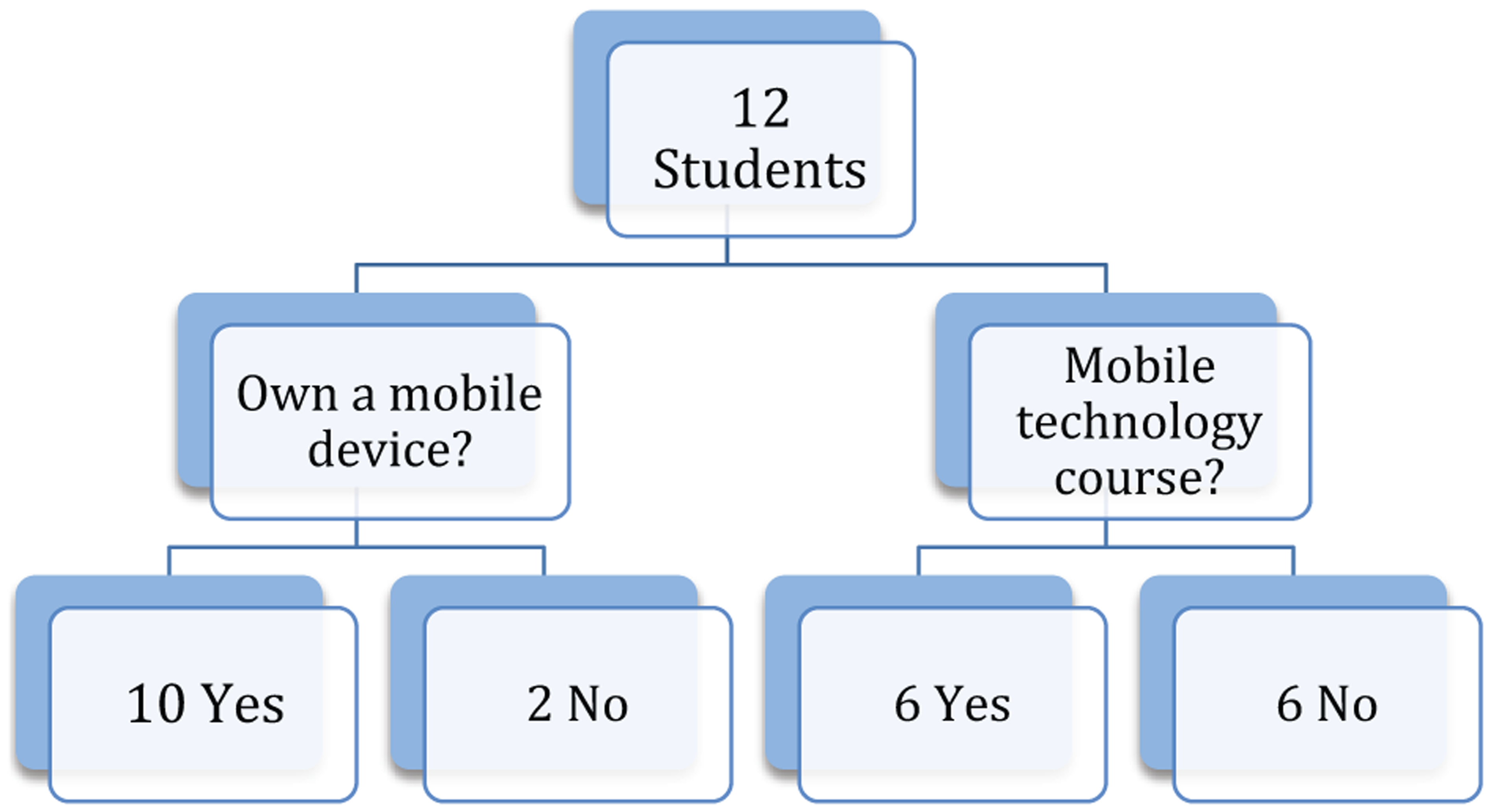
Student interaction with mobile technology.
Much like the graduate students, journalism professors reported using multiple mobile devices, such as smartphones and tablets. Journalism instructors also were more likely to use phrases such as “dynamic” and “dramatic” to describe the influence of technology on learning and curriculum.
Mobile Devices and the Classroom
Journalism undergraduate- and graduate-level students noted the inclusion of multi-media components, including recording video, audio clips; “tweeting” information; and posting to Facebook in once-traditional courses. In many instances, writing for social media was as common as learning the classic inverted pyramid. One undergraduate from Auburn University remarked that she was required to live tweet events and classes. Another undergraduate, from Indiana State University, said a photojournalism instructor made taking and turning in an assignment on a smartphone optional versus more traditional submissions via email. Much like Traxler (2007) first observed, this addition of mobile devices in the classroom has dynamically changed the way students and instructors talk and think about learning.
A graduate student noted how this pedagogical change has influenced her approach to writing. “It really got me thinking in a more interactive way” (female graduate student, University of Maryland). An undergraduate student at the University of Missouri noted that the instructional approach his professors have taken in classes have gone beyond simply writing for Twitter. “We are encouraged to check out Twitter feeds to look for news stories and keep up with what’s happening around campus” (male, junior undergraduate, University of Missouri). Another graduate student from Auburn University emphasized the importance of smartphones. She said, “In undergrad I didn’t have a smartphone yet, and I didn’t get an internship because of this. They wanted someone who could be connected at all times.”
From the educators’ perspective, there is strong interest not only in incorporating mobile technology into the classroom but also in understanding its effects on society. For one professor at the University of Kansas, the question has turned into a quest to understand how users connect with social networking sites. A professor at the University of North Carolina at Chapel Hill said, “I tell my students . . . the importance of my device is it keeps me connected to the things that are important to me on a personal level.”
Another journalism professor, at the University of Florida, revealed how academe demonstrates media ecology through educational programming, when he noted that across his school’s program, technologies are increasingly incorporated into what was once considered “traditional” journalism classes (see Figure 2). An instructor at the University of South Carolina said he relies on social media to improve his communication with his students both inside and outside the classroom. “Technology, specifically social media, provides me direct and constant communication with my students. Students will text, tweet, and Facebook me throughout the day with not only administrative tasks, but applicable concepts for discussions on class material” (male instructor, University of South Carolina).

Professor interaction with mobile technology.
This quest to understand the evolution of social media, especially on mobile platforms, is not mutually exclusive to academe. Professional journalism organizations, such as the Society for Professional Journalists (SPJ), noted that they have membership in newsrooms that are unfamiliar with platforms such as Facebook and Twitter. Some of those SPJ members actively seek educational opportunities to explore ways they can incorporate social media into their news coverage.
Everything we do in the training field has a new “technology” component. . . . We do local training “boot camps” and also travel directly to newsrooms to train on topics such as multi-platform reporting and using social media effectively. (Male journalism trainer, SPJ)
Likewise, the evolutionary media ecology of using new platforms for parlaying information is not lost on working journalists. As one journalist observed, “New technology is not imperative for communication in general, but it is certainly paramount for those who wish to remain connected to what’s happening in real time” (male radio journalist, Morgantown, West Virginia). Meanwhile, one of the top executives at the Pulitzer Center on Crisis Reporting said incorporating new technology in the field was “understood as a central means to our mission goal of engaging the broadest possible public in the global issues that affect us all.”
In many ways, these observations regarding how technology has become a way of life hints toward the future—both for students and practitioners. A female professor at Trinity University said she relies on technology to prepare presentations and runs “an almost completely paperless classroom.” Among professional journalists, there were refrains on this discourse about how devices such as iPhones or iPads have become digital lifelines to the office. A female daily newspaper reporter in Pittsburgh, Pennsylvania, noted, “If I’m out on assignment, having an iPhone or iPad allows (me) to be out of the office . . . and still be able to track communications, like e-mail.”
A radio journalist further noted that there is a growing emphasis on digital reporting in his newsroom that he does not expect to go away. “Our website stories are nearly as important as what we read on the air” (male radio journalist, Morgantown, West Virginia). For another journalist, mobile devices represent freedom in reporting breaking news. “I think it’s more about having the capability of being able to do stuff on the fly . . . I can pull my iPhone out of pocket and send photos directly to photo desk in a few seconds” (male print reporter, The Associated Press).
For many educators, preparing students to use these technological devices remains an important goal. For one journalism professor, instruction means understanding how digitally literate students are and bridging the technology gap between those who have and have not been exposed to technology. “Some (instructors) are surprised that an 18-year-old is baffled by how to use an Apple at all” (female professor, Indiana State University). Journalism educators noted that media ecology in the professional newsroom is less of a focus compared with teaching students how to critically observe how audiences are using these news tools and adapting them as mass communication tools. For example, a journalism professor at Ohio University observed that what is developed and how people use it are often two different things. “You can’t fall into the trap that technology is going to take care of things . . . Technology (doesn’t) dictate the use, the users dictate the use” (male professor, Ohio University).
Mobile Devices in the Field: Paradigm Shift or Trend?
Perhaps one of the greatest challenges facing journalism educators and media practitioners alike is understanding which technologies to invest time, training, and resources in—and which to ignore. Answers to these questions get to the heart of media ecology for both academe and the newsroom. Sometimes, decisions are driven by the bottom line: If universities cannot afford to purchase the latest tablet for students, then professors rely on students who have the devices. Likewise, decisions to test new devices are based on partnerships. For example, at the University of Missouri, a journalism professor noted that an agreement with Samsung meant journalism students had an entire semester to play with the newest Galaxy. “We are doing tests this year and we are asking, ‘Is this a paradigm shift? Are we looking at something that will replace the equipment we use now?’” (male professor, University of Missouri).
These choices are also driven by resistance to break away from comfortable routines. “One of the really big problems we’ve had is that newsrooms, although dubbed as being so ‘liberal,’ have been very hesitant to change,” opined a journalism professor from the University of Florida. Meanwhile, a male instructor at the University of South Carolina noted some colleagues opt to “ignore new technology.”
For press organizations trying to bridge the gap between education and working journalists, sometimes, the decisions driven by media ecology to adapt one technology and abandon another comes down to practicality: time. For example, at The Stanley Foundation, time was a major determinant when they opted to ignore invites by journalists to join Google+ versus establishing a presence on Facebook and Twitter. The Stanley Foundation is a non-profit, non-partisan think tank that teams up with practitioners such as Reuters to host educational summits and promote issues regarding national security. “Two to three years from now, there will be another ‘new’ thing to follow. It is hard to make the decision of what you are going to dedicate your time to” (male media specialist, The Stanley Foundation).
Discussion
This study examined how journalism educators, students, and practitioners in the United States perceive or embrace the proliferation of mobile technologies flooding the marketplace. The significance is that it illuminates the intricacies of instructional niche and advances our knowledge of how journalism students, educators, and practitioners’ perception of technological advancements alter human experience in media ecology.
Journalism professionals confirmed that this generation of journalists is prepared to report across a wide range of communication platforms. For many journalists, mobile devices are increasingly a way of life—from finding assignments with GPS apps and recording videos for the web or television broadcasts to keeping in touch with the newsroom and sources. Journalism students, many who came of age during the infancy of social networking sites, appear to be most at ease with using these new communication approaches. For this generation, the challenge lies in learning how to professionalize their messages and how that changes their perspectives about technology and the world. Many digital natives are also learning that financial limitations mean temporary barriers to the latest gadgetry, particularly for undergraduates, who are not financially independent.
Journalism educators, meanwhile, are incorporating mobile technologies into “traditional” curriculum, rather than creating courses centered solely on mobile pedagogy. At the same time, many institutions struggle with budget limitations that prevent equipping classes with the latest products for experimentation. Consequently, schools with special arrangements with technology or software firms have a clear advantage over institutions lacking such agreements. Likewise, professors who have adopted new technologies indicated that barriers include a digital divide among colleagues resistant to embrace new approaches to pedagogy. This could be an indication that attempts to advance m-learning in journalism pedagogy remains a slow progression.
This analysis is consistent with the niche premise, the idea that a medium adapts to changes in light of scarce resources. The analysis also advances the notion of media ecology due to mobile technology that shifts in technology may alter “human experience,” and ultimately, one’s perception of “reality” (Dimmick et al., 2011). Professional journalists are eager to retain audiences—even if it means taking an unorthodox approach. The explanation for the ecology in media use and media application is that journalists know audiences are gradually scarce due to a host of new avenues for accessing information. Likewise, journalism educators recognize that their task is not only to prepare students to work in this environment but also to adapt these technologies into curriculum if programs are to remain attractive to future students.
In terms of how academia is integrating new technologies into curriculum, the discourse here is consistent with previous observations that m-learning continues to be used as a supplement to traditional pedagogy rather than becoming a transformational, new approach to education (Traxler, 2010). At the same time, journalism students acknowledged that exposure to m-learning has revealed the possibilities of mass communication and prompted them toward taking a more critical approach to how they think about writing for these new communication platforms.
The analysis also demonstrates some of the challenges that lie ahead for both journalism professionals and scholars as media ecology expand current capabilities and redefine work routines. For professional journalists, the challenge remains how to gauge the way audiences will use new technologies to consume information and then select hardware or software that will make reporting possible and relevant. For journalism programs and students across the United States, this study highlights a concerted effort when it comes to adopting mobile devices into pedagogical practices. It also presents a better understanding of the niche and the persistent need to bridge the mobile digital divide between educators and students.
There are limitations to this study, namely, that the 40 journalism professionals, media specialists, professors, and students make up a relatively small sample size to fully grasp an industry as large as the mass media and academic institutions. It is important to note, however, that 40 in-depth interviews is an acceptable and sizable number for this type of conversational discourse analysis. In terms of the input from journalism institutions, the scope of data was limited to discourse from large, competitive U.S. journalism programs. Future research should expand to examine the challenges facing smaller state and regional journalism and communication schools and vocational programs, in terms of keeping up with this instructional niche and media ecology.
Conclusion
This study demonstrates that this instructional niche and media ecology remain a ripe area for future research, and it contributes to a growing field of scholarly inquisition in journalism and mass communication. It identifies milestones in m-learning, as well as the challenges facing journalism educators and practitioners alike. The fast growing dependency on new technologies is undisputed, and this discourse provides insights on commitments made by individuals in academia, newsrooms, and student lives to invest in mobile devices and critical resources.
Continuous assessment of instructional niches and media ecology is necessary to keep up with market demands of new and fast-changing mobile technologies to boost journalism and media communities both in an academic environment and in the competitive vocation. This modest study is a starting point to advance our understanding of the digital mobile evolution. It points to the urgency to develop new qualitative and quantitative ways of evaluating this important utility to society because mobile journalism has transformed information gathering, analysis, publishing or broadcasting with immediacy, and live reporting.
Footnotes
Appendix
Declaration of Conflicting Interests
The author(s) declared no potential conflicts of interest with respect to the research, authorship, and/or publication of this article.
Funding
The author(s) received no financial support for the research, authorship, and/or publication of this article.